FBI

Day of the dead

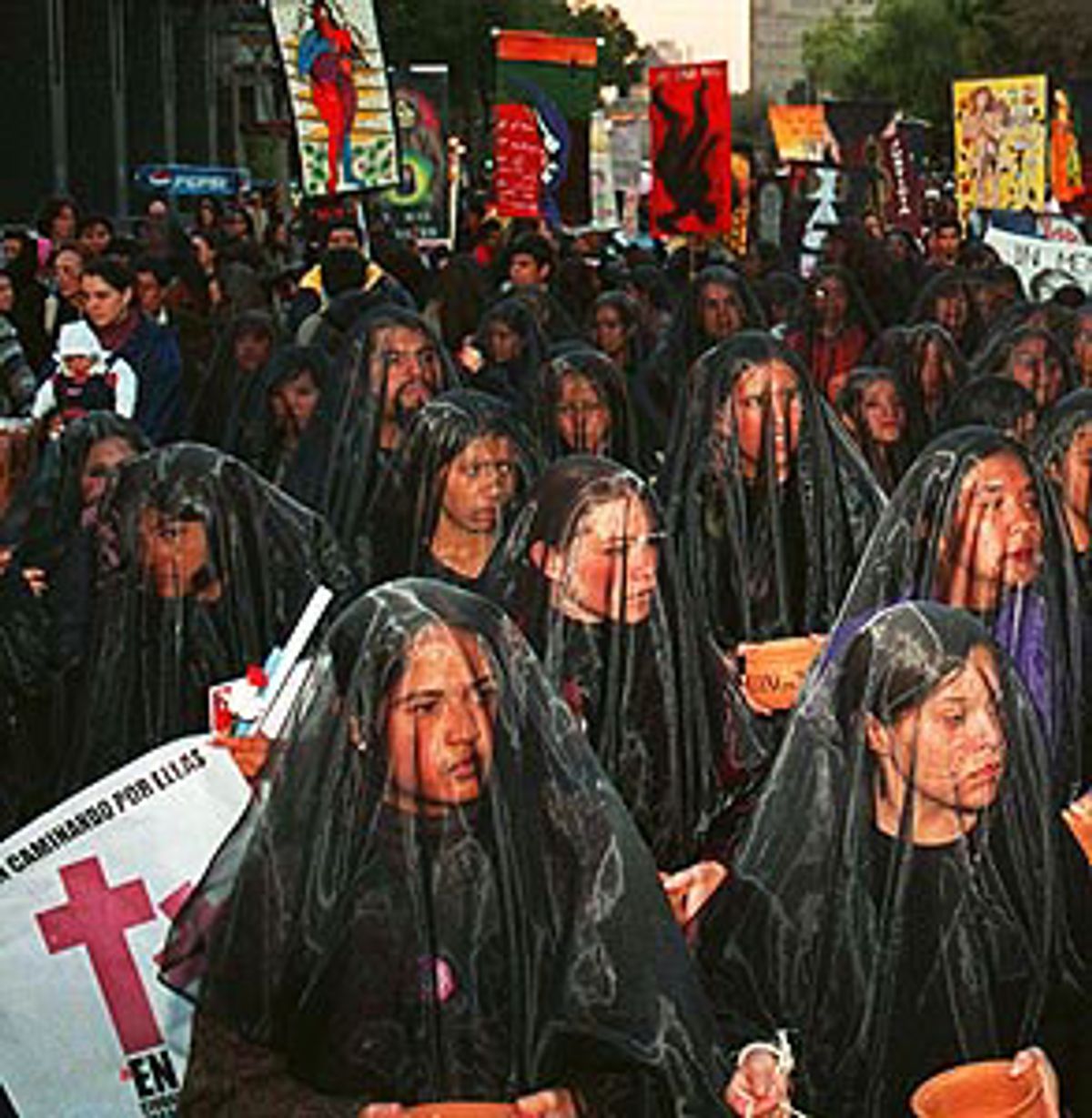
More than 325 women have been murdered in the free-trade boomtown of Ciudad Juarez in the past decade. Faced with government incompetence and corruption, people are rebelling.

  • more
    • All Share Services

Topics:

Day of the dead

The body of another murdered woman was found late last month in the Mexican industrial hub of Ciudad Juarez, dumped behind some shrubs in the squalor of the Anapra neighborhood, a ramshackle hodgepodge of corrugated tin and cardboard shacks on the sludge-washed banks of the Rio Grande. Her hands had been tied, and the evidence suggested she had been raped. The body was so badly decomposed that investigators calculated that she’d been dead for seven months.

However horrific the details, they were numbing in their familiarity. The body of a woman who had died in similar circumstances was found in the same dusty lot a couple of months earlier. The bodies of eight women were found in a lot not far away a little more than a year ago. So many women have been murdered here in the past 10 years that there is no reliable count. Most experts place it close to 325, an average of 32 a year, nearly three every month. At least 90 of the deaths are believed to be the work of one or more serial killers. Hundreds more women have simply vanished.

Like so many of the others, the woman whose body was found in late October had probably come to Juarez from the poverty of southern Mexico to work for about $10 a day in one of the many foreign-owned assembly plants known as maquiladoras that sprouted up in Juarez after the North American Free Trade Agreement was signed in 1994. And like them, too, her body was unclaimed in death and buried alone and anonymous.

Such death has become a way of life here. So, too, with the fear and paranoia that rise in such a climate. Nobody knows who is doing the killings, and the mystery only seems to deepen. Arrests made by local authorities have produced allegations of torture, witness tampering and frame-ups — but no convictions. Most here believe that the killer or killers must have enormous clout. Perhaps, some say, the killers are narcotrafficantes disposing of witnesses. Perhaps they are the sons of the wealthy and powerful indulging in sick sex. Perhaps they are cultists whose members come from the highest levels of government and finance. The theories differ, but a common assumption is that arrests made thus far are only a smokescreen for an historically opaque and corrupt government that will protect its dark secrets at any cost.

One thing seems clear: The murders arise from a social landscape that has been transformed by global economic forces. Where Ciudad Juarez was once a small, sleepy desert outpost just across the border from El Paso, Texas, the population in the past decade has exploded to 1.2 million people, many of them drawn by the lure of the maquiladoras. The tides of people have overwhelmed the ability of the city to absorb them, overwhelmed health services, social services and law enforcement. Free-trade advocates once promised that NAFTA would transform Juarez into the City of the Future — and they have been proven right in a way they never could have imagined. Today, Juarez still has the feel of the lawless Old West, but with a grim 21st century edge.

Despite promises of swift justice from Mexican President Vicente Fox and Chihuahua Gov. Patricio Martinez, they have yet to take up offers of assistance from the FBI; bureau agents in Texas have suggested that official corruption is hindering efforts to stop the murders. Chihuahua state investigators have seemingly adopted a “don’t ask, don’t tell” policy towards Juarez’s homicides, fostering an atmosphere of impunity and pervasive fear. Foreign corporations operating in Juarez that have employed many of the murdered women largely deny that such an atmosphere exists.

But in this postmodern urban culture, where the very concept of community has broken down, many bereaved family members and local activists have begun to take matters into their own hands, investigating the murders and speaking out even if it means threats and other reprisals.

Evangeline Arce’s daughter, Silvia, a street vendor, disappeared on Nov. 3, 1998. Since that day, she said, the authorities have done little to investigate. “Two days after my daughter disappeared, I went to the police and filed a report,” the mother says in Spanish, her face flaring with anger. “They promised me prompt action but when I checked back a week later, the missing persons report was never filed and the investigation had not even begun. When they finally got witnesses together, none of them would talk because they were too afraid.”

Even as Mexico continues to make strides toward becoming an open and democratic society, the epidemic of rape and murder here has exposed the heavy residue of its corrupt and authoritarian political legacy as well as the contradictions of its efforts at economic expansion.

To understand the magnitude of the breakdown, think of the sniper rampage in the Washington area this fall that left 10 people dead and three wounded. Imagine that Montgomery County Police Chief Charles Moose held a press conference and asked local citizens to catch the sniper themselves because local police were not up to the task and the federal government was not being helpful; imagine that the federal government charged that local officials in Montgomery County were complicit in the killings and impeding the investigation. Chaos would ensue, certainly. But then, multiply the number of victims by 30, by 40, by 50, or more.

That’s Juarez today.

The jumbled, exhaust-choked commercial core of this city has grown wildly in the wake of NAFTA, adding modern shopping malls, condominiums and expansive boulevards. The population is growing at twice the rate of the national average; it is expected to nearly double by 2010, to 2 million people. Many of them directly or indirectly rely on the 300 or so maquiladoras for their livelihoods.

To accommodate the new army of workers, the city has given birth to entirely new sectors. The Campestre Juarez is a luxurious conglomerate of gated communities, with a main gate that’s a life-size replica of Paris’ Arc de Triomphe. Nearby, many of the maquiladoras are situated along the Avenida de la Industria. Though the assembly-line workers sometimes can be glimpsed behind a plate glass window in aqua-blue uniforms, there usually is little sign of any activity behind the maquiladoras’ featureless walls.

Most of the new residents are poor, or on the brink of poverty, and they live in Anapra or another of the grim, violent colonias populares on the outskirts of town. In those colonias, residents usually live without sanitation, running water, electricity or paved roads.

Avenida Manuel Gomez Morin is the pothole-riddled six-lane avenue that ties these varied worlds together. Sitio Colosio Valle, a medium-sized strip mall, stands on a corner of the avenue at the gateway to the industrial sector. It is fronted by a vast parking lot and inside are various clothing outlets and boutiques. By day, the lot bustles as customers scurry back and forth, hauling their purchases to their cars — a sight similar to any mall in the suburban United States. By night, however, traffic tapers off, stores lock up and the mall’s lot becomes dark and desolate. Sitio Colosio Valle was where many of the slain and missing women were last seen.

In the mall’s parking lot, Braulio Rosas, a 40-year-old security guard, leans against the door of a giant Nike outlet. Inside the store, under bright fluorescent lights, employees frantically check inventory and scramble to close up.

“A lot of girls were picked up here,” Rosas says in a voice of calm resignation. “But really, it’s the girls’ fault. It’s because even though they weren’t putas, [prostitutes] you know, they were more like faciles [easy women]. They didn’t have to get into those cars if they didn’t want to.”

Rosas sounds cynical, but blaming the victims is by no means an aberration in Juarez. Similar notions have been offered by officials like Suly Ponce, the former Chihuahua special prosecutor in charge of the murdered women’s cases. “Sometimes there are cases that a girl meets some person, he strikes up a relationship with her, they drink … and it ends violently,” she told the Washington Post in 2000, before she was promoted to a job in the governor’s office. “It’s difficult to know.”

A handful of the women found murdered since 1993 were indeed confirmed as prostitutes. But the truth is that a large majority of the missing or murdered women were hardworking, young, poor and for the most part socially conservative. Most had migrated to Juarez from Mexico’s depressed south to work in the maquiladoras , sometimes arriving alone and with little means of contacting their families back home.

The maquiladoras , run by companies like Delphi and RCA Thomson, prefer to hire young women for assembly-line jobs. An entry-level assembly-line worker makes minimum wage, about $2 an hour. With experience, pay can rise to as much as $2.50 an hour — and compared to wages in Guerrero or Chiapas, that’s good money. But in Juarez, the women are caught in an economic trap: Since the cost of living here is only slighter lower than in El Paso, the wages that seem so high to new maquiladora workers actually ensure poverty. The workers can be hired and fired on the spot, with little pretext and no legal protection. And union activities are prohibited.

Even for those who accept the conditions, security is elusive. More often now, the global companies that own maquiladoras are closing up shop and transferring operations to China to take advantage of lower taxes, investment subsidies and outrageously cheap labor. On June 29, Royal Philips Electronics announced it was moving its P.C. monitor manufacturing operations, at a cost of 900 jobs. On July 1, Scientific Atlanta fired 1,300 workers after shutting its plant down. According to the Nov. 5 New York Times, this trend has cost Juarez 287,000 jobs in the maquiladoras since their peak in October 2000.

Not only does this slash and burn the economic base. There are brutal social reverberations, too. The city’s health system, Instituto Mexicano del Seguro Social, has reported 200,000 people falling from its list of insured after losing their company policies, according to a July article in La Prensa. Esther Chavez Cano, director of Juarez’s only battered-women’s shelter, Casa Amiga, said in a speech this summer that domestic violence cases had risen by 50 percent in July alone.

The combination of poverty and a lack of social connections renders women on the assembly line powerless and virtually invisible. And that has made them easy prey. According to the El Paso Times, about a third of the approximately 325 slain women were employed by maquiladoras at the time of their murder.

Given that few of the maquiladoras provide shuttle service to and from the colonias, the female workers often are preyed upon while walking through perilous places like Sitio Colosio Valle in the darkness of the early morning. At such an hour, the only nearby activity is that of bars and nightclubs closing up as male patrons filter into the street after a long night of drinking.

Besides China’s attractive economic climate, an intangible cause of maquiladora flight is Juarez’s chronic violence. The effect is difficult to measure. Two companies in the city’s industrial sector — including TDK, the audio tape maker — have posted banners on their factories reading: “STOP THE VIOLENCE. To Better Our City, Let’s Unite.” But most foreign companies are purely economic organisms governed entirely, it seems, by the dictates of efficiency. They have maintained a stunning silence even as their female workers are slaughtered.

Consider the case of 17-year-old Claudia Ivette Gonzalez. Her body was found in November 2001 along with seven others in an overgrown cotton field on Avenida Technologico, just blocks from Sitio Colosio Valle mall and across the street from the offices of the Association of Maquiladoras. She had worked on the assembly line for the Lear Corp., a Detroit-based auto-interior supplier. Lear has declined to publicly address Gonzalez’s murder.

Greg Bloom, editor of the Frontera Norte Sur — an Internet news service that focuses on the U.S.-Mexico border — recalled a conversation with Gonzalez’s mother, Josefina, in which she recounted her daughter’s last day. In the darkness of the early morning, Gonzalez told him, Claudia set out for her job at Lear. When she arrived at work a few minutes late after missing her bus, Claudia Ivette was promptly sent away under a policy barring tardy assembly-line workers from their shifts. A half-hour past when she usually would have returned home, her mother knew something was gravely wrong. Her worst fear — the same nagging fear shared by so many Juarez mothers — would soon be realized.

Andrea Puchalsky, Lear’s director of communications, acknowledged that the company has not made any public statements regarding Gonzalez’s murder, nor has it enacted any proactive measures to protect employees from another wave of violence. “Adding security is not a question that relates to Lear,” she said. “[Gonzalez's murder] did not happen on Lear property.”

When questioned about the murder and Lear policies, Puchalsky mentioned that a company memo was prepared for her with responses to possible questions. As to Lear’s worker-lockout policy, which apparently put Gonzalez in a precarious situation the day of her abduction, Puchalsky declined to comment on whether Gonzalez was locked out or sent home from Lear’s plant on her last day.

“We have a policy for tardiness and she was tardy many times,” Puchalsky said. “When she had arrived late to work her shift, she was not there in time to work her shift.”

When asked whether Lear’s offices in the U.S. have a similar policy in which late employees are barred from working their shifts, Puchalsky reversed her earlier statement, vehemently denying that such a policy existed anywhere within Lear’s operations. “There is not a policy to send a worker home after X number of tardy arrivals,” she said. “Typically what we do is if there is someone arriving late on kind of a warning system, there might be a notification that ‘the next time you arrive late, you have to take a day off …’ It’s not a policy, though. There is no written policy like that throughout Lear Corp.”

The body of 17-year-old Lilia Alejandra Garcia was found mutilated just 300 feet from her maquiladora in February 2001, and since then her case has come to embody the incompetence and corruption of police and prosecutors from Ciudad Juarez to the state capital in Chihuahua City and south all the way to Mexico City.

Garcia, the mother of a 5-month-old baby and a 2-year-old child, apparently was kidnapped just after she left work. She was held in captivity for a week, repeatedly beaten and raped, and then strangled. Then-prosecutor Suly Ponce told the Juarez newspaper El Diario that Garcia was the first woman of the year to be murdered and raped in this area of the city — even though two days before, the body of an unidentified woman was found naked just blocks away.

When an FBI leak revealed witness testimony linking Lilia Garcia’s killers to drug dealers, Suly Ponce dismissed it, calling it erroneous. She instead blamed workers in a circus across the street from the strip mall where Garcia was last seen. When circus managers claimed that Ponce offered them money to blame co-workers, she dropped the investigation.

According to a July article in the El Paso Times, former Chihuahua state forensic chief Oscar Maynez Grijalva said Garcia was killed in a similar manner as three of the eight women found in the cotton field with Claudia Ivette Gonzalez in November 2001. Curiously, local authorities behaved just as evasively in that investigation as in Garcia’s.

When Gonzalez and the seven other women’s bodies were found in November 2001, ex-Chihuahua Attorney General Arturo Gonzalez Rascon immediately fingered two local bus drivers as the culprits. Yet doubts about their guilt arose, especially after Grijalva — who was Rascon’s evidence expert at the time — resigned from his post, citing pressure to fabricate evidence against them. And the head of a local prison was forced from office when he documented signs of torture on the accused men after they had returned from Rascon’s office.

Four months later, in February 2002, a search-and-rescue team combing the cotton field found Claudia Ivette Gonzalez’s overalls in a plastic bag, along with strands of hair and other crucial pieces of evidence that Rascon’s investigators had failed to discover. In response, Rascon offered his opinion to the El Paso Times: “The state police have done a thoroughly professional job. I have no doubt about that.” But on Oct. 28, DNA results revealed that Rascon’s investigators had properly identified only one of the eight dead women — Gonzalez.

Stuck with a far more dubious task than catching one madman or replacing one feeble leader, Juarez’s fractured civil society has been paralyzed. A cynical mood is palpable just by speaking to citizens on the street, who unanimously express fear and distrust of law-enforcement and government officials. Some local cops are just as cynical.

“We can’t just sit around in deserted places waiting for someone to drive up and dump bodies off,” said one municipal police officer seated in an idling paddy wagon who refused to give his name for security reasons. “There are too few of us and the city’s too big … We don’t get much support from the federal government. Judicially, we are not protected like cops in the U.S. Plus, the arms they give us are weak and the bulletproof vests don’t really stop bullets. It’s not just that, though. I have a young woman in my home so I can put myself in the place of the parents who have lost their daughters. But it’s a question of society. We need their support and they need them to be more conscious if it is going to get any better here.”

The scope of the crime is so enormous, and there has been so little success in stopping it, that suspicion breeds on itself. The litany of theories as to who the killers are and what their motive might be suggests that Juarez has become a breeding ground for every imaginable predator. And yet, nobody knows. Nothing is certain. And that feeds the climate of paranoia.

Garcia and Gonzalez’s murders are rumored to be the work of a serial killer with possible ties to drug dealers. Yet Garcia was found with marks on her wrists that, according to local forensics experts, were identical to those made by police handcuffs. And upon the discovery of her daughter’s overalls, Josefina Gonzalez told the El Paso Times that someone powerful was undoubtedly responsible for the murder.

Many in Mexico’s law enforcement community agree that a ring of rich men are behind some of the killings, but they have no evidence to support the theory. Some suggest that some young men from the local aristocracy are responsible, but are being protected by their parents. A persistent theory holds that the murders — or a significant subset of them — are linked to powerful narcotraficantes who have co-opted segments of the local ruling class.

And the cynicism has been exacerbated by the fact that of the 17 men and one woman accused as serial killer masterminds of the murders, only one has been convicted, Abdel Latif Sharif Sharif, an Egyptian chemist and resident of Texas at the time of his extradition to Mexico in 1995. Currently, Sharif is awaiting sentencing for allegedly paying a drug trafficker named Victor Manuel Rivera Moreno to carry out about a dozen murders. However, evidence against Sharif is suspect and charges against him have been changed repeatedly. Once he was even charged with killing a woman, Elizabeth Ontiveros, who showed up later at police offices to prove she was alive.

In 1996, Sharif was accused of paying the gang Los Rebeldes to kill 17 women. Then, in 1999, he was charged with hiring five bus drivers and an El Paso man from his jail cell to kill seven women. Officials claimed Sharif hired the killers to deflect blame from himself. By 1999, judges had cleared him of all charges, citing an absence of concrete evidence and the possibility of witness intimidation by prosecutors.

Suly Ponce, who supervised the case, has yet to make a compelling case against him. In a 1999 radio interview, rather than presenting hard evidence, she claimed Sharif was aggressively hostile toward women because of his Egyptian background. Now she says that the case against Sharif hinges on Moreno’s declaration that Sharif paid him to carry out the killings with money he earned from 13 patents he developed for Benchmark Research and Technology. But according to an article in the El Paso Times, Benchmark has never paid employees for patent development. In a telephone interview last week with Salon, Ponce said she hadn’t known this. Angela Palaveras, the current special prosecutor, declined to discuss Sharif’s case or any aspect of the investigations.

Many local residents scoff at the notion that the killers have been caught. “We don’t believe that the guys they have arrested are the killers,” says Miguel Angel Jaramillo, a mid-level manager for the Lear Corp. “It’s obvious that they’re just scapegoats.”

Yet Ponce remains ardent in her belief that Sharif is at the center of the murders. “Today the killings continue because there are many imitators,” she told Salon last week. “But after Sharif was caught, there were almost no homicides for a year.” But according to the Juarez daily El Diario, the year immediately after Sharif was jailed — a period spanning from October 1995 to October 1996 — 28 young women were found murdered.

Meanwhile, the theories flourish and become more and more paranoid, reflecting a breakdown in public trust. By one popular theory, the women are being murdered at blood rituals for a cabal of wealthy, powerful men. Another theory posits a financial motive for murder. “We’re finding a lot of girls that are mutilated in the same way,” says a young municipal police officer who declined to give his name. “Someone’s probably killing them to take their organs to sell them for a lot of money in the U.S.” When asked if there was any evidence to support the theory, the officer replied that it was only a hunch.

Such a climate sends a message to the killers every day: You can get away with anything, even a crime on this scale. But where such a climate breeds cynicism and hopelessness among people who live and work here, it has also provoked an incipient revolt.

On her radio show “Grueso Calibre” (“Large Caliber”), popular host Samira Izaguirre frequently aired the views of guests who were critical of how authorities handled the murders. When Attorney General Rascon accused the two bus drivers of the cotton field murders in November 2001, Izaguirre hosted the drivers’ wives on her show. After that interview, advertisements began appearing in local newspapers smearing Izaguirre with claims that she frequented strip clubs and was romantically involved with one of the bus drivers. News media on both sides of the border have reported that the receipt for the ad was signed by government officials who paid for it.

Then, in February, when Izaguirre started organizing a vigil and announced a hunger strike on her show on Radio Canon, she was fired. Fearing for her safety, she moved across the border to El Paso.

Others, too, have discovered that pressing the complaint too forcefully brings reprisal. Marisela Ortiz, co-director of Nuestras Hijas Regreso a Casa (Our Daughters Back Home), a legal support group for victims’ parents, was a frequent guest on “Grueso Calibre.” Like Izaguirre, Ortiz has focused her resources on drawing attention to government and police incompetence in the slain women’s cases. And she says that, like Izaguirre, she has faced ever-increasing danger.

In Nuestras Hijas’ office in central Juarez, located inside a small one-story row house with a “For Rent” sign out front, Ortiz described the shadow of terror that has stalked her since she began pressuring the authorities.

She claims she was threatened by ex-Chihuahua District Attorney Arturo Gonzalez Rascon. “Rascon came all the way to Juarez [from Chihuahua City] to tell me not to involve myself in all the cases,” she tells Salon. “Then I got a message on my phone saying: ‘You have daughters that are alive. Take care of them.’” Rascon, in an earlier story by the Associated Press, denied the allegation.

Last May, Ortiz says, she was pursued by men in a black pickup truck who tried to kidnap her. She believes the attempt was orchestrated by Rascon’s office since it occurred only a day before she had planned to travel to El Paso for a meeting with the FBI and Texas state Sen. Eliot Shapleigh, D-El Paso, who is calling for a bi-national investigation into the murders.

Victims’ parents who came to Nuestras Hijas for help in finding their missing daughters also say they have been threatened. Mario Lee Lopez and his wife, Soledad Aguilar, lost their daughter, Cecilia Covarrubias. She was kidnapped in 1995 along with their granddaughter, who was two months old. By now their granddaughter would be 7, and Lopez and Aguilar’s own investigation has led them to believe that she is alive and living in the custody of a well-connected local family.

To an outsider it is a desperate story, all but impossible to prove. Lopez accuses Ponce of coordinating the coverup of the kidnappings and murder; again, Ponce denies the charge. And she was adamant that government officials have harassed no one. “I didn’t have any knowledge of threats against anybody,” she said. “On the contrary, we support the families and they are encouraged to be intimately involved in the investigations.”

Lopez recalls an incident in which he had gone to Juarez’s judicial building to press his granddaughter’s case and did not exactly find the kind of support Ponce mentioned. While leaving the court, Lopez says, he was confronted by a high-ranking minister who warned that if he didn’t drop the investigation, he would be tortured with electric shock devices.

“But it’s too late to stop now,” Lopez adds with a wistful smile.

Despite the campaign against Izaguirre, or perhaps because of it, the vigil took place as scheduled in March. It was an unprecedented show of solidarity, with thousands of people gathered in the cotton field where Gonzalez and the seven others were found in an irrigation ditch. There are still tatters of yellow police tape there, and candleholders left from the vigil are strewn over the site. Eight red crosses mark the spot where the bodies were found.

However, city officials have no plans to memorialize the site as Juarez’s residents have. In fact, according to a Sept. 4 article in El Diario, the site is now being used as a dumping ground for Juarez’s Department of Parks and Gardens.

Near downtown Juarez there is a monument to Abraham Lincoln, honoring him for “establishing North American industries, today the most important in the world.” Not far away is a simple gallery where the Collectiva Antigona [Antigone Collective], a group of local artists, has organized a series of public performances, installations and conferences focused on Juarez’s crisis of violence.

Each week, the artists gather to collaborate and discuss strategy. At a table with 12 other artists and writers, in an expansive room filled with cubist-inspired paintings, Antonio Munoz Ortega, a 51-year-old writer, describes the Collectiva’s goals and the problems confronting the group. “Our government is authoritarian, and authoritarian governments are principally concerned with the manipulation of life,” he says. “The victims’ families feel manipulated by the authorities’ insensitivity and this has manifested a greater and greater cynicism here that’s really dangerous. The struggle, then, is for reparation and simply regaining our daily lives.”

Ortega says he was moved to action by Samira Izaguirre’s candlelight vigil in March. He describes the building of an impromptu church in front of the Association of Maquiladoras office as an effort to “communicate through a different language, one that’s symbolic.” This decision, he says, helped lead to the formation of the Collectiva.

The rallying cry for Collectiva Antigona, as evidenced by the name, has been Sophocles’ Greek tragedy, “Antigone,” which tells the tale of a girl’s persecution at the hands of a cruel dictator for burying her brother. The Collectiva has organized readings of the play around the state of Chihuahua and plans a public performance in the future.

The Collectiva also has begun to establish a visual presence around central Juarez, most noticeably by painting a wall spanning an entire block with poetry written by participants in a recent writer’s conference on violence against women. On Nov. 1 and 2, the Mexican holiday Dia de los Muertos, the collective filled a room with traditional altars honoring the victims along with a giant cross in the center of the room covered with masks, intended to symbolize the anonymity of the victims. An estimated 1,500 people viewed the exhibit. A week later, working with Nuestras Hijas, the collective placed a coffin and flowers and had a bonfire in the cotton field ditch where Claudia Ivette Gonzalez and seven others were found.

“It is absolutely necessary to affect civil society with the intention of shaking the indolence and to provoke some sort of reaction from the people,” says Mariela Paniagua, a 41-year-old painter. “People are no longer affected by what is happening in this city. They have lost the capacity for outrage in the face of these acts.”

While Collectiva Antigona meets, another group gathers a few miles away to combat Juarez’s violence by drastically different means. Past the seemingly endless rows of cardboard hovels in the desperately poor Colonia Morelos, beyond the municipal dump, on a rocky desert mesa in the shadow of Mount Indio, members of a search-and-rescue group called Banda Civil spread out through the hills to search for more murder victims.

Luz Elena Guerrero Guerra, a strong-looking woman in her late 50s with an intense gaze, serves as president of one of Banda Civil’s six divisions. Guerra tells of how it began as a search-and-rescue group in 1985 to assist during a massive earthquake in Mexico City and evolved to respond to Juarez’s crisis. She herself found the first slain women’s bodies in 1989, before investigators had even identified the deadly trend. Today, Banda Civil’s members still lend their help during natural disasters but the bulk of their work comes in the search for bodies, monitoring of schools and a citywide crime-awareness campaign.

Ever-present terror, coupled with the impotence of Juarez’s authorities, forced Banda Civil’s transformation, Guerra says. “I’ve narrowly escaped violence many times,” she explains. “Sometimes it is just pure luck that a bus or a taxi happens to come by in time when someone is chasing me … All of us, we’re uncertain of what the authorities are telling us. That’s our indignation. If they [the authorities] aren’t interested in helping, we’ll pressure them.”

Because the group is required by law to cooperate with police, some view it with suspicion. Yet they have had success where most other activist groups have failed. It was Banda Civil members who made the crucial discovery of Claudia Ivette Gonzalez’s overalls in February, humiliating Attorney General Rascon and breathing new life into the investigation. And Banda Civil has continued to find more evidence during their weekly searches of Juarez’s human dumping grounds.

Besides its role as a search-and-rescue/quasi-vigilante group, Banda Civil has the feel of a support group, providing members with an outlet from the daily fear that comes with life in Juarez. According to Guerra, over 300 people have accompanied the group on searches and many of them are family members of missing women. And indeed, the searches are a family activity.

On one recent Saturday, the search was joined by about 60 participants of all ages and from all sectors of Juarez society, including a middle manager from the Lear Corp. There were no terrible discoveries that day, and yet afterward, as people stood around talked and listened to norteño music blaring from a car stereo, it was evident just how deeply the murders are ingrained into life here — and how some people are fighting back with whatever tools they have at hand. Perhaps the quiet optimism is derived from the age-old Mexican axiom that death brings about rebirth.

“Instead of spending our time criticizing the authorities, we’re trying to find some solutions,” says Santos. “We all have sisters and daughters here and we all feel the same. My daughter is in danger. I can’t let her live like this.”

Continue Reading Close

Max Blumenthal is a freelance writer based in Los Angeles.

Who gets to be an FBI threat?

A recent Rolling Stone article raises troubling questions about FBI entrapment schemes and their targets

  • more
    • All Share Services

Topics: , ,

Who gets to be an FBI threat?The five men arrested on April 30 for plotting to blow up a bridge near Cleveland, Ohio. (Credit: AP/FBI)

Writing in Rolling Stone this week, Rick Perlstein looks at how the FBI regularly entraps and creates “terrorists” out of anarchists and activists, while comparatively ignoring violent white supremacist groups.

Using some recent examples, Perlstein paints a startling picture. He notes the arrest this month of a small group of self-identified anarchists, participating in Occupy Cleveland, who — strung along in an FBI sting — planned to blow up a large Ohio bridge. The target was suggested and (fake) C-4 explosives were provided by an FBI infiltrator. As Perlstein put it, the episode was one among numerous law enforcement schemes since 2001 in which “the alleged terrorist masterminds end up seeming, when the full story comes out, unable to terrorize their way out of a paper bag without law enforcement tutelage.”

Perlstein contrasts the Ohio arrestees with another recently arrested group: The American Front, a “known terrorist group” of Florida-based white supremacists who — without FBI encouragement — “took a break from training with machine guns for a race war in order to fashion weapons out of fake ‘Occupy’ signs which they planned to use to assault May Day protesters in Melbourne, Florida.” While anarchists, animal rights activists and Muslims pass muster as federal targets, organized hate groups do not.

The distinction between entrapment (which is illegal) and a sting (which is legal) now appears to be a much eroded line in the sand. As Perlstein’s piece points out, it is up to a jury once arrests have been made whether law enforcement set up a trap or a sting. In previous decades, defendants have been acquitted in cases of entrapment; but not in recent years:

Not a single “terrorism” indictment has been thrown out for entrapment since 9/11 – not the Liberty City goofballs supposedly planning to blow up the Sears Tower who had no weapons and refused them when offered; not the Newburgh, New York outfit whose numbers included a schizophrenic who saved his own urine in bottles. (Even the judge who sentenced them said “the government made them terrorists.”)

One of the most famous recent cases of FBI infiltration — which is not mentioned in the Rolling Stone article — hangs over anarchist networks worldwide. Brandon Darby, the once trusted activist and organizer-turned-FBI-informant and now writer for Andrew Breitbart’s Big Government, is the dirtiest name to utter in anarchist circles. Darby infiltrated groups organizing protests around the 2008 Republican National Convention in St. Paul, Minn. Darby fed the FBI information, which helped them seize riot shields made by a group from Texas. Enraged by the seizure (but still viewing Darby as a comrade) two young men from Austin, David McKay and Bradley Crowder, bought the materials for and constructed Molotov cocktails with the thought of using them against state vehicles. The two, however, decided overnight that this was a bad idea — and left the devices at home, with no intention of using them.

Darby passed information about the Molotov cocktail plans on to the FBI, and McKay and Crowder were arrested and charged with domestic terrorism. While Crowder accepted a plea deal without trial for a two-year prison sentence for making the devices, McKay went to trial, arguing Darby entrapped him. The trial ended with a hung jury. Before the retrial, however, McKay retracted claims of entrapment and agreed to accept a plea deal (and serve a four-year prison sentence, for making the Molotovs and perjury).

Perlstein notes that “the State is singling out ideological enemies” – and if federal sting targets are much to go by, the State’s position is clear: anti-capitalists, environmentalists and Muslims are threats; racists are not. We can respond by decrying FBI activity, and by arguing that their targets are not real threats. Or, we can take patterns of FBI activity more seriously and ask why anti-capitalists are more threatening than white supremacists. This line of questioning can likely be reduced to two questions, chanted again and again up and down the country when protest front lines are faced with lines of police: “Who do you protect? Who do you serve?”

Continue Reading Close

Natasha Lennard covers the Occupy movement for Salon. A British-born, Brooklyn-based journalist, she has been covering Occupy Wall Street since before the first sleeping bag was unrolled in Zuccotti Park. One of the first journalists arrested at an Occupy action, she has managed to enrage Andrew Breitbart, Rush Limbaugh and Glenn Beck. You can follow her on Twitter (@natashalennard), and email her any Occupy updates/videos/ideas to natasha.lennard@gmail.com

FBI heroically locks up ridiculous anarchists on May Day

Feds stop inept radicals from carrying out a plot feds helped them conceive and carry out

  • more
    • All Share Services

Topics: , , ,

FBI heroically locks up ridiculous anarchists on May DayU.S. Attorney Steven Dettelbach, left, and FBI special agent in charge Stephen Anthony walk past a map showing the location of a bridge on Ohio Rt. 82. Five men, pictured on the wall behind the map, have been arrested for conspiring to blow up the bridge. (Credit: AP/Mark Duncan)

Happy May Day, fellow travelers! If you’re not currently disrupting capitalism and/or having your wrists zip-tied for exercising your right to freely assemble, you probably read about the Federal Bureau of Investigation’s latest, not-at-all suspiciously timed terror sting. The Bureau, in an inspired bit of early-20th century nostalgia, has railroaded a bunch of dangerous anarchists. (Or “dangerous” “anarchists.”) America will not waver in the face of the Galleanist threat!

Five young men from Cleveland are now in jail, accused of plotting to “blow up a bridge in the Cleveland area,” according to the FBI’s triumphant press release/criminal complaint. As is always the case with FBI terror stings, the “sting” part involved the bureau’s informant/agent provocateur mostly inventing the plot the accused have now been arrested for. In this case, the five planned to detonate smoke bombs as a distraction as they “topple[d] financial institution signs atop high rise buildings in downtown Cleveland.” But the informant (as usual, a sketchy unnamed character with a checkered past) strongly pushed the group to seriously consider different, more extreme plots. At the end, some or all of them were going to plant C-4 on the Route 82 Brecksville-Northfield High Level Bridge over the Cuyahoga Valley National Park.

So what was initially a political action aimed at financial institutions somehow morphed into a supposed attempt to destroy or damage a piece of publicly owned infrastructure in a national park. Anarchists sure do hate bridges, and parks, I guess. (No parliament of men has the authority to designate which spaces are “national parks”! The whole world is the worker’s national park!)

The FBI’s affadavit suggests that there was never actually a serious “plot.” The gang tossed around the idea of “taking out” a bridge in order to stop people from getting to work, but they also thought maybe they could use their (pretend) C4 on a Klan rally, or a neo-Nazi organization, or an oil well, or the Federal Reserve Bank. They eventually decided to maybe sink a ship. All of their many plans were super serious and well-thought out. (“To prevent capture, he suggested getting tacks that they could throw out of the back of a car if they get in a chase.”) Eventually they settled on the bridge thing, sort of, and bought fake IEDs from the guy they already suspected was a cop.

In other words, these are a bunch of dumbasses even by the standards of amateur “black bloc” dumbasses. Do you know how I know these morons weren’t serious? They planned to download the Anarchist Cookbook and follow its notoriously awful instructions. Every experienced anarchist knows that the Feds have a mole in your group house, but these guys were mainly concerned with having someone’s “hacker friend” explain to them how bitcoins work. Without the FBI’s intervention the most damage these idiots would’ve ever caused is a broken Starbucks window. So thank god they’re off the streets, and congrats to the FBI for getting this tale of dangerous, bomb-planting anarchists onto the news broadcasts on the day of Occupy’s big May Day action.

(At least the Feds are branching out from only targeting Muslims in these ridiculous “stings.” Some day all Americans, regardless of creed or color, will have their circle of friends secretly infiltrated by a paid informant.)

Continue Reading Close
Alex Pareene

Alex Pareene writes about politics for Salon and is the author of "The Rude Guide to Mitt." Email him at apareene@salon.com and follow him on Twitter @pareene

U.S. intelligence unmasked

The author of a new FBI book talks about what being a spy is really like and ways to balance liberty and security

  • more
    • All Share Services

Topics: , , ,

U.S. intelligence unmasked
This interview first appeared in The Browser, as part of the FiveBooks series. Previous contributors include Paul Krugman, Woody Allen and Ian McEwan. For a daily selection of new article suggestions and FiveBooks interviews, check out The Browser or follow @TheBrowser on Twitter

The job of the intelligence services is to understand others and help leaders act more wisely, says Tim Weiner, the author of a new history of the FBI. There’s also, he tells us, a balance to be struck between liberty and security.

The BrowserYou have spent decades studying the inner workings of America’s intelligence system, and the past few years looking at newly released files from the FBI. What will we learn by reading your new history of the FBI, “Enemies”?

You will learn that the Bureau has served first and foremost as a secret intelligence service reporting to the president of the United States. In its first incarnation under J. Edgar Hoover, who ruled the Bureau for 48 years, the FBI was the president’s secret intelligence service. Today, 40 years after Hoover’s death, we still live in the shadow of his legacy. How do you run a secret intelligence agency in an open and democratic society? How do you balance national security and civil liberty? How can we be both safe and free? These are questions that Hoover struggled with, and that we struggle with still.

Your prize-winning book about the CIA, “Legacy of Ashes,” was called “a credible and damning indictment of U.S. intelligence policy” by Publishers Weekly. What are the counts in your indictment, if you agree with that assessment?

I certainly agree that “Legacy of Ashes” is credible, because every assertion is documented. There are about 200 pages of endnotes, and about 80 pages of endnotes in “Enemies.” When I say something, I back it up. But “Legacy of Ashes” is not an indictment of the CIA. The CIA and FBI are reflections of who we are as Americans. We are the most powerful nation on earth. We project our power across the globe, and in order to do that we need good intelligence. When intelligence fails, war happens and people die. When intelligence succeeds, war can be prevented and lives can be saved.

America is not very good at gathering intelligence, but we’re getting better. It’s understandable, because Americans have only been at it in a serious and concerted way since World War II. The British have been at it since Queen Elizabeth I, over five centuries. The Russians have been at it since Peter the Great. And the Chinese have been at it ever since Sun Tzu wrote “The Art of War,” so 26 centuries.

I want my books to serve not as an indictment but as a warning. If the U.S. doesn’t strike the balance correctly between security and countervailing concerns, we may lose our rights and our liberties, and we may not survive as a free republic. We have made many mistakes, the consequences of which can be measured in blood and treasure, but we are improving – particularly over the last three years.

Let’s turn to the books you’ve chosen, beginning with Sun Tzu. Tell us about “The Art of War,” and what an ancient Chinese military treatise has to do with contemporary U.S. intelligence.

Sun Tzu, a Chinese general 26 centuries ago, tells us: “If you know your enemies and know yourself, you can win a hundred battles without a single loss.” That is the mission of intelligence. We can build all the billion dollar spy satellites we want – and we do – but to know your enemy is to talk to him in his own language. That is the job of spies, and that is what “The Art of War” teaches.

Chapter seven focuses on the dangers of direct conflict. How do U.S. intelligence agencies, as Sun Tzu says, “subdue the enemy without fighting”?

Through intelligence. Intelligence is the art of war without weapons.

How about black ops?

Well, you need to define what that is. Is it disinformation, lying, cheating or stealing? Black ops can mean all of those things. It can mean propaganda. It can mean putting a spy in the enemy’s camp. It can mean putting a bomb under the hood of the car of an Iranian nuclear scientist. The phrase “black operations” encompasses a multitude of sins.

All of them committed by U.S. intelligence?

The last one I listed was the work of the Israelis.

Let’s turn to a 1964 book that brought to light the role that intelligence services played in U.S. foreign policy.

“The Invisible Government” was the first reported book that actually described what the CIA did. It was written almost 50 years ago, and was a landmark. It explained that the CIA was not James Bond, which was just then becoming popular – that intelligence was not a matter of flying into a foreign capital in a trench coat, overthrowing a government, having a martini, making love and then catching the next plane. It showed that intelligence was a difficult, dirty, dangerous and at times tedious business which was about information, and how information meant power.

So it’s a very good book that is still vital today. And David Wise is still writing great books about intelligence.

In the introduction, the author defines the invisible government as the “interlocking, hidden machinery that carries out the policies of the United States… a loose, amorphous grouping of individuals and agencies drawn from many parts of the visible government”, with the CIA “at its heart”. Is that 50-year-old description of America’s intelligence apparatus still accurate? How did 9/11 change the structure of U.S. intelligence?

Things got much more complex. There are now 17 different American intelligence services, with a bureaucracy of interlocking directorates above them overseen by the Director of National Intelligence. All of them are required to report to the secretary of defense, who in turn reports to the president. In the last three years things have gotten better, largely due to the author of our next book.

That author is former CIA director and U.S. secretary of defense, Robert Michael Gates.

Robert Gates was the head of the CIA under the first President Bush. Under the second President Bush, at the end of 2006, he succeeded the irascible Donald Rumsfeld as secretary of defense. He stayed on under Obama until just a few months ago.

Gates, as you can see in “From the Shadows,” really understands how intelligence can serve and do disservice to the president of the United States. He probably had more experience in intelligence than anyone who has ever been secretary of defense. The secretary of defense basically runs the show when it comes to intelligence. We spend somewhere just south of $100 billion a year – the precise amount is classified – on intelligence, and the secretary of defense controls 85 to 90 percent of that.

Tell us more about this book.

Bob Gates basically got off the bus from Wichita, Kan. in 1966 and went to work for the U.S. government. He went from the air force to the CIA. After learning Russian, he became an expert – as we defined it – on Russia during the Cold War. He himself never went to Russia until the Cold War was ending, even though he was considered to be among the leading experts on the USSR. He got off the plane and Gorbachev said to him: “How does it look from the ground?” Because the U.S. had been staring down at the Soviet Union from spy satellites and planes, but we didn’t understand what was going on on the ground. We could count the missiles, but we didn’t see the potatoes rotting in the field because there wasn’t enough fuel to take them to market.

Gates learned through bitter experience, over the course of half a century, how intelligence works. It’s an amazing book. And as secretary of defense he used that knowledge to improve our intelligence services.

What precisely is the relationship between the Department of Defense and the U.S. intelligence apparatus?

Ultimately, intelligence should serve the national security of the United States. When you get up in the morning and open the paper or turn on your computer, you want to know: Is the world safe? Is my country safe? Is my city safe? Is my family safe? That is what the president wants to know too, and that is the job of intelligence.

Can any flow chart explain the relationship between the 17 agencies that are part of the U.S. intelligence service and Department of Defense?

In theory, it’s a bunch of boxes that connect and send intelligence up through the director of national intelligence and the secretary of defense to the president. In the past, it has worked more like 17 different musicians with 17 different scores playing a cacophonous tune with the conductor flailing his arms madly. But we’re getting better at it.

Next you cite one of Barbara Tuchman’s lesser-known works of history, “The March of Folly.” Tell us about it.

In short, this is one of the greatest books ever written. Why did the Trojans take in the wooden horse? Why was America in Vietnam? Barbara Tuchman explores those questions, and the answer is folly – leaders acting against the interests of their constituents.

Folly explains so much of the history of world events. People believe that the world is run by conspiracies because that is what they read in novels and see on cheap TV series. But the course of world events is determined less by conspiracies than it is by stupidity. Why did the British lose the United States? How did the Renaissance popes bring on the Protestant reformation? Folly. Lack of intelligence.

Please connect the dots to our topic of intelligence.

Consider the three meanings of the word intelligence. It is the power of your mind; it is secret information; and it is secret action taken in the name of a nation. If we had more intelligence we would know our enemies, have fewer wars and there would be less folly throughout history.

If the Trojans knew the Greeks were in the horse, they wouldn’t have opened the gates.

Exactly. Why did they let the horse in? Folly.

“The March of Folly” is used to teach blind spot analysis in business schools, a method for uncovering faulty or obsolete assumptions. How do intelligence agencies perform blind spot analysis to prevent the sort of folly that Tuchman described?

“The March of Folly” explains how not to make decisions. Leaders must learn to act only out of enlightened self-interest. To use power wisely, they must make intelligent use of information. If they blunder on based on faulty assumptions, then the Greeks end up inside of Troy and Americans wind up mired in Vietnam for a decade.

Let’s end with George Orwell’s “1984.” Most of us know it, but please explain why you chose it.

None of us love Big Brother, but we all know he is part of the family. Big Brother is like the uncle we don’t like who has to be invited for Christmas. The question is: How do we live with Big Brother without him ruining our lives?

“1984″ described, in 1948, what the modern surveillance state was going to look like. At the time, J. Edgar Hoover was creating that surveillance state. He is the man who invented the fingerprint file. Every camera that stares down on us in Washington, New York and London, and every bit of biometric data collected on us, is a tribute to Hoover. The greatness of Orwell’s book is that he saw it coming and described it in terms we could understand. What Orwell foretold in “1984″ was already happening as the book was being published. And that is what my history of the FBI, “Enemies,” is about.

But you suggest that America’s Big Brother is a bit of a bumbling uncle.

Like I say, we’re relatively new at this. We’ve only been at this in a serious way since World War II. The lessons of Sun Tzu are 26 centuries old and we’re only just internalising them. So give us a chance.

Also, to know your enemy you must talk to him in his own language. Nowadays that might be Arabic or Pashto or Chinese or Urdu. We don’t speak those languages very well. We want everyone to speak English. We want everyone to look like us, think like us and be like us. That isn’t a very good cultural climate for producing successful intelligence, nor for the enduring projection of power.

During a visit to the FBI, as you point out, President Obama proclaimed “we must always reject as false the choice between our security and our ideals.” But you suggest that liberty and security are opposing forces. How has the pendulum swung between liberty and security? And which way is it swinging now?

In the introduction to “Enemies” I point out that Alexander Hamilton, writing in 1787, said almost exactly the same thing. We have to have liberty and security. They are opposing forces and there is a constant tug of war between them. We strive to strike the right balance.

I would argue that over the last three years we’ve been getting it less wrong than we once did. Have we been attacked in a serious way? No. Have we created any new secret prisons? No. It was the FBI who reported the abuses in Abu Ghraib. It was the FBI director, Robert Mueller, who stared down George W Bush and told him to scale back electronic eavesdropping. Robert Mueller is an ex-Marine and also a great respecter of civil liberties. He has said that he is not going to go down in history as the guy who won the war on terror but took away our civil liberties – because that would be a pyrrhic victory.

When the FBI makes mistakes under Mueller, it admits and corrects them. He and the people he reports to must strike the balance between liberty and security every day. Lately, we’re doing a pretty good job. There will always be mistakes. Getting the balance precisely right is extremely difficult and, like democracy itself, is a work in progress.

Continue Reading Close

The love J. Edgar Hoover does not deserve

Clint Eastwood's kindly biopic of the FBI director skims over the vicious racist

  • more
    • All Share Services

Topics: , ,

The love J. Edgar Hoover does not deserveLeonardo DiCaprio in "J. Edgar"

Historic verisimilitude has never been Hollywood’s top priority, and its latest blockbuster, “J. Edgar,” is no exception.

Director Clint Eastwood, who often played the part of a lawman on the big screen, is now serving up what amounts to a brief for the defense of the FBI’s legendary director, J. Edgar Hoover (played by Leonardo DiCaprio).  In the process, Eastwood distorts the historical record, omitting  facts about Hoover’s ruthless abuse of power, and even sanitizing the infamous cross-dressing rumors involving America’s top cop.

The film deservedly gives Hoover credit for establishing the first federal police force that used modern forensics to nab bad guys, especially Prohibition-era gangsters whose grisly kidnappings and murders had captivated the public’s appetite for the lurid underworld of criminals and their molls. Eastwood also provides a plausible rationale for Hoover’s lifelong paranoia about Communism:  Soon after World War I ended, the Washington home of Hoover’s boss, Attorney General A. Mitchell Palmer, was bombed by an anarchist.

Fair enough.

But the biopic inaccurately portrays Hoover as a critic of Sen. Joe McCarthy. In fact, the FBI director was a crucial ally of the Red-baiting demagogue.  Indeed, at Hoover’s personal direction, agents spent hundreds of hours perusing FBI files to supply McCarthy with evidence of Communist subversion.   Hoover also coached McCarthy about how to insulate himself from criticism by labeling targets as “loyalty risks” instead of “card-carrying Communists,” which was harder to prove.  A Hoover deputy even instructed McCarthy on manipulating press coverage by releasing his attacks just before news deadlines so that reporters wouldn’t have time to interview the other side.

Nor does the film discuss Hoover’s order to “neutralize” Eastwood’s one-time costar, actress Jean Seberg, by falsely telling journalists that she was pregnant thanks to a leader of the Black Panthers.  Seberg later committed suicide; her family blamed the FBI smear.

The biopic does portray Hoover’s obsession with Martin Luther King Jr., ostensibly because of his ties to Soviet agents, which led to FBI bugs that captured the civil rights leader’s marital infidelity.  But here, too, “J. Edgar” underplays Hoover’s nefariousness.   In fact, the FBI planted listening devices in King’s home, office and hotel rooms, recording more than a dozen large tape reels whose contents Hoover provided to numerous parties: the president and vice president, the attorney general, the secretary of state, the secretary of defense, the CIA, the military, the United Nations, members of Congress, and the press.

What vital intelligence did Hoover disseminate?  That King, according to Hoover, was a “tom cat” with “obsessive degenerate sexual urges.”  The FBI claimed to have recorded King in flagrante during group sex parties in which, according to FBI transcripts, he boasted of his prowess (“I am the best pussy-eater in the world”) and invoked Jesus while in the throes of passion: “I’m fucking for God!”

Ultimately, FBI accounts of King’s sexual antics turned out to be embellished.  Although King committed adultery, a Hoover deputy involved in the smear campaign later admitted that the African-American voices captured on FBI bugs may actually have been those  of King’s associates;  to the white agents who made up Hoover’s force, all black voices evidently sounded the same.  Still, that didn’t stop Hoover’s minions from compiling yet another field report that spread the preposterous story that King, after accepting the Nobel Peace Prize, got drunk and chased prostitutes down the hallway of his Oslo hotel — while stark naked.

Hoover stubbornly believed his incendiary leaks would “destroy the burrhead.”  But they didn’t.  Despite Hoover’s best efforts to spread the dirty details, no member of the press reported on them; in the mid-1960s, such gossip-mongering was anathema to the mainstream media.  Still, no journalists had the courage to reveal the FBI’s witch hunt against King, either; news executives feared crossing Hoover no less than the politicians who were routinely blackmailed by him.  (According to author Curt Gentry, Hoover blocked a critical magazine article by circulating photos of the publisher’s wife performing fellatio on her black chauffeur.)

Even King’s assassination didn’t stop the FBI’s vilification.  Indeed, the worldwide grief over his murder made Hoover more determined than ever to resurrect the salacious stories about the martyr’s sex life.  This time, the FBI found a willing outlet: columnists Drew Pearson and Jack Anderson, who quoted from Hoover’s classified files about King’s “illicit love affair with the wife of a prominent Negro dentist.”  (Anderson later decided that Hoover had used him to implicate King in “a posthumous scandal, to turn even his death into a sordid affair.”  Three years later, Anderson paid him back by becoming the first prominent mainstream journalist to turn on Hoover — rifling through his trash, exposing his financial corruption and blackmailing techniques, even hinting that he was gay.)

And what about such gossip, including that Hoover had a secret double-life as a drag queen?  In Eastwood’s movie, the rumor is transformed from the erotic to the morose: Minutes after the death of Hoover’s mother, he grieves near her body, weeping mournfully as he dons her necklace and a favorite dress.  The lawman is not a sexual pervert, you see, just a faithful and bereaved son.

In truth, the outlandish cross-dressing story was circulated more than three decades after it allegedly occurred, when a witness of dubious credibility told writer Anthony Summers that she saw Hoover at a New York orgy, engaging in sex with young boys while reading a Bible. He was supposedly dressed in a red skirt, lace stockings, high heels and curly wig, a black feather boa around his neck and makeup with false eyelashes on his face.

Perhaps the posthumous vilification of Hoover as a depraved sexual hypocrite is only poetic justice; after all, during his lifetime, he was Washington’s consummate master of sexual slander and political blackmail.  But instead of ignoring the baseless transvestite story, “J. Edgar” attempts to sanitize it and rehabilitate Hoover’s image.

Even Eastwood’s depiction of the FBI director’s relationship with his longtime deputy and confidant — and reputed lover — gives Hoover the heterosexual benefit of the doubt.  Although Clyde Tolson (Armie Hammer) is portrayed as Hoover’s loyally swishy sidekick, Hoover returns the adoration with only a manly love, rebuffing Tolson’s overture to turn the relationship physical.  However tormented, Hoover remains in the end closeted even from himself.

To be sure, cinematic license is to be expected in such movies; feature films are not nonfiction biographies.  But given the known facts of Hoover’s life, Eastwood has painted his subject in the best light possible—better than he deserves and infinitely kinder than Hoover ever treated his many enemies, who included some of the most heroic figures of that tumultuous era.

Somewhere, J. Edgar Hoover is smiling: Clint Eastwood has made his day.

Continue Reading Close

Mark Feldstein, Richard Eaton Professor of Journalism at the University of Maryland, is the author of Poisoning the Press: Richard Nixon, Jack Anderson, and the Rise of Washington’s Scandal Culture, just released in paperback.

“J. Edgar”: Clint Eastwood’s lame and insulting Hoover biopic

Leonardo DiCaprio mumbles through this tepid, soft-focus saga of America's closeted secret policeman

  • more
    • All Share Services

Topics: , , ,

Leonardo DiCaprio as J. Edgar Hoover in "J. Edgar"

We gather today to pay tribute to two genuine American icons, but without saying anything nice about either of them. Clint Eastwood has made a movie — or at least I think that’s what it is; the lighting is often so dim it’s difficult to make out — about longtime FBI director J. Edgar Hoover, who acted as the wacko third rail of American law enforcement for almost half a century. “J. Edgar” is one of those prestige Hollywood pictures that sounds, at first, as if it might be a good idea: a name director, a supposedly big star playing a major historical figure, and a script by young screenwriter Dustin Lance Black, who since “Milk” has become the go-to scribe for what is no doubt described in story meetings as “gay material.” But instead of a good idea, “J. Edgar” turns out to be one of the worst ideas anybody’s ever had, a mendacious, muddled, sub-mediocre mess that turns some of the most explosive episodes of the 20th century into bad domestic melodrama and refuses to take any clear position on one of American history’s most controversial figures.

I’ll get to the historical and political insults of “J. Edgar” shortly, and they are legion. But most of all it’s a boring and silly movie, which features Leonardo DiCaprio bumbling around his dreary, post-Victorian suite of offices, looking worried under a mountain of latex and makeup (when he plays the 1970s-era Hoover) and talking in one of those unplaceable, old-timey Northeast Corridor accents. (Admittedly, Hoover in life had a strange voice; he lived from birth to death in Washington, D.C., but spoke in an affected manner that sounded nothing like today’s mid-Atlantic accent.) It’s like a combination of acting-school exercises and the History Channel, with all the production values and dramatic intensity that suggests. Hoover’s longtime deputy director and presumed lover, Clyde Tolson, is played by Armie Hammer as — how do I put this delicately? — an absolute flaming queen, who uses the term “fashion-forward” during a department-store shopping expedition set in about 1930. For just a minute there, it looks as if “J. Edgar” is about to become “Queer Eye for the FBI,” and I’m profoundly sorry it doesn’t.

Actually, if there’s one area where Black’s lumpy screenplay, with its awkward chronological backing-and forthing, deserves some credit, it’s in the highly plausible account of Hoover’s relationship with Tolson. From early on in Hoover’s FBI career it was widely assumed that he was gay, but the evidence was always circumstantial and the handful of people who knew him personally always denied it. (The allegations that he was a cross-dresser came from only one source, and don’t match anything else we know about this intensely cautious and private individual. Most historians view them as urban myth.) I think the fairest thing to say is that it seems likely Hoover was primarily homosexual, despite his purported romance with actress Dorothy Lamour, but not at all clear whether he acted on those impulses. Black imagines Hoover and Tolson cohabiting as “confirmed bachelors,” in a state of permanently unresolved erotic tension, which would go a long way toward explaining the secret policeman’s massively screwed-up psychology.

But when we get back to the question of how Hoover’s psychology affected his exercise of power, “J. Edgar” goes from being just a minor melodrama about a conflicted and closeted gay man to being simultaneously stupid, offensive and random. Historical characters appear and disappear in shticky little pieces — Jessica Hecht as Emma Goldman, Josh Lucas as Charles Lindbergh, Jeffrey Donovan doing the world’s worst “pahk the cah in Hahvehd Yahd” accent as Robert F. Kennedy, Christopher Shyer as Richard Nixon — without ever seeming to justify their presence on the stage. You get the feeling they’ve all got a problem with Hoover, but you’re never sure why. Maybe they just found him a weird and distasteful little man, which is certainly how he comes across. On the other hand, it might be helpful if this movie made the point that Hoover was as close as we’ve ever come (so far) to having an unelected dictator, and that the only real reason he didn’t become a Stalin-level tyrant was the constraint of a democratic political system he could not entirely subvert, much as he tried.

Eastwood and Black certainly bring up many of the things that made Hoover so noxious, beginning with the Palmer raids of 1919-20, which resulted in the arrests of thousands of communists and anarchists who had committed no crime. At the tender age of 24, Hoover was appointed to head a special Red-hunting branch of what was then called the Bureau of Investigations, which launched his long career as a self-appointed guardian of American political rectitude, devoted to stamping out dissident opinion wherever it cropped up, and whether or not constitutional rights got trampled in the process. “J. Edgar” makes clear that Hoover conducted secret surveillance on suspected Commies in Franklin D. Roosevelt’s New Deal administration, including first lady Eleanor Roosevelt (who purportedly had a lesbian affair with a reporter); perjured himself before Congress; conducted an especially vile counterintelligence program aimed at undermining the Rev. Martin Luther King Jr. and other civil-rights leaders; and generally turned a blind eye to organized crime in his relentless persecution of left-wingers.

But you get almost no sense of the extent or intensity with which Hoover mobilized the federal government’s police force to crack down on unconventional political opinion. The second Red Scare of the Joe McCarthy 1950s is never mentioned, nor is the word COINTELPRO, and Hoover’s vicious racism is largely ignored. (Intriguingly, the rumors that Hoover was gay were echoed, during his lifetime, by speculation that he might be partly black.) Furthermore, all this stuff is presented as quirky side info in a story about a weird dude who lived with his mom (Judi Dench, giving the only tolerable performance in the whole film) and had a lifelong boyfriend he maybe never slept with. Oh, and he was way ahead of his time when it came to fingerprinting. Did I mention that? Everybody pooh-poohed his interest in bringing forensic science to law enforcement, and now look! Yes, Hoover was a liar, a cheat, a hypocrite, quite likely a paranoid sociopath and incipient fascist, a terrifying incarnation of many of the worst currents of American political opinion in one individual. OK, yeah, that’s all true — but his real legacy is found in “CSI: Miami.”

Just in case you think I have some kind of personal bias when it comes to J. Edgar Hoover, well, I plead 100 percent guilty. He ruined the lives of countless innocent people and was instrumental in spreading the idea that the Constitution doesn’t apply to people who say bad things about the government. He pretty much built the slippery slide that led to the national-security state of the last decade, when civil liberties have been eviscerated and privacy is a sham. (I will further add that he personally supervised the surveillance and harassment of my mother, her then-husband and many of their colleagues in the 1940s labor movement, and I’ve seen the files to prove it.) If there’s a darker figure in American history since the Civil War, I’m really not sure who it is. Nixon? George W. Bush? Not even close. Dick Cheney? Only in his undead dreams. I only wish I believed in hell so I could believe that it wasn’t hot enough for John Edgar Hoover.

But in all honesty, I’d much rather see a vigorous, propagandistic, right-wing defense of Hoover as a bastion of true Americanism than this tepid, long-winded and phony-looking exercise, which sort of implies that, on the one hand, he wasn’t a very nice man but, on the other, he was an actual human being who suffered pain. But honestly, what can we expect from Clint Eastwood at this point? This movie says a great deal more about him, I’m afraid, than it does about J. Edgar Hoover. And what it says is that one of the greatest American screen actors of the 20th century has squandered much of that legacy in the 21st by becoming a director of indifferent Oscar-bait movies that look handsome on the surface but have nothing to say, and that nobody ever wants to watch twice. Even by the dismal recent standards of “Hereafter” and “Invictus” and “Changeling” this movie is a disappointment, because watching it once is bad enough, and because it may leave younger viewers with the impression that J. Edgar Hoover was mostly important to history because he wasn’t gay enough to have decent fashion sense.

Continue Reading Close

Page 1 of 25 in FBI