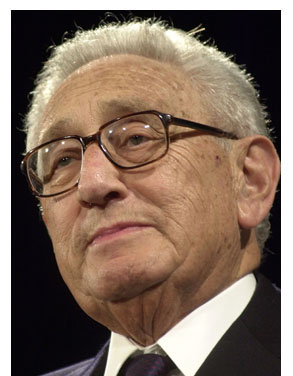

The day Henry Kissinger cried
My astonishing interview with the man who knows where the bodies are buried.
By Stephen Talbot
Just when I thought there could be no further desecration of those who perished on Sept. 11, George W. Bush appoints Henry Kissinger to direct an investigation of the government’s failure to prevent the terrorist attacks. Honestly, it took my breath away. Even in a time of cynical politics, this is stunning.
I realize, of course, that Bush never wanted any kind of independent investigation to take place — that the families of the victims compelled him to act. And if the administration’s goal is to contain and limit the probe, to avoid embarrassing revelations about U.S. intelligence failures, then Kissinger is just the man.
Forget Karl Rove. This is our true Machiavelli, a statesman famous for conducting foreign policy with a twist of treachery and deceit. From the clandestine bombing of Cambodia to supporting Pinochet’s bloody military coup in Chile, Kissinger is a man who has many secrets of his own to hide. Talk about a conflict of interest! How can Kissinger, at age 79, a lifelong member of the national security establishment, a presidential advisor who wiretapped his own colleagues to prevent leaks, suddenly become a truly independent investigator of the CIA, FBI and the White House? Who would ever believe him?
There are those who argue that Kissinger, the Cold Warrior who went to China, can surprise us once again, crowning his career and salvaging his reputation, by transforming himself into a steadfast inquisitor of his old associates, friends and patrons. “He’s working for his historic reputation now,” argues William Safire, the former Nixon speechwriter.
Call me dubious. Kissinger is too compromised, too feeble, too solicitous of power to name names and reveal any uncomfortable truths about what the government ought to have done to forestall the Sept. 11 attacks. My own experience with Kissinger only deepens my skepticism about his credibility and his willingness to reform a flawed system.
I met Kissinger last year in New York to interview him for a public television documentary I am making about the Vietnam War and the protests it provoked. When I arrived with my camera crew at his Park Avenue business address, I noticed that his consulting firm, Kissinger Associates, was discreetly missing from the lobby directory. Even prior to Sept. 11, the former national security advisor and secretary of state was cautious about his own security. There’s no telling who might show up. In Paris last year the French police arrived at his Ritz Hotel suite to serve Kissinger with a summons to appear in court to answer questions about French citizens who disappeared during the U.S.-backed coup in Chile. Kissinger immediately fled the country.
On the 26th floor we were buzzed into his office suite, questioned by a receptionist seated behind a transparent barrier, and finally admitted to a waiting room decorated in a Chinese motif.
I heard him before I saw him. In his unmistakable German accent, Kissinger was berating a female assistant for scheduling him at an event he did not wish to attend. Kissinger’s tantrums were legendary at the Nixon White House. Here I would call his tone aggrieved and imperious, except that the more he complained, the more he sounded like a grumpy old man.
Suddenly he appeared at the doorway. “What’s this about?” he growled, as if I were an unannounced intruder. I was momentarily dazed by the shock of recognition. “Oh, my god, it’s Henry Kissinger!” I thought. It was like turning a corner and bumping into the ghost of Richard Nixon or John Mitchell. An imposing figure who cast a shadow over my draft age years. And yet, something was wrong. This wasn’t the same Kissinger who prolonged the Vietnam War, lied about it, and haunted my youthful dreams. This was Kissinger diminished. An old man, recovering from surgery, shorter than I’d imagined, hard of hearing.
He motioned me into his office, closed the door and ordered me to sit on a couch to his left, explaining that he had a new “disability” — a bad right eye. “What questions are you going to ask?” he demanded. Before I could answer he told me any mention of his being a “war criminal” was off-limits.
“If you are going to ask whether I feel guilty about Vietnam, the interview is over. I’ll walk out.”
Now I was nervous that Kissinger would bolt. I played my best card. I told him I had just interviewed Robert McNamara in Washington. That got his attention. He stopped badgering me, and then he did an extraordinary thing. He began to cry.
But no, not real tears. Before my eyes, Henry Kissinger was acting.
“Boohoo, boohoo,” Kissinger said, pretending to cry and rub his eyes. “He’s still beating his breast, right? Still feeling guilty.” He spoke in a mocking, singsong voice and patted his heart for emphasis.
It was an astonishing moment. I longed for a camera. It may have been bad acting, but it was riveting.
I finally managed to stammer that yes, McNamara did express regret about the war. But Kissinger cut me off. Apparently we were not going to dwell on the former defense secretary’s bleeding heart.
In fact, McNamara, another old man, an architect of the Vietnam War, had told me, “The war could have been avoided.” He said his “greatest regret” was urging President Lyndon Johnson in 1965 to commit American troops to a land war in Asia. McNamara called the war a “tragedy.”
“It tore the nation apart,” McNamara said. “And I think to some degree we’re still suffering from that.”
McNamara’s sorrow seems genuine. The infuriating part is that he still defends his decision to keep silent in public about his disenchantment with the war until long after it was over. “It’s not appropriate for a secretary of defense to, in your terms, go public,” he admonished me. “I felt that I could do more inside than I could have outside.”
But McNamara’s public reticence deprived the antiwar movement of a powerful voice and undoubtedly prolonged the war. In November 1967, one month after more than 50,000 Americans surrounded the Pentagon, McNamara submitted a private memo to Johnson declaring that the U.S. could not win the war and should withdraw from Vietnam. LBJ was not persuaded, McNamara departed. But he never bothered to tell Americans of his dissent until it was too late.
I still consider McNamara’s failure in the late ’60s to speak openly about the war unforgivable. He had championed the war, dispatched some 500,000 U.S. soldiers to fight it, and then neglected to mention he’d been wrong after all. But at least, late in his life, McNamara is taking some measure of responsibility and admits some of his mistakes.
Which is more than you can say for Henry Kissinger. On America’s war in Vietnam — which he inherited from McNamara and the Democrats but continued for seven more years — Kissinger remains unreconstructed, unapologetic. He expresses nothing but contempt for McNamara’s anguished reappraisals.
For several minutes, Kissinger continued to hector me about my intentions, wanting to know precisely what questions I would ask. I declined as a matter of journalistic principle. I felt the interview slipping away, his irritability increasing, and then abruptly, he agreed to go on camera.
Under the lights, even our softest lights, he complained. His right eye was clearly bothering him. His answers to my first questions were curt, stiff, cautious. But I avoided the phrase “war criminal,” and after a while he settled into his standard defensive posture: speaking in that ponderous, suffocating drone that implies great meaning while revealing nothing.
As we changed tape, he snapped to life. “Good questions,” he said, which meant I hadn’t laid a glove on him. Then doubt crossed his face. “It depends on how you edit this.” And just as quickly, his confidence revived. “No, you can’t make this look bad no matter how you edit it.”
His legendary arrogance and insecurity alternated throughout the remainder of the interview. But he grew testy as I probed. He defended the U.S. invasion of Cambodia in 1970, saying, “I personally believe we should have gone in deeper and we should have stayed longer,” and he dismissed any possibility that the relentless U.S. bombing of Cambodia led to the disintegration of civil society and the rise of the genocidal Khmer Rouge.
“We could have won the war in Cambodia, which was possible,” he argued. “Vietnam was questionable.”
Asked why he did not push to end the war after he realized it was unwinnable, Kissinger groaned. “Could it have ended a year earlier, six months earlier? How do I know?” he shrugged. “I don’t think so. Besides, by that time our casualties had gotten down so low that that was not a major factor in the situation.”
Perhaps not for Kissinger or Nixon, but those casualties surely mattered to the thousands of Americans who died needlessly in the waning years of the war, not to mention the Vietnamese, Cambodians and Laotians who continued to die as Nixon and Kissinger pursued “peace with honor.”
When Kissinger’s associate, Daniel Ellsberg, gave the Pentagon Papers — the government’s secret history of the Vietnam War — to the New York Times, Kissinger went ballistic. He was deeply involved in the Nixon administration’s vendetta against the whistleblower. (And this is the man President Bush is now relying on to draw out truth-tellers from government agencies.) But he deflected my question about his campaign to destroy Ellsberg’s career and reputation, saying only, “Ellsberg is one of the brightest people I have ever met.”
Displaying his notorious thin skin, Kissinger interrupted me if I questioned anything he said. He asked me why we were still debating these matters 30 years after the war ended and then erupted at his opponents. “They present the history of the Vietnam War as if a bunch of power-crazed maniacs, first in the Johnson administration and then in the Nixon administration, who love to kill people, continued a senseless war, which the moral protesters wanted to end.” His voice rising in agitation, Kissinger exclaimed, “How plausible is such an interpretation of history?”
Out of the blue, he complained that people had no right to call him a “psychopath” for his conduct of the war. “It gets to be a nuisance,” he said, “but I’m a big boy.”
When the camera stopped rolling, Kissinger immediately said, “I bet McNamara was less strong than I was.”
Kissinger seemed very pleased with himself. I must have looked disgusted.
“I love McNamara,” he added. “He’s a wonderful man.”
Ah, the language of diplomacy.
As we packed up our gear, I asked Kissinger one last question. Something I really wanted to know. “What if the United States had allowed Vietnam to go communist after World War II?”
“Wouldn’t have mattered very much,” Kissinger muttered. Lights off. No camera recording what he was saying. “If the Vietnam domino had fallen then, no great loss.”
With that he rose, stiffly, from his chair and left the room.
Fifty-eight thousand Americans died in the Vietnam War — nearly 21,000 of them during Kissinger’s watch. More than 600,000 Vietnamese soldiers were killed during the Nixon-Kissinger years. No one is certain how many civilians died.
And yet Kissinger had just told me that none of these deaths were necessary, from a geopolitical point of view.
He is an old man now and he shows no signs of remorse. And he has never displayed a willingness to challenge the foreign policy establishment that continues to consult and flatter him.
Kissinger promises a “full accounting” of the circumstances leading to the Sept. 11 tragedy and vows, “We will go where the facts lead us.” But I don’t know why anyone would believe him. Kissinger’s specialty is the coverup. He knows where the bodies are buried, literally and figuratively, and he knows how to keep them there. And President George W. Bush knew all that when he appointed him.
The mysterious bombing of an environmental activist
Though she vehemently denied it in public, the late Earth First leader Judi Bari told me and others in private that she suspected her ex-husband was behind the notorious 1990 car bombing that is finally being examined by a federal jury.
By Stephen TalbotTopics: FBI
When I first met Judi Bari, she was lying in a hospital bed in Oakland, Calif., recovering from a bomb blast that ripped through her lower body and nearly killed her. As we spoke, she occasionally grimaced with pain, but she remained defiant in her purple Earth First T-shirt with a clenched-fist logo. She was incensed that the FBI and the Oakland police had arrested her and her colleague, Darryl Cherney, and accused them of knowingly transporting the pipe bomb that exploded in her car on May 24, 1990.
Now, a dozen years later, a federal court in Oakland is at last considering Bari and Cherney’s lawsuit against the FBI and the police for false arrest and defamation. A verdict in the case, which went to the jury on Friday, is expected at any moment. Tragically, Bari herself is not around to see the trial’s outcome. She died of cancer in 1997.
I wrote an article about the Bari case for Mother Jones magazine in 1990 and produced the documentary “Who Bombed Judi Bari?” in 1991 for San Francisco public television station KQED. Back in 1990, before the bombing, tension was mounting over Bari’s plans to lead what she called “Redwood Summer,” a series of protests against the timber companies that were clear-cutting some of the last remaining redwoods along the coast of northern California. Loggers and environmentalists were squaring off, and Bari received several death threats before her car was bombed. My documentary concluded that the FBI and Oakland police had mishandled the Bari case, ignoring evidence that absolved her and Cherney, and neglecting to pursue evidence that pointed to other suspects.
The Alameda County district attorney eventually chose not to prosecute Bari and Cherney, citing a lack of evidence. Now a jury is finally deciding if the FBI and Oakland police made a rush to judgment against two people they claimed were eco-terrorists.
But the Oakland trial focused on whether the FBI and the police botched the case, not on uncovering who bombed Bari’s car. To this day, I’m haunted by that question: If it wasn’t Bari’s bomb, whose was it? Who tried to kill her? The mystery remains unsolved.
Most of Bari’s supporters took for granted it was a political crime. From her hospital bed, Bari told me, “I should have seen this coming.” In all her public statements, Bari portrayed herself as the victim of an attempted assassination by her political enemies: the timber companies, right-wing crazies, possibly even the FBI.
But she told me something very different in private.
Bari took me aside one day back in February 1991, just outside her cabin in the foothills of Northern California, and told me in confidence that she feared her ex-husband, Mike Sweeney, might be the bomber. I can still recall the sick feeling in my stomach as she confessed her private suspicion.
Eventually Bari would publicly deny there was any chance Sweeney could have bombed her car. Sweeney denied it, too. No one ever got to the bottom of the murky drama: Bari changed her story with me, and refused to cooperate with the police and the FBI on their investigation — which was understandable when she was a suspect, less so after the charges were dropped against her.
But more than a decade later, I’m still troubled by unanswered questions in the Bari case, and I can’t help wondering whether the complicated allegiances, confused motives and conflicted feelings of Judi Bari herself — activist, mother, ex-wife, environmental hero — played a role in the bungled investigation into the crime against her.
By the time Bari told me her suspicions about Mike Sweeney, I had spent months getting to know her. I had worked closely with her as I wrote my magazine article and researched my KQED documentary. I liked her. She reminded me a bit of Bernadette Devlin, the civil rights leader in Northern Ireland. They both were short, brown-haired, fervent, outspoken.
But Bari, then 41, was not a saint. She could be vulgar, abrasive, even cruel to her minions. She was jealous of her sister, New York Times science writer Gina Kolata. She spoke idealistically of uniting timber workers and environmentalists, but more than anything she seemed to relish a good fight.
Still, I grew to trust what she told me, which is why I was stunned when she suddenly shared her dark story about Sweeney. We were walking slowly along an isolated country road — she limped badly due to her injuries from the explosion — when she said there was something I needed to know. To my astonishment, Bari alleged that Sweeney had physically abused and even raped her, on several occasions, during and after their seven-year marriage. She said he had a violent temper and she was afraid of him. I was shocked, because she had never even hinted at this in our many previous discussions. (Sweeney would eventually deny all of the allegations against him.)
Moreover, Bari declared that Sweeney had firebombed an old Navy airfield in Santa Rosa, Calif. Bari told me she discovered Sweeney assembling an elaborate coil of wires and fuses in their house near the airfield and asked what he was doing. When he informed her that he intended to burn down the hangars, she said she asked him to stop, but he refused.
I asked Bari why she had not gone to the police. Because, she said, she was pregnant with their first child and feared what Sweeney might do to her. She gave birth to their daughter Lisa in January 1981, just two months after the arson.
Despite what Bari told me about her ex-husband, she also let me know that she wanted desperately to believe that he had not gone so far as to try to kill her. It was almost too painful for her to consider, she said. Nevertheless, she felt compelled to unburden herself.
She even suggested a motive for why Sweeney might have wanted to get rid of her. Bari described Sweeney as an embittered ex-radical, who had decided to start a recycling business and resented Bari’s public leadership of a rowdy, provocative group like Earth First. In the months before the bomb wrecked her car and shattered her pelvis, Bari and Sweeney were feuding over money and ownership of a house they were building, as well as arguing over custody of their two girls.
But when my colleague David Helvarg and I began, at last, to investigate Sweeney, Bari did a curious and disturbing thing. She told us to stop. When I reminded Bari that she had encouraged us to pursue the leads in our investigation no matter where they led, and that she was the one who called our attention to Sweeney, she blurted out, “I’d like to know who did it, except if it’s Mike Sweeney.”
For personal and political reasons, Bari preferred to believe that she had been the victim of an attack by the timber industry, or some other political enemy, even the FBI. After all, that was her public persona — the martyr of a radical environmental movement.
But deep down she could not escape the idea that the person who bombed her might have been Sweeney, a man with a violent past. Bari never admitted this fear in public. It’s a secret she only told a handful of close friends.
After the broadcast of “Who Bombed Judi Bari?” in 1991, Bari denounced me for mentioning Sweeney as one among several possible suspects in the case — though I did not reveal that she herself suspected him — and asserted his innocence. It was galling, of course, because I knew she had provided the information that led me to investigate Sweeney in the first place. Her attack on my documentary perplexed many people, since the report was widely reviewed and interpreted as a pro-Bari piece, a rarity then in the mainstream media. The overwhelming response of hundreds of callers to KQED was that “Who Bombed Judi Bari?” dismantled the FBI and Oakland police case against her.
We explained how on the day of the bombing, Bari’s white Subaru had exploded as she made an abrupt swerve, triggering a simple motion control device that detonated the pipe bomb, which was coated with nails. The FBI and police insisted it was Bari’s bomb because, they alleged, it was in the back seat of her car, where she could have easily seen it, and because the nails on the bomb matched nails found elsewhere in the vehicle and at her home.
But David Helvarg and I showed that the bomb was actually hidden directly under the driver’s seat, which one could determine from her injuries as well as the gaping hole in the floorboard under the driver’s seat. I also showed that the nails could not be matched with any degree of accuracy.
I raised the obvious question: Why would Bari transport a bomb wrapped with nails — an anti-personnel device designed to maim or kill — that she knew was located just beneath her and would go off, after a timer ran out, when triggered by the motion of the car? It just didn’t make any sense. In the current trial, it is revealing that the FBI and the Oakland police are now blaming each other for who got it wrong first about the location of the bomb and the nails that supposedly matched.
The FBI insisted it had no bias against Earth First, but Helvarg and I discovered from Freedom of Information Act documents that the FBI had been tracking Earth First for years and regarded it as a dangerous group because the radical environmentalists advocated “monkey wrenching” — the destruction of logging and mining equipment. An FBI undercover agent had arrested Earth First founder Dave Foreman for conspiracy to knock down power lines in Arizona. But in their haste to portray Bari and Cherney as eco-terrorists, the FBI and Oakland police were ignoring the fact that the two had publicly renounced such Earth First tactics as “tree spiking” and were launching a high-profile campaign of nonviolent protest. Detonating nail-encrusted pipe bombs was not part of Bari’s political agenda.
Helvarg and I also conducted a thorough probe of other suspects in the car bombing. Timber companies and loggers despised Bari. We turned up a retired logger who told us he and others had been offered guns and money by an independent contractor to commit vigilante violence against any Earth Firsters caught sabotaging logging equipment. We discovered a letter sent to the Ukiah police, offering to inform on Bari and providing an incriminating photo of her posing with an automatic rifle — neglecting to mention that Bari intended the photo as a joke. The letter appeared to have been sent by an insider, someone close to her.
We also questioned a former professional football player who had become a hellfire and brimstone fundamentalist and loathed Bari for mocking and disrupting his anti-abortion rally. We even pursued several suspicious and volatile characters on the fringe of Earth First. But until Bari spoke to me about Sweeney, we had not investigated her former husband.
We began to. We discovered there had indeed been an unsolved blaze at the Santa Rosa Air Center on the night of Oct. 30, 1980. The arson fire engulfed an enormous wooden hangar, burned several small planes and forced a flight instructor sleeping at the site to flee for his life. Investigators found a tangle of hundreds of feet of wiring, electric fuses, a Kmart timer and gasoline-soaked rags used to ignite the blaze.
“It was almost murder because this was arson,” the manager of the private airfield, Bob Williams, told me. “Our flight instructor woke up with his camper in flames and just barely got out with his life.”
Williams suspected that Sweeney and Bari were behind the arson because afterward they led a public campaign to prevent an expansion of the airport. Bari acknowledged participating in Sweeney’s crusade against the airfield — though she told me she didn’t really think it was a significant issue; her husband just couldn’t stand all those little planes flying over their house. But she swore she had no part in the arson and thought it was stupid.
I tried repeatedly to speak with Sweeney himself. Alone among all the suspects and sources we contacted in researching the documentary, Sweeney categorically refused to talk with us. When I first phoned him, he slammed down the receiver. Later, he threatened to sue to prevent me from mentioning him in the documentary, but he never followed through.
At the last minute he sent me a letter in which he denied having anything to do with the Santa Rosa airfield fire or the bomb that crippled his former wife. I included his denials in my documentary. “I would never have wanted anything to happen to Judi that would have put the whole responsibility for raising our daughters on me alone,” Sweeney wrote.
When the documentary aired in Southern California, the Los Angeles Times said, “‘Who Bombed Judi Bari?’ does what many have accused Oakland police, the FBI and other police officials of not doing: thoroughly investigating the available evidence. Indeed, Talbot’s report loudly suggests that the initial arrest of Bari and Cherney after the bombing … was a rush to judgment that culminated the FBI’s tracking of the radical environmentalists.”
But Bari attacked the film in a broadside she wrote for a local alternative paper, the S.F. Weekly. (It now appears on her Web site.) “Talbot does a good job establishing my and Darryl Cherney’s innocence, and I guess we should thank him for that,” Bari conceded in the piece. But she went on to lambaste me for daring to mention Mike Sweeney — something that clearly touched a nerve with her.
“The most outrageous of his charges is that my ex-husband, Mike Sweeney, may be the bomber,” she wrote. “Talbot has only the most wildly circumstantial evidence to make him think Mike Sweeney could possibly be capable of making a bomb. He has no evidence that Mike is crazy enough to try and kill the mother of his children. My ex-husband and I have a cooperative relationship in our divorce, and he has no motive at all to bomb me. Mike was taking care of our children at his girlfriend’s house when the bomb was planted, and she can verify that Mike did not leave her house at any time when he would have had an opportunity to place the bomb. And I know my ex-husband didn’t do it, because he couldn’t look me in the eye if he had.”
My associates at KQED asked me why I didn’t defend myself by simply revealing what she had told me. But I could not do so without identifying her as my source, and I refused to do that. Bari had me at a disadvantage. She knew I would not betray her confidence as long as she lived.
But I had decided to include Sweeney in the documentary only after I discovered that Bari had told others about her allegations. She told two Mendocino County researchers who were working with her, Russell Bartlett and his wife, Sylvia Yoneda, that Sweeney had set fire to the Santa Rosa airfield. They have since confirmed this publicly.
Members of Bari’s original legal team and some of her closest friends and political allies also came to me, in confidence, and said that Bari had shared her fears about Sweeney with them. She told these friends and sympathizers that Sweeney was “bitter” and “ready to explode.” They told me in private that I would be negligent if I did not investigate Sweeney as a possible suspect in the bombing.
One of the women in Bari’s inner circle — whose identity I promised to conceal — told me that she was deeply suspicious of Sweeney, who she knew well. But she said she would not say this publicly because “Judi can’t handle this now, I have to be there for her.” But she went on to describe Sweeney as a “Dr. Jekyll and Mr. Hyde” who was “openly hostile” to Bari until the bombing, and then afterward came on like “a knight in shining armor.” She told me, “I think he’s scared shitless that his cover is going to get blown.”
“Judi is afraid of him,” one member of Bari’s legal team told me about Sweeney, adding, “I’m afraid of him.”
Others approached me to say that Bari had also told them about Sweeney’s brutality toward her. When David Helvarg asked her about those stories, she provided specific details. In a phone call on April 19, 1991, Bari told Helvarg that once when Bari criticized his relationship with his first wife, Sweeney took her by the throat and slammed her against the wall. Around the time of their divorce, Bari claimed, Sweeney raped her, and she did not resist because their daughters were sleeping nearby.
Sweeney came from a prosperous family in Santa Barbara, Calif. His father was an oil executive and a former Nixon administration appointee. At Stanford in the late 1960s, Sweeney was editor of the Stanford Daily and became involved with an ultraleft, pseudo-Maoist group called Venceremos. After graduating he tried radical union organizing, which is how he met Bari. Later he became a self-employed air conditioning contractor.
Today, Sweeney lives in Ukiah, Calif., where he runs a recycling operation, the Mendocino Solid Waste Management Authority. When KQED asked me recently to appear on a weekly news show to talk about the Bari trial, I spoke for the first time on television about what Bari had confided to me about Sweeney — the abuse, the rape, the firebombing of the airfield.
Sweeney sent an e-mail to the station — not to me — pointing out the article Bari had written in 1991, “Who Bought Steve Talbot?” (published as a chapter in her book, “Timber Wars,” as well as on her Web site), contradicting in public what she told me and others in private about her ex-husband.
Sweeney also e-mailed my brother, Salon editor David Talbot, when he learned I was preparing this piece. He pointed him to the article Bari wrote against me, and added: “Judi and her supporters struggled against all odds for 12 years to get the FBI into court to answer for its treatment of her, Darryl Cherney, and Earth First. It’s practically a miracle that the jury was ever seated, and five days after the trial starts, Steve Talbot gets on TV with an item titled ‘Casting doubt on Earth First! allegations.’ [Is this] Steve’s way of having the last laugh now that Judi can’t talk back?”
I phoned and e-mailed Sweeney, but he did not respond. I did, however, go back and reread Bari’s article as it appeared in the S.F. Weekly on June 6, 1991. Despite Sweeney’s characterization of the piece, I noticed that Bari very carefully avoided an outright denial that Sweeney burned the airfield — she called the charge “totally extraneous” but did not deny that Sweeney set the blaze. On her relationship with Sweeney, she wrote, “My ex-husband and I have a cooperative relationship in our divorce,” which was true in that they mostly cooperated in sharing responsibility for care of their children. But Bari told too many people about her serious problems with Sweeney to make that statement fully convincing.
Bari concluded the article by commenting, “I don’t think Talbot would ever presume to go to Brazil and investigate [slain Amazon forest defender] Chico Mendes’ ex-wife as a suspect in his assassination. But men seem to have a hard time taking a woman seriously enough to consider her a political target instead of a personal/sexual target.”
Yet Judi Bari is the one who told me that she feared her ex-husband might have tried to kill her. She is the one who told me he attacked and raped her. If it wasn’t true, why did she tell me? Why did she tell David Helvarg? Why did she tell some of the women who were closest to her? I had never until that moment considered Sweeney a suspect. I was limiting my investigation to the timber companies and anti-abortion fanatics and possible informants.
I kept Bari’s story a secret until after she died for one simple reason: journalistic ethics. She was my source. She revealed her story to me in confidence. I promised to listen but not to tell. It was frustrating to withhold that information from my viewers, but I am a journalist and I play by the rules of journalism, and one of those cardinal rules is: Don’t betray a source.
So, why after all these years am I revealing what Judi Bari told me about her former husband? First, Bari is dead. I protected her as my source as long as she lived. But the statute of limitations has run out. My agreement to keep her comments confidential is no longer binding.
Second, the trial in Oakland has revived interest in the case and raises the hope, however distant, that someone may actually try to get to the bottom of it. I feel an obligation to release information Bari possessed and shared with me, which might help any investigators genuinely interested in determining who tried to kill her. I can’t help wonder if her failure to share everything she knew with investigators contributed to their inability, or unwillingness, to solve the case.
A dozen years later, I wonder whether Bari ever regretted not talking to the FBI and Oakland police about what else she knew. At first, of course, she and her legal team had good reason to refuse to cooperate, since Bari was being accused, ludicrously, of bombing herself. But once the D.A. dropped the case against her and Cherney, Bari’s remaining silent only gave the FBI and police an excuse not to conduct a real investigation of who bombed her.
In fact, I talked to the FBI about the role Bari’s own evasions played in their dead-end investigation. As I was wrapping up the documentary, agent Edward Appel agreed to talk about the case on camera. He would not talk about specific suspects, but when I asked him about Sweeney, he hinted broadly that the bureau knew Bari’s ex-husband was a possible culprit. “Do you know that in this state that homicides are most often committed by relatives or friends of the victim?” Appel asked me. I replied that I knew that, and the FBI agent said, “Well, that’s something that the Oakland [police department] knows, too, and it’s something we’re very familiar with.” But he added that it was difficult to pursue suspects in such cases when the evidence is “slim” and the victim won’t cooperate. “Quite frankly, you can be stymied because people are not cooperative with you,” he told me.
One reason Bari kept silent, I think, is that she wanted to be seen above all as a kind of environmental movement hero — as a victim of corporate violence and political repression — even if that meant never answering the question of who really tried to kill her. She wanted to be a political martyr, not just another domestic violence victim.
To this day, I do not know if Sweeney placed the bomb in Bari’s car. Bari’s word isn’t proof in itself — she was in physical pain and under enormous stress after the bombing; and it’s possible that influenced her judgment about her ex-husband. And since she changed her story with me more than once, it’s hard to know for sure when to believe her: when she said she thought Sweeney was the bomber, or when she said she didn’t. For their daughters’ sake, I hope he wasn’t. For the truth’s sake, I hope that anybody who has withheld information in the case will finally talk to authorities, so the question “Who Bombed Judi Bari?” will finally have an answer, 12 long years after the crime.
Sweet dreams, honey
Every time Lynne Cheney's morbid novel hits the bookstores, her husband has a heart attack. When you read it, you'll see why.
By Stephen TalbotTopics: Books, Dick Cheney
Just in time for Christmas shoppers, Lynne Cheney’s long-lost novel “The Body Politic” is arriving in bookstores in a new paperback edition, advertised as “a revealing look at what it might be like to be the vice president of the United States.”
Let’s hope, for her husband Dick Cheney’s sake, that it doesn’t reveal what his vice presidency will be like. Mrs. Cheney’s fictional vice president, a 59-year-old Republican, dies in office of a heart attack. Her real-life husband is also 59 and has, of course, just survived his fourth heart attack. As one of her characters, a paranoid Secret Service agent, observes, “Life imitates art.”
Well, perhaps “art” is too strong a word. “The Body Politic” is a poorly written, allegedly comic, satire about life in a Republican White House, coauthored by Lynne Cheney and Victor Gold, who served as Vice President Spiro Agnew’s press secretary and coauthored President George Bush’s “autobiography,” the out-of-print “Looking Forward.”
In 1988, when the novel was originally published, Dick Cheney suffered his third heart attack and underwent quadruple bypass surgery. Twelve years later, the novel reappears and Cheney’s heart fails again. If he were a superstitious man, he might think his wife’s book is cursed.
There is something else in Mrs. Cheney’s book that might give Mr. Cheney pause. When the fictional vice president dies, his scheming, ambitious wife participates in a White House coverup of his death and manages to succeed her late husband as the country’s first female vice president. Move over, Lady Macbeth.
Mind you, this is all supposed to be funny. “The Body Politic” is, after all, one of those slapdash works of fiction penned by Washington insiders with too much time on their hands. It would be entirely forgettable except for its uncanny coincidences and remarkable reappearance at the most awkward moments.
The 1988 novel first resurfaced last summer when Dick Cheney, in charge of George W. Bush’s hunt for a running mate, became the vice presidential candidate himself. That was after Bush Senior placed that private call to Cheney’s doctor in Texas to make sure the old warhorse’s damaged heart could withstand the rigors of a presidential campaign.
Governor Bush’s selection of his father’s former defense secretary suddenly returned Lynne Cheney to the limelight. The world hadn’t heard much from Mrs. Cheney since her controversial, outspoken tour of duty as Ronald Reagan’s chairman of the National Endowment for the Humanities. Even her role as co-host of one of the lesser Beltway talk shows, the now defunct “CNN Crossfire Sunday,” was terminated in 1998. But thanks to her husband’s rise, she, too, was resurrected. Her friend and fellow cultural warrior, the virtuous Bill Bennett, commented, “She’ll be hard to muzzle.”
Lynne Cheney did, indeed, eagerly return to the public arena. However, there were two problems. First, the press discovered that one of her daughters, Mary, was proudly and openly a lesbian. Asked by ABC’s Cokie Roberts about her daughter’s public declaration of homosexuality, Mrs. Cheney promptly denied it, asserting that “Mary has never declared such a thing.” This came as a surprise to her daughter’s friends and co-workers at Coors Brewing in Colorado, where Mary Cheney worked with a gay and lesbian task force to overcome a longstanding gay boycott of the conservative-owned beer company. “Basically, I don’t talk about Mary’s personal life,” Mrs. Cheney told the sympathetic Washington Times. “We kind of have a mother-daughter agreement. I don’t talk about her personal life, and she doesn’t talk about mine.”
Conservatives were spared a shameful moment when Mary did not, as it was rumored she might, bring her female partner to the Republican Convention. While the rest of the Cheney family smiled to GOP delegates, Mary remained in the background behind her more sexually appropriate sister, Elizabeth, and young niece. But then the other problem emerged. It turned out that when she wasn’t rooting out “political correctness” at the NEH, Lynne Cheney was writing novels that were steamy, racy and politically embarrassing. Elaine Showalter, an English professor at Princeton, unearthed one of the books, “Sisters” (1981), which had been published only in Canada. Lo and behold, “Sisters” was “a gothic female historical novel,” featuring an account of frontier women in Cheney’s home state, Wyoming, who shared an unmistakable “lesbian ardor.” In one passage, the female heroine watches two women in an intimate embrace, and as Lynne Cheney writes, she “felt curiously moved, curiously envious of them.” Not exactly the sentiments one might associate with a sharp-tongued ally of the Christian Coalition.
That was not all. In “Executive Privilege” (1979), Lynne Cheney writes with sympathy and concern about a troubled president who seeks solace in daily conversations with a staff psychiatrist, only to be betrayed by — George W. Bush, take note — his vice president.
As if this rediscovered fiction might not stir up enough trouble, Cheney’s “The Body Politic” describes a Republican vice president who dies “blissfully, at age 59, in carnal arrest.” In a scene reminiscent of Nelson Rockefeller’s demise, Cheney’s fictional vice president succumbs while he is having sex with a glamorous network television correspondent in his private townhouse. Cardiac arrest during sex leaves a “beatific smile on the Vice President’s face,” writes Cheney, describing the corpse. The vice president’s fatal tryst with a TV reporter gave “new meaning to the media term one-on-one,” muses the deceased politician’s press secretary. He is only surprised that his boss, “the ultimate WASP,” was sexually attracted to the pushy Italian-Jewish correpondent, Romana Clay. (Such clever names.) “I was still under the impression that his taste in extramarital sex ran to patrician bluebloods, the discreet wives and daughters of America’s ruling dynasties. But when I saw Romana at the top of the townhouse stairs in a flesh-colored peignoir, things fell into place…”
When queried last summer about this unseemly prose, Mrs. Cheney tried to dismiss the sex scenes as the work of her co-author, Victor Gold. His name, after all, appeared first on the hardback. Inconveniently for Lynne Cheney, the order has been reversed on the new paperback: Her name now appears first in bold letters above the title. Moreover, the publisher’s blurb on top of the back cover prominently touts Lynne Cheney as “the wife of Republican candidate for vice president Dick Cheney.”
For a woman who may soon become our second lady, Lynne Cheney does nothing but disparage the office of vice president in her comic novel, arguing that “for a Type A overachiever, the Vice Presidency is the worst kind of career move.” “Under the Constitution the only thing the job calls for is waiting,” writes Cheney, “waiting for the President to die or be impeached; waiting for the Senate to wind up in a tie vote so the Vice President can break it.”
Again, that last phrase now carries more weight than when she wrote it. If Dick Cheney actually makes “the worst kind of career move” and becomes vice president, he will apparently be at the beck and call of an equally divided Senate, with 50 Republicans and 50 Democrats. Will he, too, regard this duty as burdensome and odious? All the waiting forces Cheney’s fictional vice president, Bully Vandercleve, to seek relief in adultery, or as Cheney indelicately puts it, “It was only a matter of time before he started looking for ways to drain his Type-A batteries.”
Will Dick Cheney feel similar urges? In an exquisitely divided Senate, there will be even more intrigue and political drama than in Cheney’s novel, where the Senate threatens to deadlock over a Cuban resolution (yes, even incensed Cuban-Americans figure in this clairvoyant novel). What toll this heated political maneuvering might take on Dick Cheney’s physical and mental health remains, perhaps, for another novel.
And what might we predict about Lynne Cheney’s behavior as second lady from “The Body Politic”? Her alter ego is Cissy Vandercleve, the adulterous vice president’s wife with “hot hazel eyes” and a “French vanilla complexion.” The important thing to know about Cissy is that she is ambitious, launching her career as a conservative crusader with a campaign to commemorate Ayn Rand on a postage stamp. The other thing about Cissy is that she is fed up with her role as appendage to a Washington politician.
Even Lynne Cheney’s friends describe her as ambitious and driven. She relishes political combat like her character Cissy who “loved the game” of politics but resents her second-class status as a woman. Lynne Cheney wrote an article in 1985 called “The Decline of the Dutiful Wife” in the Washingtonian magazine, and as Lingua Franca discovered, an author’s note describes her as “willing to help in her husband’s campaigns … but only if she’s given a speaking role.”
Lynne’s comic persona, Cissy, sheds no tears over her philandering husband’s demise. She immediately joins the plot to pretend the vice president is still alive, in order for the Republicans to win the presidential campaign. When the farce draws to a close, she has clawed and maneuvered her way to the top, replacing the late Bully as No. 2 on the GOP ticket. Wish fulfillment, or merely a second-rate plot that Lynne Cheney may regret writing? In any case, it resurfaces at a particularly awkward moment in our presidential history. One wonders who is at fault here: the publishers, St. Martin’s, who could not resist an opportunity to resuscitate a mothballed novel in hopes of cashing in on Dick Cheney’s new position, Mrs. Cheney or both?
Before leaving “The Body Politic” and returning to our national drama of electing a president, I feel compelled to mention two other unfortunate episodes in Lynne Cheney’s “revealing look” at the vice presidency. There is, for example, the matter of assassination. “It’s the nut mentality,” warns her Secret Service character. “They’re looking for a challenge, see? Something to get them on the evening news. Nobody’s ever shot a Vice President before. Presidents, popes, senators, governors, preachers, rock musicians, they’ve been shot. But never a Vice President. It would be a Guinness first.” This comes as a frightening suggestion of what might happen, halfway through the satiric novel. I can’t imagine Dick Cheney would find it a particularly comforting thought.
And then there’s the fate of the president, a nervous man who does not react well to pressure. His aides treat him like a child. They withhold vital information, including the fact that his vice president has been dead for six weeks. Without informing the hapless president, they hire a Las Vegas comedian to impersonate the Vice President on the radio. The impersonator is named Moishe Feinbaum, but he’s actually an African-American ex-Baptist. Oy vey! (Remember, Lynne Cheney thinks this is funny.)
Cheney and Gold portray the executive-office Republicans they know so well as manipulative, conniving, ruthless men who will do anything to seize and hold power, deceiving Congress and the American people without a moment’s hesitation. There are characters who remind us of Alexander Haig, H.R. Haldeman and G. Gordon Liddy conducting “dirty tricks” and bugging and intimidating their opponents. President Bush is even mentioned by name as someone, like Oliver North, who undertook a secret (and perhaps illegal) overseas mission. To win the presidential election, the Republicans shamelessly exploit the Hispanic vote, passing out “fortune enchiladas” with a message inside, in Spanish, saying vote for the Republican candidate.
The GOP presidential aides sneak their boss into Bethesda Naval Hospital when his blood pressure soars. They lie to the press, saying the president is only undergoing a routine checkup. When the president in “The Body Politic” is at last told the truth about his deceased vice president, he collapses from a stroke or a heart attack, and dies.
I don’t think George W. Bush has anything to worry about, though. Despite the soaring tensions of the election stalemate, the Texas governor is still jogging and they say his blood pressure is fine (although his face did erupt in that nasty boil). As for Dick Cheney, he can rest somewhat easy — as far as I know, his wife is not yet writing another novel.
The war over vouchers
As home to one of the largest school voucher programs in the nation, Cleveland is ground zero in the battle.
By Stephen Talbot
Under the cross, on a small table in the middle of St. Vitus Elementary School’s main hallway, sits a display: a crown of thorns and two large nails which look more like railroad spikes.
These are trappings of Catholic worship, not the sort of thing you usually find in, say, a Baptist church or school. But the symbols of Catholicism don’t particularly bother Janie Hays, a black, single mother who sends her daughter, Jasmine, to St. Vitus courtesy of a voucher. “We’re Baptists,” says Hays. But she doesn’t mind that the school is Catholic because “if you think about it, there’s only one God.”
St. Vitus used to be a white ethnic enclave, an inner-city parish for the Slovenians who worked in the steel mills. Now, half its students are black.
This is what the school voucher program looks like in Cleveland. Catholic schools formerly devoted to serving their white, working-class communities are now conspicuously integrated by African-American Protestants. Same crucifixes, similar curriculum, changing clientele. Of the 235 students here, only about 70 are Catholic.
The voucher program was St. Vitus’ salvation. A few years back, the elementary school was set to close, the victim of Cleveland’s changing demographics. Whites were forsaking the old neighborhood for suburbia. Enrollment withered to 130 students. But the taxpayer-funded voucher program, which began in 1995, made it possible for low-income families to send their sons and daughters to private and parochial schools. The vouchers are worth up to $2,250 per pupil, more than enough to pay the $1,900 tuition at St. Vitus. In effect, it’s a government subsidy that sustains the Catholic school.
“We’re a regular U.N.,” smiles Jeanette Polomsky, the round-faced, soft-spoken St. Vitus principal. “Our children learn together, play together and pray together.”
Polomsky is not a nun, but she’s a lifer. The oldest of six children, she graduated from St. Vitus along with all her brothers and sisters. Like her bishop, she’s committed to the “church in the city” regardless of what racial group now dominates the neighborhood.
These days at St. Vitus there are a few Hispanics and Asians, but what’s most obvious is the checkerboard pattern of white and black kids in each classroom. Stocky white boys with crewcuts and last names like Djurovic share rows of old-fashioned school desks with black kids who look like they belong in a gospel choir. They are all dressed neatly in variations of the Catholic common denominator: the school uniform.
That’s the deal the Catholic schools make with urban black kids: We welcome you and your vouchers, we will be an anchor in your economically ravaged neighborhood, but you must play by our rules. “You can’t get a whole lot of teaching done if the room is in chaos,” Polomsky stresses. “We want our children to behave appropriately and to have some personal discipline. We try to teach them that they are responsible for what they do, and that if you make good choices there are good consequences that come to you. If you make poor choices, then the consequences might not be so pleasant.”
Polomsky says this sweetly, with almost beatific grace, but you still get the message: Screw up badly and we’ll expel you — fast. It’s something a lot of public school principals would love to do with deeply troubled, disruptive kids but can’t, at least not as easily.
Hays, who works as a computer operator for the police department, appreciates the safety and structure St. Vitus provides. The voucher program enables Hays to send her daughter, Jasmine, to a school that’s strict, old-fashioned and assigns homework every night.
But as Polomsky is quick to admit, St. Vitus is “not a little patch of paradise.” Even with the voucher money, it’s a financially strapped, struggling school with woefully underpaid teachers and no frills. The starting salary is less than $18,000 a year.
“Teachers could easily make an additional $10,000 just by signing on in a public school,” says Polomsky. “This is a personal choice [our teachers] make. It’s a commitment to the school, the Catholic faith, and to sharing that faith and education with the children.”
Jasmine is faring well at St. Vitus, but she may not be able to stay. Last year, a federal judge, Solomon Oliver, declared the entire Cleveland voucher program unconstitutional — a violation of the First Amendment’s separation of church and state. The judge noted that 96 percent of the nearly 4,000 voucher students attend parochial schools and concluded that this amounted to “government-sponsored religious indoctrination.”
There are African-American parents who agree with Oliver, although his ruling sparked a firestorm of criticism and the judge agreed to allow the voucher program to continue while the case is on appeal. Ultimately, the Supreme Court will probably determine the fate of the Cleveland plan.
Kelvin Woodford, a powerfully built, handsome man who splices cable for the Cleveland power company, removed his daughters from Catholic school because “I felt to a point it is an indoctrination.” Woodford believes “you are taught with blinders” in religious schools. “A lot of people are trained and not truly educated.”
He prefers the rough and tumble of public schools combined with strong parental involvement in his kids’ education. Woodford, for example, requires his children to do weekly book reports for him.
But Fannie Lewis, an African-American grandmother and city council member who represents Ward 7, one of the poorest neighborhoods in Cleveland, says she just can’t understand why a black parent could be against vouchers. “Using this church and state thing, I mean, that’s nothing but a cop out,” fumes Lewis. “People send their children to Catholic schools because they’re looking for a better education, they’re looking for discipline, they’re not looking for no religion.”
A maverick Democrat, Lewis helped initiate the voucher program to help black parents who are desperate to escape a failing inner-city school system. “It’s like a burning house,” explains Lewis. “What do you do? Let the house burn down and kill everybody or go in there and save who you can? That’s what the voucher is about.”
Outside of Cleveland and Milwaukee, publicly funded voucher programs barely exist. And the Supreme Court may yet declare them unconstitutional.
But vouchers exist in Cleveland because the public school system fell apart under incredible strain. As Cleveland’s once mighty industrial economy stagnated and whites fled the Rust Belt city, the schools deteriorated. By 1995, when vouchers were introduced, 40 percent of Cleveland’s nearly half-million people were living below the poverty line. Voters were unable or unwilling to pass a school levy, and the Cleveland public schools were $150 million in debt. School buildings were literally crumbling.
“I remember when the Browns [the NFL team] left town, there was all this hoopla and the whole city’s in an uproar,” recalls Richard DeColibus, president of the Cleveland Teachers Union. “The very same weekend that happened, one of the roofs in our elementary buildings collapsed, just fell right in. If the kids would have been there, you would have had 20, 30 kids killed. Nobody cared.”
Violence in the schools also terrified parents and teachers. Zora Johnson is a mother of six with a bright smile and an uncanny resemblance to Ronnie Spector, lead singer of the mid-’60s “bad girl” group, the Ronettes. She is a dedicated preschool teacher in the Cleveland public schools and a union activist.
But in 1994 a fight erupted at her daughter’s middle school, someone pulled a knife, and her daughter intervened to try to save a friend’s life, only to have him bleed to death in her arms. Johnson immediately transferred her daughter to a Catholic school. “There’s no way I was going to allow her to remain in the school system,” shivers Johnson. “I was afraid she was going to get hurt.”
The stark reality is that in Cleveland the only real alternative to public school is Catholic school. No one else has the institutional network in the inner city. No one else manages to educate kids on less than $2,250 a year. Proponents of vouchers argued that new private schools would spring up to educate voucher students. But it hasn’t really worked out that way. The economics are daunting. And sometimes the temptation to take the money and run is too strong.
LaRuth Jackson, a single mother who lives in the projects, sent her first-grader, Jayve’ante, to a new school aimed at black voucher kids, the Islamic Academy School of Arts and Sciences. “What got me was the karate,” recalls Jackson. “They had it every week and I met the instructor and he was nice, you know what I’m saying?”
But the school’s promises proved hollow. Extracurricular activities vanished. It turns out that the teachers were not required to have credentials and one was reported to be an ex-con who had been jailed for murder. The founders of the school left town, owing more than $70,000 which they had collected from the state of Ohio for students who never actually attended class. A group of pro-voucher businessmen paid off the debt to avoid further embarrassment to the voucher program.
Jackson is bitter about her experience with vouchers and angry that her son wasted a year of schooling. “They do that with the black society,” says Jackson. “They give you a voucher program and then everybody think, ‘Oh, private school, better education.’ But sometimes it might not be. It’s all about the school.”
One of the great controversies surrounding voucher students is whether their academic performance improves, even in the better-run schools. The results are mixed and inconclusive. Even an outspoken voucher advocate like Paul Peterson, a Harvard professor who has studied the Cleveland program, claims only modest improvements. “On test score data, you’d have to say the gains are fairly clear in math,” Peterson concludes. “The gains in reading are less clear, more marginal.”
What studies do confirm is that the parents of voucher students feel better. “I would say the results on parent satisfaction are overwhelmingly conclusive,” says Peterson. “If parents are given a choice, they’re very happy. They’re much happier with their private schools.”
Tammy Guido is definitely one of those happy parents. She views vouchers as a life preserver. A poor, white mother of three boys, she said applying for and receiving a voucher was like winning the lottery. And like other non-Catholic parents I interviewed, she has no objection to the mandatory weekly Mass and regular instruction in Catholicism.
“I am Lutheran,” notes Guido. “Lutheran and Catholic is basically the same.” That’s not exactly the way Martin Luther saw it, but the ecumenical spirit is definitely alive and well among black and white voucher parents in Cleveland.
“I just feel any time you take public money and use it for private institutions, it’s wrong,” argues Woodford, and many agree that the $11 million a year it costs to run the Cleveland voucher plan is money better spent on improving public schools. Educators who oppose vouchers worry about the kids left behind in failing public schools after the voucher kids have bailed out.
“What about the kids who can’t find a seat in that other school that presumably is a better school, what about them?” asks Rudy Crew, who was chancellor of the New York City public schools until the other Rudy, Mayor Giuliani, dismissed him last year after Crew refused to implement a pilot voucher program.
“What kind of materials and supplies and laboratory equipment and so forth will the kids in that school have?” Crew asks. “What are you going to do? Are you going to just simply say, ‘Well, we’ve gotten a third of your kids out of here, and now the two-thirds of you that are remaining, basically don’t need this?’ That’s absurd. Not only is it absurd, it’s insidious.”
Lewis and her allies don’t want to abandon kids in deplorable public schools. But she refuses to wait any longer for politicians and educators to improve a system that has been awful for a very long time.
It’s difficult to argue with Lewis’ hard-headed pragmatism. I asked Vice President Al Gore, who opposes vouchers, what he would say to a black mother like Hays who loves the voucher program. Would he tell her, Just say no?
Gore declined to comment on the specifics of the Cleveland case, citing the court challenges. But he said emphatically, “I don’t think that we can tell any parent in this country that they ought to keep their children in a failing school for one more day.” Gore then described his solution: “That’s why I have proposed shutting down every failing school, and reopening it with a new principal, with full peer review of all teachers, new resources and a new school plan to make that school a success.”
In the education world, that’s known as “reconstitution” and it’s controversial, especially among some teachers and school administrators. It’s certainly not the usual talk one hears from Democrats. But Gore correctly calls the terrible state of poor, urban schools “a national emergency,” and he knows that if he can’t offer vouchers, he’s got to come up with some radical plan — what he constantly calls “revolutionary improvements.”
Part of that plan is a huge commitment to spending more federal money on public education — $115 billion over the next decade on “universal” preschool, as well as elementary through high school. That’s the incentive. The new plan also threatens to close failing schools.
“Look at what Governor Hunt does in North Carolina,” Gore suggested. “He had 15 failing schools. Shut them down, brought in a new team for each one of them with a new plan and new resources, and now 13 of those 15 schools are in the top rank of high-achieving schools in the state.”
Texas Gov. George W. Bush has his own, quite radical plan to deal with the worst schools. He’s proposing taking federal money away from failing schools and giving it directly to parents to spend as they see fit on their children’s education. In effect, it’s a national voucher plan, although he’s nervous about using the controversial “v” word.
Ironically, as governor of Texas, Bush declined to promote vouchers, thereby alienating some Christian conservatives who finance their own voucher program in San Antonio. But now that Bush is the presumptive presidential nominee of the Republican Party, he has adopted the party’s penchant for vouchers.
In an interview for our “Frontline” documentary, Bush said he would tap the biggest federal education program, Title I, nearly $8 billion a year, which is given to schools with low-income students: “As opposed to subsidizing failure, we ought to free the parent to make a different choice.”
Gore attacks Bush for implying that the Title I money — anywhere from $500 to $1,500 per student — would be enough to pay tuition at a private school. “That’s a fraudulent claim,” Gore charges, and he’s right. A Cleveland voucher is worth up to $2,250 and that’s barely enough to cover a modest Catholic school tuition.
But Bush doesn’t always insist that the Title I voucher would pay for a private or Catholic school. He told “Frontline:” “It could be [another] public school. It could be a charter school. It could be a tutorial. It could be anything other than the status quo.”
Chester Finn, a sometime advisor to Bush who was President Reagan’s assistant secretary of education, readily admits that each parent would get a voucher worth no more than “six or eight or nine hundred dollars” if the Title I money is divided up. Finn says it could be spent on “an after-school program” or “something over the Internet.”
Such a modest amount of money may not have the political appeal Bush seeks. But ironically, one of the architects and early implementers of the Title I program, Michael Kirst, a Democrat and Stanford education professor, agrees that Title I has outlived its usefulness and should be disbursed to parents of poor children.
Kirst knows the money won’t pay for much more than some tutoring, but he says that’s better than nothing. Kirst believes there is a genuine crisis in school systems like Oakland, which he has studied for Mayor Jerry Brown, and desperate times demand new experiments. “The Oakland schools are so bad, I wouldn’t send a juvenile delinquent to one,” says Kirst.
That sort of brash statement has resonance in a city like Cleveland, where people are fed up enough with the schools to speak their minds. Teacher union president Richard DeColibus says working conditions in the public schools are still so bad that it’s very hard to retain good teachers. “We hired 500 teachers last year, 140 of ‘em are already gone.” The biggest problems, he says, are still discipline and overcrowding in the classroom, especially in middle schools.”
Lewis is savvy enough to know you can’t blame everything on the schools. She readily recites a litany of urban woes, stressing how many kids have absent parents.
“Do you know what it’s like to grow up without either one of your parents?” she asks. “Those youngsters when they go to school, they got to fight. They just mad. You got youngsters in the juvenile system that are hard and cold now because they’re not getting any love. Nobody cares about them.”
But Lewis refuses to let schools off the hook. “We need to keep our children busy,” she tells me. “They ought to go to school year round. Six days a week.” If not, she fears another generation of black urban youth will be lost.
“Without an education, how you gonna get a job?” she shouts. “The less education you got, the less money you going to make. If you want six figures, you got to have some sense.”
She’s on a roll now, preaching, but dead serious: “Our youngsters don’t just have to compete with kids in Cleveland. They’ve got to compete globally. And if these youngsters cannot get exposed to a computer, then they’re going to be illiterate.”
Vouchers are, at the moment, a tiny, almost marginal experiment. In practice, in Cleveland, they certainly represent taxpayer support for religious schools — it’s ridiculous to pretend they don’t. And vouchers may indeed siphon money and the most-motivated parents from an already debilitated public school system.
But vouchers represent something very profound — a desperate cry from the poorest African-Americans in our inner cities that their schools are a mess and no one seems to care.
In the suburbs, no one’s talking about vouchers. A short trolley car ride from downtown Cleveland is one of the finest public high schools in America, Shaker Heights, a thoroughly integrated school, half black, half white, committed to excellence with the resources of a solidly upper-middle-class community to support it. They’ve even got their own planetarium.
Even in Cleveland, there are a few outstanding “alternative” schools — like the Newton D. Baker Elementary School with an arts-based curriculum that attracts a multiracial student body from all over the city. The test scores are strong and the music, theater and painting have reached some kids who might otherwise have lost interest in school. But Baker is an exception — the creation of an extraordinarily willful and dedicated principal, Yvonne Aguilera.
For those who lack the resources of a Shaker Heights, or who languish on the waiting lists trying to get into one of the few wonderful alternative schools in Cleveland, the appeal of vouchers will surely grow. It’s an appeal that Democrats, teachers unions and civil rights leaders ignore at their own peril.
Days of rage (cont.)
Filmmaker Stephen Talbot fires back at David Horowitz over his PBS documentary '1968.'
By Stephen TalbotTopics: Afghanistan, Martin Luther King, Jr., PBS, Ronald Reagan, Taliban
My greatest transgression, it seems, was not including David Horowitz in my article and documentary about 1968. “Me, for instance,” he volunteers when proposing the ’60s veterans I should have interviewed. Talk about narcissism! And Horowitz doesn’t even have the excuse of being a baby boomer.
It reminds me of the joke his former colleagues tell. Back in the ’60s David had a reputation for being arrogant and self-obsessed. And now that his politics have flipped 180 degrees, he’s still arrogant and self-obsessed.
Once a polemicist for the left, now a polemicist for the right. Some things never change.
Not that Horowitz hasn’t made some valid points. His perspective on the revolutionary delusions and excesses of the New Left, after 1968, and his revelations of thuggery within the Black Panthers are important to understanding the full story of what happened to the protest movements of the ’60s. In fact, if PBS or anyone else offers me funding to do more films on the ’60s, especially the late ’60s-early ’70s period — what Todd Gitlin calls “the days of rage” — I would like to interview Horowitz and other ex-revolutionaries.
On the subject of 1968, however, Horowitz is so focused on his personal odyssey from red-diaper baby to anti-communist crusader that he misses the significance of the year for most young people who were involved in the anti-war and civil rights movements. As a self-described “pre-boomer,” Horowitz by 1968 may have been a cynic trying to manipulate innocents like me — certainly I remember reading his tomes denouncing U.S. imperialism and being influenced by them. But when Horowitz claims “we had declared war on … the democratic system,” he’s talking about himself, not the thousands of young, idealistic activists who sought to end the war in Vietnam by campaigning for Sens. Eugene McCarthy and Robert Kennedy or marched with Martin Luther King Jr. to end segregation in the South.
Horowitz’s diatribes would be more convincing if he got his facts right. For instance, he accuses me of making films “into the ’80s celebrating Communist insurgents who were busily extending the Soviet sphere in Africa. America, bless its generous heart, has already forgiven Steve Talbot for that. So why lie about it now?”
What on earth is he talking about? What lie? I have made two documentaries about Africa — one about Nelson Mandela’s African National Congress (“South Africa Under Siege,” 1986) and one called “Namibia: Behind the Lines” (1981), about that country’s struggle for independence from South Africa. Both films are straightforward and honest and were praised for their reporting. One awful mistake that Horowitz’s hero Ronald Reagan made was to assume, incorrectly, that the ANC was a tool of Moscow and as a result he allied U.S. policy with the apartheid government. Even Newt Gingrich came to see that Reagan was on the wrong side of history — too bad Horowitz never saw the light.
In fact, Horowitz is still praising Oliver North (of all people!) and the Afghan “freedom fighters” — a phrase he might want to modify in light of what the Taliban are now inflicting on women and non-believers, and the revelation that one of those CIA-sponsored “freedom fighters” is the infamous Osama bin Laden.
Horowitz is less concerned with the narrative of 1968 than he is with his personal “God that failed” story. And when he gets so many details wrong it makes me suspicious of everything he writes.
For instance, how does he know whether I was “following” Martin Luther King Jr. in 1968? Without a shred of evidence, he claims I wasn’t. In fact, I was devoted to King’s cause — which is why I was so distraught at his death. Among other reasons, I was deeply impressed by King’s courageous decision to speak out forcefully against the war in Vietnam — a move strongly endorsed by Horowitz’s own Ramparts magazine. It’s true that many young blacks in urban areas of the North, and some leaders of the New Left, were growing impatient with King’s nonviolent strategy. Even King had doubts and was despondent. I said so in the documentary.
Horowitz’s fantasy that Tom Hayden destroyed the Democratic Party in 1968 is preposterous. Lyndon Johnson, Richard Daley and Hubert Humphrey bear the lion’s share of that burden. Cold War liberals were afraid to admit that they had made a tragic mistake in Vietnam. Horowitz and I agree that both sides, the protesters and Mayor Daley’s police force, were spoiling for a fight at the Democratic Convention that year — and that many people in the anti-war movement stayed away from Chicago for fear of violence. But while some radicals were eager to riot, most of the demonstrators were not, including anti-war leaders Dave Dellinger and Rennie Davis. Mayor Daley’s cops didn’t mind whether they clubbed a Yippie, a McCarthy delegate, a reporter or Hugh Hefner.
There is one sentence in Horowitz’s rant that I find encouraging. “It would be nice,” he writes, “if we could use this 30th anniversary of the events of 1968 to end the cold war over our past, and start restoring a sense of the tragic to both sides.”
Surely there was tragedy on both sides of the Cold War, and there is enormous room now for reconsideration and changed opinions. That’s exactly what Todd Gitlin did in his excellent book reassessing the ’60s and his more recent writing decrying “identity politics.” In my documentary Gitlin even says he was wrong not to vote for Hubert Humphrey in 1968.
If Horowitz were more honest himself and less of an ideological blowhard, he might make a useful contribution to this ongoing reevaluation of the ’60s.
Newt's glass house
Newt Gingrich is reluctant to stone President Clinton for adultery, not out of Christian compassion, but because he lives in a very fragile glass house.
By Stephen TalbotTopics: Bill Clinton, Infidelity, Newt Gingrich
Newt Gingrich did a strange thing this week: He restrained himself.
You would have expected the notoriously ill-tempered speaker of the House to savage a wounded President Clinton after the president’s humiliating Monica Lewinsky confession. In the heady days of the short-lived “Republican Revolution” (1994-95), Gingrich was an unleashed pit bull who never missed an opportunity to sink his teeth into the president’s exposed flesh. But now Newt is subdued, his criticism of Clinton muted.
While House Democratic leader Dick Gephardt condemned Clinton’s behavior as “reprehensible” and refused to rule out impeachment (later softening his rhetoric), Gingrich cautioned that the Lewinsky affair alone does not justify an impeachment inquiry. The Georgia Republican told the Washington Post that he believed only “a pattern of felonies” and “not a single human mistake” could constitute grounds for impeachment.
“I don’t think the Congress could move forward only on Lewinsky,” Gingrich said. Instead, Gingrich wants to return to Whitewater and other investigations of the president, even if Kenneth Starr’s report to Congress is limited to Lewinsky.
It’s tempting to congratulate Gingrich for his understanding of human frailty, but don’t mistake his comments for Christian charity. The rabidly partisan Gingrich would love to bring down Clinton. Forcing a Democratic president to resign would be sweet revenge for Gingrich, who cast himself as Richard Nixon in his high school play and has always admired the disgraced Watergate villain.
No, it’s not compassion that tempers the speaker’s censure of Clinton’s self-destructive sexual compulsions. It’s self-protection. Gingrich, lest we forget, has a closet full of sexual misconduct.
For one thing, Gingrich pioneered a denial of adultery that some observers would later christen “the Newt Defense”: Oral sex doesn’t count. In a revealing psychological portrait of the “inner” Gingrich that appeared in Vanity Fair (September 1995), Gail Sheehy uncovered a woman, Anne Manning, who had an affair in Washington in 1977 with a married Gingrich.
“We had oral sex,” Manning revealed. “He prefers that modus operandi because then he can say, ‘I never slept with her.’” She added that Gingrich threatened her: “If you ever tell anybody about this, I’ll say you’re lying.”
Manning was then married to a professor at West Georgia, the backwater college where Gingrich taught. “I don’t claim to be an angel,” she told Sheehy, but “he’s morally dishonest.”
Gingrich refused to comment on Manning’s charges, though he has admitted sexual indiscretions during his first marriage — hey, it was the ’70s, man! But Newt’s oral sex denial proved embarrassing at a time when he was the secular leader of the “family values” crowd, appearing frequently at Christian Coalition gatherings.
During Gingrich’s 1995 summer book tour, when he was testing the waters for a presidential bid, demonstrators hounded him about his oral sex hypocrisy. I was covering Gingrich for a PBS documentary when the speaker appeared at a book signing in Los Angeles and was confronted by a man waving a Bible and shouting, “I want to know here where it says that oral sex doesn’t count as adultery.” The gentleman was hustled out of the bookstore by the Secret Service before Gingrich could answer his theological question.
I was shocked to read that Clinton was supposedly considering the Newt Defense in the Lewinsky affair and relieved when he came clean, more or less. Anyone who considers oral sex not to be “sexual relations” is either doing it wrong or is a politician.
So don’t expect Gingrich to hector Clinton about adulterous oral sex. He’s been there and done that. That’s a Pandora’s Box he’d rather not re-open.
Like Clinton’s, Gingrich’s sexual history is old, tangled and furtive. Newt himself is the product of a weekend marriage. His 16-year-old mother, Kit, married hard-drinking, brawling Big Newt McPherson, whom she met at a roller rink. But she quit the marriage after just three days when he hit her. “I wanted to break our engagement,” the chain-smoking Kit told me at her home in eastern Pennsylvania. “But then we wouldn’t have Newtie.”
In return for being allowed to skip his child-support payments, Big Newt later gave up all rights to his son and allowed Kit and her second husband, Bob Gingrich, to adopt the boy.
As a high school student — precocious, lonely, overweight — Newt secretly romanced his geometry teacher, a buxom, matronly woman named Jackie Battley. The furtive romance with his 24-year-old teacher included nighttime sessions in the back of a car in remote areas of Fort Benning, Ga.
Once, Newt and Jackie were so worked up, they got their car caught in a tank trap on the military base and had to call his best friend to rescue them before a daylight exposi, according to the friend’s widow, Linda Tilton. Defying his stepfather, a stern Army colonel, Newt pursued Jackie, married her and promptly had two children.
Jackie Gingrich raised the daughters, worked to put Newt through graduate school and was a loyal political wife during his two unsuccessful campaigns for Congress in 1974 and 1976. In his make-or-break 1978 race, Gingrich enlisted Jackie to attack his female opponent, who had announced that if elected she would commute to Washington and allow her family to remain in Georgia. At Gingrich’s instigation, Jackie wrote a campaign letter declaring that Newt was a fine husband and would take his family with him, although his top aides already knew Gingrich was having affairs and the marriage was falling apart.
The most notorious incident in Gingrich’s marriage — first reported by David Osborne in Mother Jones magazine in 1984 — was when he cornered Jackie in her hospital room where she was recovering from uterine cancer surgery and insisted on discussing the terms of the divorce he was seeking.
Shortly after that infamous encounter, Gingrich refused to pay his alimony and child-support payments. The First Baptist Church in his hometown had to take up a collection to support the family Gingrich had deserted.
Six months after divorcing Jackie, Gingrich married a younger woman, Marianne, with whom he had been having an affair. They are still married, despite persistent (though unproven) rumors that Gingrich has had other dalliances.
When the speaker was considering a presidential race in 1996, Marianne Gingrich provoked a controversy by telling Vanity Fair, “I don’t want him to be president and I don’t think he should be.”
You can understand why Gingrich may well pause before seeking to impeach Clinton on matters of sexual deceit and immorality. A politician who has been an adulterer, a hypocritical practitioner of oral sex, a cruel and insensitive husband and a deadbeat dad just might want to avoid that sort of public debate.
Of course, Gingrich could go after Clinton and Vice President Al Gore on grounds of violating campaign finance law. But here, too, he is encumbered. Gingrich is still paying off his $300,000 fine by the House Ethics Committee for financial improprieties. And his own history of fund-raising, book deals and marketing of his controversial televised college course is riddled with conflicts of interest.
Moreover, there may be no more hypocritical photo op available than the 1995 Clinton-Gingrich handshake in New Hampshire, when both pledged to seek genuine campaign-finance reform. Ever since, Gingrich has done whatever he could to stymie such legislation, even when it’s sponsored by a Republican such as Arizona Sen. John McCain.
Last Saturday Gingrich blithely attended an extravagant fund-raiser outside Seattle at the estate of a man who admitted violating federal election law and paid a $5 million fine. Thomas Stewart, the chief executive of Food Services of America, hid $100,000 in GOP campaign contributions by making them in the names of his employees. Stewart recently completed two months of home detention.
Attending Stewart’s fund-raising picnic doesn’t seem like the kind of thing a speaker of the House should do just before embarking on a crusade to nail Gore for allegedly soliciting “hard money” donations from his office, or probe Clinton’s notorious 1996 fund-raising escapades. But Gingrich went anyway.
When it comes to sex, money and the White House, Gingrich is wise to remain hesitant to resume his once obligatory role of attack dog. Better that he growl harmlessly, while staying securely on his leash.
Page 1 of 2 in Stephen Talbot