Since You Asked

Across the great divide

I'm a baby boomer, but I'm not burned out. And I wanted to find out how the next generation is keeping the flame alive. My first stop: The University of Virginia.

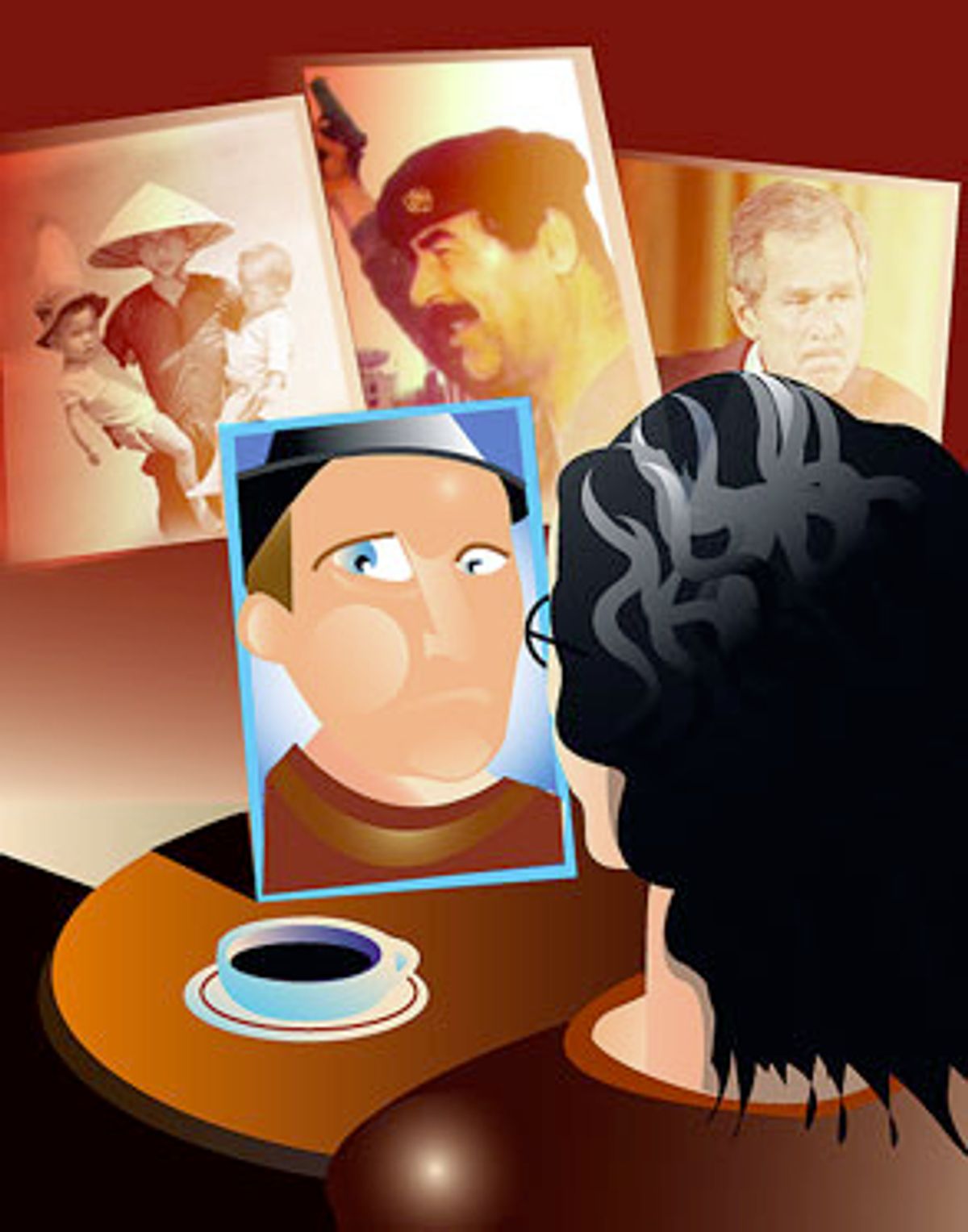
The reason I was driving a rented Chevy Blazer in a cold and gray November rain up Route 29 from my sister’s house in Lynchburg, Va., to Charlottesville to find a 19-year-old antiwar activist named Samuel Hayim Brody in the cafe of the Alderman Library at the University of Virginia was that, if you recall, readers of the “Since You Asked” column had responded by the hundreds to the question, posed some months back, “What is it like to be young today?” and they said that yes, being young today is as confusing and difficult as it always has been, but also, they said, By the way, if we may say so, we think your generation totally sucks.

They said that the boomer generation, the vaunted ’60s generation that Time magazine in January 1967 had voted Man of the Year, had sold out, had fallen down on the job, had promised and not delivered: We had promised to change the world and turned to the selfish pursuit of money, had preached love and then sown the land with bitter divorce, had pursued sexual pleasure at the expense of emotional commitment, had failed to protect the environment or to prevent war, had not saved for our old age and its inevitable medical expenses, and were fast becoming not only embarrassing but also irrelevant and, finally, invisible, like, as one letter writer put it, the homeless people they step over every day on the way to work.

Well. It would have been silly to think that the withering contempt we, the generation that didn’t trust anyone over 30, had visited upon our parents would not be visited upon us in turn. But the vehemence of the feelings was startling, and the parallels of our time and this, with war approaching, were clear. So journalistic impulses and human curiosity were both irresistibly piqued. Who are these young people who write so passionately, so articulately and in some cases with such poignant intimacy about their lives? I wanted to set off immediately to find them and see what sorts of people they were, to look in their refrigerators and sleep on their couches, to meet their pets and ride in their cars, to grope blindly, intuitively, toward some understanding, to bridge a gulf I had not even known was there.

But first I had to choose whom to visit, whose stories resonated deepest, whose voices hinted at lives that would bloom into emblems of their age. I read the letters over and over, picturing the lives behind them. I relied on instinct and on analysis; I wanted a cross section but I did not want to be doctrinaire. And I wanted to hear not just about love but about politics, religion, philosophy and family.

In the end, the way I picked Brody and the rest of the subjects whose stories will follow in the months to come involved logic, instinct and happenstance in about equal measure. Brody, intriguingly, mentioned in his letter that he had been protesting police brutality in New York at the age of 16. This struck a nerve for me; I was also out on the streets at that age. It sparked memories of an early passion for direct political action and recalled how others throughout history have had their imagination fired by news of far-off struggles they deem just and heroic.

I thought it might be inspiring to see how that ageless spirit was embodied today in a young man of 19. When I was running through the streets of Washington in the May Day action of 1971, trying to halt the workings of our own government because nothing else seemed to get our leaders’ attention, I was also about 19. What is it like for a young man today of progressive inclinations to contemplate his possible role in our nation’s likely war with Iraq? And what is it like to contemplate the possibility of a draft? Though America has an all-volunteer military, it still has a Selective Service System that requires almost all male U.S. citizens, 18 to 25, to register.

And, it must be said, while I wanted to listen and learn about this generation’s politics and passions, I also had some things to say to them, on behalf of me and my graying friends. I wanted to say that we did not simply pack up and leave our struggle for peace and justice like a buzzed-out crowd dragging their blankets across Max Yasgur’s farm. I wanted to say that specific things — complicated, difficult, demanding, painful things — had happened to each of us to turn us this way and that, that our heroes were shot, that our organizations were infiltrated and exploited and prosecuted, that we were beaten and gassed, that we had to find jobs and houses, that we had art to make and families to raise and you couldn’t do that from jail or from Canada or the streets, that each of us suffered confusion and doubt and OK, if some of us did give up on transforming the world, it was never with a cynical shrug as if to say Whatever, nevermind; it was always with a sad and chastened bewilderment that we turned away from the struggle to tend to our own wounded dreams, and we still lie awake trying to figure out what the hell happened. We are still trying to live lives worthy of our promise.

So I drove into Charlottesville that Sunday afternoon and walked across the University of Virginia campus through the rain to the Alderman Library and settled in at a long high counter below high windows through which poured a rich gray light. Students sat at small round cafe tables drinking coffee and studying, with laptops plugged in to the power and network connections along the wall. The cafe, nestled inside the high and formal house of books with its Doric pilasters and arched windows, felt a little incongruous, like a falafel stand inside a cathedral, but it was a welcome spot and one could only wish the coffee had been half as good in 1969.

Sam Brody, thin and sleepy-looking, his long black hair curling down his neck and over his ears, looking as though he still wasn’t resigned to shaving every day, wore a white crew-neck T-shirt, a floor-length coat and wire-rimmed glasses. He settled on the stool and put his book bag on the counter. His book bag was festooned with buttons, and his T-shirt was inscribed with lyrics and song titles from the band Primal Scream, written in his own hand with a Magic Marker.

Not only did the writing on his T-shirt recall an earlier generation’s style of personalizing its clothing, but the buttons on the book bag also looked familiar to fellow travelers of the ’60s who knew each other not only by the length of their hair and the brand of their cigarettes, but also by the buttons and bumper stickers they had picked up at rock festivals and demonstrations as consolation prizes for their bruises from the cops, sore hips from sleeping on the ground, and intestinal disorders from eating chili ladled out by the Diggers.

At first, Brody says, he had only the one button on his book bag, the button calling for peace in Israel and the Mideast. But then people started giving him buttons from other demonstrations, and he added them, including one supporting the struggles of the university workers. That’ll happen, the grizzled veteran of peace marches thought to himself. That’ll happen.

Two days earlier Brody had explained by telephone that he would probably be in his dorm on Sunday because he was acting as the media coordinator for the campus antiwar movement that was trying to rally opposition to an invasion of Iraq.

In the cafe, when asked to describe the movement, he says, “Well, it’s not really a movement yet,” at least not on campus. Though there is not much visible political activity at UVa, he says, he was trying to organize a rally for that Wednesday, the 20th of November.

“We didn’t want to call it a rally, and we didn’t want to call it a teach-in,” he says, “even though it’s sort of a combination of those things, because we think people are turned off by those words, and don’t want to feel like they’re participating in a rehash of something that happened 40 years ago. So,” he says, forming quote marks in the air, “we’re calling it a ‘gathering for peace.’”

Brody grew up in Manhattan’s Upper West Side, a “sort of a liberal suburb of the city,” as he calls it, populated by “liberal Jewish writers, people who eat bagels and talk about how they hate George Bush in the morning and then they come home and they send money to plant trees in Israel.” He attended the academically rigorous Hunter College High School in Manhattan. His dad has a Ph.D. in French. So does his mom. Imagine the arguments they must have had — before they separated when Brody was quite young. His father was the dean of the foreign language department at Queens College in the 1960s, and though he was sympathetic to the demonstrators’ opposition to the Vietnam War, he did not appreciate being trapped on the top floor of his office building by a sit-in. He and the custodial staff had to lower a bucket out the window for food. Perhaps Sam Brody learned an early lesson: Don’t alienate sympathizers with ill-advised tactics.

When I was in high school, we were pretty much on our own as far as our politics went. We didn’t have organized discussion groups on the Vietnam War. Brody, however, had a club in high school called the Progressive Forum that met every week at lunchtime. They had a teacher for an advisor, and every week somebody was assigned to research a topic. Imagine demonstrating against police brutality for extra credit in high school! Brody and many other high school students took to the streets of Manhattan to protest the February 1999 police shooting of Amadou Diallo. Later that year he read reports on the Internet about the Seattle protests against the World Trade Organization.

“It was just great,” he says. “It was awesome. I thought it was amazing that they had gotten this number of people out for this issue that most people don’t even know about.” While trade policies and debt restructuring lacked a certain visceral, media-friendly immediacy, Brody says, the Seattle demonstrations forced the mainstream media to at least pay attention.

After the initial euphoria came some tactical lessons.

“The Revolutionary Communist Party is so annoying,” says Brody, who attended a lot of conferences and panels organized by the International Action Center. “They were really well organized,” he says, “and they sent out fliers to people’s houses, and they had Ramsey Clark come and talk and stuff, and we thought that was pretty cool.

“But eventually we figured out that the International Action Center would be against the war in Yugoslavia and not admit that Slobodan Milosevic was bad, and they would be against going to war with Iraq but not admit that Saddam Hussein was bad, and that’s because they have this ridiculous idea that anyone who is an enemy of the United States is some kind of anti-imperialist hero, which is completely moronic. So we stopped caring about what those people had to say. But they still show up at all the protests, and they’re good organizers.”

Political action is, undeniably, of eternal interest, but so is sex, and it didn’t look as if Sam Brody was going to spontaneously begin confessing his deepest erotic exploits. So I say, “Tell me about dating on campus.” It seemed that he blushed slightly.

“I don’t really date that much,” he says. “My friends in school, in middle school, we were pretty much the kids who hung around the cafeteria and played magic cards. That’s this trading-card game that obsesses kids of around 12 to 15 years old. You buy packs of cards and play a game with them, certain cards are rare, a very sort of Dungeons and Dragons-y sort of thing. So people who do that don’t have a lot of interaction with the opposite sex.”

Besides, “I’m not so driven by the need to hook up with people that I’ll just take whatever opportunity,” he says. “I don’t care if people hook up, I’m not like a prude or puritan. I don’t care about that. But there’s a huge problem with sexual assault and date rape and stuff like that. So the culture is supposedly sexually free, but I think it’s really just still permeated with power dynamics and it’s not healthy.

“The Campus Crusade for Christ puts up signs like ‘Does the hook-up scene make you feel empty? Come find out what Jesus says about this.’ And then there’s the sort of feminist response: ‘Women: Don’t let people blame you for wearing short skirts. If a guy date-rapes you, don’t let yourself get blamed for it and speak up.’ And that’s very important to do. But it is obviously some problem with the whole culture that people can’t quite put their finger on.”

I start to say at this point that, unlike the bright and shining logic of political rhetoric, sex will never make any sense. But I get so tired of what experience has taught me, wish I could forget what I know, don’t want to sound like a windbag. So I try to shut up and listen.

But what was I to make of his refusal to vote? I thought such a bright, politically committed student, raised by liberal intellectuals, would put a certain amount of faith in voting as at least the ritual linchpin of modern democracy. But Brody did not vote in the New York state election, nor does he think voting is all that important.

“They teach you in school that voting is the highest exercise of your democratic rights, but I really don’t think it is at all,” he says. “It wasn’t like a bunch of brave politicians came to Washington and said, ‘The war is bad!’” during the 1960s, he says, rolling his eyes and waving his hands in mock surprise. “It’s the other way around. And it’s always going to be the other way around.”

On the drive up to Charlottesville I had been thinking about why the mass movement of the 1960s seemed to crumble after the Vietnam War ended. There are a myriad of reasons, many of them personal and as idiosyncratic as the personalities who populated the movement. But one of the reasons we failed to utterly transform the world, one of the reasons there seems to be such a sharp divide between the promise and the delivery, I had been thinking, as I tried to find a good Virginia radio station but settled for modern country, was that we had no enduring institution to carry on our fight.

Not that we believed in enduring institutions or would have necessarily supported one fervently, distrustful as we were, fractious and drug addled and independent and questing as we were … but still … we believed in the transcendent power of individuals, the charisma of rock ‘n’ roll and fiery oratory, the sexy anarchy of people like Abbie Hoffman and Jerry Rubin that paradoxically compelled a following even though they declared themselves not leaders. So I could not help thinking that if certain people had lived and stayed true to their vision, who knows, with their moral power, their oration, perhaps there could have been a party acceptable to hippies and radicals and young moderates as well, to young and old blacks, to immigrants full of hope and promise and jaded WASPs rooted in Jeffersonian ideals, Judeo-Christian principles, acceptable to Muslims and Buddhists and Hindus, appealing to us all but rooted firmly in the secular ideals of the Enlightenment.

So I say to Samuel Brody, “What if Martin Luther King had lived?”

What if Martin Luther King had lived and we could have all gathered at his feet and said, OK, Martin, what next? Where do we march? Where is the head of the line and where is the end, and how many blankets and how much food do we pack? If in spite of all our bruises and our trauma from the nightsticks and the tear gas he had said, Look, you have to lay down your body in the road again one more time because I have a dream but I also have a nightmare and it is a right-wing dynasty whose scions will dismantle what you have been working for and bring back what you have been fleeing, will discredit your efforts to bring economic justice, will marshal scientists to deny global warming, will marshal economists to justify globalization because they know that you, the best-educated generation in our nation’s history, are soft and middle class and because of your respect for learning you are credulous in the face of even mediocre scholarship and you lack that working-class certainty and class consciousness that made the labor movement so powerful, that this right-wing dynasty, which even now is being blueprinted, will be screwing you for the next 30 years if you splinter into factions.

“Yeah, what if he had lived?” Brody muses. “I tend to think that if he had lived, he would have become marginalized eventually, or treated like one of these grand old leaders, whom we respect but ignore what they actually say. Like Nelson Mandela, who’s sort of universally revered, but when he criticizes the United States or something, we don’t really listen to him.”

But, I say to him, somewhat wistfully and somewhat defensively, it was the lack of leaders, the toll that bullets took on our movement, that killed it.

“I think that needing leaders is something that people should challenge,” he says. “The global justice movement — which is a better name, I think, than the anti-globalization movement, because it’s really much broader than that — they really try to have leaderless actions. They have sort of unwritten rules for meetings, like if you’re a person that tends not to talk so much, talk more. And if you’re a person who tends to talk a lot, restrain yourself.

“And that’s another one of the reasons those kids wear those bandannas over their faces. I mean, partially they don’t want to be recognized. But it’s partially because anonymity is sort of part of the idea. We don’t want any revolutionary leaders.”

A decentralized movement independent of any particular leader, Brody believes, might have saved the peace movement in Israel after Prime Minister Yitzhak Rabin’s assassination in November 1995.

“If the peace movement in Israel hadn’t made such a cult figure of Rabin,” he says, “then when he died, it wouldn’t have been like they killed the peace movement.” Instead, says Brody, Israeli peace activists should have said, “‘We’ve lost our figure in power, and now we will soldier on and continue what he was doing.’” Investing so much moral and political power in one man, says Brody, “that’s dangerous.” The movement should never have allowed Rabin to become such a central figure, he says, “because all it takes then is a bullet.”

Talk of assassination takes me back to the 1960s and my brother’s fight with the draft board. I asked Brody if he had registered for the draft.

“Well, I had to register for the Selective Service or they’ll put you in jail,” he says. “But, I mean, I forgot. They sent me the original thing to register for the Selective Service when I turned 18, and I sort of forgot about it and went away and did whatever I did over the summer, and when I came to college six months later my mom called and said, ‘They sent you another thing that said if you don’t send in your registration in the next two weeks you’ll have to go to court.’ So I sent in the thing. Now I have my Selective Service number.”

I tell Brody that, having seen what my brother went through, I decided not to register back in 1971, and when the lottery numbers for my age cohort were drawn, on Feb. 2, 1972, my birthday, 9/11/53, came up with lucky No. 334. Even if the government had continued calling men up after 1972, it is not likely I would have been called.

My brother David was about Brody’s age when he got the draft notice in the mail that summer of 1969. There was never any question but that my brother would refuse.

Brody seems to feel the same way. “If there was a draft, I’d probably have to go to jail,” he says.

The night before my interview with Brody, at my sister’s house in Lynchburg, sitting around her living room in that old house downtown in the Historic District with my younger brother too, the four of us together for the first time in years, reminiscing about the war, I had asked David if he had ever been afraid of having to leave the country, or of going to jail.

“The way I thought about it,” David said, wrinkling his brow in the way he’s always done ever since I can remember, “was that with the Army or the country asking me to go to Vietnam or something, I would have had the same response if some Klanner had said, ‘David, come on out, we’re going to kill “niggers.”‘ I would have said the same thing. I’m not killing ‘niggers,’ I’m not killing Vietnamese, I have no part in this. It was the same feeling.

“I could not do it. I’m not with your program. There isn’t a choice. I really was totally naive about prison, prison life, what the possibilities were of going … I didn’t stick peanut butter up my butt to try to get out of it. I just said, No, I’m not going.”

When he had first refused induction, “this kindly sergeant pulled me over and took me to a room and discussed how I could rebuild the villages that my brethren soldiers were destroying,” he said. “I don’t care if I can rebuild a village,” he said; “I can’t be a part of this.” After he refused induction at the Coral Gables induction center, he said, “They took us away in a Galaxy 500. They took us before a federal judge.”

Our father was there, he recalled. The judge, David said, asked our father if his son the draft resister was any trouble. “And he said ‘No, no trouble.’ And so they took me from there to the FBI office and released me on my own recognizance.” He hired a lawyer for $250, a price that was considered low even for that time.

Our father had fought World War II, commanding a landing craft tank in the Pacific and had remained in the Naval Reserve. One evening shortly after David had refused induction, there was a knock at the door of our house on Rainbow Drive. My father answered the door. Standing before him was his commanding officer in the Naval Reserve. “The guy didn’t say anything, just turned his back and walked away,” David said. Presumably, he just wanted to see if it was really true, that this World War II veteran officer’s son was a draft resister.

He accepted David’s decision and never questioned his courage.

After the interview, Brody and I walked about the Lawn, where the antiwar protest would be held on Wednesday. Along the walkway were identical signs whose wording seemed to embody all the lessons his generation has learned about not alienating the masses. It could have said “Off the pigs” or “Shut down the campus,” or even simply “No war with Iraq,” but it didn’t. Instead it said, with a postmodern wink to the genius of advertising and the Orwellian arts of doublespeak: “Dissent Is Patriotic.”

Brody chuckled about the marketing implications. “That’s the first wave of fliers,” he says, likening it to the Heineken ad campaign that started off with just a star as a teaser, and only later connected the star with the beer. “And then later they come out with the ad and you go, ‘Oh, Heinekens!’” says Brody. “No,” he adds with a shrug, “I didn’t get why that was supposed to work.”

The rain was coming down hard now on Thomas Jefferson’s university, flooding the walks and drenching Brody and me as we walked from the Lawn to the parking garage. It was time to drive to Washington to interview three young women whose stories would make the political very personal indeed.

I was driving north again in the rented Blazer on Route 29, through the land where my ancestors sculled about the Chesapeake, blasting through the storm, sharing the rain-slick highway with truckers and senators, radicals and professors, pundits and bureaucrats, all driving for the Potomac. It would be the first time I had driven into Washington in more than 30 years, since May 1971 when, sleepless and cramped after driving 18 hours with 11 people in a Volkswagen van, we arrived in the nation’s capital intending to shut it down and found the streets lined with soldiers and the air filled with tear gas.

Cary Tennis

Cary Tennis writes Salon's advice column, leads writing workshops and creative getaways, publishes books, plays guitar, performs in art galleries, writes an occasional newsletter and tweets as @carytennis.

Join Cary's Online Writing Workshops

Should I nail the sexy prof?

I've got a mad crush on a lecturer. Should I proposition him, and if so, how?

(Credit: Zach Trenholm/Salon)

Dear Cary,

There is a lecturer in my faculty whom I find devastatingly attractive. I find him so attractive that I have to actively control myself in his presence. I think about him nonstop. I am a graduate student and he is a lecturer. He is probably about double my age, and I am 22. I took one of his classes a few semesters back but won’t be in any of his classes in the future.

I am sure I have made my attraction as painfully obvious as possible. Should I try to proposition him? What do you think of this sort of age gap? And how do I handle the possible (probable) rejection? I am aware of the imbalances of power, experience and maturity, as well as the conflicts of interest and possible repercussions that may ensue.

Unsure

Dear Unsure,

You may have thought and read about conflicts of interest and imbalances of power but are you ready to find, in the agonizing grip of an affair, a visceral unhappiness unlike anything you have ever known? Can you handle wanting to scream or grab a crowbar while also wanting to weep and beg forgiveness?

Are you ready to find yourself, as if living in a pre-feminist era, driven to a gradual, crippling compromise by your desire for some man who for all his fine words still seems to secretly enjoy unassailable privilege? Are you ready to be emptying ashtrays and making tea and realize, holy shit! You secretly expected his prestige and power to rub off on you but nothing has really changed! Are you ready to realize you allowed yourself to indulge in some 19th-century claptrap and did it with your eyes open and your finger on the page in this book right here where it says women are powerful and things have changed and you control your own destiny, which is sort of true in lots of ways except for the ones that really matter?

Except where actual privilege lives its actual life?

Actual privilege is nice and attractive. It just doesn’t have much of a heart.

I’m not saying be a good girl and never act on your impulses. And I’m not setting it up for I Told You So And Now Don’t Come Crying to Me or some such. I’m saying, do some research on him. Does he have a girlfriend? Is he married? Does he spend time with lots of students, or mainly with his peers? Watch him. Study him.

You are vulnerable here. Maybe you are capable of handling this. But maybe not. It wouldn’t be the first time someone thought she knew what she was doing.

So do some courageous self-assessment. Share your dilemma with your women friends. Don’t just walk in there with your eyes shut and open up for him. Power and privilege still break women’s hearts and psychotherapy is expensive especially if you didn’t get that tenure-track job even though he promised to go to bat for you in the committee and now that you think about it, weirdly enough, he didn’t really support you as energetically as you thought he would.

I mean, Are you ready to want what you didn’t think you wanted, and want it more strongly than you thought you could want anything, and then find out that no matter how much you want it you’re never going to get it because somebody else already took it and she wears weird eye shadow?

That is what happens when your lust is only a thin covering over a deeper, global longing that you don’t even know you have until after it’s driven you crazy.

Are you ready to realize that you’re the one who said all these empowered, knowing, independent-sounding words and now all you want is for this man to just stay right here and not go teach his next class while you embody your desire in the form of another cup of green tea and an omelet, which he consumes but does not appear to taste, and when you ask him a question about his work he waves it away as if it were not phrased properly and when you see him with other students, you notice a pretty young woman student who has this adoring look on her face that seems eerily familiar …

And if it comes to that will you be able to accept that he has another young student who finds him as irresistible as you do and he may be seeing her tonight, and he may lie to you about it or not tell you anything, or disappear for weeks at a time with no notice, or break a date with you without warning or explanation, or suddenly seem distant and petty and not at all interested in you and what you have to say, or become critical of you and your life choices or not want to meet your friends and family or find fault with your apartment, which is too small, or the color of your toenails, which is too bright, all of which makes you scream at him but you don’t because you don’t want him to see your juvenile, screamer-bitch side, which you only so recently thought you’d completely left behind.

Because you are a graduate student at a distinguished university and it wouldn’t be right …  after he fails to show up yet again and you are left sitting at the bar wondering why you didn’t heed the warning signs.

You could have read about this in a book. You don’t have to actually fall off a cliff to know why it’s good to stand back from the edge.

Maybe you are very tough and self-reliant and just want an adventure. I don’t know you. But if you are so tough and self-reliant, why are you sharing this with me?

I think you know there is something dangerous about this and what you really need is for someone to say, Slow down. Examine your motives. Examine your hungers. What are you really looking for?

Continue Reading Close
Cary Tennis

Cary Tennis writes Salon's advice column, leads writing workshops and creative getaways, publishes books, plays guitar, performs in art galleries, writes an occasional newsletter and tweets as @carytennis.

Join Cary's Online Writing Workshops

Baby sitter’s got a rap sheet

I thought my daughter was safe until I checked with the police

(Credit: Zach Trenholm/Salon)

Dear Cary,

This problem has been eating away at my brain and heart for a while. I cannot decide what to do. I know your answer will help me, even if you also don’t see a clear answer.

One of my children was recently diagnosed with a rare disease. That is not the problem, but helps to explain how I developed a close, trusting friendship with the mother of a child with the same disease. She has helped us so much and has given good medical advice and emotional support. She also works as a baby sitter. For us, the arrangement was perfect: this kind, well-informed person needs money and we need her special medical skills. For months, my husband and I considered her the only possible baby sitter.

Recently, we were tipped off through the school PTO grapevine that she has a criminal record and is an addict, and that stories about her have appeared in the town paper, and also that she has been banned from volunteering in the school because of this.

I didn’t believe it, but asked a librarian if there was a way to find out. The librarian gave me a link to a criminal records database for our state. All I had to do was type in her name. A long list of arrests came up for both the baby sitter and her spouse. Most were driving without a license or marijuana possession. Two were for domestic violence. I called our police station to ask if I could find out more about someone’s arrest on a domestic violence charge. I explained I wanted to know if a rumor about our baby sitter is true. The police gave me a copy of one of the domestic violence case documents. The date was just over a year ago.

It’s pretty bad: She and her husband were beating each other up in front of their kids, blood was spattering all over the kids’ toys, they were swearing at each other. The mug shot was awful. I guess mug shots usually are, but she doesn’t look at all like the person I know. I mean, it’s definitely her, but she has a weird look in her eyes.

This is as far as I got with what to do: I am not comfortable having her as a baby sitter. Whether that’s right or wrong, I am OK with my decision. I know some people might focus on her kindness and think she has moved on from her troubles, especially since there’s no record of arrests within the year.

I got halfway to this: I am ethically required to tell the people I recommended her as a baby sitter to about this. (I’ve told some of them, but only the ones I trust to not gossip.) Do I need to tell everyone?

I am completely stuck on this: Should I tell her what I know? Would she want to know? Or would it just be rude and unnecessarily confrontational of me to bring it up? She still thinks we are friends. And I guess we are. But I have stopped asking her to baby-sit (obviously) and also have stopped asking her for medical advice. I never reach out to her anymore. She is a nice person. She is kind and smart. Her arrests are from over a year ago. Should I, as her friend, let her know that the PTO grapevine is sharing her criminal record info with the rest of the town?

Thank you for reading and considering my question. I value your advice!

Need a New Sitter

Dear Need a New Sitter,

When you ask your daughter where she picked up that new vocabulary and she says, “It’s prison lingo, Mom,” it makes you feel kinda funny inside.

So I completely understand your decision to stop using this baby sitter.

There’s just something about the person who’s making sandwiches in the kitchen while your kids are watching TV that doesn’t go with “mug shot.”

Generally, when I find out somebody has an arrest record, I give them the benefit of the doubt.

But parents are funny. They’re really touchy about who tucks their kids in at night. While they’re out having dinner, they like to imagine some clean-scrubbed honors student doing her homework on the couch while the kids are watching TV or tucked into nice, clean, warm beds.

So yeah, sad as it is, I think you gotta be the snitch. You got to drop a dime on this character.

You gotta tell. Seriously. You may be depriving this person of work, but hey.

The Buddhists say we ought to seek our right livelihood. Baby sitter isn’t the right livelihood for this person.

Nobody loves a snitch. But your reputation would suffer more if it came to light that you knew about this and didn’t tell anyone. It’s like you’re endangering their kids. So tell.

Domestic violence is a definite no-no for baby sitters. Sure, she’s innocent until proven guilty. But a baby sitter can’t afford to even get arrested for such a thing. It’s a well-understood professional liability and a common-sense deal-breaker. She should find a new line of work that’s not “domestic” anything.

Continue Reading Close
Cary Tennis

Cary Tennis writes Salon's advice column, leads writing workshops and creative getaways, publishes books, plays guitar, performs in art galleries, writes an occasional newsletter and tweets as @carytennis.

Join Cary's Online Writing Workshops

I’m addicted to sexting

My wife has left me. I'm going into rehab. Is my life over?

(Credit: Zach Trenholm/Salon)

Dear Cary,

This is a hard letter to write but I will try anyway. I am now married for a little more than a year to the kindest, gentlest, most understanding wife any man can ever dream of. She is an angel in every sense of the word and this is not influenced by any guilt that I am feeling.

She is a foreigner from another country and we both met studying Mandarin in China and subsequently fell in love. Three years of long-distance relationship later, I proposed to her and we decided to get married on the basis that we both felt our relationship was special and our expectations in life were very much in sync. A few months after proposing, she found out that I have been sexting an online stranger, the contents of which were very explicit. She was very angry, disappointed and sad, but I managed to convince her to carry on with the wedding, with the promise that I will not do it again and that I will be seeking professional help via a psychologist.

Fast forward to a year later, several weeks before our wedding, and she discovered my sextings with strangers are still going on despite my promises and was close to calling off the wedding. However, due to Asian societal values (the losing of face), as well as days of coaxing, I managed to once again convince her that I can and am willing to change and to carry on with the wedding. And here we are today, six months after the wedding and she has yet again discovered another of my attempts to contact an online stranger and I am afraid that this is the straw that will break the camel’s back.

I know my actions have caused so much hurt and pain. I know I am an evil person for all the lies and deceit, and there have been many. I know that I do not deserve her at all. Yet, at the same time, I know I am not happy doing this, I do not seek out strangers in order to find a new partner, and that I love her very much and will never, ever leave her. Speaking to the psychologist, we have identified that I have issues stemming from my childhood and family that trigger my actions and I act on these triggers in order to quell these issues. In addition to that, I have anger and attitude issues stemming from childhood and family that have also affected our relationship significantly. I know this does not discount my actions and it is not an excuse. The second time she found out about my actions, the psychologist recommended me to enroll in a sex addiction rehab clinic but I felt the costs were too high and sort of talked my way out of it. She accepted it and life went on. Looking back, I know I didn’t take it too seriously, thinking that these actions were really controllable. Maybe they were.

Today, she has moved out to a hotel, all alone in a foreign country with no one to really console her as she is too embarrassed to confide these things to her family members. She has lost all trust in me and I have ruined her life and possibly scarred her fragile heart permanently. She is adamant to continue on her life alone now by studying for her masters in the U.S. and getting on with life after that without me. She does not believe I can change, both in my sexual addiction, and more importantly she does not believe I can conquer my anger and attitude problem. I myself do not know if I can change but I truly want to change and I will try my best to do so. I believe I should’ve gone for more intensive counseling and to the sex addiction rehab clinic the moment the psychologist recommended it. I also know that I feel like this each time I get caught and once everything smoothens out and she comes back to me, I get overconfident and fall back into the vicious cycle.

I love her very much but she has said that it is now too late and that I will never change and she wants to leave, but at the same time she misses me and she loves me too. I am now so very confused in regards to what I should do. Do I set her free and end her torture, or do I fight for her love and do everything I possibly can and treat all issues I have with clinical and psychological help, which I should’ve done from Day 1, and start rebuilding a better future for the both of us?

I really hope I can receive your timely advice.

p.s. I have already decided to enroll in the sex rehab clinic and anger management courses regardless of her decision.

Sext Addict

Dear Sext Addict,

You are doing the right thing by signing up for the rehab regardless of what your wife does.

She may come back or she may not. In recovery, it’s important to put your recovery first. Actually, putting your recovery first can be a revolutionary step. It can shift how you see life.

You are not an evil person. You are a person with a problem. There are many ways to describe the problem — as a disease, as a compulsion, as a maladjustment — but the important thing is that it is a behavior that can change; it does not have to rule your life and your life does not have to fall apart and you do not have to go through every day worrying when it will come back.

When you are addicted to something, you will keep doing it in spite of the consequences and this will make you feel like a terrible person. Until you face your addiction and make a fundamental change, the cycle continues. When you face your addiction for yourself, things start to change. You have noticed this already. You have begun to learn.

Your wife may come back. Or she may not. You probably hope that she comes back but you can prepare for life either way. The main thing is, you can get your life back. It may not be the life you thought it would be but it is a good life.

So throw yourself into the process of recovery! When your rehab ends, join an ongoing sex addiction recovery group. Continuing recovery after rehab is like eating well, working out and keeping the house clean. You don’t just eat once. You eat every day. You don’t just clean the house once. You clean it regularly. Recovery from an addiction is like that: It’s a regular thing.

Is there a good free group available to you? Ask your advisor in the rehab. As you can see from this website, the group Sex and Love Addicts Anonymous does have meetings all over the world, as well as online and telephone meetings.

So that’s my advice: Do the rehab, connect with others like yourself and stay close to the program. If your wife comes back, do not assume everything is fixed. Continue to put your recovery first, no matter what. You have a new life ahead of you.

Continue Reading Close
Cary Tennis

Cary Tennis writes Salon's advice column, leads writing workshops and creative getaways, publishes books, plays guitar, performs in art galleries, writes an occasional newsletter and tweets as @carytennis.

Join Cary's Online Writing Workshops

I’m too smart for this job

What happened to all my "great potential"? Where is my fabulous career?

(Credit: Zach Trenholm/Salon)

Dear Cary,

Though my “problem” (which may not be seen as a problem for some) has been on my mind for a long time, I was triggered to write after seeing the “I get paid to do nothing” letter from a professional who was in a decent position, making decent money, but really not doing much. I feel very similarly, and wonder if there is more to it than your recommendation to “give money away and enjoy the low-stress.”

For years, I was told how smart I was, over and over again. Not genius-level, mind you, but “very bright” and “advanced.” Parents, teachers, other students all echoed the same thing. School was easy up to a certain point, and early on I had the chance to skip a grade (I didn’t do it for fear I wouldn’t fit in with the grade above me, and my parents agreed emotional maturity might be an issue). Then … I don’t know what happened. Maybe it was laziness, under-confidence, or an extreme penchant for procrastination, or maybe everyone else just caught up. I was never a straight-A student but did fine, and went to a decent college. After graduation, big dreams gave way to crummy jobs, one after the other.

So, now it’s many years later, and I still have not “figured it out.” After several jobs, mostly in the same field, my career, frankly, sucks. Many of the people around me have become wealthy, most of my friends have now been in their chosen professions for a handful of years (I still struggle with making it over the two-year mark) and are seeing success, and plenty of my peers and contacts are at least “locally famous.” So what the hell is my problem? Am I dumb?

I have always wanted success and money, but never figured out how to get it. I work, yet I hate (loathe, despise, all of the applicable synonyms) it. Not just the job, but work. I feel unsatisfied, a bit hopeless about achieving the material trappings I would like to have, and have a bit of green-eyed envy when I see how well so many (not-so-smart) people have done. I’ve spent my life afraid of repeating my parents’ existence — two very smart people who have struggled, hated their own jobs, and never had the proverbial pot to p*ss in. I hated growing up that way, but now feel doomed to repeat it!

I realize this letter sounds a bit like a tale of keeping up with the Joneses. It’s not the real problem. What I wonder is, am I dumber than everyone else? How do people reconcile expectations and reality? And, when you feel this uninspired and hopeless in your work life, what do you do? Is there a happy ending or have I gotten stupid?

Thanks, Cary. I welcome any thoughts you may have … I only hope I’m not too brain dead to understand them.

Where Did My Potential Go?

Dear Where Did My Potential Go,

There is a fundamental question at the heart of this, and it has to do with how you conceive of yourself and what might make you happy. So I’m going to suggest — and this is only experimental — that you begin thinking about all the things you like, that make you happy right now. What do you enjoy today? Where would you be right now if you were happy, and what would you be doing? If a fantasy arises, go with it. Ask yourself what you want right now. Allow yourself to experience, in your mind, whatever it is that you want. Where do you see yourself? Are you alone in a room? Are you with someone else? Are you on a stage, in a car? Is there a crowd there, cheering you on? What country are you in? Is it daytime or nighttime? What are you wearing?

Think of times in the past when you have been happy. What were you doing? What was the source of your happiness? If one of your happiest times was when you were with a boyfriend at the beach, and you knew that he loved you, and it was a particular beach, and you had eaten a particular meal or seen a particular movie or had just done something particularly pleasurable, relive it. Identify all the parts of it that you enjoyed. Carry it around with you in your heart for a few days. Just let it percolate. Let it suffuse your body, all these memories of happiness and pleasure. Let them live in your body. Look for correspondences as you go through your day. If you were wearing a certain dress of a certain fabric on that day, see if you notice any dresses like that in the windows or on the streets or on the bodies of your co-workers. Do you still have those clothes? Do you like them? Have you worn them in a long time? Take them out and try them on.

As I say, this is an experiment. The object of it is to push you toward a conception of yourself not as someone who must function at a certain level to attain a certain level of satisfaction, but as a distinct individual with likes and dislikes the attainment of which will satisfy you.

You may think you want a fast car and a high salary. Maybe you do. But what I am asking is, What has actually made you happy in the past? Were you skiing? Were you drinking? Were you lying in the sun? Were you competing? Were you singing? Were you making love? What has made you happy?

You have a vast emotional memory. You have many desires. The fulfillment of desires is one way to approach happiness.

Of course, the Buddhists will tell us that desire is infinite and eventually our attempts to fulfill all our desires just result in endless quest to fulfill endless desires.

But fulfilling your desires is a start.

Have some ice cream.

Also, as to the job thing, a couple of thoughts. Think back to what you studied in school and ask yourself what parts of that you enjoyed. It’s possible that you studied something in school that you enjoyed, but now you are only doing that in an approximate way. For instance, liberal arts majors often end up in sort-of-approximate jobs. Like if you studied art maybe what you enjoyed was actually making art but you end up in some cubicle talking about art but that’s not what made you happy. What made you happy was being in the studio.

Things like that happen. Maybe you liked being at the beach so you end up in a cubicle talking to people about the beach but that doesn’t make you happy because it’s not talking to people that makes you happy, it’s being at the beach.

So that’s my suggestion to you: Forget all this success crap. Go directly to what makes you happy. Let the job eventually follow.

As to how your parents can be really smart but not good with money, and all the pain and frustration that can cause, I like the book “Rich Dad, Poor Dad.” It talks about that. Very smart people sometimes don’t understand money. My parents were like that, too. Having a practical understanding of money and its place in your life is important, so I like books like that and like “Your Money or Your Life,” too. Because it’s not about the money per se, or how much of it you are paid or can accumulate. It’s about your relationship to money.

Continue Reading Close
Cary Tennis

Cary Tennis writes Salon's advice column, leads writing workshops and creative getaways, publishes books, plays guitar, performs in art galleries, writes an occasional newsletter and tweets as @carytennis.

Join Cary's Online Writing Workshops

How do I tell her I like her?

We're friends in high school but I want more

(Credit: Zach Trenholm/Salon)

Dear Salon,

I’m a 17-year-old guy and I’m a junior in high school, and I’ve had this friend, this girl, that I’ve known since our freshman year. I’ve liked her since freshman year and I’ve just now this year become really great friends with her. My best friend moved to Missouri last year and he just moved back. Him and this girl that I’ve liked forever started going out (they have only known each other for four or five months). This made me wonder what I’ve done wrong for the past three years of my life with her, but that’s not the end of the story. They went out for three weeks and then she broke up with him because he was “too clingy” and she “sucked at relationships,” or at least that’s what she told me. She trusts me with EVERYTHING. She goes to me with things, tells me I’m funny, hangs out with me, and constantly drives me crazy for her. Right now I feel confident enough to do something about the way I feel, but since her and my best friend went out doesn’t that make her “off limits” according to the man law or guy code?

I REALLY like this girl, and I don’t want my feelings to ruin my relationship with HER by making it awkward between us if she knows. And I really don’t want my feelings to ruin my relationship with my best friend if he’s not OK with me liking this girl (that is, when I tell him, if she likes me?). I really can’t tell anybody about this because everyone I know isn’t trustworthy besides her and my best friend, but they can’t know because it involves them. I feel like I’m going crazy. So I guess my real question to you is do I tell her about my feelings and risk ruining my relationship with her? Or do I keep it to myself and forever regret it?

Sincerely,

High School Guy

Dear High School Guy,

I think the right thing to do is to tell her. But tell her in a way that doesn’t ruin the relationship. In fact, you can tell her in a way that makes it possible for the relationship to grow stronger, no matter what happens.

The friendship doesn’t have to end. Whatever she says, you and she can go through this episode in your friendship together.

Before you say anything to her, you will want to think it through. You might want to write some things down and say them out loud beforehand, to see how it feels to say these things. You might even read out loud what you want to say to her. You decide. Decide how you want to tell her. Then find a good time and place where you and she can be alone for a while.

Then say something like this:

I have something I want to tell you, but before I do, I want you to know that I value our friendship a great deal, and no matter what happens, I want our friendship to continue. OK?

Don’t blurt it out. Make sure she understands that you really mean it, that her friendship means a lot to you and that you are serious and don’t want to screw this up. Be straight with her:

I know that you value me as a friend. I value you for a friend. But my feelings for you have grown into more than just friendship. I have feelings for you like for a girlfriend.

Pause to see what she says. If she says nothing, you might ask her: Are you surprised? Did you have an idea I might feel this way?

She might say that she’s had some clues, or has thought it might be going on. She might be relieved to be able to talk about it. Or she might not know what to say.

Since you already know that she doesn’t like “clingy” guys, reassure her that you are not “clingy.” But tell her that you really do have  feelings for her, and ask her what her feelings are for you. Ask her directly. Ask her to be honest.

Then just listen.

If she doesn’t feel that way, she may want to spare your feelings by saying what a great guy you are, and she really likes you, etc. If the words coming out of her mouth sound kind and sweet but you feel let down, then she’s telling you she really doesn’t feel that way.

I don’t mean to insult your intelligence, but our wishes can sometimes distort what we hear. If you’re at all unclear, ask her to tell you point blank, yes or no, does she want to be your girlfriend. It’s important that you know where you stand.

She might say she isn’t sure, or can’t explain how she feels. If she says anything other than she wants to be your girlfriend, she probably doesn’t, and you should accept that she doesn’t feel that way toward you.

Now here is the other part of it. If she does not want to be your girlfriend, that’s OK. But you really do want a girlfriend. If it’s not going to be her, then it’s going to be someone else.

So sooner or later, you might want to ask her how she would feel if she saw you going out with someone. Ask her if she would still be your friend then. Ask her if she thinks if you had a girlfriend that your girlfriend might get jealous of your friendship.

Again, tell her that no matter what happens, she will still be your friend.

As to your guy friend, well, I’m not sure what the rules are. The important thing is to be honest and upfront with him. If she becomes your girlfriend, he will obviously know. He may not like it but one hopes you and he could still be friends. Being honest with him doesn’t mean telling him everything that might hurt his feelings. For instance, it doesn’t mean telling him she thought he was “clingy.” Know what I mean? Follow your best judgment on this.

I have high hopes for you, for her, and for your friend. Friendship is precious. You can work it out.

Continue Reading Close
Cary Tennis

Cary Tennis writes Salon's advice column, leads writing workshops and creative getaways, publishes books, plays guitar, performs in art galleries, writes an occasional newsletter and tweets as @carytennis.

Join Cary's Online Writing Workshops

Page 1 of 346 in Since You Asked

www.salon.com/topic/since_you_asked/