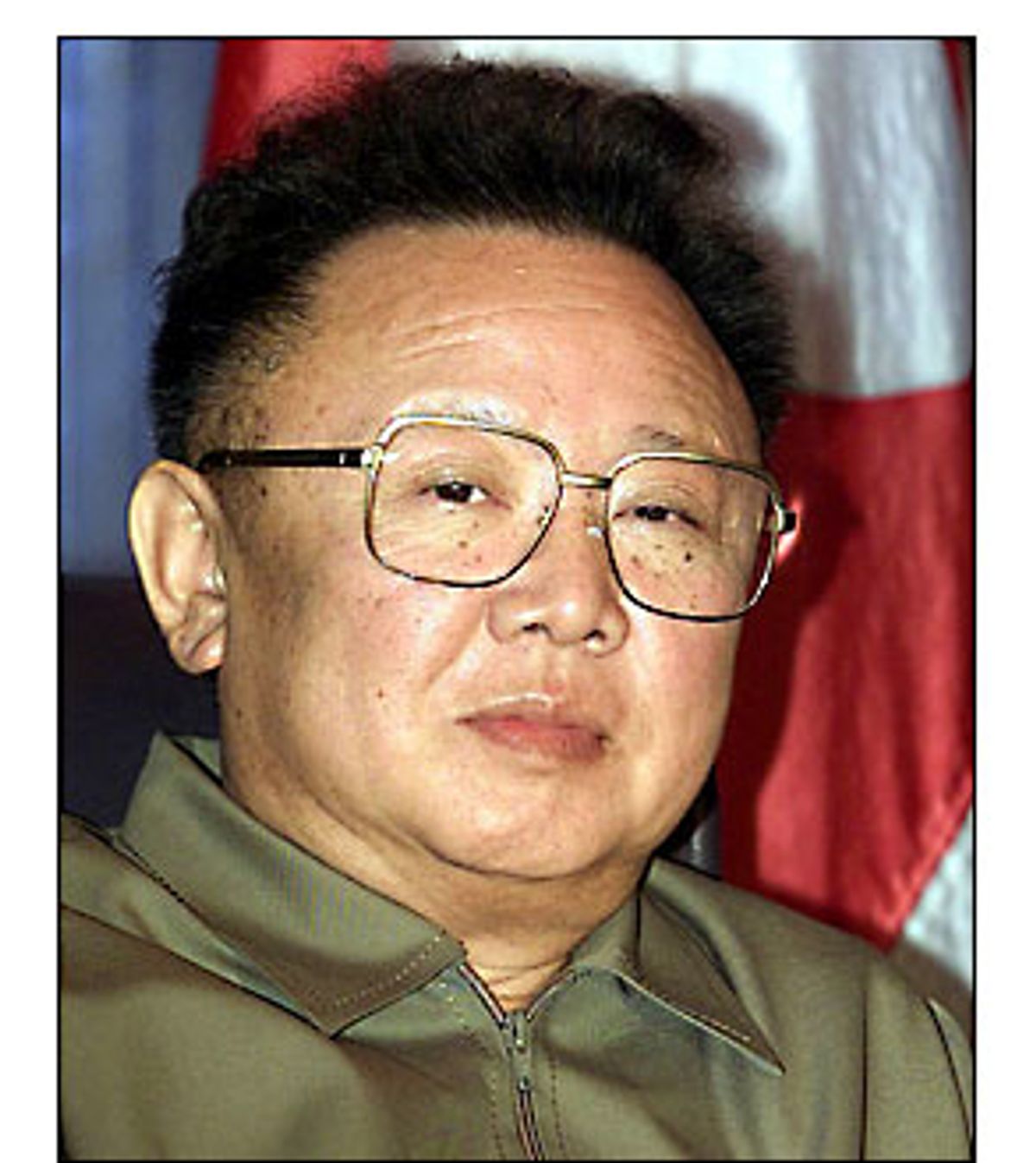
He likes fast cars and fast women, he's been implicated in murder and terrorism, and now he's got nuclear weapons. But dismissing the North Korean dictator as crazy plays into his hands.
Kim Jong Il likes Daffy Duck and fast cars, and before he became North Korea’s dictator he wanted to be a film producer. He was born on the peak of a sacred mountain, he says, and his birth was attended by thunder and lightning. In 1978 he had spies kidnap his favorite South Korean actress in order to improve North Korean cinema. His agents were implicated in the 1987 bombing of a Korean Air flight, killing 135 passengers, intended to scare away tourists from the 1988 Seoul Olympics. While his famine-starved people eat tree bark to ease their hunger, he dines on steak and cognac in the company of the “Pleasure Squad” — a variety pack of imported blondes and Asian beauties.
He’s also in charge of North Korea’s nuclear missile program. And when his minions revealed the nation had restarted its nuclear weapons program late last year, and expelled arms inspectors, the unexpected provocation had U.S. diplomats asking a vexing question: How do you negotiate with a madman?
Dr. Kongdan Oh, coauthor of “North Korea Through the Looking Glass,” insists the first step is to stop thinking of him as one. One of the West’s foremost experts on Korean politics and culture, Oh gets impatient with the media’s fixation on Kim Jong Il’s cult of personality, and says the U.S. is focusing on all the wrong things during the current showdown. Kim is contemptible, maybe even evil, but he’s not crazy, she says.
“He’s a very bright, very daring, very bold dictator who knows how to control his society and act strategically to shock,” she said in an interview with Salon. “In that sense he’s no different from a person like Stalin or Saddam Hussein, and in many ways he’s actually been more successful.”
North Korea, which has the world’s fourth largest army, has been dreaming of developing nuclear weapons since the 1950s, when Kim’s father, the country’s founder, Kim Il Sung, began trying to acquire the raw materials and know-how to develop an arsenal that might at least deter a U.S. first strike. Kim agreed to mothball the Yongbyon nuclear reactor as well as uranium enrichment facilities under the so-called Agreed Framework in 1994 negotiated by the Clinton administration. But he has signaled his intent to backtrack on the agreement at many points, and provoked the current impasse by restarting the Yongbyon reactor and working on uranium enrichment late last year.
On Thursday, the crisis U.S. officials won’t call a crisis took two new twists. North Korea announced it would withdraw from the nuclear non-proliferation treat, according to the official North Korean news agency, KCNA. But earlier the same day, President Bush gave North Korea’s United Nations envoy permission to meet with former U.N. Ambassador Bill Richardson, now governor of New Mexico, who had handled negotiations with Pyongang under President Clinton. Bush spokesman Ari Fleischer said the administration expected Richardson to hew to its official position “that we are ready to talk and that we will not negotiate.”
But the administration’s decision to let a former Clinton official play a role in the standoff was noteworthy, since Bush has frequently blamed his predecessor for appeasing North Korea. Upon taking office two years ago, Bush quickly reversed Clinton-era moves to normalize relations with North Korea, and last January he labeled the country part of an “axis of evil,” along with Iraq and Iran. Now though, facing a showdown with Saddam Hussein, the administration has been anxious to ease the new tensions, and Richardson’s involvement shows the length to which the White House may go in order to avoid a direct confrontation with Kim Jong Il.
But in the art of brinksmanship, the North Korean dictator is proving himself more talented than either Bush or Clinton, Oh says, although she credits Clinton with at least trying to engage with Kim and his oppressed, impoverished nation. As a policy analyst at the Rand Corp., Oh advised the Clinton administration before it signed the 1994 agreement, and she faults even the more engaged Clinton team for not fully understanding North Korean culture and society — and not understanding Kim.
Behind the playboy fagade, she argues, lies a savvy manager and a nuanced mind. Kim’s nuclear gambit may be designed to exact new economic aid from the West, or to get the Bush White House to return to the Clinton era path of normalizing relations. But according to Oh, until Americans understand his brand of North Korean realpolitik, Kim Jong Il has got the U.S. right where he wants it — confused and unable to act.
Is Kim Jong Il a madman?
I could not use a word like madman. He is a very bright, very daring, very bold dictator who knows how to control his society and act strategically to shock his people and the globe. In that sense he’s no different from a person like Stalin or Saddam Hussein, and in many ways he’s actually been more successful.
But you’re comparing him to dictators who have absolute control over their people.
Right. Dictators are brutal, power-hungry people with a control-freak mindset. Other than that, they are absolutely able managers of their own societies.
Is he a good manager?
If you don’t call him a good manager, then what is he? The economy has been devastated since the early 1990s and yet the country is still standing together. Something is holding them together. He uses fear and punishment to control the population and potential opposition, and somehow he’s preventing his population from standing against him. Definitely these are extraordinary skills and he’s been very successful.
But then, North Korea itself is not a normal nation-state. They’ve never experienced a contemporary open society. Up until 1910, North Korea was part of the last dynasty of the Korean peninsula. After that Korea was colonized, so they moved from a despotic dynasty to very brutal colonialism, where the rulers were Japanese, and Koreans were treated as secondary citizens. And then after that it’s communist rule. So if you look at the past century, North Koreans have never experienced a free society, so they have no comparison.
That’s precisely why Kim Jong Il can do his job so well. He can combine an olden-days Confucian style mindset, where the ruler is always respected and regarded to be almost a different species, with the traditional Korean mindset, which is very much a father-worshipping, leader-worshipping culture, and he’s manipulating that kind of mentality. Even in the worst economic situation he still has total control.
Do the North Korean people want Kim Jong Il as their leader?
That’s a tough question. The core class, about 25 percent of the population, is trusted and treated royally by Kim Jong Il and his top cadre. Then there’s the hostile class, also 25 percent, which is made up of potential opposition and people angry with the regime. In between them is a wavering class, 50 percent, and they can go either way.
There are people who say Kim is not that different from a cult leader. People will follow him no matter what.
He’s not a cult leader, but he knows how to manipulate like a cult leader.
Well, are you letting him off the hook a little? As a Westerner, I look at his leadership and say, there are people starving in his country, and yet he’s living it up, drinking cognac with his “pleasure squad” — but there’s no problem with this?
Yeah, but in the old days of the U.S. Congress, leaders were doing the same thing. They womanized and swindled too, so I don’t think it’s abnormal.
So you’re saying it’s not that different?
I don’t think so. European history creates a lot of madmen, but somehow because he’s supposedly a subdued, quiet Asian guy there’s a lot of attention focused on his personality and his style of leadership.
So it’s a question of Western perspective …
Yeah, Asians look exotic. And Kim Jong Il loves fast cars and high fashion, all these things, so I think the media hypes the image of him as a scandalous leader. By painting him that way, by making him look like just a crazy, irrational leader, the media creates even more misunderstanding among the American population. If you look at the U.K. royal family, they’re even more bizarre than Kim Jong Il. Journalists need to ask more serious questions, rather than focus on his personality and inclinations. The only [crazy] thing that he did was his state-sponsored terrorism — sending out agents [with] bombs so that the world would not show up for the South Korea Summer Olympics. That’s a little crazy.
But why would a poor country spend so much money on missiles?
North Korean missile development is not about blasting the world, but about military deterrence, because it’s a very weak, isolated, lonely country that nobody likes. And nuclear weapons are the poor man’s bomb. Conventional weapon development costs a lot of money, but if you’re a nuclear power you’re suddenly special, and your image is one of a mighty power that nobody would like to touch. In a sense you can be a very safe porcupine, without worrying about being attacked. North Koreans think this is a nice way of protecting their regime, although Americans don’t translate it that way. I don’t think that anyone’s interested in North Korea’s longevity, because it’s a bad country with a bad dictator. But if the leadership and the nation have this kind of power, then the whole game of strategy is different. In that sense the North Korean nuclear issue is not just a bluff or a bargaining tool.
Does our current foreign policy reflect an understanding of all of that?
U.S. foreign policy in Asia has always been written by events, by crisis. There’s never been a long-term strategy for truly understanding the culture and history of individual countries. We do well with China and Japan, because they’re such major countries, but we tend to leapfrog the Korean peninsula and you can imagine our contentious attitude toward understanding the North Koreans. Until my book came out, no one had written a comprehensive history of North Korea.
U.S. policy makers usually don’t give a damn about understanding North Korea. The best example is in 1994, when I was working for the Rand Corporation in Santa Monica, and I was involved in the policy process. I was telling the government elite that you’ve got to understand the mindset and cultural background of North Korea. Only then will you know how to negotiate and understand what kind of framework you’re signing for. But they completely ignored that kind of advice, and now we see a repetition of the same crisis. As long as we keep that kind of attitude, there will be numerous other crises waiting for us. Believe me.
What’s the minimum Americans need to know about North Korean culture and history to understand this crisis?
Well, I think that the average American in Kansas may not even distinguish that there are two Koreas. The amazing thing is that when the South Korean delegation, our allies, arrived in D.C., some of the government security people who weren’t very well-educated asked, “What Korea are you from?” That’s the level of overall awareness of the global situation.
It’s common sense that before we try to engage North Korea on missile issues, we need to have a bare minimum understanding of their society and culture. Secondly, we have to listen to regional policy makers — what South Korea is saying, what Japan is saying — and engage in some kind of consensus building through serious consultation, rather than assume we are the one who dictates the course of the action.
Can you compare the way the Clinton and Bush administrations have handled North Korea?
There is a huge difference. The Clinton administration used the word “engagement” — engagement and dialogue were the basic model. Bush [has emphasized] containment, deterrence, and vigilant observation of what North Korea is doing.
I was involved during the Clinton era. I think they were a little too relaxed after 1994, a little too sure that things were under control. There were criticisms in 1998, a feeling that we have to have IAEA [the International Atomic Energy Agency] push inspections to find out what’s going on in North Korea. In that sense I think the Clinton administration’s rather romantic treatment of North Korea’s weapons of mass destruction is the predecessor of today’s problem.
But President Bush’s rhetoric is sometimes too simply stated and too harsh.
In what way?
His moralistic judgments, “axis of evil,” us vs. them, are very black and white. Those kinds of descriptions are not creating any positive response from the region, even from European Union members, in dealing with the crisis. In that sense I think glib-tongued President Clinton managed to talk about North Korea more smoothly. President Bush is creating more problems, more conflict, potential friction even with his allies.
What should President Bush do?
Today? Well, he’s not making a lot of statements other than we won’t attack North Korea, don’t worry about it. But water was already spilled, in a sense. I think his “axis of evil” speech is the permanent image people have of him, as a morally righteous president demanding the world to be either with us or against us. That sentiment is widely shared, but the biblical terminology of “you are evil, so by implication we are not” is not conducive to building consensus in Asia on policy issues, particularly in the post 9/11 era.
What do South Koreans want?
South Korea has a deep dilemma. It’s unlike the Cold War days. During the Cold War, South Korea felt North Korea posed a great threat, but gradually South Korea became an economic power and they saw North Koreans who were hungry, constantly begging for international food aid. The threat perception is changing very rapidly. They saw North Koreans as hungry brothers and sisters suffering under the dictatorship. The dictatorship is hated, but nonetheless its people are victims of the system. Many younger-generation South Koreans who grew up in the post-Korean War or post-Cold War era treat North Koreans as starving family members rather than a threat. They don’t think nuclear missiles will be exploding the next day. Many of them think that the development of nuclear missiles is kind of like a survival tool, for military deterrence, to bargain for export items. So as a stalwart ally of the U.S., South Korea is between a rock and a hard place.
Is there an immediate military risk?
I don’t think North Korean leaders are stupid enough to bring the nuclear threat on themselves, unless they felt they were pushed into a corner.
Other than not pushing North Korea into a corner, what should the U.S. do?
Let the world be a part of the decision-making process. It’s already been brought to the U.N., and we need to work in concert with them and the regional powers.
In this Sunday, April 15, 2012 photo, a North Korean vehicle carrying a missile passes by during a mass military parade (Credit: AP Photo/David Guttenfelder)
FAIRBANKS, Alaska — History offers some guidance on what to expect as North Korea threatens to ”wage a sacred war” against the South Korean government and its supporters. In all the decades since the June 25, 1950, start of the Korean War, the North has not repeated its all-out invasion of the South.
That would be more reassuring if the regime had not repeatedly shown its determination to avoid coming across as a habitual bluffer, a paper tiger.
In separate incidents in 2010, after issuing dire threats of “revenge,” it did indeed sink the South Korean naval ship Cheonan and shell the South’s Yeonpyeong Island.
Although short of all-out war, both of those attacks — like others earlier such as the 1968 capture of the U.S. Navy spy ship Pueblo — were major and deadly provocations.
The government of South Korean President Lee Myung Bak and conservative South Korean news media organizations, the two groups specifically targeted by the latest threats, will need to be vigilant.
The current rhetoric stems from North Korea’s resentment of South Korean comments showing contempt for a huge and lengthy celebration commemorating the late North Korean founding dictator Kim Il Sung’s 100th birthday, which was April 15.
The centerpiece of the celebration was to be a rocket launch — supposedly putting a satellite into orbit. In the view of South Korea and the United States, it was a test of the North’s developing missile technology. In a major humiliation, the launch fizzled. Taking note of that, South Korean government and media comments also questioned the priority that the North throughout its history has given to circuses over bread, and guns over butter.
“Traitor Lee Myung Bak,” the North’s Foreign Ministry spokesman complained in a statement issued Sunday, “let loose a string of such malignant invectives that can be uttered only by a shark — that the North might spend a ridiculous amount of money for the celebrations of the centenary of the birth of President Kim Il Sung, and that the amount of fund[s] would be enough to buy a large quantity of food.”
In fact, in an April 16 radio address Lee estimated that the regime could have used the money it spent on the birthday bash to buy a six-year supply of corn for its perennially hungry population.
Because Lee and his supporters desecrated a holiday so sacred it amounted to “the great jubilee in human history,” the North’s military and civilians alike “are shaking with irrepressible resentment,” the ministry’s statement said. “They are now eagerly waiting for the issue of an order so that they may mercilessly punish the traitor.”
If there is reason to hope nothing will come of the current threats it is that phrase about waiting for “an order.”
On Friday, the regime packed Pyongyang’s Kim Il Sung Square with neat rows of tens of thousands of soldiers and civilians crying passionately for the blood of Southerners. Spokespersons for various groups in the North were quoted as saying that new leader Kim Jong Un had only to give the order and they would follow.
In other words, as has happened quite a few times over the decades, the gigantic weapon of a furious army and people has been cocked, and this time it is up to Kim — a 20-something grandson of Kim Il Sung — to pull the trigger by issuing the order to go ahead if he chooses to do so.
Not mentioning that crucial element of awaiting an order, though, was a message Monday from a unit of the military called the “special operation action group,” which warned that “the special actions of our revolutionary armed forces will start soon to meet the reckless challenge of the group of traitors.”
“Targets are the Lee Myung Bak group of traitors, the arch criminals and the group of rat-like elements including conservative media destroying the mainstay of the fair public opinion,” said the statement, released by the North’s Korean Central News Agency. (A search of KCNA articles published since January 1996 found no other mention of a special operation action group.)
“Once the above-said special actions kick off, they will reduce all the rat-like groups and the bases for provocation to ashes in three or four minutes,” the statement said. The actions will employ “unprecedented peculiar means and methods of our own style. Our revolutionary armed forces do not make empty talk.”
Among grievances the special operation action group mentioned were South Korean military boasts last Thursday that the South’s newest missiles can reach any part of North Korea — including, in the words of the North’s statement, “striking the supreme headquarters through an office window.”
The announcement included a media target list, for involvement in a campaign to “build up public opinion in favor of the rats’ group.” The list included broadcasters KBS, MBC and YTN, as well as national daily newspaper Dong-A Ilbo, which it pointedly noted has its headquarters in downtown Seoul.
Dong-A Ilbo explained that what put the newspaper atop the list was an April 17 article quoting a South Korean intelligence source on the results of reading Kim Jong Un’s lips as the young leader spoke with three senior military brass. The lip reading was done from a telecast by North Korea’s Central TV station showing the four reviewing a military parade on April 15.
The paper doesn’t come out and say so, but some of Kim Jong Un’s quotations make him appear like a kid playing under the Christmas tree with his new toys. He “smiled whenever vehicles with ballistic missiles passed, including the new long-range missile, and said, ‘Great. Great.’”
The threatened special actions are supposed to be unprecedented. That would seem to rule out another missile or nuclear test (although either or both could be in the cards separately) or an assassination raid on South Korea’s presidential Blue House, as was attempted in 1968. Since Kim Jong Un’s image polishers have attempted to portray him as info-tech-savvy, a cyber attack seems one strong possibility — although in that case the threatened “ashes” might be figurative.
Meanwhile, whether it follows through with this particular threat or not, the multitasking regime probably has succeeded at least for the time being in distracting a great many of its subjects from grinding poverty and official repression and corruption, channeling their anger away from manifest policy failures and toward external enemies.
North Korea leader Kim Jong Un salutes during a military parade to celebrate the centenary of the birth of North Korea founder Kim Il Sung in Pyongyang in this photo taken by Kyodo on April 15, 2012. (Credit: Reuters/Kyodo)
SEOUL, South Korea — After the debacle of last Friday’s failed missile launch, North Korea proved it can still put on a decent parade… and keep the world guessing about its next move.
If the Unha-3′s short-lived flight, after which it exploded and landed in pieces in the Yellow Sea, was a humiliating preamble to celebrations to mark the centenary of Kim Il Sung’s birth, the festivities in Pyongyang two days later were a sign that normal business had resumed.
Jong Un’s portly figure and haircut have invited inevitable comparisons with his grandfather. But his first public speech since becoming leader four months ago could have been written for his father, Kim Jong Il, who died of a heart attack last December.
“Yesterday, we were a weak and small country trampled upon by big powers,” he told tens of thousands of soldiers and citizens who had gathered in Kim Il Sung Square in Pyongyang.
“Today, our geopolitical location remains the same, but we are transformed into a proud political and military power and an independent people that no one can dare provoke,” he said.
The parade that followed was an opportunity for the regime to display an impressive inventory of military hardware. It included what appeared to be a new long-range missile, although it did not appear to be big enough to reach the U.S. mainland 9,000 miles away, according to analysts cited by the Yonhap news agency. Some suggested it could even have been a mock-up, designed to raise anxiety levels among its neighbors.
There were small, but symbolic departures from the past, not least of which was Kim’s relaxed demeanor once he had completed his monotone address.
But the message resonating around the square was as unambiguous as it was predictable: The military-first policy pioneered by his father, at huge cost to the well-being of the country’s 23 million people, would continue.
“Superiority in military technology is no longer monopolized by imperialists, and the era of enemies using atomic bombs to threaten and blackmail us is forever over,” he said.
The U.S. and its allies, meanwhile, are struggling to come up with an appropriate response. Japanese officials are under fire for failing to quickly announce the rocket’s launch — a delay the Nikkei newspaper called a “40-minute vacuum.” All the defense minister, Naoki Tanaka, could tell reporters later was that “some kind of flying object” had been launched from North Korea, and that Japan’s territory had not been threatened.
Japan, like the U.S., is now talking in vague terms about additional sanctions against the regime, although it is difficult to identify any meaningful measure that hasn’t been tried already. Tokyo imposed bilateral sanctions, including a ban on all imports and exports, after the North tested a long-range missile in July 2006. New measures could include tighter restrictions on remittences to the North from ethnic Koreans living in Japan.
The U.S., where President Obama faces mounting criticism of his policy of engagement with Pyongyang, has pushed for a united response to the launch from the UN Security Council. That may include a fresh attempt to deprive the regime’s nuclear and missile programs of cash by expanding the UN blacklist of North Korean accompanies and individuals. But no new sanctions have been proposed amid opposition from China and Russia.
“We will continue to keep the pressure on them and they’ll continue to isolate themselves until they take a different path,” Obama said in an interview with a U.S. television network.
The South Korean president, Lee Myung Bak, implored the North to step back from the brink. “The leadership of North Korea might think they could help further consolidate their regime by threatening the world with nuclear weapons and missiles. However, such acts will only put North Korea in greater danger,” Lee said in a regular radio address on Monday.
He noted that last week’s rocket launch cost $850 million — enough money, he added, to solve food shortages in North Korea for six years. “The way for the North to survive is to voluntarily dismantle its nuclear weapons and to cooperate with the international community through reform and open-door policies.”
His North Korean counterpart gave little indication of that in his address on Sunday. Instead, there is growing acceptance that Kim will attempt to re-establish his credibility with a third nuclear test or a provocative action directed at the South.
As the Korea Herald said in an editorial on Monday, a nuclear test would not only raise anxiety levels in Washington. It would, the paper said, “pose a serious threat to South Korea as well. “Just as Washington promises to marshal international sanctions against a nuclear test, so does Seoul need to renew its commitment to retaliating against Pyongyang for any military provocation.”
Others called for another attempt at luring North Korea to the negotiating table. Tong Kim, a visiting research professor at Korea University in Seoul, believes a revival of the Feb. 29 deal granting North Korea access to U.S. food aid in return for abandoning its uranium enrichment and missile development, could dissuade Pyongyang from another bout of saber-rattling.
“Another nuclear test by the North would certainly create more political and security problems in this year of presidential elections in the United States and South Korea,” he wrote in the Korea Times. “It would also delay the resumption of the six-party talks, which are still the best possible forum for denuclearizing North Korea.”
North Korean defectors react during a rally against Chinese government near the Chinese Embassy in Seoul, South Korea, Wednesday, March 7, 2012 (Credit: AP Photo/Lee Jin-man)
SEOUL, South Korea — There is just enough space in Ji Seong Ho’s home for his textbooks, a few clothes and a mattress. He shares a bathroom and shower with neighbors, and his only kitchen gadget is a rice cooker.
Although his cramped accommodation in central Seoul is modest, it’s still a world away from the life the 29-year-old led in North Korea until he fled in 2006 under cover of darkness.
Six months later, after a 6,000-mile journey that took him through China, Thailand, Laos and Taiwan, he completed the perilous trip that so many of his compatriots attempt, only to die en route or fall into the hands of unsympathetic Chinese authorities.
Yet more and more North Koreans are prepared to take such risks as they flee hunger and oppression in search of a new life in South Korea, where their newfound freedom is clouded by discrimination, mental health problems and financial hardship.
At around 12 percent, the unemployment rate among defectors is far higher than the 3.4 percent among South Koreans. Those working earn significantly less than their southern counterparts, despite government subsidies and three months of mandatory resettlement training, according to the government-affiliated North Korean Refugees Foundation.
Even so, a recent government survey showed that seven out of 10 adult defectors are satisfied with life in the South; only 4.8 percent said they were dissatisfied or very dissatisfied, according to the unification ministry poll.
About half of those questioned left the North due to food shortages, while 31 percent said they came to the South in search of freedom. Just over a quarter fled because of the North’s political system.
They are among more than 23,000 North Koreans who have defected to the South since the Korean War ended in a truce — not a peace agreement — in 1953. The trickle of defectors through the 1990s rose dramatically about 10 years ago, the result of a prolonged famine in which more than 1 million people may have died.
Last year 2,737 people — one of the highest figures on record — defected to the South.
Seong Ho would almost certainly have died traversing the freezing Tumen River, which separates North Korea and northeast China, had it not been for his younger brother, Ji Cheol Ho.
The elder Ji had most of his left leg and his left hand amputated after being involved in a car accident as a teenager. Using a prosthetic limb provided by the South Korean health authorities, he now walks with a barely perceptible limp.
But he journeyed to freedom on a set of wooden crutches made by his father. “The river was really high because it had rained a lot,” Seong Ho says of the night he and his brother, 26, bribed North Korean border guards with money sent back secretly by their mother, who had defected to the South in 2005.
“The current was strong, but we knew we risked being killed if we stopped where we were. Our only choice was to jump into the river. I had to swim with my good leg and my crutches. At one point I started to sink and thought I was about to die, but my brother helped me across to the other side.”
The pair split up in China to avoid arousing suspicion, agreeing they would swallow the poison they were carrying if they were caught. Incredibly, with the help of brokers, religious groups and a large slice of luck, they survived the long journey over land and sea. When they next met they were in Seoul — free, in one piece, and reunited with their mother.
Their bid for freedom could easily have ended in China, where the authorities are taking an increasingly hard line against defectors. Last week, South Korea’s parliament condemned the authorities in China after it emerged that they had forcibly repatriated more than 30 defectors captured along the border.
But their joy at arriving in Seoul was tempered by the discovery that their father had died after making an unsuccessful attempt to defect.
“He died a week before I managed to phone home,” Seong Ho says. “He waited for us to contact him, but after months went without hearing from us he decided to try to cross the border. He was arrested and tortured, and asked repeatedly where his sons were. He died three days after his release. A neighbor found his body and held a funeral for him.”
Every defector who arrives in South Korea brings with them a unique story of why and how they left the North. They are united, though, by a belief that life in the prosperous South will make up for the pain of separation from loved ones and the risks they took to get here.
Given those high expectations, it is inevitable, says Seong Ho, that some find themselves marginalized and disillusioned in their new home.
“We are a minority in South Korea, and that inevitably means there are challenges. North Korean students face discrimination, mostly because of their accent, so many defectors never get used to their new environment. It’s all about having the determination to succeed,” he says.
For his brother Cheol Ho, the simple pleasure of independent study is in stark contrast to the regimented life he led before. “Unless your family is part of the North Korean elite, you have to do an assigned job in a specific place your entire life, whether you like it or not,” he says.
“But here in South Korea, you can do anything you like. You can study as much as you want, and you can dream beyond what you are capable of. You can even dream of becoming president. But that’s not allowed in North Korea.”
The transition from the communist North to the capitalist South is hardest for the increasing number of young female defectors, many of whom are enticed by secret glimpses of life in the West on contraband videotapes.
“Most North Korean defectors I meet are women, and they have numerous problems,” says Kim Yong Lan, a South Korean activist who helps defectors adjust to their new environment.
“They are very weak as a result of physical torture. They also suffer damage to their mental health, such as fear and anxiety. They have to go through hell to get to South Korea, but when they arrive there is no one here for them. They know there is a risk that the relatives they left behind will be tortured and forced to live without enough food. That makes them feel guilty about being here.”
Kim Su Ryeon, a 23-year-old student, defected in 2006 with her mother, and arrived in the South two years later. “I once thought I had overcome my biggest challenge because I had defected and even experienced what it feels like to be on the verge of death,” she says.
“So when I first came to South Korea I was young and thought I wouldn’t be afraid of anything. … But I was wrong. I am now safe here, and my safety is important, but I now I face other psychological problems.”
Do Myeong Hak, secretary general of North Korea Intellectuals Solidarity, a Seoul-based group of defectors, says the number of refugees will continue to rise, but not just as a result of famine.
“It’s not just an issue of the food supply,” says Do, a poet who arrived in South Korea five years ago. “Even people who can make a living in North Korea are deciding to defect because they are more aware of the outside world. More information is reaching North Koreans. Even if the food supply is maintained, the number of defectors will continue to rise.”
The Ji brothers, now university students in Seoul, try to help other defectors through their organization Now, Action, Unity, Human Rights. While he builds bridges between young North and South Koreans through campaigns, meetings and social events, Seong Ho is making plans, a simple luxury he never thought possible six years ago.
“I’m a student and I don’t have regular income, but once I get a job I should be able to make money,” he says. “I live in a much smaller room compared to the one in North Korea, but I’m definitely happier here.
“The difference between South and North Korea is like the difference between heaven and hell.”
Kim Jong Nam, the eldest son of the late North Korean leader Kim Jong Il, waves after his first-ever interview with South Korean media in Macau on Friday, June 4, 2010
WASHINGTON — North Korea faces the danger of an unguided missile strike, aimed right at the center of power from a direction both near and far.
That would be the newly installed supreme leader’s elder half-brother, Kim Jong Nam, who has made some skeptical comments about the weakness of the bloodline that show an unusual insight into what’s going on in Pyongyang even though he’s a few thousand miles away.
The wires are abuzz with news of a soon-to-be-released book based on emails and interviews between Kim Jong Nam and a Japanese journalist Yoji Gomi over a seven year period. In the book, which is called “My father Kim Jong Il and Me,” Jong Nam reportedly said that North Korea is bound for collapse and called his half-brother, Kim Jong Un, a figurehead.
What “a joke to the outside world,” Jong Nam is purported to have said of the ascent of Jong Un, whom he admitted he has never actually met. More seriously, Jong Nam predicted, “The Kim Jong Un regime will not last long” and “without reform … the regime will collapse.”
The ruling elite in Pyongyang, the ones who are really in control, must be wondering what to do about a problem like Kim Jong Nam, a man who is, it seems, unafraid to speak his mind from where he lives in China.
Jong Nam’s forecast is bold; foreign analysts hesitate to speak out so frankly. We’ve been waiting so long for North Korea to collapse, for civil strife to erupt, for the generals and party leaders to lunge for one another’s throats, that it’s now fashionable to predict “stability” — a word that suggests no idea at all as to what’s going on.
Add to all these hoary perceptions the instant analysis of North Korea as “a failed state” that exists on life-support from China, and you pretty well know all that anyone has to say about the place.
Into this morass of ignorance steps Kim Jong Nam, firing off verbal salvos that are wildly unpredictable, not to mention improbable. Isn’t he risking his neck with casually dubious comments to journalists who find him from time to time near his home in the gambling enclave of Macau?
Could it be that one day we’ll wake up to find that Jong Nam has been mysteriously snuffed out like a few others who’ve dared to spill the regime’s “secrets” after fleeing for sanctuary elsewhere?
Jong Nam’s case, though, is indeed special — he’s got the Chinese on his side. They may not appreciate his odd deprecatory comments to Japanese reporters who’ve found him in the casinos, on the street, even on one occasion in a Macau bus, but last thing they want is the embarrassment of a high-profile killing on their turf.
The notion of getting rid of Kim Jong Nam, however, is not new.
After his mother, actress Song Hye Rim, died in a hospital in Moscow in 2002, the lady who should theoretically have been his stepmother, Ko Yong Hui, is believed to have thought it would be a good idea if Jong Nam just “disappeared” during travels to Europe.
Ko, of course, was pressing for the succession of one of the two sons she had during her relationship, never quite a marriage, with Kim Jong Il, before she too died overseas — of cancer in Paris in 2004.
By that time Kim Jong Nam had more or less lost out thanks to his profligate lifestyle, revealed in 2001 when he was caught trying to enter Japan through Tokyo’s Narita airport carrying a phony Dominican passport. He only wanted, he said, to take his 4-year-old son to Disneyland, but he never really lived down that incident.
More or less in exile, however, Jong Nam poses a threat that North Korea’s paranoid regime doesn’t need. The regime by now has mentioned Ko, who was born in Japan, a member of a North Korean dance troupe when Kim Jong Il first spotted her, as Kim Jong Un’s mother.
Memories of Jong Nam’s late mother have faded into oblivion, but her only son lives on as a persistent critic who might some day want to be a contender for power.
North Korea’s public-relations machine has no problem denouncing South Korean “puppets,” promising “punishment” for any and all of them and spewing out one unlikely tale after another about Kim Jong Un’s prowess.
By now the North even has a sure avenue to foreign audiences through a newly opened Associated Press “bureau” in Pyongyang staffed by two North Koreans.
Presumably they’ve both been well briefed by their North Korean handlers on just what they can file. Assuming they would like to avoid consignment to the gulag, they can be counted on to report statements and editorials as if they were news while ignoring anything to do with the inner struggle for power, much less, horrors, horrendous human-rights abuses that North Korea always denies.
Not so Kim Jong Nam. With his views now on the record, he’s emerged as a font of wisdom and insight into his late father’s fiefdom. His comments so far have been on target — as damaging as the missiles that North Korea continues to test-fire in a show of power that hides any explosions beneath the surface.
“In North Korea, you weren’t born, you were made,” muses a character in Adam Johnson’s momentous new novel, “The Orphan Master’s Son.” It’s a book that inevitably brings to mind George Orwell’s “1984,” but while Orwell’s novel is as tight and focused as a parable, “The Orphan Master’s Son” ranges from the bottom of North Korea’s social ladder to its top, with plenty of affecting, wayward and even comic supporting characters. It’s the horror and absurdity of life in a totalitarian state as it might have been depicted by Balzac.
The character who takes the reader on this wrenching journey and gives the book its title, Jun Do, is not an orphan despite having grown up in an orphanage in the provincial town of Chongjin. His mother — a beautiful singer who, like all beautiful women, we are told, got “shipped off to Pyongyang” — is simply gone, leaving his father, the Orphan Master, a devastated and none-to-compassionate man. The orphans, like the beautiful women, are little more than a commodity (if a far less valuable one), and are sold off to work at hazardous factory jobs. The resourceful Jun Do survives this Dickensian situation and lands in the army. First, he learns to fight in the pitch-dark tunnels under the border with South Korea. Then he becomes part of a seagoing team of military kidnappers who specialize in abducting foreigners with desirable talents from beaches and piers.
In the course of the novel’s first half, Jun Do will go from unwanted urchin to ad hoc envoy by way of a surveillance station concealed on a fishing boat. He even finds himself in Texas for a few days, acting as translator for a government minister (who’s actually a driver pretending to be the minister). But wherever he is, Jun Do’s fate is precarious. At any moment, anybody’s life can take a catastrophic turn. If your shipmate defects, the rest of the crew gets sent to prison camps. If your boat gets boarded by a bunch of frisky American soldiers and they make off with your obligatory photograph of Dear Leader Kim Jong Il as a souvenir, you get sent to a prison camp. If you fail in the daft diplomatic mission to which you have been detailed, you get sent to a prison camp. If you manage to avoid the prison camps long enough to grow old, the regime will supposedly send you to a retirement village on a famously beautiful beach, but when Jun Do’s ship cruises past the area one day, its white sands are ominously empty.
You can probably guess where Jun Do ends up, and then, roughly in the novel’s middle, the book switches from a straightforward, third-person narrative to a braid of very different voices. There’s a variation on the jingoistic broadcasts every North Korean citizen is forced to listen to from dawn to dusk and the first-person recollections of a nameless interrogator trying to crack a particularly tough case. The interrogator’s subject has brazenly impersonated a celebrated national hero (and possible rival of the Dear Leader) to the extent of moving in with the man’s wife, North Korea’s most beloved movie star.
The impostor is Jun Do — and he isn’t. “For us,” a seasoned operator tells Jun Do before his transformation, “the story is more important than the person. If a man and his story are in conflict, it is the man who must change.” Since the Dear Leader chooses to behave as if the impostor really is Commander Ga, then, for the time being, that’s who he is. The novel itself becomes a maze of false fronts and hidden truths — the very stuff of survival in a society based on deprivation, arbitrary cruelty and lies.
“There is a talk that every father has with his son,” explains the interrogator, “in which he brings the child to understand that there are ways we must act, things we must say, but inside, we are still us, we are family … We must act alone on the outside, while on the inside, we would be holding hands.” If I ever have to denounce you or you have to denounce me, the man is saying, remember that it’s not the real you or me who does this.
The forlorn hope that love can persist in such circumstances is belied by the interrogator’s own parents, who fear him and never speak an unguarded word in his presence. He becomes fascinated with “Commander Ga,” who seems to have found genuine love with the actress. Meanwhile, the loudspeaker voice carries on, spinning yet another version of the novel’s events, full of all the preposterous propaganda of a dictatorship built around a cult of personality. Is it even possible to possess an identity — let alone to know intimacy — in such a world, where everyone is desperately pretending to be what everyone else knows they are not? A world where, with the slightest misstep, the people you love can be swallowed up by the gulag, disappearing forever? The first time Jun Do sees an American telephone book he’s dumbstruck at the realization that “you could look up anyone and seek them out.”
Although “The Orphan Master’s Son” spins itself into a web of uncertainties, the novel never scatters, meanders or lapses into arty opacity. Johnson makes a story about the instability of stories into an impressively coherent and arresting narrative. The main character, whoever he is, moves ever closer to true selfhood, which is, for him, the equivalent of doom; yet it’s a joyful doom, as strange as that may sound. From peripheral sources, it’s clear that Johnson spent years on the research for this novel — which extended to a trip to North Korea itself — and this shows in the fine texture of his observation. But the real marvel of “The Orphan Master’s Son” is its imaginative depth and breadth, something that absolutely can’t be faked. Which may be why there are no real novelists in North Korea.