If you ask Matt Horton what he did with his summer vacation, be prepared to set aside a good part of the afternoon for his answer. Sitting on a futon couch in his apartment in Pasadena, Calif., with incense balanced carefully on a hookah and Arab singers playing on the stereo, the dreadlocked and wispily goateed 23-year-old college student launches into a two-hour speech denouncing Israeli treatment of Palestinians, the importance of nonviolent resistance, and the duty of American activists to help out their Middle Eastern brethren.
Last summer, Horton spent two months in the West Bank working as a human shield. His tasks: placing his body between Israeli soldiers and Palestinian civilians, escorting medical supplies to hospitals, occupying Palestinian homes that were due to be bulldozed, and generally trying to use his presence as a white American to protect Palestinians from what he considers Israeli brutality.
Horton had to enter Israel under false pretenses, pretending he was a backpacker going to party at the beaches. Once he got past suspicious immigration officers, he went straight to a training session with pro-Palestinian activists in Tel Aviv. There, he role-played interactions with Israeli soldiers, learned first aid and received useful military tidbits: how to tell the difference between live fire and rubber bullets, for example, or what to do if a smoke bomb goes off next to you. And then, with a group of two dozen other activists, he headed for the West Bank city of Hebron to spend two months on the front lines of the Israeli/Palestinian conflict.
Today, Horton speaks with casual aplomb about being shot at by Israeli soldiers. "You don't know what Israeli soldiers are going to do; they are really brutal. They'll just come into a neighborhood and start shooting, unannounced," Horton explains. "It is shocking, and really loud. You have to take a deep breath and compose yourself. The training helps, and knowing that you are there as observers and so you do have certain privileges -- that helps too. But while other people run away, you gotta hold your position out in the open and hold your hands up."
Horton was one of nearly 2,000 activists who have gone to the occupied territories in the last year to work as human shields under the auspices of the International Solidarity Movement (ISM), a coalition of Palestinians and so-called "internationals" who fervently believe the Palestinians are being wronged by the Israelis.
The human shield movement has become increasingly popular with today's young activists. Indeed, the movement is branching out: Many activists are planning to go to Iraq, hoping their presence will help prevent the U.S. from attacking.
"I think human shield work is the wave of the future. This is the new way to do activism," says Mark Levine, assistant professor of modern Middle East history, culture and Islamic studies at UC-Irvine. "It will take several years for there to be an emerging paradigm for where and when to do it, but it is definitely becoming a much more powerful force, because all other directions are becoming hopeless and futile."
The human shields activists in the Middle East have emphatically chosen sides in the most bitterly divisive foreign policy issue in America today. They believe that Israel's presence and tactics in the occupied territories are morally unacceptable. Their critics regard them as bleeding hearts, or worse, who are defending terrorists and (literally) standing in the way of Israel's legitimate defense needs. In April 2002, Jay Nordlinger, managing editor of the conservative National Review, denounced the human shields activists, writing that they "aren't 'peace activists': They're supporters of the Palestinian war on Israel, who want the war to succeed."
Not surprisingly, the Israeli government is also strongly opposed to the movement, which it regards as biased and playing into the hands of Israel's enemies. Israeli Embassy spokesman Mark Regev calls the human shields "misguided," adding that "the ISM are so one-sided they are almost mouthpieces for Arafat's propaganda." Israel has cracked down on obvious activists, refusing to allow them to enter the country.
The Israeli government denies that Israeli troops and settlers are unnecessarily brutalizing innocent Palestinians, arguing that Israel's harsh tactics in the West Bank and Gaza -- including blanket closures, checkpoints, and military actions -- are necessary security measures and insisting the Israeli Defense Forces (IDF) go to extraordinary lengths to spare civilians. Regev says, "If [civilians are targeted] it's against our policy, it's regrettable. We make every effort to hit the combatants; the civilians are not our enemies."
Regev also criticizes the activists for not showing as much concern about Israeli lives as Palestinian ones. "From an Israeli point of view, it would be nice if they would give human shields to Israelis too. These are innocent people who are being slaughtered. I think anyone who's looking at the Palestinian conflict in a moral way, it's very clear there is one side that deliberately targets innocent civilians, makes no distinction between combatants and noncombatants, and another that makes distinctions."
The activists retort that such answers ignore the basic political reality: Israel is an illegal occupying power, which undercuts its claims to be acting in legitimate self-defense when it operates outside its pre-'67 borders. (Israel captured the occupied territories, comprising the West Bank, the Gaza Strip and the Golan Heights, from Jordan, Egypt and Syria in the 1967 war.) They reject Israel's claims that it exercises special care not to harm civilians as absurd on their face: In their view, the very nature of the Israeli military presence in the occupied territories relegates Palestinians to a wretched life. Israeli troops, they charge, routinely engage in acts that have nothing to do with self-defense and everything to do with brutalizing and humiliating Palestinians.
International human rights groups such as Amnesty International and Human Rights Watch, as well as the Israeli human rights organization B'tselem and respected Israeli journalists such as Amira Hass, support the activists' claims, finding that the IDF has engaged in persistent human rights violations in the West Bank and the Gaza Strip, including collective punishment, assassinations, destruction of homes, indiscriminate fire directed at civilian targets, beatings, detainment of medical personnel, unjustified restrictions on movement, and other such practices. International bodies, including the United Nations, have also warned of a critical deterioration in basic standards of living in the occupied territories: Many Palestinian children are now suffering from malnutrition, sick people are often unable to get to a doctor, and education has been severely affected.
Israel has acknowledged engaging in some of these practices, including collective punishment and so-called targeted assassinations, but justified them as necessary to fight Palestinian terror. Polls have shown that a majority of Israelis are prepared to close down the settlements and give most of the occupied territories back to the Palestinians, if Israel's security needs are met. However, the outbreak of the Al-Aqsa intifada in September 2000, following the collapse of the Barak-Clinton-Arafat peace talks, has led most Israelis to be severely skeptical about Palestinian intentions -- which explains their support for hard-line Prime Minister Ariel Sharon. Many if not most Israelis now fear that the Palestinians want not only the occupied territories, but Israel proper -- that, in effect, they want to re-fight not just the war of '67, but the war of '48, when the state of Israel came into being. The rash of suicide bombings, many inside the so-called "Green Line" that denotes the '67 borders, has deepened this existential fear.
Human rights groups have also harshly criticized Palestinian suicide bombers, and some of the human shields activists have joined them. But other, more radical activists are less willing to condemn any tactics used by the Palestinians. Asked by e-mail whether he thought suicide bombing was a legitimate military tactic, Matt Horton took a softer line than Palestinian leader Yasser Arafat, who has publicly condemned the practice as immoral and counterproductive. "It is not my place to dictate the tactics of struggle to the Palestinian people," Horton replied. "My place is to discuss the Israeli brutality and violence because in the end, I do not fund Palestinian fighters with my tax dollars, I fund the Israeli military, who received over 4 billion dollars in direct military aid from the United States. The blood of the Palestinians is on my hands, and this is where my responsibility lies."
Human shield work is all about privilege: the privilege of being white or American, and by virtue of that privileged identity being a liability for the aggressors whom they encounter. For the volunteer, being a shield means giving up some of that privilege and extending it to others less fortunate. There's a long tradition of idealistic middle-class kids making common cause with the downtrodden. But in this case, that choice carries extraordinarily high risks -- which for many makes it even more attractive.
Most people who do human shield work prefer not to use the phrase "human shield" at all. They prefer vaguer terms, calling what they do "direct action," "non-violent protest" or "solidarity and communication." "Human shield" sounds distastefully passive and limited to them, as if all they do is put their bodies in front of a bullet. Activists are quick to tell you that human shield work encompasses a wide variety of activities, from escorting ambulances to participating in protests. Still, the basic premise of human shield work justifies the expression: The underlying rationale is that no one cares if a Palestinian dies, but if an American (or Canadian, or Brit, or Italian) is shot it will cause an uproar. The very presence of human shields can ward off bullets and draw the world's attention. And if one of these high-profile activists dies, the world's attention will be drawn to the situation.
As 26-year-old Huwaida Arraf, a Palestinian-American activist and one of the founders of ISM, explains, "If you have internationals in a crowd, soldiers won't fire live ammunition in fear of killing a foreign civilian. Unfortunately, Palestinians are just numbers to people, and Israel isn't held accountable for killing them. But killing a foreigner is a P.R. disaster."
ISM sprang into being in early 2001 as the violence of the second intifada began to escalate. The group was the brainchild of a group of Palestinian activists who hoped to better the lives of civilians by working with the international activist community. Every few months, the idea went, a new delegation of peace activists would fly in to participate in "civil disobedience" and "direct action," which they would then report about in the media at home. Such early "actions" included the activist occupation of the West Bank town of Beit Jala, where Israeli soldiers attempting to suppress Palestinian gunmen were shelling homes.
ISM had planned similar nonviolent civil disobedience throughout 2002 -- "freedom rides" through Israeli checkpoints, rebuilding houses that had been bulldozed -- but in April 2002, their plans changed. Eighty internationals, from Europe, Canada, Asia and the United States, converged in Israel the day after the Jewish state responded to a bloody Palestinian suicide bombing by launching a major military offensive in the West Bank. The ISM delegation quickly decided that there was a greater need to simply safeguard Palestinian lives.
"Human shield work was all we could do; it was too dangerous to do anything else," says Robert Lipton, a 43-year-old activist who participated in the delegation. "We decided to split up into different refugee camps to serve as human shields and provide escort services for ambulances which were being targeted by Israelis and shot at." (Israel denies that it has targeted ambulances, except in cases when militants have concealed weapons in them. The Israeli human rights group B'tselem asserts that the IDF has fired on ambulances without cause; human rights organizations and news organizations have reported that Israeli troops have prevented ambulances from reaching wounded victims, at times resulting in deaths.)
One ISM activist, a young American Jew named Adam Shapiro (he is married to founder Huwaida Arraf) escorted an ambulance straight into Yasser Arafat's compound in Ramallah. Marooned there as the Israeli army opened fire on the buildings, he managed to have breakfast with the Palestinian leader, who welcomed his presence.
Shapiro's story, and a subsequent uproar over six other international ISM delegates who were accidentally shot while participating in a march, became front-page news back home. Within weeks, the freshly trained ISM activists were returning home to the United States to propagandize in the press, give lectures in their communities, and mobilize more volunteers. By the time summer rolled around, hundreds of pro-Palestinian activists were emptying their bank accounts, booking flights, and heading out to Israel with visions of saving lives.
- - - - - - - - - - - -
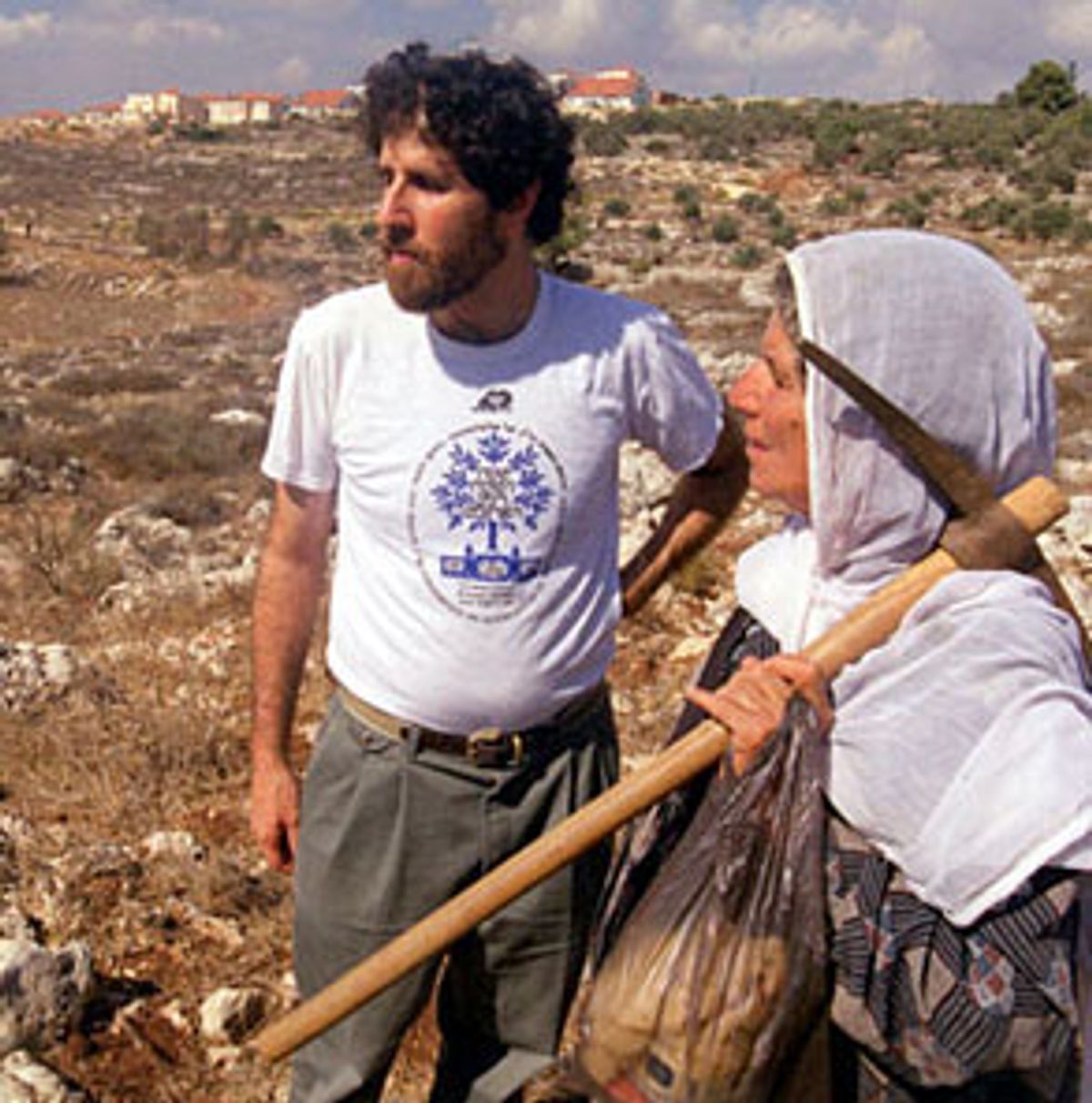
Although it has been refined and vigorously promoted by the ISM activists, human shield work is not a new concept. Most human shield workers cite as their inspiration the Freedom Summer of 1964, when mostly white students flocked to the Southern states to help endangered NAACP activists register black voters. (In fact, ISM's original "civil disobedience" plans had included 54 days of activism this July and August that organizers also had dubbed "Freedom Summer"). Others look to Latin America in the 1980s, when young people went to Nicaragua to protect the locals against the Contras during the cotton harvest. (Many activists went to the West Bank this October to protect Palestinians and their vital olive groves from Israeli settlers who were harassing them and destroying trees; one Palestinian farmer was killed by a settler.)
Other ISM activists prefer to compare their current work with Palestinians to those Americans who flew to Spain in the 1930s to fight in the civil war against the regime of Gen. Francisco Franco. The Abraham Lincoln Brigade that they formed has acquired the status of a romantic myth. As Robert Lipton puts it, "If we could do this, it would be like us going to the Spanish revolution to help out -- but without the guns. It does capture people's imaginations."
One person whose imagination was captivated was Harmony Goldberg, a 27-year-old political activist and nonprofit worker, who had studied civil rights battles during her years at UC-Berkeley and longed for a similar opportunity to "use my privilege to help in a struggle." Goldberg, who like a quarter of human shields activists is Jewish, had participated in marches and demonstrations, but felt helpless to make any real difference stateside.
"Things were getting so serious there and I was coming up against the barrier of how hard it is to directly impact what's going on in Israel and Palestine from the U.S.; it's not where things are happening," she says. When she learned that ISM was recruiting activists to go to the occupied territories, she jumped at the opportunity.
Goldberg raised money from community members in order to afford the $2,000 bill for a three-week trip. She spent time in Ramallah, where she joined local Palestinians in a march to a building where the Israeli army kept its tanks, threw red paint on the vehicles to symbolize blood, and wrote "murderer" on police cars. She moved into the homes of the families of suicide bombers, whose houses, in accordance with Israeli policy, were slated for demolition.
"Human shield work is both a way to buffer the Palestinians and just be with them during their day-to-day lives," she explains. "A lot of Palestinian resistance is just about trying to survive: staying in their houses, breaking curfews to go to markets."
In fact, Shapiro's breakfast with Arafat was something of a fluke. Volunteers mostly spend their days participating in mundane activities -- sitting in houses, riding in ambulances, joining in Palestinian-organized marches. They join the Palestinians in their everyday activities, hoping their presence will keep them safe. Rarely do volunteers have opportunities to thrust their bodies between the Israeli army's guns and Palestinian civilians.
If it did come to that moment, though, many ISM volunteers say that they would die for their cause. "No one comes to Palestine and says 'I'm ready to risk my life now,' but they want to come and see," says Arraf. "But they get there and we give them training: We don't tell anyone to expect to die, we don't want anyone to get hurt, and we've been fortunate that we've had no deaths so far. Then people make the decision that they are willing to get beaten down and step in between an Israeli soldier and a Palestinian, to protect innocent civilians."
Jordan Flaherty, a 29-year-old ISM volunteer, says that the possibility of death is ever present. "I've definitely had guns pointed at my face several times by soldiers, I've been shot at many times," he says. "One of the earliest times was when I first arrived in a refugee camp in March, and the main [Jewish] settlement was shooting into the camp from a sniper tower. The week before, they shot and killed an 8-year-old girl; and when we got there they shot at us, too. Bullets landed right by me."
Matt Horton shrugs off the danger. "A lot of people die here, in this city, every day, so I wasn't really worried about that. What I was worried about was the people there getting killed, and if I could help de-escalate that in any way, I owed them."
Even as bullets are fired in their general direction, many volunteers speak of feeling a curious sense of safety because of their identity. As Goldberg puts it, "In a way I felt safer doing actions there than in the United States, because the starkness of the privilege was so extreme."
Many activists never make it to the occupied territories. For some, it's simply a lack of money or time; others make it to Israel, only to be turned away by the Israeli government, which has a policy of not admitting obvious activists. People are now being stopped and shipped back to the States simply because of appearance. "They've stopped letting anyone who even had long hair, who looked like a hippie peace activist," says Levine, the UC-Irvine professor. As a result, the need for volunteers is always greater than the number of available activists; ISM has to take whatever bodies it can get. And without extensive screening, the drama of human shield work can draw a mixed bag of volunteers.
"There's a mentality of 'I'm a star,' and a lot of egotism: 'I am the greatest person in the world because I am coming to help these poor people,'" says Horton. "Then there are the people going, like, 'We are going to make the revolution.' People who really endanger other people's safety because they aren't committed to working in consensus and listening to the community."
Lipton says the work attracts many people he calls "danger freaks." Some, he says, have "this idea that 'We're here, let me at them. I'm going to lie down in front of the tanks, the soldiers.' They wanted to essentially be like nonviolent soldiers: They are suited up and ready for battle."
Drawn by both compassion and the adrenaline rush of a combat zone, human shields activists evince a curious mix of idealism and self-effacement -- and sometimes a willingness to see reality through one lens that can be interpreted either as reflecting naiveté or ideological blinders.
During the Israeli siege of the Church of the Nativity in Bethlehem last spring, for example, an activist who had managed to enter the church told Salon that there were no Palestinian militants in the church. Kristen Schurr, who was associated with the New York-based group Direct Action for Justice in Palestine, told Salon by phone that "there are no [militant] Palestinians in here."
Schurr was wrong: It is undisputed that among the Palestinians who had taken refuge in the church were a number of militants, including 13 on Israel's most-wanted list. (Negotiations resulted in their being sent into exile.) Schurr's statement, and some activists' refusals to condemn Palestinian terrorism, provide grist for the mill of critics who regard them as hypocritical and biased. Such critics could point out that the activists are outraged by the demolition of Palestinian houses, but have very little to say about the fact that the former inhabitants of those houses might have blown up Israeli children.
But in the spectrum of activists, some are more moderate, more prepared to condemn violence on both sides and engage in dialogue with their adversaries. In a journal entry published on the International Solidarity Movement Web site, for example, an American Jewish woman named Louisa Solomon describes a conversation with an Israeli soldier who told her he hated serving in the occupied territories and supported those soldiers who have refused to serve there (the so-called "refuseniks") but was afraid to refuse.
"He also argued about Palestinian violence against Israelis, but was able to have a decent conversation about it until he was sent to ID people somewhere else," Solomon writes. "The real issue for someone like that is about not understanding power relations. I mean, that's the issue for so many people that equate Palestinian and Israeli violence. I said to him, look, do you remember Warsaw? and he said yes, so I said, we made Molotov cocktails, we threw bombs, because we were in ghettos, being killed, what choice did we have? and so he listened.
"I find that rather than calling soldiers Nazis (listen up activists who think that's a good tactic), it is effective to address power issues from the other side, trying to get them to remember their (our) history of resistance. Trying to get them to realize what it is to be forced to use violence because the other side is OCCUPYING with tanks, and military/financial support from our very own USA. It is still possible to condemn targeting the Hebrew University, for example, or discos, but not have those incidents obfuscate the entire history of (imperialist, colonial) domination."
Perhaps from fear of being stereotyped as fire-breathing young radicals, ISM leaders point out that their volunteers range from Israelis of high school age to 75-year-old grandmothers; from "young, anti-WTO types" to conservative Republicans. But it is an undeniably youthful movement: Roughly a third to one-half of the volunteers are in their 20s, says Arraf. Activists are present in the territories year round, but they are particularly visible during the summer, when college kids use their school vacation to work with the ISM.
Still, despite the smattering of danger rangers, egotists and revolutionaries, most ISM volunteers are more traditional liberal-to-radical peace activists; the kind of seasoned organizers you'd find running nonprofits or organizing demonstrations back in the States. In fact, many volunteers, like Harmony Goldberg, say that their interest in human shield work sprang from march fatigue.
At a deeper level, many activists are driven by a sense of personal responsibility: They feel a duty to help rectify a situation that they believe their government, as Israel's staunchest supporter in the world, has helped create and perpetuate. As Matt Horton puts it, "I feel like I owe the people there a lot as a citizen of the United States. The U.S. basically enables what's happening to the Palestinians to happen."
Volunteers who come back from the occupied territories express a sense of wonder at being able to walk through the streets without fear during curfew, while the locals cower inside. "Your life is more important than theirs, but why? It's a conflict sometimes, but one you have to use," says Arraf. "It's surreal to walk in a big city without a single soul in the street, with people looking at you from their windows frightened to come outside. And you're not, only because the powers that be consider your lives more important than theirs. There's a sense of security."
For high-minded young progressives like Horton, even identifying as an American is problematic. Horton, the child of a law professor and a corporate attorney who had a privileged private-school upbringing in San Diego, has long refused to think of himself as either "white" or "American." "Whiteness and white identity is basically a union of various light-skinned people from Europe to suppress and attack nonwhite people. So I don't consider myself white, though the world system of oppression and dominance does consider me white," he declaims. "But now the situation for Palestinians is so bad that it doesn't matter, these stupid abstract ideas; if you can do anything to help people live it doesn't matter whether you're using white privilege or not."
It's difficult to measure the effectiveness of human shield work, because its success is defined by a negative -- events that didn't happen, shots that weren't fired, people who weren't killed. Most volunteers can point only to small victories: An ambulance getting through a checkpoint faster and perhaps saving a life. A local who was able to go to the market for a loaf of bread during curfew hours without being shot at. A house that wasn't demolished while they occupied it. As Jordan Flaherty puts it, "We can't say, 'Tonight the soldiers didn't come because of us,' but we can say that soldiers have never come and demolished homes while we were there."
"Often the soldiers were confused by us," says Horton. "A lot of times they would stop doing what they were doing for a little while because we confused the hell out of them, they didn't expect to see us, or know what we were going to do; and they are under orders not to kill internationals. They would check our passports and talk to us, and go back to shooting afterwards, but hopefully in a less dangerous way or something."
Levine, himself a political delegate and activist, believes that the human shield work has had a measurable impact. "The presence of someone like Adam Shapiro in Arafat's compound probably saved [Arafat's] life," he says. And even if human shield volunteers aren't always stopping bullets or bombs, Levine says, their simple presence, and their nonviolent message, inspires and educates Palestinians. "They are having a very important impact on Palestinian society, showing Palestinians that there are people from outside Palestine who are willing to risk so much to help them -- but without violence. This gives credence to the Palestinian people that they need to work on nonviolent alternates to the intifada."
From a political point of view, activists' reporting to the outside world what they have seen may be more important than slowing down a few Israeli patrols. Some activists have succeeded in publishing stories about what is happening in the occupied territories, although mostly in small or left-leaning publications. Still, with Israel increasingly making it difficult for outsiders, including journalists, to get into the occupied territories at all, activists feel that any news is better than none. A Dec. 12 editorial in the Israeli daily Haaretz noted, "Police at the borders are meant to prevent terrorists, criminals, illegal aliens and those unlawfully seeking jobs from entering the country, but lately those police systematically harass innocent visitors -- and, of course, anyone who wants to get a first-hand impression of what is happening in the territories."
- - - - - - - - - - - -
Undiscouraged by their unwelcome status in Israel, some human shield volunteers are looking elsewhere to make a statement. Iraq, where the potential of American invasion continues to build, is the latest focus of human shield drama. Voices in the Wilderness, a nonprofit organization that for six years has coordinated delegations to Iraq to record the impact of economic sanctions, is ramping up a full-time "solidarity presence" in Iraq. Since September, 100 people have signed up to go over, says Gabe Huck, a 61-year-old veteran delegate.
Because the danger in Iraq is vastly different from that on the streets of Palestine -- bombs dropping from the sky, as opposed to shots fired from guns or tanks -- the utility of human shield work there will be dramatically different. An American can't exactly stand in front of a house to protect it from a bomb; he can, however, strategize to get his eyewitness testimony about the Iraq situation in his hometown papers in hopes of swaying public opinion.
"I think people are very realistic about what can be done; most of us would understand that this is one small piece of what might deter violence," says Huck. "This is not a bunch of martyrs." But he still pauses, and adds, "Make your will before you go."
The threat of danger fails to discourage most volunteers, many of whom are anxious to go back after initial forays, mostly to Israel. For his part, Horton is eager to return, though he says he's committed to doing grass-roots mobilization in the States until he can raise money again. In fact, most activists testify vociferously that their human shield work has changed their lives: Not just because they learned the meaning of fear, and witnessed life in a war zone, but because they worked so closely with the Palestinian people. There is great psychological weight in exchanging your own body for another's, they say, in vicariously living the dangers of war; and there is also great guilt at knowing that you can go home any time.
Which is why, Jordan Flaherty observes, a lot of human shield workers need therapy when they get back to the States. "It's hard, really hard to get back to life here, it really transforms us," he observes. "It's really traumatic: traumatic to be shot at, and traumatic to be able to leave. That's your ultimate privilege: We choose to go there and put our lives on the line, and then choose to leave. But people there can't leave, they aren't choosing this because they are radicals. It is their everyday life."
Shares