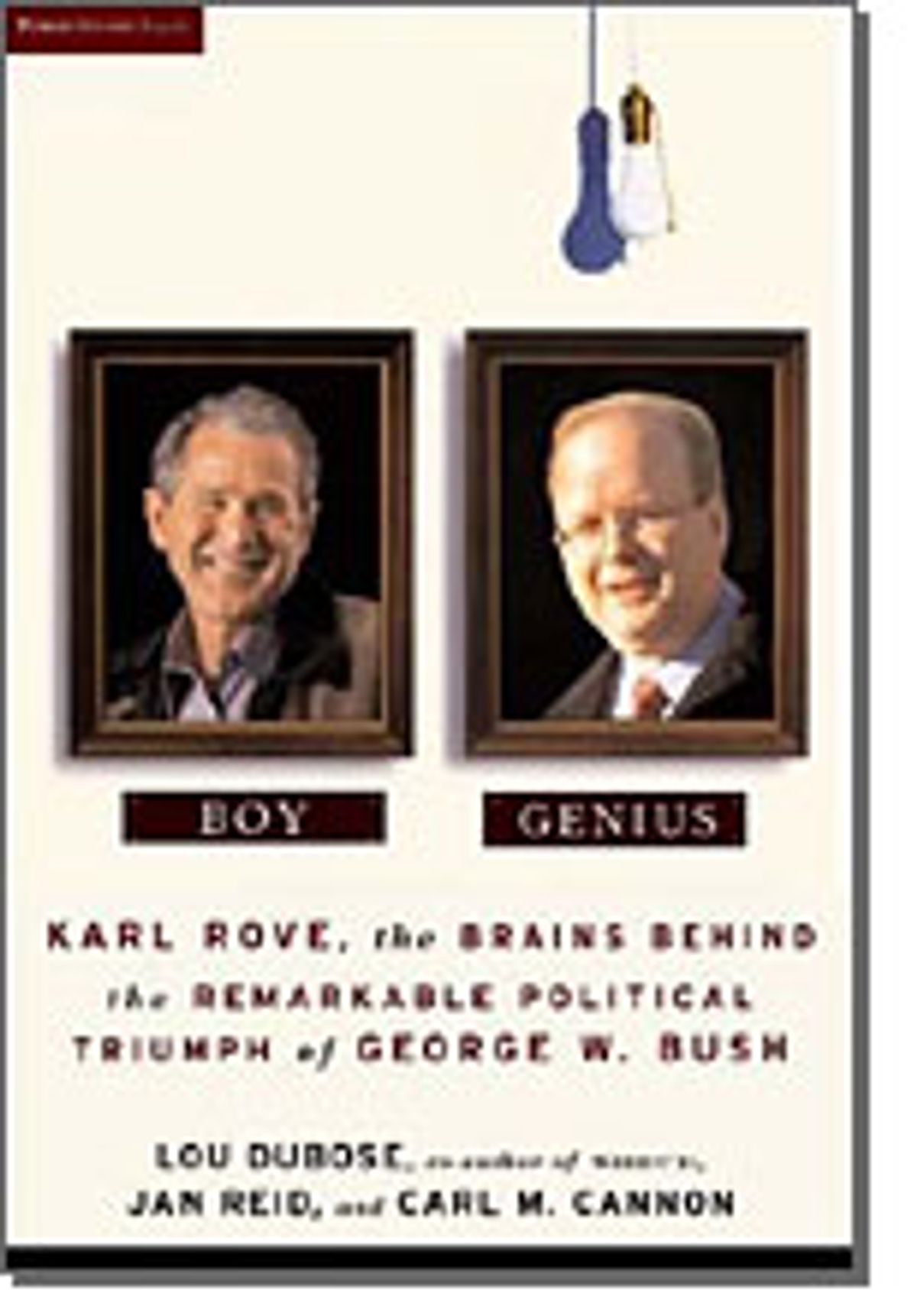
Karl Rove

The brains behind Bush

A new book pokes superficially at Karl Rove, the "turd blossom" who orchestrated George W. Bush's presidential campaign and the GOP's November sweep.

How many modern political advisors have merited two unauthorized biographies in their lifetime? The answer would seem to be just one: Karl Rove, senior advisor to President George W. Bush.

Pol predecessors with whom he’s often compared haven’t been afforded such treatment — not Bill Clinton’s James Carville, nor Ronald Reagan’s Michael Deaver. Not Jimmy Carter’s then-30-something Rolling Stone cover boys Jody Powell and Ham Jordan. (Lee Atwater, the senior strategist to Bush’s father, was dissected in John Brady’s 1996 tome, “Bad Boy” — but that came posthumously.) So somehow, on bookshelves as elsewhere, Rove manages to muscle for himself a surprising and unique niche.

The books — “Boy Genius: Karl Rove, the Brains Behind the Remarkable Political Triumph of George W. Bush,” by Lou Dubose, Jan Reid and Carl Cannon; and “Bush’s Brain: How Karl Rove Made George W. Bush,” by Wayne Slater and James Moore, which will be published in February — are certainly merited. The wonky Rove, a 48-year-old “Mayberry Machiavelli,” in the words of former White House advisor John DiIulio, is a fascinating fella who sprouted to power from humble beginnings, credentialed with nothing more than a high school education. Bush has given him the monikers “Boy Genius,” which is self-explanatory, and “turd blossom,” a Texism for a flower emerging from a cow pie.

Rove’s path to the White House is strewn with the professional corpses of most of the once proud and strong Texas Democratic Party. At a time of unparalleled peace and prosperity, he managed to effect the defeat of an incumbent vice president by George W. Bush, a man who had never been elected to any office until 1994 and who former Bush speechwriter David Frum, in “The Right Man: The Surprise Presidency of George W. Bush,” describes as “impatient and quick to anger; sometimes glib, even dogmatic; often incurious and as a result ill-informed; more conventional in his thinking than a leader probably should be.” True, there was that nasty bit of business in Florida, but Bush’s approval ratings remain quite high, and in November 2002, Rove masterminded the historic midterm GOP reclamation of the Senate and increased the party’s seats in the House of Representatives.

After Rove allegedly spearheaded the ouster of former Majority Leader Trent Lott, R-Miss., last month and replaced him with junior senator/White House water-carrier Sen. Bill Frist, R-Tenn., USA Today reported that “a senior aide to a Senate Republican sarcastically dubbed … Rove, ‘the 101st senator.’” The Note, ABC News’ widely read and respected political weblog, derided that nickname, sniffing, “as if Senators have as much power as Karl!”

But what does Rove do with that power? Reading “Boy Genius” may prompt you to avoid population centers likely to be targeted by al-Qaida. One point that authors Dubose, Reid and Cannon drive home is that Rove isn’t just willing to play dirty to win elections; nothing but winning really seems to matter to him.

After all, as Rove told Republican National Committee members in January 2002, “We can go to the country on [national security] because they trust the Republican Party to do a better job of protecting and strengthening America’s military might and thereby protecting America.” For Bush’s most powerful advisor, national security — and everything else — is merely a political tool.

The selection of former Pennsylvania Governor Tom Ridge as homeland security advisor was a political decision, not a policy one; other than visiting the crash site of Flight 93, Ridge had never dealt with terrorism issues before. And don’t forget that after Sept. 11 the White House fought tooth-and-nail against efforts by Sen. Joe Lieberman, D-Conn., and others to make the Office of Homeland Security a Cabinet-level post. Bush, famous for delegating, leaves such things up to Rove. Rove ultimately had the president completely flip-flop on the matter months later, effectively using opposition to the administration’s preferred bill — which had fewer employee protections — as a tool to defeat Democratic senators.

“The Senate has a lousy version,” Bush said. “They’re more interested in special interests, which dominate the dialogue in Washington, D.C., than they are in protecting the American people.” Of course, there was more to the complex issues and daunting task of homeland security than simply passing that bill. Last, October, in yet another alarm sounded by former senators Warren Rudman and Gary Hart, the Council on Foreign Relations issued “America: Still Unprepared — Americans Still in Danger.” (Click here for a PDF version of the report.)

James Carville knew that his talent was for campaigning, not governing, so he didn’t set up shop in the White House come January 1993, though he certainly could have. Rove, running a permanent campaign, doesn’t grasp his limitations, and at the very least this means a greater risk to American lives. In a letter he wrote to Esquire, even former Bush advisor DiIulio commented on

“… the remarkably slap-dash character of the Office of Homeland Security, with the nine months of arguing that no department was needed, with the sudden, politically-timed reversal in June, and with the fact that not even that issue, the most significant reorganization of the federal government since the creation of the Department of Defense, has received more than talking-points caliber deliberation. This was, in a sense, the administration problem in miniature: Ridge was the decent fellow at the top, but nobody spent the time to understand that an EOP entity without budgetary or statutory authority can’t ‘coordinate’ over 100 separate federal units, no matter how personally close to the president its leader is, no matter how morally right they feel the mission is, and no matter how inconvenient the politics of telling certain House Republican leaders we need a big new federal bureaucracy might be.”

How did we get into this mess? “Boy Genius” succeeds at outlining Rove’s odyssey from Utah dweeb to reigning Beltway champion, an interesting story, especially if you’re not up to speed on the political history of the Lone Star state.

Dubose and Reid are the primary authors of the parts of the book that chart Rove’s life up from childhood through Bush’s campaign against Sen. John McCain, R-Ariz., in the nasty South Carolina primary, and they are, fortunately, Texas political junkies. They introduce a cast of figures who end up as either successes because they hooked up with Rove or victims of Rove’s ruthless, but apparently entirely legal, political hardball. Treasurer candidate Kay Bailey Hutchison and Supreme Court candidate John Cornyn hire Rove to lift them up the political ladder, rung by rung, to the U.S. Senate, where they now sit. An Ann Richards protégé named Lena Guerrero wins the primary nomination to the Texas Railroad Commission, whereupon the Dallas Morning News somehow learns that she lied about her college degree.

“Karl had Lena’s transcript,” an Austin political consultant tells the authors, “but he held it until the right moment. The perfect moment. Then he screwed her.”

You don’t have to be a Democrat to be a Rove victim. Former Texas Republican Party chairman Tom Pauken states that Rove “beat me. That’s life. I’m in political exile, and Karl’s running the country.” Adds a Texas Democrat, “I always knew where I stood with Karl. I knew he was trying to kill me.”

Nevertheless, “Boy Genius” falls short of expectations. I want two things from a Rove biography: confirmation of the rumors and suspicions about Rove’s various dirty tricks (which requires that author expend some shoe leather), and a sense of what drives the man. Dubose, Reid and Cannon do not deliver.

During the 1986 Texas governor’s race, on the morning before a debate, Rove, representing GOP candidate Bill Clements, called a press conference to announce that a bugging device had been found in his office. “Obviously I don’t know who did this,” Rove said. “But there is no doubt in my mind that the only ones who would benefit from this detailed, sensitive information would be the political opposition.” Future Bush media maven Mark McKinnon, then working for Democratic Governor Mark White, insinuated that Rove had put the bug there himself, that the “whole things stinks and the wind is blowing from the Clements campaign.”

But instead of turning up a smoking gun — which, to be fair, may simply not be possible — the authors lean quite heavily on a New York Times Magazine profile of Rove by Melinda Henneberger in which Rove suggests that Henneberger watch the movie “Power,” released the year of the campaign. Henneberger is stunned to see that the plot of “Power” involves an office getting bugged. Did Rove, inspired by the movie, plant the device on himself to score a political point and then, years later, accidentally — or subconsciously — tip Henneberger off ? “I don’t have any recollection of that [scene],” Rove told Henneberger, and the authors let that suffice.

In fact, two of the book’s best nuggets come from Henneberger, who also relays a story told to her by Dallas Morning News reporter Anne Marie Kilday (and denied by Rove). According to Kilday, Rove warned her in 1994 that phone records showed that a state official reputed to be a lesbian frequently phoned Kilday at her home. “You’ve just got to be careful about your reputation and what people might think,” he advised.

To have all this put in a compendium is fun, but little of it is new. The most damning Rove tidbits surfaced in September 2000, amid various spy-vs.-spy charges and countercharges between the Bush and Gore campaigns. Briefing books were mailed to Gore pal Tom Downey, and a young Gore aide boasted of a “mole” in the Bush ranks. The distinguished authors of “Boy Genius” ought to have delivered much more. For example, there is little new information about FBI agent Greg Rampton, long suspected by Democrats of being in cahoots with Rove. Rove routinely used Rampton’s investigations of Democratic office holders against those officials in campaigns.

According to former Texas land commissioner Gary Mauro, then-comptroller Bob Bullock once told him that Rove and Rampton were working together — Rampton investigating Democrats, Rove leaking the information. “Their sole job right now, their mission in life, is to figure out a way to indict you, me, Jim Mattox, Jim Hightower and Ann Richards,” Bullock told Mauro. “They’re out to get us all.”

But the fact remains that three of Hightower’s assistants were ultimately indicted, convicted and sentenced to prison. So Rampton’s investigation was apparently justifiable. The authors retell the story of Rove’s evasions and Clintonesque parsing during a 1991 state senate hearing when Rove, nominated to the East Texas State University’s board of regents, was asked how long he’d known Rampton. “Ah, Senator, it depends,” Rove responded. “Would you define ‘know’ for me?” But this is old news, blast-faxed to reporters by Democrats in September 2000, and no dots are connected.

Likewise, “Boy Genius” produces no smoking gun from the scandalous South Carolina primary campaign against McCain, and it’s filled with reheated dish from others’ reporting. (That includes my own, I should disclose, something I realized only after I came to the book’s final pages, where sources and acknowledgments are listed). For a December 2002 New Yorker profile of Senator John Kerry, D-Mass., writer Joe Klein followed the presidential hopeful to South Carolina, where Kerry happened to run into Jim Gunn, president of the Coalition of Retired Military Veterans. At the beginning of the 2000 GOP primary campaign, Gunn had launched the opening salvo against McCain on Bush’s behalf. Later Gunn approached Kerry to repent. “I just want you to know, Senator, that you were right about McCain and I was wrong,” he told Kerry, who had defended McCain, a fellow Vietnam veteran. “Bush lied to my face and I’ll never support him again.”

Klein gleaned this just by flying to South Carolina on another story; what might Dubose, Reid and Cannon have stumbled upon if they had actually gone to Columbia, S.C., magnifying glasses in hand, to search for Rove’s fingerprints? The most we get is this:

“Someone started floating rumors that McCain was mentally unstable as a result of being tortured in Vietnam, and that the pressure of the presidency might cause him to snap. Wayne Slater, a reporter for the Dallas Morning News, wrote a piece ruminating about the origin of this whispering campaign, in which he recounted a number of questionable practices that had been attributed to Rove over the years … Slater also reported that candidates Gary Bauer and Steve Forbes had fingered the Bushies as the McCain rumormongers.

“In early December, Rove — who had not returned Slater’s phone calls about the story — confronted the reporter in the New Hampshire airport, poking a finger in his chest and saying, ‘You broke the rules!’ The outburst had an effect that Rove had perhaps not reckoned on. A reporter who was present said that as a result of the incident, ‘everyone on the campaign charter concluded that Rove was responsible for the rumors about McCain.’”

That doesn’t amount to much. And neither does “Boy Genius” when trying to explore the mystery of the man himself. Rove’s father left his mother for good on Rove’s birthday when he was a teenager. This subject is addressed in one sentence only. Rove’s mother’s suicide is dispatched with another sentence, his four-year first marriage ending in a 1980 divorce in another, his Vietnam-era avoidance of military service in a phrase.

“Boy Genius” leaves the disappointments and challenges of Rove’s life unexplored, but that’s not all. It ignores the fun, too, such as a 1973 cross-country road trip Rove took with Lee Atwater in Atwater’s brown Pinto while Rove was running for national chairman of the College Republicans. Or Rove’s first campaign manager’s job in a Nebraska congressional race a year later. In stark contrast, John Brady’s superb “Bad Boy: The Life and Politics of Lee Atwater” makes no such omissions, exploring the contradictions of the blues-loving race-baiter and even offering a harrowing account of the death of Atwater’s little brother Joe, who was killed at age 3 in the family kitchen when a deep-fat fryer tipped over on him.

The white-trash chip on Rove’s shoulder gets alluded to here and there in “Boy Genius” — most notably in connection with his other nickname — but is not delved into enough to explain the man’s drive. We hear, again, that Rove loves Myron Magnet’s 1993 treatise against liberalism, “The Dream and the Nightmare: the Sixties’ Legacy to the Underclass” — he famously hands it out to visitors with the fervor of the Gideons printing out Bibles and shipping them to motels — but why? What life experiences led to Rove’s anger against liberals and hippies and flower children?

The book even loses its focus on Rove for pages at a time in describing the aftermath of Sept. 11. Yes, this White House is secretive and disciplined, and it’s understood that Rove didn’t want to participate in the book’s creation, but I have no doubt that a little more effort would have gone a long way. Cannon, for instance, steps up with information about how annoyed Rove’s superiors are with his star status. Following a National Journal profile of Rove in April 2002, Cannon — who writes for the National Journal — reports that Bush told one of its authors that he didn’t like Rove getting so much attention in the media. Additionally, there is this juicy tidbit in which, at a Washington reception, someone asks Vice President Dick Cheney if he’d seen the story.

“Yes, I did,” the laconic veep said.

What did he think?

“Grossly excessive,” he replied.

With “Boy Genius” out, and “Bush’s Brain” on its way, I can imagine what Cheney is grumbling about these days.

Jake Tapper is national correspondent for Salon.

Using Bush’s playbook

"Karl Rove politics" aren't quite dead: Obama's strategy in 2012 will mirror W's in 2004

George W. Bush and Barack Obama (Credit: Reuters/Larry Downing)

Barack Obama’s presidency was born from nothing so much as his repudiation of George W. Bush’s administration — its policies and politics, its style and tone. One of Obama’s most effective 2008 stump speech refrains was his promise to end the era of “Scooter Libby justice, ‘Brownie’ incompetence and Karl Rove politics.”

But the political dynamics for winning a second presidential term often differ markedly from winning the first. So don’t be surprised by many eerie parallels between Obama’s 2012 reelection bid and Bush’s 2004 campaign. The president may not rely upon “Karl Rove politics” in the strictest sense, and nobody would confuse David Axelrod with Rove. But Obama’s reelection route and rhetoric may bear more than a few Rovian hallmarks.

Now that Mitt Romney has won the Republican nomination, two key features prevail over the 2012 campaign — and both were also plainly evident in 2004. First, the incumbent president’s reelection fortunes are far from certain; and, second, the incumbent faces a decent but nevertheless weak challenger who is further hampered by internal problems within his party’s coalition.

Because incumbents can’t run for reelection promising “change,” and because “hope” during a lingering recession was also off the menu, the Obama campaign’s 2012 theme of  “forward” — a word that often follows “plow,” mind you — was the best available alternative. That said, and substituting the economy for terrorism, Obama is implicitly if not explicitly advancing the same theme Bush did in 2004: America suffered a tough blow, but the situation could have been worse and, more to the point, under my stewardship the nation is steadily regaining its footing.

This counterfactual campaign theme — vote for me not because of what happened, but what might have but didn’t — is a common thread for Bush and Obama. It’s not an uplifting message, but it sufficed in 2004 and Obama is counting on it working again in 2012.

Politics 101 further dictates that when an incumbent’s reelection is in doubt, he must go negative against the challenger. Obama political operatives in the White House and at the Democratic National Committee long ago made it abundantly clear they were willing to do just that. Team Obama may not go negative against Romney to the degree the Bush camp did against John Kerry in 2004. (By mid-summer 2004, 75 percent of Bush’s TV ads were negative attacks on Kerry.) But don’t be surprised if attacks on Romney’s record and even character are plentiful, harsh and relentless. In 2008, America saw candidate Obama’s toothy grin; four years later, expect to see President Obama’s fangs.

Expect the Obama camp to emphasize two major critiques of Romney: that he is a flip-flopper willing to say anything or reverse any position to win; and that he is an economic royalist whose personal and public life suggest a person incapable of understanding the lives and struggles of average Americans. Again — note the unusual parallels with 2004.

Although Romney is a Republican former governor and Kerry was at the time his state’s Democratic junior U.S. senator, the two Massachusetts pols make for similar targets. Each man is an extraordinarily rich preppie and Ivy Leaguer. Each represents the liberal wing of his respective party. Each has shown a propensity for ruining an otherwise valid point with sloppy, backfiring language. And each has a reputation for lacking political spine.

The flip-flop frame is candidate character assassination of the first order. Like the lone negative number in a string of multiplied positives, the critique that nobody can trust any statement or claim made by a politician has the potential to negate every accomplishment or promise. If it sticks, it can be fatal, as Kerry learned in 2004.

Obama and the Democratic National Committee know their electoral history and, sure enough, last November — a year before the election and two full months before a single Iowan had caucused — the DNC released a four-minute “Mitt vs. Mitt” ad and its accompanying website with the damning tag line, “the story of two men trapped in one body.” The site is a brilliant homage to the Bush campaign’s 2004 windsurfer attack ad and the devastating, 11-minute ad the Republican National Committee produced chronicling Kerry’s “evolution” on Iraq.

And then there is what might be called “the Willard factor”: Romney as Richy Rich, the Monopoly Guy with the Bain Capital background and the Swiss bank account. His bio would be political gold to Romney’s opponent any election cycle, but it’s gold-plated platinum in the first full presidential campaign following the biggest economic crisis since the Great Depression, the rise of the Occupy Wall Street movement, and the long overdue national debate over income inequality.

Again, the wealth-personified line of attack mirrors the out-of-touch, Martha’s Vineyard yoke the Bush team put around Kerry’s neck in 2004. Right on cue, in the first public event of his reelection campaign, last week Obama attacked Romney by name and invoked the economic disconnect card with relish. “He sincerely believes that if CEOs and wealthy investors like him make money the rest of us will automatically prosper as well,” said Obama of Romney, adding that “corporations aren’t people – -people are people.” (For the record, Kerry is actually wealthier than Romney, who would become one of the richest men ever to occupy the White House, should he win.)

Obama will also try to shift the national debate toward areas of strength, as Bush did. Historically, this meant the same strategy, but with inverse implications for each party: The so-called mommy party Democrats would encourage voters to focus on more favorable kitchen-table economy issues — healthcare, jobs, education — and away from less favorable “daddy party” Republican issues surrounding foreign wars abroad and culture wars. Because Obama is net-positive in foreign policy approval and net-negative on the economy, rather than mirroring by inversion, Obama will try to duplicate Bush’s shift-in-emphasis in 2004. GOP complaints that Obama is politicizing the killing of Osama bin Laden reveal Republican fears that Obama is going to play the terrorism card in 2012 just like Bush did eight years ago.

The 2004 parallels extend beyond message. Obama will be amply resourced and enjoy a field technology by virtue of his campaign’s state-of-the-art Web, donor, volunteer and social media innovations. Remember the Bush reelection campaign’s vaunted “72-hour” voter turnout model? That seems like an Edsel compared to the Ferrari the Obama team will be sporting this summer and fall. Among the perquisites modern presidential incumbents enjoy is the option to test-drive the best mobilization machines before anyone else.

Finally, what most connects Obama 2012 to Bush 2004 is the stability of the electoral map itself. Only three states — two net to Bush — flipped from one party to the other between 2000 and 2004; only nine states flipped between 2004 and 2008. Split the difference and a good, back-of-the-napkin over-under for number of states likely to flip between 2008 and 2012 is six. And thus, like the lead sailboat during a windless race, Obama doesn’t need or want conditions to change much from 2008: He merely has to replicate the map that swept him into office, with the burden of figuring out how to shake up the Electoral College falling to Romney, just as it did for Kerry against Bush. Even Karl Rove’s mapping of the 2012 election concedes this reality.

The 2008 election was memorable; to borrow the title of one best-selling chronicle, it was a “game changer.” But 2012 will not be. In many respects, it will be a game repeater, with Obama playing Bush to Romney’s Kerry of 2004. The president may be asking Americans to look “forward” in 2012, but the best preview of his reelection campaign can be found by looking backward eight years.

Continue Reading Close

Karl Rove’s hissy fit: “Offended” by Chrysler ad

If Clint Eastwood sounded like Obama, it's because the GOP has ceded optimism to the Democrats

Karl Rove (Credit: Reuters/Fred Prouser)

I admit it: Chrysler’s “Halftime in America” Super Bowl ad reminded me of President Obama’s best recent speeches. Actor Clint Eastwood, the face of rugged American individualism, talked about “tough eras” and “downturns” and “times when we didn’t understand each other,” but then declared:

But after those trials, we all rallied around what was right, and acted as one. Because that’s what we do. We find a way through tough times, and if we can’t find a way, then we’ll make one…

This country can’t be knocked out with one punch. We get right back up again and when we do the world is going to hear the roar of our engines. Yeah, it’s halftime America. And, our second half is about to begin.

Karl Rove heard echoes of Obama’s rhetoric too, and implicit optimism about the direction of the country, and cried foul.

“I was, frankly, offended by it,” Rove said on Fox News Monday. “I’m a huge fan of Clint Eastwood, I thought it was an extremely well-done ad, but it is a sign of what happens when you have Chicago-style politics, and the president of the United States and his political minions are, in essence, using our tax dollars to buy corporate advertising.”

Rove wasn’t the only Republican who tried to cast the Chrysler ad as essentially payback to the president for supporting the bailout that kept the domestic auto industry alive. Michelle Malkin tweeted her horror Sunday night: “Agh. WTH? Did I just see Clint Eastwood fronting an auto bailout ad???”

Now, Clint Eastwood is no Democrat – he voted for John McCain in 2008, has been a Republican for most of his life, and now describes himself as having “libertarian” leanings. It’s hard to imagine he’d lend his name to an openly and intentionally pro-Obama ad. Chrysler has denied any political motive behind the Eastwood ad.

The flap over the ad confirms the GOP’s serious branding problem: The problem for Rove and the rest of the GOP is that their party’s narrative has become relentlessly negative, pessimistic and uninspiring. They’ve left the language of optimism and resilience, higher ground and common ground, to the Democrats, and lately President Obama has grabbed every opportunity to employ that language.

Rove is essentially complaining that anyone using rhetoric of resilience and tenacity, or suggests “we all rallied around what was right, and acted as one” sounds like a gosh-darn … Democrat.  That’s good news for Democrats. There’s more good news in recent polls showing that Obama is winning back at least some white working-class voters with his feistier message of economic populism. The president’s approval/disapproval ratings have been dismal with whites who make less than $50,000, with his approval dropping into the low 30s and disapproval up in the mid-60s regularly over the last two years.

Now those numbers stand at 43-54, about where they were when Obama was elected. He may not carry that cohort, but holding the share he had in 2008 will make his reelection chances much better. There’s also good news with those same voters in some Rust Belt states, including Wisconsin, Ohio and, yes, Michigan, home of Chrysler.

Karl Rove is angry because he sees the numbers, too, and he’s got to explain them away with dark allusions to “Chicago politics.” But the fact is the president saved the auto industry at a time when Republicans, most notably Mitt Romney, urged him to let it die. If he gets credit for that unpopular decision, that’s because he deserves it.

And if Clint Eastwood sounds like a Democrat when he talks about American ingenuity and optimism, that’s because increasingly it’s Democrats who sound that way – and Republicans who don’t. Ronald Reagan co-opted buoyancy and hopefulness for a generation, painting Democrats from Walter Mondale and Michael Dukakis through Al Gore and John Kerry (with a break for Bill Clinton) as Negative Nellies, whiners and complainers always finding fault with America.

Now it’s Republicans who bad-mouth the American people, warning that lax morals and laziness are behind the problems of the poor and working class (including whites), and who paint scary dystopic pictures of America under its Kenyan anti-colonialist socialist black president. Karl Rove’s hissy fit over the Chrysler ad underscores exactly how bleak his party’s vision has become.

I’ll be on MSNBC’s “The Ed Show” at 8 p.m. ET to discuss Rove and the angry GOP.


Continue Reading Close
Joan Walsh

Joan Walsh is Salon's editor at large.

Meet Karl Rove’s Sheldon Adelson

Texas billionaire Harold Simmons has given $7 million to a Rove-affiliated outside group VIDEO

Karl Rove (Credit: AP)

We’ve written a lot about Sheldon and Miriam Adelson and their $10 million in donations to a pro-Newt Gingrich super PAC. Part of the reason the Adelson donations got so much attention is that their existence was leaked to the media before the disclosure filing deadline. Since all super PACs were required to disclose their 2011 donors yesterday, we now have a much better picture of the other mega-donors who are in effect setting the agenda of the GOP primary.

One of the big headlines out of the filings Tuesday is that Harold Simmons, a Texas billionaire, gave the Karl Rove-affiliated American Crossroads an impressive $7 million over the course of just a couple months in the fourth quarter of 2011. That’s nearly 40 percent of the $18 million the group raised last year; an affiliated group, Crossroads GPS, whose donors are secret, raised more than $30 million.

Simmons gave $5 million of the money personally, and another $2 million via a corporation he owns called Contran. Even though the $7 million he gave to Crossroads (along with another $1 million to the Rick Perry super PAC) puts Simmons among the top donors of the cycle, his bank account can handle the hit. Simmons was the 33rd richest American in 2011, according to Forbes, which put his net worth at $9.3 billion. Amazingly, his net worth increased in 2011 $4.3 billion from the previous year, Forbes says.

Simmons owns companies that manufacture a range of products including metal goods and chemicals. And he has generously funded a range of right-wing causes going back to the 1980s; perhaps his most notorious effort in recent years was the money he gave to the Swift Boats group that went after John Kerry’s Vietnam service.

His campaign donations have been known to help his bottom line. Simmons has, for example, been a longtime patron of Rick Perry and he recently got a potentially lucrative favor from the governor, the Los Angeles Times reported last year:

Simmons, the second largest individual contributor to Perry, is poised to gain perhaps the most as his firm constructs the first new low-level radioactive waste disposal site in the country in three decades. The venture could not have happened without the backing of Perry, who early in his administration signed a controversial law allowing a private company to build such a facility in Texas.

Simmons’ company, Waste Control Specialists, or WCS, lobbied fiercely for the measure and eventually got its license approved by Perry-appointed state regulators despite objections from some state environmental agency staff.

Simmons’ donations to Crossroads have been funding ads like this:

Continue Reading Close
Justin Elliott

Justin Elliott is a reporter for ProPublica. You can follow him on Twitter @ElliottJustin

Rove v. Trump: the unlikely war for soul of GOP

Bush's architect attempts to wrest back control of the party from a man simply out to make a buck

Karl Rove and Donald Trump (Credit: AP)

Newsmax, a nutritional supplement sales organization and expensive email list with a right-wing news website attached, is hosting a Republican presidential debate, “moderated” by fictional television clown tycoon Donald Trump, set to air on a television channel you probably don’t actually know you have that spends most of the broadcast day airing paid programming. Historical fiction author Newt Gingrich — a disgraced serial adulterer with a still-unexplained $500,000 credit line at Tiffany and Co. who is also for some reason the current frontrunner for the party’s nomination — could not be happier. For some crazy reason, Republican campaign strategist Karl Rove is not particularly thrilled with all of this.

Rove, see, is operating from the outmoded idea that the Republican party should attempt to appeal to anyone not currently already old, angry, and skeptical of the president’s citizenship. From Karl Rove’s perspective, a man universally regarded as an unserious ass should not be hosting a major party’s presidential candidates and then selecting one of them, reality show-style, as his endorsee, live on television. For Rove, the fact that polls show associating with Trump is a net negative even among GOP voters is worrying, and not, as it is for the rest of us, hilarious.

On Fox yesterday, Rove encouraged the RNC to step in and fix this, which is unlikely to happen, because what power does the RNC have over any of these clowns?

“More importantly, what the heck are the Republican candidates doing showing up at a debate [whose moderator] says, ‘I may run for president next year as an Independent’? I think the Republican National [Committee] chairman [Reince Priebus] should step in and say, ‘We strongly discourage every candidate from appearing in a debate moderated by somebody who’s gonna run for president,’ ” he said.

Hah, so Trump is unacceptable because… he might pretend to run for president again, and not because he’s an idiotic unrepentant birther who constantly uses barely veiled racist tropes to criticize the president. Just checking!

Though the day Karl Rove objects to a Republican candidate for attempting to drum up support with bigoted dog-whistles is the day Rove accuses someone else of being incapable of feeling shame.

The point is that while everyone else is out, in glorious free market fashion, solely to make a buck (Trump has a book out! Newt has eight books out!), Rove is interested in the state of the party, and he would like to perhaps help the party to win some elections next year. The problem for him, right now, is that the actual people in his party seem to strongly prefer charlatans to proper candidates. Poor Karl Rove! The permanent Republican majority is basically becoming an angry elderly minority, convinced that it represents 100 percent of the only America that should count. (Which is not to say that this angry minority doesn’t have a good shot at taking both houses of Congress and the White House next year, so Rove should relax and continue raising hundreds of millions of dollars in anonymous money.)

Continue Reading Close
Alex Pareene

Alex Pareene writes about politics for Salon and is the author of "The Rude Guide to Mitt." Email him at apareene@salon.com and follow him on Twitter @pareene

Who’s winning the Fox primary?

The conservative cable channel treads carefully in Gingrich-Romney race

Newt Gingrich and Mitt Romney (Credit: AP)

The Republican primary campaign has become a two-man race, with unloved ostensible front-runner Mitt Romney currently suffering the indignity of trailing in the polls to self-satisfied serial adulterer Newt Gingrich. Where does the unofficial communications arm of the conservative movement stand on the race? They’re noncommittal, thus far.

We all know the basic facts: A lot of conservatives see Romney as completely unacceptable. The more pragmatic ones see Gingrich as wholly unelectable. Fox News is run by consummate conservative elite Roger Ailes. Ailes has two objectives: Generate ratings and elect Republicans. The Gingriches of the world excite Fox viewers, because of their shamelessness. Romney excites no one, but he’ll need Fox’s support if he ends up the beneficiary of a Gingrich collapse.

Fox has indulged its audience’s brief surges of affection for unelectable fringe candidates, from Trump through Cain, but the channel’s always been careful to remind the base that they may eventually have to hold their noses and vote for Romney. Karl Rove, who’s already running a shadow campaign against Obama, has made this point explicitly during his Fox appearances.

Romney went from trailing in the Fox News appearances list to getting more uninterrupted airtime over the last week than any other candidate. But Gingrich beat him in minutes the week before. And Newt was just on Hannity last night, where he seemed much more comfortable than Romney did in his earlier sit-down with Bret Baier, a tougher interviewer by any standard.

Watching Fox this morning, clips of Gingrich’s Hannity interview were replayed multiple times. Ron Paul’s devastating anti-Gingrich ad was excerpted for a minute, followed by a clip of Romney sounding like he believed in anthropogenic climate change.

The network seems, in other words, undecided at the moment, or at least willing to see if Gingrich can pull this out without humiliating himself like he always does. The Rovians may yet win the day, but for now Fox seems to be joining the GOP base in convincing itself that Gingrich is electable.

Continue Reading Close
Alex Pareene

Alex Pareene writes about politics for Salon and is the author of "The Rude Guide to Mitt." Email him at apareene@salon.com and follow him on Twitter @pareene

Page 1 of 84 in Karl Rove

www.salon.com/topic/karl_rove/