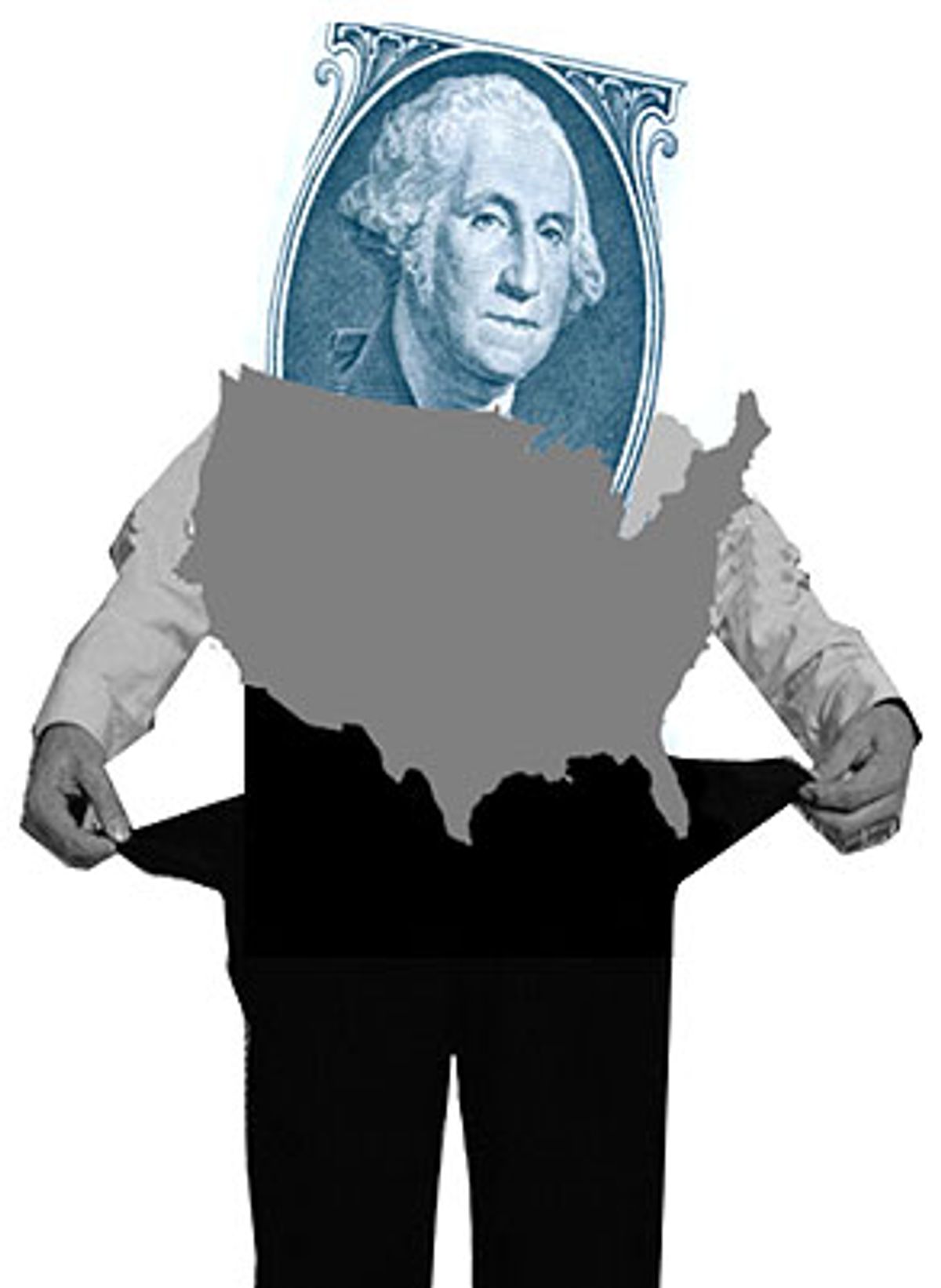
The fiscal crisis

While Bush cuts taxes for the rich, states are cutting prosthetics for the poor.

  • more
    • All Share Services

The fiscal crisis

More than a million Americans will lose publicly funded healthcare. Crime-wracked Oakland, Calif., where the number of murders nearly doubled last year, is cutting more than $5 million from its police budget. Massachusetts won’t pay for dentures, eyeglasses or prosthetics for low-income residents anymore. Oregon public schoolchildren will likely attend 15 fewer days of classes. Ohio and Kentucky are closing prisons. Illinois is slashing child-care funds for welfare families by half. The Fire Department of New York, formerly the heroes of 9/11 but now just another costly line item in the city’s shrinking budget, is set to cut eight engine companies and reduce staffing on the remaining units from five firefighters to four.

Remember how 9/11 was supposed to have rehabilitated the idea of government? Cops and firefighters and other rescue workers were our heroes, and community service was going to be sexy? That was so last year. As the fiscal crisis facing states and cities grows bleaker, politicians are thinking the unthinkable, coast to coast. There’s not enough fat left to spare essential services: Although state spending rose in the go-go ’90s, most states cut taxes in those years, too. And this isn’t their first bout of fiscal pain: 37 states cut their budgets last year, too.

Now states are facing a collective deficit as high as $85 billion for the coming fiscal year: California’s is an estimated $35 billion; New York’s is likely to hit $12 billion, Texas is at $10 billion and counting; New York City’s alone could be as high as $6 billion, more than that of 45 states. Unemployment insurance funds are on the brink of insolvency in at least eight states, which could force them to borrow from the federal government to cover payments to the jobless, and pay interest on the loans, too, only deepening their deficits.

Iris Lav sits in her office and updates the state-deficit estimates daily, almost always upward. “This is the worst crisis in the postwar period,” the deputy director of the Center on Budget and Policy Priorities says grimly. But even that bleak assessment understates the problem, Lav says, because 50 years ago the states had far fewer responsibilities. Now three-quarters of state budgets go to public safety, healthcare and education, so big deficits mean cuts in programs for everybody, but especially low-income Americans.

Most media reports identify Lav’s outfit as “liberal” or “left-leaning,” but everybody quotes their numbers, because they’re reliable. Right now, Lav probably wishes they weren’t. The hole that states, cities and counties are in “is twice as deep as the early ’90s,” when the first Bush recession forced huge state and local program cuts, the weary number-cruncher tells me. The healthcare reductions are the worst of it, she says, but many states are trimming education and public safety budgets too. California cities and counties could lose 12,000 police officers and 15,000 firefighters if proposed cuts go through, and tuition at the University of California system may jump 35 percent.

It’s against that backdrop that the Bush economic “stimulus” plan looks ever more surreal. It’s a $674 billion tax cut, with the $360 billion dividend-tax elimination as its centerpiece, and 70 percent of its benefits go to the top 5 percent of American taxpayers. Even supporters admit it won’t work as an economic stimulus. And it comes as Bush’s own budget director, Mitch Daniels, admits the federal deficit could reach beyond $200 billion next year; pessimists say it could go as high as $500 billion over the next couple of years, if the impending war with Iraq, and/or rebuilding period, is long and costly. The total cost of the Bush tax-cut plan could reach $900 billion over the next decade when interest payments on all that debt are factored in.

Spend much time looking at the headlines about state and local budget cuts — cops and firefighters? teacher salaries? prosthetics for low-income amputees? — and you’ll find yourself wondering: Has Karl Rove lost it this time? He’s the supposed mastermind of the dividend cut, designed to stimulate not an economic recovery but the lasting loyalty of the so-called investor class to the Republican Party. Ironically, it was under a Democrat, Bill Clinton, that the investor class grew, but most of us own stock through tax-deferred mutual funds or 401K plans, so the dividend tax elimination won’t help us. Can Republicans really get away with waging their own form of class warfare, on behalf of such a small band of voters?

The politics of the fiscal crisis remain hard to parse. Republicans are among the Bush plan’s toughest critics, and the dividend tax proposal probably won’t make it unscathed through Congress. Democrats and some Republicans are pushing to make the stimulus plan include a bailout for states — the House Democrats’ plan includes $31 billion to ease the governors’ pain — but many Republicans argue the states padded their budgets during good times, and ought to be forced to cut them now.

Not many Republican governors are saying that, however. Idaho Gov. Dirk Kempthorne, a GOP conservative who cut taxes 48 times in his first term according to the Washington Post, cut dental care for Medicaid patients last year; but this year he’s proposing to raise cigarette and sales taxes rather than push for deeper cuts. But where the Bush tax cuts favor the rich, the fees and tax hikes proposed by most state governors — sales taxes, sin taxes on alcohol and cigarettes, vehicle license fees — mainly hit the middle class and the poor.

Meanwhile, states are being slammed with new homeland security duties, while the Bush education and welfare-reform plans will force even more responsibilities — without funding them. Public schools are expected to meet tough new testing and accountability standards this year, even though Bush reneged on the funding he promised to pay for them, and states are cutting education budgets even further. Just last week the president announced he wants more welfare recipients to go to work, and to work longer hours — even as states are gutting the child-care and employment services that have helped get more single mothers into the labor market than ever before. And even as welfare rolls are ticking upward again, thanks to the protracted recession.

It’s hard to overstate the worst-case scenarios of the states’ fiscal crises. Improvements in public health — declining infant mortality rates, rising child immunizations, new strategies in reducing hypertension, heart disease and killers like breast and prostate cancer among the poor and working classes — could be reversed by budget cuts and service reductions. And while some may see a silver lining in the cuts to prison programs — half of all states have cut their prison budgets, according to the National Conference of State Legislatures, several have either repealed or reformed their mandatory minimum sentencing laws for drug and other nonviolent crimes, and at least five states have released nonviolent offenders early — clearly budget cuts aren’t the best way to make new policy. Just let one of those furloughed prisoners commit a heinous crime, and we’ll see a decade of progress on criminal-sentencing reform erased. Trust the folks who gave us Willie Horton to do that right.

Could all of it backfire on Bush politically? Maybe. His approval rating is already in decline, and amazingly, a majority of voters in a recent Gallup/USA Today poll said they think they’re paying a fair tax rate — for the first time in 40 years. The tax-cut constituency may finally be shrinking; Rove may finally have overreached. But for now, the most profound costs of the fiscal crisis are likely to be hidden, harder to track immediately — and borne disproportionately by the poor.

Still, there’s reason for the rest of us to worry. The states’ crisis could spiral: Felix Rohatyn, an architect of New York City’s turnaround in the 1970s, says local and state credit ratings could crumble, limiting their ability to borrow and, down the line, making it impossible to meet payroll and debt obligations. And the governors’ attempts to close their budget gaps are just what the economy doesn’t need, many experts say. Instead of an economic stimulus package, what states and counties are doing amounts to an anti-stimulus. Layoffs, tax hikes and spending cuts all take more money out of the sputtering economy, Iris Lav notes, which could further reduce state and local tax revenues, necessitating more cuts, unless there’s a dramatic turnaround. But Lav doesn’t blame them. “They don’t have any choice. It’s terrible.”

Continue Reading Close

The Politico-Breitbart mind-meld

The D.C. paper thinks a story about Ann Romney's horse habit is worse than an exposé of the president's "kill list"

  • more
    • All Share Services

Topics: ,

The Politico-Breitbart mind-meldAnn Romney, inset, President Obama and John Brennan (Credit: The White House)

Jim VandeHei and Mike Allen have a really nice gig at Politico, so I don’t know why they’re trying out for a job with the Andrew Breitbart media empire. But that’s what their deeply stupid piece decrying media bias against Mitt Romney, particularly at The New York Times and Washington Post, reads like. It could be the latest installment of Breitbart’s whiny, posthumous “Nobody Vetted Obama So We Have to Do It by Printing Stuff We Know Is False!” investigative series.

The piece is just factually wrong. First of all, the Project for Excellence in Journalism tracked Obama-Romney media coverage this year and found that the president received far more negative coverage than Romney did. GQ’s Devin Gordon took apart VandeHei and Allen here. He said everything I wanted to about the piece – most notably, the Times took the lead in reporting on Obama’s ties to Rev. Jeremiah Wright, starting with Jodi Kantor’s piece in April, 2007. Gordon found 2,950 references to Wright in the Times archives. Even if Gordon’s math is off by a factor of 10, that’s a lot of coverage.

Politico’s faux-outrage that both the Post and Times “ignored” David Maraniss’s story about Obama epic high school weed-smoking is silly, too: The future president inoculated himself against almost all drug revelations by revealing them himself in “Dreams from My Father.” The memoir leaves little doubt that Barry Obama was a lost stoner in high school. Who cares?

Meanwhile, Matt Drudge’s favorite journalists are angry that the Post published revelations about Romney’s high school bullying. They seem to think high school behavior matters in the case of Obama but not Romney, just another example of the pervasive partisan double standard in media. But I don’t want to say I learned nothing from the piece: It features populist Haley Barbour defending Ann Romney from the mean Times this way: “The New York Times does a huge exposé that Ann Romney rides horses. Well, so does my wife, and a few million other people. Watch out for equine performers!” You are so fricking losing the dressage vote, Team Obama! Take that!

The ultimate moral vacuum at the heart of the story is its failure to care that just two days after its “exposé” of Ann Romney’s fondness for seven-figure horses and the silly costumes that go with them, the Times ran a chilling investigative piece about Obama’s “kill list” process, with damning details about how the president decides on drone strikes and other methods of killing suspected terrorists.

The Times piece revealed that the administration has minimized its reported civilian casualties by counting all males killed, including minors, as “militants.” It contains the detail that echoes George Zimmerman’s thoughts about Trayvon Martin – that any young men in the vicinity of suspected terrorists must be “up to no good.” The single most haunting revelation, to me, was the fact that political guru David Axelrod sits in on the “Terror Tuesday” meetings, evidence that the president’s process is at least partly political. Oh, and “Terror Tuesday” isn’t my juvenile label for the meetings; according to the Times, that’s how they’re known in the White House. I hope they got that detail wrong. It even quotes Bush CIA director Michael Hayden praising the president but urging a little more transparency in his process. When a Bush-Cheney intelligence operative is telling you you’re keeping too many secrets, you maybe ought to think about it. (I’m going to write more about Obama, the Democrats, national security and “kill lists” next week.)

Politico’s only mention of the piece comes within Times editor Richard Stevenson’s email rebuttal to its charges. Clearly, VandeHei and Allen think a story about the president’s controversial drone policy is less grave and potentially damaging than a close look at Ann Romney’s dressage hobby. I can’t think of a better example of the mindset that drives trivial, democracy-degrading political coverage. Politico didn’t create that world, but it’s the news outlet that was most deliberately invented and perfected to make sure we continue to live in it.

Continue Reading Close

Mitt Romney’s student debt chutzpah

Romney slashed funding, hiked tuition and saddled Mass. students with loans. Now he promotes for-profit colleges

  • more
    • All Share Services

Topics: ,

Mitt Romney's student debt chutzpah (Credit: AP/Jae C. Hong)

You’ve got to hand it to Mitt Romney. For someone who’s usually as steadfast as a “perfectly lubricated weathervane,” in the words of former foe Jon Huntsman, sometimes he’s got a lot of brass. This week he released an ad blaming the student debt crisis on President Obama, when in fact out-of-control student loans were gobbling up graduates’ paychecks by the time Obama took office in 2009. In fact, Romney himself played a starring role in the crisis, cutting higher-education funding and hiking tuition back when he was Massachusetts governor (or, as he’d rather put it, during the lost years).

Broadcast in New Hampshire, the swing state that also leads the nation in per capita student debt, the ad highlighted “the fact that the president has not been able to help students deal with this crushing debt,” according to Romney spokesman Ryan Williams. Unfortunately, the ad used footage of New Hampshire students complaining about their loan burden without their permission, and one of them happens to plan to vote for Obama. “Considering I am not a supporter of Mitt Romney, this is not exactly sitting well with me,” said Southern New Hampshire University sophomore Matt Raso. The campaign pulled the footage when a local television station objected, but Ryan Williams told the Associated Press that the campaign plans to run ads blaming the student loan crisis on Obama in other swing states.

That takes a kind of chutzpah Romney rarely exhibits. He won’t stand up to birther bully Donald Trump or the misogynist Rush Limbaugh, but he apparently has the cojones to blame student debt on Obama. We’ll see how it goes. In fact, American student debt is a scandal in which state and national lawmakers in both parties share some blame. But by far the lion’s share of responsibility for the debacle belongs to Republicans. The roots of the crisis go back to California Gov. Ronald Reagan, who imposed the first “fees” on the formerly free University of California system in 1968, declaring “the state should not subsidize intellectual curiosity.” As president, Reagan helped nationalize that disdain for well-funded public higher education in the 1980s.

But it took a long roster of Republican governors to turn the problem into a crisis, and Massachusetts Gov. Mitt Romney led the way a decade ago, dramatically slashing public higher-education funding and hiking fees during his one term. According to the Boston Globe, from 2003 to 2007, fees and tuition jumped 63 percent at Massachusetts’s once-stellar system of public higher education as Romney slashed state funding year after year, for a total of $140 million, or 14 percent, in four years. Not surprisingly, average student debt in Massachusetts jumped 25 percent while Romney was governor. Between 2001 and 2011, tuition and fees have more than doubled at the state’s community college, state university and UMass campuses, but the bulk of the added burden piled up under Romney.

Romney also wanted to spin off the flagship UMass-Amherst and privatize three other colleges, including the medical school, a harbinger of what he says he’ll do as president. That agenda failed in Massachusetts, but it would be a shame to give him a second chance as president.

It’s tragic that Republicans have become the dismantlers of public universities, since it was Abraham Lincoln who signed the Morrill Act in 1862, creating the system of land-grant colleges that made the U.S. a country of unusually broad opportunity. (Of course, today’s GOP has betrayed Lincoln in many other ways.) “Abraham Lincoln is weeping today,” university president Graham Spanier told reporters when Pennsylvania’s Republican Gov. Tom Corbett slashed Penn State funding by $182 million last year. It was the aggressive expansion of college education access after World War II that helped create the vast American middle class. In 1946, only one in eight college-aged student got higher education; by 1970, one in three did. And the balance of enrollment shifted to public institutions: In the 1940s, most students attended private colleges; by 1970 three-quarters were enrolled in public ones.

Presidents from Truman through Eisenhower and Nixon to Carter continued to endorse and enable broad college access, but the tide began to turn in the 1960s as universities became hotbeds of political protest and the new educated generation began to use its college smarts to question society rather than become cogs in the corporate machine. But we can make too much of Reagan’s resentment of Berkeley radicals as a factor in his push to end free UC tuition. He and his backers were anxious to dismantle the public sector and the tax structure that made it possible as well as to privatize all sorts of formerly public institutions, creating lucrative new money-making opportunities for their wealthy friends.

The result: University tuition is up 128 percent nationwide since 1980, the year Reagan became president (and coincidentally, the year I graduated from the University of Wisconsin, when I paid less than $400 a semester). Public university tuition has tripled since then. In that same period, the middle class has shrunk, the poor have gotten poorer and the rich have gotten richer. Is it all connected to our breaking our promises to our kids about higher education? Not entirely, but it’s not a random coincidence, either.

The Romney-Reagan approach to higher education has a lot in common with their overall approach to the economy. Let’s take jobs as an example. Under Reagan, median wages for the working and middle classes began to stagnate and fall – but household debt began to rise. It was as if the GOP-unleashed private sector figured out how to make money lending families the money that they were no longer making in income. Republicans have the same approach to higher education: They slashed public funding and then let their banker friends “help” students afford higher tuition by lending them the cash to pay for it. Now, of course, the nation’s student loan debt is larger than its credit card debt, and graduates leave college carrying about $25,000 in loans. It’s like a mortgage, but without the house.

Andrew Leonard wrote a great piece Tuesday about Romney’s ties to the for-profit education industry and his commitment to relax Obama administration regulations on that high-profit, low-student-success sector. That’s the other key to Romney’s higher education agenda: slash public funding, increase the student loan burden and privatize the whole system as much as possible. Leonard explains what’s wrong with Romney’s priorities more succinctly than I could:

The biggest for-profit schools generate 80 to 90 percent of their revenue from federally guaranteed student loans. Only one out of every ten American college students attends a for-profit institution, but these students account for a quarter of all student debt and almost half of all student loan dollars in default. There’s no sugar-coating it: The booming for-profit industry is one of the worst possible examples of the “free market” in action that one can find in the entire U.S. educational sector. For-profits charge higher tuition rates than their public school competitors, graduation rates are lower, and the entire business would not exist without massive government subsidization in the form of cheap student loans.

Romney is also pledging to undo one of Obama’s most progressive reforms: his overhaul of the student loan system, taking banks (and their gouging) out of the middle of the government-guaranteed loan relationship.

It’s against that backdrop that Romney is trying to blame Obama for the student loan crisis. It won’t work. Democrats need to pay much more attention to Romney’s higher education record in Massachusetts. It’s no wonder he doesn’t like to talk about those years.

Continue Reading Close

With friends like Trump

The birther bully doubles down on Obama lies, insults CNN's Blitzer and makes it clear that he's using Mitt Romney

  • more
    • All Share Services

Topics: , ,

With friends like TrumpMitt Romney and Donald Trump (Credit: AP)

“That was a big steaming plate of shit spaghetti Trump just deposited on CNN for his supposed friend Romney,” apostate Republican David Frum wrote on Twitter Tuesday afternoon. I couldn’t say it any better.

On the day he’s hosting a supposed $2 million fundraiser for Mitt Romney in Las Vegas, Donald Trump doubled down – wait, is it tripled down? – on his birther nonsense in a hilarious interview with CNN’s Wolf Blitzer. The normally deferential Blitzer wound up telling Trump: “Donald, Donald, you’re beginning to look a little ridiculous.”

Obviously Blitzer could have cut “beginning to look a little” from his put-down, but those were harsh words coming from Blitzer. Trump had already insulted the CNN anchor’s ratings, telling him, “Frankly, if you would report [the birther conspiracy] accurately, I think you would probably get better ratings than you’re getting, which are pretty small.”

So Obama surrogates Hilary Rosen and Cory Booker were almost universally denounced for ill-chosen words on behalf of the president, but Trump gets to insult not just Obama but an influential cable news anchor on behalf of Romney with no reprisals? That’s the old IOKIYAR double standard at work, but this time, it might actually backfire and hurt Romney.

For his part, Romney refused to either cut ties with Trump or denounce him. And his refusal to do so was a craven exercise in electoral groveling. “You know,” he told reporters Monday night, “I don’t agree with all the people who support me, and my guess is they don’t all agree with everything I believe in. But I need to get 50.1 percent or more, and I’m appreciative to have the help of a lot of good people.” What else will Romney do to get to 50.1 percent? Stay tuned.

Of course, that’s not the first time Romney has refused to denounce or distance himself from a Republican supporter. When Rush Limbaugh called Sandra Fluke a “slut” and a “prostitute,” he merely said it was “not the language I would have used.” When Ted Nugent said “if Barack Obama becomes the president in November, again, I will be either be dead or in jail by this time next year,” Romney simply asked for more civility in politics. When a supporter said Obama should be “tried for treason,” Romney didn’t challenge her at all and later told reporters: “I don’t correct all of the questions that get asked of me. Obviously I don’t agree that he should be tried.” Romney keeps getting served big fat pitches to let him take a swing at a defining moment of political courage, pitches that he could knock out of the park. He just watches them float by.

Maybe Romney thinks he needs the birther loons to get elected. The base isn’t crazy about him. And Salon’s Alex Seitz-Wald reveals that Orly Taitz and Joseph Farah are thrilled that Trump continues to advance their cause. But this can’t end well. For better or worse, independents are likely to decide this election, and birther nonsense isn’t going to win them over.

I’ve probably reached my own personal low when I’m fact checking Trump’s lies, but today he consistently claimed – referencing a Breitbart.com story – that Obama’s “publisher” wrote that he was born in Kenya; in fact, the dubious story makes clear it was his literary agent, in a publicity brochure about her clients. (A former agency assistant quickly took the blame for the mistake and said the information didn’t come from Obama.)

Also, when talking about the agent’s brochure to the Daily Beast, Trump said it was a mistake made by a young man who “didn’t know he was running for president, so he told the truth.”  But when dismissing Blitzer’s reference to the Honolulu Star Bulletin’s Barack Obama birth announcement just days after he was born, Trump argues “many people put those announcements in because they wanted to get the benefit of being so-called born in this country.” So his parents knew enough to fake a birth announcement, but the young Harvard Law Review president threw all their hard work away to sell a book? Uh oh, I’m trying to find consistency in a Donald Trump argument. Time to close. Romney owns everything Trump says, and it will cost him in November.

The Breitbart.com empire must be proud Trump is using their story as “proof” of his birther nonsense. Even as they printed the allegation, they stressed that Breitbart himself didn’t support birtherism, and they insisted that they only published the story about the agent’s brochure just to prove the media didn’t vet Obama. Let’s get this straight: So they’re chiding the media for not publishing something that they themselves believe to be false. That’s awesome journalism.

In related news: Regarding the revival of Trump birtherism, I said Friday on “Hardball” that Breitbart’s journalistic proteges were “bottom feeders,” and one of them quickly proved it.  I appreciate all the support I got on Twitter, but to me it was a dog bites man story, and utterly predictable. (I apologize to dogs everywhere for that unfair comparison.)

I talked about how Trump hurts Romney on MSNBC’s “Politics Nation” Tuesday afternoon:

Visit msnbc.com for breaking news, world news, and news about the economy

Continue Reading Close

Hey, Mitt: Dump Trump!

After a new rant about Obama's birthplace, Romney needs to cut all ties with the birther loon

  • more
    • All Share Services

Topics: , ,

Hey, Mitt: Dump Trump!

Yesterday it was funny: Mitt Romney announced he was having a fundraising contest to let supporters win a dinner with the farce that is Donald Trump. President Obama has raffled off dinners with George Clooney and former President Bill Clinton; Mitt’s got Trump. Any questions? Do you see a stature gap between the two campaigns? Do you want to have dinner with two guys who like to be able to fire people? Whatever floats Mitt’s boat.

Today it’s appalling: puffed up by Romney’s flattery, the preening, orange-haired narcissist doubled down on his idiotic birther claims against the president, telling the Daily Beast’s Lloyd Grove: “Look, it’s very simple. A book publisher came out three days ago and said that in his written synopsis of his book, he said he was born in Kenya and raised in Indonesia. His mother never spent a day in the hospital.”

If you haven’t been following the story, and I tried not to, the addled spawn of Andrew Breitbart found a dusty 20-year-old catalog from Obama’s former literary agency that said he was born in Kenya. An assistant quickly said that she wrote down incorrect information. Trump doesn’t believe her.

“That’s what he told the literary agent,” Trump told Grove. “That’s the way life works … He didn’t know he was running for president, so he told the truth. The literary agent wrote down what he said … He said he was born in Kenya and raised in Indonesia … Now they’re saying it was a mistake. Just like his Kenyan grandmother said he was born in Kenya, and she pointed down the road to the hospital, and after people started screaming at her she said, ‘Oh, I mean Hawaii.’ Give me a break.”

Give us a break, Mitt. It was already embarrassing that you were using Trump as a fundraising lure – why not raffle off a dinner with Dick Cheney, who’s hosting a fundraiser for you in July? At least Darth Vader has gravitas; Trump is a joke. Pretending to run for president, Trump made birtherism his big issue, and ultimately Obama responded by prevailing on the state of Hawaii to release his long-form birth certificate – a truly sad moment for this country, when the overwhelmingly elected president, a black man, has to show a nasty rich white guy his papers.

If you ever want an example of the vicious political double standard that helps Republicans in this country, here it is: Democrat Hilary Rosen said something inartful about Ann Romney being a stay-at-home mom, and the entire Democratic Party had to denounce her; Obama campaign leaders tripped over themselves to be the first to push her under the bus; Rosen immediately apologized. But Romney has been able to keep his ties to Trump as well as misogynist Rush Limbaugh without political penalty — so far.

This is a moment for the presumptive Republican nominee to stand up for sanity and distance himself from the crackpot birther fringe, and tell Trump he’s going to have to cancel their dinner date. Maybe he’s got to wash his hair that night. Or one of Ann Romney’s cars.

Does Romney have the integrity and courage to do that? I don’t think so, but I’d love to be surprised.

Continue Reading Close

When leaders actually lead

Some Obama backers insisted the president could do nothing on his own to advance gay marriage. Boy, were they wrong

  • more
    • All Share Services

Topics: ,

When leaders actually leadU.S. President Barack Obama speaks at a campaign fund raising event in Denver, Colorado May 23, 2012. (Credit: Reuters/Kevin Lamarque)

I count myself as a supporter of President Obama who reserves the right to criticize him when I disagree. And I disagreed with his reluctance to come out in support of gay marriage for a long time. I’m also on record wishing he’d taken a stronger public stance behind several big progressive priorities — a larger stimulus, tougher Wall Street reform, a public option for health insurance, a big jobs bill – whether or not he had the congressional support to make it happen.

Throughout the president’s first term, his most ardent supporters have reacted to those of us pushing him to do – and say – more on such issues with frustration and anger, some of it nasty and personal, some of it thoughtful and well-argued. They rightly blame Congress for blocking action on key progressive priorities, but strangely downplay the power of presidential leadership. Late last year, New York magazine’s Jonathan Chait twice attacked liberal Obama critics for being “unreasonable” about what the president alone could accomplish, because “liberals, on the whole, are incapable of feeling satisfied with a Democratic president.”

Chait took particular aim at lefty image guru Drew Westen, a one-time Obama admirer who criticized the president in the New York Times not merely for what he hadn’t accomplished, but for failing to tell a compelling story. Chait accused Westen and other progressives of embracing:

…a model of American politics in which the president in not only the most important figure, but his most powerful weapon is rhetoric. The argument appears calculated to infuriate anybody with a passing familiarity with the basics of political science. In Westen’s telling, every known impediment to legislative progress — special interest lobbying, the filibuster, macroeconomic conditions, not to mention certain settled beliefs of public opinion — are but tiny stick huts trembling in the face of the atomic bomb of the presidential speech. The impediment to an era of total an uncompromising liberal success is Obama’s failure to properly deploy this awesome weapon.

Chait caricatured Westen’s argument (and the beliefs of those who agreed with it), but he got lots of love for both pieces in the pro-Obama blogosphere, where folks finally felt they had a real diagnosis for the illness of those they dismissed as “emoprogs.” But now that we see the changes wrought by Obama’s politically risky embrace of gay marriage, maybe it will be easier for folks to understand that it’s the job of political advocates not merely to praise, but to push their leaders forward.

Steve Kornacki runs down the astonishing political changes we’ve seen in the mere two weeks since the president carefully announced his supposed change of heart on gay marriage. The nation’s largest African-American organization, the NAACP, has come out behind it – and maybe most important, recognized it as an important civil rights issue. Maybe most dramatic, in Maryland, African-American voters have now flipped to support the state’s gay marriage ballot measure 55 to 36 percent –almost the exact percentage by which they opposed it in previous polling on the state issue. And in the latest ABC News/Washington Post poll, African-Americans’ support for gay marriage jumped to 59 percent from 41 percent in the wake of the president’s historic announcement.

Now, I’m not going to argue that Obama’s turnaround alone caused this sea change. The arc of the moral universe has been bending toward justice on gay rights for a long time, and as I wrote last week, the president gave it an additional tug. There have been advocates within the NAACP working to make this happen for a long time, and they deserve a lot of credit. African-American voter opinion had already been trending in this direction, even if black voters had been less receptive to gay marriage than other demographic groups. There is also an emotional and personal component to the president’s stance that makes his moral suasion hard to replicate on behalf of, say, the jobs bill or the public option. (And let’s also remember it’s white voters who are most hostile on some of those economic issues, thanks to the divide and conquer politics of the GOP over the last 40 years.)

Still, it’s hard not to conclude that Obama’s words made a significant difference in the political course of this debate. Ironically, it was once critics of Obama who mocked the power of words, and specifically the candidate’s own oratorical gifts. Obama shot back at them many times.

“Don’t tell me words don’t matter,” he told Wisconsin Democrats in February 2008. “‘I have a dream’ — just words. ‘We hold these truths to be self-evident, that all men are created equal’ — just words. ‘We have nothing to fear but fear itself’ – just words. Just speeches.” At many times over the last three years, I’ve been amazed at how Obama’s critics and supporters seemed to change sides on the question of the power of his words.

I give the folks who call themselves “prag progs” – pragmatic progressives, as opposed to “unreasonable” emoprogs – a lot of credit for fixing attention on what the president has accomplished, and reminding others not merely to fixate on what he hasn’t. But I think it’s time that all of us acknowledge that there’s a role for constructive pressure, too. Progressive change has always required impatient agitators – and it will continue to.

Continue Reading Close

Page 1 of 203 in Joan Walsh