Soviet Union

Stalin’s lies, our lies

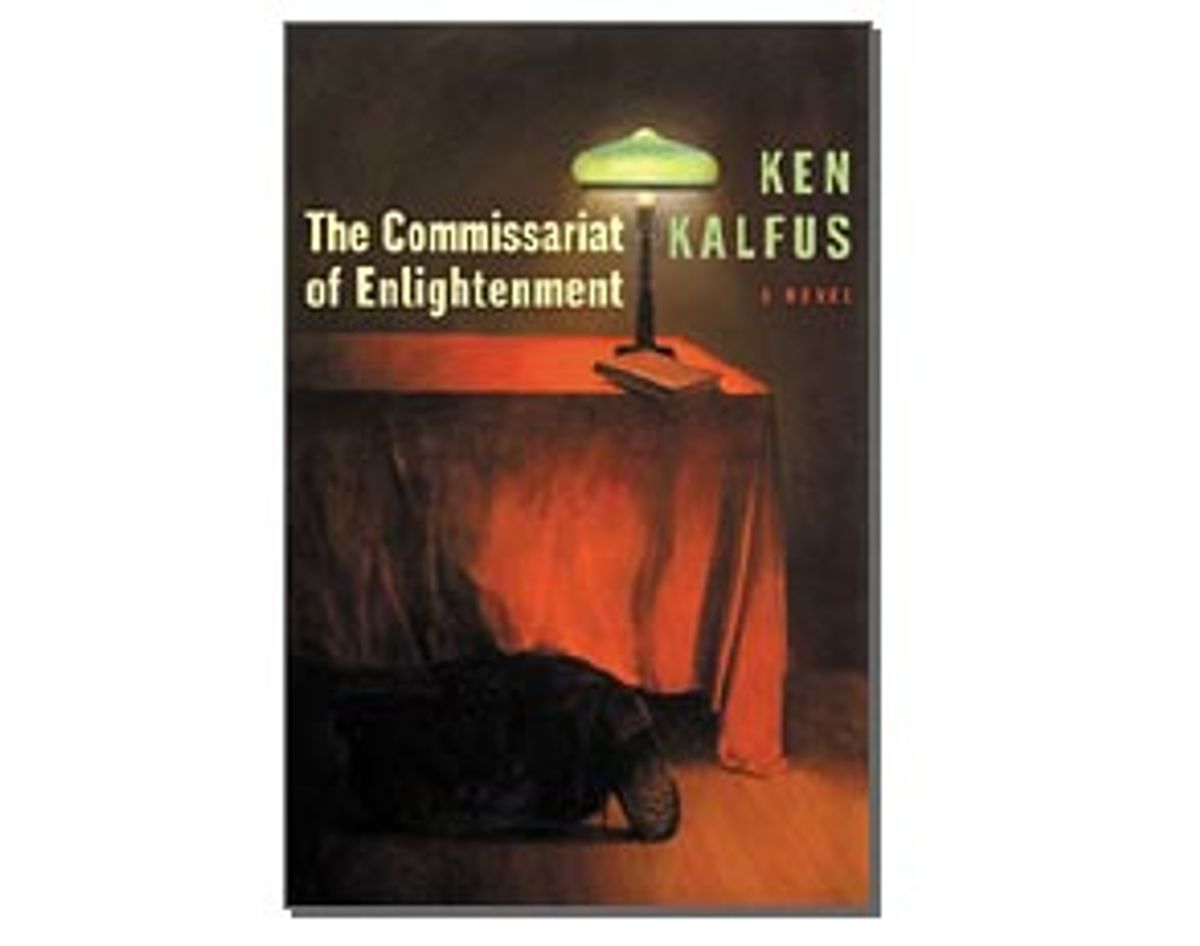
Ken Kalfus' first novel explores how untruths spread throughout the Soviet Union -- and the human heart.

  • more
    • All Share Services

Stalin's lies, our lies

The old Soviet Union now seems so dated in every way — ideology, art, political structure — that if it were not for the horrors perpetrated by that state, it would look like a lame joke, all “girl meets tractor” plays and visions of a worker’s paradise so dull no one would want to live in it even if it actually existed. But Ken Kalfus’ first novel, “The Commissariat of Enlightenment,” picks out a series of moments in 20th century Russian history that have their counterparts in the West. It’s the story of the birth and the triumph of the radically unreal. And while the Soviet Union’s lies aren’t the same as our own, in Kalfus’ view the way a certain species of lie gets told, gets spread and ultimately becomes something more powerful than the truth is the same everywhere.

“The Commissariat of Enlightenment” begins with a media circus, the ur-media circus, at least for a country that one character, a British journalist, describes as “this impossible empire,” with “its limitless, valueless steppes; its inaccessible forests; its untappable mineral veins; its teeming, unfished rivers; its lazy and superstitious natives — this hyperborean Congo.” The year is 1910, and the journalist sits on a train rattling toward Astopovo, an obscure rural town where the 82-year-old Count Leo Tolstoy lies dying in the stationmaster’s house. The count (the characters refer to him exclusively by his title) is a popular saint, revered beyond the borders of Russia and even by the nation’s illiterate multitudes. The press has pitched a circus tent outside the house where the count is sequestered, telegraphing regular updates to their newspapers, awaiting the arrival of the countess (whom the count was fleeing when he was taken ill) and patronizing the local taverns and prostitutes.

Among them is young Nikolai Gribshin, a cinematographer for Pathé Frères, the pioneering French film company. Beside his skill with a camera, Gribshin has one other aptitude, an unerring ability to recognize the future. He is transfixed by an eccentric doctor, one among the many fanatics and pilgrims drawn to the scene, who is touting a new method of achieving “life-in-death, the perfect preservation of the qualities of the vital force in a dead animal” — i.e., embalming. He is hoping to embalm Tolstoy’s corpse, to “guarantee his immortal fame.” Both Gribshin and the doctor catch the shrewd attention of a man who drifts through the crowd, noticing everything. He is a “revolutionist,” always on the lookout for anything he might make use of someday. His name is Stalin.

“The Commissariat of Enlightenment” is Gribshin’s story, from his days at the rural train stop, through the revolution — after he has taken the name Astapov in honor of the place where his life was galvanized — to his years as a Commissar of Enlightenment, the department of Stalin’s government devoted to propaganda. But this novel is just as much the story of powerful ideas and how they change when they collide with each other. In one early scene, Lenin is hiding out in a farmhouse and when Stalin comes to the door, the Hegelian password is “Thesis!”; the countersign, “Antithesis!” and the counter-countersign, “Synthesis!” That’s precisely the arc traveled by Kalfus’ novel and, in it, the art and craft of film.

The thesis is Russia, as the British journalist characterizes it: vast, inert, mired in ignorance and stubbornly devoted to its religion, a primitive faith embodied in icons. It is a land of peasants, “frozen in time, leaning away from their carts, against the direction of history.” Gribshin has learned to be skeptical about reform after a boyhood spent roaming the countryside with his schoolteacher father. “You couldn’t teach these people to read and expect to ‘elevate’ them,” he concludes. “You had to make new people, a far more complicated task.” What finally persuades him to believe in the possibility of making new people is a technology: the cinema.

Moving pictures are the antithesis of the past, to Gribshin’s mind. Working for Pathé, he grows to see that “History was no longer a story about the past. It was now. History had crystallized into a single point, a geographical and temporal nexus at the end of a smoke-and-dust-filled shaft of electric light.” When the doctor accuses him of dabbling in “another beer hall entertainment,” he protests: “Cinematography remains the most promising tool for public education.” The doctor, not coincidentally, argues that embalming “promotes universal education in a way undreamed of merely five years ago!” It’s part of the tenor of their time to talk about revolution as if it were more than just a turn of the wheel leaving you just about where you started. The masses will be taught, and transformed.

It takes Stalin to recognize the similarities between these two technological innovations and their synthesis with Russia’s deep, immanent darkness. “You are also involved in an enterprise dedicated to preserving the appearance of life,” he observes to Gribshin. Embroiled in an argument with Lenin about religion and what use the revolution might make of both it and the dying count, Stalin says, “witness the passions stirred by the Count’s presence — the idea, the symbol of the Count — you’ll understand that the masses need something to worship. They love the Count, much more than they love the ideas and symbols of revolutionary socialism … But it can be shown … that our movement is a development and modernization of the Count’s teachings. We may derive our moral authority from the Count.” “We derive our moral authority from the scientific study of history!” Lenin retorts.

What the historical moment calls for, as Gribshin/Astapov sees it, is a pitched battle between the light of science and the murkiness of Russia’s past. Tolstoy himself embodies the struggle — a man “disgusted by the sex act, regardless of its purpose or the state of affairs between the man and the woman” who nevertheless fathered 13 legitimate children and uncounted illegitimate ones; a man who deplored organized religion but was regarded as a saint; “a landed aristocrat, with thousands of peasants working on his estates” who “believed it was wrong to live off another man’s labor.” In a terrific set piece from the book’s second section, Astapov tries to free a group of villagers from the thrall of their local church by bringing in a row of movie lamps to flood the church’s mystic shadows with electric light (something they’ve never seen): “The light deeply soaked the room now, revealing its secret places — cobwebbed corners, ratholes. Ancient patches of cement glistened in the stonework. The place was filthy. In steps, the church was becoming as mysterious and hallowed as an old barn.”

But when Astapov forces open a sarcophagus to demonstrate that the local saint’s body has not, as reputed, remained in a miraculously uncorrupted state, the human capacity for irrationality thwarts him. His solution, though shocking, shouldn’t be surprising. It’s pure Stalin.

The Stalin we see in “The Commissariat of Enlightenment,” however, is mostly the trickster politician, not the brute. That doesn’t make him any less frightening, though, for Stalin is the one who first grasps that the power of the cinema lies not in its capacity to record the truth, but in its ability to “assemble facts into something useful … all sorts of facts: picture-facts, word-facts, half-facts, former facts, future facts, unfacts, facts to be drawn from the ether … Facts that are not facts — that are, in fact, lies — until they’re in the service of the revolution.” He uses technology to create not new kinds of people, but new kinds of icons; he assumes the people’s hunger for them can’t and perhaps shouldn’t be eradicated. The book ends with a gruesome scene worthy of an old “Tales From the Crypt” comic, describing the creation of the Soviet Union’s most potent crypto-religious relic.

Kalfus, a writer of chameleonic fluency, adopts a worldly, seasoned tone throughout. It’s a sometimes eerie mimicry of the voice of classic Russian novels, weary cultivation shot through with hectic flashes of doomy exuberance. This is a far cry from how the perplexities of image culture usually get explored in fiction — no jitters, no brand names, no chic numbness. Yet it feels deeper and more true that the usual DeLillo-esque exercise; Kalfus doesn’t just observe that contemporary life is dissolving into a field of flickering, substanceless projections, he asks what it is about human nature that makes us so susceptible to such mirages. And suddenly the shadow world of Soviet Russia doesn’t seem so far away after all.

Continue Reading Close
Laura Miller

Laura Miller is a senior writer for Salon. She is the author of "The Magician's Book: A Skeptic's Adventures in Narnia" and has a Web site, magiciansbook.com.

What to watch instead of “Winnie the Pooh”

While the yellow bear makes a comeback on the big screen, his Soviet doppelganger Vinni Pukh deserves some love too

  • more
    • All Share Services

What to watch instead of Vinni Pukh (or Vinni-Puh), the Soviet cousin of Winnie the Pooh.

With its totally un-Pixarlated look and nougaty nostalgia core, Disney’s new “Winnie the Pooh” movie might be the perfect antidote for the summer 3-D blockbuster. Then again, do you really want to pay $12 for a film whose main appeal is that it feels old? Not to get all Eeyore on you, but I’d just as soon fork over my money for something I haven’t seen before. (Which also rules out the new “Transformers,” with its reused fight sequences.)

I know I’m not the intended audience for “Winnie the Pooh,” and by all rights, it looks like a very cute picture. But if you’re looking for a more far-out interpretation of A.A. Milne’s children’s classic, check out the Soviet-era “Vinni Pukh” cartoons (sometimes translated as Vinnie-Puh), a trilogy of Russian shorts based on Boris Zakhoder’s translation of “Winnie the Pooh.”

Not only does Pukh-Pooh look and talk like an Ewok, but the world he inhabits is beautifully sketched out in smudged colored pencil, giving you the sensation that you are actually watching animated characters walk around the illustrated landscape of a children’s book.

Episode One: “ Winnie the Pooh


Episode Two: “ Winnie the Pooh Goes Visiting


Episode Three (in two parts): “Winnie the Pooh and a Day of Care

For any native Russian speakers out there: How well does the translation hold up? Do you prefer Vinni Pukh, or the American Pooh?

Continue Reading Close

Drew Grant is a staff writer for Salon. Follow her on Twitter at @videodrew.

Gorbachev accuses Putin of contempt for voters

Former Soviet leader also says Russian government only has imitations of parliamentary and judicial systems

  • more
    • All Share Services

Gorbachev accuses Putin of contempt for votersRussian Prime Minister Vladimir Putin seen during his meeting with Sports Minister Viltaly Mutko, left, and Tatarstan regional President Rustam Minnikhanov to discuss preparedness for the Universiade-2013 in Kazan, in the Konstantin Palace near St. Petersburg, Russia, Wednesday, Feb. 9, 2011. (AP Photo/RIA Novosti, Alexei Druzhinin, Pool)(Credit: AP)

Former Soviet leader Mikhail Gorbachev has accused Russia’s current rulers of conceit and contempt for voters in his harshest criticism of the government yet.

Gorbachev on Monday criticized Prime Minister Vladimir Putin and President Dmitry Medvedev for saying that they will decide between them who should run for president in Russia’s March 2012 presidential vote.

Gorbachev said the statements show an “incredible conceit” and disrespect for voters. Gorbachev has previously avoided personal criticism of Putin, who is widely expected to reclaim presidency.

Gorbachev, who will turn 80 next week, also denounced the main pro-Kremlin United Russia party as a “bad copy” of the Soviet Communist Party and said that Russia has only imitations of a parliament and judicial system.

“How I Ended This Summer”: A thriller from the Russian Arctic

Pick of the week: "The Shining" meets "Shutter Island" in the subtle, spectacular "How I Ended This Summer"

  • more
    • All Share Services

Grigory Dobrygin in "How I Ended This Summer"

I feel pretty safe in telling you that there are layers of social and political allegory beneath “How I Ended This Summer,” Russian director Alexei Popogrebsky’s thriller about two men alone in the Arctic. I mean, it’s a Russian movie — that goes with the turf. But you don’t have to go spelunking for deep meanings below this impressively crafted piece of cinema to enjoy it. Filmed at an actual meteorological research station in the Russian Arctic coast that was built under Stalin, “How I Ended This Summer” combines memorable images of the gorgeous, rugged wilderness, meticulous sound design that emphasizes the characters’ isolation, a dash of dark wit and a dose of madness.

Yes, if you’re keeping score at home that makes three weeks running that Pick of the Week has settled on a foreign film from a snowy northern country (with a fourth, I suspect, on the way next week). I’m not exactly doing it on purpose, but it may well have something to do with the amazing winter those of us in the eastern two-thirds of the country are enduring. Actually, compared to the frozen slush of the Northeastern megalopolis in February, the desolate beauty, perpetual sunlight and endless seafood buffet of an Arctic Ocean summer look like Barbados.

Officially, we learn very little about Pasha (Grigory Dobrygin) and Sergei (Sergei Puskepalis), the entire crew of this remote island station. They’re spending the Arctic summer monitoring instruments and sending the numbers back to some central authority, but we’re never quite sure what they’re reporting and why, we don’t know where they came from, and we don’t learn much about their lives back in civilization. There might be 20 years or so between them, and Pasha, a sleepy-eyed, earring-clad, Brad Pitt-looking hipster type, is familiar with all kinds of new technology that the grizzled Sergei views with disdain. It’s Pasha’s first and probably only summer on the island, while Sergei’s been coming there for years, and feels intimately connected with a tough-guy history that goes back to 1935.

Popogrebsky builds the psychological tension slowly but inexorably, delivering spectacular time-lapse shots of the changing landscape in this barren but beautiful place (the cinematography is by Pavel Kostomarov) and an entire litany of subtly disorienting sounds: The nearly constant background crackle of radio static; the sloshing of the sea, the hammering of wind and the cries of birds; the ubiquitous house-metal dance music from Pasha’s headphones. The film is often so spectacular, so hypnotic, that you just want to swim in its sensual wonders — but it’s propelling a narrative too. Eventually we notice, without anyone mentioning it, that while Pasha and Sergei sleep and cook walrus meat and report incomprehensible data and play video games (OK, only Pasha does that), the sun never, ever goes down. The landscape goes from morning to noon to afternoon to early evening and then starts all over again. You know, it might be enough to make you a little crazy.

Sergei and Pasha have settled into a tense but reasonably stable dynamic — the former as borderline-abusive dad, the latter as recalcitrant teenager — and life at the station is a strange combination of barren and idyllic. The principal threats seem to be boredom and loneliness, although it’s true that each man must carry a shotgun every time he leaves the station. (A geophysicist at a nearby base was eaten by a polar bear 30 years earlier.) Then Sergei decides to skip a few shifts to go catch them a barrelful of fresh Arctic trout, and while he’s away Pasha receives an emergency radio message delivering terrible news.

Like almost every other thriller in the genre’s history, “How I Ended This Summer” turns on one character doing something that’s both logically implausible and self-destructive. Why doesn’t Pasha give Sergei the bad news directly, as soon as he gets back to camp with his load of fish? To answer that question fairly, you really have to see the film. I mean, of course it doesn’t make sense — but being trapped on an Arctic island with a hot-tempered, violent loner who’s just learned something that might shatter a normal man’s personality, well, that doesn’t make sense either.

Anyway, the important part is that it’s Pasha’s moral decision, or maybe his cowardly inability to make one, that pushes “How I Ended This Summer” into the realm of quasi-Hitchcock intrigue. Pasha constructs a teetering edifice of lies and deception in order to keep the truth from Sergei, and when he can manage that no longer he heads out on his own into the Arctic fog, trying to wend his way between a murderous Sergei and the hungry bears, between a fatal mistake and acts of criminal madness. This isn’t quite a horror movie, nor does it have some astonishing plot switchback near the end, but nonetheless there are elements of, say, “The Shining” or “Shutter Island” here, in that Pasha has to recognize who his principal enemy is if he hopes to survive.

As I suggested earlier, I think you could successfully interpret “How I Ended This Summer” as a fable about generational conflict in Russia, with Pasha representing the complacent, entitled post-Soviet new technology crowd, and Sergei standing for an old-school, Communist-era ethos of macho struggle and sacrifice. Each has a fatefully blinkered vision of each other and their shared circumstances, and their struggle with each other and themselves carries the weight of a moral or religious conundrum, as if they were in a Tolstoy story instead of an Arctic thriller. By the end of this spectacular, unsparing, surprisingly hopeful film, Popogrebsky argues that if these men from different eras and different worldviews can find some way to communicate, they may yet get off that damned island.

“How I Ended This Summer” is now playing at Lincoln Plaza Cinema in New York. It opens Feb. 11 at Cinema Village in New York and Feb. 25 at the Sundance Kabuki Cinemas in San Francisco, with other cities and DVD release to follow.


Continue Reading Close

How “Battleship Potemkin” reshaped Hollywood

An electrifying new restoration reveals Eisenstein's Soviet-era classic as pioneering action cinema

  • more
    • All Share Services

How

Anybody who thinks that Sergei Eisenstein’s “Battleship Potemkin” is an “art film” either hasn’t seen the movie at all or had it ruined for them by some combination of a butchered print and a tedious film-history professor. As a remarkable new restoration of the 1925 Soviet silent classic makes clear, “Battleship Potemkin” is first and foremost an action drama, a work of straightforward emotion and pulse-quickening tension. This taut, 71-minute picture is stitched together from more than 1,300 shots, very few of them lasting more than three or four seconds. For better or worse, this film’s true revolutionary legacy is not art cinema but Hollywood; it’s got a lot more in common with Tony Scott’s “Unstoppable” than it does with Andrei Tarkovsky.

I’m not being willful or contrarian or anything — it’s just true. Of course Eisenstein was a fervent supporter of the Bolshevik Revolution, who hoped his story about a fabled 1905 uprising by sailors in the Tsarist navy would inspire the oppressed of the earth to throw off their chains and hoist the red flag (hand-tinted in this version, as at the Moscow premiere). But that context was a lot less important than he assumed at the time, and “Potemkin’s” immense cultural impact has almost nothing to do with its purported politics. (The young Joseph Goebbels, whose ideology ran in a different direction, praised the film extravagantly.)

Like other Marxist thinkers and artists of his time, Eisenstein believed that political revolution demanded a revolutionary aesthetics and a revolutionary cinema. He thought his radical innovations in camerawork, composition and (most of all) the quick-cut editing he called “montage” were part of a global shift in mass consciousness, and he was right about that part. Presumably he never imagined that his aesthetic revolution would conquer the world, divorced from the ideology that had inspired it, while the Soviet experiment in social reinvention would become a cruel and miserable failure.

According to film historian Bruce Bennett, “Battleship Potemkin” was personally imported to the United States by silent star Douglas Fairbanks and screened privately for film-industry luminaries on both coasts during the summer and fall of 1926, beginning with a bedsheet projection at Gloria Swanson’s house in New York. “Nobody went Bolshevik,” quipped a columnist for Photoplay magazine at the time, “but a lot of people left with some revolutionary ideas of filmmaking.” It’s safe to say this was one of those collisions that changed the course of cultural history. Has there been a year since the late ’20s when Hollywood didn’t produce multiple imitations of “Battleship Potemkin”?

I’m not so much talking about the most obvious kinds of film-school homage or quotation or rip-off, although the terrifying massacre staged by Eisenstein on the seafront steps of Odessa has been repurposed any number of times, from Brian De Palma’s “The Untouchables” to George Lucas’ “Star Wars Episode III: Revenge of the Sith” to “Naked Gun 33 1/3.” It’s more that “Potemkin” pioneered what became a staple Hollywood genre, the heavily fictionalized, inspirational retelling of historical events, built around easily recognizable archetypes of good and evil. Even more than that, Eisenstein’s montage technique, which builds both tension and momentum through the rapid counterpoint of different images, different camera angles and different points of view, became the model for all future action and suspense cinema.

Any rerelease of an influential classic always raises at least two questions: Can we still see, through the scrim of history, what originally made the movie seem important? And is it still capable of engaging or entertaining us on its own terms? “Battleship Potemkin” may face some of the same problems with viewers as, say, “Citizen Kane” or Godard’s “Breathless” or Bergman’s “Persona,” in that what was once revolutionary about it now seems part of our universal vocabulary. I expected this newly restored version of Eisenstein’s 1925 Russian cut (never seen outside the Soviet Union), the result of almost 20 years of work by film scholars Enno Patalas and Anna Bohn, to be visually impressive, and it certainly is. But I was startled to find myself spellbound by it from beginning to end.

With Eisenstein’s 146 text intertitles — which he conceived as musical or percussive elements — carefully restored and a newly recorded version of composer Edmund Meisel’s score, “Potemkin” no longer seems like a faded relic of Soviet agitprop but becomes a gripping anti-authoritarian melodrama. There’s not much acting or characterization in the modern sense; beefy Bolshevik sailor Vakulinchuk (Aleksandr Antonov) strikes heroic poses, while villainous officer Giliarovsky (Grigori Aleksandrov) snickers through his mustache. (Arguably Hollywood’s principal improvement on Eisenstein’s model was the addition of the star system.)

But the brilliantly mounted early scene in which the ship’s commander orders the mutinous sailors — who have refused to eat borscht made with maggot-infested meat — to be covered in canvas and then shot had me on the edge of my seat. A crazy-haired Orthodox priest, emerging from the shadows like a crucifix-carrying ogre, calls out for the rebels to accept God’s punishment, and some of the condemned men drop to their knees in terror, shrouded by the immense sheet of sailcloth. Exuding the smug, self-satisfied sadism of power, Giliarovsky orders the ship’s guards to raise their weapons and prepare to shoot: “Fire into the canvas.” And then, at the last possible moment, Vakulinchuk steps forward to strike a blow for proletarian consciousness: “Brothers! Who are you shooting at?”

Eisenstein’s mournful, haunting shots of the Odessa waterfront after Vakulinchuk’s death, which is the only section where the film engages a contemplative mode, lead us into the Odessa Steps sequence. I felt as if I were seeing that for the first time. Freed from all the imitation and parody, it’s both a breathtaking technical exercise and a wrenching glimpse of human suffering set against the cruelty of history. The mother with her dying toddler, the old woman shot in the face, the runaway baby carriage — Eisenstein could never have believed that the revolutionary regime he supported would itself commit crimes like these, and worse.

But the tragic historical irony surrounding “Battleship Potemkin” does almost nothing to undercut its power, and like all good political art it cannot be contained by politics. Eisenstein used all the tools at his disposal, inventing new ones as he went along, to engage our passions and emotions first and foremost. He was an artist and a showman more than he realized, and perhaps more than he wanted to be. The young David O. Selznick, who would make “Gone With the Wind” 13 years later, urged his MGM colleagues to study “Battleship Potemkin” as “a group of artists might study a Rubens or a Raphael.” And anybody who thinks that either Eisenstein or Selznick would be horrified by contemporary Hollywood is kidding themselves. If 3-D had been feasible in 1925, I guarantee that baby carriage would be whizzing off the screen right at your head.

The new 35mm restoration of “Battleship Potemkin” opens Jan. 14 at Film Forum in New York, with other cities to follow. This version is also available on DVD and Blu-ray from Kino International.


Continue Reading Close

“Disco and Atomic War”: How David Hasselhoff won the Cold War

A hilarious Estonian documentary (yes, really!) asks whether disco and "Dallas" defeated Communism

  • more
    • All Share Services

A still from "Disco and Atomic War"

You won’t see another documentary all year long that packs quite the same combination of pure fun and eye-opening information as “Disco and Atomic War,” a strange and delightful work of historical collage from Estonian filmmaker Jaak Kilmi. No, I know — I can feel you slipping into a coma out there: O’Hehir is trying to convince me to watch an Estonian documentary! But hang on a second while I fling a pitcher of ice water in your face and explain that this particular Estonian documentary features David Hasselhoff (in his classic “Knight Rider” phase) and dueling Finnish- and Soviet-made instructional videos about disco dancing. And you have not lived, my friends, until you have seen a bunch of 50ish Finnish people in mid-’70s leisure wear completely giving up the funk.

Composed in roughly equal parts of interviews, dryly amusing re-creations of real events and an extraordinary amount of archival footage, “Disco and Atomic War” portrays an unlikely front in the Cold War, little noticed at the time. Or at least little noticed in the West; Kilmi presents evidence that the KGB was well aware that the pop-culture frontier between Finland and Estonia was gnawing a crucial hole in the Iron Curtain. There were other places in the Eastern bloc where citizens sometimes encountered Western media, of course. But listening to West German radio on the east side of the Wall was a dangerous and clandestine affair, whereas Finnish television poured into homes in Soviet-occupied Estonia virtually unrestricted.

As the film documents, there was a thriving industry in adapters and antennae that allowed Soviet-made TVs in Tallinn, the Estonian capital, to pull in the signals from Helsinki, 50 miles north across the Gulf of Finland. No doubt it helped that Estonia was a cultural backwater (from the Russian point of view) and at best a reluctant component of the Evil Empire. Furthermore, Finnish and Estonian are closely related languages understood by pretty much no one else. (Which didn’t stop Finnish broadcasters from running faux-Soviet comedy sketches with stodgy announcers speaking mock-Estonian gobbledygook.)

Even if it didn’t have a significant historical wow factor, “Disco and Atomic War” would stand as a wonderful work of Baltic deadpan humor, in the long and honorable tradition of small countries and minority cultures making fun of themselves so the outside world won’t have to. But Kilmi builds a pretty persuasive case that when Estonians started to watch episodes of “Dallas” and commercials for Helsinki supermarkets — where you could buy actual steak — a fateful Rubicon was crossed, and there was pretty much nothing the Soviets could do about it. Samizdat videotapes of Finnish broadcasts, dubbed or subtitled into Russian, circulated throughout the Soviet Union; collective farms wrote letters to Moscow announcing that they had met their soybean quota for socialism and now they wanted to know who had shot J.R.

Now, just to be clear, the Soviet Union’s collapse was social and institutional and economic. It was a long time coming, and it wasn’t caused by a Finnish-dubbed David Hasselhoff any more than it was by Ronald Reagan. “Disco and Atomic War” is a droll Estonian fable disguised as a history lesson, and vice versa. It’s an ingenious and masterful film, so funny and so heartbreaking it may leave you giggling and crying by turns, and it reminds us that pop culture, even at its most venal and idiotic — perhaps especially then — is the gooey, delicious sauce that comes on top of Freedom fries.

“Disco and Atomic War” is now playing at Cinema Village in New York, and opens Nov. 26 at the Laemmle Sunset 5 in Los Angeles, with more cities to follow.

Continue Reading Close

Page 1 of 8 in Soviet Union