Rupert Murdoch

Rupert Murdoch strikes out

With the Sandy Koufax gay rumor, the News Corp. synergy sewer finally overflows.

  • more
    • All Share Services

Topics:

Rupert Murdoch strikes out

Most of us have learned to simply accept the fact that Rupert Murdoch’s News Corp. exists in the world, just as we’ve come to accept that there are terrorists among us, as well as people who scam grandmothers out of their savings.

And then every once in a while the News Corp. will do something so rapacious, so pathetic, that one has to stand up and say no more, to call for legal and moral measures to stop it, even if all gestures prove futile.

The latest, final line crossed? In December, News Corp.’s scandal sheet, the New York Post, reported in its Page Six gossip column that an unnamed baseball Hall of Famer had been blackmailed into cooperating with a best-selling biography about him — blackmailed under threat that the unnamed woman writer would otherwise claim the Hall of Famer was gay. At the time, the blind item got almost no attention.

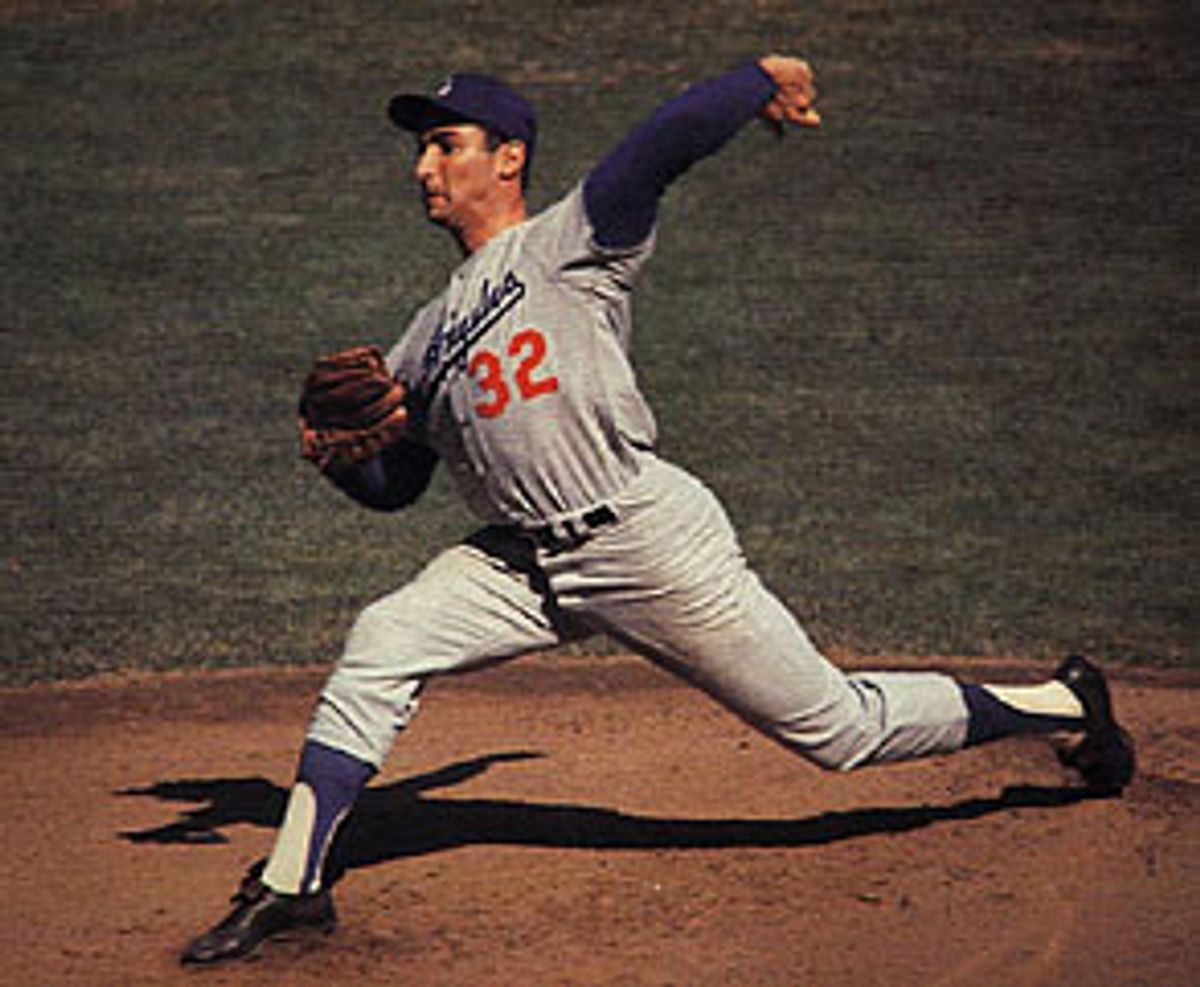
Now, as it turns out, Sandy Koufax, the Los Angeles Dodgers’ Hall of Famer, is the subject of the only recent best-selling baseball biography written by a woman (Jane Leavy’s “Sandy Koufax: A Lefty’s Legacy”). It also turns out that Koufax has quit as a special instructor for the Dodgers because the team is also owned by the News Corp.

The Post’s blind item ran Dec. 19, but it was virtually unknown among legitimate sports media outlets until news leaked out about Koufax’s resignation. And Koufax’s resignation — after 48 years as a Dodgers pitcher, minor league coach, spring instructor and unofficial pitching guru — apparently took place over a month ago. Yet it was not discovered until this week, when sportswriters arriving from Los Angeles for the Dodgers’ annual spring training in Vero Beach, Fla., asked where the Hall of Famer was. The team revealed that Koufax told Dodgers senior vice president Derrick Hall that “it does not make sense for me to promote any” of Murdoch’s companies, and that he would “feel foolish to be associated with or promote one entity if it helps another,” according to the Los Angeles Times.

Koufax has long been one of sports’ truest enigmas. After two years as a little-used “bonus baby” with the Brooklyn Dodgers, and four more as an often brilliant, often lost starting pitcher with the team, he turned, seemingly overnight, into the most dominant left-hander baseball has ever seen. He broke all extant strikeout records, threw a no-hitter every year from 1962 through 1965, and in the last six seasons of his career won 111 games and lost only 34. His retirement at the age of 31 — as abrupt as his transformation into an unhittable pitcher — only added to the legend.

The childhood friend of an extraordinary array of Brooklyn characters running the gamut from Larry King to current New York Mets owner Fred Wilpon, Koufax was married twice, the most recent union ending in divorce about five years ago. For her part, author Leavy denies both the Post’s insinuations about the blackmail and Koufax’s sexuality. In fact, what’s interesting is that so far, Koufax’s sexuality is the McGuffin in this story. The not-so-blind Post item may as well have been about his actually having been a gentile all these years (Koufax was an observant Jew who refused to pitch on Yom Kippur). The point is the News Corp.’s journalistic and ethical malfeasance, and this time around, reporters seem to get that.

It is the New York Post, of course, that published another piece of homophobic baseball gossip last spring that led the New York Mets’ Mike Piazza to feel he had to publicly announce he was not gay. Besides the Post, the News Corp. also owns Fox Television, Fox News Channel, and other companies that produce products structurally similar to “news.”

And in what is perhaps the most subtle twist of this serrated knife, the News Corp. also owns HarperCollins — the company that published the biography about Koufax in the first place.

Read the Post’s December item about the “Hall of Fame baseball hero,” then, in that context. Koufax, the Post wrote, “cooperated with a best-selling biography only because the author promised to keep it secret that he is gay. The author kept her word, but big mouths at the publishing house can’t keep from flapping.” So here’s how it worked: The same corporation that published the rumor is actually the source of the rumor. It also profited from the alleged blackmail and employed the victim.

Their book. Their tabloid. Their team. Their scandal. It is a spectacular example of synergy, working at its most efficient (when all moral, ethical and professional standards have been eliminated from the process and thus cannot gum up the works).

Finally, though, on Friday, after the news of Koufax’s principled resignation made national headlines, the News Corp. apologized — sort of. Here’s the press release.

The following will run on Page Six in tomorrow’s New York Post:

A two-sentence blind item we ran here on Dec. 19 about a “Hall of Fame baseball hero” has sparked a series of unfortunate consequences for which we are very sorry. The item said the sports hero “cooperated with a best-selling biography only because the author promised to keep secret that he is gay.” Two weeks later, the Daily News’ Michael Gross, after finding “Sandy Koufax: A Lefty’s Legacy” by Jane Leavy on the bestseller list, named Koufax as the player and ran a photo of him. Koufax himself, an intensely private man, was deeply offended by our item. The author has denied making any deal with Koufax and called our item “erroneous.” We apologize to both Koufax and Leavy for getting it wrong.

Note that even the supposed “apology” tries to blame the scandal on a competitor at the Daily News. That’s typical. I worked for News Corp. — for its Fox network and one of its cable sewers, Fox Sports Net, for three years. They were swine. Many companies are swine. But the Koufax episode is something extraordinary. This is the triangulation of swine — three bullies beating up one kid called decency.

Early in 2001, as a show of good faith with the company, I signed a contract with the News Corp.’s publishers, HarperCollins, to write a sports book. Its production was tabled after the terrorist attacks. Now I will not write the book. I’m sending the money back. My reasons are ethical and practical.

Practical?

Though the advance was only five figures, I think the News Corp. can use the dough. It might let Rupert Murdoch and his employees buy their souls back.

Continue Reading Close

Salon columnist Keith Olbermann hosts the ABC Radio Network's "Speaking of Sports ... Speaking of Everything."

Murdoch’s murky future

A UK report declares him "unfit" to run an international company. Here's what it means for his U.S. media holdings

  • more
    • All Share Services

Topics: ,

Murdoch's murky futureNews Corp. chairman Rupert Murdoch and his wife Wendi Deng arrive at the High Court in London to give evidence to the Leveson Inquiry into phone hacking, Thursday, April 26, 2012. (AP Photo/Sang Tan) (Credit: AP)
This article originally appeared on GlobalPost.

LONDON — How do you solve a problem like Rupert Murdoch?

Global PostThat’s the issue now facing sections of his media empire after a damning British parliamentary report labeled the powerful press tycoon unfit to run a major international company.

A committee of British legislators who have spent months investigating the phone hacking scandal involving one of Murdoch’s leading UK newspaper titles concluded this week with a majority verdict that the 81-year-old was “not a fit person” to be at the helm of News Corp.

Their findings grabbed attention not just in the UK but across the Atlantic, where headlines in the New York Times, Washington Post and Murdoch’s own Wall Street Journal must have made uncomfortable reading for News Corp. staff and shareholders.

The committee’s judgment carries no threat of sanction, but with lawsuits pending in the US over hacking and the threat of possible prosecution under the powerful Foreign Corrupt Practices Act, it will offer little in the way of reassurance.

Having conceded that the British parliamentary inquiry was right to highlight “serious wrongdoings” at the now defunct News of the World title, News Corp. took issue with the “unjustified and highly partisan” verdict on its boss.

Murdoch himself issued a statement to staff admitting mistakes but declaring that “our business has never been stronger.” News Corp.’s board also issued a statement saying it had “full confidence” in its CEO and chairman.

However, with criticism of Murdoch continuing to mount in the UK, questions were being raised as to what extent the report would harm his business interests both here and in the United States, with some shareholders suggesting it was time to shift power out of Murdoch’s hands.

A day after the report, elements of his $50 billion media empire appeared to be attempting to distance themselves from Murdoch, not just by prominently reporting the committee’s scathing assessment, but by explicitly stating their independence of his command.

There was speculation that a small surge in News Corp. share prices in the wake of Tuesday’s verdict reflected anticipation that the company would soon divest itself of its troubled UK newspaper titles and set wheels in motion to reduce Murdoch’s influence over the company.

Rupert Murdoch is “finished in the United Kingdom,” wrote Michael Wolff, author of “The Man Who Owns the News,” an unauthorized biography of the News Corp. founder. “Understanding that Britain is a lost front, he will retreat to his U.S. stronghold. From New York, the process of disposing of the British papers, which, by reliable insider accounts, has begun, will hasten.”

Of primary concern in the UK is whether the “not a fit person” verdict will have any impact on a separate inquiry by British communications industry regulator Ofcom over whether News Corp. is a “fit and proper” owner of a lucrative 39.1 percent stake in prominent broadcaster BSkyB.

Any decision that would force News Corp. to offload its BSkyB holding would be a considerable blow to the media giant, which had hoped to buy the broadcaster outright but later abandoned the deal after the phone hacking scandal inflamed opposition.

On Wednesday, BSkyB’s chief executive, Jeremy Darroch, used the publication of record financial results to disassociate his company from Murdoch and — clearly wary of the threat to its prized broadcast license — talk up its annual $1.6 billion tax contribution to the British economy.

“I would emphasize that it’s important to remember that Sky and News Corporation are separate companies,” he told reporters. “We believe that Sky’s track record as a broadcaster is the most important factor in determining our fitness to hold a license.”

Aware of the potential damage his presence could bring to the company, Murdoch’s son James last month stood down as chairman of BSkyB, saying he didn’t want to be a “lightning rod” for criticism over the hacking scandal.

Speculation is now mounting over whether the News Corp. brand will also be vulnerable to critical, financial and legal thunderbolts if Murdoch senior resists shareholder efforts to usher him into a backseat role.

“I think you have to be careful about extrapolating from what has been an appalling set of circumstances around one newspaper group … to the continuing demise of News Corp.,” said Charlie Beckett, director of Polis, a media and society think tank at the London School of Economics.

Beckett said that while the parliamentary verdict would certainly cast a shadow over any News Corp. deals, mergers or takeovers in the future, there was nothing inevitable about the demise of the company or its subsidiaries.

Likewise, he said that while there was support for scaling down Murdoch’s control over News Corp., shareholders would also bear in mind the fact that the media tycoon’s sharp business acumen has consistently paid dividends, regardless of any questions of ethical culpability.

“There are some people who would welcome the defamiliarization of the company, but you could also argue that this is a guy who has an extraordinary track record on delivering profit,” he told GlobalPost.

Beckett said that plans would already have been in place to arrange a succession of command, and while these may now be fast tracked down from five years to two, News Corp. would be unwise to proceed with too much haste.

“It’s in everyone’s interest for the thing to not fall apart in the next year or two. Even those people who want Murdoch to recede don’t want him to jump out of the top floor. That would be far too destabilizing.”

Continue Reading Close

Murdoch’s empire strikes back

The media mogul and his family have turned the tables on the British government in the News Corp. scandal

  • more
    • All Share Services

Topics: , ,

Murdoch's empire strikes backNews Corp. CEO Rupert Murdoch (Credit: AP Photo/Noah Berger)
This article originally appeared on GlobalPost.

LONDON — Last year, Rupert Murdoch struck a contrite note to U.K. lawmakers over the phone-hacking scandal involving his newspapers. He told them it was his “most humble” day.

Global Post

The scandal cost him one of his most lucrative titles — the tabloid News of the World — and resulted in possible criminal charges for his trusted lieutenant Rebekah Brooks and the arrest of a dozen reporters on his beloved Sun newspaper.

Now, Murdoch appears to be fighting back.

He and his son James were in the U.K. this week to face the Leveson inquiry, a judicial investigation into press standards, begun last year in the wake of revelations that journalists at Murdoch’s U.K. titles illegally hacked the voice mails of prominent public figures.

This time, he and his family appear to have turned on the British establishment, pressuring Prime Minister David Cameron and putting a key minister in the spotlight over a controversial business deal.

In his evidence on Tuesday, James Murdoch released documents that appeared to show that Jeremy Hunt, a media minister charged with examining a $13.4 billion bid by Murdoch’s News Corp. for full control of British Sky Broadcasting, had secretly helped to progress the deal.

The revelations sent Cameron’s government into a tailspin. Cameron pledged to stand by Hunt — who is overseeing the 2012 Olympics — while Hunt himself was forced to defend his actions to Parliament, denying claims he gave News Corp. a “back channel” of influence over the bid.

In an attempt to limit the damage, Hunt’s advisor Adam Smith — a key link in communications with James Murdoch — tendered his resignation at the same time that a relaxed-looking Murdoch senior was taking the stand to deny he held any sway over Britain’s politicians.

News Corp.’s bid to buy BSkyB was ruled out last year in the wake of the phone-hacking scandal, an outcome that soured the once-cordial relations between Murdoch and Cameron. This breakdown appears to have set the tone for Murdoch’s reappearance.

Even before giving evidence at the Leveson inquiry, Rupert Murdoch appeared to be on the offensive against the government. Last month he took to Twitter to complain about “old toffs and right wingers” — a likely dig at the British establishment.

More followed when he arrived in London last weekend. In one tweet he criticizes the economic policies of Cameron’s government. “Govt sending IMF another ten bn to he euro. Must be mad,” he wrote.

Murdoch’s offensive and the question mark over Hunt couldn’t come at a worse time for Cameron. His government is already under fire for provoking a recent fuel crisis and for a financial budget that was derided in Parliament as an “omnishambles.”

A recent poll showed the ruling Conservatives have lost their command over the main opposition Labour Party, largely as a consequence of the budget.

To make matters worse for Cameron, it was announced on Wednesday that Britain had slumped back into recession despite forecasts of economic recovery.

But, despite his tweets, Murdoch insists he hasn’t been gunning for the government. Asked by Leveson counsel Richard Jay if “rumors” were true that he had not forgiven Cameron, he said they were not. He added: “Don’t take my tweets too seriously.”

Speculation had been rife that Murdoch would use his Leveson appearance to launch a “slash and burn” offensive, as one commentator put it. Some speculated his revelations could take direct aim at Cameron, possibly making the prime minister’s position untenable.

Continue Reading Close

David Cameron’s fun American vacation marred by more phone-hacking arrests

As the prime minister enjoys America, his good friends the Brookses are arrested back home

  • more
    • All Share Services

Topics: , , , , ,

David Cameron's fun American vacation marred by more phone-hacking arrestsDavid Cameron and Rebekah Brooks (Credit: Reuters)

Insecure countries are known to lock up unsavory elements when international guests are expected, so it should not have been a terrible shock to see that the U.K.’s Metropolitan Police had arrested former News Corp. executive Rebekah Brooks and her horse-training husband, Charlie, yesterday, a few short months before the opening ceremonies of the London Olympic Games. The Brookses are now, apparently, back on the streets, having made bail.

The Brookses were arrested, along with four others, “on suspicion of conspiracy to pervert the course of justice.” This was the second time Rebekah Brooks, the former editor of the Sun and the now-shuttered News of the World, had been arrested — the last time it was for conspiring to intercept communications, or “phone hacking” — and this arrest suggests that News International’s extensive efforts to cover up their unethical practices may end up damaging the company just as much as the unethical practices did.

Brooks’ newspapers gathered a great deal of news by illicitly listening to the voice-mail messages of celebrities and members of the royal family and murder victims. They also had a private investigator on contract to do other law-violating things, and they had a bribery budget that would make most American newspaper publishers jealous. Once Murdoch’s British newspaper empire faced civil, criminal and Parliamentary inquiries, they went on an email-destroying binge. They have since become much more cooperative, but deleting half a terabyte worth of emails to and from executives and destroying computers used by journalists under investigation is really not a sound legal strategy.

James Murdoch, still the News Corp. heir apparent, has written a note of apology to members of Parliament. He owes them an apology because the recoverable emails among the deleted cache strongly indicate that he lied to Parliament about his awareness of the extent of phone hacking. James has also essentially fled the country, having resigned from his father’s British newspapers company and taken a job at his American-based international pay television company.

Meanwhile, British Prime Minister David Cameron is in the middle of his well-publicized state visit to the United States. Barack Obama has taken him to a “basketball match,” which Cameron found “hard to follow.” The right-leaning U.K. papers have been extremely overexcited in their coverage of the PM’s visit, because, again, national insecurity.

Cameron was surely thrilled to be out of the country when the Brookses got collared. They’re neighbors and close personal friends. Charlie Brooks and Cameron go way back — they attended Eton together, and as equally ridiculous posh stereotypes they got along famously — and earlier this month it was revealed that Cameron had ridden a retired police horse that the Met had for some reason given to Rebekah Brooks. (The only way the ensuing scandal could’ve been more British is if it had involved a Tory MP and a dominatrix.)

Speaking of horses, Charlie Brooks has one running in a race today. As the Guardian noted, he had a column published the day he was arrested in which he said, tragically, that “the happiest moment of my year is about three hours before the first race at Cheltenham on Tuesday.”

As for old Rupert himself, he hasn’t tweeted anything since Saturday. But he assured employees at the Sun that they’re in the clear, and he’s headed to London to perform damage control. His British newspapers hold a special place in his heart, making it a bit poignant — or hilarious, depending on your perspective — that that tiny arm of his vast international empire is the one that is currently destroying everything he’s spent a lifetime building.

Continue Reading Close
Alex Pareene

Alex Pareene writes about politics for Salon and is the author of "The Rude Guide to Mitt." Email him at apareene@salon.com and follow him on Twitter @pareene

Rupert Murdoch faces angry investors

News Corp.'s annual shareholder's meeting could end with a series of embarrassing votes for the powerful media mogu VIDEO

  • more
    • All Share Services

Topics: , , , ,

Rupert Murdoch faces angry investors Rupert Murdoch (Credit: AP)

Rupert Murdoch’s News Corp. is holding its annual shareholder meeting in Los Angeles. And a vocal group of News Corp. shareholders are a bit peeved at the media conglomerate’s performance recently. The performance that has upset them the most: all the phone hacking and police bribery followed by a lengthy coverup that has been rapidly unraveling this year.

The rebellious shareholders include British MP Tom Watson, who was personally lied to by James Murdoch at a Parliamentary hearing, and various pension funds. Also present: The secretary of the ethical investment advisory group of the Church of England. The Church would like Murdoch removed as director of the company.

The Guardian is delightfully liveblogging the meeting, which is handy, because News Corp. banned all cameras and recording devices. Audio of the meeting was streaming on the News Corp. corporate site for investors or those willing to claim to be investors on a registration page, but it just ended while they hold their shareholder votes. As he took questions, Murdoch sounded much more involved and feisty than he did in his confused appearance before Parliament earlier this summer. “I’d hate to call you a liar, but I know exactly how you’re going to vote,” he said to a hostile questioner who claimed to have not yet made up his mind.

Watson rehashed the various criminal complaints against News Corp. and added allegations of computer hacking. Others complained about Murdoch’s management of the corporation as a sort of personal fiefdom, with nepotism rampant. One guy wanted to talk about animal rights for a while.

Media Matters has the audio of Watson’s questioning:

Murdoch is not in much danger of losing his company. As Reuters says, he has 40 percent control of voting shares, and next largest holder is Murdoch ally and Saudi Prince Alwaleed bin Talai. But the L.A. Times suggests News Corp. president Chase Carey could end up being promoted to CEO.

There are three crucial votes: The vote to reelect Murdoch and the rest of the board, the vote to cut Murdoch’s pay, and a vote to specifically force Murdoch to step down. He’ll probably win all three but the votes could be close enough to force the board to make some changes. And in the longer term, this could ruin Murdoch’s plan to have one of his kids run the company some day. (Son Lachlan having failed, Rupert still has to choose between Elisabeth and James.)

All the “media watchdogs” in the world will never remove Murdoch from power or shame him into changing his business practices, but once major institutional investors revolt, there’s a serious possibility of the end of the Murdoch era. Money, as always, speaks loudest.

Continue Reading Close
Alex Pareene

Alex Pareene writes about politics for Salon and is the author of "The Rude Guide to Mitt." Email him at apareene@salon.com and follow him on Twitter @pareene

Murdoch to pay $3.2 million to schoolgirl’s family

Settlement reached in phone-hacking scandal that shut down News of the World

  • more
    • All Share Services

Topics: ,

Murdoch to pay $3.2 million to schoolgirl's familyNews Corp. CEO Rupert Murdoch delivers a keynote address at the National Summit on Education Reform on Friday, Oct. 14, 2011, in San Francisco. (Credit: AP/Noah Berger)

LONDON (AP) — Rupert Murdoch’s company said Friday it has agreed to pay 2 million pounds ($3.2 million) to the family of a murdered schoolgirl whose phone was hacked by the tabloid News of the World.

News International and the family of Milly Dowler confirmed the settlement in a joint statement. It said Murdoch also will donate 1 million pounds ($1.6 million) to charities chosen by the Dowler family, including youth and cancer research groups.

Murdoch shut down the 168-year-old News of the World in July after evidence emerged that its reporters had eavesdropped on the telephone voice mail messages of the 13-year-old who disappeared in 2002 and was later found murdered.

That touched off a storm of public outrage that rocked Murdoch’s media empire and ricocheted through Britain’s political, police and media establishments.

“Nothing that has been agreed will ever bring back Milly or undo the traumas of her disappearance and the horrendous murder trial earlier this year,” the Dowlers said in the statement. “The only way that a fitting tribute could be agreed was to ensure that a very substantial donation to charity was made in Milly’s memory. We hope that projects will be undertaken so that some good can come from this.”

Murdoch met with the Dowlers in July to personally apologize to the family, saying he was “appalled” to have discovered what happened.

In the statement Friday, he said he hoped something positive can be done in memory of Milly.

“The behavior that the News of the World exhibited towards the Dowlers was abhorrent and I hope this donation underscores my regret for the company’s role in this awful event,” he said.

The revelation that reporters eavesdropped on Milly Dowler’s voice mail messages while police were searching for her — and mounting evidence that phone hacking was routine at the newspaper — scandalized the British public.

In a letter to lawmakers disclosed Thursday, Surrey Police Chief Constable Mark Rowley acknowledged that his force knew as far back as April 2002 that someone working for the News of the World had accessed Dowler’s voice mail, giving false hope to the missing teen’s family and potentially interfering with the investigation into her disappearance.

The phone hacking scandal has forced the resignation of two of London’s top police officers, ousted executives at Murdoch’s News Corp. and claimed the job of Prime Minister David Cameron’s former spin doctor, Andy Coulson, an ex-News of the World editor.

Murdoch’s global News Corp. has expressed contrition, launched an internal inquiry and set aside 20 million pounds ($32 million) to compensate victims, who could number in their hundreds.

Still, the News Corp. CEO is under pressure. On Friday, he will face shareholders with small stakes in his company for the first time since the phone-hacking scandal broke in July.

British lawmaker Tom Watson, one of Murdoch’s fiercest British critics, traveled to Los Angeles to attend the annual general meeting and has said he plans to use the event to reveal new details of what he claims are covert surveillance techniques by company employees.

_____

Associated Press writer Jill Lawless contributed to this report.

_____

Cassandra Vinograd can be reached at http://twitter.com/CassVinograd

Continue Reading Close

Page 1 of 23 in Rupert Murdoch