Roman Polanski

The 75th Oscars: Hollywood dons its war paint

Movie people act all serious while Marines die, the Academy actually provides some surprises (Adrien Brody, anyone?) and Michael Moore pees on the furniture. And Nicole, honey, write a speech, OK?

  • more
    • All Share Services

The 75th Oscars: Hollywood dons its war paint

I once heard about a stripper in San Francisco who worked in one of those Talk-to-a-Naked-Girl-in-a-Box things. She would sit on a chair, spread her legs, and conceal her face with a large hardback copy of “Ulysses.” Who knew if she was actually reading it? It didn’t matter. I’m not really showing you my crotch, I’m reading the world’s most difficult and serious literature.

Wow, her customers thought. She looks smart.

Hollywood looked smart last night with its book-and-crotch act, and the book was Suze Orman’s “9 Steps to Opinionated Speaking Without Alienating the Big Money.”

What a conundrum. Hollywood vocally opposes the war, but the war is real popular in all those icky noncoastal parts of the country full of fat people who buy lotsa movie tickets, guns and bacon. Whaddaya do? Well, you take back that hot-pink, Galliano gownless evening-strap and don a serious wartime pantsuit. Actors: Act serious and respectful. Directors: Act thoughtful and concerned. And everybody: Act like the Oscars aren’t really happening — the movie industry isn’t really masturbating for itself in the mirror again, for a paying audience, because there’s a war on and that wouldn’t really be proper.

Welcome to the Humble, Self-Effacing Oscars! And what better person to deride the landed gentry of the industry from the soft pink insides than wacky old Steve Martin. All the sacred cows, gently nudged. Oh, naughty Steve. Teasing Tom Cruise for being rich. Nicholson referred to as gay, in jest. Mickey Mouse called a “black actor.” Oh, ho ho ho. Hey, for the Oscars, and somebody of Steve’s age, that stuff is downright “edgy,” and chuckles did abound. Steve Martin was pretty funny, and some of the movies this year were pretty good. But nobody was able to justify the existence of the Oscars this year. Oscar shot his self-rationalizing power-wad defending himself after 9/11. Tom Cruise and his napalm-eyed Rent-a-Passion was not around to hypnotize us into submission this year.

There were no more black people to cry tears of overdue praise for. Everybody knew the night was doomed, and they all just wanted to put their pants back on, take their tips and shut the curtain.

But the show must go on, because it was already sponsored by JC Penney and other corporations.

At least JC Penney got all dressed up for the occasion, with its new, Sheryl Crow-esque “I Am Woman, See Me Wear Tiny Dresses” campaign. And the Victoria’s Secret ad featured a Bob Dylan number, bringing soulful dignity and depth of thought to bra-and-panty sets. I’m beginning to see a trend brewing with this James Joyce beaver-shot thing. Like when Jennifer Garner’s teleprompter script had her referencing Benjamin Disraeli. On the flip side, there was Led Zeppelin shilling for Cadillac, which is sort of like putting the cover from a copy of Hustler over the text of Dale Carnegie’s “How to Win Friends and Influence People.”

There were a lot of security precautions this year, such as the really, really loud and insistent “Get the Fuck Off the Stage” music, and the wondrous disappearing microphone. Third man on the sound-editing totem pole? “I love you, Deborah!” was the best you could hope for, as the trumpets renounced your welcome and the mike sank into Mordor.

On a happy note, the Academy seemed to smell that everyone in the world expected the wholly expectable, and actually gave out some shockers to some deserving and unlikely candidates. Example No. 1: Best supporting actor Chris Cooper (for “Adaptation”), who is whompingly amazing. I couldn’t believe he’s the same actor who played the gay Nazi dad in “American Beauty”; what stealth. What alchemical shape-shifting.

Example 2: Michael Moore. I thought he was less likely to get an Oscar this year than O.J. Simpson was. Everybody knew he was going to stink up the room if he won, and, sure enough, he displayed his usual talent for getting kicked out of buildings. It’s our night, fat man, said the Academy, and we’re not about to be whined at by a guy with cole slaw on his pants. If Moore had been only slightly more graceful and less abrasive, he could have said anything he wanted to; he had the support. But he’s just not a pet you can bring in the house. He craves disgrace, he has no self-control. Last night, it wasn’t what he was saying that was the problem, but the waddling, honking and gland-spraying with which he said it.

(By the same token, I was surprised to see Susan Sarandon onstage. She looked great, and they didn’t even make her wear a rubber ball in her mouth. She’s such a lefty I’m surprised both of her eyes haven’t traveled over to one side of her head, like a halibut.)

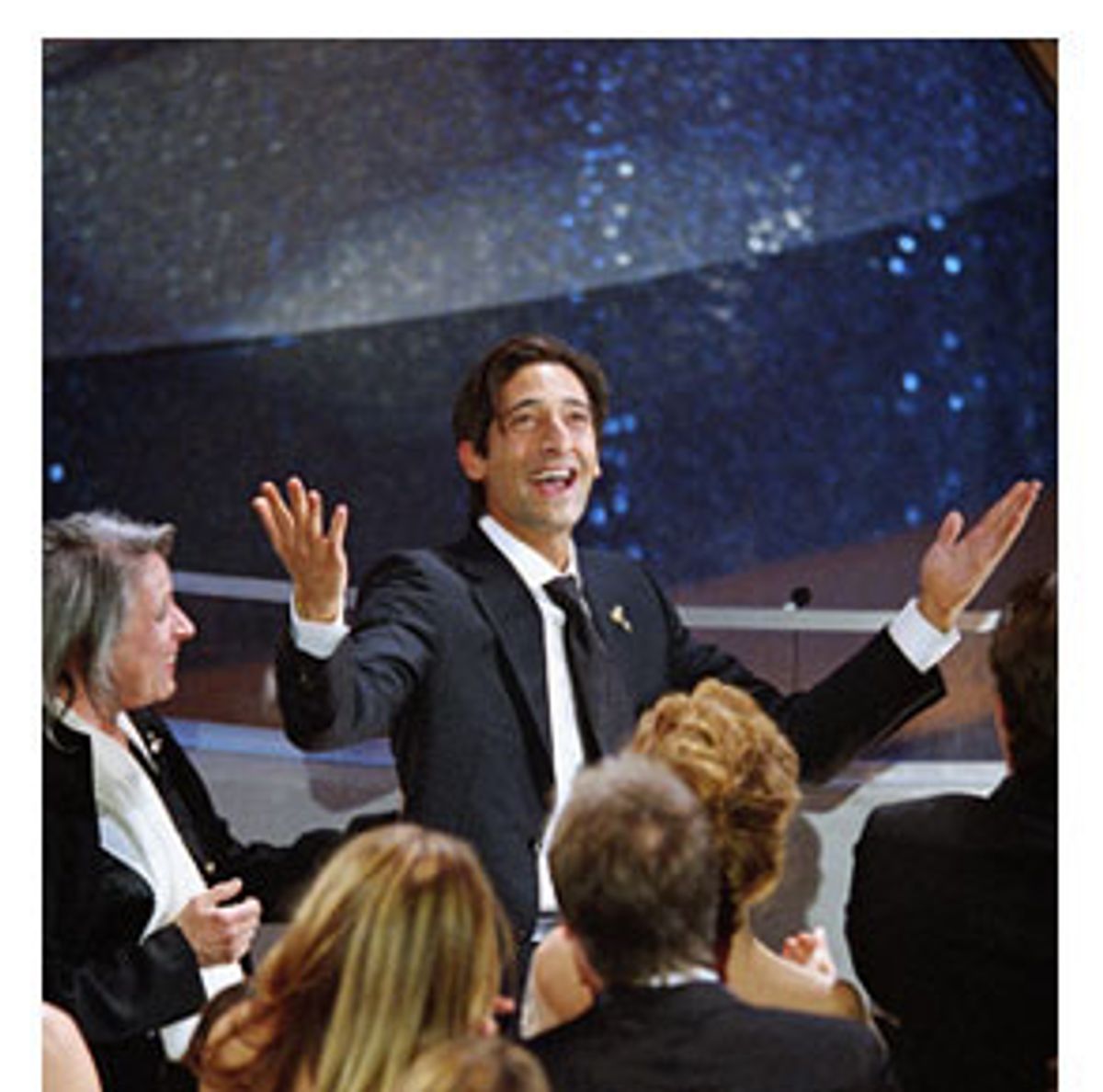
Example 3: Adrien Brody, who succeeded beautifully and effortlessly at rallying the anti-Bush sentiment Michael Moore was trying so sweatily to shove home. And Brody’s impromptu molesting of Halle Berry was a phenomenal plus.

Example 4: Roman Polanski, who won the best director award for “The Pianist.” OK, it’s another Holocaust movie, and there’s something kind of icky about that right now, in light of the whole Middle East rat-fuck mess, but whatever. The guy is a felon in exile, and that somehow makes it OK. Don’t ask me how; that’s a very complicated karmic hat trick, but it all balances out. Talent forgives everything, eventually, even pedophilia and a glut of Holocaust films.

I was unsurprised that Julianne Moore did not win anything. She has made a personal cottage industry out of looking haltingly vulnerable and on the verge of pressing thumbtacks into her veins with that pathetic smile on her face — that, and being unflinchingly nude.

For this troubled year, I figured she would probably seem a little too controversial. This is wartime, and we’ve all seen her pubic hair. Not this year, honey.

Thank God Jack Nicholson did not win again. I’m sorry; Jack Nicholson is not an Everyman. I don’t think he can adequately represent anyone’s life anymore, except maybe Warren Beatty’s. He’s too louche and unregenerate. Soldiers sometimes get a look of horror frozen on their face from witnessing one too many atrocities; Nicholson’s face is frozen in the eternal conquest of young snatch.

Then there was the whole “Chicago” thing.

I was unsurprised that Catherine Zeta-Douglas-Jones won, but not for the right reasons. She did not look surprised, nor did anyone else. Not for nothing did she marry into the Douglas camp, and yesterday was payday. She is nothing if not the prize company brood mare, birthing future company Douglases. And the part was a jewel: What actress doesn’t dream of being in a film where she’s in jail, but can still wear full hair and makeup?

While Zeta-Jones looked great in “Chicago” — she’s a nice, fulsome size — looking at Renée Zellweger in a tiny little flapper dress is like looking at Iggy Pop in a tiny little flapper dress, only on Iggy it would at least be subversive, and therefore sexy. I don’t want to see all of the divots in a woman’s sternum when I am looking down her cleavage. Collarbones should not look like BMX handlebars. Legs, preferably, should lead to an ass. Preferably, somebody singing and dancing should be able to sing and dance. And she can’t stop squinting. How the hell did Renée Zellweger get that role?

“Chicago,” while fun and basically entertaining, really could have been great if it had been performed by actual pop-music-type people. Imagine the Catherine Zeta-Jones role performed by Madonna, and the Roxie Hart role performed by Christina Aguilera. How slick would that have been? How much better the singing and dancing? How much stronger the commentary on the fleeting nature of fame? Or what if they’d used an all-black cast of Alvin Ailey dancers, and made it a comment on the disproportionate number of black people in jail? As it was, “Chicago” was a lot like watching hammy girls enjoy themselves on karaoke night. The casting for that whole film felt like pact-with-the-devil-company-shit, and the devil, as we all know, is the blobular Harvey Weinstein, who, like the neighborhood mobster, seems to have Hollywood in a painful scrotum-hold. Please, Mr. Weinstein, have mercy … Give the man his Oscars already, Paulie, for the love of God!

While the prosthetic nose was patently absurd (naturally, there are no homely actresses in the world, certainly none of any ability, no, we must use and uglify one of the world’s most coddled beauties) Nicole Kidman, in “The Hours,” came off like a very smart woman with superstrong chops and surprisingly candid depth. But she looked like a dreadful bimbo once she got up to take her trophy. Write a speech, ladies. When you don’t, you look stupid. Nothing unravels the spell of an exceptional performance faster. “Um … the world … is … in turmoil, and stuff … and … uh … I’d like to thank Miramax …”

Christ. In one dumb minute, she succeeded in reminding me that she was married to Tom Cruise for 10 years, a fact that I had blissfully forgotten in appreciation of her talent.

Who can get it up to enjoy the Oscars, if the Oscars can’t get it up? There’s so much cheap sentiment, so much hackery and political confusion. Billy Wilder is dead. Fifteen of our boys died in Iraq and 12 were taken as POWs while Catherine Zeta-Jones sang a duet with Queen Latifah that wasn’t even in the film. One could barely ignore the dripping derision when Peter Jennings growled, “Now back to the Academy Awards,” after the dismal newsbreak.

It’s all about Miramax. Harvey Weinstein is probably producing the whole war. Osama bin Laden is probably hanging out in Palm Beach with Jon Bon Jovi, and Saddam Hussein and Don Rumsfeld probably play Grand Theft Auto III in the craft services tent at the end of every shooting day. For the 76th Oscars, maybe Hollywood will stop trying to accommodate the souring mood of the world and do what they are supposed to do: Wear Harry Winston chandeliers, show their shoes to Joan Rivers, wear push-up bras and Botox and Look Pretty. It’s better, when you’re ogling a beaver shot, not to have to think too much.

Cintra Wilson is a culture critic and author whose books include "A Massive Swelling: Celebrity Re-Examined as a Grotesque, Crippling Disease" and "Caligula for President: Better American Living Through Tyranny." Her new book, "Fear and Clothing: Unbuckling America's Fashion Destiny," will be published by WW Norton.

“Carnage”: Jodie Foster crackles in Roman Polanski’s NYC comedy

Christoph Waltz, Kate Winslet and John C. Reilly also star in this crisp and clever adaptation of a hit play

  • more
    • All Share Services

John C. Reilly, Jodie Foster, Christoph Waltz and Kate Winslet in "Carnage"

A brisk and bracing four-handed comedy about two Brooklyn, N.Y., bourgeois couples whose polite get-together to sort out a playground fight between their children descends into near-savagery, “Carnage” made a perfect opening-night entry for this year’s New York Film Festival. Stars Jodie Foster and John C. Reilly got a standing ovation, and French playwright Yasmina Reza, who co-wrote the screenplay based on her worldwide stage hit “God of Carnage,” took the mic for a few remarks. But where was the director? Too busy and/or too important to show up for his own movie in Alice Tully Hall?

I kid, I kid. For better or worse, Roman Polanski has once again become a more or less normal figure in the world of international cinema, as the NYFF’s selection of “Carnage” made clear. His 2009 arrest in Switzerland ultimately came to nothing, after the Swiss authorities declined to extradite him to the United States to face sentencing for his 1978 rape conviction. Everyone at that Manhattan screening understood that he wouldn’t be there, and indeed it seems highly unlikely that Polanski, who is now 78, will ever set foot on American soil again.

You don’t need to be Sigmund Freud, however, to deduce that the master stylist who made “Rosemary’s Baby” and “Chinatown” has unfinished business with America. Polanski’s last film, released shortly after his Swiss arrest, was “The Ghost Writer,” a clever, twisty thriller that used the North Sea coast of Germany (somewhat implausibly) to stand in for its Martha’s Vineyard setting. Its story was based on a Robert Harris novel, but you couldn’t help noticing that it was about a raffish international playboy forced into foreign exile by legal problems and a secret from his 1970s past.

“Carnage” contains no particular echoes of Polanski’s biography, but it’s definitely a work of Euro-American schizophrenia. It replicates the Brooklyn Heights or Cobble Hill apartment of Michael and Penelope Longstreet (Reilly and Foster, respectively) on a French studio set, complete with digital inserts of the Brooklyn waterfront seen through the windows. The film’s funniest performance comes from long-faced Austrian actor Christoph Waltz, an Oscar winner for “Inglourious Basterds,” who’s utterly convincing as Alan Cowan, a scumbag lawyer who’s managing some kind of P.R. crisis for a pharmaceutical client, via smartphone, even as he’s making chitchat with the Longstreets. It’s Alan who tells Reilly’s Mike, after their perfunctory meeting over coffee has degenerated into booze, vomiting and brutality, “I believe in the god of carnage.”

Alan’s cellphone, along with Penny Longstreet’s beloved art books, are among the totems destroyed by the god of carnage in this tightly structured comedy of manners, which is roughly one part “Who’s Afraid of Virginia Woolf?” and one part Luis Buñuel’s “Exterminating Angel.” Although Reza’s script (co-written with Polanski) stops short of full-on surrealism or science fiction, it begins to seem as if Alan and his prissy, uptight wife, Nancy (Kate Winslet), actually can’t leave the Longstreets’ apartment, or at least not until these couples’ collision of class and sensibility reaches some resolution.
If Alan revels in privilege, power and lack of principle and Nancy is the model of upper-crust decorum — at least until she violates it egregiously — Mike and Penny are meant, on the surface, to seem more middle-class and “relatable.” He’s a contractor who made good, and she’s a highly strung, oversensitive liberal type who is concerned about Tibet and the Sudan and has some vaguely arty career. It’s one of Foster’s best and funniest performances, even if her transformation, like everybody else’s, is telegraphed in advance. Penny’s supposed sensitivity and concern for others of course conceals a near-psychotic madness (as well as an unexpected appetite for alcohol early in the day).

Seeing these four actors launching Reza’s zingers at each other at high speed is pretty much worth the price of admission all by itself, and one thing you always know about Polanski is that he won’t waste your time. I don’t actually think “Carnage” is an especially memorable film, but it’s brilliantly shot and executed, traversing the bland, upper-middle spaces of the Longstreets’ apartment with masterful economy. In a holiday season crammed with promiscuously wasteful two-hour-plus movies that seek to milk every possible emotion from you, this one keeps you laughing for 79 minutes and sends you home. But as you’re pulling your coat back on, don’t miss the tiny but important coda that happens behind the closing credits.

“Carnage” is now playing in New York and Los Angeles, with wider release to follow.

Continue Reading Close

Who wants to buy Sharon Tate’s jewelry?

An auction house offers a piece of notorious Manson murder history -- but why would someone want it?

  • more
    • All Share Services

Who wants to buy Sharon Tate's jewelry? Sharon Tate (Credit: Wikipedia)

It’s an oval opal ring, surrounded by garnets. Four stones appear to be missing. Its estimated value is somewhere between $25,000 and $50,000. And next week, is going up for auction with Gotta Have Rock and Roll with the opening bid of $10,000.

What is it that makes this particular piece of jewelry so potentially valuable? Is it the elegance of the piece? Is it the fact that it was purchased by an internationally renowned, Oscar-winning director? Or is it because the ring was allegedly worn by his pretty, pregnant wife the night she was savagely murdered by the Manson family?

On its item description, the auction house — which also currently has a few tufts of Michael Jackson’s hair “collected from the room he was staying in at the Carlyle Hotel” going for a cool thousand bucks, — claims the bauble is Sharon Tate’s “engagement ring, given to her by fiancé Roman Polanski.” But the New York Daily News reported Wednesday that parent company Gotta Have It partner Pete Siegel asserts that Tate was wearing it when she was killed. He adds, “Who knows where the bidding will end up? She was so beautiful and innocent, and very popular.” And you thought those thrill seeking true-crime fans of a recent episode of “American Horror Story,” thrilled to hold the same ashtray a killer bashed a victim with, were just make-believe.

On the evening of Aug. 9, 1969, the eight-months pregnant Tate, four other individuals and Tate’s unborn son were killed by the Manson’s family’s Charles “Tex” Watson, Patricia Krenwinkel and Susan Atkins. Tate was the last to die. As she begged for her life and that of her child, Atkins told her, “Look, bitch, I don’t care about you. I don’t care if you’re going to have a baby. You had better be ready. You’re going to die and I don’t feel anything about it.” Tate was then stabbed 16 times. Once she was dead, Atkins used Tate’s blood to scrawl the word “PIG” on a porch wall. Makes you want to run right out and buy some bling, doesn’t it?

Though Tate’s sister Debra acknowledges Sharon owned the ring, she strongly disputes the ring was on Tate’s finger the night of the murder, or that it was even her engagement ring. (Should you choose to study the images of her wedding or have the stomach for the grisly photos of the murder scene for a glimpse of her hand, they’re inconclusive.) Debra told TMZ Tuesday week that “The ring was not Sharon’s style and she never wore it,” and added, “Because Sharon was pregnant, she couldn’t fit any rings on her finger.”

On Wednesday, the auction house clarified via a spokesman that “it was speculated that the ring was on Sharon Tate’s finger at the time of death but never confirmed so we do not dispute Tate’s sister Debra’s claim.” There is, however, one existing photo of Tate wearing the ring on her pinky, adjacent to her slim wedding band.

Gotta Have It’s Siegel calls the ring simply “a great item of Hollywood collectibles.” But come on. Surely macabre curiosity is why Gotta Have It has played up “Sharon’s tragic murder” in its description of the ring, and encouraged the notion that it played a more central role in Tate’s life than it may in fact have had.

Maybe the ring’s significance doesn’t matter if you’re not the sort of person who cares about owning something a famous woman had on as her pregnant belly was being hacked into. But why would someone shell out 10 grand or more for an item if not for Manson family bragging rights? Gotta Have It knows what it’s really auctioning here, and it’s not just a “Hollywood collectible.” Instead, it’s a little bit of what Susan Atkins said she felt the night she killed Tate. It’s a lot less gruesome and a lot more expensive, but it comes from the same place. Repulsively, it’s the opportunity, as Atkins once put it, “to taste death.”

Continue Reading Close
Mary Elizabeth Williams

Mary Elizabeth Williams is a staff writer for Salon and the author of "Gimme Shelter: My Three Years Searching for the American Dream." Follow her on Twitter: @embeedub.

9. “The Ghost Writer”

Roman Polanski's thrilling economy turns the film's final sequence into nearly perfect entertainment

  • more
    • All Share Services

9.

Roman Polanski is an economical director, and “The Ghost Writer” is one of his most economical films. This story of an unnamed man (Ewan McGregor) hired to ghostwrite the memoirs of a former British prime minister (Pierce Brosnan) never makes a move without reason and never holds a shot — or pauses after a line — a millisecond longer than it needs to. You can see it in the scene we’re examining here: The film’s widely celebrated ending, which wraps up two hours’ worth of plot in just four shots.

“The Ghost Writer” is an example of a vanishing type of film direction rooted in the values of classical (pre-TV) Hollywood. Although Polanski didn’t make his first feature until 1962 (“A Knife in the Water“), he has done most of his work in that tradition. The subject matter of his movies is often disturbing — jealousy, insanity, conspiracy, the triumphs of chaos and evil — but his style is usually conservative, with a touch of elegance. He doesn’t cover action with two or three or 10 cameras to produce enough usable footage to create the illusion of comprehensiveness. Polanski more often tries to plan and shoot action from one, maybe two angles, and he doesn’t cut to a new angle unless he can get a better result than by staying where he is. Polanski’s screenwriting sensibility is just as exact — a point vividly demonstrated on “The Ghost Writer,” which Polanski co-adapted with Robert Harris, from Harris’ novel. The filmmaker doles out words the way he doles out shots: sparingly, never giving the viewers more than is necessary to keep them on the hook and waiting for the next revelation. This is a nearly perfect entertainment, never more so than in its final few minutes. 

Continue Reading Close

Reminder: Roman Polanski fled sentencing

What else is there to say about this case of justice interruptus?

  • more
    • All Share Services

Reminder: Roman Polanski fled sentencingFILE - IN this French-born film director Roman Polanski waves during a media presentation in Berlin. The Swiss government says it will make an announcement Monday July 12, 2010 about Roman Polanski's extradition to the United States for a 1977 sex case. The government says Justice Minister Eveline Widmer-Schlumpf will hold a news conference in the capital Bern at 2 p.m. (1200 GMT; 8 a.m. EDT) "on the matter of the Roman Polanski extradition decision." (AP Photo/Franka Bruns, File)(Credit: AP)

I just stuttered and “um”-ed my way through a BBC radio interview about Roman Polanski’s new-found freedom. That’s because I didn’t know how to adequately answer the host’s question: What do you make of this news? It might also have something to do with freezing up in front of a global audience of — god, I don’t even want to think about it. Mostly, though, I didn’t know what to say, aside from: “But, but … he fled final sentencing.”

Swiss officials say their ruling was purely technical and hinged on the United States’ refusal to supply a confidential transcript of a hearing with the prosecutor in charge of the case. This should come as no surprise to Swiss authorities: A court ruling barred the release of the requested material. As a result, though, the Swiss say they were unable to “exclude with the necessary certainty” that Polanski had already served his sentence. He was ordered to serve a 90-day psychiatric evaluation and was released after only 42 days, thanks to a favorable review. But even more important: he fled sentencing.

Of course, his supporters point to judicial misconduct — by way of inappropriate communication between the judge and the prosecutor — and argue that the charges should be tossed out as a result. As Brian Palmer explained in Slate, however:

Outright dismissal is an exceedingly rare remedy for ex parte communications, especially when the communications came after the plea agreement was reached. It’s far more common for the plea agreement to stand, with a new judge brought in to preside over the sentencing.

That didn’t happen, though, because Polanski fled sentencing. Did I mention that Polanski fled sentencing? Yeah, Polanski fled sentencing.

It’s amazing how much about this case has to be repeated, again and again — as Kate Harding did with her Broadsheet post titled, “Reminder: Roman Polanski raped a child.” One rarely thinks of child rape as the sort detail that is easily forgotten — not to mention the initial charges of child molestation, rape by use of drugs and sodomy — but so it was in the wake of the director’s arrest late last year. And, once again, I find myself resorting to a single, though different, refrain.

Some are grasping for an optimistic angle, suggesting that the extradition denial might be a good thing for Polanski’s victim, who has voiced her desire for the whole thing to just disappear. As Jezebel’s Anna North pointed out during the BBC segment this morning, it would have disappeared a long time ago if the state of California hadn’t waited over 30 years to actively pursue and settle the case — or if Polanski hadn’t fled sentencing.

Continue Reading Close
Tracy Clark-Flory

Tracy Clark-Flory is a staff writer at Salon. Follow @tracyclarkflory on Twitter.

Polanski free, Swiss reject US extradition request

The Swiss government refused to hand over renowned film director Polanski to the US

  • more
    • All Share Services

Polanski free, Swiss reject US extradition requestFILE - In this is Jan. 15, 2009 file photo, film director Roman Polanski looks on in Montrouge, France. The Swiss government says it will make an announcement Monday July 12, 2010 about Roman Polanski's extradition to the United States for a 1977 sex case. The government says Justice Minister Eveline Widmer-Schlumpf will hold a news conference in the capital Bern at 2 p.m. (1200 GMT; 8 a.m. EDT) "on the matter of the Roman Polanski extradition decision." (AP Photo/Michel Euler, File)(Credit: AP)

The Swiss government declared renowned film director Roman Polanski a free man on Monday after rejecting a U.S. request to extradite him on a charge of having sex in 1977 with a 13-year-old girl.

The Swiss mostly blamed U.S. authorities for failing to provide confidential testimony about Polanski’s sentencing procedure in 1977-1978.

The Justice Ministry also said that national interests were taken into consideration in the decision.

“The 76-year-old French-Polish film director Roman Polanski will not be extradited to the USA,” the ministry said in a statement. “The freedom-restricting measures against him have been revoked.”

It was unclear if Polanski had already left his Swiss chalet in the resort of Gstaad, where he has been held under house arrest since December.

Page 1 of 9 in Roman Polanski