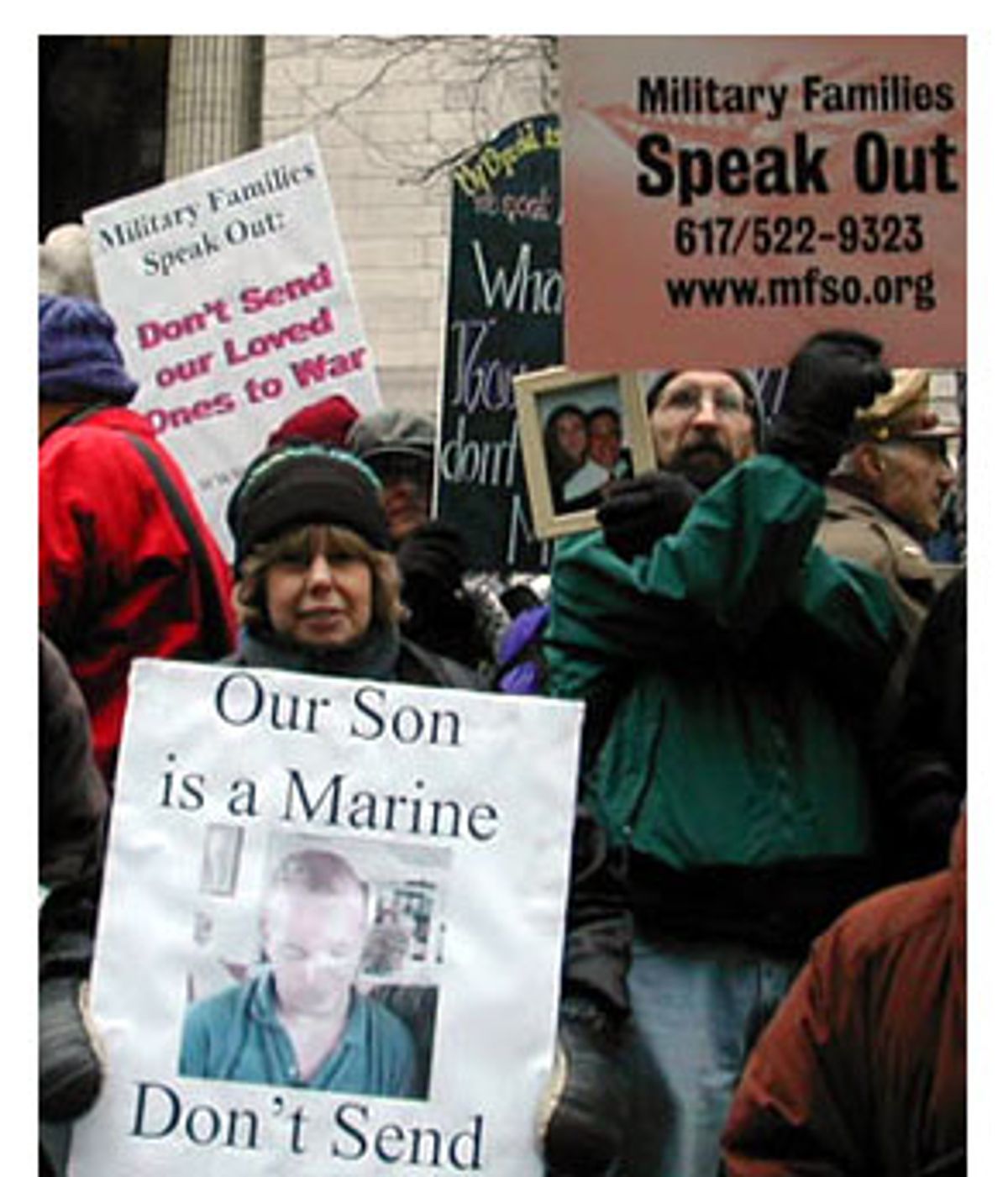
Military families who oppose the war in Iraq say there's a special horror in watching this campaign unfold. Like everyone else who has a relative serving in the Gulf, they're beset by a sickening anxiety that builds as the troops move toward Baghdad -- and that paralyzes them every time another casualty is reported. For those who believe the war is unjust, though, there's no pride in a righteous cause to ease the terror, no patriotic sense of shared sacrifice to make sense of their families' disruptions. There is just the helpless feeling that their loved ones might lose their lives for nothing.
"It hurts a lot, sacrificing our children for a war that Bush took us into," says Peter Hansen, a Navy dad in Palm Springs, Calif. "I picture my son going off to World War II and I really think I would feel differently. I'm not a pacifist, but I really feel something stinks about this, and every day I get more confirmation. I have an intuitive sense that Bush is not a good man."
"I keep thinking if I had belief in a just political cause, this would be a lot easier, but there really isn't any place to turn," says Melissa Halvorson, a graduate student in education at the State University of New York at New Paltz whose 30-year-old husband, a Marine reservist, left for Kuwait last week. "It's a little bit lonely. It would be easier to be waving a flag."
For several hundred military families against the war, a way to combat that loneliness has been to band together under the name Military Families Speak Out. The group is part activist organization, part support network -- some members have participated in teach-ins and protests with veterans groups, but others just look to its Web site and e-mails to counter what Joyce Dreysus, a military mom in Gainesville, Fla., calls "crippling, paralyzing isolation."
It's an isolation compounded by splits within families. Some antiwar military families say their children or siblings secretly share their views, but for others, a relative's antiwar stance is a betrayal. "This is not just dividing the world, this is not just dividing the population of the United States, this has come down to dividing families," says Connie Moss, a 44-year-old mother of six in rural Virginia whose 23-year-old son is stationed in the Gulf and enthusiastic about the war. For these families, it can be hard to know what to hope for -- a devastating air assault that will cripple Iraqi resistance? A campaign that aims to protect civilians but leaves troops more vulnerable?
"I support my son and the troops 150 percent, but I also have tremendous feelings of empathy and compassion for the Iraqi people," says Dreysus. "There's a tremendous amount of conflict and confusion. It's like a paradox that you're holding inside your heart."
Such ambivalence is often absent from public debate, where antiwar protests and rallies to support the troops are often characterized as being mutually exclusive. It's as if to love a soldier is to love the war he's fighting, and to oppose the war is to demean the honor of the troops. Those who hate the war that their relatives have been ordered to fight feel their voices are being ignored, and they're increasingly desperate to be heard. A query posted to the Military Families Speak Out mailing list garners dozens of responses from people who describe themselves as the furious, frustrated, terrified families of men on the road to Baghdad. They say they feel marginalized by the media and unwelcome in military communities.
"The other night on television, they said, 'Here there was an antiwar demonstration, while here is what some people are doing to support our troops,'" Nancy Lessin recalls indignantly. "That formulation is absolutely wrong, and we're trying to correct it everywhere we go."
Lessin, whose stepson Joe Richardson is a Marine serving in the Gulf, founded Military Families Speak Out in January along with her husband, Charley Richardson, and Jeffrey McKenzie, the father of a 26-year-old pilot deployed with a Marine unit. The three met at the Oct. 26 antiwar demonstration in Washington. Since January, they say, several hundred families have joined their mailing list, with between five and 10 new ones signing up every day since the war began.
"The hardest thing by far would be to lose Joe in a war that was unjust and unnecessary," Lessin says. "In that case, we think we would never, ever recover from our grief and never let go of our anger. That anger would be directed at this administration and the Congress that abdicated its responsibility and allowed this to happen."
Some families suspect lawmakers acquiesced too easily to the president's war plan because their loved ones' lives aren't at stake. Members of Military Families Speak Out repeatedly mention that only one person in Congress has a son serving in the armed forces. "I want people to be aware that this mandatory patriotism is crap," says Halvorson. "The people who initiated this war have never even come close to the military. None have families in the military. They don't stand to lose anything."
Jeri Reed is opposed to the war in part because she stands to lose so much. A 45-year-old Oklahoma City woman whose 20-year-old son Cody is in Iraq somewhere south of Najaf, she says, "I know so many kids over there that grew up with Cody, it's ridiculous. It depends who you are in this country how many kids you know over there."
She says that she doesn't know anybody with kids in the military who is "rabidly for this war," though most are reluctant to speak of their doubts. "I do speak with other parents [of soldiers] who feel the same way but are not willing to do anything about it," Reed says. "Often I think they're confused about the war and think that they are doing the right thing by saying they support it. The connection is it keeps your kid safer. Any dissent increases the danger."
Yet Reed can't contain her rage -- it crackles through the phone. It's a "horrible situation," she says, to watch her son fight a war that shames her. "Now our kids are basically trapped in the middle of Iraq, and the only way they're going to get out is by killing a lot of Iraqi people. I'm very angry. I don't want to support the killing of all these Iraqis to save my son."
Like many other members of Military Families Speak Out, Reed, who is working on a Ph.D. in history at the University of Oklahoma, says her son enlisted because he had few other options. A single mother of four boys, Reed raised her children in Chicago. She was laid off from her government job in 1989 and spent much of Cody's childhood switching between restaurant and office work, with occasional stints of welfare. Most years she earned less than $20,000. She says her son believed the military would offer him stability and a steady income.
"Cody joined the military for lack of job opportunities," she says. He had just finished high school, and "he felt he had to do something with his life. He started talking to a recruiter who really stroked his ego. He was feeling like a failure, and he was promised the world by the recruiter."
She tried to talk him out of it. "I said, 'What if they make you go do something you think is wrong?' Unfortunately, that's what happened."
Speaking of the Bush administration, her voice rises and goes taut. "They're using poor kids for their own ends," she says. "I think of Bush's daughters and niece. Look at what kind of people they are! They're going to take our kids, many of whom have been raised well, and his drug addict daughters and niece certainly won't be called upon."
Of course, most military families fiercely disagree with Reed. Indeed, says Lessin, "We have had a number of our members thrown out of military wives' groups and military mothers' groups for expressing concerns and opposition to the war." McKenzie says he was kicked off an online military families' support group for posting antiwar comments.
Halvorson, the student wife of a Marine, believes the fervent support for the war among the families of its fighters stems in part from denial and fear. Knowing how hard it is to watch a loved one fight a war that seems immoral, she understands why people might not want to admit their doubts, even to themselves. "It's really hard to wrap your mind around the fact that your loved one is stepping into a dangerous situation for no good reason. It's very hard to swallow for most people," she says. "We're in a patriotic fever right now. We're being propagandized to. There's an implied message that you're to feel guilty if you don't support the war."
She also sees how pro-war sentiment is useful for fighters in the field, which is why, since her husband has been deployed, she's been reluctant to tell him about her continuing protest.
"He is both feet in," she says. "He doesn't really have the luxury of a political view at this point. He's most interested in self-preservation and the safety of his fellow Marines. We don't really talk about the war that much because he knows how I feel. I'm not interested in changing his mind. The more enthusiastic he is, the better it is for his safety." The longer the war goes on, Halvorson says, "the more distant we are emotionally and ideologically."
Indeed, some of these families speak of a growing gulf between their feelings and those of their soldiers, which they're not sure how to bridge. "My son believes that what is happening is right. And I do not. It has caused what I'm now referring to as some collateral damage within the family," says Moss, the Virginia mother of six.
A housewife who just went back to school to study nursing, Moss, a widow, has never before been involved in any kind of activism. She knows only two people in her town who actively oppose the war -- her 84-year-old grandmother and a United Methodist minister. Yet for the past two years, she says, she's had the queasy feeling that Bush is taking the country in a dangerous direction, a feeling that became overwhelming once the march to war began.
When Bush first started to speak about a war in Iraq, Moss would e-mail her son antiwar literature. At first, she says, he told her, "You know, you might be right about this thing, Mom." Within a month, though, he'd put his doubts aside. He asked her to stop sending him articles and told her she should "go live in France."
Moss says she understands her son's feelings. "I know that in order to be in the position he is in, he has to believe in the cause to a degree," she says. Yet she also fears that he'll have to pay for what she sees as his self-delusion later on -- that is, provided he survives.
"I know the emotional and mental scars that the Vietnam veterans returned with, and I don't want to see the same thing happen to our troops," she says. "I think that when history tells the story, not only are there going to be the normal mental and emotional scars, but when these people see the truth [of the war's injustice], the scars are going to be even deeper."
This is an overwhelming worry among these families -- that the men who return to them won't be the men who left. Two weeks ago, Halvorson went to Washington. She'd missed the big protest on March 7, but felt the need to make her own stand, so she stood by herself in front of the White House with a sign that said, "Don't Kill My Husband or Make Him Kill."
Part of what she fears is the fallout that comes from any war, regardless of its legitimacy. "Obviously I want him to come home in one piece, but that's a physical state," she says. "I don't think anyone comes home from war in one piece mentally. Just being whipped up into that kind of aggression and hypervigilance necessary to go to war, it's sort of hard to come off. There are going to be things they might not want to talk about because it won't be viewed by a lot of people as a just act of war. That's why they cling so tightly to this brotherhood that they're a part of, because they're all in it together."
Hansen, the father in Palm Springs, already mourns what the war has done to his only child, Luke, a Navy medic traveling with a Marine unit. He describes his 21-year-old son as a "teddy bear" who was so deeply skeptical of the war that he considered going AWOL. He says Luke told him, "Dad, I would die for my country, but I don't want to die for Bush." Hansen says several of Luke's friends felt the same way before they reached the Middle East.
All that has now changed -- at least for Luke. Recently, Hansen posted an open letter to Bush on his Web site, saying, "I want to personally thank-you for the job you've done turning my once full-of-life son into a defeated stepford drone ... Yesterday I received first word from him. He was living in a tent city near the Iraq border ... He sounded very different. Distant. At first I thought he was lonely. I asked what was wrong. He said nothing. I asked how he was dealing with it. He said okay. Then he peppered some of his talk with anti-Iraq expletives.
"I had never heard that from him. These were not just anti-Saddam but anti-Iraq. He started talking about how there were no women for miles and how they were going to take their frustrations out on Iraq. I asked what happened to his thoughts on Bush and the war he didn't believe in, and I could hear him shrug. He said they taught him how to not think about it. I felt a palpable relief. They were winning him over. My son was being successfully brainwashed, and I was grateful. This would make it easier on him. There is no room for reason or intellect in a war like this."
While Hansen finds a kind of bitter relief in his son's growing callousness, he feels increasingly raw. He encouraged Luke's enlistment and helped talk him out of deserting, telling him to honor the commitment he'd made. Now he says he feels "utter moral agony" about his role in sending his son to war and the possible tension between Luke's safety and that of the Iraqis. "I don't want to sound melodramatic, but I'm having a spiritual meltdown," he says.
And for his pain, and the risk to his child's life, Hansen blames the president. "I'm sick about it. I'm sick in every possible way. I feel like I've lost my kid. I'm just mortified that America is following this man," he says. "It keeps me up at night to know he sleeps well at night."
Shares