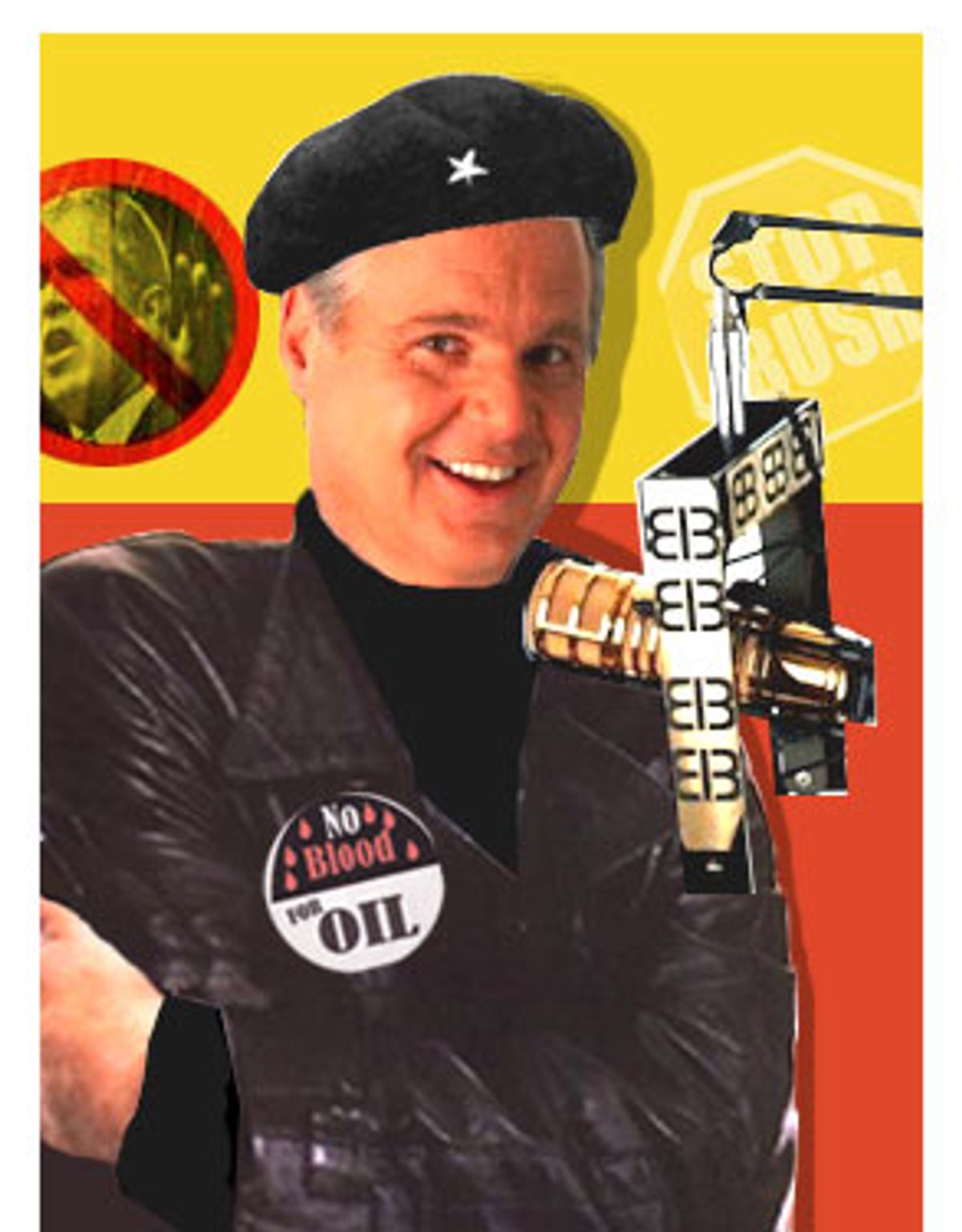
Two hours after American forces launched their "shock and awe" assault against Baghdad in March, Mike Malloy went on the air from a concrete office building outside Atlanta for his weekday syndicated talk show. "I don't know if you saw it, but I did," he said near the outset, his voice uncommonly subdued. "This is the United States attacking a truly defenseless Third World country."
For the next five minutes and 19 seconds, Malloy wordlessly broadcast the noise of missiles shrieking, bombs exploding, antiaircraft fire rattling. He had taped the audio straight from CNN, but on radio the war was shorn of television's video game visuals, its safe distance from danger. This soundtrack thrust Malloy's listeners into a nocturnal Baghdad, reeling from concussions.
When the battle tape ended, Malloy switched to a sound bite of Defense Secretary Donald Rumsfeld at a press conference lauding the "careful, measured beginning" of the war. Then Malloy returned to the air, saying, "This is a dark day, this is a filthy day, this is a day for shame." And finally, heading into a commercial break, he wove together more combat racket with a madrigal-like song by Pink Floyd, "Goodbye, Blue Sky."
For nearly 20 years, Mike Malloy has been making talk radio like this: caustic, abrasive, inventive, confrontational and resolutely left of center. It has won him admirers and awards, and it has cost him jobs. At a time when the very genre of talk radio is widely seen as synonymous with strident conservatism, his career both ratifies and belies that premise.
Malloy has hosted shows on major stations in major markets -- WSB in Atlanta and WLS in Chicago -- defying the conventional wisdom that liberal talk radio barely exists. Yet the fact that Malloy, at age 60 a proven success with a numerous honors and much critical praise, now reaches only a handful of affiliates on a network run by a labor union attests to the structural obstacles liberal talk radio faces. The vast majority of his listeners hear him not on the radio at all, but from his own Web site, which streams live audio of his daily show and also links to an archive of recent broadcasts. The site attracts "tens of thousands" of listeners each day, Malloy estimates.
For worse or better, then, Malloy operates under the commercial radar. "I do feel restricted and closed in," he said. "Having worked for two 50,000-watt stations whose signals would boom out over half the country, yes, it does feel a little claustrophobic now. But we have six telephone lines, and they stay busy after the first few minutes of the slow. Kind of like the way it was when I was in Atlanta and Chicago on radio stations."
Malloy may well figure prominently in a high-profile effort to provide a liberal alternative on commercial radio. Sheldon Drobny, the venture capitalist from suburban Chicago who has put in upward of $10 million to start a liberal talk-radio network by the end of 2003, was inspired partly by Malloy's shows, first on WLS and now on the I.E. America Radio Network, owned by the United Auto Workers. Malloy even recommended the man, Jon Sinton, whom Drobny hired as chief executive officer of the nascent network, AnShell Media.
"I don't want to violate anybody's contract or hurt anybody else," Drobny said in a recent telephone interview. "But Mike's the kind of homegrown entertainment we're looking for. He's not only very seasoned, he's very entertaining, he's a hard-hitting opposition to the right wing. And he reaches both the elites and the blue-collars."
Michael Harrison, publisher of the trade magazine Talkers, named Malloy to his "Heavy Hundred" list three times in the past four years. "Just like Rush Limbaugh," he said, "Malloy is a radio guy. He's paid dues. He's there to entertain, not to save the world. When he's exposed, he gets ratings. And when he's not exposed, he can't get ratings."
To consider Mike Malloy's career is thus to reckon with the reasons liberal talk shows do, or don't, get that exposure. The child of Democrats in the union stronghold of Toledo, Ohio -- his mother a waitress, his father a cost analyst for construction projects -- Malloy grew up listening to such radio staples as "The Shadow," Jack Benny, and "Amos 'n' Andy." He had bounced through four colleges in as many states by the time he landed in Atlanta in the late 1970s. There he honed his journalistic talents as an editor of the alternative weekly Creative Loafing and later as a writer on CNN. Acting with the Southern Theater Conspiracy, an avant-garde troupe, he learned "how to use language, how to be dramatic, how to leave someone wanting more."
All of those skills came into use in 1985, when he apprenticed himself to a conservative talk-radio host named Ludlow Porch on the Atlanta station WCNN (no relation to the cable network). Though their politics stood at a polar remove, Malloy appreciated Porch's populist style of humor, which reminded him of both Will Rogers and Harry Golden. "Ludlow said you have to remember you're not the smartest person sitting behind the mike," Malloy recalled. "He said, Play to your audience's intelligence, to their curiosity, not to their prejudices."
By late 1986, Malloy was hosting his own late-night show on 50,000-watt WSB. His chief issues included the Reagan administration's involvement in Central America, especially the arms-for-hostages deal, and the creation of a Palestinian state alongside Israel, and he performed strongly enough to be moved into a midday slot. It placed him in direct competition with Limbaugh, however, at the very time Georgia congressman Newt Gingrich was successfully leading the Republican Party into control of both houses of Congress for the first time in a half century. "I was swamped," Malloy admitted. In 1995, WSB replaced Malloy with Dr. Laura Schlessinger, herself part of the conservative phalanx in talk radio.
Taking over a 10 p.m.-1 a.m. show on WLS in Chicago in 1997, Malloy raised listenership by a double-digit margin and regularly put his station in Chicago's top five for the overnight slot. In addition to being named to the Heavy Hundred in 1999 and 2000, he won the Achievement in Radio award for the best overnight show in the Chicago market. He championed the causes of several death row inmates who were ultimately exonerated or pardoned.
Most of all, in a deeply polarized time in national politics, Malloy whetted his satiric blade. The more that conservatives (and their favorite talk-show hosts) accused President Clinton of both real and imagined high crimes and misdemeanors, the more Malloy ridiculed what he routinely called the "flying-monkey right." Or as he once put it, "I'm picking on Republicans tonight. And every night."
When Paula Jones came forward to charge belatedly that the president had, years before, sexually harassed her, Malloy mimicked her in a creaky twang out of the "Beverly Hillbillies": "It was me. I was the one. See, it says right there it's me. Right here on my shirt label, where my momma sewed it on: 'That s.o.b. sullied my reputation.' That's what he did. Can you bring that camera in a little closer?"
The ascent of then-Gov. George W. Bush as a presidential aspirant in the late 1990s inspired all of Malloy's working-class contempt for a rich boy. "Oh, W., you want a baseball team?" he said in a typical bit, imitating the senior Bush. "How about an oil company? Off-shore drilling rights in the Red Sea. Red Sea. Never mind. We'll get it for you."
Yet in March 2000, Malloy left WLS. The official version, part of a formal settlement, portrayed his departure as the product of mutual consent. But Eric Zorn, a columnist for the Chicago Tribune, pointed to ideology as the real cause, citing an e-mail from the WLS program director, Mike Elder, that had criticized Malloy's "very dark and mean-spirited approach." (Elder, now an executive with WRKO in Boston, refused several requests to comment for this article.) "They were always on his case about being too harsh, too rough on his conservative callers," Zorn said of Malloy in a recent telephone interview. "But the truth is, he was no rougher on his callers from the right than Rush or Dr. Laura are with their liberal callers. I don't think there's any question that if Mike Malloy had his exact same manner and style and rating and was politically conservative, he'd still be on the air."
Interestingly, Malloy found himself virtually unemployable. Major stations such as KIRO in Seattle, WMAL in Baltimore, and KOA in Denver all expressed interest, solicited his demo tape, and then backed away. "They'd say, 'Your program is too edgy,' or 'Too dark and depressing,'" Malloy recalled. "Very simply, it means too liberal."
He signed on with the I.E. America Radio Network in October 2000. The UAW network streams audio on the Internet and serves about 170 stations, none in markets larger than Omaha and Santa Fe. The network's average weekly audience of 1.7 million listeners amounts to what Rush Limbaugh might reach in one or two big cities. Even at that, I.E. America has had far greater success placing service-oriented shows like "Antique Talk," "Car Care Clinic" and "The Employees' Lawyer" than Malloy's political talk. By the last count, merely four stations carried him. Despite such obscurity on the radio dial, the show has built such a following on the Internet that I.E. America must sometimes triple its bandwidth when Malloy starts his three-hour shift at 9 p.m. each weekday. (He switched to the later time slot on April 21.)
Those who do locate Malloy can hear him ridicule "President Dazed and Confused" and the "Bush Crime Family," playing songs like "Thick as a Brick" or "Pencil-Necked Geek" for sardonic punctuation. They hear regular callers ranging from the Cincinnati trucker nicknamed Gizmo to Senate Minority Leader Tom Daschle of South Dakota. They hear newscasts from an outfit called the Workers Independent News Service, whose slogan promises, "WINS is not about what big business wants you to hear. It's about us." What they don't hear very much of is paid advertising -- though the regular buyers include Advil and Hidden Valley Ranch Dressing -- and for a commercial network that is a problem.
So the question remains exactly what to make of Malloy's experience, what larger insight into the political shape of talk radio it yields.
Malloy and a number of media critics and scholars place substantial blame for the political slant of talk radio on two acts of government. First, in 1987, the Federal Communications Commission repealed the fairness doctrine, which required radio stations to present at least a semblance of political balance. Then, in 1996, the Clinton administration pushed through the Telecommunications Act, which deregulated the ownership of radio stations. The former action gave legal latitude to dogmatic talk shows; the latter drastically reduced competition.
To put it in more personal terms, when Malloy started in talk radio 18 years ago some 400 companies owned radio stations. Now six conglomerates dominate. The ideological alternative that Malloy had provided early in his career to Ludlow Porch is no longer required.
Radio experts disagree, however, on whether the radio conglomerates of today push a conservative agenda out of true belief or apolitical greed. "You can't avoid the fact that corporate owners are sympathetic to right-wing politics, especially on business and economics," said Robert McChesney, a professor of communications at the University of Illinois in Champaign. "And if any show is remotely close to a gray area, you'll go with whatever's close to the politics of your advertisers."
War with Iraq brought several radio corporations into overt advocacy. Clear Channel Communications, the nation's largest owner of radio stations, with 1,225 affiliates, sponsored pro-war rallies in several cities. Cumulus, another major owner, organized the demolition of CDs by the Dixie Chicks after one of the group's members publicly criticized President Bush. Protest songs, a staple of FM in the Vietnam era, received scant commercial airplay this time. The presence of Colin Powell's son Michael as chairman of the FCC exerts a chilling effect on radio dissent during wartime, media critics such as McChesney maintain.
The counterargument holds that conglomerates simply choose programming that is demonstrably profitable. By this line of reasoning, liberal talk radio suffers for the same reason free-form music does: It requires management to take a risk. Conservative talk radio, in contrast, boasts a proven model in Rush Limbaugh. His show can be syndicated into scores of markets, and his style can be cloned.
"Radio on the left lacks compelling personalities like Limbaugh," said Alan Stavitsky, a scholar of the radio industry and the School of Journalism and Communication's associate dean at the University of Oregon. "The thing to understand about Rush is that he was trained as a disc jockey. He began in music radio. He brings that ethos and those production values to his program." (Limbaugh also never bothered registering to vote for more than a decade, as Paul D. Colford revealed in his unauthorized biography.)
The most prominent efforts by liberals to crack the talk-radio market, in contrast, involved the politicians Jerry Brown, Mario Cuomo and Jim Hightower. Effective stump speakers, none mastered the improvisation, conversation and give-and-take of talk radio. Only Hightower remains on the air, though in drastically reduced form. Instead of hosting a talk show, he contributes two-minute commentaries to about 100 stations, mostly in small markets.
For all that, liberal talk radio is not quite so marginal as it may first appear. When critics decry the dearth of such shows, Michael Harrison of Talkers magazine notes, they are referring to one part of the radio universe: commercial radio for white audiences. There, he estimates, 80 percent of the political shows indeed espouse a conservative message.
Yet liberal hosts such as Neil Rogers of WQAM in Miami and Lionel of the WOR network have survived. Fox recently began syndicating Alan Colmes, the designated liberal punching bag on its cable news station. The talk on black stations, meanwhile, leans heavily to liberal in the person of such hosts as Cliff Kelly of WVON in Chicago and Mary Mason of WHAT in Philadelphia. The nonprofit Pacifica network reaches an audience of 800,000 with stridently left-wing programming. National Public Radio draws 22 million listeners, of whom two-thirds describe themselves as being politically moderate or liberal. NPR's syndicated talk shows -- "Talk of the Nation," "The Connection" and "The Diane Rehm Show," among others -- strive for a balanced, centrist approach that qualifies as liberal in comparison to that of Limbaugh and his imitators.
The liberal radio audience, then, might be thought of as a mirror of the liberal coalition, Stavitsky said. As both a political movement and a radio demographic, the so-called angry white men of conservatism coalesced around fundamental beliefs and values, including an antipathy toward Bill Clinton and the putatively liberal mainstream media. The liberal coalition, in contrast, contains an unwieldy amalgam of whites and minorities, elites and populists, globalist free traders and labor union protectionists.
The phenomenon of NPR suggests yet another challenge for liberal talk radio -- the aesthetic of the genre. In focus groups conducted by George Bailey, an audience analyst and a professor at the University of Wisconsin in Milwaukee, NPR listeners described commercial talk radio as "sensational," "loud," "argumentative," "angry" and "shallow." Those traits contrasted with their preference for "radio based on civility, on calm, informed, open discourse," as Bailey put it.
One of the arguments raised by those who doubt that left-wing talk radio will ever challenge Limbaugh is that liberals will always, by their nature, be more open-minded, tolerant and nuanced than conservatives -- and that those noble traits are a commercial snooze. According to this line, a red-faced conservative ranting against the evils of liberal do-gooders or evil Muslims has a hot message and a natural constituency of resentful white men; his liberal counterpart, trying to defend federal programs or explain the historic roots of the Mideast conflict, has neither. While this generalization may contain some truth, Malloy's two-fisted, take-no-prisoners show proves that liberals can dish it out entertainingly, too.
Malloy and the founders of AnShell Media believe they can build an expansive audience for liberal talk radio. Fifty-two percent of American voters, Malloy regularly reminds his listeners, voted for Al Gore or Ralph Nader for president. On the bestseller lists in the past few years, unapologetic, aggressive liberals like Michael Moore, Barbara Ehrenreich and Al Franken have perched alongside the Mona Charens and Bernard Goldbergs.
Can commercial radio be so uniquely resistant? "Absence of proof is not proof of absence," said Jon Sinton, AnShell's CEO. "Five years ago, how many people thought there was a mass radio audience for rap?" The name most publicly bandied about as a prospective on-air host for AnShell is that of Franken, whose background as a satirist includes a stint of "Saturday Night Live." Malloy remains formally under contract to I.E. America, but his relationship with Sinton makes him appear to be a logical choice for AnShell should he become available.
Malloy put the challenge of creating viable liberal talk radio in concrete and comparative terms. Limbaugh has had 12 years to build his audience, and he built it without pressure for immediate success. He enjoyed the backing of a media guru in Roger Ailes and an aggressive syndication company. He explicitly tied his show not just to conservatism as a movement but also to the Republican Party. I.E. America has not even sent Malloy to such vital showcases as the New Media Seminar and the National Association of Broadcasters and Radio Advertising Bureau conventions. How much better AnShell might do for its talent remains mere speculation at this point.
"A program like mine, presented nationally, would instantly resonate with millions of listeners who are completed turned off by the conservative babble that is choking the country," Malloy said. "I believe this honestly, not just as an article of faith. The audience is there waiting. And they spend money, which is, after all, what radio is all about."
Meanwhile, far from being humbled by the American conquest of Iraq, he has been busily churning the war's aftermath into material. From a studio adorned with a poster of George W. Bush as Alfred E. Neuman, he has scourged the American commitment to protect oilfields while leaving the archaeological treasures of the Baghdad Museum wide open to looters. He has mordantly noted the failure to find any weapons of mass destruction. Compared the "photo op" of Saddam's statue being toppled with the grassroots demolition of the Berlin Wall. And when one caller asked about Islamic fundamentalists filling the power vacuum, he said with finely tuned sarcasm, "Sure as God made little green apples."
- - - - - - - - - -
Listen to an audio clip of Mike Malloy's show.
Shares