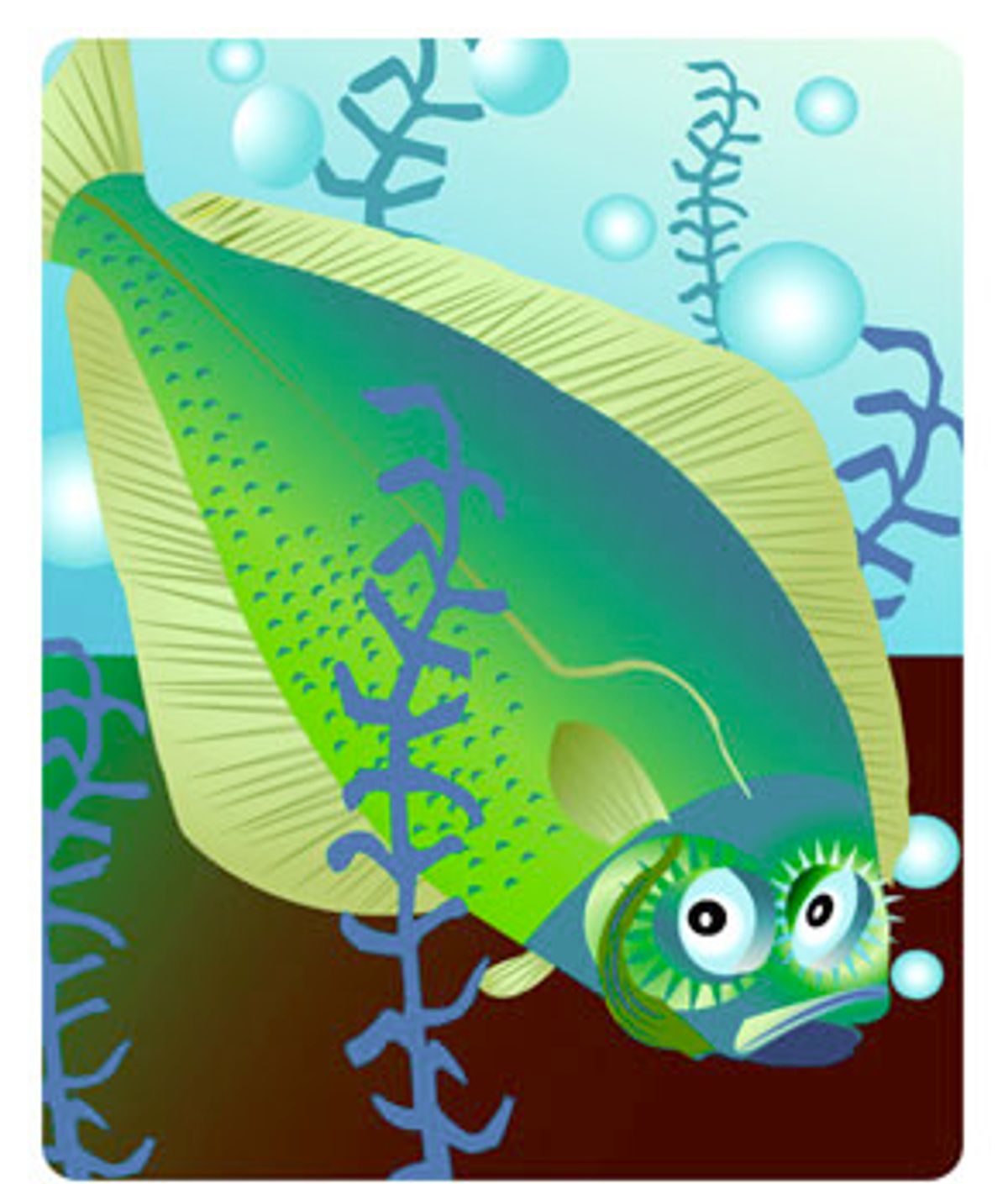
The Pacific halibut is an unlikely poster fish for conservation concerns.
It lacks the cuddly appeal of land-dwelling mega-fauna, like the grizzly bear, that mug it up on environmental brochures aimed at encouraging human beings to open up checkbooks.
The big flatfish, which can grow staggeringly huge, up to 495 pounds, is shockingly alien-looking.
It's the eyes.
When the little halibut is a mere 1-inch-long larva, its left eye starts wandering. Literally. It migrates across its snout to the other side of its face. The grown fish has both eyes lodged on the right side of its head, so it can swim a fishy sidestroke on the bottom of the seafloor while using both peepers to gaze upward, scanning for prey.
Scientists say the freaky eyes and strange sidestroke are perfectly reasonable evolutionary adaptations for a bottom-dwelling fish. But they still look wrong to us. And yet, the Pacific halibut is one of the few large fish that has anything going right for it today. Unlike its Atlantic halibut cousins, which have been commercially fished nearly out of existence, and scores of other giant sea creatures that are barely hanging on, the Pacific halibut is thriving. As a result, conservation groups consistently recommend Pacific halibut as a good choice for seafood lovers, while the Atlantic halibut is strictly off-limits.
Throughout the seven seas, the world's biggest fish are getting smaller -- literally -- caught before they can grow to a size worthy of Hemingway, their populations declining to pitiful, historic lows. International fishing regulations tend to be an after-the-fact joke, and even the U.S.'s fishing industry suffers from a back-scratching level of self-regulation worthy of Enron. But through tight regulation and international cooperation, the Pacific halibut is making a comeback, weathering the rise of industrial fishing techniques that have clear-cut the oceans.
- - - - - - - - - - - -
On May 15, Nature magazine published a bombshell of a report, based on a decade of research by two biologists, charging that most of the oceans' big fish populations have been reduced to just 10 percent of their historic levels.
In the study, Ransom A. Myers and Boris Worm from Dalhousie University in Halifax, Nova Scotia, document the dramatic decline of the ocean's large pelagic, or oceangoing, fish such as tuna, swordfish and marlin, as well as groundfish, such as cod, halibut, skate and flounder. Nine-tenths of the oceans' largest, most valuable fish have simply been fished out, they conclude.
"It's on a similar scale to the liquidation of the bison and the passenger pigeon," says Mark Powell, director of fish conservation for the Ocean Conservancy.
Today, the wholesale slaughter of the American bison in the 19th century inspires frank incredulity at its sheer barbarism. But how will the world respond to the mass disappearance of huge, valuable predatory fish that are hidden deep in the ocean? "Fishing is our last buffalo hunt," says Kate Wing from the Natural Resources Defense Council. "Fishing is the only wild capture industry that we have left in the United States. Everything else is produced or farmed."
Since industrialized fishing began in the 1950s, the industry has found ever more efficient ways to strip-mine huge catches from the sea, including long lines that cast thousands of hooks on a single line running as far as 50 miles out into the ocean. Myers and Worm found that it takes just 10 to 15 years for these industrial-strength commercial fishing techniques to reduce a newly discovered fish community to a tenth of its natural population.
But well before such techniques were pioneered, overfishing decimated stocks. Case in point: the Atlantic halibut. By 1830, the Atlantic halibut had nearly been fished out of the Massachusetts Bay region, after just five to 10 years of commercial exploitation, according to "The Conservation of Atlantic Halibut in the North Atlantic," a paper also authored by Myers.
As fishermen moved to different regions throughout the Gulf of Maine in search of the fish, the pattern of discovery and overfishing continued. "The Atlantic halibut was once very abundant off of the Northeast coast of the U.S., but has now decreased to the point where it is not even mentioned in most management plans," Myers writes.
The numbers are sobering for anyone who has ever enjoyed a tasty halibut fillet. "In the 1950s, Atlantic halibut landings peaked at almost 25 million pounds; in 1999 landings were approximately 25,000 pounds," says the Seafood Choices Alliance, one of several conservation groups trying to encourage consumers to make environmentally conscious choices about what fish they eat.
Today, there is no commercial sale of Atlantic halibut in the U.S., and there's only a small amount available in Canada, says David Nemerson, a conservation biologist at the National Aquarium in Baltimore. And it's still fished recreationally in the United States. But just because Atlantic halibut are no longer being commercially fished doesn't mean that the fish will magically rebound. For one thing, large fish come back slowly, if at all.
"[The Atlantic halibut] is a very large fish that used to grow to over 700 pounds," says Nemerson. But like many very large fish, "They grow slowly, mature late in life and have relatively few numbers of offspring, so they don't tend to bounce back from overfishing."
But that's not the Atlantic halibut's biggest problem. There's also the danger of getting caught in the wrong net. Because the few Atlantic halibut that remain feed on and swim with other sea creatures that are still profitable, such as cod and scallops, they are often killed as "bycatch" when those fish are harvested. "Bycatch" is the industry euphemism for the fish that accidentally die in the nets and on the line when another species is caught. For Atlantic halibut, that means being scooped up by bottom-trawlers cruising for scallops and cod.
Some 25 percent of what fishermen catch around the world is thrown out as bycatch, according to "America's Living Oceans: Charting a Course for Sea Change," a new study released Wednesday by the Pew Oceans Commission, a consortium of scientists, conservationists and some fishermen. The commission calculated that 2.3 billion pounds of marine wildlife were thrown back -- injured or dead -- in U.S. waters in the year 2000 alone.
Unfortunately, the plight of the Atlantic halibut hasn't led to any organized rescue attempt on the part of fishery regulators.
"We don't protect Atlantic halibut even though it is commercially extinct, and very near biological extinction," says the Ocean Conservancy's Powell. The attitude of fishery regulators, says Powell, is "'if I don't see it brought to market, then it doesn't exist.'"
If there ever was an industry that gives the lie to the free-market fantasy that the best regulators of an industry are that industry itself, it would seem to be the commercial fishing world. After more than 25 years of self-regulation, almost one-third of all American fish species are considered overfished by conservationists.
Most fish conservation specialists point the finger at the regulators. In the United States, fishery managers concentrate on those species that can still yield a profit. That's because the appointees to the eight regional fishery management councils that set much of fishing policy in the U.S. are dominated by commercial fishing interests.
Even sports fishermen grumble that the rules that govern them are made by the big-money, industrial fishing guys: "It appears to be a regulated industry, but it's pretty darn unregulated. It's the wolf watching the henhouse," says Gregg Parsley, an Alaska charter boat captain, who takes recreational fishermen out searching for halibut.
Doug Hopkins, an attorney with the conservation group Environmental Defense, sits on the New England Fishery Management Council. He's the one and only representative from a conservation or environmental group on any of the eight regional councils. "Fishing is not a very big piece of the economy," he says. "It just happens to be one that's been able to call its own shots politically, essentially forever."
The eight regional councils were formed in the mid-'70s as part of a patriotic act to protect the interests of U.S. fishermen. "In 1976, foreign fishermen dominated American waters," explains Sarah Newkirk, an attorney and a research fellow at the Stanford Fisheries Policy Project.
In 1976, an Act of Congress established a 200-mile "exclusive economic zone" around the coastline of the United States, effectively banning fishermen from other countries from America's coastal waters. At the same time, it created a council system that let fishermen help set the limits on what they could catch, assuming that they'd take the long view and prevent overfishing. That hasn't happened. "The regulatory structure that they put together was probably just an afterthought," Newkirk says. "The fishermen dominate the appointed members of the council, which creates an inherent conflict of interest."
Take New England, where the influence over the council by fishing interests means that the "total allowable catch" that the council sets for cod each year is a "soft" number. There are no quotas. The fishery is not even closed for the year when the annual limit has been taken out of the water.
The "total allowable catch" is just a target, which means that the target has been exceeded for the last seven years. "In the Gulf of Maine, we've had an overrun total target of anywhere from 140 percent to 200 percent plus," says Hopkins, who serves on the New England Fishery Management Council. "Which means that it doesn't mean anything."
Which brings us to the Pacific halibut fishery. Even the most doom-and-gloom conservationists have high praise for it. "People love it because it's really science-driven," says Wing from the Natural Resources Defense Council. "We're going to figure out how many fish we can afford to catch, and we're not going to allow anyone to catch more than that."
The North Pacific Fishery Management Council has to adhere to limits set by the International Pacific Halibut Commission, which governs the catch of Pacific halibut by American and Canadian fishermen. It's hardly a worldwide coalition, but it's an international effort that's had good results for decades simply by conducting scientific assessments of how many halibut are available, and sticking to the limits that fisheries biologists set -- instead of the fishing industry setting its own targets, and carelessly exceeding them at will.
The North Pacific Fishery Management Council has to adhere to the catch limits that the International Pacific Halibut Commission hands down. It achieves that by setting strict quotas on how much halibut each commercial operator can catch a year, during the halibut season. The Department of Commerce, which oversees all the regional fishery councils, is now considering a similar quota system for recreational charter boats that fish for halibut in Pacific waters. That would make one of the most tightly regulated fisheries in the country even tougher.
Long before industrialized fishing ravaged the oceans, the Pacific halibut had already been pummeled by overzealous harvesting. "1888 was the first commercial delivery of halibut," says Gregg Williams, senior biologist for the International Pacific Halibut Commission. "They quickly overfished it into the 1920s. There wasn't any left."
But, in contrast to its Atlantic cousins, it has been carefully brought back to fishable levels through tough regulation. A treaty between Canada and the U.S. set up the International Pacific Halibut Commission in 1923 to conduct scientific research on halibut stocks in the area and set limits on how much Pacific halibut can be fished by either country every year. Today, "The commercial quota is at an almost historic high level. The basic message is: We've got a lot of halibut in the water," says Williams.
Even in this fishery, the problem of bycatch hasn't been solved, however. Bycatch accounts for 12 to 13 percent of the halibut that are slaughtered each year, says Williams. That's a huge percentage, compared to the 2, 3 and 4 percent bycatch that other fish like salmon and crab suffer.
But the Pacific halibut fishery can handle the level of bycatch because the total halibut capture is controlled. In other fisheries the rules are much more lax, because "the fishermen write the regulations for themselves," says Newkirk.
The international cooperation between Canada and the U.S. is a key factor, say conservationists, in understanding why the North Pacific Halibut fishery has been successful -- and it could offer a road map for larger-scale operations aimed at dealing with overfishing on the deep seas. Any hope of restoring those fish populations will require major international cooperation among the very countries, such as Japan and Russia, now competing for the free-for-the-taking wealth of the sea.
Historically, nations have competed to strip-mine the ocean of its fish, rather than cooperate to preserve them. "There really are no international management regimes for anything other than tuna," says George Leonard, marine science coordinator for the Monterey Bay Aquarium. "They've been working for years in the Atlantic on bluefin tuna, and it continues to be overfished."
As the problem of overfishing, both in the deep seas and closer to home, becomes more and more apparent, the U.S.'s regional fisheries council system is coming under new scrutiny. On Wednesday, the Pew Oceans Commission released its recommendations for how the U.S. should overhaul its oceans policies. The hard-hitting report argues that "the crisis in marine fishery management is a crisis in governance," and charges that the regional council system lets "commercial interests drive management decisions." The commission calls for the creation of a new national oceans agency that would reform the council system to operate with a true conservation mandate.
Already, fishing groups are trying to discredit the commission as too heavily weighted toward environmental concerns. But a congressionally chartered, more conservative group, the United States Commission on Ocean Policy, is also reviewing how the country manages its waters. That group's recommendations are expected in late summer. Conservationists hope that any recommendation that both commissions make will be hard for Congress to ignore.
But they don't expect a large-scale crackdown on a self-regulated industry with the Bush administration leading the charge. "With this Congress and this president, I cannot imagine it," concedes Sarah Newkirk from the Stanford Fisheries Policy Project.
It's hard to get the public -- and therefore Congress -- excited about the disappearance of creatures they don't usually see except on their dinner plates. Unlike an old-growth redwood forest clear-cut for timber, the ocean's waters conceal what's been taken from it. Plus, those freaks-of-nature fish, like the enormous Atlantic and Pacific halibut, with two eyes googling out from one side of their heads, don't exactly inspire gut-level mammalian sympathy.
"People connect with the ocean in a very limited way; they go to the beach," says Doug Hopkins from Environmental Defense. "If there is still sand there, and shells washed up on the beach, and they don't find oil slicks or needles lying around, it looks OK." For any real change to come in how we think of harvesting fish, "It's going to take the public perceiving greater ownership than the public seems to perceive now."
Shares