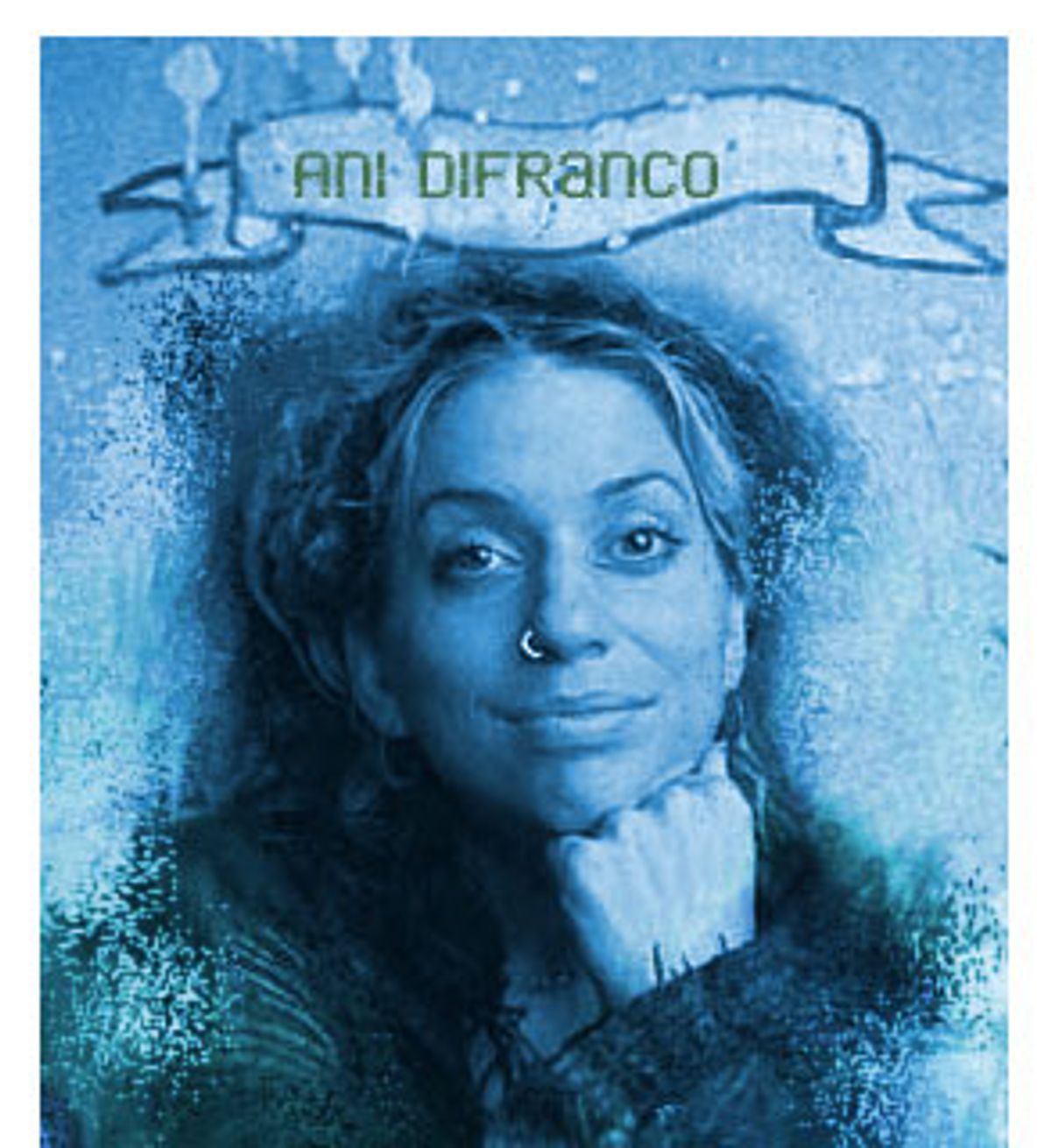
You have to see Ani DiFranco in person to appreciate her fully. As she herself observes in "Evolve," the title song on the album she released earlier this spring, "It took me too long to realize/ that I don't take good pictures/ 'cause I have the kind of beauty that moves." She has an energy that translates best onstage -- an intensity that makes you want to watch her and an authenticity that's refreshing in the age of manufactured pop idols.
She's also one hardworking woman. In the past year, she has put out a double-disc live album, "So Much Shouting, So Much Laughter," the new studio album and a documentary about her life, "Render," all on top of a grueling tour schedule. If anything, the pace is picking up -- and the goddess of do-it-yourself music is doing even more of it herself this time. She's finishing up another new album in her New Orleans studio to be released by this winter, and for the first time she's handling all aspects of the recording process personally. "It's just me and an eight-track reel-to-reel," she says. "Not even an engineer."
This past year has been a time of change for DiFranco, from relocating her recording studio to New Orleans to her separation from her husband to going solo again after years with a band. As usual, she's chronicling her life through her music. And, as usual, this includes a close examination of politics, from time-honored topics like abortion and the death penalty to the actions of the Bush administration. It's hardly surprising that she was among the artists to speak out most forcefully against the U.S. government's reaction to 9/11, especially the war in Iraq. But for all that, she's self-deprecating and bubbly. After talking to her, it's easy to understand why she has such a legendarily devoted following. Salon spoke to her by phone during a break in her New Orleans recording sessions.
So why New Orleans?
Oh, it's just so musical! I'm in love with this town. I found myself out here more and more over the years. It's just so inspirational. I came down here years ago and recorded a few records at a studio in town that used to be here. So I kind of got a jones for it.
How are you able to produce so much work in such a short amount of time?
[Laughs.] Well, if you cut out the sleeping part of the day and add in the nighttime, then you can get a lot more done. I mean, it's kind of true, I am a legendary insomniac. And, you know, part of it is my emotional problem, whatever the hell that is. But then part of it is just like literally having more creative ideas than I can manifest. So I find I lie down and my head starts spinning and I just start thinking about all these things, whatever there is to think about. Part of my great privilege in life is that I can do what I love for work. So not only is it impossible to turn it off, I wouldn't want to turn it off! Music and politics are just kind of a 24/7 thing with me, I guess.
You've always been very political, but since the Bush administration came to power, your political songs, like "Self-Evident" and "Serpentine," seem to have gotten more sweeping and complex.
Well, the escalation of wrongness is terrifying. It's deflating and it's maddening and enraging. Things are getting to a world crisis at the hands of, you know, imperialist America. We're all feeling it, so of course that's coming out. And it doesn't come out in small packages, I guess.
And part of it is that I'm growing up. I've always looked at my writing as political, you know, because I look at everything that way. So even when I'm writing about a love affair or something very private as part of my experience as a young woman in the world, I think of it as very political stuff. I'm aware of it as being so. But now that I'm, whatever, 32 or something, it's like it's my problem. My government, my country and the current political international crises are my problems because I'm an adult American. I find that, unwittingly sometimes, I feel more connected to the superstructures of society. We're born into these systems, but we're very much outside them when we're young. It's like it's not our society. We have no power. We're only learning, really, how it works and what our role in it is. I'm writing about big-P politics for the first time, just because it's more a part of my life now. Suddenly I'm a voting adult and it's my job to fix it.
The 10-minute song/poem "Serpentine" is very emotional and ambitious. In an interview on your Web site, you say you "cried and cried" when you finished recording it. Why did you write that song?
Well, you know, when those big buildings fell down in New York, it seemed like a whole lot of chaos ensued in so many people's lives, on a macrocosmic and a microcosmic level. It sort of makes one wonder about the connection between all of these things, you know? A lot of people I knew underwent real tumultuous changes and losses. There seemed to be an inordinate amount of death and transition and even birth, in addition to the precipice of chaos that our whole society felt. So, that's when I started writing "Serpentine." It took me a long time to write. My instinct was to connect in a big way all those levels of change and make myself accountable on each one of those levels. I guess I see myself as an analogy for my country.
In "Serpentine" you say, "I've been around the world now/ and I can say this about America:/ The mind control is steep here/ the myopia is deep here." What do you mean by mind control in that song?
I'm not really that well traveled. I've just been a few places. I exaggerate. I form big opinions based upon small bits of knowledge. [Laughs.] One thing that is great about traveling so much is learning about where you come from. We all speak from our own perspectives, but I think the American tendency is to be very ethnocentric. I began to experience it as a kid growing up, learning history from the perspective of the elite ruling class. As I travel around, I've begun to realize that there's a way of looking at it where America is a pretty big evil empire that is trying to carry out an imperialist program in the world. And we're becoming very hated and we have very little awareness of it because we're so saturated with corporate propaganda. I keep trying to explain to people outside America, "No, we're not all evil. We're just ignorant."
And then there's the question of how the media sustains that.
Yeah, the media, of course, the corporate media, the fucking corporate whores. To turn on the TV, you're very hard-pressed to find truth in any form. It all works within this corporate superstructure that just eliminates any kind of challenging information. You know, I find in Europe that the access to information is much greater. I learn more about what America is doing when I'm in Europe than here. It's basically censorship. It was the same thing 10 years ago when we had our first Let's Devastate Iraq war. It's completely censored news, it's not news at all. But we're still not willing to cop to this. It's kind of new, I think. We have this guy in office that's trying to careen our country from a democracy to a dictatorship in a few years. And we're still in collective denial about how far it's gone.
In the unreleased poem "Grand Canyon of Light," you talk about how you love your country, that you're "indebted joyfully" to people throughout history who have "fought the government to make right." Why did you write that poem?
Well, right up until we started bombing Iraq, I was speaking out onstage a lot against the war. I just found myself sad, and then I was confronted with these audiences that were like, "Ani, speak to it, speak to it." I didn't feel I had anything useful or heroic to say, but then I found myself onstage and people kind of expected and demanded it from me. So I endeavored very purposely to write a patriotic poem. You know, I wanted to get in on the patriotic action! I was meditating on a quote by Mark Twain, "Loyalty to the country always, loyalty to the government when it deserves it." There's an essential distinction between America the country -- as in the people, the land, the culture, you know, the real America, which I love -- and the government, the ruling elite which I loathe and which is trying to destroy this place for its own aggrandizement. Of course, the big fallacy in the media -- this lying, whoring media -- is that patriotism is blindly accepting, noncritical, silently following. That's a very fascist idea, not a democratic idea of patriotism at all. So I wanted to make that distinction, in order to pave a path to a different kind of patriotism.
There's a lot of sadness and melancholy in your music right now. Can you talk about that?
Well, it's funny. I've had a couple of different conversations with friends and loved ones that know and understand what I'm trying to do and help me know and understand it. A couple of times lately people have described my work as uplifting. I'm conscious of that myself -- I think I agree with Woody Guthrie that a song should uplift. But then there's this little pause in the conversation where the person looks at me and goes, "I mean, it's not like it's happy or anything." I guess it's a kind of roundabout way of uplifting. I think that exorcising demons and giving relief to the darkness is a way of infusing it with light and overcoming it. I try to regain a little bit of personal power through confronting those things. I have noticed that through music I have made myself a stronger, more empowered, happier person, and helped other folks, maybe, along the way to be inspired or stronger in themselves. It's not necessarily through tra-la-la, but through moving from the dark places into something lighter.
You also sing about smiling. In the song "Phase," you say, "This vague little smile is my all-purpose expression/ the meaning of which I will leave to your discretion." What is it to you to smile?
I think to smile is kind of my default setting. It's my mom in me. I remember somebody on MTV describing me as "alarmingly happy," you know, in that kind of condescending way. But of course a smile doesn't always mean happy. As I'm less and less happy on a daily basis, I'm conscious of the fact that I wear this smile and it's not necessarily a happy one. So what is it and why is it there? I guess it's my way of hiding. But I also see it as part of my human duty. It's sort of like, life is hard, life is suffering. Chances are it's sucking for any given person at any given moment. And so to scowl and shrug our way through the day almost seems redundant. I see being outwardly cheerful as one of my missions. Not just thinking about the pursuit of happiness in that big way, but on a practical, daily level. But lately I've been thinking about how much of it is healthy, because to a certain point, it's also healthy to show your emotions. Am I really hurting myself by this? And is it fake? I don't want to be fake.
You're talking about nature more in your songs. In "Evolve," you sing about becoming transfixed with your part in nature. And there's an unreleased song called "Animal" in which you say there's an animal looking out from behind your eyes.
Well, you know, I don't know much about nature. I've always been a city girl and I've always been enamored by people and culture. I'm fascinated by human dynamics. But one of the catalysts was this fucking pseudo-religious war that they started trying to market to us for awhile before it became counteracting the eminent nuclear threat before that became liberating Iraq, or whatever spin they want to put on it. So, I just found myself stepping back, little me in my little life, thinking my tiny thoughts, very far away from all of that -- the governments and wars and religions, and the war-torn Middle East and this battle of male will. And I began to think that we're always going to have wars as long as we have these patriarchal structures controlling us. I think that the template of how to live together and respect each other is in nature. It's almost a pre-religious thing. And there's a tendency in patriarchal structures to think of oneself as being above nature, whatever the religion, like we are very special beings that are created in God's image and therefore have the right to rule over all kinds of things. And our awareness of ourselves as animals, or part of an ecosystem, is nil. I'm beginning to realize that all these laws created by governments are simply imagined by men. The only true laws are the ones of nature.
So are you a vegetarian?
No. But I don't eat a lot of meat. It's about moderation. I'm not against eating meat as a concept, just as a sort of industry.
In the documentary "Render," you have a section where you ask fans not to scream "I love you, Ani!" or sing along with the songs. What's that about?
Well, basically so that folks watching the documentary would maybe realize if they were part of that dynamic. It's better than it used to be. I'm growing up and my audience is growing up a little bit, so the dynamic is changing. When you're trying to make music, it's hard to really sing with your full self, like stay in the song and really follow it, if somebody is caterwauling over you. It's impossible to hear your own song unfolding or to make it new again when you're just kind of struggling against that. It's like busking in a train station against a din of whatever. It's a loving, affirming kind of din, but it's still very unmusical. Sometimes it just totally prevents me from being able to focus, which defeats the purpose of us all gathering there.
In the song "Here for Now," you talk about wondering if your instrument needs to be miked and fantasizing about disappearing from the moment. Then you say that that thought is the one thing that saves you from your "fear of being here." What is that song about?
I guess it's about being paralyzed by a moment, whether that's, "Oh, I'm onstage in front of thousands of people and I suck and my hair is dumb and I can't remember how this goes," or "I'm standing here before this person who has -- whatever it is," but a situation that is such a big deal. I think it's me trying to pacify myself, like whatever it is that's such a big deal isn't such a big deal in the great scheme of the planet. It's almost like taking refuge in the fleetingness and the insignificance of myself. Just stand here and get through this moment because in a few minutes you'll realize this moment wasn't such a big deal.
What's it like to go back to your old songs now that you're older? I mean you must have changed musically and personally ...
Brutal! Or what you were wearing? All of it! I have a deep well of self-loathing and insecurity to go dipping in and this kind of job provides ample opportunities for that. One thing I do is I don't read anything about me anymore. I haven't for years now. And that really helps. And I certainly don't go back and listen to the records I made! And I don't look at pictures. I try to keep my focus off that, off me. It's incredibly embarrassing to make all your mistakes publicly and do a lot of growing in front of people. But, you know, whatever.
Does that affect the songs you choose to perform?
Luckily for me, I still really like a lot of the old songs. They've had troubled little lives, you know, but they're good kids. Unfortunately, their big class picture will long outlive them. They're covered in pimples, you know, and the hair was terrifying. You know, these albums that I've made, they're not necessarily good manifestations of these songs, but there's still a lot of songs from the first album onward that have meaning to me, that I still play with a full sense of being in it. But when I want to pull out an old song, I have to go back and relearn it -- and that means I have to put on the record. I know that will send me spiraling for days into the self-loathing pit, so that's a tough endeavor. I suppose the humbling is probably useful.
Shares