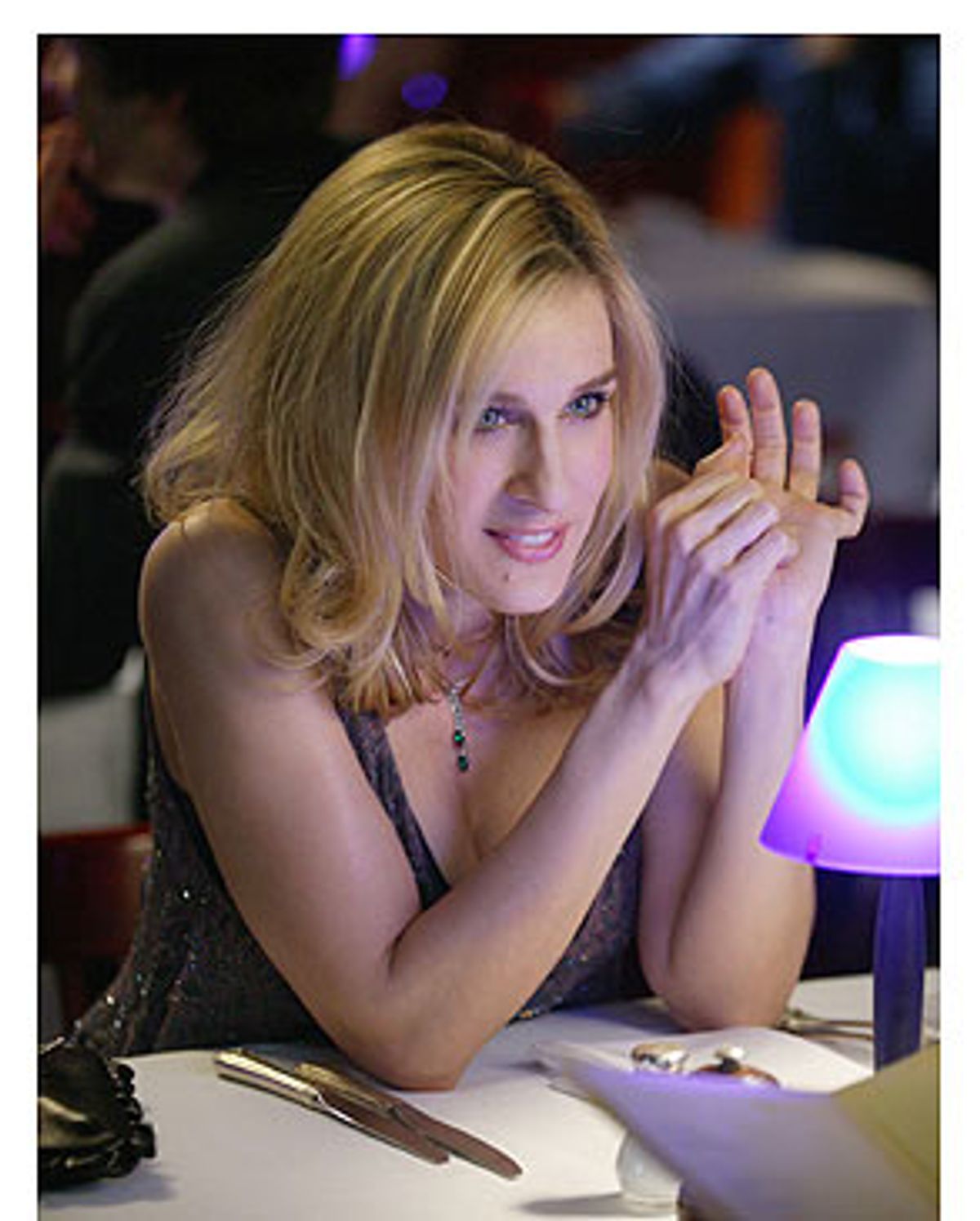
HBO

The trouble with Carrie

Sarah Jessica Parker has spoiled the delicate chemistry of "Sex and the City" by turning her once-flawed character into a boring uptown bombshell -- and by refusing to get naked.

  • more
    • All Share Services

The trouble with Carrie

“Sex and the City” begins its sixth and final season on Sunday, and if you were to take the ads for the series at face value — the ones that have shown up in bus shelters, phone booths and magazines in New York and elsewhere — you’d think the show had only one star. Those ads feature Sarah Jessica Parker as Carrie Bradshaw, the Manhattanite sex columnist whose adventures in the world of urban dating (not to mention shopping) have always been the centerpiece of the show.

The ads, done in moody, soft-focus black-and-white, give off the perfume of tasteful, risk-free glamour. Parker-as-Carrie looks like a ’50s Italian movie star in glossily tousled blond curls (with roots just sooty enough for street cred); her dreamy eyes are rimmed with Cleopatra-via-François Nars kohl, her lips molded into a sexpot pout. This Carrie is more together than ever, at least in the magazine-ad kind of way — you can just tell she’s sexier, softer, kinder than before. I’ll bet she still smokes, but she probably doesn’t wield a butt with the absent-minded, aggressive fierceness of the old days; she now has a heightened awareness of how elegant the cigarette looks perched in her hand. She’s more confident and more dazzling than ever, a woman striding toward her 40s with a wan smile and a tight butt.

Would the 1998 Carrie Bradshaw be able to stand the 2003 version?

Ensemble comedies are tricky things, and the longer an ensemble comedy survives, the rockier the terrain gets. For most of its five previous seasons, “Sex and the City” has been the brightest, most stylish, most consistently entertaining ensemble comedy on television. That’s largely thanks to Parker, but not solely: Her three costars have always been as integral to the show’s pleasures as she is. Kim Cattrall is Samantha, a woman who dates around, happily, without commitment, enjoying a sex life something like the one Hugh Hefner envisioned for himself and his fellow playboys back in the ’50s. Cynthia Nixon is Miranda, the sensible corporate lawyer who’s tougher and more blunt than most of the men she dates, but who has a core of kindness that the others can’t match. And Kristin Davis is Charlotte, the sweet but hardly dumb brunette who believes in true love above all, although she doesn’t underestimate the value of real estate.

The four actresses have proved to be a formidable and beautifully integrated team. For the first four seasons, at least, they complemented one another as if each of their careers had been headed toward this single focal point all along. They must be a joy to write for, considering their rapport is almost palpable: They pick up on one another’s cues with ease, bolstering their respective strengths and rendering their weaknesses invisible.

But sometime during the fourth season, things began to change, most significantly around Carrie’s character. Parker’s Carrie has always been the ringleader, and at first, especially, it was easy to see why.

For one thing, the show was based on the work of real-life New York writer Candace Bushnell, with Carrie her fictional counterpart. The role represented Parker’s biggest break, after years of being a well-regarded actress but not exactly a star, and it was a break she deserved: Parker is one of the most gifted comic actresses of her generation. Her timing is sure and sharp. She has a knack for physical comedy. And her beauty is more classical than classic: The contours of her features are noble and good-natured. She has the kind of face you’d see on a Roman coin.

All four characters have changed since the show’s inception — they’d have to, or what would be the point? But Parker’s Carrie has changed the most, perhaps not coincidentally since Parker became one of the show’s executive producers a few seasons back. Since the show’s debut, Miranda has had a baby; Samantha has attempted a committed relationship; Charlotte has gotten married and then divorced. And plenty has happened to Carrie, including an on-again, off-again romance with the charismatic and mystifying Mr. Big (Chris Noth) and a messy almost-marriage to the dopey dreamboat Aidan (John Corbett).

But somehow, the story lines written for Carrie now seem bigger and bolder, even as her mistakes and missteps don’t carry the same weight as those of the others. There’s something vaguely superior, or maybe even not so vaguely, about the way her character eases, time after time, into the show’s most glowing light. Parker has changed as an actress, and not wholly for the better: Her line readings can still be wonderful, but there’s something stiff and self-conscious about her, particularly as her character has shifted from a loopy, smart, sharp-witted urban beauty to a chic, classy, uptown-style babe. She seems to have slipped all too comfortably into the role of boring bombshell. She was infinitely more likable, and more interesting, as an awkwardly confident city girl.

Miranda, Samantha and Charlotte have grown more complex and more intriguing as characters; Carrie has simply grown more polished. And there’s one more thing that sets Carrie apart from her cohorts, and Parker apart from her costars: Of the four, Parker is the only one who routinely wears a bra or “bedsheet bandeau” during love scenes.

The unspoken message is, It’s OK for them to take their clothes off, but you won’t catch me doing it.

I’ve often heard real, live single New York women complaining about “Sex and the City”: “Five hundred bucks for a pair of shoes — no way!” “That walk-in closet is the size of my bedroom and living room combined!” “My friends and I never talk about vibrators at brunch, nor would anything as sickening as a cosmopolitan ever cross our lips!” And don’t forget the ever-popular “I wouldn’t be caught dead wearing a tam-o’-shanter at an outdoor cafe!”

OK, I admit that Carrie’s Season 5 tartan tam did come close to snapping the bra strap of suspended disbelief. (Carrie’s outfits, which have become more bizarrely affected with each passing season, are too much of a galloping horror to go into here.) But since when is farce supposed to be realistic? Even if the show were true to life, its value would never lie in how accurately it portrays the reality of single city women. The show’s grand joke is that while just about every city woman wouldn’t mind some degree of glamour and sophistication in everyday life, the city’s job is to prevent glamour and sophistication whenever possible — there must be a budget allocation for it.

Strategically placed wind tunnels in various locations around the city are waiting to blow your dress up around your shoulders whenever possible, preferably as you’re passing a construction site. When you go out for your Times in the morning, you may very well brush by a man peeing against a wall. (For some strange reason, it never happens if you’re buying the Post or the Daily News.) That careering city bus probably isn’t going to hit you, but it is likely to splash nasty puddle water on your Gaultier tutu the very first day you wear it. The nerve of the place!

The city — and society at large, which of course encompasses the dating world — demands civilized behavior from us, and look what we get in return. That’s a delicious setting for the bumpily unfolding saga of these four women — all of them in their mid-30s or thereabouts and all of them good-looking, independent-minded and reasonably successful at their careers — as they try to manage the unruliness of mere living.

“Sex and the City” is neither a window into real life nor, heaven forbid, a model of how to behave or dress when you’re a young woman living in the city. Its sophistication lies not in the fact that these women lead sophisticated lives; in fact, the noisy jangle between the lives they’re trying to build for themselves and the lives they’re actually getting is what makes “Sex and the City” so delectable.

The writing doesn’t represent the way people talk as much as the way we want to imagine people talking. “Sex and the City” is high comedy sparked with low, a modern comedy of manners in which it’s perfectly appropriate to use common slang as well as forbidden words like “pussy” and “dildo.” “Sex and the City” picks up threads of the dexterously clever tradition of Oscar Wilde and Noel Coward and adds dollops of low comic raunch. When the show is in high gear, both the writing and the acting show a deftness of touch and a love of the ridiculous, as well as a recognition that if our lives were exactly as we wanted them, they wouldn’t be nearly so funny. Society does exist for a reason: It’s there for us to make fun of, to chafe against, even if we freely admit to enjoying its trappings. In “Sex and the City,” a silk gardenia on a jean jacket subs for a boutonniere on a dinner-jacket lapel.

Like all the “Sex and the City” actresses, Parker has been a joy to watch, straight through the first three seasons and most of the fourth. But in the fifth season — or perhaps beginning near the end of the fourth, around the time Carrie broke up with Aidan for the second time — Parker suddenly seemed to be trying too hard. Her look on the show became more polished, for one thing: Her bobbed hair had lost some of its appealing, wayward craziness; her eye makeup looked as if it were the result of a solid half-hour in front of the mirror, instead of the more natural “two flicks of the mascara wand” effect most of us busy girls make do with.

Parker’s new look was definitely prettier: For better or worse, she suddenly seemed more like a conventional beauty. But as the season wore on, she seemed to have lost some of her spark, her eccentricity. Her mannerisms, and even the set of her mouth, seemed to change subtly, becoming more studied and less natural. You started to see the broad, goofy grin less and the practiced smile more. And tiny, weird aberrations suddenly came to the fore: Even when she does something as simple and as seemingly natural as pushing her hair back from her face, her movements seem calculated and affected. (I’ve noticed her using one erect forefinger to delicately and precisely push back the front strands of her hair — the kind of thing I’ve only ever seen drag queens do, and even then, only onstage.)

The difference between the old Parker and the new is even more pronounced when you look at the first few episodes of the show, from the late ’90s. The 2003 Carrie walks with the gait of a supermodel. She radiates glamour with a capital “G,” a far cry from the woman who, just seconds after meeting Chris Noth’s Mr. Big on the street for the first time, totters off on her stiletto heels, pulling down the back hem of her black ultramini with a few mighty tugs. For a split second, her legs threaten to fold under her; with a coltish toss of her head, she rights herself, averting disaster. Parker’s trim figure is lovely, but her faintly gangly physicality (and, more specifically, her ability to put it to such good use in comedy) is what makes it truly beautiful. In that raven minidress, she’s a chic black daisy on impossible stems.

The new Parker might stumble on her stilettos now and then just to remind us she’s still human, still a little bit like the rest of us. But it isn’t nearly the same. In one of the first-season episodes, she and Miranda, Samantha and Charlotte sit around a table eating takeout, grumbling about how so many men seem to want only supermodels. Samantha’s self-image is solid, but Miranda and Charlotte are tough on themselves. “Look at you two, you’re beautiful!” Carrie exclaims, annoyed and impatient with their nonsense — she refuses to coddle them. With one hand, she holds a copy of Glamour magazine aloft, making a remark about its near-perfect cover model. With the other, she picks a piece of food from between her teeth. And in between all this, she barely stops talking.

Now that’s our Carrie. More recently, though, a certain prissiness — something that was never apparent before — has crept into her character. Maybe the writers (the show uses a revolving team of writers and directors, with a few regulars) are mostly to blame for that, but you can’t help wondering if Parker hasn’t had a hand in shaping her character’s direction.

The most blatant example is an early episode of Season 5, in which Carrie accidentally walks into Samantha’s office just as Samantha is giving an impromptu blow job to the overnight-delivery guy. Carrie flees the office, embarrassed. Later, Carrie makes a sneering wisecrack about the incident, and when Samantha accuses Carrie of judging her for being “loose,” Carrie admits that she would never behave as Samantha does. Samantha is understandably hurt. And while Carrie does eventually acknowledge that she had been judgmental toward Samantha, there’s something a little superior about the way Carrie sits so comfortably in the role of the good girl who would never act like “that.” Even the way she learns her lesson is a little smug; Carrie is magnanimous enough to have seen the error of her ways. But you still wonder if, deep down, she doesn’t think Samantha is just a little cheap.

Carrie’s persnicketiness about what she will and won’t do in her sexual life is underscored by the fact that Parker is the only one of the show’s four actresses who won’t do nudity. At one point or another, Cattrall, Davis and Nixon have all stripped down to varying degrees; Cattrall has been the boldest of all, which makes sense, since Samantha’s sexuality is so integral to her character.

But how many times have we seen Carrie in bed with this or that beau, making love well into the night with her bra firmly fastened around her torso, or with the sheet wrapped primly around her shape? Whether or not an actress does nudity is her choice to make. But when you’re part of an ensemble of actresses as fearless as Cattrall, Nixon and Davis — actresses who don’t strip down wantonly, but who will do so when the script demands it — there’s something cowardly about Parker’s effusive modesty. All actresses have to protect their image to some degree; but sometimes, in order to make a character seem real, you’ve got to bare more than your soul.

On the one hand, you could applaud Parker for her staunch principles. And again, her contract is hers to negotiate, after all. But there’s a whiff of hypocrisy in the fact that she’s the only member of an ensemble cast who will notably not take off her clothes. The show is called “Sex and the City,” which means that it’s sometimes going to be about dating, which means that it’s at least occasionally going to be about sex (although, admittedly, the show is almost never as overtly about sex as its name would lead you to believe). In real life, sex often leads to nakedness. I wouldn’t have wanted any other actress to play Carrie Bradshaw. But I think an actress’s willingness to do nudity should have some bearing on the roles she chooses to begin with.

If a character is never seen naked, even when the setting would make nakedness seem completely natural and believable, doesn’t that suggest that the actress playing that character is putting her image ahead of the demands of the role? Worse yet, I think Parker’s unwillingness to strip down — even in a modest way, as, say, Davis has done — suggests an unspoken judgment about her colleagues.

An acquaintance of mine who worked as an editor of children’s textbooks once explained the intricate rules of illustration to me: You can’t show a bear wearing only a shirt, since that implies that the bear ought to be wearing pants, but isn’t. By the same token, Parker’s resolute modesty stands out, suggesting that her colleagues should be wearing brassieres or bedsheet bandeaus and simply are not. Parker obviously doesn’t feel comfortable doing nudity. But the strictures she adheres to make us even more aware of the chances her colleagues willingly take.

I freely admit to being tougher on Parker than I am on any of her colleagues. That’s partly because, in the past year at least, it seems that Davis, Cattrall and Nixon have been overshadowed by the Parker spotlight, even though their work has been much stronger than hers. I feel particularly protective of Davis: Charlotte, with those kitty-cat cardigans and that fetching schoolteacher smile, was pure genius last season. I can’t wait to see what she’ll do in this last one.

But I still hold out hope that Parker will turn herself around. The show’s writers have hinted that Season 6 will feature plenty of Mr. Big — a good sign, since Parker has always been funnier and more relaxed with Noth than with any of her other on-screen boyfriends. Parker won my heart long ago, perhaps around the time she played the bendy, spacey SaNDeE* (“and a star over the E!”) in Steve Martin’s “L.A. Story.” I want her show to be as resoundingly vibrant in the end as it was at its start.

I can’t begrudge Parker the desire to enjoy being, at last, a conventional beauty. She can keep the perfect hair and the meticulous eye shadow and the weirdo-chic wardrobe, the closet full of Manolo Blahniks and the New York apartment that could comfortably house a family of four. Realism be damned — humanity is all that counts. I just want to see her pick her teeth.

Stephanie Zacharek is a senior writer for Salon Arts & Entertainment.

Ernest Hemingway made silly

HBO's unintentionally hilarious "Hemingway & Gellhorn" gets everything disastrously wrong

  • more
    • All Share Services

Ernest Hemingway made silly Nicole Kidman and Clive Owen in "Hemingway & Gellhorn"

Here’s something you should consider doing before watching HBO’s inadvertent comedy “Hemingway & Gellhorn,” a disastrous two-and-a-half-hour CliffsNotes on the passionate, dysfunctional love affair between Ernest Hemingway (Clive Owen) and his third wife, the war correspondent Martha Gellhorn (Nicole Kidman), which airs Monday night. Find some Hemingway — take it off the shelf, download it to a Kindle, load a page of “The Sun Also Rises” onto your computer via Google books — and leave it within arm’s reach. You are going to want to read from it at fairly regular intervals to remind yourself that though he may have been a drunk, a brute and a womanizer, Ernest Hemingway was not a complete and total idiot. And then you can also use it to shield your eyes from the movie’s myriad crimes against sepia, its extensive use of what appear to be Instagram photo effects, the hot pink blood, Metallica’s Lars Ulrich in a beret, and the scene toward the end of the film in which Kidman’s face is superimposed over real footage of emaciated bodies at Auschwitz and Dachau.

Hemingway and Gellhorn met in Florida in 1936, when she was 28 and he was 37, already famous and married to his second wife. The two covered the Spanish Civil War together, then lived with each other for a few years, married in 1940 and were divorced by 1945. Despite the fact that Gellhorn covered every major conflict between the Spanish Civil War and Vietnam, she is best known as Ernest Hemingway’s third wife, a designation she bridled at both in real life and in the film. “Hemingway & Gellhorn” purports to rectify this. She, not Hemingway, is the movie’s protagonist and narrator. It begins on a close-up of Kidman, in old-age makeup — she looks good wearing all those wrinkles she’s fought so tirelessly to erase — speaking to a documentary crew in a smoky, deep contralto about her life. But though the film pays lip service to making Gellhorn more than, as she put it, “a footnote to someone else’s life,” it chooses to do so by focusing only on the period of time in which … she was that footnote. With friends like these, better they not be filmmakers.

At least Gellhorn does not come across quite as badly as Hemingway, who brays and screams and generally behaves like an overgrown child. When we first see him, he is drinking, smoking and cackling maniacally while reeling in a marlin, the Not That Old Man and the Hunter S. Thompson Outtake. It gets more Gonzo from there, as in when he and Robert Duvall, playing a USSR general, clench a red scarf between their teeth and threaten to play Russian roulette before Tony Shaloub calms them down with vodka.

Clive Owen has been stripped of all sex appeal — future directors take heed: Wire frames and a mustache are Clive Owen’s sexual kryptonite — despite having lots of sex. (I can imagine Corey Stoll’s incredibly dashing Hemingway, from last year’s “Midnight in Paris,” pointing at this version of Hem and cackling.) As for his writing, though he is occasionally seen standing up, typing away, and floating his pages into the trash, of the two lines of writing we hear, one is plagiarized from an earlier conversation and the other is “If a man can stand he can fight” — the sort of stereotypical stinker of a Hemingway line that makes people hate Hemingway.

But the disaster of “Hemingway & Gellhorn” isn’t on Owen, who gives this silliness his all, or Kidman, who devotes herself and even, occasionally makes it work. In almost every instance, the script and direction settle for the simplest, dullest explanation of its main characters’ behavior, even when that’s in direct contradiction of something mentioned earlier. (Philip Kaufman, who in an earlier life made “The Unbearable Lightness of Being,” is the director here, and he keeps insisting on inserting Kidman and Owen into real historical footage like he’s Forrest Gump with access to iMovie.)  In the very first scene, the older Gellhorn narrates that she never liked sex, a comment she made in real life as well. But every time she and Hemingway bang in this movie — in one endless sequence, they screw while actual bombs are going off on the street outside — she seems as into it as the most gifted porn star.

In this movie, when Gellhorn saddles up to Hemingway at a bar in Key West, all sass and ass, it can’t be because he cuts such a dashing figure — after all, he’s drunk, covered in blood, and a dead ringer for Groucho Marx — but because he’s Ernest-effing-Hemingway. Martha Gellhorn was a major, ballsy, charismatic operator, a woman driven and brave enough to crash a boys club and go to war, time and time again, but the movie ignores all the hundreds of spiky, complicated, difficult, even selfish reasons that a person as interesting, intense and ambitious as Gellhorn might want to be with someone of Hemingway’s stature. (When Gellhorn insists on leaving Hem to go cover the end of WWII, Hemingway cheats on her. In real life, Gellhorn cheated too, but that detail didn’t make the cut.) Instead, Gellhorn loves Hemingway, but she can not shirk her duty to bear witness to world events. Hemingway loves Gellhorn, but he needs to be the center of attention.

At the end of the movie, the documentarian asks an older Gellhorn about her relationship with Hemingway, and she bristles. The man has been dead for nearly 40 years, she’s moved past him, and she’s lived a plenty interesting life on her own terms, she says. Then the crew leaves and she goes directly to her desk to read a letter from Hem, because, whatever the movie pretends, it doesn’t believe her.

Continue Reading Close
Willa Paskin

Willa Paskin is Salon's staff TV writer.

Aaron Sorkin’s right-wing fantasy

In the "West Wing" creator's new HBO show, the hero is a Republican VIDEO

  • more
    • All Share Services

Aaron Sorkin's right-wing fantasyJeff Daniels in "Newsroom"

The trailer for HBO’s “Newsroom,” Aaron Sorkin’s forthcoming drama, set behind-the-scenes of a cable news program, debuted last night. In it, the well-respected news anchor Will McAvoy’s (Jeff Daniels) long-held political neutrality is finally exploded when he is hectored into explaining “Why America is the greatest country in the world.” His answer is an exasperated “It’s not the greatest country in the world.” McAvoy continues in the most condescending tones to address the blond college student who asked the question: “Just in case you accidentally wander into a voting booth one day, there’s some things you should know,” he says, before unleashing a barrage of statistics about America’s relative incompetence. In other words, it’s classic Sorkin — rapid-fire, dense, smart, patronizing and morally outraged — except for one thing. Will McAvoy is a Republican.

Over the course of his career, Sorkin has tapped into a liberal fantasy of politics more regularly than probably anyone. In “The West Wing” Sorkin created the dream Democrat, President Josiah Bartlett, not just an erudite and morally impregnable man, but one who wielded his intelligence like a sword. When pushed, Bartlett pushed back, with logic and truth, righteousness and all the Bible quotes he needed.

Bartlet may be Sorkin’s most famous liberal fantasia, but he’s not his only one. He created two more in the presidential election that took place in later seasons of “West Wing,” a face-off between the inspiring, Hispanic candidate Matt Santos, a character who was loosely based on the not-yet-president Barack Obama, and the socially moderate, fiscally conservative, pro-choice Republican Arnold Vinick, Sorkin’s first stab at creating a Republican a Democrat could love.

Then in Sorkin’s disastrous “Studio 60,” set behind the scenes of a “Saturday Night Live”-type show, Sorkin introduced another fantasy, the relatively liberal believer. Harriet Hayes, who was based on Sorkin’s ex-girlfriend Kristin Chenoweth, was (supposed to be) a supremely talented performer and devout Christian, with a more or less nuanced take on social issues and an active sense of humor despite her faith.

And now here’s Will McAvoy: “I’m a registered Republican,” he says. “I only seem liberal because I believe hurricanes are caused by high barometric pressure and not gay marriage.” Forget presidents who can slay conservative ideologues with their words, the fantasy Sorkin’s trafficking in now is that endangered species, the socially moderate, reasonable Republican (or, if you want to put it a little more ambitiously, the socially moderate, reasonable Republican on cable news). In the trailer, right-wing talk radio is already hating on McAvoy and his denouncement of American exceptionalism, but  in “Newsroom,” if not in the real world, the right’s ire shouldn’t hurt McAvoy too much: Sorkin’s going to give him a voice, and make him a hero, among liberals anyway.

Continue Reading Close
Willa Paskin

Willa Paskin is Salon's staff TV writer.

Sarah Palin’s Hollywood ending

HBO's "Game Change" presents Palin as simply a bumbling Tina Fey -- and misses the real story of the 2008 campaign

  • more
    • All Share Services

Sarah Palin's Hollywood endingJulianne Moore as Sarah Palin in HBO's "Game Change" (Credit: HBO Films)

HBO’s “Game Change,” airing this Saturday, is not actually an adaption of the book “Game Change,” by Mark Halperin and John Heilemann. It is “Sarah Palin Goes Rogue,” the movie, with a couple of anecdotes borrowed from the notoriously gossipy account of the 2008 election as a whole. (Or, arguably, it’s an adaptation of Scott Conroy and Shushannah Walshe’s “Sarah From Alaska.”)

That is sort of a shame. The Palin thing is the most heavily over-covered story line of the entire 2008 campaign, so focusing on it might be totally logical from a marketing perspective, but it’s unfortunate from an artistic one. The film re-creates various moments of YouTube campaign ephemera very well — remember when that old white lady called Obama an Arab and McCain looked uncomfortable? When it takes us behind closed doors, it’s to witness scenes any moderately close observer of the election and its aftermath could’ve dreamed up him- or herself. It might have been fun to see a TV movie about the Democratic primary fight; the personality clashes of the disastrous Clinton campaign would have made for entertaining television, and Mark Penn is surely a creature crying out for a grotesque Emmy-winning portrayal by, say, Paul Giamatti.

Instead, McCain has won the nomination three-and-a-half minutes into the film. Soon we’re watching Julianne Moore watch Tina Fey on TV. You remember the “SNL” sketches making fun of Palin, right? In case you don’t, “Game Change” airs lengthy chunks from most of them. It also has tons of actual footage from CNN and MSNBC and Fox News, and it re-creates debates and speeches and the Couric interview and the Charlie Gibson interview and a bunch of other things you saw either live or on YouTube when they happened.

Moore’s performance is not just fair but maybe even flattering. (For one thing, she doesn’t hit those flat upper Midwest vowels as gratingly as the real Palin.) Woody Harrelson plays strategist Steve Schmidt — the film’s protagonist — as a grizzled, “too old for this shit” campaign veteran called back to the trail against his better judgment. Jamey Sheridan is given barely anything to do as Mark Salter, McCain’s “conscience.” Salter, the primary author of his “Maverick” mythos, is limited, after the Palin selection, to making a hilariously over-telegraphed face of concern as everyone else in the war room applauds her first speech.

But the film is about Schmidt and Nicolle Wallace because they were pretty clearly Halperin and Heilemann’s primary sources, and we watch them become horrified by the depths of Sarah Palin’s ignorance at exactly the same time as everyone else in America became horrified by her ignorance.

Because it’s Hollywood, there’s very little politics in the film’s depiction of politics. Policies are simply things for Sarah Palin to write on note cards and not memorize. Operatives confidently declare, in faux Sorkin-ese patter, that if this or that meaningless decision is made, it means “we’ll lose by five.”

There is a sheen of faux cynicism (McCain swears like a sailor!) but it masks complete naiveté: Everyone is basically honorable and decent. Nicolle Wallace — a member of the Bush administration communications team — is sincerely alarmed at the prospect of someone as dangerously ignorant as Sarah Palin in the White House. On election night, she breaks down in tears as she admits to Schmidt that … she didn’t vote. They embrace.

The film subscribes to the simplest theory of Sarah Palin: That she is childlike, vain and incredibly ignorant but also an essentially decent person and wonderful mother. The moments that come closest to “unfair” — Sarah Palin doesn’t know that the head of Great Britain’s government is the prime minister, not the queen — are basically plausible. This isn’t Andrew Sullivan’s conniving, dangerous pathological liar. It’s an overwhelmed working mother whose most unhinged moments are explained by a crash diet. Her convention speech is largely stripped of its snarling attack lines, imagining a world in which it appealed to “the base” because of Palin’s heartfelt commitment to special-needs children and not because she was very good at saying mean things about Obama. (The film actually repeats the bullshit story that her teleprompter broke midway through, and she kept going.) Even when the film has her take a major heel turn — “if I am single-handedly carrying this campaign, I am gonna do what I want!” — after “winning” her debate with Joe Biden (played by video footage of Joe Biden), she is still basically an innocent seduced by the adoration of riled-up crowds and national attention. (Todd Palin barely does anything.)

The constant use of actual news footage adds a bit of verisimilitude but also constantly raises the question of why this lightly fictionalized version of the election actually needs to exist. “Game Change” is not really for serious political junkies, who remember all the stuff that did happen and will scoff at the stuff that didn’t. (At one point, John McCain answers his ringing iPhone in the middle of the night. He used a BlackBerry, HBO.) But if casually politically involved people want to see their assumptions about Sarah Palin reinforced, well, there are still those “SNL” sketches.

In the end, the Republican operatives who foisted Sarah Palin on an unprepared nation are rightly horrified that they created a monster, but at no point does anyone act concerned that their actual candidate was himself an angry, warmongering old crank with extremely fungible principles. Sure, Sarah Palin didn’t know what the Fed did. Do we have any proof John McCain knew what it should’ve done? Maybe everyone actually was totally unfair to poor Sarah Palin.

Continue Reading Close
Alex Pareene

Alex Pareene writes about politics for Salon and is the author of "The Rude Guide to Mitt." Email him at apareene@salon.com and follow him on Twitter @pareene

The writer behind HBO’s “Game Change”

Salon talks to screenwriter Danny Strong about Sarah Palin and why he considers her a modern-day "Pygmalion'"

  • more
    • All Share Services

The writer behind HBO's Ed Harris as John McCain and Julianne Moore as Sarah Palin in "Game Change"

In recent years, Danny Strong has become the go-to guy for political drama for HBO. He’s gotten an Emmy nomination and Writers Guild of America award for his screenplay for the 2008 “Recount,” about the 2000 presidential vote in Florida. And now he’s gone back to work with that film’s director, Jay Roach, on the anticipated adaptation of the controversial bestseller “Game Change,” which premieres on HBO Saturday. “Game Change” chronicles Sarah Palin’s rise during the 2008 presidential race and features a superlative performance by Julianne Moore as Sarah Palin, along with Ed Harris as John McCain and Woody Harrelson as McCain’s senior strategist Steve Schmidt. It is already getting pushback from Republicans, who are calling it a political-year propaganda film.

Oddly enough, Strong began his entertainment career playing key roles in cult series – Jonathan Levinson on “Buffy the Vampire Slayer”; Paris’ boyfriend on “Gilmore Girls”; the hopeful copywriter hired after Don Draper stole his idea on “Mad Men.” We caught up with him in Atlanta last week.

Sarah Palin is introduced on about page 350 of John Heilemann and Mark Halperin’s “Game Change,” a book that covered the 2008 Obama, Clinton, McCain and Edwards races as well. Was it always going to be just about her?

It was the director Jay Roach’s concept to just do the Palin story, and I agreed that I thought that was the best approach, for various reasons. One, I thought it was the most exciting story in the book, but not only that, I thought it was one of the most exciting stories in recent American politics. I just thought it would make an amazing movie. I also thought that doing a story about Barack Obama at this time, it would be impossible for the film not to come across as an informercial for his reelection and it would be difficult for an audience to get lost in a movie about him while he was still president. I think there’s a great movie there, too. But I think that movie needs to be made after he’s out of office.

When did you start to work on this? And, as in “Recount,” I understand it began with a lot of your own reporting.

I think we started in late summer, 2010. I did 25 interviews with people in the campaign and then read a ton of other books, too, on the subject, particularly Sarah Palin’s book “Going Rogue,” which was a beat-by-beat account of what happened in the campaign from her point of view.

What percentage of the movie was based on the book and what was your own reporting?

I would say 90 percent of the movie is the book, 5 percent is my original reporting, 5 percent is other sources.  But so much of my own reporting was just trying to confirm the veracity of the book, which I found to be extremely accurate, based on the interviews.

I don’t want to misrepresent I was some big scoop-getter in this process. The movie really is built on the back of reporting of the book. There’s nothing I found out that I wouldn’t have been able to find out if it hadn’t been the work John and Mark had done. But there’s one thing [I found out] that’s already been put on record that I’ll just mention – that Palin thought that the queen of England was the ruler of England. That’s something I got from my own reporting.

There were also some surprising quotes in the book that I don’t remember seeing in the movie, such as when she said during a low point of preparing for her single debate “If I’d known everything I know now, I wouldn’t have done this.”

Yeah, you know that was in the movie. It was in the script and was shot. It just ended up on the cutting room floor. But you’re absolutely right. It’s an amazing line, isn’t it? When you’re editing a film, you’re just trying to get it to breathe; you’re trying to make it work. Things kind of just get cut here and there. And that was just one of those moments. I believe that line was the casualty of a scene that was made significantly shorter.

How was this process different from your last film, which was also a political potboiler based on recent events?

In the case of “Recount,” I had never done anything like that before. I had no background in journalism. I always tell people the biggest advantage is that I had no idea what I was doing. It was really exhilarating and kind of scary. By the time I did this, I’d done several projects now where I’ve interviewed people. I’ve just done it a lot more. I’m used to it; I’m used to dealing with sources.

Also, one of the big differences between the two films is that “Recount” has Democrats and Republicans, but this one is just Republicans. By the way, I prefer dealing with just one party in a movie rather than dealing with two, because you have all these balance issues that have nothing to do with story. You know, for every scene of one party, you have to have a scene of the other, kind of thing. In this we just get to tell our story.

Did you see any similarities in Katherine Harris, who is one of the central characters in “Recount”?

I don’t really see many  similarities between Katherine Harris and Sarah Palin as far as their portrayal in film. In “Recount,” Katherine Harris is secretary of state of Florida overseeing the recount process. The film shows how she, beat by beat, does everything she can to help one candidate. That’s violating her oath of office, and I think the film is very critical of that.

In “Game Change,” the film doesn’t show Sarah Palin doing anything unethically. It shows how Palin goes on to become this beloved, charismatic figure within the party, whereas Katherine Harris is not. This is just the story of someone who has been thrust on the national spotlight literally overnight, as Katherine Harris was, and is doing her best to try and make things work. I think Katherine Harris was doing her best to try to help one candidate get elected, when she should have been overseeing a fair and impartial process.

You do get to show the charismatic side of Palin, particularly on the rope lines or when she’s meeting other parents of Down syndrome children.

Yeah, the scenes were really moving. When campaign staffers would tell me those moments on the rope line, whether they loved Sarah Palin or didn’t love Sarah Palin, they all told me it would make them cry. You need to show what made her so beloved and dynamic. That’s an amazing part of the story.

Political dramas in general seem rife for criticism even before the film is released.

Absolutely. And that happened on “Recount” too. It happened on the Democrats’ side. Warren Christopher came out and attacked the film before he had seen it. In this case, we have Sarah Palin staffers basically attacking the film before they’ve seen it. To be honest with you, I don’t think it serves either one of them. I think both portrayals are much more complex, dynamic and layered than they realized because they hadn’t seen the film. It gives the films a lot of publicity.

We’ve had screenings across the country by now, and one of the main things that people talk to me about afterward in the Q & As is how sympathetic she comes across at times; how they never imagined they were going to see her in the light that they see her in – particularly liberal Democrats that don’t care for her are surprised about how much sympathy they have for her with the pressure she was under.

I’ve heard that one of the Palin staffers who complained had offered to be a consultant earlier.

Yeah. The offer was in an email to me, where he asked to be our confidential consultant with formal agreement. And I’m just very surprised. In the same email he basically validated the book by saying that the portrayal of Sarah Palin was complex and unique, not false and inaccurate. So I was pretty stunned that a week ago, a year after that email, he came out and attacked the film as being based on a book that’s grossly inaccurate. And if it was so grossly inaccurate, I don’t know why he would have offered to have been our confidential consultant a year ago.

We did hire a consultant. The person we hired [Chris Edwards] was someone who we thought had a very balanced, fair viewpoint of the entire campaign. He was her deputy chief of staff on the campaign, so he was there for everything.

And the reason to have a consultant is to get all the details right?

Yes. To have someone on set who sat next to Palin for those 60 days is an enormous asset. And he was primarily utilized for helping us with the technical details of what it’s really like on the campaign plane, who sits where; helping out with making the green rooms look how they actually looked. The goal was to make it look and feel as authentic as possible, and he was a great asset for that.

One of the other charges against “Game Change” is that HBO deliberately scheduled this for right after Super Tuesday to ruin any Palin election plans.

Me and Jay Roach never believed she was going to run back when we started  working on this in earnest in summer 2010. It was kind of the accepted discussion in political circles and in the press that she was not going to run, so that was really never a concern for us. And we were right; she never ran. We never thought this film was going to affect the election. I don’t think anyone who sees this movie is going to vote differently because of it. I don’t think it makes Republicans look negative. I don’t think it makes Obama look positive. I don’t think it’s going to affect the election at all.

But don’t you hope this film has an effect in the broader sense?

I hope has the effect of making people question what they want in a leader. The themes of the film aren’t partisan themes. The themes of the film are about the process, about how we elect our president and what we value in a leader, and how that value system and that process has been shifted by the internet, YouTube and the 24-hour news cycle.

I got the feeling it was a “Frankenstein” story – that these consultants had created a monster they regretted unleashing on the nation.

It was a “Pygmalion” story – I conceived it and Jay Roach completely agreed that this was a Pygmalion story of them finding an individual and then trying to turn her into something that perhaps she’s not. And there are consequences to that. And they lived the consequences.

Don’t you think it will affect any of Sarah Palin’s political plans going forward?

I don’t think anything is going to affect Sarah Palin except for Sarah Palin. No matter what she does, or what happens, she just has a base of support and they love her, and nothing’s ever going to change that. And people who are not fans of Sarah Palin — I don’t think anything’s going to change that. Because I think everyone has their opinions of her, and those opinions are essentially set in stone.

The goal of the film wasn’t to try and change anyone’s mind about anything. The goal of the film was to talk about the process of how we elect our president, and here’s a pretty crazy story in which a candidate was not vetted to be vice president of the United States. She was not properly vetted, and we came very close to having a vice president that perhaps wasn’t prepared for that job.

“Game Change” premieres Saturday at 9 p.m. on HBO.

Continue Reading Close

Ricky Gervais: My conscience never takes a day off

In a Salon exclusive, the comedian answers critics, explains his hilarious new HBO show, and talks "Office" sequels

  • more
    • All Share Services

Ricky Gervais: My conscience never takes a day offWarwick Davis and Ricky Gervias in "Life's Too Short"

Ricky Gervais is not listening to those who say he should pick on someone his own size.

“Life’s Too Short,” which begins next Sunday on HBO, is a mockumentary that follows Warwick Davis, a real-life showbiz dwarf with a very real small-man syndrome. Like David Brent on “The Office” and Andy Millman on “Extras,” Davis suffers a mean case of self-delusion, even as his career tanks, his wife leaves him and a massive unpaid tax bill comes due. He compares himself to Martin Luther King Jr., while also talking about the importance of his dignity, all while falling out of his SUV or asking strangers to press doorbells he can’t reach.

It’s painfully and excruciatingly funny, yet in early episodes, at least, Davis is an extraordinarily likable Napoleon. In an interview last week, Gervais insisted that the show is not making fun of Davis or little people. And in a wide-ranging discussion that might surprise some after his controversial and sometimes mean turns hosting the Golden Globes, Gervais says that comedy and humanity can’t be separated. “Comedy is about empathy,” he says. “Comedy is about the blind spot, comedy is about rooting for them, comedy is about flawed characters.”

You have a tradition of writing and playing characters who are dangerously self-deluded, who can’t see the blind spots everyone else notices right away. “Life’s Too Short” follows a dwarf actor who not only says he wants to be the Martin Luther King Jr. of little people, but believes that if anyone takes offense at that, he points out that he’s never seen a black person shot out of a cannon before. Was part of the challenge for you making it both OK to laugh at a dwarf in these circumstances, but also somehow humanizing him so completely?

Well, the thing is, we wanted to make it clear that we weren’t laughing because he was a dwarf. There’s nothing mildly amusing about that. He doesn’t have to be a dwarf at all, really. It’s that he’s got small man complex. He’s conniving, manipulative, pretentious. When he falls out of his car, we’re laughing at him because he chose a car that’s not right for him. Way too big for him. And he was just saying, “I carry myself with dignity.” It’s about getting his comeuppance.

So, we want people to see the difference between a show that exploits little people and a show that shows exploitation of little people, and this is clearly in the latter. And Warwick is so likable, we had to make him into a little Hitler to feel that you could laugh at him and want him to get his comeuppance. Because despite everything, he’s drenched in humanity.

You’re right, we had to make sure people knew that they were allowed to laugh. And there will still be people that aren’t sure – around England there are people saying, “Oh, why is it funny that he’s caught in a cat flap” [trying to get back into a house after his wife changes the locks]. It’s funny if anyone gets caught in a cat flap. How is that not funny? [Warwick] is a fantastic physical actor. He’s like Chaplin or Harold Lloyd or something. So we’re going to exploit that. And I mean that in the sense of exploiting his skills, as opposed to exploiting his height, which we don’t. And if people think that a dwarf actor is not allowed to do slapstick, that’s their prejudice. How dare they say that Warwick Davis can’t do slapstick in case someone might think that we’re just laughing at him because he’s a dwarf falling over, as opposed to all the other reasons.

Some people might think that’s convenient: You get to make the joke about the dwarf falling over, after all, and immunize yourself from criticism. Or are people just too quick to take offense?

Some people believe it’s their job. And what you’ll notice is, it’s always someone taking offense on someone else’s behalf. You know? It’s always the person saying, I’m not a dwarf myself, but I find that offensive. It’s crazy. You see that all the time. And I’ll tell you why, it’s because whenever you do something slightly taboo, or contentious, or you’re dealing in any irony or satire, people mistake the subject of the gag with the target of the gag. You can tell a joke about race, without it being racist. You can tell a joke about disability, without it being disabilist. And I have done it all my career. David Brent (Gervais’ character in “The Office”) felt uncomfortable around people of difference.

So he goes up to a black man in “The Office” and assures him “I love Sidney Poitier.”

Right, clearly we’re laughing at him not knowing how to behave. When he grabs the girl in the wheelchair and says, “I’ll take her down the stairs,” because he wants to be seen helping out on camera. And when Gareth says, “Well, the disabled should be tested to make sure they are claiming benefits and they’re really disabled. Stick pins in their legs, or something like that.” We’re laughing at their stupidity. And, let’s not forget, people like that exist. People like that exist.

As cynical as people think I am with the subject matter I deal with and the flawed characters I show, I’m a romantic. There’s always hope in my characters and there’s always hope in my shows. And there’s nothing more exhilarating than redemption. Forgiveness is very important as well. I like to take an absolute asshole, and show him the error of his ways, and have him say sorry. Who can’t forgive when it’s a genuine apology.

What humanizes them is that gap between the way they see themselves — the aspirations they have, who they hope to be — and the person they really are.

That’s a staple of British comedy. It’s always about the blind spot. It’s always that we’re laughing at the difference between how David Brent sees himself and how the rest of the world sees him — particularly with middle-aged, midlife-crisis males. Men as boys, men who never grow up — the man wants to be cool and loved. And Warwick’s a branch of that tree really. He wants to be thought of as the Martin Luther King of little people. He’s not and he never could be. And he doesn’t really care about dwarf rights; he cares about himself. He exploits dwarfs, he takes all the best jobs for himself. [In a later episode] he goes on the board of the Small People’s Society – he’s the deputy president, but he wants to be president. That’s what annoys him more, he wants to be president. So he’s more worried about being top dog – he doesn’t care about their rights. In fact, one episode he’s there and there are a lot of little people there, and he’s trying to recruit them to be human bowling balls. And the president says, “I don’t think this is the right forum for that,” and he says, “This is the perfect forum, it’s full of dwarves, isn’t it?” He’s like David Brent: He thinks he’s going to try to fight sexism and racism, but he doesn’t really know how to. Because he’s a bit sexist and racist himself.

And yet, on some level, we’re all a little afraid that we have some David Brent in us, aren’t we?

We see ourselves in them, of course we do. We look at David Brent, and everyone, it’s fundamental — everyone is worried about their reputation. David Brent wasn’t a bad person at all. People say, “Oh, nasty boss from hell, bastard.” He wasn’t any of those things. His worst crime is he made the mistake of confusing popularity with respect … But the downfall of society will be people just wanting to be famous. And everyone is now. Everyone on Twitter is a broadcaster. TV shows are obsessed about what people say on Twitter. It’s bizarre. Just make the show!

I use Twitter as a bit of a social experiment. I’m working on a show at the moment, so I do the odd tweet to see what happens. And I think people might think I’m schizophrenic cause I’m playing a few different characters now and again because I’m trying to see the reaction. It’s fascinating what comes back.

What can you share about the characters?

It’s a new sitcom set in an old people’s home and it’s about the forgotten — everyone’s forgotten. Just like all sitcoms, when it comes down to it, it’s them against the world. It’s a family. It’s all these arbitrary people who didn’t know each other, and they’re in there now because they’re in the last years of their life. And it’s about the people who help them, who themselves are losers and have their own problems. It’s about a bunch of people with nothing, but making the most of it, and they’re together.

It’s a show about kindness. Kindness is more important than anything else. Kindness is more important than intelligence, than success, than rewards, everything. Kindness is the most important thing. And it’s about that. So, it’s a very good experiment for me, Twitter. Because you see the absolute worst and best in people.

It’s interesting that you use the word “kindness,” because that’s exactly what Tom Hanks accused you of not being when you hosted the Golden Globes last year.

Right, “He used to be a tubby, kind comedian.” “And neither of those things he is now.”

Were celebrities genuinely offended at your jokes, or was it all a game to generate attention?

No, no, they weren’t. A couple of people said that people were, so that goes into legend. But who was really offended by it, you know? And the other thing is that I’m not going out to hurt people’s feelings and embarrass them; I’m going out to make people laugh. But I also have to make a decision as a comedian – do I pander to the 200 people in the room, or the 200 million people watching at home?

There were critics this year who expected an edgier performance.

I started with a backlash. If you’re going to stand up there, and you’re going to say what’s on your mind, and you’re going to take contentious subjects head-on, as many people are going to hate you as love you. And I wouldn’t have it any other way. I cherish the gasps as much as the cheers. And the groans as much as the laughs. I look at it in Darwinian framework. I’m going to do what I do – not so much proudly, but because I have to do this – and I’ll either survive, or I don’t. And so be it.

Seeing as it’s televised, there’s no doubt about it. If you just want a sycophantic back-slapping session, by all means, but don’t put it on telly, because there’s nothing in it for us watching at home. There’s nothing in it. Winning awards is the most boring thing to watch you’ll ever imagine, so I try to make it a spectator sport. So that was doing my job as a comedian, I think. Two, whatever you say, someone will claim it’s offensive. And to that I say, offense is taken, not given. It’s up to you whether you’re offended. And I’ll add one more thing: Just because you’re offended, doesn’t mean you’re right.

If people are offended, they certainly have a funny way of showing it — Sting, Liam Neeson and Johnny Depp are all among the celebrity cameos on “Life’s Too Short.”

Well, I understand why they do that now. Because I’ve had a taste of my own medicine recently when I did “Curb Your Enthusiasm.” When you play a twisted version of yourself, you realize that the more awful you are, the more armor you wear, in a way, because you’re saying, “Oh, I can’t be like this, because that’s too mad, it’s too terrible.” And so, it’s sort of like you build a credibility shield.

There’s a line in the first episode of “Life’s Too Short” when you’re doing an excruciating improv session with Liam Neeson and he makes an awkward AIDS joke. You and Steven Merchant both try to talk him out of it. Neeson asks, well, why can you do it? You both just shrug. Well, why can you do it?

Because I know what I’m doing. And I know the real target of the joke every time. I’m not one of these people that thinks comedy is your conscience taking a day off. My conscience never takes a day off. I can justify everything I’ve done. I can tell anyone why that joke is justified comedically. Comedy is an intellectual pursuit – as soon as you bring real emotions into it, it stops being comedy and starts becoming rallying. I’ve seen comedians go out there and go, “Why are there so many immigrants?” and get a round of applause. And I go, well, where’s the joke? That’s not a joke; you’re just with like-minded bigots. And the reason why a real racist joke isn’t funny, why an actual racist joke isn’t funny, it’s not because it’s offensive. It’s because it’s not true. It’s based on a falsehood. As soon as someone says, “Why is it that Mexicans always …” I’ll say, well, they don’t. That’s not true. I’ll stop you there. You can’t go on. The punch line’s irrelevant to me now, because the premise is false. So, as I said, I can justify everything I do. And that’s why I can do it. And the fact that there’s anyone in the world that gets it, makes me know that it’s gettable. If everyone in the world said, “That joke’s terrible,” I’d have to go, “Wow, I’m the only person in the world that thinks that works.” But that doesn’t happen. It doesn’t happen at all. It’s the opposite. Ninety-nine percent of the people say that’s fine and 1 percent say you can’t say that. Well, watch me.

Do you have a line you won’t walk over? Or a Potter Stewart-sense of when a joke has gone too far?

I’ll tell you how I find that line myself. My own sense of morality. And that’s the problem with offense, it’s not right or wrong, it’s personal. It’s feelings, and feeling are personal. I’ll give you an example. I did a stand-up show and I played this non-reconstructed character who gets everything wrong. I say things like, “Steven Hawking. They say he’s a genius, but he’s not. He’s pretentious.” So it’s me getting stuff wrong, I’m the idiot. “I saw a documentary about this little Indian girl. She had to walk 12 miles every day just to get water. She should move.” It’s things like that. It’s getting it all wrong. I made jokes about famine, the Holocaust, cancer, AIDS, everything. Right? And I got a letter saying, we enjoyed the show, but we didn’t appreciate the jokes about the Holocaust. And I wanted to go, but you enjoyed the jokes about AIDS and famine? That’s your thing, and everyone’s got a thing. But it’s personal.

You studied philosophy for several years. How did that shape your perception of how comedy works?

I think there’s a similar train of thought with a joke: start with a real premise and take it through to its logical conclusion. There’s a flowchart of choices, and there’s a certain scientific method to comedy. Where, experimentation, the proof’s in the pudding. Particularly with stand-up. The audience picks your best jokes for you. It’s an evolution. The jokes are the genes, and it’s the survival of the fittest.

My first love’s always been sort of science and nature, and the arts, in equal proportions. It’s myth that if you’re a logician or you’re an atheist you can’t appreciate the beauty of nature. It’s a total myth. It makes it more beautiful to me that it was random events. I don’t see the problem in it. I just did this show with Richard Dawkins, it’s about the meaning of life and everything. My bit was “Well, if you’re an atheist, what’s the meaning of life for you? What do you get out of it? What’s the point of living?” And I just listed them: It’s friends, family, loved ones, a decent job of work, making a difference and creativity.

Right — things you can actually do in this life, without waiting for the next one.

I think religion was born, really, out of a certain spirituality. But the two are very different. Spirituality is a personal thing and there’s nothing wrong with that. If that helps you, thinking a superior being created the universe in six days and he loves you — if that gets you through and you do good things in his name and not bad, then good for you. I think the Dalai Lama said, ask me my religion, my answer is kindness. And there’s nothing wrong with that. I don’t think they’re right, I don’t think there is a God, and I don’t think they are going to go to heaven. But whatever gets you through, whatever makes you kinder, is fine by me.

Then there’s religion, which is a different kettle of fish. Now these are people who are arguing over whose God’s right and are killing people in the name of it. They’re stoning people to death for believing in the wrong God. That’s what I’ve got a problem with. I don’t think there is an afterlife, and what’s strange about even the kindest people among religious folk is they often say things like, “Well, if you think that this is all there is, then what’s the point?” Which is such a strange thing to me — because that’s why I cherish every moment more. Because it’s not going to last forever. And who wants to live forever, really. Fuck all. Terrible. Terrible idea.

Lastly: We live in such a nostalgic, reunion culture. And yet you’ve really never gone back and revisited these shows. They’ve had really well-defined lives and no matter how popular or influential they’ve become, you’ve probably resisted millions for another “Office” special. Why not show us where David Brent is now?

Because they’re important to me. They’re really important to me. And I’ve seen people let me down in the past by doing a series too often, one too many times. I think they should survive in their own world, and that’s it really. And also, it begs the credibility a little bit if a fake documentary team is still hanging around Slough for 10 years. I think one of the reasons for the success of “The Office” was the realism. I think that’s what resonated. Because nothing comes close to real life. It’s like how art tries to emulate the beauty of nature, and sometimes it nearly, nearly gets close. Well, sometimes comedy and drama create the excitement of real life, and the closer you can get to it, the better you’ve done. You can have the greatest movie of all time – you can be watching “The Godfather” at home – and if there’s a screech of tires and a shout of the neighbors you’re at the window, because real life wins.

Continue Reading Close

David Daley is the senior culture editor of Salon.

Page 1 of 28 in HBO