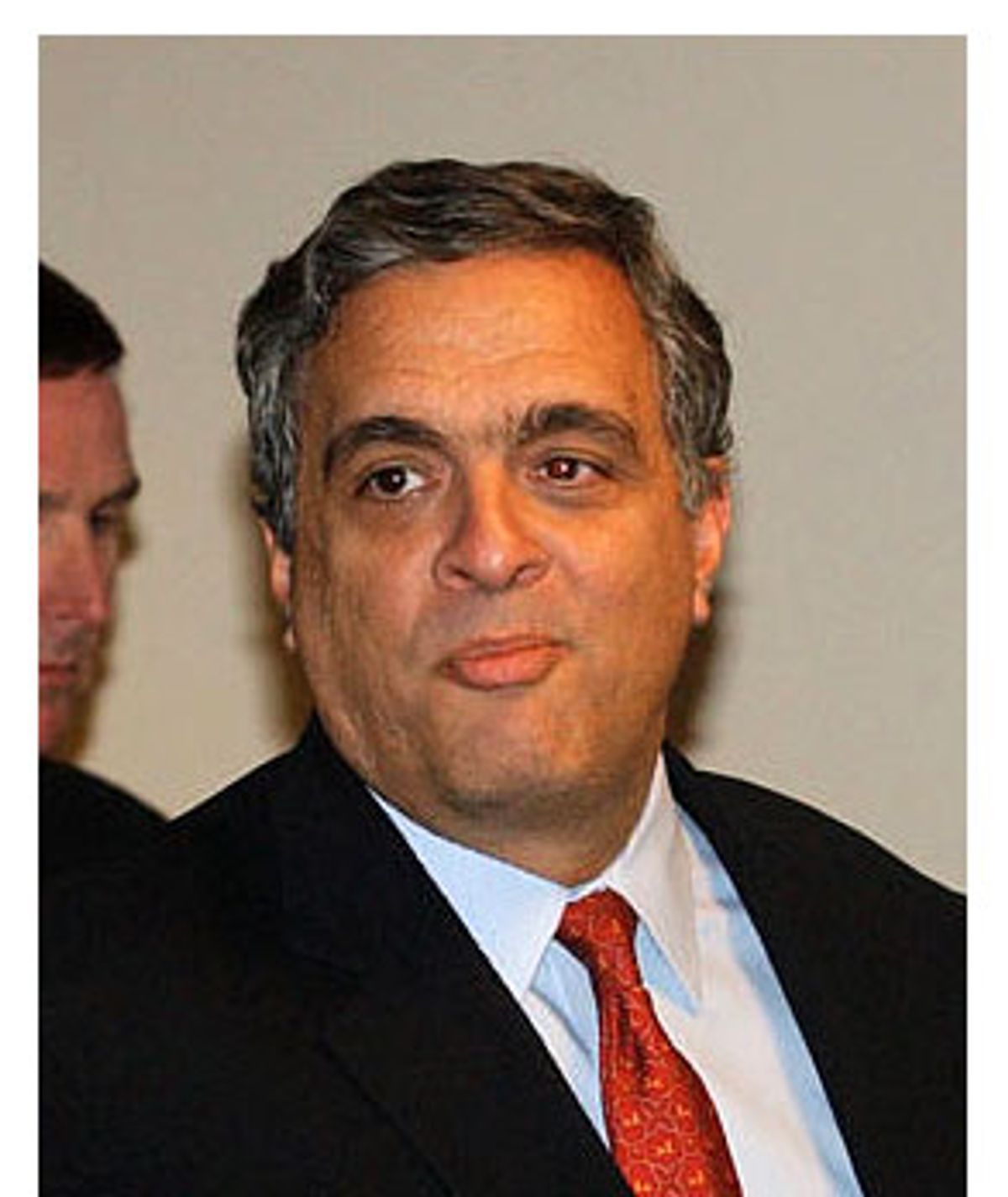
Late last week the White House sought to close the books on the Iraq-Niger-uranium debacle, with President Bush officially pronouncing CIA director George Tenet responsible for the intelligence blunder. At the same time, the president reaffirmed his “absolute confidence” in Tenet and the rest of the agency.
But according to a former CIA officer, the politicization of U.S. intelligence has devastated many in the field — and dangerously weakened our country’s security.
“We’re hearing from dozens of [intelligence] people. A lot of them are very demoralized,” says Ray McGovern, a 27-year CIA veteran who worked as an agency analyst under seven presidents, from Kennedy to the first President Bush. “The cardinal sin in this business is to cook intelligence to the recipe of high policy,” he says.
McGovern is a member of the “steering group” of Veteran Intelligence Professionals for Sanity, a group of retired spooks, some highly decorated, which has been speaking out for several months about a dangerous fundamental breakdown in the U.S. intelligence system — a system, McGovern asserts, that must remain free of White House meddling if it is to play its vital role in protecting the nation’s security. VIPS has published a series of articles and open letters to the White House; its latest letter to President Bush on Monday denounced the administration’s “campaign of deceit” in driving the nation to war, and demanded Vice President Dick Cheney’s immediate resignation in light of his central role — particularly Cheney’s allegedly deliberate use of the fraudulent Niger-uranium report to sell Congress on the war. The letter also called on Bush to appoint an independent committee to investigate the intelligence breakdown, and to allow U.N. weapons inspectors back into Iraq posthaste, for the sake of U.S. credibility.
The White House has scrambled to lay the blame on the CIA’s doorstep, but McGovern, though he has no love for Tenet, says Tenet is only one part of a much larger problem — one that ultimately extends into the upper reaches of the Pentagon and the White House. Although Tenet formally took responsibility for including the faulty Niger-uranium data in a crucial National Intelligence Estimate report in September 2002, McGovern says it’s Condoleezza Rice who is ultimately responsible for the intelligence information that makes it into the president’s State of the Union address. Nor does the buck stop with Rice: The pressure to cook the books came from the top and pervaded the administration. McGovern believes that only the White House and the vice president’s office could exert the kind of intense pressure necessary to cement bogus intelligence information into the ultimately authoritative NIE report — and keep it there through the string of drafts leading up to a prime-time presidential speech.
By distorting the truth and corrupting America’s intel system, says McGovern, spineless agency leaders and a White House with its finger on the scales have not just demoralized the CIA and other agencies, they have thrown the nation into considerable danger. Without an intelligence community that’s consistently motivated to serve up objective information, “the president has nowhere to turn to find out real answers,” he says.
Tenet himself began fighting back on Wednesday, during a closed hearing before the Senate Intelligence Committee, where he told a senator that a White House official pressured him to include the specious Niger-uranium report against his better judgment. On Thursday MSNBC quoted an anonymous source saying that Tenet “reluctantly” fingered National Security Council member Robert Joseph during the hearing.
VIPS, which includes roughly 30 members from across the civilian and military intelligence spectrum, from the FBI and the State Department’s Bureau of Intelligence and Research, to the CIA and Department of Defense, has been warning that America’s intelligence system was in trouble for months. In a February 2003 article, McGovern wrote of the grave dangers of a politicized intelligence community: “The integrity of the intelligence process is one casualty. But the real losers are the young men and women we send into battle, and whose names we later chisel into a wall.”
The group claims no ideology or partisan agenda, only the desire to uphold the raison d’être of the CIA and its peer agencies: providing essential, objective information to policymakers in its mission to prevent enemy attacks on the United States. According to McGovern, the group feels an affinity with the organization Veterans for Common Sense, where VIPS currently publishes its reports. VIPS steering group members, however, have made their voice heard through mainstream media outlets as well: The former director of the CIA’s Office of Regional and Political Analysis, William Christison, spoke out in the Washington Post in April 2002; and Patrick Eddington, a military imagery analyst at the CIA’s National Photographic Interpretation Center for almost nine years, has contributed Op-Ed pieces to numerous publications including the Washington Post, the Los Angeles Times and the Washington Times, and is a regular television news commentator.
McGovern himself is currently a full-time co-director of the Servant Leadership School, a faith-based community outreach program in Washington, D.C. Salon spoke with him from Washington on Wednesday, as the White House continued to try to brush aside the Niger-uranium report scandal.
The VIPS letter to President Bush on July 14 charges that Vice President Cheney’s office led a “campaign of deceit” that drove the nation to war, and calls for Cheney’s immediate resignation. What ultimately makes the case against Cheney?
The most egregious crime committed here was the use of evidence known to be fraudulent, which purported that Iraq was seeking uranium from Niger for its nuclear program. This is different from having a body of evidence that’s susceptible to varying interpretation. A forgery is a forgery.
The vice president’s office had commissioned Ambassador Joseph Wilson [in February 2002] to go to Niger and look into the matter, and he came back and told them the information was no good. So if this trip was taken at the behest of the vice president’s office, it strains credulity beyond the breaking point to think that when the ambassador got back to report his findings, the vice president’s office said, ‘Actually, we’re not interested in that any longer, so don’t tell us what you found out.’
Then there’s the fact that Cheney launched the [pro-war] campaign on Aug. 26, 2002, with a strong speech that went far beyond what the evidence allowed, in saying that the Iraqis had restarted their nuclear program. Cheney was way out in front of everybody else, particularly Colin Powell. On March 16, 2003, as a sort of coda to this, he alleged that Iraq had in fact reconstituted its nuclear program, and that the CIA and others agreed with him on this. False. They hadn’t.
Why is it imperative that Cheney resign immediately?
I can’t think of anywhere in government where honesty is more important than the intelligence business. Intelligence analysts need to operate on the working assumption that they’re seeking truth. When they find it, they analyze it the way they think the truth leads, and then they serve it up to policymakers in that form.
It’s up to policymakers what they do with the fruits of these efforts. When analysts see it being distorted, it’s incredibly demoralizing. It leads to the conclusion, “Maybe I better not serve up the truth anymore, maybe I should serve up what I know they want to hear.” When that becomes the case, the country is in considerable danger. If intelligence analysis is prostituted like that and is no longer objective, the president has nowhere to turn to find out the real answers to his questions.
Have you gotten any response from the White House to the letter?
No, we haven’t. We’d like to have one, but we’re not surprised: After all, Rep. Waxman of California wrote a letter to the president back on March 17 — he has a lot more status than VIPS — and he’s still received no response from the White House. His letter was a very bitter one, saying, “Look, Mr. President, in September and early October your people lied to me about this nuclear threat, and on the strength of that lie, I voted for war. I want you to tell me how that could’ve happened.”
Aside from the “steering group,” who are the people behind VIPS? How many are there, and is it just CIA?
We’re a movement that’s growing; the current count is 30. The open letter to Bush on Monday has sparked an amazing amount of interest, which is really encouraging, and affirming. We’re not just CIA; we have intelligence veterans from across the spectrum: FBI, DIA [the Defense Intelligence Agency, part of the Pentagon], Army Intelligence and INR [Bureau of Intelligence and Research, from the State Department]. Yesterday I had a National Security Agency person call me and say, “Hey, I noticed you don’t have anybody from NSA, count me in.”
Having left the CIA a decade ago, how are you able to speak for the current sentiment inside the agency, or inside the greater U.S. intelligence community, about all this? Who are you talking with, and hearing from?
We’re hearing from dozens of people. The sad part is that we’re hearing from midlevel analysts and even lower-level journeymen who are slogging away in the intelligence trenches trying to find the truth and tell it. Unfortunately, in the decades since William Casey and Bobby Gates were the CIA’s directors, there’ve been more careerists — malleable folks who sniff the wind to find out which direction it’s blowing, and trim their sails accordingly. So now you have some people at relatively senior levels who’ve bubbled to the top by knowing the “correct” answers to the questions they know are on policymakers’ minds. Whereas these people were a complete exception in our time, the proportion has grown.
When we retired from the agency, and by that I mean the VIPS steering group, people knew who we were and what we stood for, and the levels at which we operated — basically the most senior levels of both the military and civilian intelligence communities. We enjoy a certain reputation for integrity, and that’s the premier value in intelligence work. So when people see that value being played with fast and loose, they need somewhere to turn. They need people who know the business, who know how much of a sin this is.
So how widespread is this current rancor inside the intelligence community?
A lot of people are very demoralized. And those who aren’t, frankly, are ipso facto suspect. The cardinal sin in this business is to cook intelligence to the recipe of high policy; the raison d’être for a place like the CIA is to have one place in government which can operate without fear or favor, which can speak truth to power. Where the president can go and say, “Look, I want the straight scoop here. Forget about the State Department’s policies, forget about what Wolfowitz, Rumsfeld and Perle are saying, tell me what you really think.” If the president doesn’t have that, he’s missing an incredibly valuable ingredient in policymaking.
The current situation is, by definition, a huge problem for the intelligence community. The people not at all demoralized right now, by and large, occupy senior-level positions. It’s a sad commentary, because leadership is the key. George Tenet is very malleable and likes to be a team player. Witness what he did on Feb. 5: He sat himself down behind Colin Powell as Powell served up this embroidery of intelligence information before the U.N. Security Council, and Tenet sat there like a potted plant, as if to indicate that the CIA stands — or sits — behind everything the secretary of state is saying.
That was an incredibly demoralizing gesture for folks in the CIA who’ve resisted tremendous pressure ever since 9/11 to prove a link between Iraq and 9/11. There’s no evidence of that, and these people, to their great credit, said, “Sir, I’m sorry, but I’m not going to write something I don’t believe.” So here’s Tenet sitting behind Powell, and Powell’s drawing a picture of al-Qaida operatives in Iraq. Sure, there were a couple there, but what Powell didn’t say was they were in a place that was not controlled by Saddam’s government. [The small Ansar al-Islam militant group, which fought Saddam from its enclave in northern Iraq until its fighters were killed or expelled during the war, has been linked to al-Qaida.] So the evidence used to “prove” this link was fraudulent from the get-go. And these analysts had to watch this on TV, with Tenet sitting right behind Powell as he’s telling this cooked-up story.
What’s your feeling about the intel group installed by the Pentagon, the Office of Special Plans?
It’s a technique used by some very convinced policy officials when they want a certain answer to an intelligence question, and when they can’t get it from the duly established organizations, they aren’t above setting up their own shop. They needed a little group to come up with the “correct” answers, so they created this outlying group of non-specialists, gave them some information where they knew what the conclusions were supposed to be, and what do you know? They came up with the right conclusions.
The administration knew long before the war that the Iraq-Niger connection was bogus — it was struck from the speech Bush gave in Cincinnati on Oct. 7, 2002. Given your knowledge of the CIA’s inner workings, how could something so flagrant possibly make it into a presidential State of the Union address three months later?
It’s very clear to me how: Condoleezza Rice has actually told us how it happened. Her explanation says the evidence was in the National Intelligence Estimate prepared last August and September on weapons of mass destruction in Iraq — which is true. The NIE is by far the most authoritative pronouncement, not only by the CIA, but by the entire intelligence community. It’s very carefully done. This story about Iraq trying to get uranium from Niger was in there — this was evidence long since disproved, and yet someone insisted it be included in the document. The State Department was so shocked by this, they put in a footnote saying that in their view, the information was garbage. Rice says the footnote appeared on Page 55 or something like that, so that nobody paid any attention to it.
So the real question is, how did that information get into the NIE last fall? The reality is that the vice president’s office knew that it was spurious — but the vice president had led the charge on Aug. 26, saying Iraq was reconstituting its nuclear program, and there wasn’t a shred of evidence of that. So they dusted off this forgery and peddled it on the Hill to get Congress to vote for war. Since the NIE was in progress at that time, they insisted it be included despite [objections] at the State Department and the Department of Energy.
So around Christmastime, here’s this drafter of the State of the Union speech, whom Condoleezza Rice instructs to draft a couple of paragraphs about WMD in Iraq, and the drafter says, “Where do I get that?” and she says, “Well, consult the NIE.” So the damage had already been done with the NIE report itself. Condi should’ve known better with this. The key question is, who allowed it to stand in that report? It’s exactly the kind of pressure that folks who are malleable managers do not have the guts to resist. The senior person in charge of the NIE bowed to the pressure that came from the White House, and presumably from the vice president’s office, so that the report would support what the vice president had already said. Cheney set the terms on Aug. 26, and who’s going to come out with a report that says otherwise?
In the old days, that’s exactly what we would’ve done, and we’d be persona non grata in the vice president’s office. Not so anymore.
If George Tenet is to blame for the blunder, why is President Bush backing him now with “absolute confidence,” rather than asking for Tenet’s immediate resignation?
Well, George Tenet is not to blame. If you look at his statement carefully — and this is vintage Tenet — he says, “I confess, she did it.” He says, “I confess I didn’t catch the error because I didn’t read it carefully enough, but I didn’t put the error in there.”
So he’s taking responsibility by saying, “I’m captain of the ship and this happened on my watch?”
But he’s not the captain of the ship. Condoleezza Rice is. She’s responsible for this text of the president’s speech, not George Tenet. And she’s explained it: She says, “We got it from the NIE report.” People don’t realize what that really means. The NIE report, having already been prostituted, means the deceit and the damage run that much deeper.
But who is ultimately responsible for the NIE report?
That is Tenet. But if we’re talking about the president’s speech, Condoleezza Rice is responsible. But you’re right about the NIE report — that’s George Tenet, and the malleable manager he appointed to manage it.
That said, how does the president blaming Tenet square with the widespread accounts of CIA warnings about the Niger report months prior?
Tenet’s influence and stature is like that of a successful congressional staffer. He’s a lawyer, and he knew how to ingratiate himself with both sides of the aisle — usually a good thing in politics, but not a good thing when it comes to the responsibilities of a CIA director. Because if he’s going to speak truth to power he’s going to make lots of enemies.
But he doesn’t have the stature of Rumsfeld or Cheney. If you look at Cheney’s Aug. 26 speech — remember, this is around the time when Cheney visited the CIA on multiple occasions — there’s great pressure on the analysts to produce. Will it be an honest estimate, saying there’s no evidence of an Iraqi nuclear program? Or will they stick stuff in there that they know will make Cheney look right? I hate to say it, but this was the course chosen, and Tenet is that kind of person. Where does that leave Tenet now? Well, he played the team game. He should’ve threatened to resign if that kind of fraudulent stuff appeared as “intelligence,” but he didn’t. He hung around as part of the team.
No wonder the president has complete confidence in him. He does what he’s told, no matter what his analysts think.
What do you make of Tenet’s pointing the finger at Robert Joseph of the NSC during Wednesday’s Senate Intelligence Committee hearing?
The only thing Tenet confessed to before was being a lousy proofreader. What Tenet’s really saying now is, “How many times did I have to tell these guys that the report was bogus?” The fact that Tenet now mentions Joseph’s name doesn’t surprise me — somebody has to draft these things, and my information was that it was Joseph who drafted that section of the speech. He was the natural choice; he’s a proliferation guy at the NSC and very much a hard-liner.
Is there any precedent for this kind of intelligence breakdown? You were in the CIA during the LBJ administration — how does the Iraq-Niger debacle compare to the Gulf of Tonkin escalation in Vietnam?
There’s always pressure of this kind, and it’s always intense with matters of war and peace. Gulf of Tonkin maybe rivals this, though it doesn’t strike me at all as being nearly as contrived and concerted and jointly plotted over a long period of time. I was [at the CIA] during Tonkin, and I know the second incident didn’t happen: the initial report of a big firefight going on, which was disputed by a Navy pilot, James Stockdale, who was flying overhead at the time and reported pitch blackness. The initial report was a mistake, a lightning storm or something, but there was certainly no attack on U.S. ships.
My colleague who was writing this up for the next daily report outlined this in his draft and sent it up the line. He was told, “We’re not going to put a piece out for tomorrow morning.” He asked, “What could be more important than this?” and the word came back down that the White House had already decided to go to war, and that the agency wasn’t going to wear out its welcome there.
So you’re saying this has happened before, but not on the same scale in terms of planning.
Look, I’m not at all excusing what happened back then — these are both really egregious sins. Just consider what happened after Tonkin. Years later, McGeorge Bundy told a wonderful vignette on the “McNeil Lehrer News Hour.” He explained that the president came in the next day [after the alleged incident] and said to him, “OK, Mac, we’ve got the documentation we need, now go over to the Hill and sell that resolution.” Bundy protested that the evidence wasn’t good at all, and LBJ turned to him and asked, “Look, are you part of the team?” Well, we know his answer. That was August 1964. Eleven years of war in Vietnam followed, with almost 60,000 U.S. soldiers killed, and over a million Vietnamese killed.
McNeil and Lehrer didn’t bother to ask Bundy why he did it. I mean, Bundy was no slouch — he was [a dean at] Harvard, so he wasn’t going to be out in the street looking for a job. So you can imagine the severe pressure from policymakers at that level, especially a president who makes very clear he wants to hear “yes, sir.” Bundy caved in, and that’s what’s happened here.
You seem to be saying that intelligence is always politicized to some degree by the White House.
No, I don’t agree that intelligence is always politicized. It depends on who’s president, and who that president selects as head of the CIA. There have been incredibly honest CIA directors who wouldn’t bend to this kind of pressure. I’m thinking of Bill Colby and Stan [Stansfield] Turner — and I’m also thinking of a fellow named George H. Bush. When the first President Bush was CIA director, he’d been chair of the Republican National Committee, so all of us were afraid he’d be inclined to participate in policy decisions, and perhaps even mess with the intelligence. He solemnly promised not to do that.
Well, I worked directly for him, and you know what? He kept his promise. He recused himself when policy decisions were made, and he was very faithful in representing what we analysts thought, down at the White House. And when he was president he knew, and expected the same from his CIA directors.
What do you see as the greatest dangers of a politicized intelligence system in terms of broader democracy and national security?
Analysts are human beings. They want to make a good living and be promoted just like the rest of us. But if all you have left in the intelligence community are analysts who have really good noses for which way the political wind is blowing and trim their sails accordingly, the country is in grave danger. You have to depend on somebody to tell it like it is. There’s an inscription at CIA headquarters: “You shall know the truth, and the truth shall make you free.” When you lose all the people who believe that, you’ve lost a precious asset. The ability of the president to make a well-informed, objective policy decision is greatly diminished.
Why did the U.S. intelligence community fail to prevent the 9/11 attacks? And why, almost two years later, does the American public still have no clear explanation of what went wrong?
It was an egregious failure, and there’s no getting around that. Enough information has come out to indicate there were enough bits and pieces for a junior high school kid to figure out something very bad was about to happen. We know there were high-level meetings where assertions were made that bin Laden would attempt something pretty spectacular. There was a president’s daily brief prepared on Aug. 6, 2001, entitled “Bin Laden Determined to Strike in the U.S.,” and we know in the body of that report there were allusions to plane hijackings. I haven’t read that report; this much was leaked to the press. But I do know that when a daily brief has that kind of title and mentions those kinds of things, then it’s very important indeed. It appears the administration just took them as routine warnings.
I don’t subscribe to the more sinister theories; I take the more charitable interpretation: gross incompetence on the part of the president and the CIA director. The president was served up with repeated warnings, so much so that the “cry wolf” syndrome set in. He didn’t know what to do with all the information, so he went off to Texas to chop wood instead. Nobody collared him and said, “Hey, this is really serious.”
Pearl Harbor was the reason the CIA was set up in 1947, expressly to prevent this kind of thing: one central clearing house for all the bits of information. Its raison d’être was objectivity, and to prevent such an attack. But the CIA director only has the power to carry out this mission in deference to the president. Unless the president makes it clear, like Jimmy Carter did with Stan Turner, that the CIA director is his main man for intelligence, and that anyone who interferes will be sent packing … that hasn’t happened with this president. Right now the director of the CIA has a hell of a lot of responsibility, and very little authority. He doesn’t control 80 percent of the intelligence budget, which is in the Pentagon.
In the end, it all goes back to who we elect in November.
Does VIPS have any kind of ideological or partisan agenda?
Look, we’re not afraid of speaking up on these issues, and we feel our credentials speak for themselves. I have letters from George H. Bush, and awards given to me upon retirement. In other words, I graduated summa cum laude. This is true of my other senior-level colleagues as well.
We don’t have a partisan agenda — that’s basic to who we are as intelligence professionals. To be against the war is not to be partisan, it’s to be sensible. People in this town are intellectually unable to believe that there can be a group working inside Washington without a partisan agenda. When we say we’re dedicated to the pursuit of truth and career protection for people pursuing truth, people’s eyes glaze over, and they shrug and say, “Yeah, right.” It’s a hard thing to believe.
What’s the press missing in all this? Is there other evidence of a contrived pre-war campaign to mobilize public opinion? After all, it seemed there was reason to believe that Saddam, with the way he thwarted U.N. inspectors, etc., did actually have WMD programs…
He did have WMD programs. What wasn’t talked about was how they were [mostly] destroyed. We have that from his son-in-law, Hussein Kamel, who defected in 1995. He was head of the Iraqi WMD programs. He told U.N. inspectors what Saddam had and where, and after the inspectors found and destroyed most of that, Kamel claimed that he himself ordered the rest destroyed. Of course you don’t take that at face value, but this came from someone who’d been a pretty credible source in the past, and he was a defector.
A few weeks ago [Mahdi] Obeidi [head scientist of Iraq's uranium enrichment program in the '80s and early '90s] dug up a rose plant in a garden and revealed a few centrifuge components and some blueprints. Obeidi explained that his orders in 1991 were to squirrel this stuff away for the day when the order was given to reconstitute the program. He said that order never came.
How do you feel about the post-9/11 reorganization of U.S. intelligence agencies into the one behemoth Department of Homeland Security? What does it mean for the agencies in terms of doing a credible, nonpartisan job?
I agree with President Bush on this. He was courageous and right when he said creating a Department of Homeland Security would be a huge mistake — that’s what he said for several months anyway. He said it would detract from our fight against terrorism and bog down the system for years.
What changed his mind? Pressure grew, of course, for the president to show that he was doing something [after 9/11] on a big organizational level. There were revelations about failures within the INS, and lack of communication between the FBI and CIA.
Colleen Rowley, the courageous FBI agent in Minneapolis who wrote the letter to the FBI director about the overlooked hijacking intelligence, testified before Congress in May of last year. The same day, when the publicity would have been all about her, the president went on television and said, in effect, that he’d changed his mind about the Department of Homeland Security. Now, do I think he decided this just to take the press away from Rowley? Of course not. But it does account for the timing, I think. The legislation wasn’t ready yet; it took Congress several more weeks. Everything is choreographed in this administration.
This [new department] couldn’t be worse. I used to run our intelligence exchange with the Germans, and I can tell you that sharing with foreign intel services is a delicate prospect; you have to give them some sort of guarantee that the exchange will be protected. Now, do you think they’ll be eager to hand over sensitive information and risk a source if it’s going to a department with 170,000 people in it, where they have little idea of who’s going to be responsible for handling it? So what could be more noxious to the system? The bulk of our terrorism information comes from these services.
Of course, there is justification for fixing the INS and other problems in terms of sharing information, but to create a mammoth department — the biggest ever, aside from the Pentagon — even from a management point of view, makes no sense at all. It will actually endanger the intelligence process and the fight against terrorism.
Do you think the American public is ultimately willing to overlook the major intelligence failures of the Bush administration, including the Iraq-Niger report?
The important thing will be what happens on the ground in Iraq. Nobody I know expects the administration to be able to extricate itself quickly from what’s happening. With each week that produces a handful of U.S. casualties, more questions will be asked. If I were a father of a son who died over there, I’d be banging on the White House door, wanting to know why he was sent over to disarm Iraq of WMD that don’t appear to exist.
I think there’s a basic decency to the American people, and they really do care when kids go off to get killed. And they care about being lied to. Even the press is finally waking up — apparently they don’t like to be lied to either. There is some prospect, I think, that as things wash out here, the invasion of Iraq will be seen as an unprecedented blunder, and those responsible for selling it to Congress will be held accountable. It may not happen until November of next year, but it seems more likely now than it did just a short month ago.
If this scandal does blow over, what are the consequences for U.S. national security going forward?
Well, we have Iran, Syria and North Korea. Because of the administration’s preemptive doctrine, those countries are now rushing to accelerate their nuclear weapons programs, and unless the U.S. public demands truth from the administration, I think the administration will just take the next step. Look at the documents from the Project for a New American Century [a Washington-based neoconservative think tank founded in 1997, which urged invading Iraq before 9/11 and is dominated by militarist unilateralists and supporters of Israel's Likud Party]: They provide the strategic and ideological justification for it. The consequences could be immense.
Editor’s note: This story has been corrected since its original publication.
Journalists are obsessing over Watergate again. Debate exploded this week over a new biography of Washington Post editor Ben Bradlee, excerpted in New York magazine. It suggests the legendary editor privately doubted aspects of Bob Woodward and Carl Bernstein’s reporting that helped bring about the resignation of President Richard Nixon in 1974.
The story prompted a strong denial from Woodward, a demurral from Bradlee, an online chat at Poynter and a Daily Beast story by independent scholar Max Holland, who argues Woodward and Bernstein’s book about the scandal, “All the President’s Men,” is “a fairly tale, albeit a compelling one.” After hyping the story for a couple of days, Politico then dismissed it as “a storm in a Washington teacup.”
Not quite. As Reuters columnist and Watergate buff Jack Shafer points out, “Watergate is the Ur-journalism story.” It is a true tale that defines the profession’s imagination and its relation to Washington power. But this latest round at the Watergate cooler has been stronger on the Ur- than the journalism, focusing more on the implications of Woodward and Bradlee’s thinking than on the abuses of power that they sought to uncover.
That’s too bad. If Watergate still matters, it is because the story tells us something about the intersection of power and journalism in Washington. The ur-personalities of these veteran newsmen are important but so are new facts, and recent revelations illuminate one aspect of the story that is often overlooked: the role of the CIA.
Woodward acknowledged as much in what is perhaps the single most interesting Watergate revelation of recent years. In June 2007, the CIA released most of the so-called “Family Jewels,” a long-suppressed internal report on the agency’s abuses of power. The newly declassified documents, Woodward wrote in the Post, showed in “telling detail” how the CIA, under the leadership of director Richard Helms, served as “the perfect Watergate enabler.”
The Helms/Nixon relationship lies at the heart of the Watergate story. Nixon, of course, was a paranoid genius, a master of resentment politics at home and geopolitical maneuvering abroad. Helms, his long-serving director of Central Intelligence, was the epitome of a CIA man in the Cold War: correct, discreet and ruthless.
The CIA’s involvement in Watergate, Woodward noted, “is one of the murkiest parts of the story.” He and Bernstein didn’t write about it much in “All the President’s Men,” not because they didn’t have suspicions but because they could not pin the story down. Howard Baker, vice chairman of the Senate Watergate Committee, likened the Agency’s role to “animals crashing around in the forest — you can hear them but you can’t see them.” And Helms’ role was especially elusive. Said Baker: “Nixon and Helms had so much on each other that neither one of them could breathe.”
Thanks to the release of the “Family Jewels” report and an extraordinary collection of 11 conversations between Helms and Nixon in 1971-73 (first published online in 2009) we can see (and hear) what Nixon and Helms had on each other: knowledge of the other guy’s record of ”dirty tricks.”
Plenty of people suspected this at the time. The Agency’s fingerprints were evident in the botched burglary at the offices of the Democratic National Committee in the Watergate apartment complex. It was well known that five of the seven burglars had worked for the CIA. Four were Cuban-Americans from Miami involved in the Bay of Pigs operation. It was less well-known that the two ringleaders, James McCord and Howard Hunt, were career officers who had been personally close to Helms for more than a decade.
In his 2007 Post story, Woodward revealed that McCord had written the CIA director after his arrest in June 1972, seeking assistance. Another senior Agency official told Helms that he “felt strongly” that the letter should be turned over to the FBI, which was supposedly conducting a rigorous investigation of Watergate.
“It was a critical moment in the Watergate probe,” Woodward wrote, “with Nixon seeking reelection that fall and desperate to keep the botched burglary from spoiling his chances.” He went to write:
McCord’s letter to the CIA could have been important evidence; according to later testimony, he was seeking assistance from the CIA, where he had worked for decades, and was on the verge of blowing the whistle about Watergate, as he did months later in a famous March 21, 1973, letter to Judge John J. Sirica.
Instead, Helms told the FBI nothing. Investigators never learned the story and Woodward and Bernstein could never shake Helms’ dubious denials of any connection to the burglars, whom the Agency blandly portrayed as “retired” employees acting on their own.
In hindsight, Woodward wrote that Helms “was anything but forthcoming.”
“The CIA had no involvement in the break-in. No involvement whatever,” Helms testified to the Senate Watergate committee on Aug. 2, 1973. “The agency had nothing to do with the Watergate break-in,” he added. “And I hope all the newsmen in the room hear me clearly now.”
You get the feeling Woodward felt Helms was personally lecturing him. (I left a message for Woodward requesting comment; he did not respond.)
The question, Woodward wrote in 2007, was, “What could have Helms known?”
One possibility, he said, was that he knew Howard Hunt was carrying out burglaries for the president. Another document made public in 2007 showed that Hunt had sent a memo to the CIA two months before the Watergate burglary seeking to hire a former CIA employee “accomplished at picking locks.” Helms, Woodward suggested, might have gotten wind of what Hunt was doing.
The question of what Helms knew about Watergate still matters because, amazingly enough, after 40 years later, we still don’t know who ordered the burglary or why. As Shafer told the Poynter discussion, “I’ve read all the books, listened to all the lectures, and even eaten dinner in the Watergate and I don’t know why Nixon’s people broke into the DNC twice and bugged it.”
What is certain is that Helms knew Hunt was working for the White House as early as April 1971. In response to Nixon’s pestering, Helms had offered the president two CIA reports on the failed Bay of Pigs operation in 1961 and a report about the assassination of South Vietnamese president Ngo Dinh Diem in 1963. Nixon was looking for facts that would impugn the reputation of President John F. Kennedy and thus harm the presidential ambitions of the martyred president’s younger brother, Sen. Edward Kennedy who was expected to run for president in 1972.
“Obviously, I’m going to hand this stuff over to the President,” Helms told Nixon aide John Ehrlichman, “but I’d be terribly glad if you would get his backing not to share it with a lot of the staff of there. For example, I know that Howard Hunt has been doing some work. There’s nothing he’d like better than, as an old Agency hand to run around in some of the soiled linen there is around here, in the garbage cans and so forth.”
Here you can almost hear the clench-jawed East Coast mandarin that Helms was — “terribly glad” and “soiled linen” and all that — doing his damnedest to suck up to the president. The Nixon-Helms collaboration deepened in October 1971 when Nixon summoned the CIA director to the White House. Before the meeting, Ehrlichman briefed Nixon why Helms’ was visiting: He had “dirty line” to share. He said the CIA director had told him
that his relationship with past presidents had been such that he would not feel comfortable about releasing some of this very, very dirty linen to anyone without first talking it through with you because he was sure that when you became a former president you would want to feel that whoever was at the Agency was protecting your interest in a similar fashion.
Ehrlichman also reminded Nixon of Helms’ concerns about Howard Hunt, the White House “consultant.”
“Helms is scared to death of this guy Hunt that we got working for us because he knows where a lot of the bodies are buried,” he said.
When Helms arrived in the Oval Office, Nixon wasted no time in assuring him that he would keep the secrets of the CIA, which he called without irony, the “Dirty Tricks Department.” Nixon said:
“I know what happened in Iran [CIA-sponsored coup in 1953] and I also know what happened in Guatemala [CIA-sponsored coup in 1954] and I totally approve of both. I also know what happened at the Bay of Pigs [the failed invasion to overthrow socialist Fidel Castro in 1961], which was planned under Eisenhower. I totally approved of it. The problem was not the CIA. …
Nixon wanted it to be known that he could be trusted to defend the agency.
My interest there is solely to know the facts in the event that as time goes on here, things heat up, and this becomes an issue. That is what I want you to understand regarding any information.I need it for a defensive reason … “
Then, in his abrupt, awkward way, Nixon launched into a soliloquy about what political controversies the documents might shed light on:
Who shot John? Is Eisenhower to blame? Is Johnson to blame? Is Kennedy to blame? Is Nixon to blame?
In the context of a negotiation over sensitive government records from the early 1960s, Nixon’s aside — “Who shot John?” — could only have been a reference to the assassination of President John F. Kennedy in Dallas in 1963. But if Nixon was implying that the CIA might have something to hide on the question of who ambushed the liberal president in Dealey Plaza, he was also assuring Helms he would keep the Agency’s secrets.
“I need to know what is necessary to protect frankly, the intelligence gathering and the Dirty Tricks Department and I will protect it,” Nixon said. “I have done more than my share of protection, and I think it’s totally right to do it.
Helms sensed his opportunity and spoke for the first time. He had an offering.
“Sir, as a matter of fact the reason that I want to speak …” he began. Helms said he had found a previously unknown document about the assassination of Diem in South Vietnam in 1963.
“When I saw this document I thought to myself, ‘This is the kind of document that I would be rather irresponsible if I didn’t go to the president and tell him what this document was,’” Helms explained. “I’ve got it right here. It’s got extracts from State Department cables, Defense Department cables …”
Helms passed the documents to Nixon. Nixon didn’t get anything with “who shot John” but he get a lot of who shot Diem (rival generals) and he might be able to use that against the hated Teddy Kennedy. The meeting ending on a satisfactory note for both men.
Nixon then passed the Diem cables to aide Chuck Colson (whose recent death was another blast from the Watergate past) who gave them to none other than Howard Hunt. A veteran undercover officer and dirty tricks specialist who loathed President Kennedy, Hunt doctored the cables to create the impression that JFK was complicit in the assassination of Diem, a pro-American despot. The forged documents were then shown to a Life magazine writer in the hopes of creating problems for Ted Kennedy’s expected presidential candidacy. Life magazine turned down the story, perhaps because the animus behind the story was so transparent. Hunt moved on to other missions for the White House. The story of the doctored Diem cables was later uncovered by Watergate investigators but Helms’ supporting role remained obscure.
Helms and Nixon had forged an effective partnership. They spoke at least five more times in the coming months. On June 16, 1972, Nixon called him to tell about certain secret CIA operations involving Mexican President Luis Echeverria, the details of which are still secret. So when Hunt and other former CIA men were arrested at the Watergate the next day, Nixon simply assumed the CIA director would help him stonewall the investigation.
“We’ve protected Helms from a hell of a lot of things,” Nixon told his chief of staff H.R. Haldeman on June 23, 1972. He wanted to remind Helms that the investigation might lead to Cuba-related revelations that would harm the CIA.
“You open that scab and there’s a hell of a lot of things,” Nixon went on, “and we just feel that it would be very detrimental to have things go any further. This involves these Cubans, Hunt and a lot of hanky-panky that we have nothing to do with ourselves.”
Nixon could be sure Helms would know what he was talking about. He had been seeking sensitive CIA reports about the Bay of Pigs operations for more than a year; Hunt was a leading figure in that operation. In his 1979 memoir, Haldeman speculated that Nixon was tacitly reminding Helms of two extraordinarily sensitive issues: the CIA’s plots to kill Fidel Castro and the assassination of JFK. The Oct. 8, 1971, tape lends credence to the notion. If Nixon had offered to protect the Agency’s interests on “who shot John” then surely Helms would cooperate with the White House in smoothing over what his press secretary described as a “third rate burglary.”
Nixon assumed wrong. “This has nothing to do with the Bay of Pigs,” the normally calm Helms shouted at Haldeman, who was surprised as his rage. Helms was a canny bureaucratic operator who was sensitive about Cuba and assassinations. He knew he could not block the FBI’s investigation without risk to his own position and he saw no reason why he should. Hunt was a useful scoundrel whose screw-ups were legendary but whose loyalty to the Agency was assured. Publicly and privately, Helms maintained the fiction that the Agency knew nothing of Hunt’s proclivities — and he kept very quiet about his own back channel to McCord. As Nixon and his aides scrambled to cover up the White House’s “dirty tricks,” the FBI — and the young reporters at the Washington Post — began to unravel the story, albeit without much insight into Helms’ role as enabler.
The secrets that Nixon and Helms shared exerted invisible gravitational force on the unfolding scandal. From his jail cell, Hunt let it be known that he would talk about his knowledge of “highly illegal conspiracies” at the CIA unless he was paid off. To underscore his point, he then published a memoir of the Bay of Pigs operation, “Give Us This Day,” which opened with a denunciation of President Kennedy for his “shameful” failure to support the Agency’s anti-Castro rebels. His point was blunt and subtly ominous: if JFK had backed the CIA venture, he might not have been killed by an allegedly pro-Castro gunman in Dallas. Hunt was not one to get sentimental about the playboy president’s bloody end in Dallas. Like others in the CIA, he thought JFK was a contemptible weakling who had it coming. The “whole Bay of Pigs thing” was fraught indeed.
Amid such black intrigue, the spymaster proved more agile than the president. Helms avoided talking about what he knew of Hunt’s service to the White House while Nixon succumbed to the burglar’s blackmail, ordering aides to raise money to pay off Hunt for his silence. The CIA man cultivated Washington Post publisher Katharine Graham as a social friend. Nixon enmeshed himself further in the scandal.
Nixon and Helms parted ways in December 1972. Nixon forced the CIA director to resign; Helms extracted an ambassadorship so that his exit from Washington would not be tainted with Watergate or presidential disfavor. Besieged by investigators and the press, Nixon resigned 20 months later. Helms had to plead guilty to charges of lying to Congress about a CIA assassination conspiracy in Chile. But admiring colleagues rallied to his defense and, he was never held accountable for the Agency’s deeply suspicious role in the intelligence failure that culminated in the crime of Dallas. Thanks to the forgiving culture of Washington, both men outlasted their notoriety in the 1970s and lived out their lives as controversial but ultimately respectable statesmen.
The Shakespearean struggle of Richard Nixon and Dick Helms is central to the Watergate story. It speaks a volume about the covert workings of power in Washington and is still shrouded in official secrecy 40 years later. (For example, the JFK Assassination Records Collection at the National Archives contains 366 pages of CIA documents on Howard Hunt that have never been made public.) But the unfinished story of the CIA and Watergate fits awkwardly in the annals of the scandal. Its implications eluded the best journalists of a generation and its legacy is not reassuring to readers.
–
Read: “The Keeper of Secrets Earns His Reputation,” by Bob Woodward, Washington Post, June 27, 2007.
Listen: “Who shot John?” Richard Nixon and Dick Helms’ discuss CIA dirty tricks on Oct. 8, 1971; read a summary here. Courtesy of Nixontapes.org.)
Continue Reading
Close
This interview first appeared in The Browser, as part of the FiveBooks series. Previous contributors include Paul Krugman, Woody Allen and Ian McEwan. For a daily selection of new article suggestions and FiveBooks interviews, check out
The Browser or follow
@TheBrowser on Twitter
The job of the intelligence services is to understand others and help leaders act more wisely, says Tim Weiner, the author of a new history of the FBI. There’s also, he tells us, a balance to be struck between liberty and security.
You have spent decades studying the inner workings of America’s intelligence system, and the past few years looking at newly released files from the FBI. What will we learn by reading your new history of the FBI, “Enemies”?
You will learn that the Bureau has served first and foremost as a secret intelligence service reporting to the president of the United States. In its first incarnation under J. Edgar Hoover, who ruled the Bureau for 48 years, the FBI was the president’s secret intelligence service. Today, 40 years after Hoover’s death, we still live in the shadow of his legacy. How do you run a secret intelligence agency in an open and democratic society? How do you balance national security and civil liberty? How can we be both safe and free? These are questions that Hoover struggled with, and that we struggle with still.
Your prize-winning book about the CIA, “Legacy of Ashes,” was called “a credible and damning indictment of U.S. intelligence policy” by Publishers Weekly. What are the counts in your indictment, if you agree with that assessment?
I certainly agree that “Legacy of Ashes” is credible, because every assertion is documented. There are about 200 pages of endnotes, and about 80 pages of endnotes in “Enemies.” When I say something, I back it up. But “Legacy of Ashes” is not an indictment of the CIA. The CIA and FBI are reflections of who we are as Americans. We are the most powerful nation on earth. We project our power across the globe, and in order to do that we need good intelligence. When intelligence fails, war happens and people die. When intelligence succeeds, war can be prevented and lives can be saved.
America is not very good at gathering intelligence, but we’re getting better. It’s understandable, because Americans have only been at it in a serious and concerted way since World War II. The British have been at it since Queen Elizabeth I, over five centuries. The Russians have been at it since Peter the Great. And the Chinese have been at it ever since Sun Tzu wrote “The Art of War,” so 26 centuries.
I want my books to serve not as an indictment but as a warning. If the U.S. doesn’t strike the balance correctly between security and countervailing concerns, we may lose our rights and our liberties, and we may not survive as a free republic. We have made many mistakes, the consequences of which can be measured in blood and treasure, but we are improving – particularly over the last three years.
Let’s turn to the books you’ve chosen, beginning with Sun Tzu. Tell us about “The Art of War,” and what an ancient Chinese military treatise has to do with contemporary U.S. intelligence.
Sun Tzu, a Chinese general 26 centuries ago, tells us: “If you know your enemies and know yourself, you can win a hundred battles without a single loss.” That is the mission of intelligence. We can build all the billion dollar spy satellites we want – and we do – but to know your enemy is to talk to him in his own language. That is the job of spies, and that is what “The Art of War” teaches.
Chapter seven focuses on the dangers of direct conflict. How do U.S. intelligence agencies, as Sun Tzu says, “subdue the enemy without fighting”?
Through intelligence. Intelligence is the art of war without weapons.
How about black ops?
Well, you need to define what that is. Is it disinformation, lying, cheating or stealing? Black ops can mean all of those things. It can mean propaganda. It can mean putting a spy in the enemy’s camp. It can mean putting a bomb under the hood of the car of an Iranian nuclear scientist. The phrase “black operations” encompasses a multitude of sins.
All of them committed by U.S. intelligence?
The last one I listed was the work of the Israelis.
Let’s turn to a 1964 book that brought to light the role that intelligence services played in U.S. foreign policy.
“The Invisible Government” was the first reported book that actually described what the CIA did. It was written almost 50 years ago, and was a landmark. It explained that the CIA was not James Bond, which was just then becoming popular – that intelligence was not a matter of flying into a foreign capital in a trench coat, overthrowing a government, having a martini, making love and then catching the next plane. It showed that intelligence was a difficult, dirty, dangerous and at times tedious business which was about information, and how information meant power.
So it’s a very good book that is still vital today. And David Wise is still writing great books about intelligence.
In the introduction, the author defines the invisible government as the “interlocking, hidden machinery that carries out the policies of the United States… a loose, amorphous grouping of individuals and agencies drawn from many parts of the visible government”, with the CIA “at its heart”. Is that 50-year-old description of America’s intelligence apparatus still accurate? How did 9/11 change the structure of U.S. intelligence?
Things got much more complex. There are now 17 different American intelligence services, with a bureaucracy of interlocking directorates above them overseen by the Director of National Intelligence. All of them are required to report to the secretary of defense, who in turn reports to the president. In the last three years things have gotten better, largely due to the author of our next book.
That author is former CIA director and U.S. secretary of defense, Robert Michael Gates.
Robert Gates was the head of the CIA under the first President Bush. Under the second President Bush, at the end of 2006, he succeeded the irascible Donald Rumsfeld as secretary of defense. He stayed on under Obama until just a few months ago.
Gates, as you can see in “From the Shadows,” really understands how intelligence can serve and do disservice to the president of the United States. He probably had more experience in intelligence than anyone who has ever been secretary of defense. The secretary of defense basically runs the show when it comes to intelligence. We spend somewhere just south of $100 billion a year – the precise amount is classified – on intelligence, and the secretary of defense controls 85 to 90 percent of that.
Tell us more about this book.
Bob Gates basically got off the bus from Wichita, Kan. in 1966 and went to work for the U.S. government. He went from the air force to the CIA. After learning Russian, he became an expert – as we defined it – on Russia during the Cold War. He himself never went to Russia until the Cold War was ending, even though he was considered to be among the leading experts on the USSR. He got off the plane and Gorbachev said to him: “How does it look from the ground?” Because the U.S. had been staring down at the Soviet Union from spy satellites and planes, but we didn’t understand what was going on on the ground. We could count the missiles, but we didn’t see the potatoes rotting in the field because there wasn’t enough fuel to take them to market.
Gates learned through bitter experience, over the course of half a century, how intelligence works. It’s an amazing book. And as secretary of defense he used that knowledge to improve our intelligence services.
What precisely is the relationship between the Department of Defense and the U.S. intelligence apparatus?
Ultimately, intelligence should serve the national security of the United States. When you get up in the morning and open the paper or turn on your computer, you want to know: Is the world safe? Is my country safe? Is my city safe? Is my family safe? That is what the president wants to know too, and that is the job of intelligence.
Can any flow chart explain the relationship between the 17 agencies that are part of the U.S. intelligence service and Department of Defense?
In theory, it’s a bunch of boxes that connect and send intelligence up through the director of national intelligence and the secretary of defense to the president. In the past, it has worked more like 17 different musicians with 17 different scores playing a cacophonous tune with the conductor flailing his arms madly. But we’re getting better at it.
Next you cite one of Barbara Tuchman’s lesser-known works of history, “The March of Folly.” Tell us about it.
In short, this is one of the greatest books ever written. Why did the Trojans take in the wooden horse? Why was America in Vietnam? Barbara Tuchman explores those questions, and the answer is folly – leaders acting against the interests of their constituents.
Folly explains so much of the history of world events. People believe that the world is run by conspiracies because that is what they read in novels and see on cheap TV series. But the course of world events is determined less by conspiracies than it is by stupidity. Why did the British lose the United States? How did the Renaissance popes bring on the Protestant reformation? Folly. Lack of intelligence.
Please connect the dots to our topic of intelligence.
Consider the three meanings of the word intelligence. It is the power of your mind; it is secret information; and it is secret action taken in the name of a nation. If we had more intelligence we would know our enemies, have fewer wars and there would be less folly throughout history.
If the Trojans knew the Greeks were in the horse, they wouldn’t have opened the gates.
Exactly. Why did they let the horse in? Folly.
“The March of Folly” is used to teach blind spot analysis in business schools, a method for uncovering faulty or obsolete assumptions. How do intelligence agencies perform blind spot analysis to prevent the sort of folly that Tuchman described?
“The March of Folly” explains how not to make decisions. Leaders must learn to act only out of enlightened self-interest. To use power wisely, they must make intelligent use of information. If they blunder on based on faulty assumptions, then the Greeks end up inside of Troy and Americans wind up mired in Vietnam for a decade.
Let’s end with George Orwell’s “1984.” Most of us know it, but please explain why you chose it.
None of us love Big Brother, but we all know he is part of the family. Big Brother is like the uncle we don’t like who has to be invited for Christmas. The question is: How do we live with Big Brother without him ruining our lives?
“1984″ described, in 1948, what the modern surveillance state was going to look like. At the time, J. Edgar Hoover was creating that surveillance state. He is the man who invented the fingerprint file. Every camera that stares down on us in Washington, New York and London, and every bit of biometric data collected on us, is a tribute to Hoover. The greatness of Orwell’s book is that he saw it coming and described it in terms we could understand. What Orwell foretold in “1984″ was already happening as the book was being published. And that is what my history of the FBI, “Enemies,” is about.
But you suggest that America’s Big Brother is a bit of a bumbling uncle.
Like I say, we’re relatively new at this. We’ve only been at this in a serious way since World War II. The lessons of Sun Tzu are 26 centuries old and we’re only just internalising them. So give us a chance.
Also, to know your enemy you must talk to him in his own language. Nowadays that might be Arabic or Pashto or Chinese or Urdu. We don’t speak those languages very well. We want everyone to speak English. We want everyone to look like us, think like us and be like us. That isn’t a very good cultural climate for producing successful intelligence, nor for the enduring projection of power.
During a visit to the FBI, as you point out, President Obama proclaimed “we must always reject as false the choice between our security and our ideals.” But you suggest that liberty and security are opposing forces. How has the pendulum swung between liberty and security? And which way is it swinging now?
In the introduction to “Enemies” I point out that Alexander Hamilton, writing in 1787, said almost exactly the same thing. We have to have liberty and security. They are opposing forces and there is a constant tug of war between them. We strive to strike the right balance.
I would argue that over the last three years we’ve been getting it less wrong than we once did. Have we been attacked in a serious way? No. Have we created any new secret prisons? No. It was the FBI who reported the abuses in Abu Ghraib. It was the FBI director, Robert Mueller, who stared down George W Bush and told him to scale back electronic eavesdropping. Robert Mueller is an ex-Marine and also a great respecter of civil liberties. He has said that he is not going to go down in history as the guy who won the war on terror but took away our civil liberties – because that would be a pyrrhic victory.
When the FBI makes mistakes under Mueller, it admits and corrects them. He and the people he reports to must strike the balance between liberty and security every day. Lately, we’re doing a pretty good job. There will always be mistakes. Getting the balance precisely right is extremely difficult and, like democracy itself, is a work in progress.
Continue Reading
Close
Two years from today Americans will observe the 50th anniversary of the assassination of President John F. Kennedy. It is likely to be a moment of national introspection, as well as an opportunity to complete the historical record of one of the most painful days in American history. Yet, incredibly enough, the Central Intelligence Agency is likely to object to declassifying all of its records related to the murder of the 35th president in Dallas on Nov. 22, 1963. The question on the 48th anniversary of the tragedy is whether the CIA’s extreme claims of JFK secrecy — reiterated in federal court filings this year — will be allowed to stand.
The tediously unresolved case of the assassinated president never quite goes away as some would wish. Stephen King’s new book, “November 22, 1963,” is yet another imaginative retelling of a critical day in American history, a densely layered epic that appeals to the enduring impulse to understand how the president of the United States was gunned down in broad daylight, and why no one was ever brought to justice for the crime.
The official story, still defended by an articulate minority, was heard in a National Geographic special last weekend. Kennedy’s death was said to be the tragic result of the psychotic actions of one individual. But as the NatGeo special demonstrates, the defense of that perspective is growing more eccentric. The program offered a novel interpretation of the photographic and forensic evidence from historian Max Holland that has been cogently addressed by independent researchers and is not shared by many JFK scholars, whether pro- or anti-conspiracy. Holland’s theory merely confirms what has long been obvious to many: There are a lot implausible theories of who killed JFK, and the notion that a “lone nut” was solely responsible is one of them.
More likely, Kennedy was ambushed by enemies who sought to avoid detection. That is what JFK’s widow, Jacqueline, and his brother Robert believed. As David Talbot demonstrated in his 2007 book “Brothers,” Bobby Kennedy concluded within hours of the gunfire in Dallas that his brother had been killed by anti-Castro Cubans. For the rest of his life, RFK never abandoned a conspiratorial interpretation of his brother’s death. (Full disclosure: Talbot is my boss and friend.)
The story is well-documented. Within a week of the assassination, RFK and Jackie Kennedy sent a friend to Moscow with a message for the leadership of the Soviet Union. As historians Aleksandr Fursenko and Tim Naftali reported in their 1999 book on the Cuban missile crisis, “One Hell of a Gamble,” Bobby and Jackie wanted the Soviet leadership to know that “despite Oswald’s connections to the communist world, the Kennedys believed that the president was felled by domestic opponents.” This finding is worth repeating on the 48thanniversary of JFK’s death: Jackie and Bobby Kennedy “believed that the president was felled by domestic opponents.”
Naftali, now the director of the Richard Nixon Presidential Library in California, told me in an email that he and his co-author learned the story from a Soviet diplomat, Georgi Bolshakov, and found his written account of Bobby and Jackie’s message in the Soviet archives. In that message Bobby and Jackie sought to assure the Soviet leadership that they did not believe that Oswald acted at Castro’s behest. The clear implication of the message was that Bobby and Jackie held the American right, not the international left, responsible for the crime in Dallas. “I was a little surprised what little reaction the … story got,” Naftali wrote.
No doubt inadvertently, the National Geographic JFK special fostered a reassuring yet false view of American history: that there is little reason to doubt the official story blaming a “lone nut.” In fact, Bobby and Jackie were not alone in suspecting conspiracy in Dallas. At the time, 60 percent of Dallas residents suspected a plot. JFK’s successor, Lyndon Johnson, privately suspected a plot emanating from JFK enemies in Cuba or Vietnam. In Havana, Fidel Castro, a man whose peaceful dotage is proof positive he knows something about detecting CIA conspiracies, concluded JFK had been killed by a right-wing faction within his own government. More recently, University of Virginia professor Larry Sabato, a mainstream political pundit and author of a forthcoming book on the legacy of Kennedy’s assassination, has joined critics of the official JFK story.
“Critical documents that could explain more about what happened are being hidden, and aggressively so,” Sabato told me in an email. “It’s no wonder a large majority of Americans believe in various conspiracy theories. There’s plenty to be suspicious about.”
Sabato has company in academia. There is a growing scholarly consensus that JFK was killed by a conspiracy. Since 2000, five tenured historians at U.S. universities have published scholarly studies that addressed the causes of JFK’s death. Four of the five concluded there was a conspiracy (though they did not all agree on who was responsible).
Thus the enduring conundrum of JFK’s assassination story. While a confident minority in the opinion-making class dismisses any consideration of conspiracy, the majority of the public is left to ponder a bewildering array of theories without much guidance about what is actually the most plausible explanation of how the president came to be killed.
As someone who has written about the JFK story for 28 years without advocating any ”theory” of the case, I recommend seven steps for those who want to understand the causes of JFK’s death.
Step 1: If you are looking for evidence of a JFK conspiracy, do as prosecutors and law enforcement do: start in the middle and work your way up.
It is tempting but foolish to start your personal JFK investigation by seeking to identify the gunmen or the intellectual authors of the crime. Start by identifying the people who were less involved and use them to identify those who were more complicit.
As a reporter for the Washington Post, I started by investigating those employees of the CIA most knowledgeable about the accused assassin, Lee Harvey Oswald. Over the years, I found a dozen or more CIA officers who had sent or received cables about Oswald while President Kennedy was still alive. I interviewed some of them, as well as their surviving descendants, friends and associates. My goal was to answer the investigative reporter’s basic question: What did these CIA people know about Oswald? And when did they know it?
Step 2: Understand the intense psychological resistance to Step 1.
Some people cannot distinguish between serious journalism about the JFK story and the meretricious conspiracy theories peddled by the 9/11 truthers. This is unfortunate. Such resistance to conspiratorial thinking, while sometimes useful, too often rationalizes a kind of anti-journalistic defensiveness that actually prevents discussion of the JFK story.
Talk show host Chris Matthews, a decent liberal and huge fan of JFK, grows agitated at the suggestion that a serious person might disagree with the official story. Cass Sunstein, an otherwise sane senior advisor to President Obama, has proposed that the government infiltrate JFK conspiracy chat groups to dispel the allegedly dangerous and delusional ideas discussed there. Former New York Times editor Bill Keller recently admitted he deletes all emails on JFK assassination without reading them, but offhandedly noted, “There’s always has been something fishy about that assassination.”
In the face of such denial and indifference, the interested citizen must turn to books such as David Kaiser’s “The Road to Dallas,” and James Douglas’ “JFK and the Unspeakable” to get the latest evidence on JFK’s assassination. Fortunately, the public can now visit quality websites, such as that of the Mary Ferrrell Foundation — which has the largest online collection of JFK records – JFKLancer, and the home page of professor John McAdams. The sites seek to identify the most reliable information about the JFK story and encourage debate about the key questions, a chore most U.S. news organizations have long disdained.
Step 3: If you want to get into the conspiratorial weeds, educate yourself on Operation Northwoods.
This is story that the likes of Chris Matthews and Bill Keller don’t care to engage too closely. It emerged from a wealth of new information released as a result of Oliver Stone’s all-too-believable 1992 movie “JFK.” Among the new records were a batch of long-secret records about a Pentagon scheme known as Operation Northwoods. These documents showed that by mid-1963, U.S. military planners had developed a uniquely devious approach to advancing their preferred policy of “regime change” in Cuba. The Northwoods concept called for CIA operatives to mount “terrorist” actions on U.S. soil that would then be blamed on the Castro government. By framing Cuba as an irresponsible and violent actor, the U.S. could justify an invasion of Cuba — something that the Joint Chiefs of Staff unanimously favored. JFK emphatically rejected such pretext operations in a tense meeting with the JCS in March 1962. Yet the Northwoods planning continued, with CIA input, through the summer of 1963, according to the documents.
The Northwoods documents lend credence to Stone’s depiction of Kennedy’s death as the work of a high-level national security cabal that sought to blame the crime on a communist to avoid detection. That sort of scenario was not the ex post facto invention of a Hollywood screenwriter. It was Pentagon policy circa Nov. 22, 1963.
Step 4: Understand the CIA’s role in the JFK story as it emerges from files declassified since Stone’s movie.
The new JFK files do not prove there was a conspiracy but they do prove this: There was a group of senior Agency officers who knew much more about Lee Harvey Oswald in late 1963 than they ever said publicly or shared privately with colleagues.
In Langley those knowledgeable about Oswald while JFK was still alive included James Angleton, the chief of the Agency’s Counterintelligence (CI) Staff. Angleton was a protean character whose penetrating intellect and obscure exploits have inspired a small library of books and several Hollywood movies. He was also an alcoholic, ultra-right-wing paranoiac who ran covert operations with no oversight from anyone. At least three of his closest aides, Jane Roman, William J. Hood and Birch D. O’Neal received pre-assassination intelligence on Oswald.
In Mexico City, Winston Scott, the trusted chief of the CIA’s Mexico City Station (the subject of my book “Our Man in Mexico”), his aide Anne Goodpasture, and his not-so-trusted deputy David A. Phillips oversaw the surveillance of Oswald’s visit there just six weeks before JFK was shot dead.
In the CIA’s Miami station, the chief of the psychological warfare branch, George Joannides, was running a network of Cuban agents who exposed and denounced Oswald for his pro-Castro political activities in New Orleans.
Most of these officials were not involved in any plot to kill JFK. I interviewed Roman, Hood and Goodpasture at length and came away certain they had nothing to do with any JFK conspiracy. I wrote a book about Win Scott and came to the same conclusion. As for Jim Angleton and David Phillips, I presume their innocence but have much less certainty about it.
The newly declassified CIA’s records show that Angleton’s CI staff kept track of Oswald constantly from October 1959 to November 1963. At Angleton’s direction, more than 40 reports about Oswald’s travels in the communist world, his family life and his political views were funneled to a secretive office in the Counterintelligence Staff known as the Special Investigations Group. The SIG was headed by Birch O’Neal, a loyal aide who had served as CIA station chief in Guatemala during the CIA-sponsored coup d’etat in 1954.
The CIA files show that the pace of intelligence gathering around Oswald quickened in mid-1963. In August 1963, Joannides’ assets started reporting on Oswald’s antics in New Orleans. When Oswald visited the Cuban consulate in Mexico City a few weeks later, he was surveilled by Phillips. When CIA and FBI reports on Oswald were sent to the SIG, they were signed for, and read by Angleton’s staff. No, this isn’t Internet fable: The routing sheets with their signatures can be found in the National Archives, and Roman and Hood confirmed their authenticity in separate interviews.
Six weeks after Angleton’s aides reviewed the Oswald file, JFK was shot dead and Oswald was arrested for the crime. These CIA officers did not investigate and conclude that Oswald had acted alone. Some, including Phillips and Joannides, took actions to insure that blame for the crime of Dallas would fall on Cuba. Others, like Scott, scrambled to learn more about Oswald. Angleton blandly disavowed his long-standing interest in Kennedy’s accused killer and concealed the paper trail that proved it.
Step 5: See the crime of Dallas as people in the CIA saw it.
In the course of writing my book about Win Scott, a math teacher from rural Alabama who transformed himself into one of the best CIA officers of his generation, I found that he knew there was something very wrong with the Agency’s handling of information about Oswald.
Scott knew that deputy CIA director Dick Helms had lied to the Warren Commission about the Agency’s pre-assassination surveillance of Oswald. And he learned that Angleton, a longtime friend, had kept him “out of the loop” on the latest intelligence about Oswald in October 1963.
Scott also harbored doubts about his deputy Phillips, the chief of the agency’s covert operations against the Castro government at the time. After Kennedy’s assassination, Scott downgraded Phillips on his job evaluation, and came to question his reporting on Oswald. When Scott privately aired some of his misgivings to a colleague in the British intelligence service a few years later, Angleton intercepted the message and sent a warning to Scott: Do not talk about JFK’s assassination with anyone.
In the upper echelons of the CIA, Lee Harvey Oswald was not regarded as a “lone nut.” At the level of Jim Angleton, Win Scott and David Phillips, Oswald was regarded as an extremely sensitive operational matter. It is inevitable that historians will view him the same way.
Step 6: Understand how U.S. national security operatives organized political assassinations in the 1960s and 1970s.
David Phillips was still alive when I arrived in Washington in the 1980s. He had retired from the Agency to found a pro-CIA lobbying group, the Association of Foreign Intelligence Officers. Phillips was a charming, cunning man, and a lively writer, even penning the occasional column for the Washington Post Outlook section where I later worked. One colleague at the Post, well-versed in the intelligence world, once told me that he had gotten to know Phillips. “He wasn’t the type” to be involved in a plot against JFK, this colleagues assured me.
A couple of years later, the nonprofit National Security Archive obtained via the Freedom of Information Act (FOIA) a cache of CIA records about a notorious political assassination in October 1970. The documents showed President Richard Nixon had ordered the CIA to take action to prevent leftist Salvatore Allende from assuming the presidency of Chile. The assignment was given to a task force directed by Phillips, by then one of the most senior operative in the Agency’s Latin America division, which identified a target: Gen. Rene Schneider, the commander in chief of the Chilean armed forces. Schneider’s crime: He had decided that Allende, winner of a recent election, should take office.
If you want to know how the CIA went about killing a political enemy at that time, study the records of this operation. Phillips brought in a team of four Agency operatives to organize a group of Chilean co-conspirators who were supplied with “three sterile 45 caliber machine guns.” The Agency’s operatives consulted with the Chileans about when to act and how they might justify the crime. The conspirators ambushed Schneider’s car in traffic, smashed the window with a sledgehammer, and shot him with the U.S.-supplied guns. After Schneider died a day later, Chile scholar Peter Kornbluh notes that Phillips co-authored a cable saying the CIA station had “done [an] excellent job of guiding [the] Chileans.”
Perhaps David Phillips was not the type to participate in the assassination of a U.S. president. But he did orchestrate the murder of a Latin American commander in chief. And his operational expertise in political assassination was never disclosed to congressional JFK investigators in the late 1970s.
Of course, this appalling episode in 1970 does not prove that Phillips participated in a JFK conspiracy in 1963. But if the CIA is interested in quelling long-standing conspiratorial speculation about Phillips, it should practice full disclosure to set the record straight.
Step 7: Return to Step 1; start in the middle of the alleged conspiracy and work your way up.
Thanks to CIA records declassified since 1998, we now know much more about a key aspect of the JFK story: the Agency’s underappreciated role in spreading the story that JFK had been killed by a communist.
As David Phillips mounted covert operations against the Castro government in the summer and fall of 1963, he was assisted by George Joannides, a dapper, 40-year-old spy from New York City. In Miami Joannides handled the CIA’s contacts with a network of anti-Castro Cuban students whom Phillips had recruited on the campus of the University of Havana before Castro’s revolution. Within hours of JFK’s murder in Dallas, Joannides’ agents got his approval to alert reporters to the fact that Kennedy’s accused killer was a member of a pro-Castro group called the Fair Play for Cuba Committee. Their revelation generated headlines in the Washington Post, New York Times and dozens of newspapers across the country asserting what some still believe: JFK was killed by a pro-Castro communist.
We can now see that the aftermath of JFK’s assassination bore an eerie resemblance to the schemes envisioned in Operation Northwoods: After a terrible crime was committed in the United States, CIA operatives covertly sought to arrange for the blame to fall on Castro, the better to justify a U.S. invasion.
Was the CIA’s post-assassination propaganda about Oswald (to use Bill Keller’s word) “fishy”? The likes of Chris Matthews and Cass Sunstein (and even Keller himself) may try to dismiss the thought. But Jackie and Bobby Kennedy could not. They “believed that the president was felled by domestic opponents.”
It certainly seems fair to ask: Did Angleton, Phillips or others who were well-informed about Oswald before the assassination simply misunderstand and underestimate him as he made his way to Dallas with a gun? Or is it possible that one or more of them participated in some kind of covert operation — sponsored by the Agency or the Pentagon — to manipulate Oswald before Nov. 22, 1963, for the sake of advancing the U.S. policy of overthrowing Castro?
Thanks to CIA secrecy, such questions cannot be answered.
One view is that there is not much more to learn about the CIA and the JFK assassination. On the National Geographic show, Max Holland was asked if there was a “holy grail” of JFK assassination researchers. He cited Oswald’s tax records, which remain private at the request of his widow, Marina, who still lives in Texas (and believes her first husband innocent of JFK’s murder).
I think most published JFK authors would find Holland’s assessment too narrow. There are other important JFK records that remain at large. Diplomatic historian David Kaiser has identified several. Researcher William Kelly has shown that Office of Naval Intelligence (which had responsibility for tracking Oswald, an ex-Marine) possesses assassination-related files that it has never released.
James Lesar, a veteran Freedom of Information Act litigator in Washington (and, more full disclosure, my pro bono attorney), has a larger holy grail: the 50,000-plus pages of unreleased JFK assassination records now held by the National Archives. Much of this material has been classified as “Not Believed Relevant” to JFK’s assassination — and most of it is. But within the NBR records, and elsewhere in CIA archives, are still-secret files of some of those officers who were knowledgeable about Oswald before Kennedy’s murder — and they are quite relevant to understanding how JFK was killed. At least 1,000 pages of such material remains secret.
How do we know? In 2003 I sued the CIA for the records of George Joannides, a secondary character in the JFK story. Eight years later, the Agency is still fighting the release of some 330 records on him, a legal defense that the New York Times aptly described in 2009 as “cagey.” Agency lawyers are scheduled to appear in federal court later this year to argue that none of this antique material can be made public in any form — supposedly for reasons of “national security.”
With Lesar’s help, I discovered that the National Archives retains 605 pages of CIA records about David Phillips in the JFK Assassination Records Collection in College Park, Md. The Archives also has 222 pages about Birch D. O’Neal, Angleton’s aide who received reports on Oswald regularly between 1959 and 1963. The Agency says it will not release the Phillips and O’Neil material until at least 2017.
(Anyone can view what is known about these files by searching the National Archive’s JFK Assassination Records Collection here. Enter “David Phillips” or “Birch O’Neal in the first search field and “NBR” in the second. Then click on “Display Search Results.” To view more details about the withheld files, click on “Display All/Selected Hits.”)
These records can and should be made public by the 50thanniversary of JFK’s death in 2013. The National Archives is now embarked on a crash course to declassify some 400 million pages of classified U.S. government records. Two years ago, Michael Kurtz, a senior official at the Archives, said in a public hearing in Washington that the still-secret JFK assassination records would be a priority for release by 2013, a position that the Archives has since backed off. In the risk-averse culture of Washington, there is little appetite for full JFK disclosure. President Obama’s laudatory executive order on open government has proven entirely ineffectual in the case of assassination-related records.
Thus on the 48th anniversary of the Dallas tragedy, we have the usual dispiriting situation: the public remains confused, and the prospects for full disclosure are not bright. We collectively wonder if there is a “holy grail” of the JFK assassination story and the CIA refuses to share. The courts are acquiescent, and what remains of the press cannot be bothered to address the obvious questions.
Nonetheless, I prefer to experience Nov. 22 as a day of hard-won hope. Public interest in JFK and Jackie Kennedy (and to a lesser extent, Bobby) remains intense and widespread. Thanks to the Internet, public access to the full historical record of the JFK assassination story has never been greater. Many people sense that JFK died for a reason and want to know what it was. We’re not delusional. We’re realistic. We want the real history of our country.
Continue Reading
Close
A growing number of former government insiders — all responsible officials who served in a number of federal posts — are now on record as doubting ex-CIA director George Tenet’s account of events leading up to the Sept. 11, 2001, attacks on the United States. Among them are several special agents of the FBI, the former counterterrorism head in the Clinton and Bush administrations, and the chairman of the 9/11 Commission, who told us the CIA chief had been “obviously not forthcoming” in his testimony and had misled the commissioners.
These doubts about the CIA first emerged among a group of 9/11 victims’ families whose struggle to force the government to investigate the causes of the attacks, we chronicled in our 2006 documentary film “Press for Truth.” At that time, we thought we were done with the subject. But tantalizing information unearthed by the 9/11 Commission’s final report and spotted by the families (Chapter 6, footnote 44) raised a question too important to be put aside:
Did Tenet fail to share intelligence with the White House and the FBI in 2000 and 2001 that could have prevented the attacks? Specifically, did a group in the CIA’s al-Qaida office engage in a domestic covert action operation involving two of the 9/11 hijackers, that — however legitimate the agency’s goals may have been — hindered the type of intelligence-sharing that could have prevented the attacks? And if not, then what would explain seemingly inexplicable actions by CIA employees?
As we sought to clarify how the CIA had handled information about the hijackers before 9/11, we found a half dozen former government insiders who came away from the Sept. 11 tragedy feeling burned by the CIA, particularly by a small group of employees within the agency’s bin Laden unit in 2000 and 2001, then known as Alec Station.
Among them was Gov. Thomas Kean, co-chairman of the National Commission on Terrorist Attacks Upon the United States, which was responsible for investigating 9/11. He agreed to an on-camera interview for our documentary in 2008. He surprised us by voicing many doubts and questions about the CIA’s actions preceding Sept. 11 — and especially about former CIA director George Tenet.
Four years after Tenet testified to the commission, Kean said the CIA director had been “obviously not forthcoming” in some of his testimony. Tenet said under oath that he had not met with President Bush in the month of August 2001, Kean recalled. It was later learned he had done so twice.
Did Tenet misspeak? we asked the New Jersey Republican.
“No, I don’t think he misspoke,” Kean responded. “I think he misled.”
A tale of two hijackers
The story buried in footnote 44 of Chapter 6 of the 9/11 Commission report was this:
The commission became aware in early 2004 of a warning written by Doug Miller, an FBI agent working inside the CIA’s Alec Station. In January 2000, Miller tried to inform his bosses about a man named Khalid Al Mihdhar, who had previously been identified as a member of an al-Qaida operational cadre. By the spring of 2000, the CIA had learned that Mihdhar and another suspected al-Qaida operative, Nawaf Al Hazmi, had likely arrived in Southern California. But the CIA did not pass along the information to the FBI.
The draft cable — blocked by Miller’s CIA superiors — was not turned over to the commissioners or to the earlier congressional investigation. It was discovered in CIA records by an investigator working for a concurrent inquiry conducted by the Justice Department’s inspector general. Apparently it had been missed by Tenet’s DCI Review Group, convened immediately after the attacks to examine CIA records in order to prepare the director for the coming government investigations.
Kean was disturbed by the revelation.
“The idea that that information was left out of something that was so essential for the FBI, whose job it is to work within the United States and track these people … you know, it’s one of the most troubling aspects of our entire report, that particular thing,” Kean said.
We pushed Kean. Could it be this was a simple mistake, a failure to recognize the significance of Mihdhar and Hazmi, as the CIA had initially characterized it?
“Oh, it wasn’t careless oversight,” Kean replied. “It was purposeful. No question about that in my mind … In the DNA of these organizations was secrecy.”
Mihdhar and Hazmi boarded American Flight 77 at Washington Dulles airport on the morning of Sept. 11. After the plane took off, they joined three other men in commandeering the aircraft and flying it into the Pentagon, killing a total of 184 people.
So how then had George Tenet and those responsible at the CIA managed to get away with misrepresenting the incident as a mistake for so long?
“Tenet was a likable guy,” Kean concluded. “He got away with some stuff because people liked him.”
“Malfeasance and misfeasance”
In 2009, former White House counterterrorism chief Richard Clarke took the scenario further. In an on-camera interview he suggested that Tenet, once a close friend and colleague, had ordered the withholding of the information about the two al-Qaida operatives from the FBI and from the White House.
Clarke explained why he had come to that remarkable conclusion. Tenet, he said, followed all information about al-Qaida “in microscopic detail” and would call Clarke at the White House several times a day to share “the most trivial of information.” In addition, there were terrorism threat meetings held in person every other day.
We must have had dozens, scores of threat committee meetings over the time when they knew these guys had entered the country … They told us everything except this … So now the question is, why?
The only explanation Clarke could offer was admittedly speculative: that the CIA may have been running an operation to recruit the two al-Qaida operatives while they were living under their own names in Southern California. This might appear to have been a reasonable thing for the CIA to do. After all, Bill Clinton’s White House had long complained to the agency about the lack of penetration agents in al-Qaida.
But if the CIA was following or recruiting or monitoring Mihdhar and Hazmi in the United States, that might well have qualified as operating on U.S. soil, a violation of the agency’s charter. Once the two men were identified as hijackers on Flight 77, CIA officials may have begun a coverup of their earlier “malfeasance and misfeasance,” as Clarke charges.
His language is blunt, especially for a national security policymaker.
“I am outraged and have been ever since I first learned that the CIA knew these guys were in the country,” explained Clarke. “But I believed for the longest time that this was probably one or two low-level CIA people who made the decision not to disseminate the information. Now that I know that 50 CIA officers knew this, and they included all kinds of people who were regularly talking to me, saying I’m pissed doesn’t begin to describe it.”
Clarke said he assumed that “there was a high-level decision in the CIA ordering people not to share that information.” When asked who might have issued such an order, he replied, “I would think it would have been made by the director,” referring to Tenet — although he added that Tenet and others would never admit to the truth today “even if you waterboarded them.”
The view from the FBI
We found the same suspicion was also prevalent among FBI counterterrorism agents from the time, particularly those who had worked under a legendary FBI agent named John O’Neill in New York. O’Neill, movingly portrayed in Lawrence Wright’s Pulitzer Prize-winning “The Looming Tower,” was one of the special agents in charge of counterterrorism in the FBI’s New York office. He retired to serve as chief of security at the World Trade Center and was killed in the Sept. 11 attacks, only three weeks after leaving the bureau.
O’Neill’s deputy for counterterrorism was Pasquale D’Amuro, who was appointed inspector in charge of the FBI’s investigation into the attacks.
“I am cautious about saying it, because you have to deal with the facts,” D’Amuro told us. He said that he was told that Richard Blee, the chief of Alec Station, and his deputy, Tom Wilshere, had blocked the sharing of intelligence on Mihdhar and Hazmi with the FBI.
“I had heard that Blee stopped it from coming over, that Blee and Wilshere had had the conversation and stopped it,” D’Amuro said. “There’s no doubt in my mind that that went up further in the agency than just those two guys. And why they didn’t send it over — to this day, I don’t know why.”
Jack Cloonan, former manager at the FBI’s al-Qaida-busting I-49 Squad, is another insider pained by the CIA’s actions.
“If you start to look into everything that’s Khalid Al Mihdhar and Nawaf Al Hazmi, you can’t help but conclude to most people’s minds that this is it,” Cloonan, said during an emotional interview in his New Jersey living room. “9/11 occurred not because the systems failed. The systems actually worked. Somebody made a critical decision not to share this information … If you look at this, it’s really just a handful of people. I don’t know how they sleep at night, I really don’t.”
The CIA’s failure to inform the FBI meant that a last chance to stop the hijackers was missed, says Clarke.
“And if they had….” Clarke told us, his voice trailing off. “Even as late as Sept. 4,” he went on, “we would have conducted a massive sweep. We would have conducted it publicly. We would have found those assholes. There’s no doubt in my mind — even with only a week left — we would have found them…”
Clarke is not an infallible or even a disinterested witness. As a top counterterrorism adviser at the time of the attack, he cannot help but take the tragedy personally. That said, the fact that at least three FBI agents share his views certainly enhances his credibility.
A spokesman for the CIA rejects the notion, telling Salon, “any suggestion that the CIA purposely refused to share critical lead information on the 9/11 plots with the FBI is simply wrong.” The spokesman cited the 9/11 Commission report and a report of the CIA’s independent inspector general. (The latter study, completed in 2004, has never been made public.)
The story of the alleged CIA intelligence failure attracted little other media interest until this August. That’s when Tenet, Richard Blee and another CIA official criticized by Clarke, Counterterrorism Center director J. Cofer Black, replied to our request for an interview. We had asked them to respond to Clarke’s speculation.
Although they declined to be interviewed, Tenet, Black and Blee sent us a joint written statement that charged Clarke was “reckless and profoundly wrong” and that he had “suddenly invented baseless allegations which are belied by the record and unworthy of serious consideration.”
The statement, which we shared with the Daily Beast, was newsworthy because the three men had never before felt the need to explain their actions directly to the American public.
“We testified under oath about what we did, and what we didn’t know,” they stated. “We stand by that testimony.”
The relevance of their testimony to Clarke’s theory is hard to assess. Tenet and Black were never asked about the surveillance of Mihdhar and Hazmi, at least in their public testimony. Blee’s testimony has never been made public.
“You’re not going to say anything”
The CIA’s explanation is not convincing to Mark Rossini, an FBI agent who was assigned to Alec Station in 2000 and 2001. The assignment of tracking Khalid Al Mihdhar, he told us, had been given to a young staff operations officer who shared responsibility for watching events in Yemen along with Alec Station deputy chief Tom Wilshere.
Rossini, who resigned from the FBI in the wake of legal troubles, recalled in a phone interview that the staff officer’s direct supervisor was a redheaded analyst working directly for Wilshere. He says that this supervisor, not referred to by even so much as an alias in any of the government reports on 9/11, is the same woman who told congressional investigators that she had hand-delivered Mihdhar’s visa information to FBI headquarters. This was later proven false when the investigators checked the log books at the FBI headquarters, discovering that she had never set foot in the building. Eleanor Hill, staff director of the congressional inquiry, also told us that her investigators found no evidence that the FBI had ever received the information.
Rossini remembered that the staff operations officer working under that redhead had ordered him and his fellow FBI agent Doug Miller not to tell their colleagues at the bureau, including John O’Neill’s New York office, that Mihdhar was likely on his way to the United States in early 2000.
“She got a little heated,” Rossini recalled. “She just put her hand on her hip and just said to me, ‘Listen, it’s not an FBI case. It’s not an FBI matter. When we want the FBI to know, we’ll let them know. And you’re not going to say anything.’”
Only two days before, this same officer had sent a message internally throughout the CIA misleading her fellow agents into believing that the information had been passed on to the FBI. Her later conversation with Rossini makes it appear that this was a deliberate misstatement. According to the Justice Department inspector general, she sent the misleading message only hours after posting an electronic note on Doug Miller’s draft warning to the FBI: “pls hold off … for now per [the CIA deputy chief of bin Laden unit],” a reference to Tom Wilshere.
We now know the staff officer is a woman named Michael Anne Casey. Her red-haired supervisor was a woman named Alfreda Frances Bikowsky.
Google penetrates the CIA
How we learned the names of those two CIA personnel can be summarized in one word: Google. In the case of the redhead, an Associated Press article from February 2011 seemed to refer to her. She had also been referenced in Jane Mayer’s book “The Dark Side,” by her middle name, Frances. The AP article stated that she had an unusual first name. After searching State Department nominations from the past decade — often cover positions for CIA personnel but still entered into the Congressional Record -– a contemporary historian named Kevin Fenton with whom we work closely found a name that seemed to fit.
For the staff officer, we knew three important facts. She had a “man’s name” — most likely Michael, the name used in the Commission Report. She was in her late 20s at the time of the incident, and was a “CIA brat,” meaning she had at least one parent or another family member inside the agency. We wondered if she might be related to a prominent CIA figure, as her boss Richard Blee had turned out to be. One of the first names that came to mind, given her probable birth year, was William J. Casey, Ronald Reagan’s CIA director.
Pairing the first name “Michael” with the last name “Casey,” we found a number of people with that name working in State Department or military positions. Again looking in the Congressional Record, we found the name Michael Anne Casey — a woman with a man’s name — and another website listing Casey as 27 years old in 1999 and living in the D.C. area, which seemed to make her very likely the person in question. (Incidentally, we were later informed that she is no relation to William J. Casey.)
A CIA threat
When we informed the agency’s Public Affairs office that we planned to release an investigative podcast on iTunes on Sunday, Sept. 11, that named Bikowsky and Casey, the agency replied immediately.
“We strongly believe it is irresponsible and a potential violation of criminal law [emphasis added] to print the names of two reported undercover CIA officers who you claim have been involved in the hunt against al-Qaida,” said spokesman Preston Golson.
Erring on the side of caution, we took the names out of our podcast. On the day we released the revised podcast on our website, we heard from Sibel Edmonds. A former FBI analyst and prominent whistleblower, Edmonds posted a story on her blog Sept. 21 stating that she had three credible sources and a document confirming that the redhead in our revised story was Bikowsky. She also stated that the staff officer involved was Michael Anne Casey and cited our website, Secrecy Kills. It was only then that we discovered our webmaster had briefly and inadvertently placed our entire email to the CIA on our site. Edmonds saw the information and published it.
Within minutes the information had spread widely through social media on the Internet. Before long Gawker breathlessly announced the latest of the CIA’s problems: that Bikowsky, who had risen to become the head of the CIA’s global jihad unit, had been outed. The rather more significant story — that a CIA intelligence failure had contributed to the 9/11 attacks — got short shrift from the popular gossip site.
In an effort to clarify the story, we asked the CIA two factual questions. We asked if Bikowsky’s statement to the congressional 9/11 inquiry — that she had delivered Mihdhar’s visa information to the FBI prior to the attacks — was accurate.
We also asked if former FBI agent Mark Rossini’s recollection that Michael Anne Casey had told him not to report information about Mihdhar and Hazmi was accurate.
The agency did not address the specifics of either question.
“We do not, as a rule, publicly confirm or deny the identities of currently serving agency officers,” a spokesman replied. “That includes those dedicated to the disruption of terrorist plots. The officers involved in those critical efforts have, thanks to their skill and focus, saved countless American lives.”
The story of Mihdhar and Hazmi could easily be clarified, says Robert Baer, a retired CIA officer in the Middle East who worked directly with some of the people involved.
“A lot of these people who withheld this information were not covert operatives,” he explained. “There was no reason to hide their names. They are out there in the public. You can find them in data and credit checks and the rest of it … They certainly could have been brought before the House or the Senate in closed session and an explanation and a report put out there.”
Langley on the defensive
The CIA prefers not to disclose but to protect the handful of people at the heart of this story.
Tenet remained George W. Bush’s CIA director for another two and a half years, where he was famously involved in passing along faulty intelligence about weapons of mass destruction that justified the disastrous invasion of Iraq. On Dec. 14, 2004, George Tenet was awarded the Presidential Medal of Freedom by President Bush.
Richard Blee, chief of Alec Station in 2001, reportedly took over the CIA operation during the invasion of Afghanistan to capture or kill Osama bin Laden when bin Laden was surrounded in the mountains of Tora Bora three months after 9/11. According to 23-year career CIA officer Gary Berntsen, as reported in his book, “Jawbreaker,” Blee was in charge at the time bin Laden managed to slip away to Pakistan to live comfortably for nearly a decade. Harper’s Ken Silverstein reported that Blee was active in the controversial renditions and detainee-abuse programs. He is now retired and living in Los Angeles.
We do not know exactly what became of Tom Wilshere, a mysterious figure who has managed to maintain an even lower profile than the rest. Dale Watson, former head of the FBI’s Counterterrorism Division, told us that us that Wilshere became a White House briefer during the Bush era.
Casey and Bikowsky have risen in the CIA’s ranks, despite the fact that Bikowsky has been associated with at least one major blunder. The AP reported that Bikowsky was at the center of “the el-Masri incident,” in which an innocent German citizen was renditioned (a euphemism for kidnapped) by the CIA in 2003 and held under terrible conditions (a euphemism for tortured) in a secret Afghan prison. The AP characterized it as “one of the biggest diplomatic embarrassments of the U.S. war on terrorism.” It was no doubt something more to Khaled el-Masri. Despite that episode Bikowsky was promoted.
As chief of the counterterrorism center, Cofer Black was the boss of Casey, Bikowsky and Blee. He too was associated with the abuses of the extraordinary rendition program. He resigned shortly after George Bush was elected to a second term. Black then served as vice chairman of Blackwater USA, the controversial U.S.-based private security firm, from 2005 to 2008. Earlier this month Republican presidential candidate Mitt Romney announced that Black would join his campaign as a foreign policy adviser.
Continue Reading
Close