Abdelatif Khader has a bare, sunlit office in this West Bank village, and on the wall is one map: the projected route of what Israelis call their "security barrier" around Palestinian territory. Palestinians have a different name for it -- the "apartheid wall" -- and Khader is the coordinator of the Palestinian campaign to stop the wall in the sector around the city of Qalqilya. Today, this village has become the front line in the fight.
"Did you hear that Condi Rice used the term 'apartheid wall' with a group of Jewish lobbyists?" a foreign aide in one of the PLO's legal departments crows to Khader. A glum looking middle-aged man wearing a photographer's jacket with pockets, Khader smiles politely at the aide's exclamation. "That is exactly what we need," he says. It's doubtful that Condoleezza Rice, the national security advisor to President Bush, actually made the remark; no confirmation can be found anywhere. But the Palestinians have correctly gauged that something has shifted in the Bush administration's attitude toward the barrier.
In talks at the White House with Palestinian Prime Minister Mahmoud Abbas, Bush said Friday that the wall is "a problem" that he will discuss with Prime Minister Ariel Sharon during the Israeli leader's upcoming visit to Washington. "It is very difficult to develop confidence between the Palestinians and Israel with a wall snaking though the West Bank," said the president. The Israelis have already acknowledged that Rice, during her visit to the region at the end of June, voiced opposition to the 8-meter-high barrier as it is now planned. Earlier this week, during the visit of Israel's Foreign Minister Silvan Shalom to Washington, U.S. Secretary of State Colin Powell also indicated that it is under scrutiny. "We have to take a more serious, in-depth look to see whether or not it helps the process," said Powell. The message seems to be that it was fine for the Israelis to do as they chose while bombs were exploding in Jerusalem and Tel-Aviv, but now that the two sides are moving tentatively along the new "roadmap" to peace, the plans may have to be changed or scrapped.
The fence was near the top of the agenda in the talks between Bush and Abbas. The president is expected to try and do whatever he can to prop up Abbas, who is perceived to be under attack in his own constituency for being too cozy with the Israelis without getting much in return. The release of Palestinian prisoners from Israeli detention was a priority in the talks, but Bush said he would not force Israel to release people who might again engage in terror. The barrier now offers Palestinians a new point on which the administration may actually agree with them. There is even the faint prospect of a clash between Bush and Sharon, who has reportedly already told Rice that Israel would continue with the construction of the fence because it was in the country's "security interest." He has also stressed that it is not meant as a "political barrier" that would prejudge the outcome of negotiations on final borders with the Palestinians.
Looking at the walls and fences around Qalqilya and Jayyous, it is difficult to believe that the mammoth project is not permanent. At a cost of $1.3 million per mile, it also sounds too expensive for a temporary measure. The Palestinians don't want a wall at all between them and Israel. Many hope to be able to go back to work in the Jewish state, and a fence with gates will make that more difficult. The barrier also separates families from each other and in some places runs through villages. Some in the Palestinian Authority say that if there has to be a fence, it should run along the "green line" that used to be Israel's border with the West Bank between 1949 and 1967. But in many places it does not, and so it is seen by the Palestinian leadership and many people here as just another Israeli land grab. As the first part of the wall is nearing completion -- about 120 miles along the northern part of the West Bank and near Jerusalem -- large tracts of Palestinian land are ending up on the Israeli side of it.
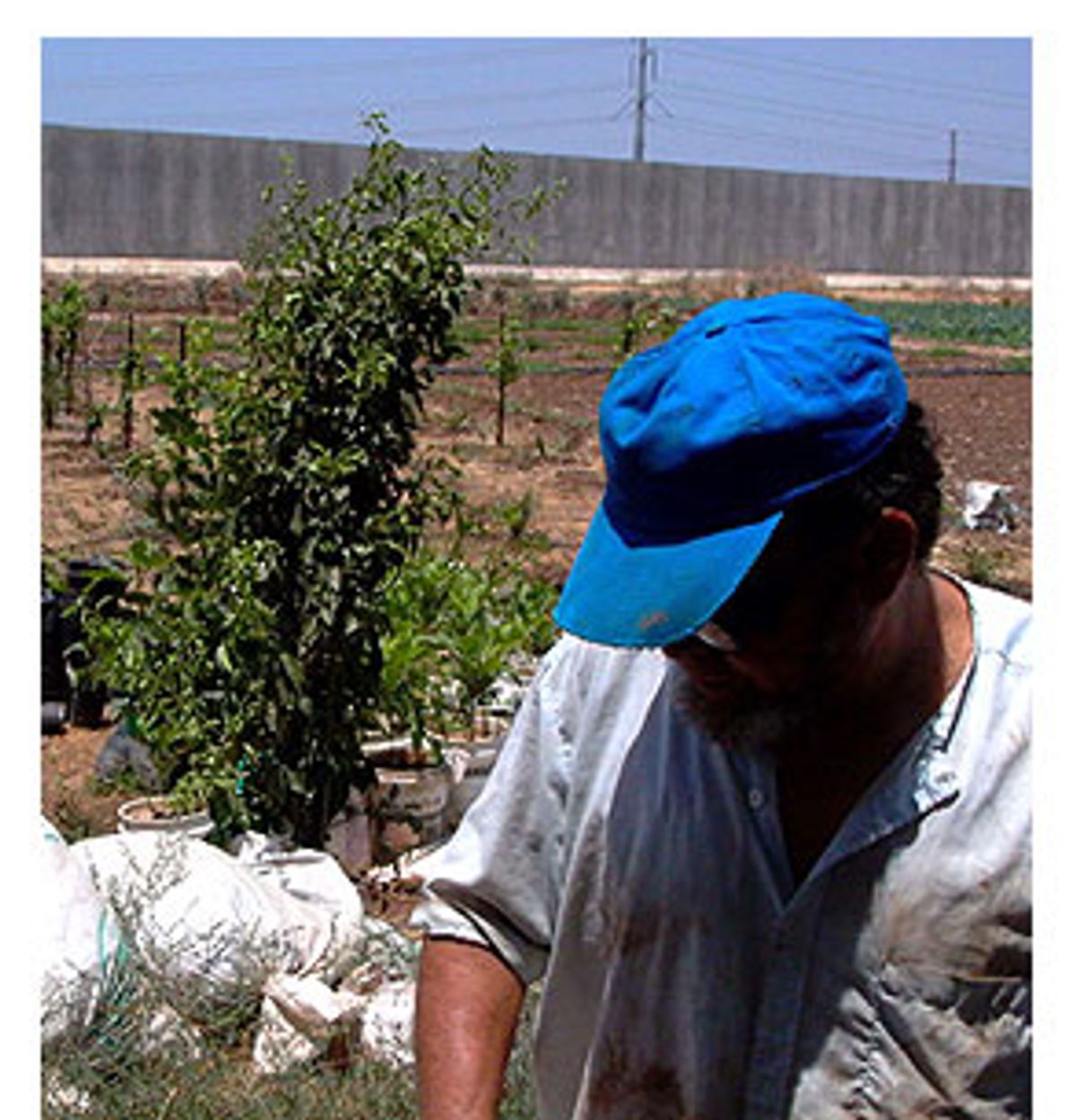
The people of Jayyous are genuinely afraid of losing their agricultural land, most of which has been cut off from the village by the new fence. Abu Soufian emerges bent and walking on a stick from a rickety shelter in a field near Jayyous. He says he is lucky because he built it a long time ago, using an old Volkswagen van and some corrugated iron, as a place to take naps in the afternoon when he worked the land. "Now, all we had to do was put up a sheet to sleep under at night," says Abu Soufian. "I'm not leaving my land alone anymore. I will stay here with my wife at least six days a week. If I could add a bathroom and a kitchen here I would never go back to my house in the village. I can live without the village but I cannot live without my land."
Mayor Fayez Salam says that 73 percent of the Jayyous' land is now on the other side of the fence. The fence has blocked off 97 percent of irrigated agricultural land. All the village's greenhouses that produce the highest yields are also on the other side. Some 300 out of the village's 550 families are totally dependent on agriculture, says the mayor, especially since the outbreak of the intifada almost three years ago when it was no longer possible to work across the border. Israel has included gates in the fence where Palestinians can cross to have access to their land, but many in Jayyous are suspicious of the gates. "They can close them or make it difficult to get special permits," says one landowner. "We cannot take the chance," says Abu Soufian. "We have to take care of our land every day. What will happen if the gates are closed for a few days and we cannot water our crops?"
Thus far, the two gates near Jayyous have been more or less open. That has not stopped some Palestinians from trying to create a much different impression. Sharif Omar, a villager who owns large tracts of land on the other side of the fence, is a veteran member of the Palestinian Land Defense Committee and has fought numerous Israeli annexation attempts in the past. He does not believe Israel's claim that the barrier is there purely for security reasons. In his fields outside Jayyous, he points to a tower that he says marks the old green-line border. "That is four miles away and here the fence passes just yards from our houses in Jayyous. Do they really need those four miles, could they not have built it on the border?" Omar seems to be the driving force behind the decision of some 30 families to stay on their land, in shelters and tents.
In his own breeze-block shelter, Omar is accompanied by foreign volunteers from the International Solidarity Movement. "My brothers help us," he says. "They stand at the gate to make sure nobody is beaten." Omar and the internationals say that harassment at the gates is frequent and brutal. They themselves have not witnessed any incidents, though, and Omar has until now always been able to pass through the gates. One young Palestinian farmer says he was beaten that morning by the guards from the private security company who patrol the fence. He says he has no marks on his body, though, and the beating may have been more like some pushing and shoving.
Soufian Shemasni, the son of Abu Soufian, tells a more indicative tale of petty harassment. Earlier in the week, after he had gathered potatoes from the field, the guards made him, his brother and his father unload them all from the van several times "to search for weapons," Soufian says. When the family got fed up, he says, the guards trampled on the potatoes, threatened to put a chain around Soufian's neck and drag him behind their jeep and to beat him and his family. Eventually a border police unit arrived, says Soufian, but those officers also beat them before letting them go. The family left the potatoes because they had become damaged in the scuffle. Whether the whole story is accurate or not, it does indicate the intrinsic fear that many Palestinians have of crossing Israeli checkpoints. Abu Soufian says that he and his wife sleep on the land because he is less likely to be harassed than young Palestinian men such as his son.
Palestinians say the fence not only threatens their land, but their water. Khader says that in Jayyous, six out of the seven wells that are used for irrigation are now on the other side of the fence. This pattern, he says, is repeated along the whole of the first section in the Northern West Bank. Since water resources are also crucial for the viability of a future Palestinian state, Khader sees the Israeli control of the wells as a pre-planned political maneuver that has nothing to do with security.
The effects of the fence are clearest in nearby Qalqilya, a major West Bank town that juts into Israel. It's just 10 miles to the Mediterranean from Qalqilya, at the point where the Jewish state is at its narrowest. Over the last couple of years, many attackers have set out from the city to wreak havoc in Israel. As a result, Qalqilya has been virtually cut off from the rest of the West Bank for more than two years. Now that cordon sanitaire has been made visible by high gray concrete walls and barbed wire fences on three sides. On the fourth side the army maintains a checkpoint. Everybody going in and out has to present papers, though trucks can haul their cargo back and forth without controls.
The results have been disastrous for Qalqilya, says Mayor Mahrouf Zahran. Unemployment in the town stands at 64 percent. Of the population of 41,000, 3,000 have left town over the last three years, mainly shop owners who have decided to make a new start elsewhere in the West Bank. In total, some 600 businesses have closed. Part of the reason why Qalqilya is walled off, rather than fenced, is that the Israelis want to prevent shooting at nearby Israeli fields, houses and a new toll road, the country's first. Earlier this month, a young girl was killed when she traveled with her family over the road. Mayor Zahran says that he favors good relations with the Israelis. He tells about past cooperation and how many people from Israel used to come shopping in Qalqilya.
"The wall will only cause more resentment and violence," the mayor says.
The fence also cuts many villages off from each other and from towns where essential services, such as schools, hospitals and markets, are located. Abdelkarim Ahmed, the mayor of the nearby village of Azoun Athme, has tears in his eyes when he looks at his house across the road. "I will be cut off from the village by the wall that will run along this road," he says. To get to his job, he will have to drive around it to a gate several miles down the road, a delay of at least 15 minutes. "But for many pupils of our school who live nearby it will be much tougher," Ahmed says. "I don't know how they can keep coming; they used to just walk into the village but that will no longer be possible. The Israelis have offered to build a tunnel underneath the road," he says, "but that will cost millions and the village will have to pay for it. Besides, the army will then keep security control over the tunnel."
In Israel, all these complaints cut very little ice. Sitting in an easy chair in his air-conditioned office in the Knesset, Israel's parliament, the powerful chairman of the Foreign Affairs and Defense Committee, Yuval Steinitz, does not want to let the concerns of a "few Palestinian farmers" interfere with the security needs of his country. Steinitz, a member of Sharon's ruling Likud Party, vehemently rejects a question about the trajectory of the wall. "Why is it that people always ask me about the viability of a Palestinian state?" he fumes. "What about the viability of Israel, what about our right to survival?" He maintains that there can be no return to the borders that Israel had between the end of the war of independence in 1949 and 1967 when it conquered the West Bank. "There have to be security zones," says Steinitz, but then he backtracks on whether these zones are already included in the planning for the wall.
Steinitz is a former member of Peace Now; he went over to the Likud in 1994 when he concluded that the Oslo peace process would lead to disaster. With the air of a man who cannot keep himself from saying "I told you so," he insists that he wished things were different. He still wants his country to withdraw from the West Bank and Gaza, but only to "defensible" positions. Anyway, Steinitz says, it's the Palestinians' own fault that Israel is building the wall -- if they had not started with suicide bombings, it would never have come to this. "In Oslo, we agreed that the Palestinian Authority would be a demilitarized entity," he explains. "We have seen what such agreements count for." Steinitz says he still hopes that something will change on the Palestinian side, so that "then we may not have to build the wall and spend so much money on it." Even though he is one of the few people who should know, he cannot -- or will not -- say anything about the course of the rest of the wall.
Gerald Steinberg, a professor of political science and a strategic analyst at the Bar Ilan University near Tel Aviv, largely agrees with Steinitz. "It's a bit much that first the Palestinians don't want to negotiate with us anymore about borders, among other things, and they turn to violent means to get what they want, and then they complain when we unilaterally draw a line to defend ourselves," says Steinberg. He does agree, though, that the barrier has a political aspect despite the heated denials of the government. "All the twists and turns in the fence may look idiotic from the outside but actually it is very logical in the Israeli political reality," says Steinberg. "Every settlement wants to be included and they lobby the government. That is how the route is determined."
Ironically, the fence was largely a left-wing idea initially, pushed by prominent Labor Party politicians and meant to be built on or close to the green line. It was seen as a means of reasserting the old border, thereby making a withdrawal from the West Bank more likely and providing a defensive line at the same time. That's why it is still viewed with animosity by many on the right, despite the efforts of many settlements to be included on the "right side" of the separation. Many nationalists don't want to see any acknowledgement that even limited areas of the West Bank may have to be given up. The most extreme among them would rather see the whole Palestinian population expelled.
Still, the Palestinian use of the term "apartheid" in connection with the wall is misleading. The West Bank is occupied territory and its residents don't have the same rights as the citizens of Israel, Jewish or Arab. There is no systemized structure of racial discrimination in place that is comparable to the apartheid that used to define South African society. Where the apartheid claim does make some sense, though, is where it is used to describe the possibility of the Palestinians being forced into several, possibly three, separate enclaves, just like the South Africans tried to do with the black population in the so-called Bantustans. Sharon has in the past said he may support a Palestinian state on some 45 per cent of the West Bank that will include well over 90 per cent of the population. The Palestinians see the fence as another step toward the realization of such a plan.
Abdelatif Khader in Jayyous is among those who does call it apartheid. "They are extending the fence to include the settlement of Alfei Menashe," he says. "There are 5,000 settlers there. In Qalqilya, which is being very badly affected by the detour, you have more than 40,000 and in the villages nearby another 25,000 will suffer. Now you tell me, if 5,000 Israelis are more important than 65,000 Palestinians, is that not apartheid?"
Remarkably, though, even as Khader fulminates against the fence, he is preparing to live with it. In a nearby village, he has taken measures to have water delivered to fields on the other side that will be cut off. "I know it seems paradoxical and many people first said we should only resist," Khader acknowledges. "But if we don't take any steps to live with it for now, then we will certainly lose the land on the other side."
Shares