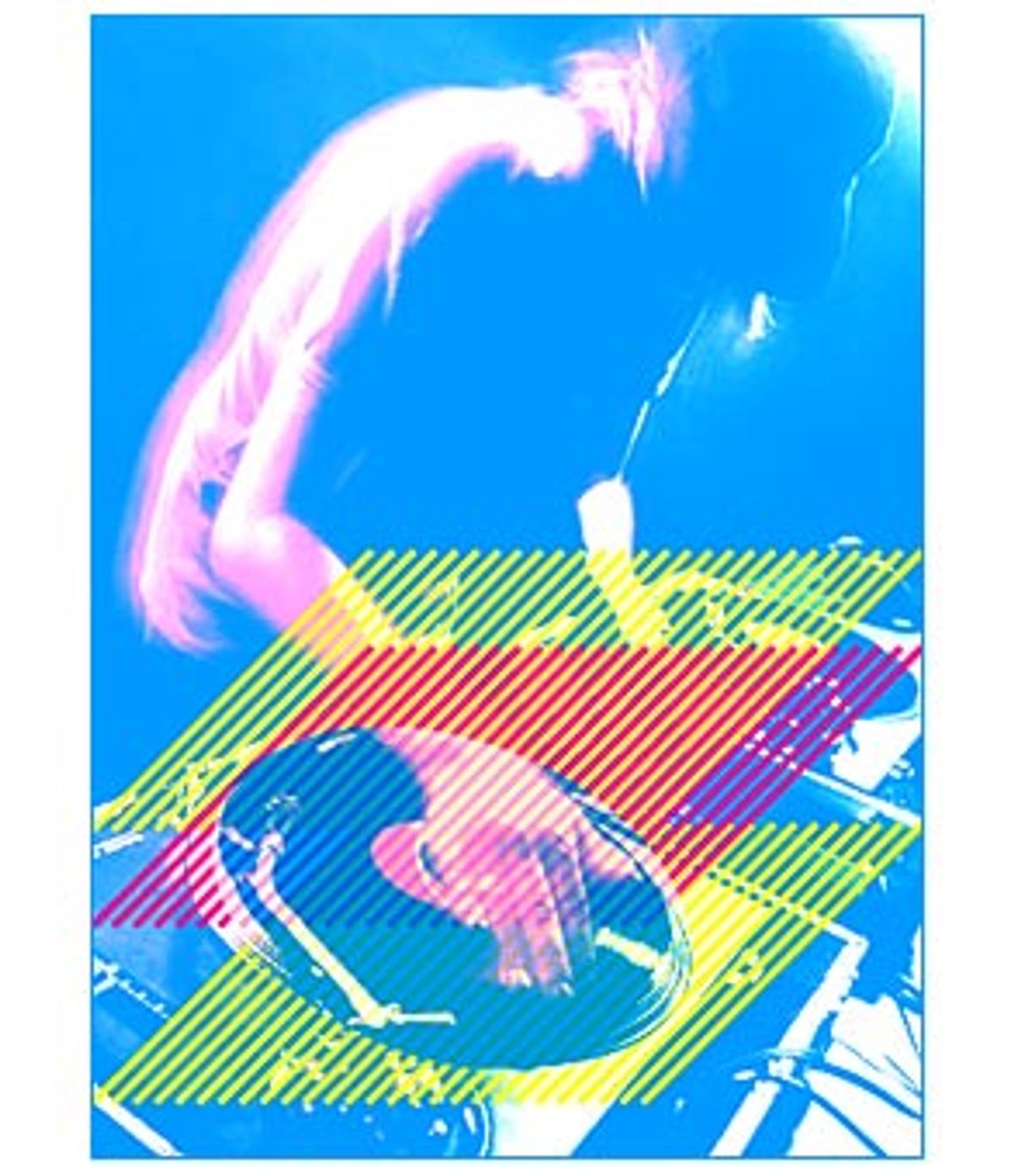
In the 1993 club hit "Rebel Without a Pause," Chuck D. raps over Herb Alpert's chirpy trumpet: "A rebel in his own mind/ Supporter of a rhyme/ Designed to scatter a line/ of suckers who claim I do crime." That incongruous hybrid of hip-hop and bouncy pop, created by the group Evolution Control Committee, sounds as startling and amusing today as it did a decade ago, and still ripe with meaning.
The wacky juxtaposition spawned its own kind of revolution, inspiring legions of the club remixes now called "mash-ups" -- with one classic example being "Smells Like Booty," in which Destiny's Child wails over Nirvana's classic dirge and drone. Also referred to as "bastard pop," mash-ups involves blending samples from two songs -- generally, one song's vocals atop another's instrumental or rhythm track. The sum of the parts often surpasses the originals. The more disparate the genre-blending is, the better; the best mash-ups blend punk with funk or Top 40 with heavy metal, boosting the tension between slick and raw. Part of the fun is identifying the source of two familiar sounds now made strange -- and then giggling over how perfect Whitney sounds singing with Kraftwerk.
Exploding onto Britain's dance club scene in the last couple of years, mash-ups are cut 'n' pasted by superstar DJs whose aliases sound like email monikers: Ultra 396, Kid606, Anon, Mc Sleazy. Distributed free on the Internet, on bootleg CDs and on 12-inch "white labels" in U.K. shops, mash-up recordings may be becoming yesterday's news overseas, just as they're beginning to attract a significant audience on this side of the pond. Mash-ups are easy to create on home computers with software any competent downloader can find for free. But because the necessary artistic clearances are tough to obtain at best, mash-up devotees are bootleggers almost by definition.
As in a wrestling match or a courtroom battle, the two "mashed"acts are presented as opposing each other: "Kylie Minogue vs. New Order," "Tag Team vs. Marilyn Manson" or "The Ramones vs. Abba." Mashing the titles of the two tracks adds another layer of wit: Soundgarden matched with Joni Mitchell is "Like Woodstock." Splice the Bee-Gees with Michael Jackson and you get "Billie's Alive"; Chris Isaak vs. Eminem yields "Wicked Superman" and Christina Aguilera vs. the Strokes turns out to be "A Stroke of Genius" (which it is).
Mash-ups might be the ultimate expression of remix culture, which has grown out of a confluence of influences: widespread sampling, DJs as performers, and the proliferation of digital technology, as well as a tangle of diverse musical styles from jungle to house to garage and techno. To lapse into postmodern jargon for a sec, mash-ups are the highest form of recontextualization, recycling toasty tunes by fusing pop hooks with grunge riffs, disco divas with hardcore licks. The groove and crunch combination melds black music back into rock, or pulls out a song's surprising inner essence. Toss in something vintage, obscure, silly or unexpected and the duet totally transcends all musical formats and canons of taste.
"The Remix," a Friday-night show on London's XFM radio ("where dance rocks") has proudly championed mash-ups, providing their primary on-air outlet, says James Hyman, the show's co-host for three years. Though mash-ups are a side dish in the show's diet of remixes, the listeners devour them, and "The Remix" has launched such hot DJs as Freelance Hellraiser, Jacknife Lee and Audio Bullys, whose work can be found on the album "The Best Bootlegs in the World Ever," a critical fave (and a bootleg itself).
Belgian brothers Stephen and David Dewaele, aka Soulwax and/or 2 Many DJs, assembled and released the nonstop, album-length mash-up "As Heard on Radio Soulwax, Part 2" (there was no Part 1, although there have been several subsequent installments), morphing Prince into Sly and the Family Stone slipping into the Velvet Underground's "Waiting for My Man" over the throbbing "Peter Gunn" TV show theme. All 45 samples were exhaustively cleared -- for the Benelux countries only. So buying the album as an import is legal (you can easily find a copy on the Web right now), even if owning and playing it in the United States is a legal gray area at best.
From Vanilla Ice to the Verve, the controversy over sampling rights and the prohibitive costs of clearance payments, potentially due to publisher, label and artist, keep mash-up bootlegs underground, perhaps contributing to their allure. Ironically, artists who sampled aplenty in the '90s, such as the Beastie Boys and the Chemical Brothers, aren't necessarily eager to grant permissions. Touting the "buy it don't burn it" philosophy, Missy Elliot, whose "Get UR Freak On" has been mashed 50-plus times, tells consumers to turn their backs on bootleggers.
After radio stations received cease-and-desist letters for playing mash-ups, "Freak Like Me," mashed by Girls on Top (aka Richard X) with Adina Howard backed by a Gary Numan track, was re-recorded with The Sugarbabes' vocals to circumvent legal difficulties -- and hit No. 1 on the U.K. charts.
Labels should love mash-ups, insists Jon McDaniels, program director of C89.5, a Seattle high school radio station whose teen DJs constantly play bootleg imports on the daily mix show. "They breathe new life into old stuff,." he says. (A current favorite is Dannii Minogue vs. Dead or Alive: "I Begin to Spin.") Admittedly, mash-ups may not inspire the purchase of Celine Dion's CDs, but they may rekindle interest in a forgotten career. Consider the example of the proto-mash-up, Run-D.M.C.'s mid-'80s collaboration with Aerosmith on "Walk ThisWay."
It wasn't until a landmark case in 1991 that casual sampling of borrowed material was deemed illegal, when Gilbert O'Sullivan sued Biz Markie for unauthorized use of "Alone Again (Naturally)." The judge quoted the Seventh Commandment, "Thou shalt not steal." Would hip-hop have survived that long without widespread pilfering -- and where would the already crippled music business be without the rap "fad"many thought would fade?
Though credited as the grandfathers of mash-ups, Ohio's Evolution Control Committee is more into satirical audio collage ("plunderphonics") than reinventing pop songs. When threatened with a lawsuit by CBS for sampling news anchor Dan Rather over AC/DC for a track on their latest compilation, "Plagiarhythm Nation, Vol 2.0," ECC responded that copyright law allows "fair use"of materials for parody purposes.
With Madonna and the Sex Pistols giving permission to Go Home Productions for its "Ray of Gob," mash-ups may yet go mainstream. "If it's official, things could get interesting," suggests XFM's Hyman. On the other hand, says Osymyso (aka Mark Nicholson), whose "Intro Inspection" crams 100 songs into a 12-minute tour de force, "Legitimizing these tracks will remove the spontaneity that made them work in the first place."
Though there are gazillions of club DJs in the U.S., it's tough to find mash-ups on American airwaves outside a handful of free-form stations. WFMU, the legendary indie station in Jersey City, N.J., features turntable artists during the show "Re: Mixology." Program director Ken Freedman (aka DJ Jesuspants) has scheduled such renowned mashers as Go Home Productions and the Australian DJ known as Dsico, "that No-Talent Hack" (sic).
"What does it matter if the remix of Justin Timberlake's 'Cry Me a River' with 'Let It Whip' as the track came from the label or not?" asks Sean Ross of Airplay Monitor, a radio trade publication. As long as 15 different mixes are provided for every song by labels and radio, he adds, "There's no reason listeners won't keep doing their own."
While a growing core of fans adores mash-ups, some consider them one-gag novelties. Some don't get them and others -- those who aren't willing to spelunk in the darker corners of pop culture's gray market -- literally can't get them. Disclaimers on mash-up sites generally state that music copyright is held by the artist, that remixes will be deleted on request and that listeners are downloading songs for "evaluation purposes only" and agree to erase all material within 48 hours.
After the Recording Industry Association of America succeeded in suing three students for file-sharing, launching a new front in its battle against piracy, president Cary Sherman proclaimed: "When individuals 'share' copyrighted music, without permission of the copyright holder, they are liable." The RIAA is now gathering evidence to prepare a new round of lawsuits in mid-August, potentially targeting anyone who downloads copyrighted music. To say the least, mash-up entrepreneurs are in the crosshairs.
"Record companies use the Web as too much of a scapegoat," says Hyman, of London's XFM. He notes that Apple's iTunes Music Store sold millions of songs in its first few weeks, clearly indicating that people will pay for music -- they just don't want to pay $20 for a crap album. Late to jump on the Internet bandwagon, the music industry is scrambling to recoup revenues it believes it has lost to bootleggers and file-sharers. (The industry's own numbers suggest a catastrophic 26 percent sales drop since 1999.)
The RIAA's refusal to accept downloading is like its fight against blank cassettes in the '80s, says E. Michael Harrington, a music professor at Belmont University in Nashville who specializes in intellectual property issues and has served as an expert witness in copyright lawsuits. Harrington compares the industry's effort to criminalize customers to the Titanic's captain ignoring the iceberg: "Oh, we're sinking. Let's sue the passengers. Creativity is being stifled by copyright laws that are outdated, unrealistic and misinterpreted."
There are potential violations galore in the world of sampling, Harrington explains, but the law is tricky. In some cases the lack of qualitative similarity between different songs has led judges to conclude that sampling is not copyright infringement, as with the U.S. Supreme Court's 1994 decision that 2 Live Crew's parody of Roy Orbison's "Oh, Pretty Woman" was acceptable under the fair-use doctrine. "At its best, the law reflects our values," says Harrington. "When it's not, it just regulates them."
As far back as Mozart, he adds, "There's an age-old tradition of fooling around with music everyone knows and casting it in a new light, giving it new meaning." It's a murky business when ideas of authorship and artistic control come into question. When is it filching, when is it flattery and when is it just funny?
Mash-ups may further muddy the legal waters because they can transform their original sources so dramatically. Organizations like the Electronic Frontier Foundation and Musicians Against Copyrighting of Samples say they are seeking "reasonable copyright" reforms that would permit sampling. Members of Negativland, the California experimental band sued by Island Records for its 1991 parody and remix of U2's "I Still Haven't Found What I'm Looking For," support a "sampling license" for remixers' use. BoomSelection, the now-defunct online clearinghouse for bootlegs, referred to the "plundering nature of pop music" in its last-ever Web posting, crediting mash-ups with pushing the boundaries of cool. "There's no longer any shame in loving Hall & Oates," read the site -- when mixed with Daft Punk, something new and improved is created.
Mash-ups might be better understood as part of a continuum rather than a new trend. They will likely mutate further and encourage more bands like Detroit's Electric Six, described as "White Stripes gone Studio 54." Anyone who wants to can download the vocal track to their song "Gay Bar," create their own remix and submit the new version to XFM for possible airplay on "The Remix." So far, Hyman says, the submissions have ranged from "the diabolical to the hilarious to the surreal." He has played "brave, cheeky and genius" versions backed by the "Batman" theme, reggae classics, the Village People's "YMCA," 50 Cent and Motorhead.
In DIY culture, consumers are the producers, owning the tools of production -- a laptop instead of guitar, bass and drums. The bedroom is the studio and factory machinery moves out of the nightclub onto the Internet for millions to access. The media monopolies are fighting back, but with the airwaves gobbled up by conglomerates, homespun mash-ups may be the people's digital antidote.
Hot Aussie remix DJ Dsico "that No-Talent Hack," who mashed Britney Spears vs. Chic to create "Goodtime Girl" -- guides the budding mash-up maker with how-to lessons. Select compatible melodies (mix an a cappella vocal with a different music track -- say, Snoop vs. Foo Fighters, or maybe J.Lo vs. Ben Folds). The possibilities are endless. Tweak tempos, mix and fix pitch, time loops with cheap or free software (audio apps such as Sonic Foundry, Pro-Tools Free, Cool Edit Pro, Acid, Wavelab or Peak). Arrange, adjust, upload. "You gunna be da next Freelance Hellraiser," Dsico declares. "The future is now."
Shares