Environment

Bush’s stealth attack on the atmosphere

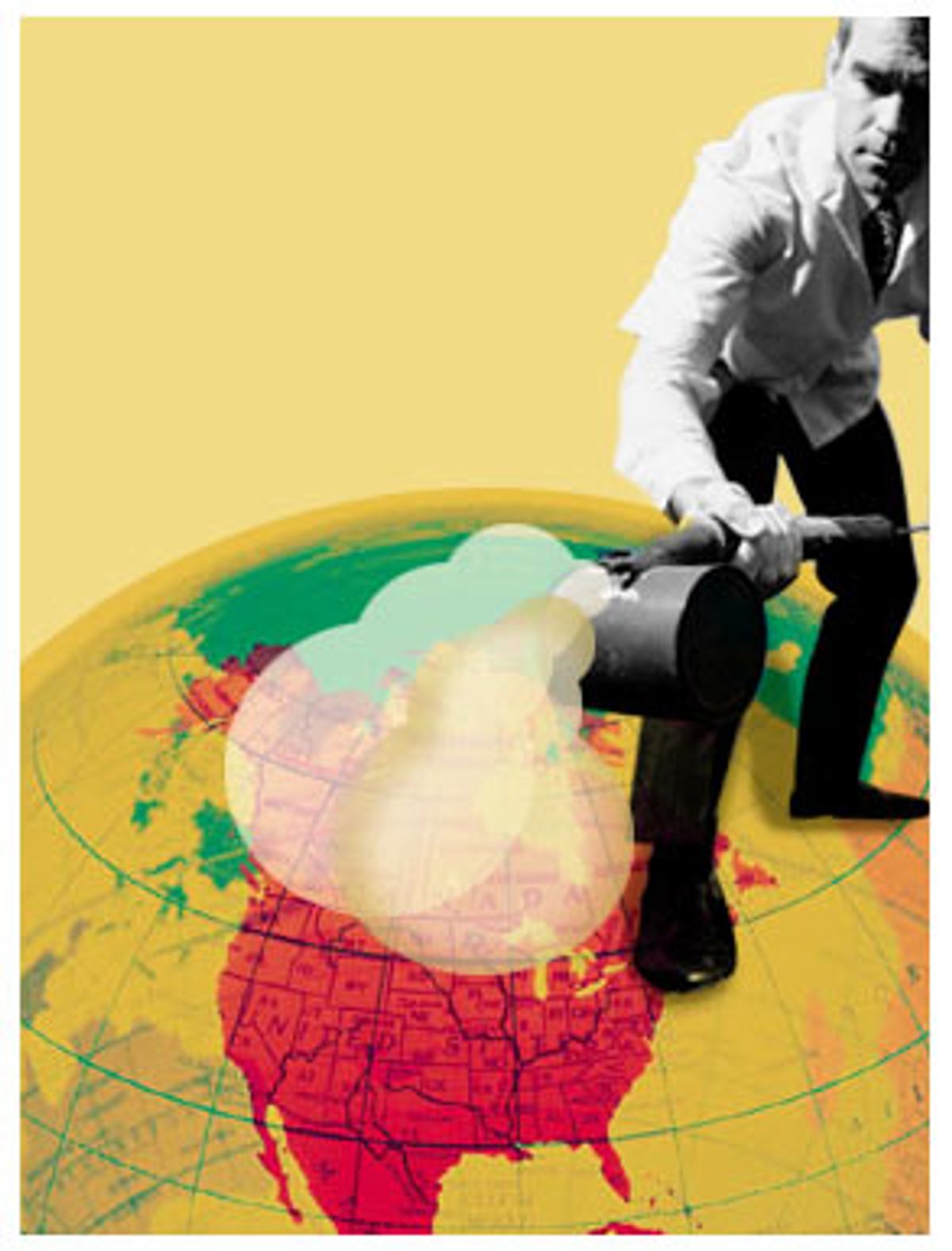
The same administration that denies global warming now wants to dramatically increase the use of an ozone-eating chemical. Agribusiness is very happy.

Day and night, ships arrive from around the globe at America’s ports. Sealed steel boxes are hoisted from hulls onto waiting trains and trucks that roll to every state in the nation. Roughly 21,000 such containers enter the country each day, packed with millions of wooden crates and pallets. Along with their cargo, they can also hold invasive insects like the Asian long-horned beetle, which if it escaped to U.S. forests, could defoliate millions of trees and do billions of dollars in damage.

The Bush administration, to combat this very real problem, wants to force foreign countries and American ports to fumigate nearly every last board-foot with methyl bromide, a deadly pesticide. There’s just one catch: methyl bromide is a direct, dangerous threat to the ozone layer, and because it’s mandated for a total phaseout under both the Clean Air Act and the Montreal Protocol ozone-protection treaty, a massive production increase would violate both U.S. and international law. Bush’s plan, which purports to benefit the environment, instead appears calculated to undermine the Montreal Protocol while wildly profiting some of the GOP’s staunchest financial backers — a handful of methyl bromide manufacturers and the agribusiness interests that are the biggest users of the chemical.

The Montreal Protocol has been called the greatest environmental victory in history and hailed as a triumph of international cooperation. Starting in 1987, the United States, under the Reagan administration, worked with 166 other nations, plus corporations like DuPont, to ban manmade chemicals that were allowing more deadly ultraviolet rays to reach the earth.

Now the Bush strategy could delay or even reverse the healing of the ozone layer, scientists say. It could derail the treaty itself, posing a significant health risk to humans and other life across the globe. The administration has launched a two-pronged attack on the protocol: A newly proposed rule by the Department of Agriculture would demand methyl bromide fumigation for nearly all imported raw-wood packaging, and the Environmental Protection Agency wants to allow U.S. farmers and businesses to use millions of added pounds of the poison on crops and golf courses.

“I think it is quite serious,” says Don Wuebbles, a University of Illinois researcher who has studied the ozone layer for 30 years. “I would be concerned about anything that will lead to a potential increase of methyl bromide … It’s still one of the most important contributors to ozone depletion.”

Methyl bromide is an odorless, colorless, little known but lethal agricultural pesticide. And its byproduct, bromine, “kills ozone something like 50 times more effectively than chlorine on an atom-for-atom basis,” says William Randel, the senior atmospheric scientist at the National Center for Atmospheric Research.

The Bush initiative comes at a time when reports and studies show that, after years of concern and global action, Earth’s protective ozone layer is starting to heal. Human output of chlorofluorocarbons has fallen dramatically; atmospheric levels of methyl bromide have been falling, too, as the phaseout of the chemical is beginning to take effect.

Just this month, the Christian Science Monitor reported that scientists have found “unambiguous evidence that Earth’s sunscreen, the tenuous shield of ozone in the stratosphere, is slowly beginning to recover from nearly thirty years of human triggered loss.” One key reason for the recovery, said the newspaper, is the declining use of methyl bromide, one of the most worrisome gases now threatening the ozone layer.

“Methyl bromide has decreased [in the atmosphere] more than 10 percent since 1998,” Steve Montzka, the National Oceanic and Atmospheric Administration scientist who made the discovery, told Salon. “We think the most likely explanation of where that decrease in atmospheric methyl bromide is coming from is due primarily to the Montreal Protocol restrictions on its production.”

If all human production of methyl bromide ceased today, says a 2002 World Meteorological Organization scientific assessment, global ozone depletion would be reduced by 4 percent. That doesn’t sound like much, but a total ban could curb harmful ultraviolet rays, cutting non-melanoma skin cancers by about 8 percent and eliminating up to 600,000 cases of cataract-induced blindness annually, according to the United Nations Environment Program.

Under the Montreal Protocol, methyl bromide production has already been curtailed by 70 percent of 1991 baseline levels, with a total ban due in 2005. But by playing a cagey numbers and lawyers game with the treaty, the administration hopes to keep the chemical in use at high levels after the phaseout date both in the United States and abroad, pleasing its agribusiness patrons while maintaining the appearance of staying within the letter of the law.

“There is no question that this is a case of another big polluter, of an industry well connected to the administration — just like coal or oil — looking for multimillion-dollar favors,” says David Doniger, policy director of the Climate Center of the Natural Resources Defense Council. The new rule proposed by the U.S. Department of Agriculture to fumigate all raw solid-wood packaging shipped into the United States, could skyrocket global methyl bromide production. (While heat treatment is a suggested alternative, its higher cost would likely result in methyl bromide being the method of choice.)

The department says it is merely implementing a mandate of the U.N.’s International Plant Protection Convention, agreed to by 118 nations. But that agreement offers only guidelines, not strict rules, and it allows for multiple forms of treatment, including the use of chemicals that wouldn’t damage the ozone.

The Agricultural Department concedes that its universal fumigation plan could raise methyl bromide’s use from current global levels of roughly 55,500 metric tons to as much as 158,500 metric tons. That worst-case scenario could triple production of the pesticide worldwide, and in the department’s own estimation, increase human-made methyl bromide emissions by a staggering 155 percent, enough to cause significant harm to the ozone layer. The Agriculture Department did not respond to several requests by Salon to speak with the lead scientific author of this damning report. However, the agency insists that this scenario is unlikely.

Unfortunately, if the department approves the new rule, it will have almost no control over the amounts of methyl bromide actually used, since most fumigating would occur abroad, before shipment. The U.S.-imposed regulation could also force developing countries to use far more methyl bromide than they now need, hampering their efforts to cut future use of the chemical as required under the Montreal Protocol.

Typically, treaty exemptions must be approved by the U.N. Ozone Secretariat, the Montreal Protocol’s governing body, but a loophole allows the Agriculture Department to put its rule into practice without such approval. That’s because quarantine and pre-shipment applications for invasive-pest control accounted for a minuscule amount of methyl bromide use in the past and weren’t banned.

“What you have is a situation where the quarantine use was a small but important one, the tail on the dog,” explains Doniger, of the Natural Resources Defense Council. “What the Montreal Protocol parties decided to do was phase out the dog — the many agricultural uses for methyl bromide — and live with the tail. Now the Bush administration wants to reverse the situation. Under the Department of Agriculture proposal, the tail will become three times larger than the dog.”

The Agriculture Department admits in its environmental assessment that its strategy, while putting the ozone layer at risk, may not even be effective. Some bugs will survive methyl bromide fumigation, and even a few will be harmful since they can multiply, eventually ruining crops and ecosystems. The department even admits to better alternatives. One surefire approach would be to ban all raw-wood packing, a viable global goal if done over a reasonable transition period.

The Agriculture Department isn’t the only agency spurring methyl bromide production. The Environmental Protection Agency is seeking methyl bromide “critical use” exemptions at the U.N. Ozone Secretariat meeting in Nairobi, Kenya, in November.

The EPA, reportedly under pressure from the White House and Agriculture Department, wants exemptions to raise methyl bromide use by 39 percent above 1991 baseline levels for 16 crops, including strawberries, tomatoes, ginger, sweet potatoes and turf grass. The agency says there is no technically or economically viable alternative for these crops. If granted, these exemptions alone would stop and reverse the pesticide’s total phaseout in 2005.

While EPA claims its exemption request doesn’t violate the letter of the law as stated in the treaty, Doniger, a Clinton administration diplomat, disagrees. “What we negotiated in 1997 was a total global phaseout of methyl bromide in four steps, [reaching] a total phaseout in 2005,” he told Salon. “An exemption was included, in that last step, that allowed continued production for ‘critical uses,’ in order to help the manufacturers and users achieve a soft landing before total phaseout.”

But the Bush exemptions, if approved, would roll back a 70 percent methyl bromide reduction already in place, to a 61 percent reduction. Instead of a total ban, it would permit the manufacture of 10,000 metric tons of the pesticide, not counting the Agriculture Department’s quarantine and pre-shipment request.

“If the Bush administration interpretation of the treaty were followed, the parties could agree to any amount of exemptions,” says Doniger. They could raise production all the way back “to 100 percent of each country’s 1991 baseline,” he adds. “This is an absurd reading of the protocol.” The U.S. also wants an added exemption in 2006, a contingency not ever addressed by the treaty.

The EPA says that its exemptions “reflect a downward trend,” but anyone doing the math can see that the U.S. is asking for a 9 percent increase over current production. When asked whether Salon’s math was correct, Drusilla Hufford, director of the global programs division at EPA, skirted the question repeatedly.

“We are absolutely not in violation of the Montreal Protocol,” Hufford asserts. “I think that looking at it as a setback is a mistake. It isn’t an appropriate question to ask … We have conducted very successful phaseouts of a number of chemicals that included this kind of policy approach.” True, the phaseout of other ozone depleters allowed exemptions, but not of such massive proportions. For example, a tiny exemption for chlorofluorocarbons was allowed for personal asthma inhalers.

When asked when a total ban of methyl bromide might happen, Hufford said: “I really couldn’t predict that.”

Doniger worries that the Bush administration request, if approved by the United Nations, may weaken the will of other nations. “If the United States backs out of its methyl bromide phaseout, you could see the developing countries balking not only about phasing out methyl bromide, but other chemicals as well. Why should they go to strenuous efforts to get rid of [them] … when America isn’t meeting its commitments? We could see the whole treaty unravel.”

Josh Karliner, a board member with Corporate Watch, an anti-globalization activist group, expresses another worry about a failed ban. “This is also a Homeland Security issue. A few weeks after 9/11,” he says, “I got a call from the Coast Guard wanting to track down information on methyl bromide production and distribution because it is a highly toxic, colorless, odorless gas. This is not the kind of chemical you want to be freely proliferating at this dangerous time in history.”

EPA claims that there are no viable alternative to the pesticide. But as long ago as 1995, a U.N. scientific panel concluded that alternatives to methyl bromide were either available or at an advanced stage of development for more than 90 percent of methyl bromide uses. That puts the lie to an EPA claim that there has been insufficient time to approve substitutes.

That’s also a far cry from a methyl bromide industry claim that farmers worldwide have absolutely no “effective alternatives” to the poison, reports Corporate Watch. It is to those industries — the methyl bromide makers, users and lobbying groups — to whom one must look to understand the Bush administration’s attempt to backpedal on its treaty commitments.

Just three companies dominate 75 percent of all methyl bromide production: U.S.-based Albemarle Corp. (a spinoff of the Ethyl Corp.), along with the Great Lakes Chemical Corp. and Israel’s Dead Sea Bromine Group. They make up what the Chemical Marketing Reporter calls “the global bromine industry oligopoly.” Both U.S. companies have poor environmental records: Albemarle has been fined nearly a million dollars for violations since 1993, while Great Lakes Chemical was rated Arkansas’ worst polluter during the 1990s, based on annual federal Toxic Release Inventory Data, says Corporate Watch.

In truth, methyl bromide might have been disposed of as toxic waste had not the companies contrived its use as lethal pesticide. Methyl bromide is a highly poisonous byproduct in the manufacture of a popular flame retardant, tetrabromobisophenol-A (TBBA), used increasingly by the computer industry. As demand for TBBA grows, so does the amount of toxic methyl bromide resulting from the industrial process, as does a need for the companies to sell or dispose of it.

Besides its ozone-depleting characteristics, methyl bromide is designated a Class 1 acute toxin by the EPA, with a reputation for killing humans as well as insects and weeds. It’s been used for 50 years to sterilize soils prior to the planting of crops. Injected into the ground, it kills virtually every living thing, good or bad. It’s also used to fumigate fruits, vegetables, dried nuts and grains before they’re sent to market, and to fumigate homes, warehouses and grain elevators. The exposure of humans to it can cause nausea, chest pains, numbness, convulsions, coma and death. The U.S. National Cancer Institute recently linked methyl bromide to increased prostate cancer in product handlers. Farm workers and environmentalists have sought a ban for decades.

Which is perhaps why the methyl bromide makers and users are such generous political patrons. For example, the Floyd D. and Thomas E. Gottwald family of Virginia, controllers of Albemarle and Ethyl corporations, gave roughly $345,000 in the 2000-02 election cycle to the Republican National Committee, the Bush campaign, GOP congressional candidates and others, according to the Center for Responsive Politics.

Methyl bromide producers and agribusiness interests belonging to the influential Crop Protection Coalition have vigorously fought the ban on methyl bromide, while giving $2.3 million in political contributions in the 1990s, according to Common Cause.

From 1990 to 2002, agribusiness gave more than $203 million to Republican candidates and $93 million to Democrats. George W. Bush received $2.7 million for his 2000 campaign from the industry, while Al Gore culled just $314,000. Agribusiness contributions to the Bush 2004 campaign, at $697,000, already nearly equal those of energy and natural-resource interests ($736,000), likely assuring both sectors continued favor in the Bush-Cheney administration.

The Center for Public Integrity in its report, “Unreasonable Risk: The Politics of Pesticides,” relates how Texas Republican Rep. Larry Combest paraded the Crop Protection Coalition’s 35 member groups through a 1998 congressional hearing, then decided in favor of the absolute necessity of the chemical: “We have no proven cost-effective substitute for methyl bromide,” he said. “Methyl bromide is an essential tool for many aspects of our modern agricultural industry.” Combest received about $196,000 in contributions during the 1998 election cycle from agribusiness, plus another $320,000 in 2000.

House Majority Leader Tom DeLay has strong agribusiness connections, as demonstrated by his support for the industry — and by his campaign war chest. A pest exterminator by trade, he has fought all Clean Air Act amendments since 1990, especially those attempting to ban methyl bromide. When ozone-depletion researchers won the Nobel Prize in 1995, DeLay said: “I am puzzled at how the Swedish Academy of Sciences could award to these professors the Nobel Prize in chemistry for theories that have yet to be proven.” He then accused Sweden of being “dominated by the agenda of radical environmentalists” and derided the award as “the Nobel appeasement prize,” according to Global Change magazine and the Sierra Club. During that election cycle DeLay accepted $108,900 in contributions from agribusiness.

Political contributions seem to have brought dividends to the industry, along with the occasional grand jury investigation. While he was California’s governor, Republican Pete Wilson received $190,000 in campaign contributions from 1989 to 1996 from Sun-Diamond Growers of California, a major methyl bromide industry player, according to the San Francisco Chronicle. As governor, Wilson worked diligently to delay, then prevent, a statewide methyl bromide ban, even though the pesticide had killed 19 California residents and poisoned 400 since the early 1980s, according to the San Diego Union Tribune. The poison is still legal there even near schools and homes.

In 1996, a federal jury found Sun-Diamond guilty of offering thousands of dollars in illegal gifts to Clinton administration Secretary of Agriculture Mike Espy (the unfolding of the scandal had caused Espy’s resignation in 1994). According to the grand jury, one of the things Sun-Diamond sought was the help of Espy and the Agriculture Department in persuading the EPA not to ban methyl bromide, reported the New York Times.

As evidence comes in demonstrating the atmospheric healing power of the methyl bromide phaseout, the U.N. Ozone Secretariat remains silent about how it will respond to the EPA exemption demand at the November Nairobi meeting. America stands nearly alone in its large request, with only Italy and Greece seeking large exemptions. How the protocol parties will respond to the Department of Agriculture’s abuse of the quarantine and pre-shipment exemption is also unknown.

However, a U.S. response to any opposition offered by the secretariat is less in doubt. Should America fail to get its exemptions approved, House Energy and Commerce Air Quality Subcommittee chair Joe Barton, another Texas Republican, stands ready to create a legislative fix that would allow the continued production of methyl bromide, putting the United States in direct violation of the Montreal Protocol, according to the Environment and Energy Daily news service.

The “Barons of Bromide,” as Corporate Watch calls Albemarle, Great Lakes Chemical, Sun-Diamond and other methyl bromide purveyors, are brokering for a big boost in business, even at the cost of an international treaty crisis. If they and the Bush administration succeed in cowing the Montreal Protocol parties, their strategy could keep methyl bromide on the market forever, or at least until the ozone layer fails.

Glenn Scherer is an environmental journalist who resides at EcoVillage at Ithaca, N.Y.

Farmers’ sand-frac nightmare

Some parts of rural America are being ruined by an unstoppable new mining industry -- and it's spreading

Frac sand piles up at a processing plant in Chippewa Falls, Wis. (Credit: AP/Steve Karnowski)
This piece originally appeared on TomDispatch.

If the world can be seen in a grain of sand, watch out. As Wisconsinites are learning, there’s money (and misery) in sand — and if you’ve got the right kind, an oil company may soon be at your doorstep.

March in Wisconsin used to mean snow on the ground, temperatures so cold that farmers worried about their cows freezing to death. But as I traveled around rural townships and villages in early March to interview people about frac-sand mining, a little-known cousin of hydraulic fracturing or “fracking,” daytime temperatures soared to nearly 80 degrees — bizarre weather that seemed to be sending a meteorological message.

In this troubling spring, Wisconsin’s prairies and farmland fanned out to undulating hills that cradled the land and its people. Within their embrace, the rackety calls of geese echoed from ice-free ponds, bald eagles wheeled in the sky, and deer leaped in the brush. And for the first time in my life, I heard the thrilling warble of sandhill cranes.

Yet this peaceful rural landscape is swiftly becoming part of a vast assembly line in the corporate race for the last fossil fuels on the planet. The target: the sand in the land of the cranes.

Five hundred million years ago, an ocean surged here, shaping a unique wealth of hills and bluffs that, under mantles of greenery and trees, are sandstone. That sandstone contains a particularly pure form of crystalline silica.  Its grains, perfectly rounded, are strong enough to resist the extreme pressures of the technology called hydraulic fracturing, which pumps vast quantities of that sand, as well as water and chemicals, into ancient shale formations to force out methane and other forms of “natural gas.”

That sand, which props open fractures in the shale, has to come from somewhere.  Without it, the fracking industry would grind to a halt. So big multinational corporations are descending on this bucolic region to cart off its prehistoric sand, which will later be forcefully injected into the earth elsewhere across the country to produce more natural gas.  Geology that has taken millions of years to form is now being transformed into part of a system, a machine, helping to drive global climate change.

“The valleys will be filled… the mountains and hills made level”

Boom times for hydraulic fracturing began in 2008 when new horizontal-drilling methods transformed an industry formerly dependent on strictly vertical boring. Frac-sand mining took off in tandem with this development.

“It’s huge,” said a U.S. Geological Survey mineral commodity specialist in 2009. “I’ve never seen anything like it, the growth. It makes my head spin.” That year, from all U.S. sources, frac-sand producers used or sold over 6.5 million metric tons of sand — about what the Great Pyramid of Giza weighs.  Last month, Wisconsin’s Department of Natural Resources (DNR) Senior Manager and Special Projects Coordinator Tom Woletz said corporations were hauling at least 15 million metric tons a year from the state’s hills.

By July 2011, between 22 and 36 frac-sand facilities in Wisconsin were either operating or approved. Seven months later, said Woletz, there were over 60 mines and 45 processing (refinement) plants in operation. “By the time your article appears, these figures will be obsolete,” claims Pat Popple, who in 2008 founded the first group to oppose frac-sand mining, Concerned Chippewa Citizens (now part of The Save the Hills Alliance).

Jerry Lausted, a retired teacher and also a farmer, showed me the tawny ridges of sand that delineated a strip mine near the town of Menomonie where he lives. “If we were looking from the air,” he added, “you’d see ponds in the bottom of the mine where they dump the industrial waste water. If you scan to the left, you’ll see the hills that are going to disappear.”

Those hills are gigantic sponges, absorbing water, filtering it, and providing the region’s aquifer with the purest water imaginable. According to Lausted, sand mining takes its toll on “air quality, water quality and quantity. Recreational aspects of the community are damaged. Property values [are lowered.] But the big thing is, you’re removing the hills that you can’t replace.  They’re a huge water manufacturing factory that Mother Nature gave us, and they’re gone.”

It’s impossible to grasp the scope of the devastation from the road, but aerial videos and photographs reveal vast, bleak sandy wastelands punctuated with waste ponds and industrial installations where Wisconsin hills once stood.

When corporations apply to counties for mining permits, they must file “reclamation” plans. But Larry Schneider, a retired metallurgist and industrial consultant with a specialized knowledge of mining, calls the reclamation process “an absolute farce.”

Reclamation projects by mining corporations since the 1970s may have made mined areas “look a little less than an absolute wasteland,” he observes. “But did they reintroduce the biodiversity? Did they reintroduce the beauty and the ecology? No.”

Studies bear out his verdict. “Every year,” wrote Mrinal Ghose in the Journal of Scientific and Industrial Research, “large areas are continually becoming unfertile in spite of efforts to grow vegetation on the degraded mined land.”

Awash in promises of corporate jobs and easy money, those who lease and sell their land just shrug. “The landscape is gonna change when it’s all said and done,” says dairy farmer Bobby Schindler, who in 2008 leased his land in Chippewa County to a frac-sand company called Canadian Sand and Proppant. (EOG, the former Enron, has since taken over the lease.) “Instead of being a hill it’s gonna be a valley, but all seeded down, and you’d never know there’s a mine there unless you were familiar with the area.”

Of the mining he adds, “It’s really put a boost to the area. It’s impressive the amount of money that’s exchanging hands.” Eighty-four-year-old Letha Webster, who sold her land 100 miles south of Schindler’s to another mining corporation, Unimin, says that leaving her home of 56 years is “just the price of progress.”

Jamie and Kevin Gregar — both 30-something native Wisconsinites and military veterans — lived in a trailer and saved their money so that they could settle down in a pastoral paradise once Kevin returned from Iraq. In January 2011, they found a dream home near tiny Tunnel City. (The village takes its name from a nearby rail tunnel). “It’s just gorgeous — the hills, the trees, the woodland, the animals,” says Jamie. “It’s perfect.”

Five months after they moved in, she learned that neighbors had leased their land to “a sand mine” company. “What’s a sand mine?” she asked.

Less than a year later, they know all too well.  The Gregars’ land is now surrounded on three sides by an unsightly panorama of mining preparations. Unimin is uprooting trees, gouging out topsoil, and tearing down the nearby hills. “It looks like a disaster zone, like a bomb went off,” Jamie tells me.

When I mention her service to her country, her voice breaks. “I am devastated. We’ve done everything right. We’ve done everything we were supposed to. We just wanted to raise our family in a good location and have good neighbors and to have it taken away from us for something we don’t support…” Her voice trails off in tears.

For Unimin, the village of Tunnel City in Greenfield township was a perfect target. Not only did the land contain the coveted crystalline silica; it was close to a rail spur. No need for the hundreds of diesel trucks that other corporations use to haul sand from mine sites to processing plants. No need, either, for transport from processing plants to rail junctions where hundreds of trains haul frac-sand by the millions of tons each year to fracture other once-rural landscapes. Here, instead, the entire assembly line operates in one industrial zone.

There was also no need for jumping the hurdles zoning laws sometimes erect. Like many Wisconsin towns where a culture of diehard individualism sees zoning as an assault on personal freedom, Greenfield and all its municipalities, including Tunnel City, are unzoned. This allowed the corporation to make deals with individual landowners. For the 8.5 acres where Letha Webster and her husband Gene lived for 56 years, assessed in 2010 at $147,500, Unimin paid $330,000. Overall, between late May and July 2011, it paid $5.3 million for 436 acres with a market value of about $1.1 million.

There was no time for public education about the potential negative possibilities of frac-sand mining: the destruction of the hills, the decline in property values, the danger of silicosis (once considered a strictly occupational lung disease) from blowing silica dust, contamination of ground water from the chemicals used in the processing plants, the blaze of lights all night long, noise from hundreds of train cars, houses shaken by blasting. Ron Koshoshek, a leading environmentalist who works with Wisconsin’s powerful Towns Association to educate townships about the industry, says that “frac-sand mining will virtually end all residential development in rural townships.” The result will be “a large-scale net loss of tax dollars to towns, increasing taxes for those who remain.”

Town-Busting Tactics

Frac-sand corporations count on a combination of naïveté, trust, and incomprehension in rural hamlets that previously dealt with companies no larger than Wisconsin’s local sand and gravel industries. Before 2008, town boards had never handled anything beyond road maintenance and other basic municipal issues.  Today, multinational corporations use their considerable resources to steamroll local councils and win sweetheart deals.  That’s how the residents of Tunnel City got taken to the cleaners.

On July 6, 2011, a Unimin representative ran the first public forum about frac-sand mining in the village.  Other heavily attended and often heated community meetings followed, but given the cascades of cash, the town board chairman’s failure to take a stand against the mining corporation, and Unimin’s aggressiveness, tiny Tunnel City was a David without a slingshot.

Local citizens did manage to get the corporation to agree to give the town $250,000 for the first two million tons mined annually, $50,000 more than its original offer. In exchange, the township agreed that any ordinance it might pass in the future to restrict mining wouldn’t apply to Unimin. Multiply the two million tons of frac-sand tonnage Unimin expects to mine annually starting in 2013 by the $300 a ton the industry makes and you’ll find that the township only gets .0004% of what the company will gross.

For the Gregars, it’s been a nightmare.  Unimin has refused five times to buy their land and no one else wants to live near a sand mine. What weighs most heavily on the couple is the possibility that their children will get silicosis from long-term exposure to dust from the mine sites. “We don’t want our kids to be lab rats for frac-sand mining companies,” says Jamie.

Drew Bradley, Unimin’s senior vice president of operations, waves such fears aside. “I think [citizens] are blowing it out of proportion,” he told a local publication. “There are plenty of silica mines sited close to communities. There have been no concerns exposed there.”

That’s cold comfort to the Gregars. Crystalline silica is a known carcinogen and the cause of silicosis, an irreversible, incurable disease. None of the very few rules applied to sand mining by the state’s Department of Natural Resources (DNR) limit how much silica gets into the air outside of mines. That’s the main concern of those living near the facilities.

So in November 2011, Jamie Gregar and ten other citizens sent a 35-page petition to the DNR. The petitioners asked the agency to declare respirable crystalline silica a hazardous substance and to monitor it, using a public health protection level set by California’s Office of Environmental Health Hazard Assessment. The petition relies on studies, including one by the DNR itself, which acknowledge the risk of airborne silica from frac-sand mines for those who live nearby.

The DNR denied the petition, claiming among other things that — contrary to its own study’s findings — current standards are adequate. One of the petition’s signatories, Ron Koshoshek, wasn’t surprised. For 16 years he was a member of, and for nine years chaired, Wisconsin’s Public Intervenor Citizens Advisory Committee.  Created in 1967, its role was to intercede on behalf of the environment, should tensions grow between the DNR’s two roles: environmental protector and corporate licensor. “The DNR,” he says, “is now a permitting agency for development and exploitation of resources.”

In 2010, Cathy Stepp, a confirmed anti-environmentalist who had previously railed against the DNR, belittling it as “anti-development, anti-transportation, and pro-garter snakes,” was appointed to head the agency by now-embattled Governor Scott Walker who explained: “I wanted someone with a chamber-of-commerce mentality.”

As for Jamie Gregar, her dreams have been dashed and she’s determined to leave her home. “At this point,” she says, “I don’t think there’s a price we wouldn’t accept.”

Frac-Sand vs. Food

Brian Norberg and his family in Prairie Farm, 137 miles northwest of Tunnel City, paid the ultimate price: he died while trying to mobilize the community against Procore, a subsidiary of the multinational oil and gas corporation Sanjel. The American flag that flies in front of the Norbergs’ house flanks a placard with a large, golden NORBERG, over which pheasants fly against a blue sky.  It’s meant to represent the 1,500 acres the family has farmed for a century.

“When you start talking about industrial mining, to us, you’re violating the land,” Brian’s widow, Lisa, told me one March afternoon over lunch.  She and other members of the family, as well as a friend, had gathered to describe Prairie Farm’s battle with the frac-sanders. “The family has had a really hard time accepting the fact that what we consider a beautiful way to live could be destroyed by big industry.”

Their fight against Procore started in April 2011: Sandy, a lifelong friend and neighbor, arrived with sand samples drillers had excavated from her land, and began enthusiastically describing the benefits of frac-sand mining. “Brian listened for a few minutes,” Lisa recalls. “Then he told her [that]… she and her sand vials could get the heck — that’s a much nicer word than what he used  – off the farm.  Sandy was hoping we would also be excited about jumping on the bandwagon. Brian informed her that our land would be used for the purpose God intended, farming.”

Brian quickly enlisted family and neighbors in an organizing effort against the company. In June 2011, Procore filed a reclamation plan — the first step in the permitting process — with the county’s land and water conservation department. Brian rushed to the county office to request a public hearing, but returned dejected and depressed. “He felt completely defeated that he could not protect the community from them moving in and destroying our lives,” recalls Lisa.

He died of a heart attack less than a day later at the age of 52. The family is convinced his death was a result of the stress caused by the conflict. That stress is certainly all too real.  The frac-sand companies, says family friend Donna Goodlaxson, echoing many others I interviewed for this story, “go from community to community. And one of the things they try to do is pit people in the community against each other.”

Instead of backing off, the Norbergs and other Prairie Farm residents continued Brian’s efforts. At an August 2011 public hearing, the town’s residents directly addressed Procore’s representatives. “What people had to say there was so powerful,” Goodlaxson remembers. “Those guys were blown out of their chairs. They weren’t prepared for us.”

“I think people insinuate that we’re little farmers in a little community and everyone’s an ignorant buffoon,” added Sue Glaser, domestic partner of Brian’s brother Wayne. “They found out in a real short time there was a lot of education behind this.”

“About 80% of the neighborhood was not happy about the potential change to our area,” Lisa adds. “But very few of us knew anything about this industry at [that] time.” To that end, Wisconsin’s Farmers’ Union and its Towns Association organized a day-long conference in December 2011 to help people “deal with this new industry.”

Meanwhile, other towns, alarmed by the explosion of frac-sand mining, were beginning to pass licensing ordinances to regulate the industry. In Wisconsin, counties can challenge zoning but not licensing ordinances, which fall under town police powers.  These, according to Wisconsin law, cannot be overruled by counties or the state. Becky Glass, a Prairie Farm resident and an organizer with Labor Network for Sustainability, calls Wisconsin’s town police powers “the strongest tools towns have to fight or regulate frac-sand mining.” Consider them so many slingshots employed against the corporate Goliaths.

In April 2012, Prairie Farm’s three-man board voted 2 to 1 to pass such an ordinance to regulate any future mining effort in the town. No, such moves won’t stop frac-sand mining in Wisconsin, but they may at least mitigate its harm. Procore finally pulled out because of the resistance, says Glass, adding that the company has since returned with different personnel to try opening a mine near where she lives.

“It takes 1.2 acres per person per year to feed every person in this country,” says Lisa Norberg. “And the little township that I live in, we have 9,000 acres that are for farm use. So if we just close our eyes and bend over and let the mining companies come in, we’ll have thousands of people we can’t feed.”

Food or frac-sand: it’s a decision of vital importance across the country, but one most Americans don’t even realize is being made — largely by multinational corporations and dwindling numbers of yeoman farmers in what some in this country would call “the real America.”  Most of us know nothing about these choices, but if the mining corporations have their way, we will soon enough — when we check out prices at the supermarket or grocery store. We’ll know it too, as global climate change continues to turn Wisconsin winters balmy and supercharge wild weather across the country.

While bucolic landscapes disappear, aquifers are fouled, and countless farms across rural Wisconsin morph into industrial wastelands, Lisa’s sons continue to work the Norberg’s land, just as their father once did. So does Brian’s nephew, 32-year-old Matthew, who took me on a jolting ride across his fields. The next time I’m in town, he assured me, we’ll visit places in the hills where water feeds into springs. Yes, you can drink the water there. It’s still the purest imaginable. Under the circumstances, though, no one knows for how long.

Ellen Cantarow’s work on Israel/Palestine has been widely published for over 30 years. Her long-time concern with climate change has led her to investigate the global depredations of oil and gas corporations at TomDispatch. Many thanks to Wisconsin filmmaker Jim Tittle, whose documentary,The Price of Sand,” will appear in August 2012, and who shared both his interviewees and his time for this article.

Continue Reading Close

Worse than Keystone

Environmentalists are focused oil and gas, but a bigger carbon disaster may be brewing in the Pacific Northwest

A coal mine owned by Arch Coal Co. (Credit: AP/Matthew Brown)

Coal is without question our dirtiest fuel source: When burned, it dumps toxins like mercury and nitrogen oxides into the air and packs an outsize punch when it comes to carbon emissions. Since America has a lot of it, though, we’ve tended to use a lot: Historically, around half our electricity has been generated by coal combustion plants. But as a result of sustained anti-coal activism, low prices for natural gas, and new EPA regulations on power plant emissions, Americans are using a lot less coal than we used to, and the future of the sooty stuff in this country is looking dim. So the U.S. coal industry is pinning its hopes on China. While historically most of our exported coal has gone to Europe, U.S. exports to China increased 176 percent between 2009 and 2010, and that number is likely to keep rising as the Asian market for coal continues to expand. The prospect of shipping coal across the Pacific is even more appealing considering that Western states like Wyoming and Montana have vast coal reserves in the Powder River Basin, one of the largest coal deposits in the world.

But while the incentives to drastically scale up Western-mined, Asia-bound coal exports exist, the infrastructure to do so does not — at least, not yet. Coal mining companies are hoping to change that by building up to six coal export terminals in the Pacific Northwest — three apiece in Washington and Oregon — with the combined capacity to ship around 150 million short tons of coal to Asia each year. These new plans would more than double 107 million short tons of coal the U.S. exported in 2011.

But good news for the coal industry is bad news for the climate, and whether Powder Basin coal is burned here or abroad, it’ll add the same amount of greenhouse gas emissions to an already-warming atmosphere. In 2007, Powder Basin coal alone was responsible for an estimated 877 tons of carbon, around 13 percent of the U.S. total; Eric de Place at the Sightline Institute crunched the numbers and found that the coal shipped by just two of the proposed terminals would be responsible for more annual emissions than the tar sands oil carried by the Keystone pipeline. As Bryan Walsh points out, many industrialized countries have cut their own carbon footprint by exporting carbon-intensive fuels to be burned elsewhere, essentially employing an accounting trick rather than actually reducing global emissions. But climate activists aren’t going to let us get away with it if they can help it: Having largely succeeded in stopping Americans from burning coal, activists are trying to make sure no one else burns it either. And, as with Keystone, they’re seeking to accomplish their climate goals by blocking fossil fuel infrastructure from being built.

Climate change is notoriously difficult to organize around, but climate activists have won one small victory after another by allying with local communities who are worried about the more immediate and tangible impacts of fossil fuels on health and quality of life. Shipping coal overseas instead of using it at home may cut down on pollution from coal-fired power plants, but the health impacts of coal could simply be shifted to the communities along the transportation route and near the proposed port sites: accordingly people in Montana, Washington and Oregon have raised concerns about coal dust, diesel pollution, increased railway traffic and use of waterfront space.

In Washington, new ports have to pass a review under the State Environmental Policy Act, and in late 2010, the state temporarily blocked one proposed coal terminal at the Port of Longview, citing increased greenhouse gas emissions.  Other terminals, like the Gateway Pacific Terminal, are similarly contentious: Though past campaigns have sought to build connections between Washington’s labor and environmental constituencies, local communities are divided along those familiar lines over whether the project should go forward. In Oregon, the proposed terminals aren’t subject to statewide review, yet Gov. John Kitzhaber has joined protesters in voicing concerns about the environmental and health impacts of increased coal traffic, calling for a “full national debate” on the matter. While the EPA has also weighed in with concerns, the federal government has no formal role in the review process, so whether coal exports actually become the focus of a national conversation will probably depend on how successful activists are at stopping them.

Matt Yglesias thinks they have a decent shot, explaining that “the fact that the vast coal reserves of the American heartland need to pass through the relatively narrow bottleneck of the generally progressive Pacific Northwest gives environmentalists one of their best available opportunities to curb carbon dioxide emissions in the absence of any meaningful progress toward a national or global framework.” But if the coal industry starts to get worried, it’s hard to imagine Republicans and coal state Democrats won’t gleefully seize the opportunity to denounce the protesters as tree-hugging job killers. In fact, the Obama administration’s so-called war on coal is already shaping up to be a campaign issue in states like Kentucky and West Virginia, which together employ nearly half the coal mining industry’s 83,000 workers. But employment in renewable energy industries is rapidly outstripping coal mining jobs, and coal isn’t likely to ever produce another great jobs boom: Even if Western coal mining ramps up, it’s over twice as productive as Appalachian mining, which means more profits but fewer jobs, and the coal export terminals themselves won’t create many jobs either.

Still, it’s common to hear the argument that if China’s going to get its coal somewhere, we might as well be the ones who sell it to them. And sure, Indonesia and Australia will continue to supply China with coal regardless of what the U.S. does. But there’s evidence to suggest that the loss of U.S. coal exports could still make a difference in China’s energy habits. In a recent paper, former University of Montana economics chairman Thomas Powers argues that stopping coal exports could actually result in enough of a price hike to decrease coal use in China, saying that “decisions the Northwest makes now will impact Chinese energy habits for the next half-century.”

Of course, all the usual caveats still apply: The coal being exported still represents a small fraction of global carbon emissions; coal may be replaced with other carbon-intensive fossil fuels; dealing with climate change requires system-wide changes rather than a patchwork of stopgap local measures. While the battle continues in the Northwest, coal may find other routes out of the country: Coal producers have made deals with ports in British Columbia and along the Gulf Coast, where environmental scientists are concerned that the runoff from expanding coal-exporting facilities in Plaquemines Parish could undermine Louisiana’s attempts to restore its rapidly disappearing wetlands. On the other hand, coal investments are riskier than they seem: If Mongolia starts selling more coal to China, or if China itself starts mining and using more coal, the bottom could fall out of the market, leaving Oregon and Washington with worthless coal terminals.

At the same time, the argument for why coal exports matter actually is pretty simple: as Grist’s David Roberts sums up, “to prevent the climate from spiraling forever out of control, we’re going to have to leave most of the remaining fossil fuels in the ground … we desperately need to keep coal in the ground anywhere and everywhere it’s possible.” American activists can’t stop Australia or Indonesia from selling China coal, but if they can manage to stop American coal from leaving the country or being used within its borders, a huge amount of coal — and the carbon it contains — will stay put. So while it’s a big if, it’s a battle many feel they have no choice but to fight.

Continue Reading Close

Alyssa Battistoni writes about the environment and politics from Seattle.

Is it ethical to drive stick?

More drivers are buying manual transmissions -- a boon for auto sentimentalists but bad news for the environment

(Credit: cristapper via Shutterstock)

Ever since I first watched my dad drive his chocolate brown Datsun 280 ZX back in the early 1980s, I’ve been inculcated to believe that driving — true driving — can only be performed with a stick shift. From that childhood experience, I came to see the manual transmission as a birthright passed down from my grandfather, to my father, and eventually to me via a series of tense, stall-filled lessons when I turned 16. In my case, after ripping apart the transmission one too many times, my dad went barking drill sergeant on me, eventually teaching me that a stick requires a special kind of focus, and that I needed to ease up more slowly on the clutch in order to get into first gear on those damn inclines. Through the experience, I learned to consider my stick-shifting skill a special talent with transcendent value.

Yes, of course, in the intervening years I’ve had the chance to drive an automatic transmission. But that has always felt a bit like playing a post-Konami Code game of Contra — a bit too easy, a bit too idiot proof, a bit too, shall we say, inauthentic. On top of that, the automatic always seemed like a wasteful luxury because it always was more expensive and less fuel-efficient. That difference consequently added an ascetic populism to the inherent machismo of the engine-revving manual transmission.

No doubt, for stick shift enthusiasts, these factors have all conspired to create an alluring mystique around the manual transmission — one that, according to new data, is on the rise.

Last week, USA Today reported that while “the percentage of new vehicles with stick-shift gearboxes remains a small slice of the new vehicle market,” the “the first quarter this year manuals were in 6.5 percent of new vehicles sold, and that’s getting close to double each of the past five years.” The stick shift is back in a big way — but is that really such a good thing?

Upon hearing the news, my initial thought — for aforementioned reasons — was that, yes, of course it’s a good thing. In an ocean of bad drivers and wasteful vehicles, the news seemed like a distant island of hope. I thought that perhaps more motorists are being converted to the automobile religion (cult?) I first was exposed to in Dad’s Datsun 280 ZX. And maybe, just maybe, that’s a sign that American drivers are wising up, both stylistically and efficiency-wise.

Then I did a bit more investigation, and realized the news might not be so good, and that my quasi-religious fervor for the gearbox may have blinded me to my catechism’s new downsides.

In the past, the stick shift was an all-but-guaranteed fuel saver. But not anymore. As AOL Autos notes, computer technology has advanced to the point where “automatics have become so efficient that most of the time their fuel economy is on par with manuals — and in some cases even better.” USA Today notes that such a trend may eventually erase the long-term price differential between manual and automatic transmissions, meaning the manual will lose its frugal-chic appeal. Meanwhile, according to AOL, new technology also boosts automatics’ overall performance (read: speed), meaning many driving aficionados have come to prefer the automatic over the manual.

Thanks to all this, on the days I don’t bike to work and instead fire up my 11-year-old Saturn and shift it into first gear, I no longer feel so righteous or populist. I feel like part of the problem — not just because I’m driving a fossil fuel-dependent vehicle, but also because the manual transmission seems like a silly relic. Likewise, word that manual transmissions may be coming back no longer seems like such great news; it seems like more proof that when it comes to transportation, we’re still prone to making shortsighted decisions.

And yet, I can’t let go of my love for the stick — or maybe “can’t” isn’t the right word. Perhaps “don’t want to” is more appropriate. If the automobile is still one of the key chronological markers in a typical American’s life (and, unfortunately, it still is), the stick shift is a special symbol of our general heritage, and my specific family traditions.

That’s why I was happy to see that there remains one significant reason to still love the manual transmission — a reason that’s substantive, rather than just aesthetic or experiential. In the age of distracted driving, many believe the stick shift might encourage kids to stay focused on operating their vehicles, rather than operating their smartphones. The idea is that because a manual transmission requires special attention to operate, it doesn’t allow for as much multitasking as an automatic.

While there’s no science (yet) to prove the manual-transmission-as-deterrent-to-distracted-driving hypothesis, the memory of those first harrowing stick-shift lessons — with my dad imploring me to “really focus, goddammit!” — suggests to me that there’s something to the theory.

At least, that’s what I’m going to tell myself to justify my stick-shift fetish — that is, until the automatic fully surpasses the manual in every other way.

Continue Reading Close
David Sirota

David Sirota is a best-selling author of the new book "Back to Our Future: How the 1980s Explain the World We Live In Now." He hosts the morning show on AM760 in Colorado. E-mail him at ds@davidsirota.com, follow him on Twitter @davidsirota or visit his website at www.davidsirota.com.

An eco-pioneer’s final words

The visionary author of "Ecotopia," who died in April, warns of dark times ahead, but sees a path through the decay

This document was found on the computer of "Ecotopia" author Ernest Callenbach (1929-2012) after his death. It originally appeared on TomDispatch.com.

To all brothers and sisters who hold the dream in their hearts of a future world in which humans and all other beings live in harmony and mutual support — a world of sustainability, stability, and confidence. A world something like the one I described, so long ago, in “Ecotopia” and “Ecotopia Emerging.”

As I survey my life, which is coming near its end, I want to set down a few thoughts that might be useful to those coming after. It will soon be time for me to give back to Gaia the nutrients that I have used during a long, busy and happy life. I am not bitter or resentful at the approaching end; I have been one of the extraordinarily lucky ones. So it behooves me here to gather together some thoughts and attitudes that may prove useful in the dark times we are facing: a century or more of exceedingly difficult times.

How will those who survive manage it? What can we teach our friends, our children, our communities? Although we may not be capable of changing history, how can we equip ourselves to survive it?

I contemplate these questions in the full consciousness of my own mortality. Being offered an actual number of likely months to live, even though the estimate is uncertain, mightily focuses the mind. On personal things, of course, on loved ones and even loved things, but also on the Big Picture.

But let us begin with last things first, for a change. The analysis will come later, for those who wish it.

Hope. Children exude hope, even under the most terrible conditions, and that must inspire us as our conditions get worse. Hopeful patients recover better. Hopeful test candidates score better. Hopeful builders construct better buildings. Hopeful parents produce secure and resilient children. In groups, an atmosphere of hope is essential to shared successful effort: “Yes, we can!” is not an empty slogan, but a mantra for people who intend to do something together — whether it is rescuing victims of hurricanes, rebuilding flood-damaged buildings on higher ground, helping wounded people through first aid, or inventing new social structures (perhaps one in which only people are “persons,” not corporations). We cannot know what threats we will face. But ingenuity against adversity is one of our species’ built-in resources. We cope, and faith in our coping capacity is perhaps our biggest resource of all.

Mutual support. The people who do best at basic survival tasks (we know this experimentally, as well as intuitively) are cooperative, good at teamwork, often altruistic, mindful of the common good. In drastic emergencies like hurricanes or earthquakes, people surprise us by their sacrifices — of food, of shelter, even sometimes of life itself. Those who survive social or economic collapse, or wars, or pandemics, or starvation, will be those who manage scarce resources fairly; hoarders and dominators win only in the short run, and end up dead, exiled, or friendless. So, in every way we can we need to help each other, and our children, learn to be cooperative rather than competitive; to be helpful rather than hurtful; to look out for the communities of which we are a part, and on which we ultimately depend.

Practical skills. With the movement into cities of the U.S. population, and much of the rest of the world’s people, we have had a massive de-skilling in how to do practical tasks. When I was a boy in the country, all of us knew how to build a tree house, or construct a small hut, or raise chickens, or grow beans, or screw pipes together to deliver water. It was a sexist world, of course, so when some of my chums in eighth grade said we wanted to learn girls’ “home ec” skills like making bread or boiling eggs, the teachers were shocked, but we got to do it. There was widespread competence in fixing things — impossible with most modern contrivances, of course, but still reasonable for the basic tools of survival: pots and pans, bicycles, quilts, tents, storage boxes.

We all need to learn, or relearn, how we would keep the rudiments of life going if there were no paid specialists around, or means to pay them. Every child should learn elementary carpentry, from layout and sawing to driving nails. Everybody should know how to chop wood safely, and build a fire. Everybody should know what to do if dangers appear from fire, flood, electric wires down, and the like. Taking care of each other is one practical step at a time, most of them requiring help from at least one other person; survival is a team sport.

Organize. Much of the American ideology, our shared and usually unspoken assumptions, is hyper-individualistic. We like to imagine that heroes are solitary, have super powers, and glory in violence, and that if our work lives and business lives seem tamer, underneath they are still struggles red in blood and claw. We have sought solitude on the prairies, as cowboys on the range, in our dependence on media (rather than real people), and even in our cars, armored cabins of solitude. We have an uneasy and doubting attitude about government, as if we all reserve the right to be outlaws. But of course human society, like ecological webs, is a complex dance of mutual support and restraint, and if we are lucky it operates by laws openly arrived at and approved by the populace.

If the teetering structure of corporate domination, with its monetary control of Congress and our other institutions, should collapse of its own greed, and the government be unable to rescue it, we will have to reorganize a government that suits the people. We will have to know how to organize groups, how to compromise with other groups, how to argue in public for our positions. It turns out that “brainstorming,” a totally noncritical process in which people just throw out ideas wildly, doesn’t produce workable ideas. In particular, it doesn’t work as well as groups in which ideas are proposed, critiqued, improved, debated. But like any group process, this must be protected from domination by powerful people and also over-talkative people. When the group recognizes its group power, it can limit these distortions. Thinking together is enormously creative; it has huge survival value.

Learn to live with contradictions. These are dark times, these are bright times. We are implacably making the planet less habitable. Every time a new oil field is discovered, the press cheers: “Hooray, there is more fuel for the self-destroying machines!” We are turning more land into deserts and parking lots. We are wiping out innumerable species that are not only wondrous and beautiful, but might be useful to us. We are multiplying to the point where our needs and our wastes outweigh the capacities of the biosphere to produce and absorb them. And yet, despite the bloody headlines and the rocketing military budgets, we are also, unbelievably, killing fewer of each other proportionately than in earlier centuries. We have mobilized enormous global intelligence and mutual curiosity, through the Internet and outside it. We have even evolved, spottily, a global understanding that democracy is better than tyranny, that love and tolerance are better than hate, that hope is better than rage and despair, that we are prone, especially in catastrophes, to be astonishingly helpful and cooperative.

We may even have begun to share an understanding that while the dark times may continue for generations, in time new growth and regeneration will begin. In the biological process called “succession,” a desolate, disturbed area is gradually, by a predictable sequence of returning plants, restored to ecological continuity and durability. When old institutions and habits break down or consume themselves, new experimental shoots begin to appear, and people explore and test and share new and better ways to survive together.

It is never easy or simple. But already we see, under the crumbling surface of the conventional world, promising developments: new ways of organizing economic activity (cooperatives, worker-owned companies, nonprofits, trusts), new ways of using low-impact technology to capture solar energy, to sequester carbon dioxide, new ways of building compact, congenial cities that are low (or even self-sufficient) in energy use, low in waste production, high in recycling of almost everything. A vision of sustainability that sometimes shockingly resembles “Ecotopia” is tremulously coming into existence at the hands of people who never heard of the book.

- – - – - – - – - – - – - – - -

Now in principle, the Big Picture seems simple enough, though devilishly complex in the details. We live in the declining years of what is still the biggest economy in the world, where a looter elite has fastened itself upon the decaying carcass of the empire. It is intent on speedily and relentlessly extracting the maximum wealth from that carcass, impoverishing our former working middle class. But this maggot class does not invest its profits here. By law and by stock-market pressures, corporations must seek their highest possible profits, no matter the social or national consequences — which means moving capital and resources abroad, wherever profit potential is larger. As Karl Marx darkly remarked, “Capital has no country,” and in the conditions of globalization his meaning has come clear.

The looter elite systematically exports jobs, skills, knowledge, technology, retaining at home chiefly financial manipulation expertise: highly profitable, but not of actual productive value. Through “productivity gains” and speedups, it extracts maximum profit from domestic employees; then, firing the surplus, it claims surprise that the great mass of people lack purchasing power to buy up what the economy can still produce (or import).

Here again Marx had a telling phrase: “Crisis of under-consumption.” When you maximize unemployment and depress wages, people have to cut back. When they cut back, businesses they formerly supported have to shrink or fail, adding their own employees to the ranks of the jobless, and depressing wages still further. End result: something like Mexico, where a small, filthy rich plutocracy rules over an impoverished mass of desperate, uneducated, and hopeless people.

Barring unprecedented revolutionary pressures, this is the actual future we face in the United States, too. As we know from history, such societies can stand a long time, supported by police and military control, manipulation of media, surveillance and dirty tricks of all kinds. It seems likely that a few parts of the world (Germany, with its worker-council variant of capitalism, New Zealand with its relative equality, Japan with its social solidarity, and some others) will remain fairly democratic.

The U.S., which has a long history of violent plutocratic rule unknown to the textbook-fed, will stand out as the best-armed Third World country, its population ill-fed, ill-housed, ill-educated, ill-cared for in health, and increasingly poverty-stricken: even Social Security may be whittled down, impoverishing tens of millions of the elderly.

As empires decline, their leaders become increasingly incompetent — petulant, ignorant, gifted only with PR skills of posturing and spinning, and prone to the appointment of loyal idiots to important government positions. Comedy thrives; indeed writers are hardly needed to invent outrageous events.

We live, then, in a dark time here on our tiny precious planet. Ecological devastation, political and economic collapse, irreconcilable ideological and religious conflict, poverty, famine: the end of the overshoot of cheap-oil-based consumer capitalist expansionism.

If you don’t know where you’ve been, you have small chance of understanding where you might be headed. So let me offer a capsule history for those who, like most of us, got little help from textbook history.

At 82, my life has included a surprisingly substantial slice of American history. In the century or so up until my boyhood in Appalachian central Pennsylvania, the vast majority of Americans subsisted as farmers on the land. Most, like people elsewhere in the world, were poor, barely literate, ill-informed, short-lived. Millions had been slaves. Meanwhile in the cities, vast immigrant armies were mobilized by ruthless and often violent “robber baron” capitalists to build vast industries that made things: steel, railroads, ships, cars, skyscrapers.

Then, when I was in grade school, came World War II. America built the greatest armaments industry the world had ever seen, and when the war ended with most other industrial countries in ruins, we had a run of unprecedented productivity and prosperity. Thanks to strong unions and a sympathetic government, this prosperity was widely shared: a huge working middle class evolved — tens of millions of people could afford (on one wage) a modest house, a car, perhaps sending a child to college. This era peaked around 1973, when wages stagnated, the Vietnam War took a terrible toll in blood and money, and the country began sliding rightward.

In the next epoch, which we are still in and which may be our last as a great nation, capitalists who grew rich and powerful by making things gave way to a new breed: financiers who grasped that you could make even more money by manipulating money. (And by persuading Congress to subsidize them — the system should have been called Subsidism, not Capitalism.) They had no concern for the productivity of the nation or the welfare of its people; with religious fervor, they believed in maximizing profit as the absolute economic goal. They recognized that, by capturing the government through the election finance system and removing government regulation, they could turn the financial system into a giant casino.

Little by little, they hollowed the country out, until it was helplessly dependent on other nations for almost all its necessities. We had to import significant steel components from China or Japan. We came to pay for our oil imports by exporting food (i.e., our soil). Our media and our educational system withered. Our wars became chronic and endless and stupefyingly expensive. Our diets became suicidal, and our medical system faltered; life expectancies began to fall.

And so we have returned, in a sort of terrible circle, to something like my boyhood years, when President Roosevelt spoke in anger of “one third of a nation ill-housed, ill-fed, ill-clothed.” A large and militant contingent of white, mostly elderly, Anglo-Saxon, Protestant right wingers, mortally threatened by their impending minority status and pretending to be liberty-lovers, desperately seek to return us still further back.

Americans like to think of ours as an exceptional country, immune through geographical isolation and some kind of special virtue to the tides of history. Through the distorted lens of our corporate media, we possess only a distorted view of what the country is really like now. In the next decades, we shall see whether we indeed possess the intelligence, the strength, and the mutual courage to break through to another positive era.

No futurist can foresee the possibilities. As empires decay, their civilian leaderships become increasingly crazed, corrupt, and incompetent, and often the military (which is after all a parasite of the whole nation, and has no independent financial base like the looter class) takes over. Another possible scenario is that if the theocratic red center of the country prevails in Washington, the relatively progressive and prosperous coastal areas will secede in self-defense.

“Ecotopia” is a novel, and secession was its dominant metaphor: how would a relatively rational part of the country save itself ecologically if it was on its own? As “Ecotopia Emerging” puts it, Ecotopia aspired to be a beacon for the rest of the world. And so it may prove, in the very, very long run, because the general outlines of Ecotopia are those of any possible future sustainable society.

The “ecology in one country” argument was an echo of an actual early Soviet argument, as to whether “socialism in one country” was possible. In both cases, it now seems to me, the answer must be no. We are now fatally interconnected, in climate change, ocean impoverishment, agricultural soil loss, etc., etc., etc. International consumer capitalism is a self-destroying machine, and as long as it remains the dominant social form, we are headed for catastrophe; indeed, like rafters first entering the “tongue” of a great rapid, we are already embarked on it.

When disasters strike and institutions falter, as at the end of empires, it does not mean that the buildings all fall down and everybody dies. Life goes on, and in particular, the remaining people fashion new institutions that they hope will better ensure their survival.

So I look to a long-term process of “succession,” as the biological concept has it, where “disturbances” kill off an ecosystem, but little by little new plants colonize the devastated area, prepare the soil for larger and more complex plants (and the other beings who depend on them), and finally the process achieves a flourishing, resilient, complex state — not necessarily what was there before, but durable and richly productive. In a similar way, experiments under way now, all over the world, are exploring how sustainability can in fact be achieved locally. Technically, socially, economically — since it is quite true, as ecologists know, that everything is connected to everything else, and you can never just do one thing by itself.

Since I wrote “Ecotopia,” I have become less confident of humans’ political ability to act on commonsense, shared values. Our era has become one of spectacular polarization, with folly multiplying on every hand. That is the way empires crumble: they are taken over by looter elites, who sooner or later cause collapse. But then new games become possible, and with luck Ecotopia might be among them.

Humans tend to try to manage things: land, structures, even rivers. We spend enormous amounts of time, energy, and treasure in imposing our will on nature, on preexisting or inherited structures, dreaming of permanent solutions, monuments to our ambitions and dreams. But in periods of slack, decline, or collapse, our abilities no longer suffice for all this management. We have to let things go.

All things “go” somewhere: they evolve, with or without us, into new forms. So as the decades pass, we should try not always to futilely fight these transformations. As the Japanese know, there is much unnoticed beauty in wabi-sabi — the old, the worn, the tumble-down, those things beginning their transformation into something else. We can embrace this process of devolution: embellish it when strength avails, learn to love it.

There is beauty in weathered and unpainted wood, in orchards overgrown, even in abandoned cars being incorporated into the earth. Let us learn, like the Forest Service sometimes does, to put unwise or unneeded roads “to bed,” help a little in the healing of the natural contours, the re-vegetation by native plants. Let us embrace decay, for it is the source of all new life and growth.

Continue Reading Close

Gorgeous saga, global crisis

"Last Call at the Oasis" paints a haunting, even poetic, portrait of the global water crisis. Will anyone listen?

Here’s the short version of humanity’s relationship with water, as delivered by hydrologist Jay Famiglietti in Jessica Yu’s compelling and often gorgeous documentary “Last Call at the Oasis”: “We’re screwed.” Yes, we should all install low-flush toilets and plant gardens that require less watering, but conservation is simply insufficient to cope with a global fresh-water crisis that involves many interlocking factors: overpopulation and overdevelopment, depletion of groundwater, climate change, and widespread contamination.

Solving the human race’s worsening water problem requires overcoming what Yu’s film terms the “Hydro-Illogical Cycle,” which is defined by the belief that because most of the Earth’s surface is covered in wet stuff, there’s no problem. As one horrified woman proclaims in a hilarious segment that explores the possibility of marketing recycled and purified sewage water (to be sold under the brand name Porcelain Springs), “This says to me that there’s some shortage I don’t know about. When they show those photographs from space, there’s a lot of water!”

“Last Call at the Oasis” is the latest social-advocacy documentary from Participant Media, whose previous output includes “An Inconvenient Truth,” “Food, Inc.” and “Waiting for ‘Superman,’” along with many other less obvious (and less successful) films. Like most of those movies, it’s adapted from existing material in another format, in this case journalist Alex Prud’homme’s book “The Ripple Effect.” At its best, Participant has been able to marry a message-delivery system to a genuine cinematic experience, and that’s definitely what Yu — an eclectic talent whose work includes the documentary “In the Realms of the Unreal” and the narrative feature “Ping Pong Playa,” along with numerous TV episodes — delivers here. “Oasis” packs in a lot of dire information, but it wraps it in often-spectacular images and cutting-edge graphics, moving from Las Vegas to rural Michigan to the Australian outback to the nearly depleted waters of the Jordan River, where the traditional baptismal spot of Jesus has become a fetid swamp contaminated with sewage from a nearby Israeli town.

While the discussion in “Last Call at the Oasis” is never directly about partisan politics or ideology, and although Yu relies mostly on the testimony of respected scientists, this film probably faces a version of the “Inconvenient Truth” problem. It’s largely preaching to the converted, in the sense that if you fail to accept certain basic premises — that climate change is a scientific fact, for example, and that fresh water is a limited and fragile resource that is nearly maxed out on a global scale — then you’ll just blow this off as left-wing fearmongering. In one especially effective section, Yu shows us file footage of Sean Hannity and Sarah Palin ostentatiously taking the side of Latino farmers in California’s Central Valley who were denied irrigation water because of an endangered fish called the Delta smelt. Then she has a scientist explain the larger context: Yes, the smelt is an insignificant species in and of itself, but you can’t consider it on its own. In fact, it’s a key indicator species in an enormous interlocking ecosystem that extends from the rivers and estuaries of the inland West to San Francisco Bay and the Pacific Ocean. If the smelt dies, that tells us the whole system is dying.

“Last Call at the Oasis” follows a familiar pattern seen in Participant productions and other social-issue docs, but it does so with such panache and visual variety that I really never felt lectured at. About three-quarters of the film lays out an immensely complicated set of problems and argues that they’re all connected. Agriculture and overdevelopment in the West and Southwest have drained the regions’ reservoirs and aquifers nearly dry, while in many wetter heartland areas the groundwater has been poisoned with exotic industrial toxins and antibiotic-laced cattle manure. Americans’ growing use of all sorts of supplements and pharmaceuticals — many with unknown long-term effects — has created a problem for municipal sewage treatment facilities, which are set up to remove trash and organic waste, not unknown chemical compounds.

Then, of course, Yu has to make the case that it’s not too late for us to clean up this precious resource — along with sunlight, the one absolutely necessary component of life on Earth — and learn to share it better. Erin Brockovich leads a campaign on behalf of poisoned homeowners in Midland, Texas, that leads to new regulations on hexavalent chromium in drinking water. (Yu does not fail to mention that Midland is George W. Bush’s adopted hometown.) The Israeli town stops pumping poop into a Christian holy site, and a coalition of Jordanian, Palestinian and Israeli activists work on a plan to share the Jordan River’s water. Many people, the marketing firm discovers, can be convinced to try Porcelain Springs. (The water we drink every day is recycled sewage, too — we just don’t know where or when it happened.)

If anything, the real downside of “Last Call at the Oasis” comes after the movie is over, when you think back over the rather thin optimism of the last 20 minutes. Sure, Los Angeles will supposedly start piping recycled tap water by the end of this decade, and that’s great and all. But that does nearly nothing to address the fact that only about 1 percent of the planet’s water is drinkable, and 80 to 90 percent of that is used to grow food, often in agricultural regions (like the Central Valley of California) that would otherwise be barren. In case you’re wondering about desalinating seawater, by the way, the answer is no. (It’s like the hydrogen-car solution to the energy crisis, an expensive boondoggle that won’t work.) So we need to figure out how to use a lot less water, very quickly, with a rapidly growing population. Or we just shrug our shoulders and agree with Famiglietti’s two-word prognosis.

“Last Call at the Oasis” is now playing at the Lincoln Plaza Cinema and Sunshine Cinema in New York, and at the Landmark in Los Angeles, with wider release to follow.

Continue Reading Close

Page 1 of 158 in Environment