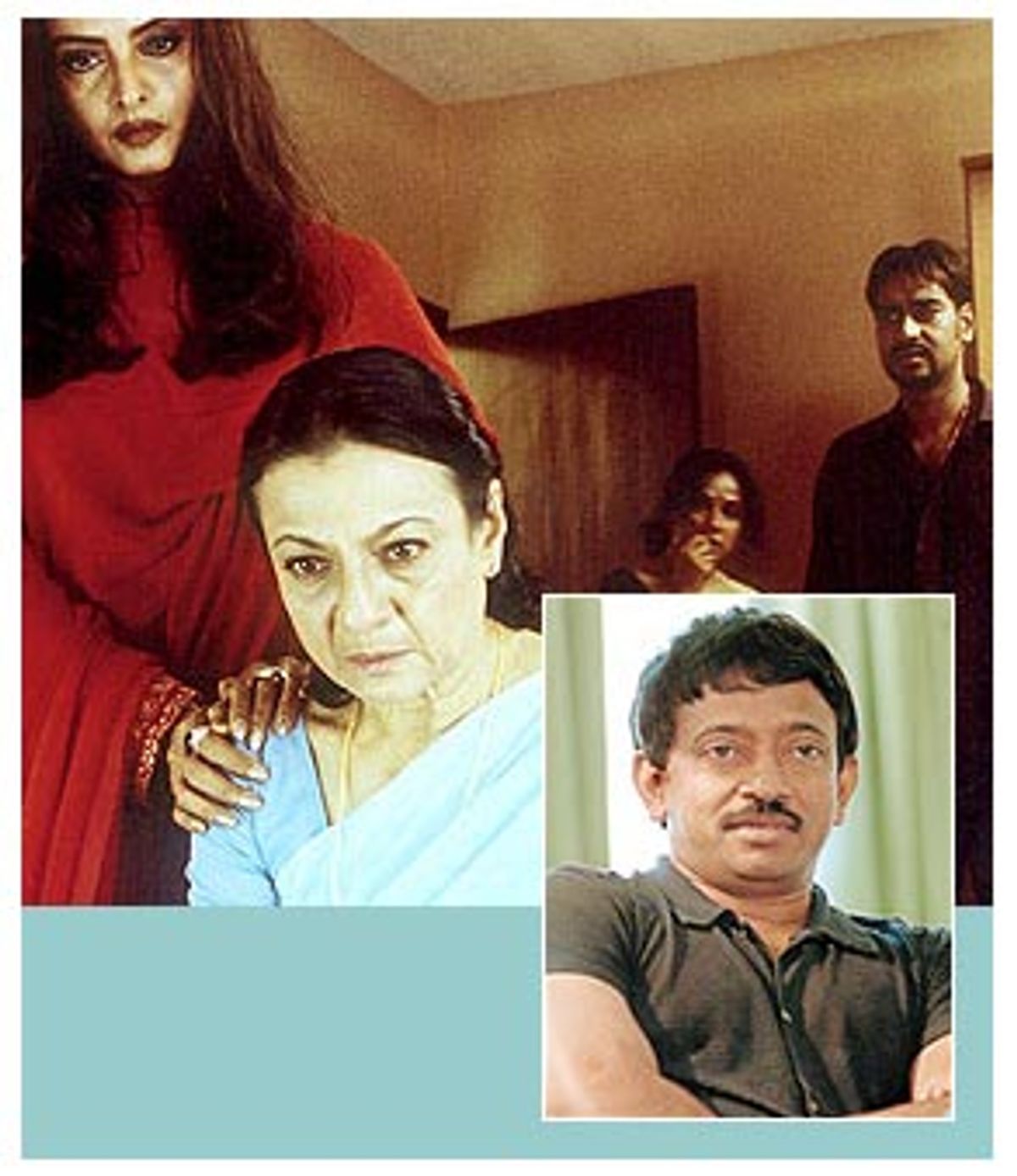
Poolside at the Sun-n-Sand Hotel, where the coolest film stars of 1970s Bollywood once hung out, a group of young, slightly nerdy Indians is guzzling beer and joking about sending Father's Day bouquets to Ram Gopal Varma. The innovative and unconventional film director, known as "RGV" to the public and "Ramu" to his fans and friends, is Bollywood's answer to Quentin Tarantino.
India's Hindi-language film industry, known internationally as Bollywood, produces 150-plus movies a year that are widely popular across South Asia, parts of Southeast Asia and Africa, the Middle East and the large Indian diaspora in the United Kingdom and North America. Varma has been thumbing his nose at Bollywood and its traditions since he entered the industry 12 years ago. In that time he has built up a band of young guerrilla filmmakers, who revere him for being the antithesis of everything Bollywood seems to stand for. He has personally directed 20 or so films (such definitions are not always clear in Bollywood) and also serves as a producer for young directors he hand-picks to work with him.
The group I'm sitting with at Sun-n-Sand, at 1 o'clock in the morning, includes Samir Sharma, the writer of RGV's latest directorial venture, "Bhoot," and American Shimit Amin, the editor of "Bhoot," who made the move to Bombay from Los Angeles when he was offered a chance to work with RGV. The song-free horror flick has scared the pants off a country that is sick of juvenile candy-floss romances, opulent family sagas about loving one's parents and terrible rip-offs of Hollywood action films.
"Bhoot" ("Ghost"), which was released in late May, became Bollywood's first real hit after a disheartening series of flops that had producers gasping for breath. Last year, the industry racked up losses of more than 3 billion rupees ($63 million) on an investment of 10 billion rupees. Only one in 25 films made a profit. So "Bhoot's" success arrived as something of a shock. Bollywood is finally realizing it doesn't have to spend millions on shooting song-and-dance sequences in Switzerland, as "Bhoot" -- set in a middle-class Bombay apartment -- has proved. The film has more than recovered the 65 million rupees it cost to produce.
People outside India are noticing. Last year, three nonresident Indian businessmen zeroed in on RGV to start a film company called Que Sera Sera Productions. Then 20th Century Fox India signed a distribution deal with RGV's Varma Corp. "Ramu is one of the few people who is up there in quality and content," says Aditya Shastri, managing director of 20th Century Fox India. "He is very progressive, which we like, and also competent and uncomplicated. He isn't convoluted like the other egotistic characters in Bollywood. He is a precious client for us."
RGV's obsession with making script-oriented, low-budget, quick-turnaround movies is unheard of in chaotic Bollywood, where films always go over budget, are always behind schedule and rely too much on overpaid stars. RGV rarely chooses huge stars to work with him. Like Tarantino, he is so confident of his scripts that he gets new actors -- or actors whose careers are on the skids -- to star in his films. In the process he has become something of a starmaker, much like Tarantino, who in "Pulp Fiction" resurrected John Travolta from Hollywood's dustbin, and in "Jackie Brown" brought Pam Grier's sexy cool blaxploitation persona to the 1990s mainstream.
Vivek Oberoi, currently Bollywood's hottest star, proved his worth in Varma's taut 2001 film "Company," about Bombay's underworld gone international. (He is currently up for a leading role in Roland Joffe's forthcoming "The Invaders.") In "Satya" (1998), another film about the underworld set at a more local level, RGV generated fantastic performances from Manoj Bajpai and J.D. Chakravarty, both until then relegated to small roles in Bollywood. Audiences went berserk over "Satya" and Bajpai began to be called "Bhikhu Mhatre," his name in the film. No such movie had ever previously been made in India.
"I had heard that someone got shot by the Mafia," says Varma, sitting in his temporary office in north Bombay. "And as people like to do, they recounted all the details of the man who was killed. How his day started, what he ate, what he was wearing, where he was going, etc. It got me thinking about the killer's day. What was that like? What did he eat or wear or do? I spoke to the police, the intelligence agencies, and I realized that they [the underworld] are like anyone else really. Something pushes them over the edge and in that sense they too are victims."
The articulate 41-year-old, who ditched his glasses and discovered the gym a couple of years ago, is a muscled, mustachioed man with penetrating eyes and a calm demeanor that belies his boundless energy. He is a pro at multitasking. In between answering my questions, he fields phone calls, sends text messages and eyeballs promotional items for his various films.
RGV loathes the namby-pamby love stories and family dramas that Bollywood churns out, so much so that he often includes cutting comments about them in his own films. In "Company," one of his characters makes a pointed reference to the Bollywood smash "Kabhi Khushi Kabhi Gham" (or "K3G"), a ghastly, opulent movie with the tag line, "It's all about loving your parents." A character in "Company" sardonically remarks, "It's all about loving your loving."
RGV says he has no interest in saccharine movies or the characters who inhabit them. "I don't want to make a 'Devdas,'" he tells me, referring to last year's big hit, probably the most expensive Hindi movie ever made, about a man so obsessed with his first love that he dies grieving because he can't have her. "I have no patience for that character," Varma snorts. "If he can't get her, he should go find someone else."
"His films are more intellectual than the others but they aren't pretentious," says film analyst Amod Mehra. "They are all different and he always tells a good story."
RGV also doesn't care about following trends. In Bollywood, where if one family drama succeeds, 20 others follow, directors and producers make all sorts of false assumptions about audience taste. "I make movies that I want to see," he says. "I'm interested in everything. Fear, desire, greed, violence. They are all present in all people and they all are an inspiration for me. Why should I assume that the audience wants just one particular kind of film? They are not cattle. Ninety-five percent of our films flop. That should tell people they know zilch about the audiences. Audiences will watch anything that entertains them."
Varma is extremely critical of Bollywood and its methods. "I think directors and producers make movies for distributors [who fund their projects] rather than for the audience. I don't. I put my money where my mouth is and don't join the bandwagon."
RGV's films follow no identifiable pattern and adhere to no template. "Rangeela" is a musical about a chorus girl with movie star aspirations who gets her big break and finds her leading man has fallen in love with her. "Daud" is a road movie. "Kaun" is a murder mystery with only three characters. "Darna Mana Hai" is an episodic supernatural thriller. "Jungle" is inspired by the case of a notorious sandalwood smuggler and "Mast" is about a young lad's obsession with a movie actress, and is loosely based on RGV's own admiration for erstwhile Bollywood superstar Sridevi.
Of his upcoming productions, "Ab Tak Chhappan" is about police "encounters" in Bombay -- a term used when specialized officers are sent to kill dangerous criminal suspects rather than arrest them -- "Nimmi" is about a child trapped in a forest, and "Chala Vinod Tiwari Film Banane" is about a small-town man who comes to Bombay with a script, hoping to make the kind of films he loves to see.
RGV is said to be stubbornly unbending with his crew. "If someone doesn't agree with him, and I don't mean just creatively, he won't drop the subject and leave it at that. He gets extremely vindictive," says a young writer who has worked on some of RGV's successful films and has vowed to never work with him again. "He has gone out of his way to fuck me up in the industry. And I am a nobody, so people will tend to believe him. He has made it personal. He calls up people I'm working for -- he's putting his finger into my projects and trying to screw things up." This writer asked not to be identified in this article.
RGV may be a "power-tripper," as one Indian newsmagazine called him, but he is also his own worst critic. He calls some of his movies "pretty lousy," but can never be accused of making clichéd films. He doesn't brood about box office failure. He learns from his flops. "I don't get emotional about these things," he says. "I hate when people call their films their 'babies.' They are not anyone's babies. I am affected by the box office only to the extent that I continue to have the freedom to make my next film. And making my films the way I want to has never been a problem. Not in the last 12 years."
This kind of dissection seems to come easily to RGV. The man lives, eats and breathes films and has been doing so, he says, since he was 8 years old. He was deeply influenced by the Hollywood films he watched in his childhood, from "Mackenna's Gold" to "The Guns of Navarone" to "The Sound of Music" to "Jaws." As a student at engineering college in the Telugu-speaking southern state of Andhra Pradesh, he took in eight to 10 films a week, with an indulgent uncle and friends subsidizing his obsession.
"I studied films in the theaters," he says. "Once, I saw a movie seven times, and the eighth time I watched it with my eyes closed so I could absorb the musical score. I knew the story, I knew the characters, but I wanted to know how the background score worked." He would narrate movie stories to his friends, but would substitute the bits he didn't like with what he would have liked to see. Often, his friends would come back to him saying they liked his version better than the movie. "Maybe it was around that time that the germ of making movies was planted in my brain. It still wasn't a conscious desire, though."
After engineering, which he failed twice -- he hated studying -- RGV started shopping around ideas for movies. "I tried to tell stories to producers but they just couldn't understand what I was talking about," he recalls, smiling perhaps a little smugly. At that time, many Indians were going off to the Persian Gulf or African countries to find better-paying jobs. The young Varma decided to go to Nigeria to make some money and finance his own filmmaking career. On the way to acquire documents for his journey, he and his friend happened to stop at a video library.
"That gave me an idea," he says. "I knew so much about movies that I thought I should open a video library that would be different." He didn't go to Nigeria, and thank God for that. At his new video store, he stocked movies that few had seen. He described them to his customers and soon he had a fan club. If he happened not to be at his store, customers would leave and return only when he was back.
In 1990, at the age of 28, Varma finally found someone who understood him: Nagarjuna, a star of Andhra Pradesh cinema. The actor loved his story for "Shiva" and decided to give him a break. RGV wrote and directed the film, despite lacking any prior experience behind the camera. "I have always believed direction is about visualizing," he says. "A director is the one who has to use the talents of the cameraman, the dialogue writer, the music director, etc., and amalgamate all the talents into a cohesive whole."
"Shiva," which was about student violence on university campuses and the nexus between the local Mafia and student bodies, broke all box office records in Andhra Pradesh. Nagarjuna's faith in Varma was justified, as the actor was catapulted to superstar status.
When Varma made it to Bollywood in the mid-'90s, people in the industry knew about him already. For his first full-fledged Hindi film, "Rangeela" (1995), he managed to cast big-name stars like Aamir Khan and Jackie Shroff. (Khan, incidentally, later became the producer of "Lagaan," the Bollywood film that was nominated for the Best Foreign Film Oscar in 2001.) "Rangeela" was a smash. Urmila Matondkar, the heroine, until then only known for her lousy hairstyles, horrific dress sense and dubious acting skills, became movie-mad India's sex symbol. Maxim magazine featured her as one of the world's sexiest women. RGV was responsible for this mind-blowing makeover.
His next directorial outing will be a big-budget international film, shot mostly in America with an American crew, and featuring Bollywood superstar Amitabh Bachchan. Did RGV feel he needed to prove he could do a big-budget extravaganza? He denies it. "This movie demands a big budget. I don't sit here and say, 'Now I want to make a big-budget film.' I don't work like that." This one too is sure to be different.
"He experiments like nobody does," says analyst Amod Mehra. "In the process he has had his share of flops, but that doesn't deter him. His style is more Hollywood than Bollywood."
One of RGV's young acolytes, 31-year-old director Chandan Arora, talks about how gutsy he is. "There are no prefixed rules or norms with him. Most people want to be safe but he wants to explore new things. He involves everyone in his project. I may be editing the film, but I have the creative space to suggest anything. Anyone working on the set can make a suggestion. As a result everyone gets involved and interested in the project."
No wonder intelligent young writers, editors and aspiring directors go to great lengths to track him down. RGV's office receives dozens of phone calls every day from newcomers wanting to pitch him ideas. Word has gotten around that he's open to suggestions from anyone in his crew, including grips, electricians, lighting technicians. Six of his seven upcoming projects as a producer are being directed by first-timers. In patronage-ridden Bollywood, Varma is the only person who gives a chance to such raw aspirants.
"Here you have to have a father, grandfather or uncle in the business to make it," says film critic Deepa Mehta. "It's great that he gives newcomers a chance."
RGV scoffs at any suggestion that he's being altruistic. "This is a mutually beneficial relationship," he says. "In fact, I can say I'm exploiting them. They are pure, uncorrupted by the industry and have passion." Varma once famously said that he is to Bollywood what al-Qaida is to America. "I was joking," he stresses. "But the point I was trying to make is that I am raising an army to put a dent in the system that makes movies like 'K3G.'"
Ramu's band of outsiders knows that and loves him for it. While I dine with some of his crew at Rain, an upscale new bar in Bombay's Juhu district frequented by Bollywood stars, a Varma Corp. executive producer comes bounding up to us with his latest tale. He claims he had RGV frothing at the mouth by suggesting he make a garish family drama like "K3G." Everyone at the table looked aghast. One said, "How could you even suggest something like that?"
The story was false, an elaborate joke. The producer guffawed into his beer for the rest of the evening. But the incident is a testament to how well RGV's 20- and 30-something protégés understand him. If he is huffy, they respond indulgently, as they would to a beloved uncle. They imitate his quirks -- like his habit of saying, "Correct, correct," if he agrees with something -- and they laugh at his paranoia when he says, "Now you can all go and sit in Barista [India's version of Starbucks] and talk about me."
He's right, of course. Nobody in Ramu's circle talks about much else.
Shares