Canada

Canada’s safe haven for junkies

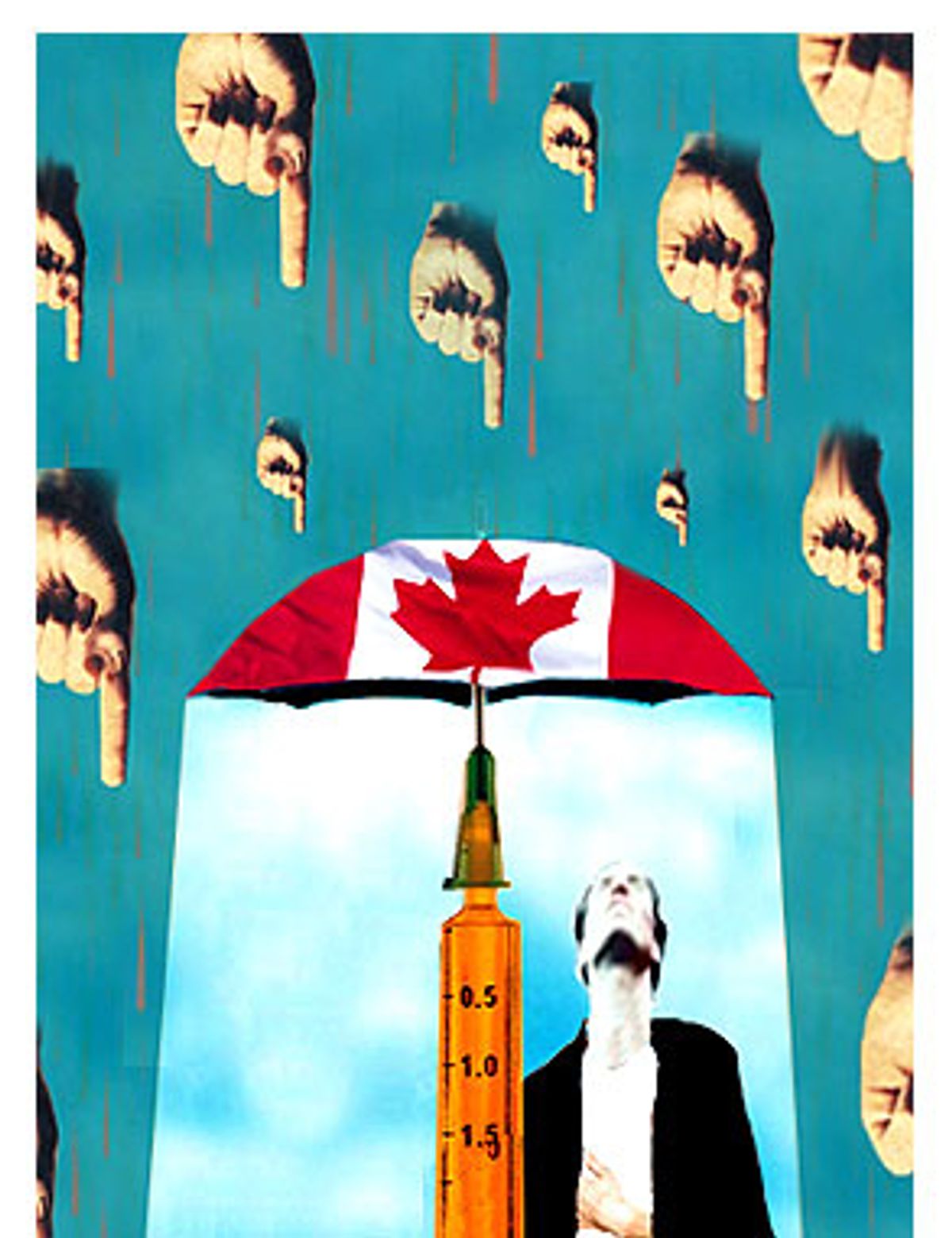
Vancouver hopes to save hundreds of lives by opening street clinics where heroin addicts can shoot up safely. But the White House is accusing Canada of going AWOL from its war on drugs.

  • more
    • All Share Services

Canada's safe haven for junkies

It’s 11 o’clock on a busy Wednesday night inside 327 Carrall St. A dozen junkies nod on ragged couches and chairs lining the downtown storefront’s cluttered front room, where one handwritten sign on the wall declares: “End the war on the poor.” The Clash rattles through a pair of stereo speakers ancient-sounding enough to be an AM radio. The occasional flare of rubbing alcohol spikes through the haze of cigarette smoke and smell of hot coffee — in the smaller back room, two or three junkies at a time inject heroin or cocaine into their veins using sterile swabs and fresh needles under the watchful eye of a registered nurse. In here they can also receive advice on vein care, skin infections and detox programs, or just temporarily escape the hustle of one of the bleakest city blocks in all of Canada.

“I can do my fix in here without getting jacked for it,” says Shelley, a young woman with dark, tired eyes. Bruised holes dot the crooks of her arms. She wears a tight white blouse, fishnets and black boots — one of the 80 percent of women who work in the sex trade among the neighborhood’s nearly 5,000 drug addicts. “People are pretty nice to each other here,” she says with a slight smile.

The 327 Carrall St. operation is illegal, but the mayor’s office has looked the other way since it opened on April 7. The guerrilla safe-injection site running here every night from 10 p.m. to 2 a.m. ensures junkies have sterile gear to shoot up with, and discourages them from fixing alone — a main contributing cause of overdose — in the festering alleys and decrepit residency motels of the neighborhood. The site is the de facto vanguard of an evolving “harm-reduction” strategy that the city of Vancouver hopes will help clean up the streets and halt a decade-long illicit-drug catastrophe that’s killed more than 2,000 via overdose and infectious disease.

Essentially, the situation here has been so bad for so long that the government is willing to help addicts plunge illegal drugs into their veins if it means stemming the greater tide of destruction. If the city’s official plan stays on track, by mid-September street junkies will be able to walk into a storefront at nearby 135 East Hastings St. almost any time of day and get high in a safe, clean facility administered by the provincial Vancouver Coastal Health Authority. It’s a prospect that’s angered conservatives from Ottawa to Washington.

For now, this makeshift site operating in privately donated space is about all the street addicts have. The slogan “Solidarity, Resistance, Liberation” is painted on a sign above the front entrance; inside the front room I’m greeted by the revolution’s unlikely leader: a 26-year-old activist wearing a baseball cap on her shaved head. Megan Oleson is a registered nurse who works in critical care at Vancouver General Hospital by day; every night she comes here to provide clean needles and advice to junkies (who must supply their own drugs), with the help of volunteers including current and ex-users. Friendly and mild-mannered, Oleson is modest about her role. She emphasizes that staffing a safe-injection site with addicts’ peers is vital to promoting its use. “They really run the site,” she says. But it’s quickly clear from the way everyone greets her that Oleson is revered by the dozens of patrons, up to 30 per night who inject drugs and another 70 to 100 who come in just for a little sanctuary. Other activists in the neighborhood say Oleson rarely sleeps, but she looks relaxed and focused — a petite Florence Nightingale with a pierced nose, red tank top and combat boots.

To Canadian conservatives, however — and to an agitated Bush administration keeping a glaring eye on ever-liberalizing Canadian social policy — Megan Oleson is more akin to Public Enemy No. 1. She’s a renegade promoting criminal behavior and the decriminalization of hard drugs — the patron saint of a policy that would nurture chronic abuse, the further decay of city neighborhoods, and capitulation in the long, hard-fought war on drugs. And Washington may have good reason to fear what’s happening in Vancouver: If the new policy, planned and fought for at the local level, indeed proves effective, other North American cities troubled by throngs of drug addicts — Seattle, San Francisco and New York — may be eager to follow.

Vancouver’s bold strategy has further provoked the Bush administration, which recently has watched Canada sanction gay marriage and close in on federal decriminalization of marijuana. The prospect of government-backed hard-drug use next door has the White House palpably unsettled: As soon as Vancouver’s planned site gained Canadian federal approval in late June, U.S. drug czar John Walters went off. “It’s immoral to allow people to suffer and die from a disease we know how to treat,” he told the Associated Press. “There are no safe-injection sites,” he added, calling the policy “a lie” and “state-sponsored personal suicide.” David Murray, special assistant in the U.S. Office of National Drug Control Policy, told the Vancouver Sun on May 2 that likely “unintended consequences” of the safe-injection site could force the U.S. to tighten border controls to prevent increased drug trafficking. That could, of course, negatively impact trade of all sorts.

All of which bounces off Megan Oleson. “There’s really nothing radical about this place,” she says, once things slow down and we’re able to go into the less-crowded back room to talk. “It’s highly practical. Safe-injection sites are first-contact work at the ground level. I do about two or three referrals every night to shelters, to places that offer detox and prevention, and to recovery homes.” At a nearby table partially curtained off with a sheet, a young woman licks her lips as she cooks a shot of heroin, her face knotted with anticipation. “The reality of it,” Oleson continues, “is that for those who want to break away from the hustle of the street, and many of them do, this gives them time to think about it, and to have someone to talk to.”

She keeps a nonchalant eye on the junkie, who now has a skinny rubber tube cranked around her left bicep. The woman finds the swollen vein on her forearm, slides the needle in and presses the plunger down. Oleson quietly notes her good technique; uninformed junkies often jab needles into their arms, legs or neck, causing abscesses and other skin problems. The woman tilts her head back against the wall, eyes closed, her face dropping. “Drug users and people in poverty deserve dignity and help,” Oleson says.

As we exit through the front room for a quick walk to the corner store, Oleson notes that the rules at 327 — no fighting, no dealing, no unsupervised fixing — are set by the users themselves. “There’s nothing better than people determining their own health needs, right?” she asks. Looking around at all the nodding faces tinged with easiness and pain — many of them Asian, black or indigenous, most of them impoverished — it’s a tough question to answer.

Since 1993, greater Vancouver has seen an awful share of the needle and the damage done: an average of 147 overdose deaths annually among an estimated 12,000 injection users of heroin and cocaine. At first, the long-term drug crisis is hard to fathom amid the picturesque landscape: a prosperous city ringed by lapping bays, green forests and mountains; home to a vibrant, polyglot community of almost 2 million still riding the rush of a successful bid for the 2010 Winter Olympics.

But detour into the roughly 10 blocks of the notorious downtown Eastside and the lush environs give way to the stench of urine, piles of trash, and discarded needles. The neighborhood’s boarded-up storefronts, few dingy bars and numerous flophouses give no clue that the tourist-friendly Gastown and Chinatown districts are close by. Infectious disease has swept through a desperate populace of back-alley users commonly preparing fixes with dirty needles and puddle water — more than 30 percent have HIV and 90 percent hepatitis C. Fearful of law enforcement and street thugs, some hurried addicts use their own blood to dissolve powdered narcotics for injection. The concentration of poverty scattered around the open drug scene’s epicenter at Main and Hastings — known locally as “pain and wasting” — was recognized by the 1996 Canadian census as the poorest neighborhood in the nation. By 1997, with hundreds of deaths on the downtown streets, city officials had declared an epidemic.

According to Dr. Evan Wood, an epidemiologist at University of British Columbia, an abundance of cheap drugs and acute poverty underwrite the ghetto of despair. Displacement due to law-enforcement patterns and “ridiculously underfunded” addiction treatment exacerbate the problem.

“The only really effective way to deal with the drug crisis is to get at the demand side,” says Wood, who also conducts leading HIV/AIDS research at St. Paul Hospital in Vancouver. “But there’s a five-day waiting list to get into detox, and you have to phone every morning to keep yourself on that list.” It’s a striking state of affairs, given Canada’s reputation for providing a vast social safety net. With nowhere to turn, most addicts choose to inject — the fastest and cheapest way to get high — regardless of the health dangers.

The first of its kind on the North American continent, Vancouver’s official safe-injection site will be a proving ground for the city’s ambitious “Four Pillars” drug policy. The strategy also calls for greater treatment and prevention programs, and vigorous law enforcement targeting dealers — but not addicts, whom the policy says should be treated as a health problem. At an annual cost of about $2 million (Canadian), the site will offer 12 injection stations, a medical emergency room, counseling offices, and a “chill-out” room where users can socialize or simply relax after their latest fix, according to Viviana Zanocco, a spokesperson for the Vancouver Coastal Health Authority.

Although illicit-drug use inside the site will be permitted by special federal exemption, defining a boundary for street enforcement may remain tricky. “One Catch-22 is that people will still have to purchase their illicit drugs from somebody,” says Zanocco. “How does the site work if people are too scared to go in because they’re afraid the police will be standing outside the door? It’s a struggle, I admit it. We’re working with the police department on a strategy.”

“This is a health problem, not a criminal problem,” says Vancouver Mayor Larry Campbell. Like many other Canadian officials, Campbell appears unfazed by Washington’s rhetoric. “We have conservatives in Canada, too, and they won’t look at fact or reason either,” he says flatly. “I’ve been to Zurich [Switzerland] where they had a problem way worse than ours, and I’ve seen the results.” The harm-reduction component of the widely endorsed plan — Mayor Campbell was voted into office in 2002 promising to implement it — is modeled after programs in Europe and Australia, which have dramatically reduced overdose deaths and the spread of disease.

Though Canada is tagged a firebrand of progressive social policy next to the U.S., it, too, has long fought a supply-side war on drugs. Almost 95 percent of the roughly $500 million spent annually on Canada’s drug strategy goes toward efforts to reduce the illicit drug supply. But that paradigm may be cracking now, due in part to the dire situation in Vancouver, and some leading-edge research at University of British Columbia.

With an in-depth study of the city’s injection drug users already in progress, Evan Wood and his colleague Dr. Martin Schechter, head of UBC’s epidemiology department, were able to measure the impact in late 2000 of a seizure of 220 pounds of heroin — the single largest drug-enforcement win in Canada’s history. Following more than 120 addicts during the months before and after, the researchers reported that “the massive seizure appeared to have no impact on injection users or on the perceived availability of heroin.” In fact, the study found that the median price of heroin in Vancouver dropped 20 percent following the seizure, with no change in purity, suggesting an even more saturated supply. Separate research showed the number of fatal overdoses actually ticked higher in the following months.

Wood and Schechter also cite a 2001 United Nations report indicating that only 5 percent of the global illegal drug flow is successfully thwarted by law enforcement. Still, the problem isn’t on the enforcement front lines. “The responsibility lies with the politicians and policymakers who continue to direct the overwhelming majority of resources into failing supply-reduction strategies, despite the wealth of scientific evidence demonstrating their ineffectiveness,” they write. “Our strong consensus [is] that curbing HIV and overdose epidemics requires a shift toward prevention, treatment and harm reduction.”

The devastation visible on Vancouver’s downtown streets leaves little doubt that the war on drugs has failed here. But working with an inherently unstable clientele of street junkies, there are no guarantees harm-reduction measures will succeed. Coaxing marginalized addicts to embrace an official safe-injection site could prove difficult — let alone making the site an effective stepping stone to detox and rehabilitation.

“I used to break into cars all the time, anything to get another fix,” says Robert, a jittery 37-year-old junkie in shorts and a tattered T-shirt who asks me for 15 cents at the corner of Abbot and West Pender. It’s early afternoon and a couple of businessmen in suits whisk by; normal commercial activity and the hardcore street hustle blend with a strange ease on this block. Robert’s fingertips are blackened, and scabby holes pock the backs of his hands, his forearms and the sides of his neck. He says he’s heard about the coming safe-injection site, but quickly adds, “I don’t shoot no more.” We go into the McDonald’s on the corner, where he pays the few extra cents he needed for his order: two strawberry sundaes, with extra peanuts. “I think that site is a foolish idea,” he says, repeating unconvincingly that he’s been clean for three months.

Back outside at the bus stop, Robert greets a young addict named Jasmine, then sits down to eat. He keeps glancing across the street, where a couple of prostitutes work the corner in broad daylight, a pimp-dealer type lurking close behind. “You don’t think I’m going to be on heroin do you?” he says, jiggling on the bus stop seat. “I’m not ever going to be a junkie again. Never.”

Angelic-faced Jasmine says the site wouldn’t get her off the street. “When you have to fix, you do it wherever you want. You won’t wait to go to some other place.”

“Yeah, you just go around the corner,” Robert exclaims.

“Think about it, people that fix coke get so retarded,” Jasmine chimes. “You think they’ll really stay inside there? They’re gonna boogie straight out the door all jacked up!” she laughs.

“Yeah, tear up … start ripping the carpets up!” laughs Robert. His face goes flat again. “It’s like a stupid joke,” he says, shaking his head.

But the site is a grave matter for Ann Livingston of Vancouver Area Network of Drug Users, an activist group working out of a ragtag office just down the block at 50 East Hastings St. The city’s harm-reduction plan has wound through six years of study and debate, with the new safe-injection site promised over a year ago. “Just what really is a public health emergency?” implores Livingston, who helped set up the guerilla site at 327 Carrall. “It’s a really vicious, violent thing to leave in place, while people diddle around and argue about protocols and funding. It verges on criminal negligence to stand by and watch a group of people year after year when you can predict extremely accurately how many will get HIV/AIDS, and how many will die.”

The activist group, made up of hundreds of current and former addicts (Livingston herself is not a drug user), hasn’t waited around. It runs nightly “alley patrols,” and now distributes 1.5 million clean needles per year, according to Livingston — that’s roughly half the 3 million given out annually in Vancouver, which has the largest needle exchange in North America.

“We have a really long way to go,” agrees Fiona Gold, a “street” nurse at the nearby office of the B.C. Center for Disease Control. Gold oversees CDC outreach in the Eastside. “I’ve told far too many people here they’ve tested positive for HIV. It’s just nuts. We really have to do something different.” According to the latest Vancouver drug use epidemiology report, injection drug use was the predominant mode of HIV transmission in B.C. from 1994 to 2000. A 1997 study of more than 1,400 Vancouver needle users revealed an HIV infection rate of 18 percent — the highest level anywhere in the developed world. Since 1997 the number of new cases in the city has dropped significantly, but the report suggests that decline may be due to a “near saturation” of the addict population considered most prone to infection.

Conservatives, Gold also points out, should be equally invested in the harm-reduction strategy — especially those who are fiscally conservative. Every HIV-infected addict dropped into the healthcare system costs the Canadian government an average of $150,000 in long-term care; the cost of 12 such patients would pay for the new site to run for a year, she says.

Gold introduces me to Earl Crow, a middle-aged ex-rocker from southern California with stringy blonde hair, dark brown eyes and a humble smile. He tells me how he came to Vancouver four years ago hooked on speedballs, a potent mixture of heroin and cocaine. “I was really wired, I was shooting a gram a day,” he says. But he made the decision to clean up, joined Vancouver Area Network of Drug Users in 2000 and became its president for the next year and a half. He now works outreach for the CDC in the Eastside, giving out information and clean needles, and watching for medical emergencies in the back alleys — sometimes putting in 12-hour days.

But he also knows the daunting odds harm-reduction tactics must overcome. “When I was using there wasn’t a fucking person in the world who was going to come and save my life,” he says. “It had to come from my own heart and head.”

Crow agrees to take me around with him, and we head up Powell Street to nearby Oppenheimer Park. The mild afternoon and oasis of grass belie the park’s reputation as a drug-dealing hub; at night, Crow says, it’s one of the city’s most dangerous spots. We run into a young addict named Michelle who says she’s been in the neighborhood for 15 years, and we talk as she hurries us down the block. We reach the local welfare office and she darts inside. “She’s all jumpy like that because she’s been up for a few days,” says Crow. “The beginning of the month is tough. It gets busy for us out here because people binge.” He adds that some healthcare workers are worried the new safe-injection site could become a “revolving door” for addicts who inject coke, a much more fleeting fix than heroin. “Some of them whack 20 or 30 times a day,” he says.

Michelle comes back out, check in hand, and as we hustle back toward Oppenheimer Park, I ask her what she thinks about the coming site.

“Maybe it’ll work, but not if you have to go through all the nurses and a bunch of forms and shit. You’ll be withdrawn by the time you can get a fix,” she says, skipping along. “And it won’t work if it’s all super-clean and they’re gonna freak out if there’s one little drop of blood on the floor.” At the corner of Jackson Street, she spots who she’s looking for and flits off across the block.

For more than a decade, harm-reduction programs in Europe have produced compelling results. In Zurich, Switzerland, many streets that were once needle-littered and crime-ridden are no longer so forbidding. And since the country’s first safe-injection site opened in 1986, there hasn’t been a single fatal overdose at any of the 13 sites operating across three Swiss cities, according to the U.S.-based advocacy group Drug Policy Alliance. Frankfurt, Germany, a city with population and drug-user demographics similar to those of Vancouver, opened five sites beginning in 1994; fatal overdoses there declined from 147 in 1991 to 26 in 1997, and the spread of HIV among drug users declined dramatically as well.

Studies of the European programs show less clear results, however, in battling long-term addiction. Though conservatives often denounce harm-reduction policy in strictly moral terms, such mixed results may be enough to arm the policy’s opponents with a more practical argument: that chronic junkies pose a greater criminal threat than a public health one.

“To many harm-reduction advocates, heroin use is a practical [health] problem, but that’s not a plausible view if you live in a neighborhood where drug addicts steal your television set,” says Mark Kleiman, a drug policy expert and professor of public policy at University of California Los Angeles. “Ask people living in those neighborhoods if they want a safe-injection site next door, and they will say — perfectly reasonably — no.” In fact, notes Kleiman, many harm-reduction supporters themselves get caught up in an ideological battle against the conservative crusade. “As a result,” he says, “I don’t think they take into account all the possible consequences of harm-reduction measures.”

But the Canadian federal government appears convinced of the potential benefits; it’s promised $1.5 million to fund research at the pilot site, and if the site proves effective, several more could follow in the Vancouver area and in other cities facing illicit-drug problems, including Winnipeg and Toronto.

Urban hard-drug havens in the U.S. could be next. According to a New York Times report on Aug. 11, New York City is estimated to host a staggering 200,000 heroin addicts — more than 16 times the number in Vancouver, and 20 percent of the nearly 1 million addicts living in the U.S.

“It’s certainly reasonable to expect that if this is successful in Canada, that some people will want to imitate it here,” says UCLA’s Kleiman. The prospect of entering uncharted legal waters may be another reason Washington conservatives are sounding a defiant note. “It’s unclear to me whether or not current federal law would forbid a safe-injection site,” says Kleiman. “It’s not at all obvious to me that it would, because the site does not provide illicit drugs. There’s no doubt that those who want to keep U.S. drug policy very supply-reduction focused feel threatened by this.”

Mayor Larry Campbell, who first saw the Vancouver drug crisis blooming while working as a narcotics officer three decades ago, says that becoming B.C. chief coroner in 1996 galvanized his view of harm-reduction policy. “When you’re going into a room every day and there are two people dead with needles still in their arms, you know the status quo isn’t working,” he says. “I went from being an enforcement officer to one whose major job was to prevent death. Hopefully this policy will do that, and prevent disease, and will give us back the heart of our city.”

But conservatives also argue that the positive results of harm-reduction programs overseas may not translate across different cultures or cityscapes. “I think there are far more serious difficulties with the Swiss model than have been acknowledged,” David Murray of the U.S. Office of National Drug Control Policy, a social anthropologist by training, told the Vancouver Sun in May. “My impression is that the presumed benefits will turn out to be illusory.” Enabling addicts to pursue their habit, conservatives say, will inevitably boost neighborhood crime and deepen urban decay.

“It is possible safe-injection sites are a good idea,” says UCLA’s Kleiman. He points to the success of needle exchange programs in promoting drug use abstinence, though he stops short of the controversial heroin distribution plans that the U.K. and others have tried, with mixed success, in the past. “But purely from an economist’s point of view,” he says, “a safe-injection site makes being a drug user easier, and one would expect that to lead to more people becoming drug users and staying drug users.”

“This isn’t a game I’m playing where we win or lose, it’s peoples’ lives,” says Mayor Campbell. “If it doesn’t work, we’ll try something else, but we know that pure enforcement doesn’t work. Remember, I’m an ex-narc and I have many friends in the DEA and FBI. The fact of the matter is, the most compelling reason to do this is the U.S. system — just take a look at your jails. Prisons are a growth industry in the United States, and a vast majority are in there for drugs, of some form or another.” Indeed, more than 70,000 inmates, or roughly 55 percent of the U.S. federal prison population, are currently locked up for drug offenses, according to the Federal Bureau of Prisons. “People don’t come out rehabilitated, and the drug and health problems aren’t dealt with,” says Campbell. “We’re simply trying to move beyond outdated laws.”

Evan Wood of University of British Columbia further points to a study published by his colleague Dr. Mark Tyndall in the April 2003 scientific journal of the International AIDS Society, which concludes that jailing addicts actually worsens the HIV epidemic. Tyndall’s study shows that Vancouver injection drug users incarcerated over the prior six months faced nearly triple the risk of HIV infection. “We know HIV spreads very rapidly among addicts in prison, where they’re sharing rigs,” says Wood, affirming that illicit drug use on the inside is indeed commonplace. “I go to many [international] public health conferences … and my understanding is it’s no different in the U.S.”

Standing in the pleasant salt breeze of the city’s trendy Yaletown neighborhood, former Vancouver Mayor Philip Owen explains why he defied all expectations and made harm-reduction policy an emblem of his nine-year career in office. Owen served from 1993 with the backing of the conservative Non-Partisan Association until the party dumped him from its 2002 election ticket. He was instrumental in setting the four-pillar drug strategy in motion in 1997. Owen says his perspective began to shift when a wave of crack cocaine hit the streets in 1996, and he made several trips to the Eastside to observe the growing problem. “I got to know some of the people there. It was quickly obvious: The user is sick and the dealer is evil,” he says. “What are you going to do? Lock up a 16-year-old girl who’s selling her body because she needs dope? You have to lock up the dealers and treat the addicts.”

Dressed in a crisp button-down shirt and khakis, the now-retired Owen is more diplomatic than polemical — until the discussion shifts to Washington. “In the State of the Union address, George W. said his approach to the narcotics problem is to prevent importation, and to treat those who are addicted.” Owen claps boisterously. “Wonderful! Then do it! The problem is, the U.S. hasn’t done it for 30 years and it’s just bullshit to cloud over a serious issue like this. They haven’t stopped the importation — they can’t — and the consumption is rampant as can be. So that’s just fine: Keep flying your planes over Colombia, Turkey and Afghanistan, and burning crops and blowing planes out of the sky,” he fumes. “It isn’t working and we can’t wait at the city level because we’ve got destruction here. And it’s in Seattle and Portland and San Francisco and New York. We have to deal with this at the street level, so don’t come here and criticize us.”

UCLA’s Kleiman offers a bit more tempered advice for a displeased Bush administration.

“A really sensible U.S. government might say to Canada, ‘We think this is a really dangerous experiment, but if you’re crazy enough to try it in your neighborhood, God bless you, and we’ll watch,’” he says. “A scientific view of drug policy would say, ‘Here’s an opportunity for us to learn something.’ Of course, that’s not what I expect to see from Washington.”

For Megan Oleson, such debate is almost beside the point. A little before 1 a.m., Oleson and I are sitting on a bench in Pigeon Park, a dreary cement strip on the corner a half block from 327 Carrall. The street hustle is going strong: people dealing, smoking, drinking and using, several homeless people sleeping on the pavement. “A lot of institutions and healthcare workers claim they understand harm reduction,” Oleson says, “but in the end you’re challenging a lot of stigmas. You get these people parachuting into ghettos, who don’t really care what people’s health needs are.”

Still, it seems dubious to assume all these despairing people could rescue themselves.

When we walk back inside 327 Carrall the relative calm is striking, though it’s still plenty busy an hour before closing time. Some addicts sit drinking coffee, some nod off. A couple of others are pacing, anxious to get through the door into the back room.

It’s not hard to imagine the look on John Ashcroft’s face, were he to walk inside this place. Yet, not one person has died here since the site opened over four months ago — even as a couple of people per week are pulled off the nearby streets in body bags.

“I’m here because I hate seeing my friends inject in the alley,” Oleson says. “I hate going to fucking memorial services because people go to their hotel room and OD because they’re alone.”

She heads for the fixing room, pausing to greet a couple of familiar faces before she gets back to work.

Mark Follman is Salon's deputy news editor. Read his other articles here.

Quebec students mark 100 days of tuition protests

Tuesday's protests came on the heels of a new emergency law that aims to to limit public protests

  • more
    • All Share Services

Quebec students mark 100 days of tuition protestsThousands of protesters march through the streets of Montreal in a massive demonstration against tuition fee hikes on Tuesday, May 22, 2012. (AP Photo/The Canadian Press, Ryan Remiorz)(Credit: AP)

MONTREAL (AP) — Tens of thousands of students marched through the streets of Montreal to mark 100 days since the movement against higher tuition fees began. Tuesday’s protest came after Quebec’s provincial government passed emergency legislation intended to end Canada’s most sustained student demonstrations ever.

The peaceful protest turned more violent in the evening as demonstrators set off fireworks and threw beer bottles at police. Riot police responded with pepper spray. Police spokesman Simon Delorme said at least 100 people were arrested. Two police officers were injured, and four people were taken to the hospital. The extent of their injuries was not immediately known

Since the emergency law was passed Friday, nightly protests have often turned violent, resulting in some 300 arrests Sunday alone. The new law requires that a detailed agenda be provided for protests of more than 50 people.

Police declared the Tuesday night protest illegal after no one provided an itinerary. “They didn’t share the route, demonstrators were wearing masks and projectiles were thrown at police officers,” the Montreal police said on their Twitter feed.

Student groups have vowed to challenge the emergency legislation in court. Rights groups say the law limits protesters’ ability to express themselves democratically.

On the eve of Tuesday’s protest, the most militant of three major student groups said it would defy the new law and call for protests and strikes to continue throughout the summer, a busy period of outdoor festivals in Montreal which draws in millions of dollars in tourist revenue.

Quebec Premier Jean Charest has refused to roll back the tuition hikes of C$254 (US$249) per year over seven years. Quebec has the lowest tuition rates in Canada, and they would remain among the country’s lowest after the increases.

The conflict has caused considerable social upheaval in the French-speaking province known for having more contentious protests than elsewhere in Canada.

Continue Reading Close

Ontario legalizes brothels

In an effort to protect prostitutes, the Canadian province's top court strikes down some restrictions on sex work

  • more
    • All Share Services

Ontario legalizes brothelsSex workers listen to a presentation at the 16th International AIDS conference in Toronto (Credit: Reuters/JP Moczulski)
This article originally appeared on GlobalPost.

Ontario’s top court has legalized brothels in the Canadian province, a ruling that is meant to protect the safety of sex workers.

Global PostThe landmark decision taken Monday, decided that the dangerous work of prostitution could be made more safe if it occurred under one roof with security staff, reported the Globe and Mail.

The Appeals Court of Ontario said that some of the country’s anti-prostitution laws were unconstitutional as they restricted the prostitute’s ability to protect themselves — a ruling already made by a lower court in 2010 but appealed by the provincial and federal governments.

The court also said that it would re-model the law against pimps, which prohibits living off the work of others by adding “in circumstances of exploitation,” reported PostMedia News.

This is thought to allow violent or manipulative pimps to be arrested, while permitting prostitutes to be able to hire drivers and security staff for their safety.

Prostitution is legal in Canada with many caveats.

According to the Associated Press, while sex work might be legal, soliciting sex and operating a brothel are both criminal acts.

While the latter provision was struck down, the court upheld the ban on soliciting sex in public.

According to the National Post, the new laws will likely prompt similar challenges in other provinces around the country.

The case was brought forward by an appeal by the provincial and federal governments, which opposed the earlier lower court ruling.

The case took nine months of deliberation and a week of oral arguments with more than 25,000 pages of evidence, according to the National Post.

Witnesses at the hearings included current and former prostitutes, police, activists, politicians and journalists.

Both sides said they will take their case to the Supreme Court of Canada if they lost.

The new laws, which will be binding in Ontario, will come into effect next year.

Continue Reading Close

Canada’s other pipeline project

After Keystone, Prime Minister Harper fights to keep the U.S. out of the Alberta oil sands debate

  • more
    • All Share Services

Canada's other pipeline projectCanadian Prime Minister Stephen Harper speaks at the White House complex in Washington, Wednesday, Dec. 7, 2011 (Credit: AP Photo/Carolyn Kaster)
This article originally appeared on GlobalPost.

TORONTO, Canada — Prime Minister Stephen Harper has lashed out at American groups opposed to a pipeline that would allow oil from Alberta’s tar sands to be shipped to Asian and U.S. markets.

Global Post

Harper capped a week-long attack on U.S. environmentalists with a nationally televised interview Monday night, essentially telling American opponents of the proposed pipeline to butt out of Canada’s affairs.

The 731-mile Northern Gateway pipeline would run west from the massive oil sands deposits of northern Alberta — across pristine wilderness and more than 700 rivers and streams — to a proposed supertanker port on the Pacific coast of British Columbia.

Harper accused American groups of hijacking public hearings by a federal regulatory agency, which is assessing the environmental impact of the $6.6 billion pipeline project. Decisions on the development of Alberta’s oil sands should be left to Canadians, he said.

In an interview with the CBC, Canada’s publicly-funded broadcaster, Harper ridiculed U.S. environmentalists: “Certain people in the United States would like to see Canada be one giant national park for the northern half of North America,” he said.

More than 4,000 people have registered to have their say at the National Energy Board’s hearings. In earlier statements, Harper criticizing what he said was “the use of foreign money to really overload the public consultation phase of regulatory hearings just for the purpose of slowing down the process.”

Harper’s Conservative government is determined to find more markets for northern Alberta’s oil sands — tar-like bitumen deposits that cover an area the size of Florida.

Quick approval of the Gateway project became more urgent for the government after the U.S. postponed a decision on a different pipeline, KeystoneXL, proposed to deliver Alberta’s tar sands oil to refineries on the U.S. Gulf Coast. On Wednesday, President Barack Obama denied a permit for that pipeline, according to Bloomberg News, but said the company could refile if it came up with a more environmentally sensitive plan.

Environmentalists on both sides of the border want to stop Alberta’s booming oil-sands development. They denounce it as “dirty oil,” noting it comes from massive open-pit mining that fells huge swaths of forests, produces millions of gallons of toxic sludge, and increases Canada’s greenhouse gas emissions.

With the Gateway project, they also point to the dangers of oil spills, either though pipeline ruptures or supertanker accidents. To reach the proposed port at Kitimat village, supertankers would need to navigate through 186 miles of island-dotted channels and fjords, and waters known for storms, fogs, and strong tidal currents. The proposal would lift the moratorium on oil tanker traffic on the coast of British Columbia, and 200 supertankers a day would make the challenging journey to Kitimat. The pipeline would transport 525,000 barrels of thick oil daily.

Last week, Harper’s Natural Resources Minister, Joe Oliver, slammed “environmental and other radical groups that would seek to block this opportunity to diversify our trade.”

“These groups threaten to hijack our regulatory system to achieve their radical ideological agenda,” Oliver wrote in an open letter. “They use funding from foreign special-interest groups to undermine Canada’s national economic interest.”

“We think decisions about these Canadian projects should be made by Canadians,” Oliver added in an interview with the Globe and Mail. He also took a swipe at “billionaire socialists … people like George Soros.”

Harper’s spokespeople specifically pointed fingers at the Washington-based National Resources Defense Council, whose advisory committee includes actors Leonardo DiCaprio and Robert Redford.

The government has been silent, however, about strong opposition to the pipeline from many of B.C.’s aboriginal leaders, who fear oil spills will ruin the livelihoods of their communities. The pipeline is projected on land claimed by B.C.’s First Nations.

The federal government’s outburst against “foreign intervention” was widely denounced. Even the staid Globe and Mail, which supported the Gateway pipeline in an editorial, criticized the Harper government for spewing what “almost sounds like anti-Americanism.”

Many accused Harper’s government of hypocrisy. They noted that Harper, his ministers, and Canada’s ambassador to the U.S. intervened in the U.S. debate about KeystoneXL, doing all they could to get the pipeline to the Gulf Coast approved. Likewise, Canadian companies spent millions of dollars trying to influence U.S. public opinion on Keystone, including the hiring of high-priced American lobbyists.

To then accuse others of foreign intervention in the Gateway debate struck one leading Canadian columnist as “a bit rich.”

Besides, when it comes to foreign interests, none are more powerful than the oil companies lined up to back the Gateway project at the regulatory hearings — China’s SinoCanada Petroleum Corp, Britain’s BP, America’s Exxon Mobil, France’s Total E&P, and Japan Canada Oil Sands Ltd.

Large sums of foreign money are also funding the pro-pipeline lobby. Enbridge Inc., the Calgary-based company proposing the Gateway pipeline, has a $100 million fund from multinational corporations to promote the project, including $10 million from Sinopec, the state-owned Chinese oil company.

“Multinational oil companies are hijacking Canadian’s ability to decide their energy future,” NRDC director Susan Casey-Lefkowitz wrote in a recent blog post defending her U.S.-based group’s efforts against Gateway.

Relations between environmentalists and the Harper government have always been strained. War was essentially declared when the government announced last December it would pull out of the Kyoto Protocol, the international treaty to reduce CO2 emissions. Alberta’s controversial oil-sands development has become the main battlefield.

Continue Reading Close

Big Oil and Canada thwarted U.S. carbon standards

Emails show how a Washington lobbyist enlisted Canadian officials to beat back U.S. carbon standards SLIDE SHOW

  • more
    • All Share Services

Big Oil and Canada thwarted U.S. carbon standards Canadian diplomat Gary Mar and oil industry lobbyist Michael Whatley (Credit: Reuters/Ken Durden/republicanconference)

READ THE EMAILS: Selected messages from an oil industry lobbyist to a Canadian diplomat

When President Barack Obama decided in early November to delay a decision on TransCanada’s Keystone XL pipeline until after the next election, America’s environmental movement celebrated one of its biggest victories in recent memory. And no doubt the news came as a blow to Alberta’s tar sands industry, and to Canada’s oft-stated dream of becoming the next global energy superpower.

But behind activists’ jubilation lurked a somber reality, an untold story with much wider implications. The broader fight to reform Alberta’s tar sands, the one which actually stood a chance of breaking America’s addiction to the continent’s most polluting road fuel, has been quietly abandoned over the past several years. For that we can thank the planet’s richest oil companies and their Canadian government allies, who’ve together waged a stealthy war against President Obama’s climate change ambitions.

Their battle-plan is revealed in more 300 pages of personal emails obtained through a Freedom of Information request to the Alberta government. The story in the emails, reported for the first time here in Salon and The Tyee, Canada’s leading independent online news site, traces a year in the relationship of Michael Whatley, a GOP-connected oil industry lobbyist and his friend, Gary Mar, a smooth-talking and ambitious diplomat at the Canadian embassy in the Washington, DC.

The messages lay bare a sophisticated and stealthy public relations offensive, one designed to manipulate the U.S. political system; to deluge the media with messages favorable to the tar-sands industry; to sway key legislators at state and federal levels; and most importantly, to defeat any attempt to make the gasoline and diesel pumped everyday into U.S. vehicles less damaging to the climate. The goal of it all? “Defeat” Obama’s effort to reduce carbon consumption and keep America hooked on Canada’s $441 billion tar sands industry, no matter what the cost to our planet’s future.

That campaign has largely succeeded too, with only a small group of players any the wiser.

On Pennsylvania Avenue

Perhaps the best place to start is on December 30, 2009. It was a bad day for Michael Whatley, founding partner at a K-Street consulting firm in Washington called HBW Resources that has close ties to Alberta’s tar sands industry. The reason: 11 Northeast and Mid-Atlantic governors had agreed in writing to consider adopting one of the planet’s most forward-looking climate change policies, something called a low-carbon fuel standard. Whatley thought his friend Mar would be interested. “Please let me know your thoughts,” Whatley emailed him.

The world’s very first low carbon fuel standard was adopted by California in 2007. It’s a complex climate change policy based on fairly simple logic. If global warming is to ever get solved, it will mean radical changes to the transportation sector, right now the second-biggest source of carbon emissions, after electricity generation, in the U.S. economy. Many of that sector’s emissions are pumped directly out of vehicle exhaust pipes. But the actual industrial process of extracting energy from the ground, and then refining it into road fuel, also releases vast amounts of carbon.

The goal of California’s low carbon fuel standard, and others like it, is to reduce these so-called “upstream” emissions, thereby making every gallon of gasoline, diesel or biofuel pumped into an automobile 10 percent less damaging to the climate.

The Northeast and Mid-Atlantic governors had signaled their support for such a policy in the final days of 2009. Rising levels of greenhouse gases, they declared in their individually signed Memorandum of Understanding, “pose serious risks” to human health, the environment and the global economy. They went on: “Developing alternatives to our continued reliance on petroleum-based fuels will foster economic growth and enable increases in fuel security and reliability.”

Whatley interpreted this document as a dangerous attack on the oil and gas companies he helped represent. The very next day he fired off an urgent email to Mar, who had an office in the mammoth modernistic Canadian embassy on Pennsylvania Avenue.

The governors’ plan, Whatley wrote, warrants “a very serious response on all levels.”

“As we have discussed, this fight cannot take place within DC — and we need to get a team funded and on the ground in these 11 states as soon as possible,” he wrote.

Less than a month later, the scale of that assault would grow larger still, when Whatley and Mar declared war on every low carbon fuel standard then under consideration in America. They had reason to worry. Certain road fuels would obviously fare much worse than others under a California-style standard, chief among them anything produced from Alberta’s tar sands. The province’s sprawling strip mines and toxic tailings ponds help result in a carbon footprint 23 percent bigger than most conventional oil operations, according to a recent Stanford University study.

The upshot is that any state or region considering a low carbon fuel standard could become a much more difficult place for the tar sands sector to sell its products. If ever adopted by the United States nationally, such a policy might devastate the Alberta-based industry, a 2010 Ceres-RiskMetrics report concluded. “The U.S. transportation market could conceivably disappear” for those firms.

With so much at stake, Whatley and Mar, the lobbyist and the diplomat, developed what amounted to a declaration of climate policy war.

“On behalf of HBW Resources,” Whatley wrote to Mar and another Alberta government official on January 25, 2010, “I would like to submit the attached documents as a proposal to develop and execute [an oil sands] campaign.”

The memorandum of 11 governors to consider a low carbon fuel standard was just one part of the existential threat facing Alberta’s tar sands. Ten Midwestern states were also studying the policy, as were policymakers in Oregon, Washington and Florida. And in the U.S. Congress, it seemed like every few months some representative proposed to do the same. Senator Barack Obama himself, in fact, had introduced a low carbon fuel standard as Illinois Senator in 2007, and then campaigned on the policy during his bid for president.

So Whatley wasn’t taking any chances. With the support of the Alberta government, he said he would “defeat efforts” to develop fuel standards in “Northeast, Mid-Atlantic and Midwestern states” and fight anything similar at the national level. He pledged as well to “address potential efforts” to develop clean fuel legislation in “Washington, Oregon, Michigan, Minnesota and other states.”  Whatley also mused about “conducting a grassroots operation” in “target states” that would “generate significant opposition to discriminatory low carbon fuels standards.”

(Mar himself does not appear to have responded in writing to the proposal. But sometime in the 2010/11 accounting year, Alberta’s environment ministry quietly paid Whatley’s consulting firm, HBW Resources, close to $36,000 for “supplies and services.”).

Perhaps the reason Whatley was so confident in his ability to influence America’s political process, is that he was once deep inside it. Years earlier, Whatley served as attorney and senior policy advisor on George W. Bush’s first presidential campaign and transition team. And Whatley was later appointed chief of staff  to Senator Elizabeth Dole, a former cabinet secretary and the wife of GOP elder statesman Bob Dole.

Then in the late 2000’s, Whatley’s firm created the Consumer Energy Alliance, a “grassroots” organization supported by such prominent tar sands producers as BP, Chevron, ExxonMobil, Marathon, Shell and Norway’s Statoil. The group claims to be providing “a voice for consumers interested in vital public issues.”

Environmental groups, however, dismiss the claim, saying the grassroots look more like astroturf, and the consumer rhetoric is a guise. “They’re a front group that represents the interests of the oil industry,” said analyst Luke Tonachel of Natural Resources Defense Council in an interview.

The Consumer Energy Alliance has been one of the most outspoken critics of low carbon fuel standard legislation. In August 2009, it began running a series of slick radio and TV ads in Tennessee, Montana and the Dakotas, warning that such policies “threaten thousands of American jobs” and “would be disastrous for American consumers.” Each ad instructed viewers to complain to their state’s representatives in Congress, providing phone numbers to make it easier.

One of those numbers belonged to Tennessee senator Lamar Alexander, the plaid-shirted Republican who had once observed that a national low carbon fuel standard “makes a lot of sense.” Whatley orchestrated a classic pincer movement strategy. As the ads ran in Alexander’s home state, Whatley pressured the senator in Washington, D.C.

“I am working a deal to keep Lamar Alexander from offering an LCFS amendment,” Whatley wrote to Mar on September 30, 2009. “If we can keep him off of it — it will die an ugly partisan death on the Senate floor.” Less than two weeks later, Alexander told Knoxville media he was undecided on the policy he once favored.

The irrepressible Gary Mar

Mar, too, could also cite victories in the fight to keep America hooked on Canada’s oil sands. The diplomat first made his name as a minister in Alberta’s provincial legislature. He was known at the time for his oversize personality, sometimes belting out old Elvis songs during cabinet meetings, and once posing for a newspaper photo in front of portraits of Winston Churchill and John F. Kennedy.

As minister of international and intergovernmental affairs in 2006, and with the province’s tar sands industry booming, Mar oversaw the creation of Alberta’s Washington office, a home-base for provincial lobbying efforts located inside the Canadian embassy. Less than two years later, Mar himself was appointed as the province’s U.S. diplomat. Gregarious and talkative, he had no trouble making powerful friends. “It’s amazing he’s not cloned somehow,” the American Petroleum Institute’s Cindy Schild said in an interview last spring. “He’s everywhere. He knows everybody.”

Mar’s lobbying wasn’t just confined to the U.S. capitol. Anytime state policymakers tried to introduce global warming laws potentially bad for Alberta’s oil sands, Mar hit the road, ready to glad-hand and charm. One major victory came in early 2009, when he apparently worked closely with the Maryland legislature to remove a climate bill that would have banned sales of high-carbon road fuel.

“I found myself spending a great deal of time trying to influence state governments,” Mar recalled later on his website. “I have had influence in stopping legislation that would have been unfairly harmful to Alberta’s interests in Minnesota, Michigan, and Maryland.”

Despite their skills and experience, Mar and Whatley knew that defeating climate policy required allies. That’s why one of the first strategy proposals in Whatley’s January 25, 2010, campaign briefing to Mar was to team up with “affiliated energy coalitions and trade associations, thought leaders, elected officials, unions and key allies.” The goal was to enlist these players to “build opposition” towards low carbon fuel standards “in each of our target regions.” The campaign apparently needed “state-based and regional 3rd party advocates for Canadian oil sands” to give it legitimacy.

Who better to play that role than the “energy consumer groups” — the airlines, truckers, railroads, highway users, shippers — most dependent on oil? So item #1 on Whatley’s “Action Plan” was to develop “easy-to-read and user friendly informational briefs” for trade associations, unions and others. With the proper motivation, these groups could “generate op-eds and letters to the editor of regional and local newspapers,” reads the proposal. And they could also “write letters to governors and key elected officials.”

This supposed popular groundswell would then be legitimized further, it explained, by a select group of “thought leaders”, those public intellectuals with the ear of political power. Whatley’s proposal suggested engaging with seven prominent think tanks, two of which, the Cato Institute and the Heritage Foundation,  received millions of dollars in funding from Koch Industries to question the science behind global warming.

To keep everything moving smooth, HBW Resources (aka the Consumer Energy Alliance) would perform its traditional functions: running anti-fuel standard ad campaigns, coordinating with such “key allies” as the American Petroleum Institute, lobbying policymakers and political leaders and generating as much media attention as possible. If everything went to plan, Whatley’s briefing concluded, “HBW Resources will be able to successfully draw critical local, state and regional attention to the adverse impacts of efforts to restrict imports of Canadian oil sands into the United States.” In other words, let the assault begin!

“Thanks for being great to work with” 

One of the campaign’s first victories came in mid-April of that year, when Wisconsin abandoned its low carbon fuel standard. Unable to visit public hearings in the state capital, Madison, because of a snow storm, Mar had gotten two Canadian consuls to read a prepared statement opposing the policy.

That intervention infuriated local scientist Peter Taglia, who said in an interview last year that he “was disappointed with the Canadians…They behave basically the same way the Texas oil companies do.” The Consumer Energy Alliance, meanwhile, was ecstatic about Wisconsin’s decision. “The removal of the economy-killing [fuel standard] is good news for consumers in the Badger State,” read a statement on its website.

Still, Whatley and Mar didn’t really get to test out their tar sands battle plan until two months later, in mid-June, when Alberta’s then-environment minister Rob Renner embarked on a “Clean Energy Mission” to the American Northeast. In between meetings with influential state policymakers, the minister delivered the keynote address at a Consumer Energy Alliance-sponsored fuel standard forum in Boston. His anti-climate policy comments were reported on by E&E News ClimateWire and others, 18 reporters in total.

Whatley’s forum also delivered the tar sands gospel to such attending trade groups as the Massachusetts Motor Transport Association and the Associated Industries of Massachusetts. “We have been assured by several of the participants in the forum that they will be willing to send letters to their governors, the federal Congress and the Obama administration opposing a discriminatory LCFS,” Whatley reported triumphantly to Mar

Ten days after the update, Mar emailed some warm praise to his lobbyist colleague. “Thanks for keeping me several steps ahead of other advisors.” To which Whatley replied: “Thanks for being great to work with.”

But such backslapping shouldn’t be confused with complacency. For on the same day as that email exchange, Whatley was marshalling forces against another climate initiative, one that threatened to bring his and Mar’s entire campaign crashing to the ground. On July 16, 2010, oil industry lobbyists were aghast to learn the details of Congress’ latest low carbon fuel standard proposal. This one was drafted by Senator Debbie Stabenow, Michigan Democrat, who intended to amend it to the comprehensive climate legislation then being debated in the Senate.

“Not sure if you are aware of this potential threat,” reads an email sent from an unnamed ally to Whatley. “[The National Petrochemical and Refiner's Association] is implementing an aggressive media, grassroots and lobbying effort against this potential amendment.”

Within a week the Consumer Energy Alliance had joined that effort, launching a two-week TV and radio ad campaign costing $1 million in Michigan, Ohio, Indiana and Minnesota. Perhaps it needn’t have bothered. Two days later Senate majority leader Harry Reid announced the Democrats were now abandoning their entire climate bill, legislation that had been years in the making. “We know where we are,” Reid told reporters. “We know that we don’t have the votes.”

And with that the best chance to establish low carbon regulations on America’s fuel supply – and by extension, Alberta’s tar sands industry – died a little noticed death. Of course, such legislation was still being considered by dozens of states. But the environmental zeitgeist behind it had clearly started to weaken, a process accelerated by that November’s Republican landslide in the 2010 mid-term elections.

Whatley and Mar took full advantage of this political shift on November 15, 2010, by hosting “an informal breakfast to honour Governors and Governors-Elect”, alongside Canada’s U.S. ambassador, Gary Doer, at the W Hotel, near the White House. And the next month, an email update reported that the Consumer Energy Alliance “met with officials from the Governor’s office, the Cabinet, and legislative staff in New Jersey and Delaware to discuss the implications on LCFS.”

A lot happened over the next year. First, in mid-March, Mar resigned from his U.S. diplomatic posting in order to launch a failed bid for premier back in Alberta. (Now appointed as the province’s representative to Asia, Mar “isn’t answering questions about Washington”, a government spokesperson said).

Then in the fall, a simmering debate over TransCanada’s Keystone XL pipeline exploded onto the national consciousness. As America’s environmental movement declared stopping the project its number one priority, the Consumer Energy Alliance fought back with what it described in the emails as an online “Echo Chamber.”

Any time a “CEA or CEA member” creates a “Press Release, Call to Action, Blog, etc.”, said a flow chart prepared by the group, that item would be “pushed to Media” and then sent “to affiliates for ECHO.”

By the time November hit though, even the best efforts of the Consumer Energy Alliance were not enough to keep President Obama from postponing a decision on Keystone XL until 2013, well after the upcoming election. But while that news made headlines across the planet, the demise of America’s fuel standard push continued to go virtually unreported.

These days California is the only U.S. jurisdiction implementing the policy. There’s little support for the standard in the Midwest, where the economy is weak. And as for those 11 Northeast and Mid-Atlantic states? “The work continues,” University of California-Davis transportation researcher Sonia Yeh said in an interview. “But they’re struggling forward. So far there’s no indication any of the states will go ahead and adopt it.”

The Whatley-Mar plan had achieved its goal: helping to blunt President Obama’s climate change agenda. And few outside of the Canadian embassy were any wiser.


READ THE EMAILS: Selected messages from an oil industry lobbyist to a Canadian diplomat

Continue Reading Close

Geoff Dembicki is lead reporter on energy issues for The Tyee, an award-winning online source of news and views based in Vancouver, British Columbia.

The loud American I swore I’d never be

When I moved from Canada people mocked me for my "aboots." I promised I wouldn't change. I was wrong

  • more
    • All Share Services

The loud American I swore I'd never be (Credit: dundanim via Shutterstock)

If you met me after I moved to America, you would likely notice a few things. I’m tall. I wear a lot of flannel. I have questionable taste in shoes. And I sound absolutely adorable. I know this because I have been told it over and over since I moved from Canada five years ago. “You sound adorable,” said a neighbor in my East Village walk-up during my first week in New York. “Adorable,” said a classmate at grad school orientation, right before he told me that Canadians all seemed dreadfully boring.

I had no idea I even had an accent, let alone that I sounded adorable, before I moved here. But in learning about the way I spoke, I ended up learning a lot about my adopted country — and about myself.

For most Americans, it’s almost impossible to tell a Canadian accent from a Midwestern one. And to be fair, the differences are pretty subtle. We pronounce some of our vowels like the British (something linguists call “Canadian shift”), and raise our diphthongs before voiceless consonants (called “Canadian raising”). But most people identify us by our different ways of pronouncing “au” sounds — which, to some people, sounds like “oot” and “aboot” — and our tendency to say things like “eh” and “heh” at the end of tentatively declarative sentences.

To make it more confusing, most Canadian celebrities seem to lose their accents as soon as they become even mildly famous. You’d never think that Rachel McAdams or Jim Carrey both hail from Ontario by listening to them. The Canadian of the moment, Ryan Gosling, has famously shifted from a Cornwall, Ontario. accent to a butch Brooklyn truck driver accent over the course of his career. There are even companies that specialize in teaching Canadian actors to start talking like Americans.

The thing is, when it comes to accents, the way we perceive them has little to do with the way people actually talk, and everything to do with our prejudices. Italian accents sound sensual because we think of Italians as sensual. German accents sound brusque because we think Germans are cold and calculating.  And, for the longest time, all Americans sounded to me like aggressive jerks.

When I was younger — and living in Edmonton, a frozen city in Western Canada with the world’s largest cowboy boot — family and friends spoke disdainfully about America, and their lack of politeness and deference. They resented the “brain drain”; that so many Canadian professionals were being lured south of the border by big paychecks and prestigious jobs. And I had been repeatedly told about the many ways that America had mistreated Canada over the course of history, from the war of 1812 to NAFTA.

Based on Idaho news reports that were beamed across the border, America seemed like a more dangerous version of home, with a lot more chain restaurants and less firearm safety. I didn’t understand why Canadians would want to move to America. Canada had universal healthcare, and safe cities and an enormous sculpture of a pyrogy on a fork. All anybody seemed to do in Idaho was get shot in a TGI Fridays.

After college, I worked on Canadian TV shows and in strange service jobs in Toronto. I considered opening up a video store with a friend. And then I came across a graduate program in, of all places, New York City. I had been to New York a couple of times as a teenager, and found it both fascinating and unnecessarily pushy. I had traumatic memories of a woman yelling at me when I accidentally touched her purse in a grocery store. I couldn’t imagine myself fitting in there and yet, the graduate program sounded perfect. So I applied, and to my surprise, I got in. I convinced myself that if I went I wouldn’t be a real traitor — it would only be for two years, then I’d move back to Toronto. And I wasn’t going to let America change who I was.

Then the mockery began. As it turns out, to American ears, British people sound smart; French people sound sophisticated; but Canadians sound like teenagers with a learning disability. When I said “about” in graduate seminars, I would hear my classmates snicker. A prospective employer teased me about my accent in a job interview. A man from New Jersey tried to hit on me in a bar by asking me to “say aboot.” When I demurred, he asked me again, three more times. ”I’d like to see someone try this with a Frenchman,” I thought.

The implication was clear: Canadians are pushovers. I had always been quiet and shy, and was used to feeling uncomfortable in social situations, but this rankled. “Americans are self-important,” I would tell my friends back home, “and they laugh whenever I pronounce ‘sorry’ or Regina.” While other transplants were falling in love with the city, convinced they never would want to leave again, I was scrambling to avoid any commitment whatsoever.  I barely decorated my apartment; I tried not to make too many close friends; I eschewed dating. I refused to use anything but the Celsius scale when talking about the weather.

My accent was one of my key forms of resistance, and I started to exaggerate it. I would cartoonishly draw out my “oot” sounds when I met strangers, and I started punctuating my sentences with “eh,” something I had never done before, but everybody seemed to think I should do, since they had seen Canadians do it in movies. My accent became a parody of what it was supposed to sound like, or what I sounded like back home. I was like a German speaker imitating the cast of “Fargo.” A stranger I met in an airport asked me if I came from Alabama, because I sounded “so Southern and proper.” Someone else thought I was South African.

My two-year anniversary in New York came and went, and somehow, I ended up staying. After finishing school, I found a job, and a work visa, and then another one. It wasn’t a conscious choice, but it made sense, and my feelings about New York began to shift. I began to see those trademark American qualities from a new perspective. It wasn’t that New Yorkers were aggressive or insensitive, they were assertive. They could ask for what they wanted. They weren’t self-entitled so much as self-confident. They got things done.

And I started to want those qualities for myself. Now I would complain if my waiter got my order wrong, instead of eating whatever meal he brought me. I started standing my ground against my landlord. I would fight for a place in a crowded subway instead of getting pushed out. At one point, some Swedish tourists were blocking the doors of the subway at my stop. “Excuse me,” I said, without any success. “Get out of my way!” I said again. When that didn’t work, I yelled, “Get the fuck out of the way!” They scattered.

As I left that subway car, I was in shock: Did I really just swear at a group of middle-aged Swedes? Something had fundamentally changed — I wasn’t a polite Canadian anymore. I was something else: An asshole, maybe, but also mostly an impatient New Yorker. I felt like a new, assertive person. And, as time went by, I stopped noticing the fact that Americans spoke differently than me. The jokes about my accent dwindled. Despite my best intentions, I started to belong.

A few weeks ago, my friend Steve came to visit New York for the first time. We had grown up together in Edmonton, and we hadn’t seen each other in a long time. Midway through our dinner, he said, “Thomas, you sound like an American. I can’t hear your Canadian accent anymore. On top of that, you speak so much more aggressively. It’s like you’re always yelling.”

“WHAT ARE YOU TALKING ABOUT?!” I screamed.

Over the last five years, my accent’s makeover has mirrored my own transformation from shy, deferential Canadian into a moderately assertive American. I suppose it’s a very mild version of what other immigrants go through upon their arrival in the United States — the thousands of non-English speakers who face culture shock and widespread discrimination every year — but it proves that whenever we arrive in a foreign place, we all have to figure out who we are and what we want to be. Our prejudices shatter and shift. It’s not a sign of weakness — it’s a sign of growth.

When I visit home, I may no longer sound like the person I expected I would be. I sound like the person I am. And that’s just fine with me.

Continue Reading Close
Thomas Rogers

Thomas Rogers is Salon's Arts Editor.

Page 1 of 22 in Canada