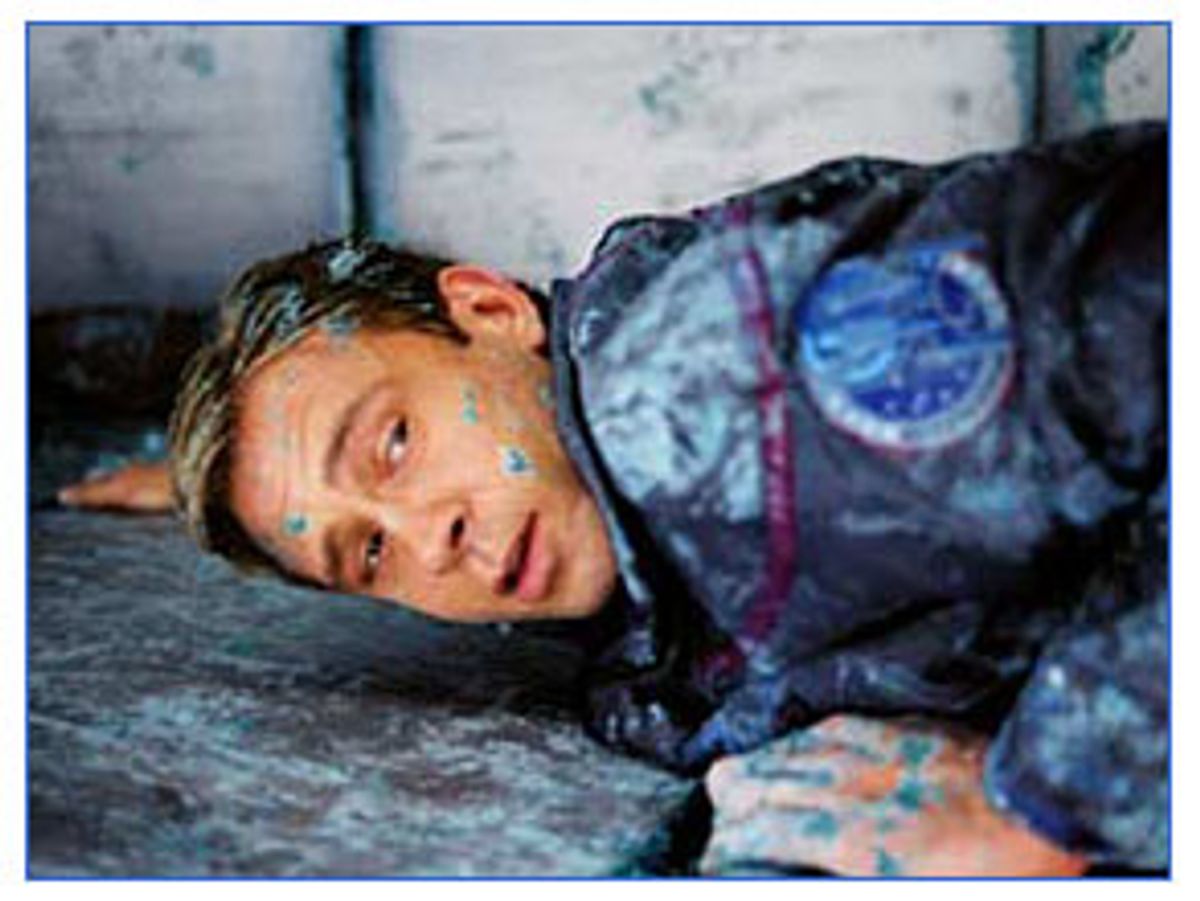
Star Trek

“Star Trek’s” new moral frontier

UPN's "Enterprise," back for its third season, has saved the Trek franchise with messy, moving and ambiguous story lines torn from the 21st century.

  • more
    • All Share Services

“Star Trek” fans will have a new reason to sigh in relief on Wednesday night as “Enterprise” returns for its third season, ready to prove all over again that it is not “Star Trek: Voyager.” The fourth Trek series, which ended in 2001, was a tired debacle in my eyes, and those of most “Star Trek” fans. Its creators seemed to think they could re-create the magic of “Next Generation” or the mood of “Deep Space Nine” by reusing their stories and adding gimmickry and Big Bangs.

“Enterprise” doesn’t have a gimmick. It has a premise, an interesting question to answer: How did humanity go from the bottom to the top of the galactic totem pole? What happened between the era of “Enterprise,” in the 22nd century, and the time of the original 1960s “Star Trek” series, featuring Kirk and Spock, some 115 years later? Why and how did humans rise to equal status with other spacefaring species?

“Enterprise” follows the best Trek tradition in making the era seem fresh and undetermined and arresting, even though we know how things will turn out. Or do we? The uncertainty of these eager and fragile characters matches the uncertainty of our times here on 21st-century Earth, and the writers play with time to enhance that uncertainty. “Enterprise’s” setting both in the “Star Trek” chronology and in our real time forces it to meditate on what might be, and on the dirty tricks people of all species will play to affect that future.

To recap: The Vulcans, a frowning and logical race (think Spock, only more tight-assed), made the first alien contact with Earth in 2063. Ever since, they’ve been holding Earth’s hand and keeping the training wheels on humanity’s ventures into deep space. Capt. Jonathan Archer (Scott Bakula) and his crew explore, are nearly destroyed by forces they don’t understand, meet new races, and generally try to prove the Vulcans wrong. As in other “Star Trek” series, the ideas are the meat of the thing, with a salad of special effects … and a dessert of cheesecake.

Yes, I would be remiss in not mentioning the babe factor in “Enterprise.” The creators seem to believe that the flesh of Jolene Blalock (who plays Vulcan science officer T’Pol) is as hot as the stars that the Enterprise passes, and should show up as often. In every other episode she bares various parts of her body in plot twists that would hardly please the logical Vulcan mind. In the T&A tradition of modern Trek, she is the skin equivalent of Jeri Ryan from “Voyager” and Marina Sirtis on “Next Generation.” The season premiere goes so far as to show her in a cleavage-revealing uniform. Linguist Hoshi Sato (Linda Park) has only removed her shirt once that I can recall, and that was by accident. Yes, they are the only females on the bridge of the Enterprise. To be fair, we see some of the males partially disrobed as well, but they don’t make it into the trailers.

The other structural flaw: the theme music. Against all Trek tradition, the theme music to “Enterprise” contains lyrics. Lyrics about the unbreakability of the singer’s soul, and about faith of the heart. I would prefer “I’ll Be There for You” from “Friends” to this. Welcome rumors are afloat that the third season will see a change in the opening score, and my screener copy of the season premiere strengthened those rumors by omitting audio over the lovely opening montage of naval and aeronautical history.

My other complaints are of the “This episode wasn’t as great as it could have been” variety. The first two seasons of “Enterprise” have seen fewer ghastly missteps than we saw in the first two seasons of “Next Generation” or “Deep Space Nine.” Sure, the captain and doctor withheld a cure from a disease-ravaged race and committed passive genocide for wholly spurious reasons, and T’Pol embarrassed herself and us while in pon farr, the Vulcan mating cycle. But these isolated low points can’t mar this show’s accomplishment: After hundreds of hours of Trek movies and TV episodes, “Enterprise” is making the franchise new again, creating fresh stories and possibilities.

The young crew of “Enterprise” is trying to make sense of when and how to intervene in other societies. There is no pat-and-easy Prime Directive of noninterference yet; these episodes will form the basis cases for later policies. Like a relatively young United States, the human race sticks its collective nose into forces and peoples it doesn’t understand, while the Vulcans are the cautioning mentors who have been around the block a few times, calling to mind Old Europe. Several episodes have developed this theme in different directions, and only some episodes feature direct references to the present day. But almost all of them tacitly reference 21st-century political problems.

The Cabal, a faction of the Suliban race, is attacking humans (among others) because its future-seeing master tells them to. Among other ramifications, we see peaceful Suliban citizens rounded up and placed in internment camps, oppressing and radicalizing them, yet perhaps protecting them from the bigoted populace. The Enterprise liberates one such camp, but it can’t liberate them all, and we end the episode musing over the escapees’ fate.

The Xindi, another mysterious alien race, has sent a weapon to Earth and massacred millions of humans, because they have heard (from the same future-seeing master, or someone like him) that humans will destroy the Xindi home world in 400 years. We are shocked, we are heartbroken, we want revenge. But we don’t even know where the Xindi live, much less how powerful they are.

This latter episode, the second season finale, strongly referred to the terrorist attacks of Sept. 11, 2001. “Enterprise” premiered just a few weeks after those attacks, and the story acknowledged, and responded to, that involuntary setting. The Trek framework is well adapted to telling this story of an allegorical war on terror; one episode can cover a day or many months, as developments hasten and slow.

Like “Deep Space Nine,” “Enterprise” entices us into caring about its characters, then forces you to watch them doing the dirty work of the state-security apparatus. In the season premiere, we see Archer bribing a sleazy mining official for an interview with his Xindi employee. Far from home and out of its depth, the crew is bound to experience some blowback, as it indeed does here. I want to see more of this. I want to see “Enterprise” compensate for drawing the analogy between 9/11 and this ahistorical, unpreventable alien massacre. “Enterprise” can redeem itself by emphasizing that our incidents and relationships with other races have ramifications, that there are other fish in the pond.

When chief engineer Tucker finds out that his sister has been killed in the Xindi attack, he refuses to hold a special service for her, arguing that the size of the slaughter takes precedence over one person’s memory. And then he begs the captain for the chance to take revenge on the mass murderers: “And tell me we won’t be tiptoeing around — none of that noninterference crap T’Pol’s always shoving down our throats.”

This is why the moral dilemmas of “Enterprise,” from now forward, will feel real and messy and moving: Earth has an interest. Capt. Picard of “Next Generation” sometimes struggled over playing God, sure, but usually human lives weren’t at stake. Are torture scenarios next, as in Fox’s contemporary terrorism drama “24″? How far will Archer go to avenge and protect human lives? “Enterprise’s” new, darker and denser story arc holds a promise even more alluring than Jolene Blalock’s bum.

Sumana Harihareswara lives in San Francisco and maintains Cogito, Ergo Sumana.

Why it still matters when a celebrity comes out

After the suicide of a bullied gay teen, actor Zachary Quinto realized he had to speak up to bring hope

  • more
    • All Share Services

Why it still matters when a celebrity comes out Zachary Quinto (Credit: AP/Chris Pizzello)

Yep, he’s gay. In an interview in New York magazine this weekend, Zachary Quinto, the 34-year-old actor who’s made himself a nerd icon over the years with his roles in “Heroes” and “Star Trek,” officially identified himself as “a gay man.”

What makes Quinto’s disclosure unique isn’t that he’s finally acknowledged his sexuality. It’s that his announcement came after nearly a decade of high-profile success — and consistently terse refusals to discuss his private life. Just a year ago, while he was performing in the revival of “Angels in America” and speaking out passionately for the Trevor Project, he told the New York Times, “The fact that these things are such hot-button issues right now, socially and politically, I would much rather talk about that than talk about who I sleep with. I would love to be a voice in this maelstrom of chaos and obsessive celebrity infatuation that says, ‘Let’s talk about something that matters.’”

For Quinto, the secrecy surrounding his private life has always seemed less about staying in some self-imposed closet than as an opportunity to broaden the breadth of his roles. He’s moved fluidly between playing  gay, straight and Mr. Spock his whole Hollywood career. Right now, for example, he can be seen playing a gay – and very dead – homeowner in “American Horror Story,” and as one of Anna Faris’ ill-advised hookups in “What’s Your Number?”

Straightness is very much the assumed default in two places: Hollywood and everywhere else. It’s all but expected for heteros to take on gay roles – and rack up Emmys and Golden Globes while deflecting questions about how uncomfortable those love scenes really were. Yet despite the strides made by comfortably out stars like Neil Patrick Harris, the notion of gay actors playing straight was still sufficiently “weird” a year ago to merit a Newsweek think piece.

So for Quinto, the actor, to leave room for doubt as to whether he was a gay man in straight roles or a straight man playing gay ones must have been an interesting exercise – the ultimate test of the persuasiveness of his performances. Quinto, the man, however, seems to have now arrived at a different place. Speaking on the harrowing recent suicide of bullied gay teen Jamey Rodemeyer, Quinto told New York, “As a gay man I look at that and say there’s a hopelessness that surrounds it, but as a human being I look at it and say ‘Why? Where’s this disparity coming from, and why can’t we as a culture and society dig deeper to examine that?’ We’re terrified of facing ourselves.”

On his official website Sunday, Quinto expanded on his thoughts, writing, “in light of jamey’s death — it became clear to me in an instant that living a gay life without publicly acknowledging it is simply not enough to make any significant contribution to the immense work that lies ahead on the road to complete equality…. I believe in the power of intention to change the landscape of our society — and it is my intention to live an authentic life of compassion and integrity and action.”

At a certain point, identity isn’t just “who you sleep with.” It’s who you love. It’s who you are. And the problem with the homophobes of the world is that they don’t understand that. They’d boil all of us down to what happens in our bedrooms instead what happens in our hearts and minds. That’s why Quinto’s coming out matters. It’s a successful man’s acknowledgment that who he is as a person shouldn’t make a difference in how he does what he does for a living. And that while pretending to be someone you’re not makes sense when you’re in front of the cameras, it’s no way for anybody to live a life.

Continue Reading Close
Mary Elizabeth Williams

Mary Elizabeth Williams is a staff writer for Salon and the author of "Gimme Shelter: My Three Years Searching for the American Dream." Follow her on Twitter: @embeedub.

“Star Trek”: Coming to a theme park near you!

Is the interactive kiddie spinoff "Star Trek Live" the final, gruesome nail in Gene Roddenberry's space-coffin?

  • more
    • All Share Services

A still from "Star Trek: The Animated Series"

A still from “Star Trek: The Animated Series”

Gene Roddenberry must be spinning in his grave. Or he would be if he had one; his ashes were shot into space in 1997. (Wait, I’m confused. Does that mean he’s always spinning in his grave?) With Roddenberry and his wife, Majel Barrett Roddenberry (Nurse Chapel in the original “Star Trek”), now both dead, control over the “Star Trek” franchise has devolved onto a slithery nest of interlocking corporate interests. Which accounts for a troubling press release I received on Friday, announcing the creation of something called “Star Trek Live.”

Although the “Trek” franchise presumably has renewed Hollywood viability after this summer’s lively and successful J.J. Abrams prequel — the 11th “Star Trek” movie overall — it long ago entered a decadent phase of creative and marketing metastasis: Spinoffs producing spinoffs, actors becoming directors becoming authors. (I’m still waiting for a film version of “Star Trek: The Animated Series,” or a Web-only series based on William Shatner’s co-authored “Trek” novels. Somebody’s probably working on them.)

That provides some context for the genesis of “Star Trek Live.” But what the hell is it, exactly? My first guess, while cagily inspecting a press release that’s crammed with merchandising buzzwords and light on specifics, was that somebody who hadn’t been reading the paper lately was following through on some three-year-old scheme to launch a “Star Trek” Broadway musical. Now, that sounds like a pop-culture disaster of heroic and delicious proportions, so I’m sorry to report it isn’t happening. With discretionary spending in free fall and the recent closure of “Shrek: The Musical,” Hollywood studios are backing away from the Great White Way as an ancillary revenue stream.

No, “Star Trek Live” is something else, “an interactive stage show” that’s “targeted for a run in theme parks and performing arts centers across the country.” The show “combines cutting-edge special effects, unmatched audience interaction and an exploration of real space-age technology,” taking “audiences of all ages on an exhilarating journey with Captain James T. Kirk and Vulcan science officer Spock.”

Yeah, I know what you’re thinking. You’re thinking: ZOMG! This is what Roddenberry’s atheist-Apollonian vision of the future has come to! Unemployed dinner-theater actors in Kirk and Spock drag and plastic tricorders, doing a laser show for the kiddies! At Waldameer WaterWorld in Erie, Pa.! It will bear the same relationship to any actual “Star Trek” incarnation as that teeny-tiny Stonehenge in “Spinal Tap” bears to seeing Led Zeppelin play live in 1973! And you’re absolutely right.

OK, OK, let me pay some lip service to journalistic fairness by reporting that “Star Trek Live,” while a property of CBS Consumer Products, will actually be created by the Mad Science Group, a “science enrichment provider” that creates shows for schools, camps and other youth venues. It’ll be some kind of hybridized edutainment product, in which Kirk and Spock train a fresh group of “Starfleet cadets” on their first day at the Academy. Learn, learn, learn; science, science, science. But wait, enough of that, shorty — the Earth is under attack from unknown aliens! Put down those curly fries and shoot those bastards!

I’m not backing off my initial, bigoted assumption that this latest bastardized effort to grub a few more dollars off a canceled 1960s TV series is an idiotic debasement of the already-flaccid “Star Trek” legacy. But, hell, that’s nothing new. And let’s face it, fellow parents: If these people can bottle even 0.5 percent of the Trekker spirit, in a package that appeals to the science-nerd kids who are too chicken for the vomitous coaster rides, we’ll all be grateful. If they can end it with a group line-dance number — hopefully led by “Kirk” and “Spock” doing the Robot — I take back everything I just said.


Continue Reading Close

Early odds on the Oscar derby

"Up," Clooney, "Precious," "Lovely Bones," "Nine" all leading contenders. Plus: Is indie dead? (Part 174)

  • more
    • All Share Services

Early odds on the Oscar derbyA still from "Up"


A still from “Up”

It’s an autumnal phenomenon, as predictable in its own way as the first signs of red and gold in the treetops: As dozens of new movies flood the fall marketplace, most of them without a hope in hell of reaching a paying audience, people in the industry begin to protest that the film economy is finally and permanently broken. This year the alarm has been sounded by indieWire blogger Anne Thompson, long among the most levelheaded and reality-based of Hollywood reporters, and that fact has momentarily transfixed the attention-impaired elite of movieland.

“The old independent market is over,” wrote Thompson last week, summing up the aftermath of the just-completed Toronto International Film Festival, which saw only a handful of modestly scaled distribution deals. “A new one will take its place. But we are smack in the middle between the end of one paradigm and the start of another, and it’s a scary place indeed.” Added Thompson, “I saw one movie after another [at Toronto] that was unreleasable in the current climate,” predicting that most of the 145 films for sale at Canada’s huge film marketplace “will wind up streamed, downloaded and viewed on a small TV or computer or mobile screen.”

As one New York indie-film publicist told me recently, once you get below the level of the handful of quasi-independent pictures that will be released by big Indiewood players like Sony Pictures Classics, Magnolia, Weinstein or Miramax, the market these days is mostly about self-distribution. In practical terms, that means filmmakers paying to get their movies into theaters briefly, in order to generate some reviews so they can generate a little money from those small-screen venues Thompson is talking about. While I’m sure that method will pay off for occasional movies, it isn’t much of a business model for the indie industry.

With Toronto in the rearview mirror and the New York Film Festival opening on Friday — always the unofficial kickoff to award season — it’s time to ask another question about this year’s movie marketplace: Where the hell are 10 best-picture Oscar nominees going to come from? The Academy’s brilliant and/or desperate decision to double down for 2010 looks especially strange in a season that so far is bereft of either Oscar-friendly middlebrow hits or “Dark Knight”-style pop smashes with artistic pretensions. Needless to say, I don’t know what the final list of nominees is going to look like, but I promise you this: One or two of them are really going to be from the moon.

But let’s not get ahead of the game; it’s only September. Here are the contenders as I see them right now (and I haven’t seen all of them yet, not by a long shot). The list is organized solely according to what you might call the Rorschach principle; I thought of movies, and wrote them down, in this order:

“Bright Star” Universally beloved by critics, Jane Campion’s Keats-in-love comeback vehicle sounds like a viable Oscar candidate, at least in theory. In practice, its opening week was tepid at the box office, and my hunch is that the Academy has turned away from costume romance, no matter how well executed, since the days of “Shakespeare in Love.”

“A Serious Man” Low on movie-star wattage, this ambiguous fable set in 1960s Midwestern Jewish suburbia is the most overtly personal film Ethan and Joel Coen have ever made — and I’m not alone in thinking it’s one of their best. (More to come next week, including an interview with the Coens.) IndieWire editor Eugene Hernandez has declared “A Serious Man” to be the sleeper of awards season, and he could well be right. Having swept the floor with “No Country for Old Men” just two years ago, however, the brothers may be at a tactical disadvantage with Oscar voters.

“Broken Embraces” Do I actually believe that Pedro Almodóvar’s latest overheated Spanish melodrama has a shot at Oscar gold? Well, no. But I do believe that having 10 best-picture nominees opens a slot for a token foreign-language film, and it might as well be a bubbling-over potboiler with Penélope Cruz in it, playing the doomed lost love in a story-within-a-story told by a film and literary icon (Lluís Homar) who was blinded in a terrible accident. Got all that? Haven’t seen this yet; needless to say I can’t wait.

“Up” Another lovely, wistful kid-adult crossover from the Disney/Pixar factory, and in any earlier year it’d be automatically consigned to the animated feature category. “Up” will still win that award, but given widespread disappointment over the non-nomination of “Wall-E” last year, it also seems just possible that this heartwarming tale of two outcasts on a quasi-mystical balloon journey will garner a nod for the big prize.

“The Hurt Locker” There was considerable Oscar buzz around Kathryn Bigelow’s Iraq bomb-squad flick after its release, which largely reflected Hollywood’s affection for the oft-overlooked ex-wife of James Cameron, as well as a collective sigh of relief that somebody had finally made a movie about the Iraq conflict that audiences would actually pay to sit through. You hear a lot less of that now. Like most of Bigelow’s movies, it’s a terrific mind-fuck actioner, probably best viewed with the dialogue dubbed into another language. I’m thrilled to have her back, but a best-picture nominee? Probably not.

“Up in the Air” Two words: Oh. Yeah. Now, I haven’t seen Jason Reitman’s adaptation of Walter Kirn’s tragicomic novel about a corporate downsizing consultant (George Clooney) and maybe I’ll decide it sucks. But word out of Telluride and Toronto has been outstanding, and from a strategic-positioning point of view, everything about this project — the pedigree of star and director, the seriousness of the theme, an acclaimed supporting cast featuring Jason Bateman and Vera Farmiga — feels right. Oscar front-runner, until something else comes along.

“The Men Who Stare at Goats” This is the season’s other Clooney vehicle, in which he stars alongside Ewan McGregor, Kevin Spacey and Jeff Bridges in an implausible-but-not-quite-true story about a secret psychic unit within the United States Army. Sounds like a pretty darned entertaining premise, but there must be a reason that virtually nobody who has seen it is talking this one up as Oscar fodder.

“Get Low” One of Toronto’s few breakout films, this directing debut for Aaron Schneider was just collected by Sony for probable year-end release. A folktale-flavored Depression-era yarn about a small-town Tennessee eccentric (Robert Duvall) who stages his own funeral while still alive, “Get Low” also features Bill Murray, Sissy Spacek and Lucas Black. In other words, as much rural Americana and indie cred as you could possibly want, with some left over.

“An Education” This winsome little surprise about a teenage girl’s coming-of-age in pre-swinging London was the unexpected delight of Sundance last winter, but it’s the kind of movie that won’t stand much hype. Suffice it to say that Carey Mulligan gives a star-making performance — she’s the Oscar nominee here, frankly — and director Lone Scherfig handles the period, and Nick Hornby’s screenplay, with tremendous finesse.

“Precious: Based on the Novel ‘Push’ by Sapphire” This is the first film ever to win audience awards at both Sundance (where it was shown as “Push”) and Toronto, mainly because most movies that generate buzz don’t remain on the festival circuit for more than nine months. Still, a picture that was initially perceived as an unmarketable downer — the story of an overweight, illiterate, twice-pregnant Harlem teenager, made by little-known director Lee Daniels — has gradually been transformed into a bona fide Oscar contender. Having Oprah Winfrey and Tyler Perry as executive producers hasn’t hurt, but even infotainment magnates as powerful as they cannot control audience response — and the response to this movie, and its leading performances by Gabby Sidibe and Mo’Nique, has been electric.

“The Lovely Bones” I haven’t even spoken to anybody who’s seen this, and it remains faintly possible that Peter Jackson’s screen version of Alice Sebold’s narrated-from-the-other-side bestseller won’t be ready for pre-Christmas release. Still, with that pedigree and a cast headed by Mark Wahlberg, Rachel Weisz and Susan Sarandon, Jackson will have to screw it up pretty badly not to be included in the Oscar conversation.

“Nine” No, not “District 9″ or “Cloud Nine” or “9,” but director Rob Marshall’s screen version of the hit Broadway musical inspired by Fellini’s “8 1/2.” If you’re confused, you’ve identified one of this mega-production’s potential pitfalls. With seven credited writers, eye-popping production values and a cast that features recent Oscar winners Daniel Day-Lewis and Marion Cotillard, along with Penélope Cruz, Judi Dench, Nicole Kidman and Sophia Loren, producer and distributor Harvey Weinstein’s got to be hoping for major hardware to get this expensive project into the black.

“The Road” Redolent of artistic seriousness, this post-apocalyptic fable from Aussie director John Hillcoat (“The Proposition”) is adapted from a Cormac McCarthy novel and stars Viggo Mortensen and Charlize Theron as its protagonists, dubbed only “Man” and “Wife.” (Guy Pearce and Robert Duvall also star.) Film-festival response has been superlative, and Mortensen and Theron have established themselves as beloved stalwarts of the Hollywood left. They’re both in the running for acting awards, but my sight-unseen guess is that “The Road” may prove too unforgiving for best-picture voters.

“Inglourious Basterds” Kind of a cool idea, but I don’t buy it — and only partly because I didn’t much like the movie. Christoph Waltz is absolutely going to be nominated as a supporting actor, but Hollywood simply ain’t giving its big prize to a spectacle this disorganized, anarchic and sadistic.

“Star Trek” Exactly the sort of film the extra best-picture slots were supposed to benefit. J.J. Abrams pulled off a neat rebooting of the franchise, and I quite enjoyed it. But best picture? Nah. “Star Trek” is a nicely made summer popcorn movie that will reap the usual benefits, those being in the technical award categories.

Continue Reading Close

Why the original “Star Trek” still matters

Cheap, sexist and nerdy? Check, check and check. But the original Kirk and Spock offered an erotic, Apollonian beacon of hope amid the darkness of '70s culture.

  • more
    • All Share Services

Why the original

Courtesy Paramount Home Entertainment

Images from “The Best of Star Trek: The Original Series.”

In perhaps the most famous “Star Trek” episode of them all, Capt. James T. Kirk (William Shatner) and Cmdr. Spock (Leonard Nimoy) stand in their stretchy mock-turtle uniform shirts, lady-pleasin’ tight pants and pointy-toed Beatle boots on one of those studio-lot sets designed to evoke a prewar American city. People shuffle past in shabby clothes, and a black automobile with large, curved fenders crawls down the street. “I’ve seen photographs of this period,” says Kirk. “An economic upheaval had occurred.”

“It was called ‘Depression,’” says Spock, raising one painted eyebrow in archetypal distaste. “Circa 1930. Quite barbaric.”

As many of you will have spotted already, this is from “City on the Edge of Forever,” a time-paradox yarn written by science-fiction legend Harlan Ellison (who has feuded with the show’s producers and their copyright heirs ever since). In it, Kirk falls in love with a kittenish Salvation Army type, played by Joan Collins, who envisions a future of space travel and peaceful global cooperation, and wants to rescue the world from the threat of impending war. Kirk comes from that future, of course. Not only can he not tell her that, he must also allow her to be run down by a bus to avoid a fatal disordering of the space-time continuum that would result in Hitler conquering the world and the Starship Enterprise never existing at all.

In its narrative ambition, its talky, theatrical density, its high-minded moral tone and its nerdy philosophizing, that episode captures a great deal about what made “Star Trek” such a potent cultural force. I guess that’s why it’s included, along with three other episodes, on “The Best of Star Trek: The Original Series,” a new DVD/Blu-ray release presumably meant to lure viewers of J.J. Abrams’ hit film back to the source material. No “Star Trek” fan could possibly be happy with such a mini-collection — where, I ask, is “Mirror, Mirror”? “The Doomsday Machine”? “The Devil in the Dark”? — but I enjoyed watching this tremendously.

Watching “Star Trek” in 1970s syndication was such an important part of my childhood and adolescence — I’ve seen every episode at least five or six times, and some many more than that — that I’m not capable of assessing the show’s uneven, low-budget craftsmanship with any degree of detachment. For me, “Star Trek” and the Rolling Stones, as much as they might appear to be polar opposites — one supremely American and the other English, one Apollonian and optimistic, the other Dionysian and pessimistic — were the cultural phenomena that made the pre-punk-rock early ’70s tolerable. A person interested in those things was, prima facie, not interested in Donny Osmond or “Happy Days,” had conceivably read a book not required by teachers and furthermore could plausibly have access to decent weed.

Even if some of its flaws look more glaring 30-odd years later, I think the original “Star Trek” still has a passion and vitality that partly stem from its cheapness; the threadbare sets and effects created a coherent, suggestive atmosphere, and forced your attention onto the storytelling and the characters. It stands out, even after all this time, as something unique in television history. Of course “Star Trek” can never be the cultural lodestone it once was. Having spawned four official follow-up series, 11 feature films (and counting) and countless non-canonical works — if you haven’t heard about K/S porn or the immense and disputatious fanfic universe, I’m not helping you — and inspired an entire genre of serial intergalactic futurism from “Space: 1999″ to “Babylon 5″ to “Battlestar Galactica,” the novelty of Gene Roddenberry’s creation has pretty well worn off.

In the middle of the Cold War, Roddenberry imagined a radical-progressive, Enlightenment-fueled vision of the human future, one in which the conflict between capitalism and communism had been long transcended, along with other earthbound forms of racial, ethnic or religious strife. Strikingly, there is no religious or mystical dimension to the “Star Trek” universe at all, at least until much later in its development. (Roddenberry regarded himself as an “agnostic atheist,” and banned any religious references from the show.) It was based around the chronic tension between reason and emotion, represented of course by the tension between Spock and Kirk and the actors who played them, the immeasurably gifted Nimoy and the hambone, cocksure Shatner (a second-rate Canadian Shakespearean, before his “Star Trek” celebrity).

Roddenberry’s vision of what “Star Trek” could and should be, even if it was indifferently realized, was pretty close to Richard Wagner’s conception of the “Gesamtkunstwerk,” a work of art that would incorporate drama, poetry, philosophy and music. He worked with the best writers he could get, despite his borderline-tyrannical reputation and various controversies surrounding his handling of royalties. Ellison wrote “City on the Edge of Forever,” and Theodore Sturgeon, another big-name sci-fi author, wrote “Amok Time” (also included here), the famous episode in which Spock goes into some kind of Vulcan estrus and must return to his home planet in order to mate. (The principle that Spock has no emotional life is something like the edict in Greek mythology that no living human can enter the underworld; it must be flouted at every opportunity.)

In the arid landscape of late-1960s television, largely devoted to quasi-realistic forms like the family sitcom or the police procedural, “Star Trek” was new and startling in several different ways: a science-fiction series that was literary and imaginative and heavily allegorical, that ladled out historical and political messages by the quart and that delivered a distinctive undertone of adult sexuality.

OK, yes, it might be better described as a swaggering, Hefneresque and profoundly sexist version of semi-adult, semi-repressed sexuality. Preening Kirk, arguably the most sexualized male character in TV history, tomcats from one interstellar honey to the next. In Season 1, beehive-haired Yeoman Rand (Grace Lee Whitney) seems to serve as his personal concubine, but for that matter there’s something haremlike about the female personnel aboard the Enterprise in toto. They all apparently departed on a five-year space mission directly from their other jobs as go-go dancers behind Smokey Robinson and the Miracles.

Nurse Chapel (Majel Barrett, later Roddenberry’s wife) moons pathetically for the chaste and logical Spock, who is himself locked in a sub-rosa competition with the bitchy and sexually ambiguous “Bones” McCoy (DeForest Kelley) for Kirk’s attention. Spock pretends not to notice Chapel, but behaves like an outrageous tease; in “Amok Time,” he strokes her tear-stained cheek and murmurs, “It would be illogical for us to protest against our natures.”

But hey, this stew of delightful and appalling ingredients produced the first black-white kiss in the history of American narrative television, the aliens-made-them-do-it snog between Kirk and Lt. Uhura (Nichelle Nichols) in the 1968 episode “Plato’s Stepchildren.” (Contrary to legend, that smokin’-hot moment did not produce widespread outrage in the American South. Widespread arousal, certainly.) In the same scene, Chapel finally gets to kiss Spock, while protesting the whole time that she really, really didn’t want it to happen like this.

One could lazily argue that the breakthrough of “Star Trek,” which was first a cult show and then a mass phenomenon, led to the much bigger breakthrough of “Star Wars” a few years later. Beyond a loose, generic connection, I see much more opposition than similarity between the two. George Lucas’ space dramas are a bastardized mishmash of 1950s serials, classic quest mythology, film history and J.R.R. Tolkien, all elements pretty much absent from “Star Trek.” Of course there’s some crossover, but the two things appeal to different generations and different sensibilities

If Lucas is defiantly pop-cultural in orientation, delivering archetypal structure and fast-paced action rather than plot and conversation, Roddenberry skews much closer to traditional high or middlebrow culture. Despite the speculative-fiction surroundings, he’s really an old-fashioned tale-spinner, with roots in the short story and the theatrical stage. In the second season, Roddenberry introduces a Russian navigator named Chekov, and as distant as “Star Trek” may seem from “The Cherry Orchard,” I don’t think the name was picked out of a hat. His near-namesake Anton Chekhov was a master of the sudden reversal, the ironic sting in the tail — devices Roddenberry’s writers use over and over.

In an effort to make the original “Star Trek” relevant to contemporary viewers, whatever that’s supposed to mean, CBS/Paramount has rejiggered some of the cheesy effects, remastered the whole series in disconcertingly brilliant high-definition, and made them available on Blu-ray, iTunes, XBox Live and no doubt other platforms yet to be devised. I don’t object to such things, and the four episodes on this disc (the one I haven’t mentioned is the lamentable “Trouble With Tribbles”) look amazing, even if the increased resolution exposes the thick makeup on Shatner and Nimoy, making them look even more like drag queens out of uniform than they did before.

But “Star Trek” worked just as well, and maybe better, on a black-and-white secondhand TV pulling in signals from two cities away through an untwisted coat hanger. To those of us watching that way, with a couple of friends and some lukewarm Hamm’s beer, it offered a tiny oasis of imaginative escape. It wasn’t an escape into a mythical realm of impossibly perfect heroes and implacably evil villains, but into a future of global techno-humanist harmony. It seems ludicrous now, yes, but in that simultaneously chaotic and innocent time it hovered just over the horizon as a distant possibility. A future where we would all agree that war and poverty and economic depression were barbaric, and where the girls would all wear miniskirts and nylons.

Continue Reading Close

The utopian economics of “Star Trek”

The young Spock's movie shout-out to "new growth theory" isn't just a nifty inside joke -- it's a bold statement of confidence in the promise of technology.

  • more
    • All Share Services

The utopian economics of

There are many clever moments in the thoroughly satisfying new “Star Trek” movie, but the one that has economists chattering is more than just smart: It strikes right to the core of what the Star Trek future is all about.

The scene comes early, when a pre-pubescent Spock is undergoing the formidable educational process inflicted on all Vulcan children. We see and hear him say the words “nonrival” and “nonexcludable” (and we can imagine his computer tutor nodding encouragingly).

And then we move on, without explanation. To my children, and, I imagine, to most Trekkies, the moment was just one more jargonistic outburst in a franchise that has always delighted in excessive indulgence in meaningless techno-gibberish. But the economists in the audience all started high-fiving each other: Whoa, who could have expected a shout-out to economist Paul Romer’s breakthrough paper, “Endogenous Technological Change,” in a “Star Trek” movie? Awesome!

The words jumped out at me, because a few years ago, I had the good fortune to read economics writer David Warsh’s superb chronicle of how Romer’s paper defining “new growth theory” changed the course of economic thought, “Knowledge and the Wealth of Nations.” As Warsh notes in his preface, the first paragraph of Romer’s paper states:

“The distinguishing feature of … technology as an input is that it is neither a conventional good nor a public good; its is a nonrival, partially excludable good.”

A “nonrival” good can be shared without losing anything. An apple, say, is a rival good: If one person eats it, the other person can’t. A pirated download of the new “Star Trek” movie is nonrival — it can be copied endlessly. Excludability refers to whether you can prevent someone from sharing, as with, for example, copy protection or a jail sentence.

As Warsh explained to me during an interview three years ago, Romer’s great contribution was that he mathematically proved “that the economically important thing about knowledge is that it is ‘nonrival’ — everybody can use it at the same time.”

Romer put it this way:

Economists studying public finance have identified two fundamental attributes of any economic good: the degree to which it is rivalrous and the degree to which it is excludable. Rivalry is a purely technological attribute. A purely rival good has the property that its use by one firm or person precludes its use by another; a purely nonrival good has the property that its use by one firm or person in no way limits is use by another. Excludability is a function of both the technology and the legal system. A good is excludable if the owner can prevent others from using it. A good such as the code for a computer program can be made excludable by means of a legal system that prohibits copying or by means of encryption and copy protection schemes.

What does this mean for “Star Trek?” The Star Trek universe is built on a fundamentally optimistic premise : Technological growth will lead us into a future of abundance and prosperity. Transporter beams and warp drive-capable starships are just the beginning. Any society that enjoys the benefits of replicators able to produce any food or beverage the consumer might desire at the merest voice command is a society that has pushed the nonrival, nonexcludable benefits of knowledge diffusion to the maximum extent possible.

Here’s some more from Romer’s paper:

The raw materials that we use have not changed, but as a result of trial and error, experimentation, refinement, and scientific investigation, the instructions that we follow for combining raw materials have become vastly more sophisticated. One hundred years ago, all we could do to get visual stimulation from iron oxide was to use it as a pigment. Now we put it on plastic tape and use it to make videocassette recordings.

Of course, who needs videocassette recordings when you have holodecks?

Technological change — improvement in the instructions for mixing together raw materials — lies at the heart of economic growth … Technological change provides the incentive for continued capital accumulation, and together, capital accumulation and technological change account for much of the increase in output per hour worked … [But] instructions for working with raw materials are inherently different from other economic goods. Once the cost of creating a new set of instructions has been incurred, the instructions can be used over and over again at no additional cost.

To some people, the implications of Romer’s work are all too visible in the restructuring of the music industry and news business. Anything that can be digitally copied is nonrival and very difficult to exclude. So anyone whose job depends on the processing or delivery of information is feeling a great deal of stress right now about the difficulty of devising business models that thrive in a nonrival, nonexcludable operating environment. But in the long run, suggests Romer and as potentially demonstrated by “Star Trek,” the benefit of expanding knowledge and technological change will be widely distributed prosperity: an end to scarcity, a future where the fundamental challenge of providing for our basic needs has been solved. (Although, one hastens to note that there will always be insane Romulans and all-devouring Borg invaders to deal with — so life will never be perfect!)

In these times of economic disarray and incredible environmental threats and devastating energy constraints (Where do we find the dilithium crystals that power everything, after all?), it might be hard to see that abundant Star Trekkian future anywhere else but in a movie theater. But the policy prescription inherent in Romer’s work is that the best way to provide for long-term growth is to invest in education, in the training of scientists and engineers, in the production of knowledge — new sets of instructions — that benefit everyone. It’s a theme that President Obama echoed last week when, while announcing some changes in how the government handles unemployment benefits, he stated that “education is the best bet we can make as individuals and as country.”

So, to quote his predecessor: “Bring it on!”

Continue Reading Close
Andrew Leonard

Andrew Leonard is a staff writer at Salon. On Twitter, @koxinga21.

Page 1 of 7 in Star Trek