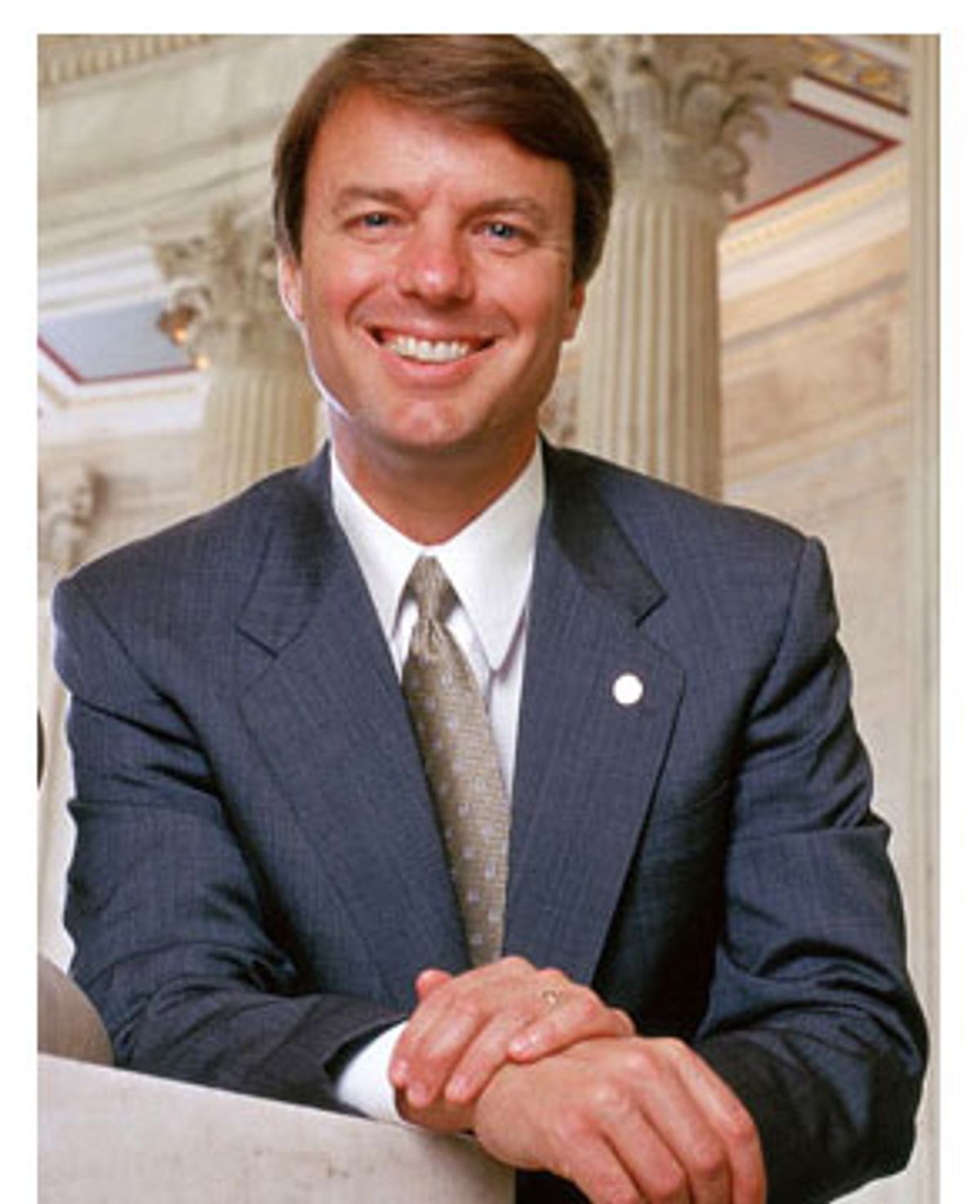
Back when Howard Dean was the unknown ex-governor of a tiny New England state, North Carolina Sen. John Edwards was winning prestigious early media primaries, getting anointed one of a handful of Democrats with the political star power to beat George Bush in 2004. Time magazine named Edwards "The Democrats' New Golden Boy" in 2001 and U.S. News & World Report put him on its cover last year as a man who could give Bush a scare. Throw in glowing portraits by curmudgeonly Christopher Hitchens in Vanity Fair and Nicholas Lemann in the New Yorker, and a year ago Edwards looked like someone who'd be in the top tier of Democrats as the race got underway for real this fall.
But instead, as Edwards officially kicked off his presidential campaign Tuesday with a speech outside the mill where his father used to work in Robbins, N.C., the question hovering over the race now is not "How far can he go?" but "Is his candidacy over before it officially began?" Even some supporters are asking how such a promising candidate wound up running such a mediocre campaign to date, and whether he can fix it. The news that Gen. Wesley Clark will declare his own candidacy on Wednesday was yet another blow on a day when Edwards hoped he'd have the news cycle to himself.
It's a strange turn of events for Edwards, because his political admirers haven't been limited to the media over the years. Sen. Patrick Leahy, D-Vt., once declared that Edwards had the potential to be the best debater the chamber had seen in 25 years, and some Democratic strategists have called him the biggest talent since Clinton. Back when Edwards was supposed to run for reelection in North Carolina, Sen. Jon Corzine, of New Jersey, the chairman of the Democratic Senatorial Campaign Committee, who's charged with regaining the Democratic majority, called him among the three or four top politicians in the country. With the pending retirements of Sens. Fritz Hollings of South Carolina and Zell Miller of Georgia, Democrats who can win in Southern states are becoming a rare commodity in the chamber these days. And given that the party has not been able to get to the White House with a candidate from above the Mason-Dixon line since John F. Kennedy, Edwards was expected to be a front-runner.
And yet Edwards lags behind Dean, John Kerry, Joe Lieberman and Dick Gephardt in most polls, both nationwide as well as in the crucial early primary states like Iowa and New Hampshire. Talking to Jon Stewart on "The Daily Show" Monday night, Edwards tried to make light of his low poll standing, noting that his campaign kickoff wasn't really coming as late as it seemed, since "I don't know if you've seen the polls, but I think it will be news to some people that I will be running for president."
Many Democrats believe he made a crucial tactical mistake by devoting himself to raising money during the first half of the year and spending less time than some of the field's leaders on the stump in Iowa and New Hampshire. Now Edwards is spending money on advertising and he's vowed to hold at least 100 town hall meetings in New Hampshire before the January primary, but some say it's too little, too late.
"He's spending his money now and he's not moving," said one Democrat.
But campaign manager Ed Turlington, who used to practice law with Edwards, said the campaign is proceeding as expected. "I think we're right on plan," he said. "We're moving past the exploring phase and into the heat of the battle."
It's hard not to notice that some of Edwards' strengths are also weaknesses. People magazine put him on its list of most beautiful people in 2000 and Elle named him sexiest politician in 2001, but his foppish hair and youthful features make him "look 20 years younger than he is and he's running in a year when experience actually matters," said University of Virginia politics professor Larry Sabato.
Most daunting is his political youth. Edwards has yet to complete his first Senate term, and the best he can point to on his résum&eacaute; to demonstrate foreign policy acumen is a seat on the Senate Intelligence Committee. While critics note that Bush had just begun a second term as Texas governor when he ran for president, in post-9/11 America many political observers think even Bush might be passed over as too unseasoned to run the country during wartime if he were setting out this time around. "If Bush ran as the candidate he was in 2000 against an eight-year incumbent vice president, he would have a much more difficult time explaining away his lack of foreign policy experience compared to a vice president," said Sabato. "It matters now."
Edwards' inexperience has shown through as his gold sheen flecked off in his long run-up to Tuesday's announcement. He was blasted for his performance on "Meet the Press" in May last year -- National Journal columnist William Powers said he "came off as ill-prepared and vague, incapable of producing an original thought on any subject." And while his supporters have counted on his intelligence and his telegenic looks to capture voters' attention and make up for his experience deficit, Edwards hasn't shone in the debates to date. He's had some bad breaks: He had the unlucky distinction of following Rev. Al Sharpton in the order of the debate sponsored earlier this week by the Congressional Black Caucus at Morgan State University in Baltimore. After Sharpton set the audience roaring by revealing his favorite song is "James Brown's number on the Republican Party, 'Talking Loud, Saying Nothing,'" Edwards complained, "I've got to follow that?" He told the crowd his favorite song was Small Town" by John Cougar Mellencamp, earning points for not pandering, but little else.
Even his wife, Elizabeth, admitted he didn't shine that night. "It was pretty hard to cut through. He likes Al but you don't try to compete on his turf. You got to let it cool down for a second so you can say your piece."
But Edwards was also upstaged by Sharpton on what was arguably his own turf, when six of the candidates addressed NARAL Pro-Choice America earlier this year. That time Sharpton followed Edwards -- and lighted up the crowd of white women, while Edwards' speech was pronounced a dud by the New Republic.
Even good news seems to be followed by bad for Edwards. He appeared to score a coup last week at a Washington meeting of 1,500 politically active members of the Service Employees International Union, when SEIU president Andrew Stern said Edwards "moved from having almost no support to being one of the top three candidates that the members leaving this conference are interested in." But Edwards' supporters seemed to overreach by distributing a newspaper report that Edwards had surged with SEIU officials while Kerry had fallen out of contention for an endorsement, and an SEIU official had to deny that assertion, saying only that Edwards had made a good impression with the group.
Meanwhile, Edwards' plan to use his war chest -- he raised $11.9 million since Jan. 1, making him second among the Democratic contenders -- to buy television ads in Iowa and New Hampshire hasn't paid off in a huge surge yet.
After nearly a month of advertising in New Hampshire, Edwards has crawled from 2 percent support in the middle of August to 6 percent in a Boston Globe-commissioned poll after Labor Day. But his ranking in the polls, 5th place, didn't budge. In Iowa, after he ran ads for two weeks, he remained at 6 percent in the polls but dropped from 4th to 5th place after Lieberman garnered 12 percent in a Research 2000 survey.
So how does Edwards hope to prevail? His neighboring state of South Carolina, which will host the most important primary immediately following the Iowa and New Hampshire contests, provides a ray of hope. Edwards began airing ads there on Aug. 15 and according to two polls conducted by Zogby International, he jumped from 5 percent and 4th place (one slot behind Sharpton) to 10 percent and a one-point lead over Dean for first place. While statistically that's not a real lead, psychologically it's a boost for the campaign.
Edwards' campaign chairman, Ed Turlington, admits South Carolina is a "must win" state for his candidate, just as Iowa is said to be a must win for Gephardt of neighboring Missouri. Don Fowler, a former DNC chairman who now chairs the party in Richland County, S.C., predicted that only two or three of the top five Democrats will survive Iowa and New Hampshire to make it down to his state's primary, pointing to the year 2000, when there were seven GOP candidates running, but only two survived to South Carolina: Bush and Sen. John McCain, R-Ariz.
"If Edwards survives Iowa and New Hampshire and is considered viable he would be in a good position to carry [the state]," said Fowler.
But survival for Edwards means moving up in the polls in both states. Political analyst Charlie Cook says if Edwards fails to finish third in Iowa or New Hampshire it would be almost impossible to win South Carolina.
Even some of Edwards' backers admit he may have planned wrong by focusing on raising money early rather than hitting the stump.
"I would have run a different sort of campaign," says Michael Bauer, a Chicago-based lawyer, businessman and political activist who is on Edwards' national finance committee and steering committee. Bauer agreed that Edwards should have put a little less emphasis on raising money and more on campaigning. John Edwards clearly had a visibility problem from the start. "I can't tell you how many people ask me who I'm supporting and then ask 'Who's that?' It affects your ability to do national fundraising," said Bauer.
But the fundraiser says Edwards' decision not to run again for Senate gave his campaign a real boost. "There were starting to be a great many doubts about whether he's really in it and not hedging his bets," said Bauer. "He's taking a 'burning the ship at the shore' strategy that's a good message to supporters that he's really in this."
It should also be said that thanks to Edwards' early fundraising prowess, he's assured of surviving until the third round of primary battles.
"We have enough money to carry us through the Feb. 3 date and to run a media campaign in every one of those states ... and compete at the level we need to," said Eileen Kotecki, the co-chair of Edwards' national finance campaign.
Edwards' staff is hoping that with his Southern roots and his place as a moderate who's arguably more centrist than Dean, Kerry and Gephardt, Edwards could thrive in states such as Arizona, Delaware, Missouri, New Mexico, North Dakota and Oklahoma, which are scheduled to host primaries on Feb. 3.
If he doesn't do well enough in those moderate states to earn the nomination -- or at least the No. 2 spot on the ticket -- it's questionable whether Edwards, once the golden boy and a great hope of the Democratic Party, will be able to fulfill the political future many expected for him.
But Elizabeth Edwards, at least, says she isn't worried about her husband. "There has never been in our married life, and we've been married for 26 years, a time when we faced a problem he didn't think he couldn't solve. He always thought if he just worked hard enough at it and put all the resources he had to it he could solve people's problem."
Asked after last week's debate how he would maintain his public profile after leaving the Senate should he fail to capture the nomination, Edwards struck a resolute pose.
"I absolutely refuse to accept that proposition," he said. "I intend to be the nominee and that's exactly what's going to happen."
His Hollywood good looks combined with his steely determination in the face of adversity would have made the moment perfect for a movie about the making of a president. Too bad all the television cameras were crowded around Howard Dean standing a few yards away. George Clooney, who was filming the first episode of HBO's new inside-the-Beltway series "K Street," stood nearby as well, but he was signing an autograph.
Shares