
Tom Cruise

Planet autism

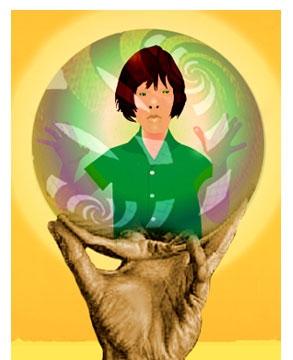
Last summer, a man in California shot his 27-year-old autistic son to death and then shot himself. I understand why.

  • more
    • All Share Services

Planet autism

Lose track of time on the phone, get distracted with the mail, daydream over a cup of coffee, that’s all it takes. The odor has finally made its way down the hall. When you see the balled-up pants and diaper on the floor you know you are too late. A bright red smear across the door, the molding, the wall. Turn the corner and the bedroom is a crime scene. An ax murder? In fact, it is only your daughter at her worst. (Worse than three days without sleep? Worse than ear-splitting screams that physically hurt, actually cause you to drop what you hold in alarm, compel you to shriek back at your delighted child who smiles at you sincere as a spring day?) Shit everywhere. Splashes of blood glistening like paint, black clots, yellow-brown feces, and a 3-foot-in-diameter pond of vomit that your daughter stands in the middle of, a dog-eared copy of Family Circle in one hand, reaching for the TV with the other. She is naked except for stockinged feet, blood soaked up to her ankles. Hands dripping, face marked like a cannibal, she wears an expression of utter bewilderment: What’s happened to me? Where am I? Is this good? Am I OK? There being nowhere to walk without stepping in some bodily emission, you throw bath towels down like a bridge to get to her.

Stripping her unavoidably stains you. A bloody hand print on the square of your back as she balances herself when you roll down her sopping stockings. You hope she touches nothing else but what does it matter as the bathroom remains appalling in spite of the previous cleanups: cabinet handles encrusted with dried excrement, brown swipes on the light switch, corner of the mirror, shampoo bottle, Q-Tips, ceramic figurines, curtain louvers. (Holiday guests take you aside to warn you of rodents in unusual locations. Ancient turds in drawers, inside books. You thank them. Apologize. Yeah, it’s an ongoing problem.)

In the warm rain of the shower she proceeds to dig. She is excavating for what remains of the impacted stool, hard as a French roll. This entire episode, this habit, the result of some maddening control issue. The behaviorists, the gastroenterologists, the living-skills experts all suggest their strategies and therapies and videos and diets and oils and schedules. Certainly she knows what you want — appropriate toileting. And there are occasions when she does just that. Goes in, sits, finishes. This, maybe 5 percent of the time. Some huge, softball-size stool discovered in the toilet bowl. You shout for each other and gaze in wonder as at a rainbow or falling star. That’s how excited you are.

Get in the shower with your daughter. Wash her hair three times, scrub her down, between the toes, everywhere. Take an old toothbrush to her nails. Towel her down. Her hair, lightly — enough. Better stop. Know how she hates that. Let the rest air-dry. Get her dressed. Diaper. Thank God for extra large Good-Nites. (Remember the college gal at Safeway in her Birkenstocks and hemp sun hat: “Didja know,” she must inform you, “it’s disposable diapers that are filling up America’s landfills?”) Next, deodorant, sweat pants, the rest. Rewind the movies. Pop in her favorite CD soundtrack (“Annie”) and program it for loop. Pull out a couple of old Redbook magazines. Make sure all the doors are locked. Remember when she wandered away, found in the middle of the street, a garbage truck honking at her like she’s some stray mutt.

- – - – - – - – - – - -

Sooner or later, parents raising children with severe learning disabilities receive the “Welcome to Holland” essay by Emily Perl Kingsley. It describes a couple planning the trip of a lifetime to Italy. They prepare and study and learn everything they can about their cherished destination. When their plane lands, though, an announcement: They have arrived in Holland. Holland? They wail. We’ve dreamed all our lives of Italy. Italy is where they want to be. Not here!

“But there has been a change in the flight plan,” Kingsley writes. “You’ve landed in Holland and there you must stay.” New guide books, a new language, a completely different group of people than those you hoped to meet. Worse still, “everyone you know is coming and going from Italy and they are all bragging about what a wonderful time they had there. And for the rest of your life you will say, ‘Yes, that’s where I was supposed to go. That’s what I had planned.’”

- – - – - – - – - – - -

Two hundred years ago most of these kids were tossed down the well or thumped against the fence post. It was either that or watch your own torn to pieces by the coyote, or trampled to death in the corral, or drown in the duck pond or tumble off a ledge or wander off in a blizzard. If you were of an educated class, institutionalization became an option. A way out. There were always the few, though, whose pride or familial loyalty or stubbornness would not allow them to abandon such a child. Upright, determined mothers — mostly — who would rescue the idiot from the snowbank, from their husband’s impassive grip, and nurse it and attend and teach the strange thing until the child might even say “hello” when ordered and carry a basket of eggs without stumbling.

There’s just something missing in his head is all. He be slow, like your Uncle Bert. The husband had grown up seeing three-headed lambs and bizarre carrots looking more like udders. He was aware of nature’s imperfections. Sometimes it snowed in August. Sometimes the bread didn’t rise. Best to throw out that mix. Best to keep the lines clean, the herds strong, purebred. But his wife refuses to push the runt away. Her husband, a man who shoots old mules and pulls out the dead weed and makes a Saturday night vest from the skin of a stillborn calf, has neither pity nor patience with the wife’s indulgent efforts in the matter of the idiot. He will ignore the child. Like the lame piglet and the other orphaned stock following the wife around for the bottle, if she wants to put up with that, well, just keep ‘em out of my way.

- – - – - – - – - – - -

Autism. Auto: for “self,” or “same.” The tendency to view life in terms of one’s own needs and desires … unmindful of objective reality. (Webster’s) At one time a generic term applied to children navigating pre-social orientation. Developmental psychologist Jean Piaget noted 6-year-olds playing marbles as completely indifferent to rules, fairness, winners, losers. Two or more side by side yet no group norms emerged. Possibly each child played an entirely separate game. “[Their] relations to the world are autistic — determined largely by the wishes and preferences of the individual.”

A tiny but multiplying percentage of seemingly healthy children persist in spurning socialization, cocooning themselves from human contact. Pediatric shrinks, at a loss, anoint the manifestation Serious Emotional Disturbance, later sanded down to “disorder.” Enter Bruno Bettelheim, who postulates his infamous “refrigerator mom” theory. Everybody remembers this from Psych 101. How to explain these peculiar, silent, radically remote children? Normal and handsome in every other respect? Freudian, clearly. Cold, aloof mothers disdaining the maternal bond. Curiously, other siblings either below or ahead of the odd child have no complaints. Her ex-husband, his pride squashed, confused, castrated, weighs in for the prosecution: “That bitch was an iceberg! Kid wouldn’t go near her.” Of course, the kid wouldn’t go near anyone. Anyone at all. (Autistic infants, it is believed, produce abnormally high levels of endorphins at birth; they receive no pleasure from bonding with their mothers and, by extension, ignore incentives for social interaction.)

Today, autism is recognized as a profound and mysterious neurological disorder characterized by certain behavior types and patterns of interaction and modes of communication. A spectrum disorder, in fact, encompassing so many symptoms that intake counselors, after exhausting considerations of Tay-Sachs, Fragile X, Kleinfelter’s and Turner Syndrome, still categorize whole generations of 2-year-olds as “Other Health Impaired.”

Media presentations emphasize the savants: the 6-year-old Beethoven or the human calculator, or there, on Discovery Health, a teenage Rodin. The average autistic children, not excluding the savant, struggle with varying degrees of developmental retardation. They can operate the VCR but cannot button their coat. Have no interest in markers or crayons but will spend hours tearing paper, leaves, twigs into micro particles. Some are high-functioning — can read and speak, attend college, develop careers. Temple Grandin (autism’s John Nash), a world renowned authority on cattle psychology whose visionary stockyard designs have transformed one-third of the bovine and pork operations in this country alone, strolls through corrals of half-ton Herefords. They snort like grizzlies and paw the earth. She knows that one switch of their mighty heads would crush any man’s clavicle yet they allow her to walk among them, scratch their necks, communicate. The complexity of human interaction, however — reciprocity, Romeo and Juliet — remains as elusive to her as colorless green ideas sleeping furiously.

For better or worse, autism may be in the throes of its own 15 minutes of fame. It’s had recent cover stories in both Newsweek and Time and features on virtually all the TV magazine shows. Look, there’s NFL star Doug Flutie frolicking with his autistic kid while shilling for a long-distance provider. Beck holds benefit concerts for autism research. Nicholas Sparks’ recent supermarket potboiler concerned a missing child with autistic symptoms. A fictional senator on “The West Wing” filibusters Congress on behalf of his autistic grandchild. Our biggest stars share the screen with autistic protagonists: Richard Dreyfuss, Tommy Lee Jones, Bruce Willis, and Tom Cruise, most famously, supporting Dustin Hoffman’s “Rainman,” a watershed entry in the MR Film Festival. Other screenings celebrate the asylum romps, “King of Hearts,” “One Flew Over the Cuckoo’s Nest,” “Awakenings,” “Quills,” “K-Pax,” films presenting madness as romantic, adorable or courageous — hence, “A Beautiful Mind.” Some are only excuses for actors to chew scenery — witness Sean Penn in “I Am Sam” or worse, Elizabeth Shue’s embarrassingly artificial portrayal of autistic Molly in the 1999 movie of the same name.

The movies prefer to apply the humanistic model to disability so that any attendant bleakness or the utter incomprehensibility of some conditions becomes only aberrant behavior immaterial to the subject’s uniqueness as a human being. This same psychological model, however, views its members as basically rational, oriented toward a social world and motivated to getting along with others. But the autistic rarely makes adjustments to the world. Their own world remains self-generated and self-contained. Autism, as one text suggests, is “imagination self-determined.” A world of, perhaps, pure imagination. Is this a curse, or are they in fact angels among us? Some autistic youngsters learn to sing before they ever speak. Others spin in place, their eyes closed, for hours, in their own encapsulated rave.

- – - – - – - – - – - -

Celestial metaphors do little to temper the exhaustion you struggle with as your daughter, still going strong at 3:30 a.m., cranks out her version of the diagnostic handbook for developmental disorders’ Greatest Hits. This in spite of receiving her meds back, when? 7 that evening? Enough detox, compulsion blocker and synapse stim to sober a junkie. But for some reason — full moon, diet, puberty? — her sleep patterns have been cross-circuited. The deeper into brutal night she marathons the more wired, delirious, hypermanic she becomes. You have isolated yourself in her room. The same home-taped “Sesame Street” plays the same two and a half hours over and over. This, an integral part of the same preservative tic impelling her to clutch to her chest all manner of unrelated objects: a door stop, a bean bag, a ball of foil, a coaster, a hairbrush, a subscription card, a winter scarf. When she bends to pick up yet another item — a shoe — invariably the lot of it gets away from her and you watch as the bundle spills to her feet. Dutifully, robotically, she gathers everything up again, dropping some, retrieving, dropping again like a bumbling vaudeville comic. You watch this fascinated, then impassioned, then with alarm (what … the hell … is she doing? ) then with dull acceptance. It is just the same scene from the same interminable clip on the Late Show from hell.

You doze. You wake, her hand on your face. Time to rewind the video. Surly with fatigue you shove her aside as the school bully would some playground twerp. Clothes all over the floor. She’s emptied her dresser, the closet. Inexplicable sculptures composed of sweaters pancaked with a book, then a stocking, a puzzle piece, an old moldy pretzel all constructed in mysterious, calculated intent. They dot the little room like totems, mushrooms, shrines amid a Japanese garden. You sit together as the VCR motor whines. Yoga on the TV — must be dawn. Beautiful bodies made of rubber on some tropical shore. Hey, they got nothing on your kid whose quadruple-jointed limbs can do Cirque du Soleil moves. An hour later your wife wakes you. (What do you do without a partner? How is this possible alone? Sex … maybe a quick tumble whenever the kid sleeps. Jumping each other like scamps. Going at it. Then you notice your child standing in your bedroom, waiting. Standing there like Carrie, shiny red as a candied apple, wet footprints, dogs licking her legs. Coitus interruptus anyone?) Sunlight streaming through the window. Is she down? you ask. Is she asleep? She’s in the shower, your wife responds. She got me up.

Daylight seems to click her down a few amps. She seems alert and ready for the day. A full circle has transpired and now, a familiar morning ritual. Calming, predictable. Breakfast. More pills. Hair. Teeth. Dressed. (Help your 15-year-old daughter on with her bra every morning and the female breast loses most of its mystery.) Get her on the bus. Now you must leave for work. Can’t take any more sick days. So sleepwalk through the motions. Hope your reserves kick in. Take an early lunch. Doze in the car for an hour. Throw down three cups of mud stewing since morning. Limp ’til 5:30. Collapse at home. Sleep through midnight. Again, your wife wakes you. Yeah, she’s still up, she informs you — napped two hours at school, cruising ever since. Your wife has clients tomorrow. She must crash. Time for your shift.

Men may be from Mars and women, indeed, Venus. But Planet Autism is where you reside now.

Doctors know everything. Doctors know squat. Hire an immunologist to pursue research your own internist finds superfluous. Ophthalmologists say don’t bother with glasses — they’ll never keep them on. Neurologists and psychiatrists prescribe truckloads of alchemy, names suggesting the moons orbiting this new world: zyprexa, naltrexone, clonidine, ranitidine, trazodone. Some indeed become the magic pill. The miracle drug. But getting there can resemble trial and error binges that would shrivel Hunter S. Thompson.

Ten years ago there were pediatricians who didn’t know autism from the Ottoman Empire. Now it’s the diagnosis du jour. An entire alternative health industry sprouts up around it. The usual suspects, some expert, or a blood chemist, or an Indonesian pharmacist places an ad in Prevention magazine, publishes a newsletter, hits the conferences, premieres a Web page and before long a thousand parents are in line for facilitated communication, blue-green algae, auditory integration therapy, the secretin hormone, whatever. Maybe it will actually work? At least for a couple of weeks, maybe a month. If the guinea pig is your kid she may demonstrate a promising response. Increased verbalization. Improved eye contact. Focused participation within some innocuous family activity. Then cruelly, predictably, her confused wiring, a permanent hard drive virus directs her biochemistry to countermand the positive results of the new substance, to develop — in effect, immunity to it. And so in time this latest, exciting remedy becomes no more than an asterisk in the snake oil file.

Western medicine is on the defensive. The U.S. Department of Education reports a 900 percent increase in cases of autism since 1992. On C-SPAN exhausted, terrified, furious parents vent their hopeless wrath during congressional hearings investigating claims that Big Pharma has ignored for years their belief that pediatric vaccinations precipitated their children’s acquisition of autism. Is the mercury-based preservative contained in the vaccines — Thimerosal — overwhelming the baby’s premature immune system? A generation ago kids received these shots in measured intervals. Today, some infants get a concentrated cocktail so as to be done with it.

Sensing the inevitable, bills exonerating vaccine manufacturers from liability snake their way through Congress. The most notorious of which, a rider — Mickey Finn’d at the 11th hour into the density of the Homeland Security Bill under cover of smallpox! — attempted to exempt Eli Lilly from any and all damages related to vaccine complaints. The provision’s author? Senate Majority Leader Dr. Bill Frist, R-Tenn. Uncovered by public watchdogs, it has since been removed from the bill.

- – - – - – - – - – - -

Bicker with, annoy, scream at, then finally threaten school administrators who want to dump your child in a room full of vegetables. Obtaining effective programs and services, you learn, is like squeezing water from wood. (What was the final straw that pushed Vermont Sen. Jim Jeffords out of the GOP? Bush’s refusal to increase federal funding for special education.) Fight like hell for the best curriculum, the best teachers. Otherwise, you’re just a rube swallowing input consisting of, “sign here.” Individualized education programs can be expensive. School districts will dig in their heels. Be reasonable, the administrators say. Fuck them. Demand everything. Let the band hold bake sales.

New Age pests, overdosed on media mythology, overhear you are the parent of an autistic child and, eyes aglow, pronounce, “Oh! And isn’t that just a blessing?” In Wisconsin, storefront fundamentalists suffocate an 8-year-old autistic boy to death while attempting to “exorcise” his strange behaviors. Evangelicals offer how it is the world’s collective sin that is to blame. Manifesting itself as suffering, wickedness, the mysterious afflictions that befall the innocent. Clueless neighbors, whose own children run wild, devoid of discipline, remark, “Yeah, our kids are just like her — ‘cept we got three of them.”

Years go by and your daughter has yet to intellectualize danger, fear, gravity, pain. At Costco you’ve lost her twice. There are terrifying seconds after you realize she is gone, gone! And she’d go off with anyone. Anyone holds out their hand she would take it. But there she is at the video bins … Later she puts her hand through a plate glass window. You don’t notice until, filling the hummingbird feeder, you glance at her shredded arm. Waiting in the E.R. presents another nightmare, a treadmill of Kafkaesque absurdities. Like your kid is going to sit in a chair for three or four or five hours. Right. Must keep moving. So you walk with her without rest. Gliding together in sweeping, repetitive loops throughout the waiting room, holding her arm upward as much as possible. Still, she manages to lunge for stranger’s drinks, hoot and scream inappropriately, bolt down hallways. She is atomic. She is the nucleus around which her positively charged parents rotate — or deflect from — in collision. Finally, the triage nurse buzzes you in. “Oh, autistic? You should have said something. I would have bumped you.” Insurance? Yeah, but for godsakes don’t mention autism. HMO’s won’t cover it. Taking her vitals is akin to restraining a wild animal. Half a dozen nurses, two paramedics and some beefy security guys must hold her down 40 minutes before the knockout drops relax her. All this for eight stitches.

Occasionally, guardian angels materialize. A young woman who bonds with your child like some mysterious winged sibling. But eventually they must leave, to pursue a career in special education or guide rafters in Wyoming. Departments of developmental disabilities, in their infinite wisdom, offer alternatives under the auspices of placement vendors who contract with lowest bidder employment agencies. Minimum wage high school grads show up at your door, thick as a brick, snapping gum, caked in makeup, don’t know autism from order-of-fries-with-that? So you train them. It’s either that or quit your job so somebody is home after school. Well, the new gal is finally enough along that you figure she can handle taking her charge out in public. The cops explain later that your daughter caused such a scene in the parking lot of Target somebody thought a kidnapping was in progress. Her new aide, useless, tugging on the screaming preteen, became hysterical when the police arrived. The sheriff’s helicopter, whirling figure eights, exacerbates everything. Your daughter, you are told, was unresponsive to police commands, resisted contact. She was handcuffed after attempting to bite one of the officers.

- – - – - – - – - – - -

In the apocalypse scenario, your nightmare — infrastructure cleaved, roads clogged, E.R.’s overwhelmed — your kid drags down the entire family. As does the diabetic kid, the wheelchair kid. Does someone stay behind so that the family may survive? Or does the family reject this, insisting the unit stay whole while around them entropy multiplies?

In August 2002, Delfin Bartolome of Laguna Niguel, Calif., shot to death his 27-year-old autistic son, Dale, and then himself. You must acknowledge that you know this man. You have seen him in your coffee, the windshield, the mirror. A father approaching 60. The young adult under his roof knocking him down reaching for the cereal. A succession of in-home aides quit. The mother, fighting her own infirmities, avoids her son. Placement in group homes refused.

Siblings of the grown disabled child still living with the parents say, I got my own problems. The father sees his son in 10 years locked away somewhere. Forgotten. No advocate. No family. No warmth of touch. Who will care what his pleasures are? Will someone ever take him rafting down the Bitterroot again? The father sees his son wandering hallways the rest of his life. Soiled pajamas. Decaying teeth. His only human contact a brusque toweling down after a lukewarm shower.

For most people, autism, like abstract art or Alzheimer’s or astrophysics, remains startling and unfathomable. For parents, the raising of children with severe disabilities confirms the indifference of nature, the disorder of the universe. Any potential, any ambition they once may have entertained for themselves has forever been compromised. Together with their remarkable, impossible children they make a life on a different planet. Where the gravity is very strong. And the climate rarely changes.

Scot Sea lives in Tucson, Arizona.

“Mission: Impossible — Ghost Protocol”: At long last, the year’s best action flick

Don't count out the star or the franchise! The latest "Mission: Impossible" is a terrific holiday surprise

  • more
    • All Share Services

Tom Cruise in "Mission: Impossible - Ghost Protocol"

Take an aging star often viewed as a weirdo, a director who’s never made a live-action film and the fourth installment of a 15-year-old movie franchise whose roots go back to 1960s television. What do you get? Well, it certainly could have been a total disaster, or an awkward nostalgia exercise, but instead “Mission: Impossible — Ghost Protocol” is something even more unlikely: the most exciting action flick of the year, by a huge margin. Director Brad Bird brings all the wit, style and imagination of his animated films (“Ratatouille,” “The Incredibles” and “The Iron Giant”) to this slick secret-agent techno-fantasy. As for 49-year-old Tom Cruise, he’s surely ready for a comeback after weathering the worst publicity of his celebrity career. He’s back in his comfort zone here as renegade super-spy Ethan Hunt, who is exactly the kind of charismatic, overamped control freak we all believe (rightly or wrongly) that Cruise is too.

I’m not going to claim any degree of redeeming social value or trenchant political critique in “Mission: Impossible — Ghost Protocol.” It reflects a 21st-century climate of profound paranoia, high-tech espionage and renewed superpower tension between Russia and the United States, and that’s all accurate enough. But Cruise, as the executive producer who controls this franchise, is crafty enough to avoid anything that smacks of ideology; the bad guy here isn’t an Arab jihadi or a Moscow crime lord or a deranged American general or anything like that. Indeed, he’s almost a standard-issue Bond-style supervillain: Hendricks, aka Cobalt (Michael Nyqvist, of the Swedish “Dragon Tattoo” trilogy), is a Scandinavian scientist gone nutso, who has decided that the only way to save civilization is to erase it with nuclear war and start over again. (I find myself strangely willing to entertain this argument, on the intellectual plane — but the surgery required does seem radical.)

As the story begins, Cruise’s Agent Hunt is out of the picture, moldering in a Russian prison on unknown charges. (Remember, any IMF agent who gets caught is disavowed by the U.S. government: “Who, him? No idea; total bad apple. Go ahead and lock him up.”) Another team of agents, headed by newcomer Jane Carter (Paula Patton) and Anglo tech-geek and comic relief Benjy Dunn (Simon Pegg), run a mission that goes badly wrong in Budapest, thanks to an ice-blond French assassin (Léa Seydoux). Then they’re sent to Russia to spring Hunt from prison, in the first of several terrific action set pieces, whereupon they pick up their next assignment, a self-destructing video message (of course) in a decrepit Soviet-era phone booth (of course). It’s a simple mission: Break into a high-security archive inside the Kremlin and extract some important records before Cobalt gets them.

I shouldn’t give away much more, except to say that however ingenious and delightful the IMF’s plots and schemes are in this part of the movie, Cobalt is a step ahead of them the whole time. He sabotages their Kremlin break-in in spectacular fashion, not merely staging a headline-grabbing terrorist attack but making it bear the fingerprints of Ethan and friends and pushing the Russians and Americans right to the brink of war. This initiates “Ghost Protocol,” as Tom Wilkinson helpfully explains during a brief appearance as “the Secretary,” a shadowy U.S. government official in charge of the superspooks. Instead of pretending to be unauthorized, now the IMF team really is unauthorized. They’re supposed to stop Cobalt from blowing up the world, but without any government support or sanction or information, covert or otherwise.

Bird’s direction has such brio, and Cruise’s performance as the unkempt, long-haired version of Ethan is so relaxed and charming, that even when “Ghost Protocol” resorts to empty showmanship it feels like good fun rather than pure pandering. (The impressive cinematography, much of it in huge-format IMAX, is by Robert Elswit.) Oh, I could explain how and why Ethan winds up climbing the outside of the Burj Khalifa in Dubai, currently the world’s tallest building, using only magnetic “gecko gloves” that don’t quite work as well as advertised. But does it really matter? It’s a dazzling sequence with a smashing conclusion, that left the audience of cynical Manhattanites, at the preview screening I attended, first breathless and then cheering. (Cruise is such a madman that much of what we see in the film is really him stuck to the windows of the 2,700-foot skyscraper, although I’m not saying that stunt work and digital trickery aren’t also involved.)

First of all, Hunt, Carter and Dunn — joined by Jeremy Renner as Brandt, a CIA analyst with a troubled past — try to run a complicated sting on Cobalt, who is meeting the French killer-babe assassin in Dubai to haggle over stolen Russian nuclear codes he needs to launch his yearned-for Armageddon. Then there’s a pulse-pounding chase, on foot and by sports car, through a zero-visibility sandstorm. And then — what the hell? — the tour of nefarious night spots of the developing world moves on to Mumbai, where a lecherous Indian tycoon (Anil Kapoor) hosts a lavish party, Renner’s character dons magnetic chain-mail underwear, and Cobalt hopes to use a second-string telecom satellite to launch a Russian nuclear strike on San Francisco. (I wouldn’t call Josh Appelbaum and André Nemec’s screenplay profound drama, but it conceals its twists artfully.)

My only questions about Brad Bird as a director are: 1) Why the hell has he only made three movies in 12 years; and 2) If Tom Cruise saw that he could do this, why didn’t anybody else? Given Bird’s excellent animated features, you’d expect him to be adept with humor, character byplay and rapid-fire storytelling, and you’d be right. (He does especially well using Pegg’s character as the foil who continually punctures the hardass atmosphere.) But this movie has not just one or two but four or five of the most coherent and exciting action sequences in recent history, culminating with a beautifully choreographed final face-off between Cobalt and Ethan in a vertical Mumbai parking garage. Looking back at the “Mission: Impossible” franchise, each of the films has had a strong directorial signature, beginning with Brian De Palma’s 1999 original and continuing with subsequent entries by John Woo and J.J. Abrams. Whether “Ghost Protocol” is the best in that expensive series of helicopter shots and exploding speedboats is up for debate, naturally, but it’s pretty doggone close. This is pure escapist cinema at its best, without morality or apology or guilt.

“Mission: Impossible — Ghost Protocol” is now playing worldwide in IMAX theaters only, with wide release to follow beginning Dec. 21.

Continue Reading Close

Jessica Chastain: The dazzling redhead who's suddenly everywhere

After "Tree of Life" and "The Help" -- and with six more movies on the way -- Jessica Chastain's moment has arrived

  • more
    • All Share Services

Jessica Chastain: The dazzling redhead who's suddenly everywhereActress Jessica Chastain of the U.S. poses for photographers as she arrives on the "Wilde Salome" red carpet at the 68th Venice Film Festival September 4, 2011. REUTERS/Alessandro Bianchi (ITALY - Tags: ENTERTAINMENT PROFILE TPX IMAGES OF THE DAY)(Credit: Reuters)

Jessica Chastain may not yet qualify as a movie star, but within seconds of meeting her you completely understand why every casting agent in Hollywood is convinced she will become one. To put it bluntly, she is dazzling — and I’m talking more about her manner and presence than her beauty, although she’s exceptionally pretty, with flaming red hair and pale, translucent skin. She’s vivacious and charming, seemingly without effort, and has the kind of spectacular smile that uplifts everyone’s spirits within a 50-foot radius.

It makes you wonder where all those casting directors and filmmakers who so desperately want Chastain in their movies now were a few years ago, when she was a little-known television actress whose biggest part had been a four-episode role on “Law & Order: Trial by Jury.” There are no answers beyond the usual clichés: Showbiz is full of pretty faces, and sometimes all it takes is one little break. Chastain’s break was pretty big, and came when Terrence Malick cast her opposite Brad Pitt in “The Tree of Life,” where her shimmering, ethereal presence created a thematic and visual balance to Pitt’s intense, compulsive, authoritarian father-figure.

But “Tree of Life” was only the tip of the iceberg, and the 30-year-old Chastain has most definitely been making up for lost time. In terms of audience appeal, her biggest role has been as Celia Foote in “The Help,” the hapless, white-trash-made-good housewife who was both that film’s comic relief and, in an odd way, its most honest and unaffected white heroine. The scene when Celia insists on eating lunch in the kitchen with her African-American maid (Octavia Spencer) — who is none too sure she wants to be friends with this high-maintenance, neurotic white lady — was arguably more moving than “The Help’s” more histrionic race-relations drama.

It’s not much of an exaggeration to say that Chastain seems to suddenly be in every upcoming film. Within the last year or two, she has played a Mossad agent (the younger version of Helen Mirren) in “The Debt,” a detective in the serial-killer drama “Texas Killing Fields” (out next month), Virgilia in Ralph Fiennes’ version of Shakespeare’s “Coriolanus” (to be released this winter) and Salome in Al Pacino’s meta-theatrical “Wilde Salome,” which premiered in Venice a few days before I met her at the Toronto International Film Festival. Her big-budget Hollywood breakthrough may lie just ahead, since she will reportedly star opposite Tom Cruise and Olivia Wilde in “Horizons,” an interplanetary science-fiction thriller from “TRON: Legacy” director Joseph Kosinski.

Then there’s “Take Shelter,” an intense psychological horror drama from indie director Jeff Nichols — looking for his own breakthrough after the 2008 underground sensation “Shotgun Stories” — which Chastain was promoting in Toronto. I’ll have more to say on this film very soon, but it’s an absolute knockout, one of the best American films of the year. Chastain and the remarkable Michael Shannon play Samantha and Curtis, a married couple in small-town Ohio clinging to the lower edges of the working class. It’s very much a film about this moment in America, a film about economic recession and madness and faith and family, even  climate change and disastrous weather. Samantha must decide whether to cling to Curtis or flee from him as he goes through a breakdown and suffers from disturbing, apocalyptic visions — which may just have some basis in reality.

So, Jessica, you’ve had this amazing run of movies. I understand you can pull up the list in your mind pretty easily.

Yes! Let’s see, there’s “Tree of Life,” “The Help,” “The Debt,” “Take Shelter,” “Texas Killing Fields,” “Coriolanus” and then “Wilde Salome,” which just played in Venice. So six films that have already come out or are coming out, and seven if you include that one.

And you just finished shooting at least one other movie. Or two, if we count Terry Malick’s next film as well.

Yes, I just finished working on “The Wettest County in the World.” I’d be surprised if that came out this year.

That’s John Hillcoat’s film, right? Another collaboration with Nick Cave. (They made the 2006 Aussie western “The Proposition.”)

Yes! And I’m so excited about this film. I keep telling everyone that the acting, across the board is — oh, my gosh — every performance was mind-blowing. It’s got Guy Pearce, Tom Hardy, Shia LaBeouf, Gary Oldman, Mia Wasikowska. The ensemble is sick.

Can you actually keep all these movies clear in your head? I mean you come to a festival to help out some movie you shot a long time ago, and people like me ask you to remember specific episodes or specific scenes.

I mean, sometimes it’s hard. I don’t have a problem remembering the films, because they’re all like children at a certain point. But when people say, “Can you tell me a funny story, something that happened on set?” And you’re like, oh God, from “Tree of Life”? That was three years ago. So trying to think of a funny thing that happened, that’s a bit tough. Other than that, I remember them all like my beloved children.

Right. What about if I’m, like, “What was going through your mind in this scene? Why does your character do that?”

Oh, I’ll remember that forever, yeah. With the characters that I play, I absolutely know them and the psychology of where they come from. What they deal with every day, what their fears are. I don’t think I’ll ever lose that.

Well, you’ve been picking winners. It’s such a terrific list. In “Take Shelter” and “Tree of Life” and “The Help,” you play these really different women who are touchingly, doggedly loyal to very difficult husbands. That’s not much of a connection, maybe, but I do feel a kinship between Mrs. O’Brien in “Tree of Life” and Samantha in “Take Shelter.” Do you see it that way?

You know, I see more difference between these characters, because Mrs. O’Brien in “Tree of Life” is the representation of grace, whereas I feel like Samantha in “Take Shelter” is closer to nature. She has a lot of nature in her. The most dangerous animal in the wild kingdom is the mother grizzly, or, like, the female tiger. They’re the ones who do all the killing. I think Samantha is more like that. Nobody messes with her family, nobody hurts her child. In fact, she reacts with violence, she hits her husband in the face. She’s very, very strong. She’s the head of the household, really. He makes the money, but she makes the rules. For me, they are completely different women, but I can understand what people see there: They’re both women who stick with their husbands, they’re both powerful and committed mothers.

A lot of people talk about Terry Malick’s methods, and about his unwillingness to discuss the film too much. I wonder if that was a big difference between these roles, working with him versus working with Jeff Nichols. Because these are two powerful and disturbing films that have an allegorical quality.

Actually, when we did “Tree of Life” we talked about it a lot. I had the script and I knew exactly what the film was when we were making it. I was very much a part of that conversation. I think people who say they’re not sure are usually people who come in for a couple of days. I just had that experience recently on Terry’s new film. I don’t know what the film’s about, I never read a script, and I came in for less than a week! It was strange going from “Tree of Life” to this thing where I had to say, “I have no idea what I’m doing, but fine!”

“Take Shelter” was really different. We had no time to shoot this film! So we couldn’t have a lot of discussion. We really had to be quick. I met Mike [Shannon] on Saturday night, I think it was. On Sunday, we hung out with Tova Stewart, who plays our daughter, for a little bit, and then on Monday we were filming the doctor scene that comes at the end of the film. We had never met before, and for a movie that Jeff says is about marriage and faith, that’s a scary thing. You go in there and you think, OK, I have to make this relationship as real as possible. We don’t have time to be polite, we just have to be honest.

Did you have to do that classic actor thing, where you identify ways the character is like you, and work from that?

Not really. I kind of felt Sam before, I understood her journey. I’d had the script for a while, but I was mostly concerned with the relationship between Mike and me, between Curtis and Samantha. I mean, the whole film hinges on this relationship. What does this man have at stake, what does he stand to lose? If that’s not there or that’s not strong, then the film doesn’t work. Jeff even told us that there’s a look between Samantha and Curtis at the end of the film, at the very end. And if that look doesn’t work, the whole film falls apart.

I agree with that, and that’s really a devastating moment between them. Talk about the way Samantha changes, and this relationship changes. Because I think this is one of the most interesting screen depictions of marriage I’ve seen in a long time.

What I really like about the dynamics of what we play is that in the very first scene, we don’t even look at each other. It doesn’t mean we’re not in love, but I find that really honest. These are people who’ve been together a long time, they’re going about their day and saying, “Oh, don’t forget to pick up this thing. We’ve got to be here at this time.” There’s no time for, like, “Hello, darling.” Which sometimes you see in films, let’s show that they love each other: “Hello, my love.”

We’re being as realistic as we can, and then at some point there’s this change where she starts to look at him, and realizes something’s wrong. It’s like, how long have I not seen this? How long has this been going on? She’s wondering, have I been taking this relationship for granted? All of a sudden he’s somewhere else, and I don’t know how he got there.

To me, the most important shift in Samantha’s character is after the ambulance comes to the house [after Curtis suffers an apparent seizure in the middle of the night]. Then there’s a scene where Curtis lays everything out on the table. Before that, I think Samantha was heartbroken and thought their relationship was over. There was no communication left, and the closeness they had was gone. After that scene, when he shows such great faith in her, in telling her this and trusting her to be there, she in turn shows great faith in him. Even when something happens later and she feels like he hurts her daughter and she hits him, she still shows faith in this man, like she knows he’s beyond his own actions and behavior.

Often marriage is portrayed in the movies with these very even, steady arcs. Either the people are pulling apart, pulling apart, until it’s over or they have one big crisis and then get back together. This marriage has a lot of wobble, a lot of give and take. It shifts back and forth.

Yeah, absolutely. After that moment where I hit him — and I hated doing that scene, because I hate violence and I love Mike! I don’t want to hit him in the face! — after that scene, when she decides to come back, she lays everything out on the table. It’s not like [overdramatic voice], “I love you, my darling!” I loved that, and it’s not the expected idea of, you know, we just had a fight and let’s make up, in Hollywood. It’s not until the fish-fry scene, when they’re in public and she has demanded that he be there, that she truly understands the place where he has gone. [Curtis suffers a major public breakdown in that scene.] And from then on, she needs to act with the utmost compassion that she can muster.

That scene is something, as people will soon discover. Michael Shannon is a very powerful actor all the time, but that’s like watching a volcano erupt. We’ve been waiting for it and waiting for it, we know it’s going to happen, and then — oh, man.

It was amazing. He’s such a brilliant actor. After the very first take of that scene, all the people applauded. All the extras, and I was like, “No, you’re supposed to be scared of him! Don’t clap!” He’s one of those actors — it’s undeniable, his talent. He has so much intensity and power physically, because he’s a big guy, but also he’s got this great face and these amazing eyes. There’s such strength in him, and that masks this really intense vulnerability, this epic vulnerability. He’s got both, and that’s really exciting — to be in a scene with somebody who can muster such great strength and such vulnerability.

Let me ask this the right way: The end of “Take Shelter” is very ambiguous, and I’d like to hear your opinion. Without giving too much away, is Samantha entering his reality, maybe his madness? Or is what we see happening at the end of the movie really happening in the outside world?

I don’t want to answer that question.

I didn’t really think you would.

No! [Laughter.] I guess it’s because — and I found this out with “Tree of Life” — when I answer questions, it’s not as interesting as an audience member solving it for themselves. I made a mistake at Cannes, after someone saw “Tree of Life” and totally loved it, and then they asked me something. I answered the question and, like, you could see them going, “What?” They were so disappointed with my answer! I was like, whoops, I learned my lesson right now.

Well, if they were asking you the question, it probably means they already thought they knew the answer.

Exactly! They have an opinion about what it is, and they want me to validate their opinion. They want me to agree with them so they can say, “Oh! I was right!” But if you say something else, they’re wondering, maybe I didn’t get the movie, maybe I didn’t understand it. It’s more interesting when we see ourselves in films, when they move us on a personal level. For me to impose what I think it is robs the viewer of that experience.

“Take Shelter” opens Sept. 30 in New York and Los Angeles, with wider national release to follow.

Continue Reading Close

Pop Torn: 10 pieces of culture we’re feeling iffy about

We're on the fence about: Cats that act like dogs, Justin Timberlake's drug use, Tom Cruise's singing and more

  • more
    • All Share Services

Pop Torn: 10 pieces of culture we're feeling iffy about

1. Natalie Portman is now a mommy: The “Black Swan” had a little duckling this week that she is naming god knows what. Probably something odd though … that’s how celebrities are, you know?

2. Speaking of which: Robin Williams named his daughter Zelda because he liked the video game.

3. Gwyneth Paltrow just can’t stop being “Glee”-ful: The GOOP founder showed up at the live show on Thursday night in New Jersey to sing “Forget You.” Again? Again.

4. Justin Timberlake on marijuana: He smokes it!  Alert the presses!

“The only thing pot does for me is it gets me to stop thinking,” the “Bad Teacher” star explains. “Sometimes I have a brain that needs to be turned off. Some people are just better high.”

5. Katie Holmes continues to be a robot: Latest sign the actress has had a lobotomy? Going on record to say her husband, Tom Cruise, has an “incredible” voice.  You mean this guy?

6. She will never have to deal with bullies again: Leslie Taylor’s sweet 16 party included performances by Jay-Z and Kanye.  And what did your parents get you? (It better be a pony.)

7. Just call them the Spooky Lips: The Flaming Lips played Pink Floyd’s “Dark Side of the Moon” at the Hollywood Forever Cemetery this week. Then they raised the dead and had a party (not necessarily in that order).

8. Ladies, get ready: Turns out we’re more likely to get divorced if we had sex at a young age, and we’re still really terrible drivers.

9. John C. Reilly is not joining “The Hunger Games”: So sad. But has not said anything one way or another about joining “Game of Thrones” next season. Just sayin’.

10. Dogs that like cats that like dogs that like cats: And are having one hell of an identity crisis this week:

Continue Reading Close

Drew Grant is a staff writer for Salon. Follow her on Twitter at @videodrew.

Why do so many people dislike Katie Holmes?

The star inspires vitriol -- and fascination -- because she's the perfect mom we all know

  • more
    • All Share Services

Why do so many people dislike Katie Holmes?Katie Holmes

Is Katie Holmes truly so terrible? Well, she’s probably not all that great. In recent weeks, she’s been the subject of toxic rumors that her new thriller, “Son of No One,” was such a bomb at Sundance that audience members stormed out — a tale eagerly lapped up by legitimate news organizations like Reuters. The Hollywood Reporter observed, “When Katie showed up on screen, there was a collective groan. She plays the wife of a Queens cop and she was completely miscast. They have her cursing a lot. And when she swore, there were chuckles.”  And even though other critics who attended the screening have since offered differing accounts of what really went on, the fact that such a rumor started — and took off with such vigor — gives an indication of how little Holmes is regarded by audiences and the press.

Maybe the speculation was based on the blink-and-you-missed-it failure of her last Sundance outing, “The Romantics.” Or perhaps it was the mixed reviews for her 2008 Broadway debut in “All My Sons,” a performance that prompted Ben Brantley to observe that Holmes delivered her lines “with meaningful asperity, italicizing every word.” Or maybe it’s her freaky husband.

Long ago, the former “Dawson’s Creek” star was just another so-so television actress with a string of middling to decent movies under her belt — Neve Campbell without the girl-on-girl scenes.  But her public image changed forever the day she met actor and couch jumper Tom Cruise in 2005.  Within two months, she was engaged, and within a year she was married and toting around a baby daughter. By then, the actress, who once drew raves for “Pieces Of April” — Elvis Mitchell praising that “Each actor shines, even Ms. Holmes” — appeared to have been assimilated by the borg. The former Catholic had embraced her husband’s Scientology to the extent that she acquired a new “best friend” — who doubled as her “Scientologist chaperone.” And soon, like many new mothers, she had put her career on the back burner to raise her daughter, the world’s most obsessed-over little fashionista, Suri Cruise.

More than five years later, Holmes still seems better known for her shopping trips and hair color commercials than her work. Increasingly, she’s a woman who appears less and less to have a there there, one so placid, she’s repeated in several interviews that she lets her 5-year-old tell her what to wear

So when her latest project — starring as Jackie in an eight-, count ‘em, eight-hour miniseries on the pahk yuh cah Kennedys — was dumped by the History Channel, you could almost hear the schadenfreude. It hasn’t slowed down a bit now that the miniseries has been picked up by the fledgling Reelz network, thanks in part to the trailer’s revelation of Holmes’ apparent typecasting as the breathy, unblinking first lady.

Sure, a big part of the umbrage — and the bottomless tabloid fascination — concerns Holmes’ seemingly Svengali-like mate. For years, rumors have swirled that Cruise, learning nothing from Japanese horror movies, “auditioned” several comely starlets for the role of his offscreen leading lady before connecting with Holmes. But it’s not so much Cruise himself as the notion of a woman who would at best so easily surrender her religious convictions and personal ambitions that makes Holmes such an easy target for shudders. She may possess the Little Miss Perfect vibe that Gwyneth Paltrow practically invented, but she lacks Paltrow’s air of steely achievement. And she certainly inspires considerably more vitriol than her Oscar-winning predecessor, Nicole Kidman.

Instead, despite her fame and opulent wealth and weird religion, she hits a nerve because she is that familiar, one-in-every-crowd mom — the woman whose worshipful marital devotion can be summed up with, “We do collaborate on everything at home. But I mean, he’s Tom Cruise!” She’s that lady, the one who dabbles in fashion design even though her company’s website has zero images of its wares.  She’s the woman who seems, but for one or two different life choices, the sort who’d totally be dominating on “Toddlers and Tiaras.” She’s the one with the husband everybody really hopes doesn’t tag along on the play date, the one who, on the day after you’ve missed your child’s bedtime because you’re working overtime to pay for orthodontia, swans onto the playground to complain she’s thinking of firing her maid. It doesn’t matter if it’s true. What matters is how wholeheartedly audiences swallow it. Katie Holmes may be a well-rounded woman who happens to truly adore her beautiful daughter and movie star husband. But while she is no great actress, when she does her dead-behind-the eyes Stepford shtick, she’s chillingly convincing.


The Kennedys | Barry Pepper | Greg Kinnear | Katie Holmes | Tom Wilkinson | Movie Trailer | Review

Continue Reading Close
Mary Elizabeth Williams

Mary Elizabeth Williams is a staff writer for Salon and the author of "Gimme Shelter: My Three Years Searching for the American Dream." Follow her on Twitter: @embeedub.

“The Romantics”: A “Big Chill” for this decade?

Katie Holmes and Josh Duhamel make out and murmur Keats in this slight but intriguing ensemble wedding dramedy

  • more
    • All Share Services

Josh Duhamel and Katie Holmes

In “The Romantics,” a pleasantly lo-fi ensemble movie written, directed and produced by Galt Niederhoffer (and based on her own novel into the bargain), we’ve got the collision of two or maybe three achingly meaningful narrative and cinematic modes. It’s a wedding movie! It’s a country-house movie! (Arguably, the wedding-at-a-country-house movie, almost always set on the New England coast, is already its own genre.) It’s one of those “Big Chill”-type reunion movies, where an entire generation — or at least its richer, whiter, better-looking microcosm — faces the fact that it’s not as young as it used to be and that its dreams have, alas, turned to dust!

OK, I’m being mean, largely because “The Romantics” is a middling little movie that tries to trespass on Bergman-Renoir territory and simply isn’t adroit enough to pull it off, and because in its weaker moments it’s overheated and silly. Niederhoffer’s title is meant to refer to her characters, whose collegiate clique took on the name thanks to their incestuous dating habits, but also to the Romantics in the English-lit, turn-of-the-19th-century sense. So we get Katie Holmes and Josh Duhamel, as the maid of honor and intended bridegroom, not merely snogging furiously out in the woods on the night before the wedding like a couple of soap opera characters, but also murmuring snatches of “Ode to a Nightingale” into each other’s ears.

Thing is, Niederhoffer manages to sell us this codswallop, or very nearly does. There’s a reason why movies are so often staged around weddings and funerals; the metaphors they offer are meaningful. We’ve all had life crises at weddings, or at the very least drunk way too much and danced long into the night with someone we’ll never see again. There is something about the ritual, about the funny clothes, about the away-from-homeness, that brings buried emotions and repressed libido to the surface. And while Niederhoffer displays no particular aptitude for film direction — the movie’s awkwardly constructed and clumsily edited — she’s got a strong cast full of young Hollywood talent and intimate, imaginative photography by Sam Levy. (He also shot Kelly Reichardt’s “Wendy and Lucy” and Isabella Rossellini’s “Green Porno” series.)

Katie Holmes is probably better known to the public as a celebrity wife and mom than as an actress at this point. That’s genuinely too bad, and she gives “The Romantics” a halfway convincing spine as Laura, a doe-eyed and seemingly fragile New York writer whose old flame, Tom (Duhamel), is about to jump the broom with Laura’s onetime college roommate, the blonder, softer and bosomier Lila (Anna Paquin). Formally, the movie is built around these three characters in old-fashioned playwriting fashion: Collisions between Lila and Laura — the first friendly and the second apocalyptic — bracket the action, with intermediate tension-building encounters between Lila and Tom and then Tom and Laura. (The latter being the one where they’re scrunched up under a tree, mumbling, “My heart aches, and a drowsy numbness pains my sense …”)

Nearly everything that happens amid and among this trio is thoroughly and unfortunately predictable, and Duhamel’s Tom is written as such an irritating Gatsby-Kennedy Northeast Corridor cliché — an Irish-American Ivy League champion swimmer turned Ph.D. candidate — that you have to wonder what the two chicks are fighting over. Surely they can find a future of leafy suburban lawns, country-club memberships, prescription medications and being cheated on without all this sturm und drang on the road to the church.

Despite all that, there’s an interesting texture to “The Romantics” that renders it highly watchable right through to its mystifying conclusion. Levy’s camera roams among these drunken and fatefully uncertain people like an unseen cast member. Holmes’ gritty, agonized central performance is matched by Malin Akerman, who nearly steals the show as the promiscuous and debauched Tripler, who is married to Jake (Adam Brody) but itches to do bad things and mess up as many people’s lives as possible. Rebecca Lawrence is also good as Weesie, a wallflower who reveals hidden depths, but let’s not talk about Elijah Wood’s awkward turn as the drunken, lecherous Chip. (Wood needs to restart his career in Hungary or undergo radical surgery or simply quit — he played a hobbit, and there’s no undoing that fact.)

This isn’t the first young-adult-targeted movie to borrow moods or techniques from the ultra-indie “mumblecore” movement (meaning the films of Andrew Bujalski, Joe Swanberg and various others) and import them into a more commercial narrative form. I wrote exactly the same thing recently about the romantic comedy “Going the Distance,” and this movie is likely to be greeted with the same enormous collective yawn. There’s a larger issue here that we’ll have to talk about some other time, that being Hollywood’s sudden and near-total inability to make coherent and non-insulting movies aimed at adult female viewers. If I’m cautiously suggesting that “The Romantics” is worth your time — at least in a VOD or cable, not-much-else-going-on-tonight sort of way — it’s almost as a discussion topic. This is almost, but not quite, a contemporary relationship drama that might click with younger audiences. But isn’t somebody ultimately going to make that movie? I mean, someday?


Continue Reading Close

Page 1 of 22 in Tom Cruise