Advertising

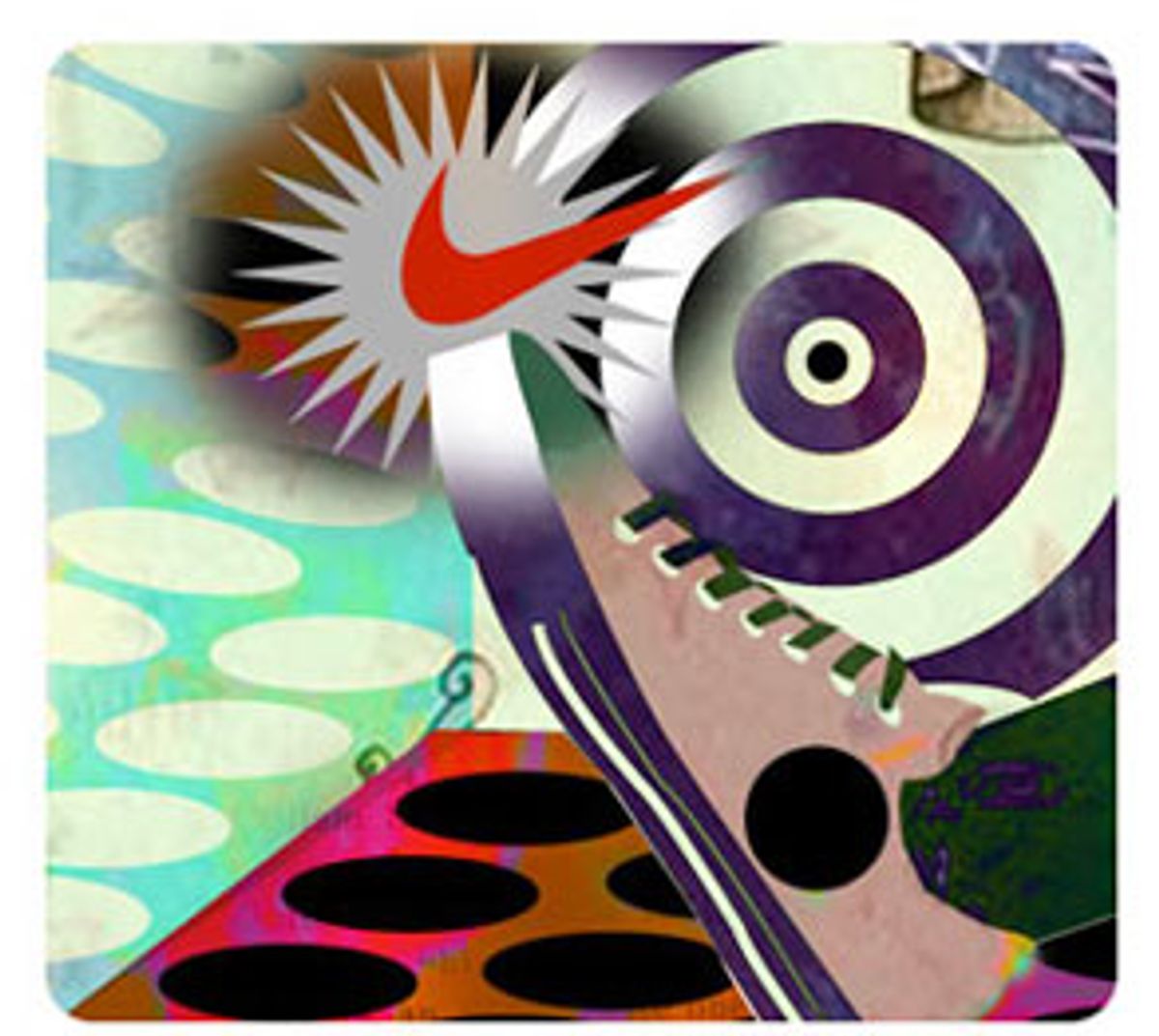
Are you ready for some “unswooshing”?

Adbusters founder Kalle Lasn aims to beat Nike at its own game, by selling "Black Spot" sneakers to consumers tired of shelling out for megabrands.

  • more
    • All Share Services

Are you ready for some

Kalle Lasn isn’t scared of the U.S. PATRIOT Act. “America has become a bit of a monster,” says the punchy, 60-something founder of Adbusters, the anti-consumption magazine based in Vancouver, B.C. “Some of the things the U.S. is doing, in Israel, in Cancún with the WTO, I just can’t take it any longer. It’s gotten to the point where I almost think I’ve become a terrorist.”

But Lasn is no Osama bin Laden. The author of “Culture Jam: How to Reverse America’s Suicidal Binge,” Lasn is one of the leading figures in the “culture jamming” movement, an international grassroots effort that uses the logic of commercial images to critique corporate hegemony and rampant consumerism. Under his leadership, Adbusters’ preferred method of culture jamming has been to publish ad parodies, such as “Absolute Impotence,” a photo of the familiar bottle drifting in spilled vodka, or a Nike satire that morphs Tiger Woods’ smile into a Swoosh.

Last month, Adbusters announced a new phase in state-of-the-art meme warfare. (“Memes” refer to the core images, slogans or ideas that culture jammers manipulate: e.g., a swoosh, or “Just Do It.”) Although the campaign’s targets, Nike and CEO Phil Knight, appear frequently in the magazine’s culture jams, the latest strategy moves Adbusters out of the realm of parody and into the competitive world of global marketing and production.

More specifically, the Adbusters Media Foundation, the nonprofit that brought the world Buy Nothing Day and TV Turnoff Week, has decided to go into the sneaker manufacturing business. According to Lasn, the plan is to market a “Black Spot sneaker, a shoe that will resemble the retro-style Converse but with one crucial difference. In place of the ubiquitous Nike swoosh, the Adbusters shoe will display a prominent anti-logo “black spot,” the magazine’s anti-corporate trademark.

“Phil Knight had a dream,” reads the, well, ad for the “Unswoosher,” located on the back cover of Adbusters’ October issue. “He’d sell shoes. He’d sell dreams. He’d get rich. He’d use sweatshops if he had to. Then along came a new shoe. Plain. Simple. Cheap. Fair. Designed for only one thing: kicking Phil’s ass.”

By January, the magazine plans to manufacture an initial line of 10,000 sneakers, which will retail globally for about $65 a pair. The release will follow a $500,000 marketing campaign, hyping the sneakers on CNN, in the New York Times, and on the major networks. “One of the many reasons I really love this campaign,” said Lasn. “Is that we are selling a product, not an idea or advocacy. We are selling a sneaker. So those stations that have systematically refused to sell us air time over the past 10 years for our ideas will now have no choice but to sell us air time.”

Since the nonprofit broke the news of the Black Spot late last August, Nike hasn’t exactly been shaking in its shoes. “As a global leader, it doesn’t surprise us that we occasionally get targeted by groups who use the strength of our brand to leverage their agenda,” said Caitlin Morris, senior manager of Nike corporate communications.

Reaction on the anti-corporate-globalization front has been mixed. Some question the wisdom of an anti-advertising magazine going into the advertising business, while others think Lasn would be better off targeting clothing manufacturers that don’t receive as much international scrutiny.

But for some heavy hitters in the no-sweatshop movement, the Black Spot couldn’t have come at a more propitious time — just days after the Converse brand sold out the “Chuck Taylor” shoe to Nike. For years, that was the sneaker of choice for millions opposed to megabrands churning out sneakers in Third World factories.

“The anti-sweatshop forces need a few alternatives in the marketplace,” says Jeff Ballinger, author of the original Harper’s Magazine 1993 exposé on Nike’s labor practices, and now vice president for policy and sourcing at No Sweat. “Kalle’s right to see that. I’ve given ‘sweatshop’ talks to a wide variety of groups for over a decade and one of the first questions is: ‘What can we buy?’”

Lasn admits the “ethical sneaker” may not succeed. Still, employing what appears to be a signature combination of brashness and nostalgia, Lasn said the time has come for a change in how activists deal with “rogue companies.”

“We got tired of all the lefty whining and the boycotting. It wasn’t making any difference,” he said. “Quite apart from how many percentage points in market share the Black Spot sneaker can take away from Phil Knight — that’s of course the ultimate goal but may be a long time coming — in the meantime, we can go a long way toward uncooling the Swoosh, which is losing momentum fast.”

“I have a grandiose plan,” Lasn said. “My dream as a culture jammer is that a small group of people with a limited budget could have the power to choose a megabrand we don’t like for valid reasons and uncool that brand, to show that we the people as a civil society have the power to keep a corporation honest. Now that would be something that would actually redefine capitalism.”

Adbusters, which has a circulation of 120,000, bills itself as the “Journal of the Mental Environment.” The magazine’s philosophy is that advertising encourages people to see themselves primarily as consumers, and its parodies reveal the “truth” behind slick corporate logos: the environmental and human costs of consumption, the abuses of corporate power, and private monopolization of public airwaves.

Lasn, whose descriptions of Knight as “that mind-fucking bastard Philly boy” bear a certain resemblance to the “axis of evil” rhetoric coming out of Washington, D.C., is the former head of a market research company in Tokyo. As a culture critic, his diatribes against Nike don’t focus on the athletic footwear corporation’s labor practices per se, but on the notion of branding in general and the “pseudo-empowerment” brand that Nike attaches to its products in particular. Citing research on the 3000 marketing images most people consume every day, as well as studies linking advertising to an increase in mood disorders, Lasn said rage against the toxic cultural clutter epitomized by Nike ads is going to launch a new kind of revolution.

“Twenty-five years ago we woke up to the fact that the chemicals in our food, water and air, even a few parts of a billion, actually will give you cancer,” he said. “That was when the modern environmental movement was born. Once people make that connection between advertising and their own mental health, that could be the birth of the modern mental health environmental movement.”

When that moment happens, said Lasn, “we will suddenly see the $400 billion worldwide industry collapse to half its size.”

But for some, Lasn’s railing against the Orwellian force of advertising is exactly what makes his decision to market a Black Spot sneaker a bit curious. After all, we live in a world where AIDS, crime and all sorts of global unrest have been turned into fodder for Benetton ads. The medium, as they say, is the message.

This is why people like Naomi Klein, Canadian author of the landmark text “No Logo,” aren’t quite so enthusiastic about the revolutionary potential of the Unswoosher. “Publications that analyze the commercialization of our lives have a responsibility to work to protect spaces where we aren’t constantly being pitched to,” she told the Toronto Globe & Mail. “This can be undermined if they are seen as simply shilling for a different ‘anti-corporate’ brand.” Lasn disagrees.

“Nike’s empowerment is pseudo-empowerment,” he says. “But if we are actually able to launch an anti-brand, then the empowerment around the black spot is actually a real kind of empowerment: the power of us the people to have a business climate that is to our liking. It’s the most beautiful kind of empowerment I can think of.”

Adbusters launched Buy Nothing Day, says Lasn. “But we never said it’s bad to buy something, just bad to buy too much.” What’s more, promoting the Black Spot sneaker will not be Adbusters’ first foray into “real” advertising. The magazine has been raising money to get a Black Spot ad, a series of anti-corporate, anti-U.S. phrases set to Jimi Hendrix’s rendition of “The Star Spangled Banner,” on television. Although all the major networks have rejected the ad, CNN has aired the Black Spot promo — during the Crossfire political debate program.

At Adbusters’ offices, located in a Vancouver residential district, the Unswoosher enterprise has something of a Mouse That Roared quality to it. A newly hired business manager is working on locating investors and distributors for the Black Spot. The magazine has already taken preorders for 1,000 pairs, and will use its nest egg of $250,000 to bankroll the initial 10,000 sneakers. According to Lasn, people are “coming out of the woodwork” to offer advice about where the Black Spot should be manufactured — and what kind of labor to use.

Industry watchers are skeptical. “[Adbusters] has absolutely no idea how complicated global production and marketing is,” says John Horan, publisher of Sporting Goods Intelligence. The magazine could save time and money, he suggested, by selling T-shirts emblazoned with “We want to kick Phil Knight’s butt” for $10 each.

Ignoring the naysayers, Adbusters has generated a final list of three possible factories: a factory in Missouri, referred by a former Nike employee who has inspected more than 70 factories worldwide, and two union factories in Asia: one in South Korea, and another in Indonesia. The latter were recommended by Jeff Ballinger, VP for sourcing and policy at No Sweat Apparel, the company Lasn has retained to help Adbusters source a union factory for the Unswoosher.

Lasn obviously relishes the idea of manufacturing the sneaker in Missouri. But just as he rejects the argument that there is something problematic about Adbusters advertising shoes, so he has contrarian things to say about some of the anti-sweatshop rhetoric governing the international workers’ rights debate. In particular, he says, the “go local” movement is overrated, propelled more by trade unions than activists.

“I have a huge amount of disdain for all those people who are trying to keep all the jobs in North America,” he said. “Here we are, the richest part of the world, we’re only 5 percent of people in the world, and all of a sudden we’re losing a few jobs and having a few doldrums in our economy. Let’s give the jobs to the Koreans and Indonesians. They need it more, and if we can find a good factory and if we could promote workers’ rights worldwide, all the better.”

The Estonian-born Lasn recalled a seminal trip he took around the Third World when he was in his 20s. “I know from personal experience that many of those factories that campus people dismiss as sweatshop labor are actually very good factories,” he says, “and that the people who live near those factories are just yearning to work in those factories. A good part of those sweatshop people are seriously misguided.”

If Lasn’s idea of pulling Third World workers up by their bootstraps mimics the language of liberal capitalism — not to mention Phil Knight — it’s also an idea that reverberates across segments of the no-sweatshop apparel movement.

“Globalization is an opportunity to globalize the labor movement,” says Ballinger. “Today, the only way to protect a worker’s job anywhere is to defend worker’s rights everywhere.” The Black Spot sneaker represents a clear step forward in the anti-sweatshop movement, says Ballinger. “If the union-made Black Spot sneaker can kick Phil Knight where he feels it — in the pocketbook, we won’t get more window dressing from Nike and Reebok; we’ll get a real change in policy.”

But Marsha Dickson, director of Educators for Socially Responsible Apparel Business, says the Black Spot campaign is naive in light of efforts that have been made by Nike and other members of the Fair Labor Association, a coalition of industry, university and nongovernmental organizations that issued its first public report in June.

“While the tracking charts clearly show that much work remains to be done,” said Dickson via e-mail, “the bottom line is that Nike, Reebok and Adidas are really acting as leaders. If a campaign such as [the Black Spot sneaker] is needed, it should focus attention to the thousands of clothing manufacturers and retailers that are not participating in the FLA. We know nothing or very little about how these companies treat the workers that make their products.”

The FLA was the recipient of the $1.5 million Kasky vs. Nike settlement in June. In 1998, Marc Kasky, a California anti-globalization activist, sued Nike for allegedly stretching the truth in its statements regarding contract factory labor practices in Asia. The California Supreme Court agreed with Kasky in a 4-3 ruling. Nike then appealed to the U.S. Supreme Court. Corporate interests had paid close attention to the case, in which Nike claimed that what it said — whether or not it was true — was noncommercial speech protected under the First Amendment.

At its Sept. 22 shareholders’ meeting in Portland, Ore., Nike stockholders celebrated their first protester-free gathering in several years. The footwear company registered a record $10.7 billion in revenue in its 2003 fiscal year, and its stock price increased 40 percent, to a high of $62.50 in late September.

Lasn, about to fly off to Indonesia in his newly minted role as factory inspector, is undeterred. The Black Spot sneaker, he says, is part of a larger goal to “tweak the genetic code of corporations”: an anti-corporate-globalization process that ranges from rewriting the rules under which corporate charters are reviewed and revoked, to a general “crusade against bigness.”

“I grew up in a time when cynicism didn’t exist,” says Lasn, “that hidden assumption that nothing can change, that you better get used to capitalism, and that cultural revolution is not even possible.”

“I don’t quite see it that way. I am old enough to have seen a number of cultural revolutions. I believe another one is coming up.”

This story has been corrected since it was originally published.

Linda Baker is a journalist in Portland, Oregon.

America’s road sign legends

Burma-Shave's rhyming ads turned highway billboards into poetry, and changed advertising -- and America

  • more
    • All Share Services

America's road sign legends
This article originally appeared on Imprint.

ImprintIn a simpler time, when automobiles went slower and the pre-Eisenhower highway system in the United States was less developed, there was a popular advertising campaign that ran from 1927 until 1963. It consisted of rhymed messages sequentially staked on the right side of the road, all ending with the advertiser’s name, “Burma-Shave.”

Examples of vintage Burma-Shave road signs, including a blue South Dakota version. (Ray Crockett photo)

These red ads (one state, South Dakota, insisted that they be dark blue to keep them from conflicting with the red reserved for warning notices) usually consisted of five signs. For example: “DON’T PASS CARS/ON CURVE OR HILL/IF THE COPS DON’T GET YOU/ MORTICIANS WILL/BURMA-SHAVE.”

Some slogans touted Burma-Shave as a pre-aerosol “brushless” shaving cream—a cream you could scoop out of a jar and lather onto your face without relying on an old-fashioned brush and moistened soap in a mug.


("Thoroly"? I guess if the word doesn't fit the composition, change the spelling. . .)

In 1925, Clinton Odell, a Minneapolis lawyer, took the liniment his father created and transformed it into a brushless shaving cream. He named his company Burma-Vita—Burma, because most of the essential oils in the liniment were from the Burmese portion of the Malay Peninsula, and Vita from the Latin for “life”: “Life from Burma.”

Some of Burma-Shave’s primary “brushless shaving cream” competitors were Barbasol and Noxema.

The company was sold to Philip Morris in 1963, and all the signs were removed soon thereafter. As a testament to the campaign’s cultural significance, a set of signs was donated to the Smithsonian, where it still resides. But the brand eventually petered out. After being sold yet again (this time to the American Safety Razor Company) and then reintroduced in 1997, it never regained a hold in the market.

A history of the Burma-Vita Company, written by Frank Rowsome Jr. and illustrated by Carl Rose, was published by the Stephen Greene Press in 1963.

By the early 1960's, the rising costs of road-sign maintenance (as well as new and more effective ways of advertising) sounded the death knell for the Burma-Shave signs.

The following pages from Frank Rowsome Jr.’s book list all the road-sign Burma-Shave phrases produced from 1927 to 1963.

Continue Reading Close

7Up’s branding revolution

How "Bib-Label Lithiated Lemon-Lime Soda" became one of America's most popular soft drinks

  • more
    • All Share Services

7Up's branding revolution
This article originally appeared on Imprint.

ImprintI became interested in pop bottles (I grew up in the Chicago area where we all said “pop”) and related stuff when I was about 12 years old. I had gone inside an old garage that was attached to a neighborhood house that was being torn down and inside was a cache of un-returned pop bottles that must have dated from the 1940-’50s period. I took one of each type home (about 20 of ‘em) and yes, still have them to this day. I really got off on all the different labels and colors of glass and because I used to like to read old magazines I actually recognized most of the brands that were no longer around or had changed their design. I’ll go into this more in a future post, but wanted to lay some sort of a foundation for this piece, which is exclusively on 7Up, with a special focus on their branding efforts of the 1950s.

The soft drink that would be known as 7Up was created in 1929 by Charles Leiper Grigg in St.Louis as part of his “Howdy” line of sodas and was originally called “Bib-Label Lithiated (it contained the mood stabilizer lithium citrate until 1950) Lemon-Lime Soda.” It was almost immediately re-labeled “7 (7 natural flavors) Up Lithiated Lemon-Lime,” and then finally just “7Up”.

The first 7Up logo from 1929.

In terms of logos, an original winged trademark soon gave way to the red squared logo that lasted until the late 1960s that coincided with that period’s brilliant “Uncola” re-branding campaign. I always felt they had GOLD in that Uncola moniker. . .

A 1935 7Up label before the Howdy Company's name was changed to 7Up in 1936, followed by two Howdy beverage labels.

By the late 1940s 7Up was the third most popular soft drink in the United States. By the time the 1950s rolled around, the company had employed extensive branding techniques to keep the momentum going. The following three binders contain examples of what was offered to the bottlers and distributors to reinforce the product’s presence.

A catalog of 7Up sales/marketing items circa 1954.

This page includes tipped-in glossy paint chips.

These next three pages would NEVER fly with the HR Dept in 2012. . .

Before everyone had TV's in their home, it was common to go out to watch television.

7Up Sales & Promotion Merchandise Catalog circa 1954 - 59.

(would love to have those binders. . .)

Actual cloth swatches included.

More swatches.

1959 "Salesmakers" Catalogue

2 actual decals using the older logo with the woman reaching for bubbles- love the way the color is broken down into separate shapes and levels.

Actual booklet attached.

"Fresh Up Freddie" was the 7Up mascot created in 1957 by ad agency Leo Burnett and Walt Disney to help sponsor the Disney "Zorro" TV series.

Here’s a link to more info on “Freddie”: http://www.cartoonbrew.com/disney/fresh-up-freddy.html

Remember, it's from 1959. . .

Ditto. . .

2 mid-1930's 7Up bottles.

Left: 1940's bottle with 8 bubbles on label. Right: 1950's bottle 7 bubbles.

"Like" was introduced in 1963 as a diet version of 7Up. It contained Calcium Cyclamate which was determined to be a carcinogen in 1969. "Like" was discontinued in that same year and Diet 7Up was introduced in 1970 sans the Cyclamates. This bottle is dated 1964.

Late 1960's/early 1970's can.

"The Uncola".

As a final footnote, I was lucky enough to work on spots for 7Up International using the Susan Rose/Joanna Ferrone character “Fido Dido”! Here’s one of my favorites done while I was at the Ink Tank Studio in N.Y.: http://www.youtube.com/watch?v=8JpHjeGXyw8

Copyright F+W Media Inc. 2012.

Salon is proud to feature content from Imprint, the fastest-growing design community on the web. Brought to you by Print magazine, America’s oldest and most trusted design voice, Imprint features some of the biggest names in the industry covering visual culture from every angle. Imprint advances and expands the design conversation, providing fresh daily content to the community (and now to salon.com!), sparking conversation, competition, criticism, and passion among its members.

Continue Reading Close

Pepsi’s creepy Jackson revival

A ghoulish new campaign brings him back from the dead. Maybe it's time to stop looking backwards

  • more
    • All Share Services

Pepsi's creepy Jackson revivalMichael Jackson (Credit: Reuters/Kimimasa Mayama)

As if Michael Jackson wasn’t creepy enough when he was alive. The self-proclaimed King of Pop, who died nearly three years ago, is making a return via a new Pepsi campaign. The fabulously un-self-aware tagline? “Live for Now.”

The corporation is set to festoon one billion cans of Pepsi around the world – that’s one billion cans – with the singer’s unmistakable silhouette. It’s a bold move for a company whose most famous association with Jackson is that back in 1984, his hair caught fire filming a commercial for them. Jackson’s estate orchestrated his sponsorship resurrection, and a family spokesperson confirmed to the Wall Street Journal Thursday that “more such marketing agreements are planned.” Did anyone else just feel that collective shudder of revulsion?

Even dead, Jackson is a massive draw. He’s currently the subject of a global Cirque du Soleil tour with the horror movie title “Immortal.”  And Pepsi knows that overseas – especially in markets like Asia — his brand is as ubiquitous and American as well, cola.

Bringing back the dead is a peculiar – if increasingly common – gambit. Now that the earth has run out of living celebrities, they’ve had to revive Tupac to perform at Coachella  and Grace Kelly to make kissy face with Charlize Theron to sell perfume.  They even had to dig up Martin Luther King Jr., to pitch for Mercedes-Benz.

There comes a time when a celebrity passes into our iconography. Today, seeing the images of Elvis and Marilyn and James Dean in different pop culture contexts barely seems any stranger than fake Abraham Lincolns selling cars in February. And why wouldn’t Jackson’s people wring a few more opportunities out of his incredibly lucrative image? Somebody’s got to pay for all those $10 million mansions.

Senior PepsiCo marketing executive Frank Cooper told the WSJ that the new campaign will be both “respectful” and “forward looking.” It may be respectful. But there’s nothing “forward” about the dead. Jackson’s image survives as an easy symbol of pop music, but the man whose life ended from propofol intoxication three years ago, whose doctor is currently serving time for involuntary manslaughter, couldn’t seem less like the right spokesman for the notion of “living for now.”

Continue Reading Close
Mary Elizabeth Williams

Mary Elizabeth Williams is a staff writer for Salon and the author of "Gimme Shelter: My Three Years Searching for the American Dream." Follow her on Twitter: @embeedub.

Ashton Kutcher’s brownface fail

The actor's racist ad is pulled -- but what's left isn't much better

  • more
    • All Share Services

Ashton Kutcher's brownface failAshton Kutcher

Somewhere, Charlie Sheen is laughing and saying, “At least I never did that.” This week, we learned what’s even less funny than Ashton Kutcher: Ashton Kutcher in brownface.

In an ill-advised Popchips ad spoofing online dating that launched Wednesday, the “Two and a Half Men” star appeared as a variety of love-hungry “World Wide Lovers” vying for your affection. In a spectacular display of racial tone-deafness, one of them included “Raj.” Raj, all darkened skin and heavy accent, is “a Bollywood producer looking for the most delicious thing on the planet.” He’s looking for something “Kardashian hot … I would give that dog a bone.” He brags that he once won a milking contest, and he does a little dance that will haunt your nightmares.

Shockaroonie, some people found this offensive. The ad went the wrong kind of viral, with a social media explosion of negative feedback. It’s not that comedy with a racial element is always wrong wrong wrong. The Jewish Hank Azaria is currently in his third decade of playing the Indian Apu Nahasapeemapetilon on “The Simpsons,” and nobody seems to be outraged about this. Kutcher’s incredibly unnuanced performance isn’t that, though. On his blog, writer Anil Dash explains it perfectly –  “a fake-Indian outfit and voice” constitute “the entire punchline” of the clip. And, as he eloquently put it, “I can’t imagine I have to explain this to anyone in 2012, but if you find yourself putting brown makeup on a white person in 2012 so they can do a bad ‘funny’ accent in order to sell potato chips, you are on the wrong course. Make some different decisions.”

And so that’s what Popchips is trying to do. On Wednesday, in a “message from Keith” on the company’s website, its founder, CEO and foe of proper capitalization Keith Belling wrote, “we received a lot feedback about the dating campaign parody we launched today and appreciate everyone who took the time to share their point of view. our team worked hard to create a light-hearted parody featuring a variety of characters that was meant to provide a few laughs. we did not intend to offend anyone. i take full responsibility and apologize to anyone we offended.” That’s a constructive, self-aware response to a potential public relations disaster. (Kutcher, who in recent months has been tainted by his hasty Twitter support for Penn State coach Joe Paterno and a divorce that featured rumors of unprotected extramarital sex, has so far had no comment on the problematic ad campaign.)

It’s a positive thing that Popchips understood its mistake and made an immediate effort to rectify it by pulling the ad. That step forward is mitigated somewhat, though, by the a large number of “get over yourself” responses on Anil Dash’s blog. We’ve still got much work we need to do in this country around issues of stereotypes and sensitivity, folks.

You don’t have to look any further than the entire Popchips campaign to see what I mean. Its remaining “World Wide Lovers” include the stoner Brit “Nigel,” who’s “seeking higher planes of consciousness” (GET IT????), the effeminate German “Darl” — a swishy riff on openly gay designer Karl Lagerfeld — and the dumb redneck “Swordfish.” In the end, there’s also regular old, newly single Kutcher, who describes the other guys in the club as a “freak show.” Hey, geniuses at Popchips – you’re still perpetuating gross generalizations. Also: They’re not funny. It’s a great big snack-loving country. Being cool about brown people – and gay people, and people others would call “white trash” – shouldn’t be such a crunch.


Continue Reading Close
Mary Elizabeth Williams

Mary Elizabeth Williams is a staff writer for Salon and the author of "Gimme Shelter: My Three Years Searching for the American Dream." Follow her on Twitter: @embeedub.

FCC takes on super PACs

The commission voted to require stations to post political ad data online -- but it won't be searchable

  • more
    • All Share Services

FCC takes on super PACs (Credit: Screenshot from American Crossroads anti-Obama ad)
This originally appeared on ProPublica.

The Federal Communications Commission voted 2 to 1 this morning to require broadcasters to post political ad data on the Web, making it easier for the public to see how as much as $3.2 billion will be spent on TV advertising this election.

The files — which, among other information, detail the times ads aired, how much they cost, and whether stations rejected ad buy requests from campaigns — are currently available only on paper at stations.

The FCC rejected a push by the industry to water down the measure. But the rule as passed also has serious limits. For example, the data will not be searchable or uploaded in a common format.

The rule will first apply to affiliates of the four major networks (ABC, CBS, NBC and Fox) in the top 50 TV markets. All other stations will have until July 2014 to come into compliance.

“[L]arge areas of some swing states, like Virginia, Missouri, Wisconsin and Michigan, could see an influx of advertising in markets outside of the top 50,” the Sunlight Foundation noted in an analysis today. It was also not immediately clear exactly when the rule will go into effect for the top 50 markets.

Then there’s the crucial question of the format in which the files will be available. FCC spokeswoman Janice Wise told ProPublica that the commission is not creating a searchable database of the political ad files.

“We’ll accept whatever [file] format they provide,” she said in an email.

That will make it much more difficult to analyze the information.

Wise said there are no specific plans to make the database searchable.

By opting to allow stations to submit political data in any format, the commission departed from a recommendation made last year by in an FCC working group report.  The report called for the political file to be put online and that “as much data as possible [be] in a standardized, machine-readable format” that “could also enhance the usefulness and accessibility of the data.”

Also not clear is how the broadcast industry, which vigorously lobbied against the rule, will react.

“[W]e will be seeking guidance from our Board of Directors regarding our options,” the National Association of Broadcasters said in a statement decrying the vote.

In March, the industry group submitted a filing with the commission raising “serious questions about the FCC’s authority” to require stations to put political ad data online.

“That was written as a legal memorandum, which is code for, ‘We’ve lawyered up and we’re ready to sue over this,’” says Andrew Schwartzman, a longtime FCC watcher at the Media Access Project.

The broadcasters’ group declined to comment beyond its statement.

On a Thursday earnings call for Belo Corp., one of the companies that has been fighting the disclosure measure, CEO Dunia Shive suggested that broadcasters would continue to fight the new disclosure rule.

“I don’t think the conversation is over with respect to being able to continue talking about if we will ultimately have to include ad rates online,” she said, Broadcasting & Cable reported.

Belo spokesman R. Paul Fry told ProPublica that the company merely “want[s] to continue the dialogue on this subject.”

The FCC also said today it would review the new rule after a year to see if any changes need to be made before all stations will be required to come into compliance in July 2014.

Continue Reading Close
Justin Elliott

Justin Elliott is a reporter for ProPublica. You can follow him on Twitter @ElliottJustin

Page 1 of 66 in Advertising