Whitney Joiner

The Army be thuggin’ it

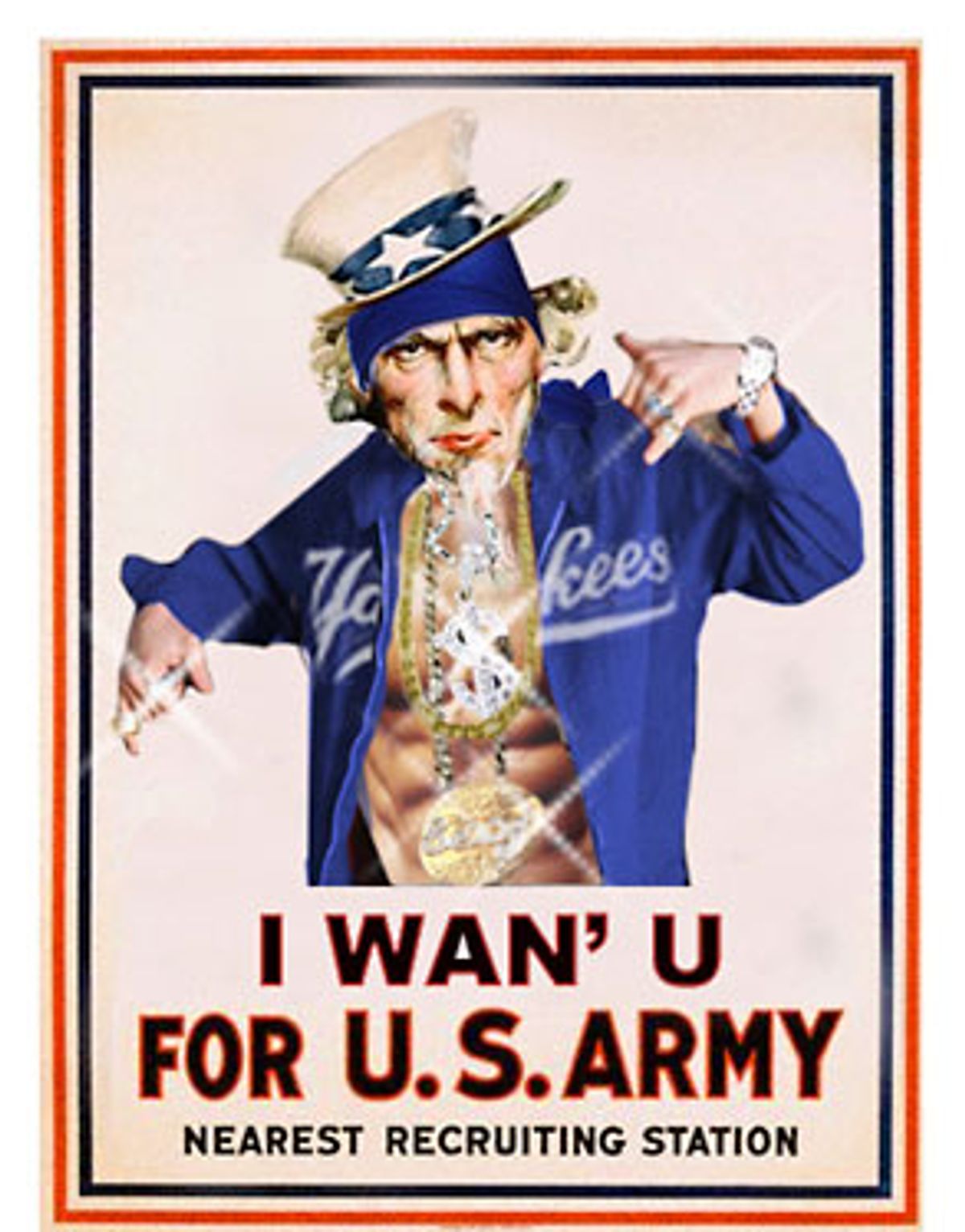
The military is teaming up with hip-hop bible the Source to recruit black urban kids with pimped-out Hummers and off-da-hook merchandise.

  • more
    • All Share Services

The Army be thuggin' it

Three times a week, 48 weeks a year, a four-man team drives a huge yellow Hummer to a different location. It might be a college or high school campus, a major fraternity gathering, an NAACP event, MTV’s Spring Break, or BET’s Spring Bling: If lots of African-American teens will be there, the Hummer wants to be there, too.

Spray-painted with patriotic images (a rippling American flag, a smiling white woman in a U.S. military officer’s uniform), the yellow Hummer is the signature vehicle for the U.S. Army’s “Taking It to the Streets” campaign, a hip-hop-flavored tour launched a year ago by Vital Marketing Group, the Army’s African-American events marketing team. During these events, the Taking It to the Streets team lets possible recruits hang out in the Hummer, where they can try out the multimedia sound system or watch Army recruitment videos. The Army’s team often throws contests, too: Which possible recruit can shoot the most baskets, do the most push-ups, go up the rock-climbing wall the fastest? The winners are awarded Army-branded trucker hats, throwback jerseys, wristbands and headbands. Want a customized dog tag? They’ve got a machine that makes them. Want to see what it’s like to fly a plane? There’s a flight simulator.

It’s all to convince urban teens that the Army understands hip-hop culture: The Army knows you play basketball and wear jerseys, because the Army is down with the streets.

“You have to go where the target audience is,” says Col. Thomas Nickerson, director of strategic outreach for the U.S. Army Accessions Command, who says that the Army just reached its recruitment goal of 100,200 enlistees this year. “Our research tells us that hip-hop and urban culture is a powerful influence in the lives of young Americans. We try to develop a bond with that audience. I want them to say, ‘Hey, the Army was here — the Army is cool!’”

But critics say that the Army’s co-optation of hip-hop in its streetwise campaign is misleading, because it markets a life-changing and possibly life-threatening commitment as a fun, cool consumer choice. And some, like Rep. Charles Rangel (D-N.Y.), who argued for a reinstatement of the draft in January, voice concerns about the overrepresentation of people of color in the Army.

“One of the reasons why I advocated the draft is because, in terms of a national crisis, we should have shared sacrifices,” Rangel says. “When the government says we have to stay in Iraq, we have to show that we’re prepared to lose lives, the ‘we’ should be a broad cross-section of America. They’re not asking all of America: They’ve targeted those Americans who are not getting a fair shake in our society.”

African-Americans and Hispanics are consistently overrepresented in the armed forces. Even though the numbers have evened out a bit this year, the 2003 Army is 16 percent black, compared with 11 percent of the country, and 13.4 percent Latino, compared with 11 percent of the country.

The Vital Marketing Group is about to take its recruitment campaign for African-Americans a step further by teaming up with hip-hop bible the Source. This fall, Vital will launch a new tour separate from the Taking It to the Streets campaign: The Source Campus Combat Tour will start in late October, hitting five Northeastern college campuses with high percentages of African-American students. Like Taking It to the Streets, the Campus Combat Tour will feature interactive exhibits and physical challenges, but Campus Combat culminates in a grand MC battle judged by the Source’s editors.

“When I saw the Source was teaming up with the Army, I was outraged,” says Bakari Kitwana, former executive editor of the Source and author of “The Hip-Hop Generation: Young Blacks and the Crisis in African-American Culture.” “It’s a betrayal of their readership. The military has historically used African-Americans, while the country has not done justice to African-Americans.”

Niche marketing to minorities is a recent development for the Army. Two years ago, the Army’s newly hired advertising agency, Leo Burnett, threw out the stale 20-year-old “Be All You Can Be” tagline and replaced it with a jazzy new campaign called “Army of One.” This heavily researched and focus-grouped motto — emphasizing the Army’s recognition of each soldier’s individual talents — and its accompanying advertising blitz are especially geared toward the short attention spans of the 72 million Generation Yers. “It’s becoming really difficult to establish brand loyalty, because kids are bombarded with multiple messages,” says Joseph Anthony, CEO of Vital. (According to American Demographics magazine, the average teen takes in 3,000 marketing messages a day.)

To compete with all the other brands vying for kids’ attention, the Army launched a dynamic, interactive Web site with a strong cyberrecruiting team, multilingual chat rooms, a downloadable “America’s Army: Operations” video game, and new commercials focused on Army skills that easily translate to civilian life. And there are Army of One campaigns tailored to specific groups. Muse Cordero Chin, the Los Angeles-based agency that heads up the African-American-geared ad campaign for Leo Burnett, will roll out print and TV ads predominantly featuring blacks early next year. (Muse works closely with Vital, which creates and markets the campaign’s events.) San Antonio’s Cartel Creativo has developed Spanish and English ads featuring Latin music for the Hispanic community. And for the past year the Army has sponsored a NASCAR car and recruited at races; the mostly white, rural NASCAR audience has already generated over 40,000 leads for the Army.

Companies discovered a long time ago that utilizing hip-hop culture — the musicians, the clothing, the lifestyle, the accoutrements — is the ticket to selling products to teenagers. Sprite’s sales skyrocketed after it launched its “Obey Your Thirst” campaign geared to urban youth. When Tommy Hilfiger’s clothes became popular with rappers, his sales shot into the billion-dollar range. McDonald’s just signed Justin Timberlake, the poster boy of white soul, to do a hip-hop jingle, produced by the superstar duo the Neptunes. While most hip-hop advertising is an attempt to attract both those who live the hip-hop lifestyle and those who just covet it — the Army is specifically targeting black youth with their new Source-sanctioned campaign. Since everyone else is marketing with hip-hop — and since it works — why shouldn’t the Army?

A majority of African-American kids are hip-hop fans, so marketing with hip-hop just makes good business sense, says Vital’s Anthony. “[This campaign says] ‘We want to come to your environment instead of trying to get you to come to ours,’” he says. “The Army wants to better understand your community.” (It helps that all of Vital’s employees are young and black, Anthony says. “The African-American market is more responsive to marketing that’s communicated to them through people who look like them. There’s more of a trust factor there.”)

Everything about the campaign, down to the headbands and Army jerseys, should send that message. “Those are big fashion statements in the urban community right now, but before [Vital] was involved, those types of premiums didn’t exist,” says Anthony. “We’re trying to make the Army more relevant and utilize more of these trends. If we make Army apparel a part of their wardrobe, it just creates a connection. They’re able to see the brand in a different light, as cool.”

Vital has big plans for the partnership with the Source. It doesn’t stop with the Campus Combat Tour: Vital hopes to use the 488,000-circulation subscription list for direct-marketing campaigns, create some cross-branded Web sites, throw more Source-branded events, and possibly even appear in the editorial content of the magazine; eventually, there may be reader contests in which the winners will appear in the Source.

Right now, the partnership is in a test period, says Anthony, to “see how the relationship bears fruit,” but both the Army and the Source say they hope to expand the tour next year. And Vital wants to partner with other “urban platforms,” like Vibe magazine and BET — albeit cautiously. “We don’t want to come out of the gate seeming as if we’re trying to buy our way into urban culture,” Anthony says, “and we don’t want our media partner to be perceived as if they’re selling out for money.”

But what if that happens? “We’ve just got to try and position this as a monumental shift in the U.S. Army’s ideology in approaching urban youth,” he says.

Besides the Source tour in the Northeast and the nationwide Taking It to the Streets campaign, Vital produces another recruitment tool for the Army, a comedy tour that travels to historically black colleges in the Southeast. But Campus Combat is the only tour with another well-known and respected brand attached. And that’s critical: It’s not easy to convince a bunch of African-American teens that the Army might be their best career choice, but with the Source, the oldest and best-known hip-hop magazine, behind it, the Army gains some much-needed street cred.

“It gets us access,” says Col. Nickerson, of the Army-Source partnership.

It makes sense that the Army’s looking to hip-hop to attract urban youth, says Craig Werner, a professor of Afro-American Studies at the University of Wisconsin-Madison. “They know that to sell themselves they need to plug in with the culture,” he says. “The Army has been the most egalitarian institution in the U.S., bar none, since the desegregation during the Korean War. If an African-American kid is looking for a career in which talent and character will be rewarded, there’s no better place than the Army. Having said that, I find the whole thing pretty disgusting. It’s an attempt to capitalize on desperation. We’ve created a job market in which [young African-Americans] don’t have a damn chance.”

The overrepresentation of minorities in the Army is often cited as proof of the continuing struggle for people of color in the mainstream economy. The Army needs to target ethnic groups, says Kendall Martin, account supervisor at Muse Cordero Chen, because it needs to “mirror” the country. “The Army wants to make sure it improves on representing all groups,” he says. “The Army wants to look like America.”

But the Army doesn’t really look like America, and with a volunteer service, it never will. And considering that one of the Army’s main draws is money for college, it’s definitely not economically diverse; kids who don’t need those incentives aren’t as enticed to enlist.

“If you’re a middle-class black kid, you’re not enlisting, any more than any middle-class white kid is enlisting,” Werner says. “The Army has nothing to do with the general profile of American culture. It’s lower middle class, disproportionately black and brown, and disproportionately Southern and rural.”

Nickerson says he doesn’t have any information on the socioeconomic demographics of the Army’s enlisted men. “We don’t focus on economic backgrounds,” he says. “If you qualify to join the Army, I don’t care what your economic or social status is.”

Since the campaigns tailored to minorities were launched only this past year, it’s too soon to measure their impact. But the Army has hit its quota of enlistees — before deadline — three years in a row.

“I think you underestimate the commitment of young Americans,” Nickerson says, when I ask how the Army can possibly hit its numbers given the combative state of global affairs. (After all, you’ve got to wonder if the flashy ad campaigns and free headbands will keep recruitment numbers up as the body count in Iraq continues to rise.) “We’ve got the best recruiting force in the world. We’ve got a soft economy, and we’ve got opportunities that resonate with young Americans.”

For people of color, the economy’s slide has been especially hard: Last month’s census data saw poverty numbers rising for all Americans, but especially for blacks. A quarter of African-Americans are living in poverty.

It’s one of the reasons why the Army-Source campaign infuriates Kitwana. “The Army is providing jobs, and I think that is a good thing, but we have to put that in context: Why does our country not have jobs for young people?” he asks, pointing out that unemployment rates for black youth are twice the rates for whites.

“One of the things that [African-Americans in the Army] complain about is that we’re over here helping these people, and that’s all good, but when we come back home, the hood is fucked up,” says Kitwana, who researched the military’s economic effect on young African-Americans for “The Hip-Hop Generation.” “We can be using this same energy to get drugs out of our community, to redevelop the economic infrastructure. It feels empty, as important as it is, to know that we’re going back home to that.”

“Look at it as the Army returning to that community a better person and a leader in that community,” counters Nickerson. “Young Americans who join the Army leave the Army a better person.”

Chris White, the Source’s vice president of corporate sales, says there’s nothing to criticize about its partnership with the Army. The Source is just helping an important Source advertiser get its message out to kids. “The Army has made a very strong advertising commitment for the year,” he says, adding that these days, advertisers are more interested in marketing partnerships, like the Army-Source deal, than just buying ad pages. “Clients want more than just an ad page in a magazine,” White says. “This is our first foray into doing cool marketing programs with the Army, and it’s our hope that it leads to a bigger relationship.” (Calls to the Source’s editorial staff were not returned.)

The Nappy Roots, one of this year’s most popular hip-hop groups who traveled to the Middle East this summer on the USO tour, don’t see a problem with the use of hip-hop in the Army’s campaigns. “I think a lot of poor folks go into the service because that’s the only way out for a better education, better jobs, and seeing the world,” says the Nappy Roots’ Big V. “It’s their only way to travel. Everybody can’t be a musician or a successful doctor or lawyer.”

Some young people in the Army’s target demographic agree: “The Army gives young people opportunities, especially urban people,” says Sterling Canter, 23, of Brooklyn. “It’s not all about killing. There’s an upside to it.”

“Joining the Army is a personal choice,” agrees Devon Edmeade, 25, also of Brooklyn. “Even if Jay-Z was passing out enlistment papers, I’m not joining. But still — it’s a choice. They use hip-hop to market beer and clothes. So why not the Army? I think it’s cool.”

But isn’t it a paradox that hip-hop — now a culture, but one based on a genre of music rooted in inner-city resistance to the white majority — is being used to sell the military to African-Americans? Well, sort of, say critics like Werner and Bakari. In many ways hip-hop’s past has little to do with its present. The last decade has seen hip-hop evolve from gangsta rap, which reveals the hard-knock life of the projects, to a celebratory bling-blingism that fetishizes personal acquisition and the lifestyles of the rich and famous. From Biggie Smalls’ yacht cruise in 1997′s “Hypnotize” (arguably the watershed moment for the so-called bling-bling era) to Busta Rhymes’ shill for his favorite liqueur in 2003′s “Pass the Courvoisier,” it’s a bit hard to argue that hip-hop shouldn’t be used for marketing purposes, or to draw the line between acceptable or unacceptable uses of hip-hop.

“What has hip-hop been used for? To market mainstream capitalist culture,” says Werner. “The contradiction is that mainstream capitalist culture is what’s keeping those kids who need the military as an escape poor. The capitalist system wants to create a desperate labor market. It wants to create a situation in which a whole lot of people with real talent are so damn desperate just to make a living that they’re not going to think about the terms on which they’re offered that living. You’re signing up to perpetuate the same system that put you in the position where you had no alternative except to sign up.”

Franz Mullings, 20, a student at the New York City Technical College, agrees. “I don’t think they should exploit hip-hop to get people to join the Army,” he says. “Hip-hop’s not what the government is about. They don’t care about people in the hood. They don’t come around when things are going down. They shouldn’t exploit our culture.”

It’s not the Army’s place to address or solve these issues, says Muse Cordero Chen’s Martin. “I know very few marketing campaigns that have been able to vault over and satisfy solutions for specific larger social problems,” he says. “Our goal is to present the Army as an option for career advancement, as a life alternative, and as a way to represent one solution out of many for African-Americans specifically. If someone’s looking for a way out of their current position, the Army presents a very compelling argument.”

For Rangel, it’s not just the message — it’s the medium. “It’s so unfair to people who don’t have an even playing field in this country to give them the option to run around in Hummers and play hip-hop games,” he says, “when, at the end of the day, what you’re talking about is putting their life on the line.”

The yogification of America

How one 19th-century Midwesterner got us all doing the downward dog -- and paved the way for puppy yoga

  • more
    • All Share Services

The yogification of America(Credit: © Nicole S. Young)

By now it’s safe to say that the Great Yoga Takeover of America is complete. According to a 2008 Yoga Journal study, 15.8 million Americans engage in some form of the ancient Indian physical and meditative practice, spending almost $6 billion a year on yoga classes, mats, DVDs and exotic retreats. There’s yoga for couples, yoga for babies, yoga for dogs. (As the New York Times reported recently, there’s already a scrappy, populist yoga-for-the-people movement afoot, a backlash against the steep price tag of upward of $20 for a 70- or 90-minute class.)

But how, exactly, did yoga become so firmly entrenched in American culture? While its explosion is certainly a product of the last few decades, it still comes as a surprise — given its massive popularity — to find that not so long ago, yoga was considered dangerous, possibly evil, and certainly a threat to the chastity and delicate nature of American women. Yoga as home-wrecker? That’s a new one.

It’s all thanks to a man named Pierre Bernard, writes Robert Love, a magazine editor (Rolling Stone, Best Life) and professor at the Columbia University Graduate School of Journalism, in his fascinating new book “The Great Oom: The Improbable Birth of Yoga in America.” Born Perry Baker in Leon, Iowa, in 1876, Bernard started to study yoga — both the physical poses, and a number of mystical spiritual teachings — in his teens, working with a Syrian Indian teacher named Sylvais Hamati. After bringing yoga to the hypnotism-, occult- and magic-obsessed 1890s San Francisco, the charismatic and controversial Bernard eventually settled in Nyack, a town up the Hudson from New York City, where he opened an ashram that drew Broadway performers, prizefighters, British spies and a number of wealthy heiresses. He was derided as a fake and a charlatan by his critics, and deemed a guru by his followers, but without Bernard, nicknamed “the Great Oom” by the New York press, we might not be heading to our Saturday morning classes today, mats under our arms, ready to practice.

Salon spoke to Love over the phone about his new book, Bernard’s colorful life story and his influence on yoga today — and what he might think about those yoga-for-dogs classes.

The story of how you came to write “The Great Oom” is a colorful and fascinating tale on its own. How did you come to learn about Bernard?

When my wife and I moved into this stone cottage overlooking the Hudson, we found mystic symbols carved into the walls: on the back of the bathroom door there was a lion-headed snake, and an ankh carved into the granite above the front door. That tipped us off that there was something unusual about the house. And then our neighbor told us about this so-called father of yoga who had operated just down the hill from where we live.

He seems like such a product of his time: 1890s to 1920s America. What was happening then that allowed Bernard to prosper and gain a following?

Bernard devoted his entire life to teaching hatha yoga in America, from the time that he was a young man in San Francisco in the 1890s to 1955, when he died. When he grew up there was a fascination with the occult: secret powers and the ability to change the material world in front of people. The perception of yoga at the time was limited to photographs and stories of Indian yogis who could do fantastic feats of asceticism, lying on the proverbial bed of nails, hanging on a hook over a fire, in some ways mortifying the body. While Bernard seemed to have a great respect for the other powers of yoga, he did deal with the esoteric and occult trappings associated with it; he gave demonstrations of trances in which needles were passed through his cheek and tongue and ears without any evidence of feeling pain. That was one of the first ways he came to the public’s attention in 1898, when he gave one of these demonstrations and made the New York Times.

And the idea of these unseen powers was in the air at the time. Hypnotism was an obsession. We’d just come from inventions like the telegraph, in which invisible energy was conducted over wires; nobody knew the extent to which other marvelous invisible powers could be had.

How did he manage to change the public’s perception of yoga?

At the same time that he was pitching the occult powers associated with yoga, he was also ministering to the rich and wealthy in terms of being a health guru, helping them with physical and psychological problems. He always played both sides of yoga’s appeal to the public.

He was not only teaching yoga’s health benefits but he was teaching it in classes, in the Tantrik Order, a secret society he started in San Francisco. It was kind of ordered on the model of the Freemasons and the theosophists, but it was a way of teaching yoga without saying the word “yoga.”

The Tantrik Order was a secret society, and yet his mission was to popularize yoga. How does that make sense?

I don’t think you do square it. In Bernard’s life, you can kind of trace the path of yoga as it was perceived in America, from the hidden and occult view of it to the acceptance of it as a form of therapy for health. By the 1920s he’d put the Tantrik Order aside; it wasn’t the main focus of his operation. When he moved up to Nyack, it was all about fresh air, cleanliness, hygiene and yoga as part of a full, well-lived life. He turned from the occult toward the idea of yoga as therapy, as sanctuary from a stressful world — in the same way that yoga itself, or the way that we perceived it, has morphed.

Back then, yoga was actually perceived as a slippery slope to moral downfall, especially for women. Why?

It’s fair to say that there was an American war against yoga in 1910 and the years afterward. Yoga had morphed from being the pastime of harmless eccentrics to something that was dangerous and subversive and possibly hurting the virtue of American women. It was based on some cases in which women gave away some amount of their fortunes to Indian swamis. In 1911, the Washington Post reported that the government was looking into this, conducting investigations. And certainly the fear that it was unleashing the sexuality of women. In the 1910s, the exoticness of it, the Orientalness of it, always came associated with loose sexuality. This wasn’t American Christianity.

Bernard was arrested in 1910, at exactly the time of the passage of the Mann Act (the White-Slave Traffic Act), and charged with inveigling women into his den of sin for the purpose of sexual intercourse. He was thrown into jail in 1910 and spent the entire summer. He was released later in the year, and the charges were ultimately dropped. The entire nation was seized by this fear that there was a conspiracy of foreigners to steal American women. There were purity and vice commissions set up around the country.

What were these turn-of-the-century yogis looking for?

We think people who lived 100 years ago were not stressed out, but they were. People came to him for all kinds of medical and stress issues. He turned around people who were in trouble physically or mentally, and promised peace of mind and the ennobling of the spirit.

Today, part of what makes yoga so popular is its vague spirituality, a kind of free-floating message about acceptance and oneness. How does that connect to what he was teaching then?

What he believed was a kind of amalgamation of Hindu tantric beliefs. It was centered on worship of Shakti, the feminine power and regeneration principle. A kind of a worship of the body was at the heart of Bernard’s beliefs. Also, that all truth is sacred, that nobody really has a direct line on truth, that it’s there in Hinduism and Buddhism and Christianity. There was never any dogma attached to what Bernard taught; it was a practical spirituality that gave results — making it very modern, related to the mind-cure movement at the time and to the New Age movement of today.

That’s the thing that’s wonderful about yoga. It’s a step-by-step practical spiritual philosophy. He saw it that way, and that kind of hooks it up to the way we think about it. He was the guy that made yoga safe for America, and vice versa, in many ways.

Today, yoga is a spiritual and physical cure-all, a panacea for everything that ails us. And it’s a huge commercial industry. There’s even yoga for dogs, and babies. What do you think he’d make of what yoga has become?

Part of his influence was that he did set the stage for the commercialization of yoga. But he himself catered to the carriage trade. His life was based on an American model of the guru-student relationship; most of the people who came to the club had personal relationships with him. They weren’t just students; he was their guru. I think he would’ve turned up his nose at the variations of yoga — dog yoga, things like that.

Did the yoga he taught actually look like what we know of yoga today?

There are no films of it, but there are photographs of people doing the asanas that we would recognize today.

It was fascinating to see him develop in the same kind of guru vs. huckster dynamic we’ve seen in other controversial religious and spiritual figures who’ve brought Eastern spirituality to the West. In your last chapter, you ask whether he was a genius or a fraud, but you don’t come down specifically on one side or another. What is your baseline feeling on Bernard?

I don’t think you can call him an out-and-out fraud, or a charlatan, and I certainly think you can call him one of yoga’s pioneers in America, and also someone who cared deeply about yoga and made it his entire life’s mission. Did he do things that were immoral or illegal at certain times in his life? He did. He was a rogue with a scandalous past. He wasn’t a devil, and he wasn’t a saint.

Besides the same physical practice, do you think the same spiritual strains are here now?

That’s a hard question to answer, because what is the spirituality of yoga? There’s a gauzy spirituality that yoga classes come wrapped in, but it’s not a hard-edge spirituality with very much discipline besides getting to class, as far as I can tell. Yoga absolutely came from a spiritual discipline in India, so it’s not surprising that it has spiritual components; we have tended to concentrate on the physical aspects of yoga in America and seem to, only lately, be more interested in the spiritual side.

Continue Reading Close

Not quite Americans

Sexual assault, enslavement, no medical care -- Peter Orner, author of an oral history of illegal immigrants, discusses the nightmares experienced by this vulnerable population.

  • more
    • All Share Services

Not quite Americans

The small Texas town where I live, Marfa, is the home base of one of the largest U.S. Border Patrol sectors, covering 165,000 square miles and encompassing 25 percent of the U.S.-Mexico border. From my house, I can hear the Border Patrol headquarters’ intercom, alerting agents to calls on line two or line three; their green and white patrol cars are everywhere, around town and throughout far west Texas. It’s a daily reminder that we are living on the edge of a line in the desert, a line that Homeland Security is vigilant about protecting — keeping certain people in and certain people out. A line that migrants will spend thousands of dollars, countless days and untold psychological turmoil trying to cross in an attempt to make it into America.

So it’s fitting that writer Peter Orner was recently working in Marfa as a writer-in-residence for the Lannan Foundation, a literature and arts foundation in Santa Fe, N.M., that offers a residency program here. While Orner is a celebrated novelist and short-story writer — his novel “The Second Coming of Mavala Shikongo” was a 2006 Salon Book Award winner — his new book, “Underground America: Narratives of Undocumented Lives,” marks his departure from fiction. (“Underground America” is the third of the McSweeney’s Publishing “Voice of Witness” books, a series dedicated to documenting social injustice through oral history.) Through 24 narratives, Orner, who edited the book and led a 22-person interviewing team, gives voice to a small handful of the millions who’ve illegally crossed into this country.

We hear about these migrants on the news: We watch pundits discussing immigration, we see videos of walls on the Mexican border, we know that they are here. But what do we know of their daily lives: Why they came to the United States? What they left behind in their home countries? In “Underground America,” Orner and his co-interviewers attempt to answer those questions. The stories are heartbreaking and human. “My only crime was working hard,” says “Diana,” a 44-year-old Peruvian migrant working in post-Katrina New Orleans. Eventually caught by immigration officials who refused her access to a lawyer, she was detained in a prison, wearing shackles and chains, and allowed to shower only once a week. After struggling in poverty in Guatemala, 28-year-old “El Curita” came to the U.S. dreaming of a better life; he worked as a housepainter for an American woman who used his lack of legal papers to force him into domestic slavery.

Rather than discuss “Underground America” over coffee, Orner and I crossed the border into Mexico, an hour away, for lunch. In Presidio, Texas, we drove over the trickling Rio Grande — where five miles of the border wall will soon appear on either side of the crossing — to Ojinaga, Mexico. After a lunch of chicken fajitas, we drove back across the border. On the American side, we silently perched on a concrete bench while border officials searched my car. It was a strangely intimate moment to share with someone I hardly knew.

In the introduction to “Underground America,” you write that there are 15 million undocumented migrants in the U.S. That’s an incredibly large group.

Congress estimates that there are between 12 and 15 million undocumented immigrants in the U.S., but the truth is that it’s at least 20 million, we think. Every city, every little town in Iowa, all the meatpacking in this country, all the fruit picking — it’s all undocumented people.

So many of these stories are unbelievably nightmarish — slave labor, sexual assault, riding in the back of a packed truck without bathroom access for days. Did everyone you interview have these kinds of experiences?

No. But everyone had some connection to the nightmare. To give you an example, one story that didn’t make the book, that of a woman from the Hudson Valley in New York — while we were interviewing her, she got a phone call. Her nephew had tried to cross over in the desert and was missing for five days. No one knew what happened to him. He was scheduled to arrive in Tucson or wherever at a certain date, and then he didn’t show up. So you’ve got a missing nephew who may be dead in the desert, and you’re on the phone in Hudson, N.Y.

So the issues are out there for most people in this situation. You’re hard-pressed to find people who treat you wonderfully. There’s this misnomer that they’re here to steal our jobs and take our money. But the fact of the matter is, I didn’t personally find any success stories.

Was it hard for your subjects to open up? You change their names, but there are a lot of details.

Right. The hardest thing, initially, was to gain people’s trust. “Liso,” the South African woman [who came to the U.S. on a missionary visa and mistakenly trusted the sponsors who promised to extend her status but instead let it lapse and forced her into domestic slavery] — three of us interviewed her as a group. When we knocked on the door, she asked us 10 times if we were from Homeland Security. She asked in the middle of the interview, because she thought, Why are you asking all of these questions if you’re not part of the government? She didn’t trust us. Now she does. We went out, we had a meal, we spent a lot of time with her, and she started to trust us more. But there wasn’t a reason to trust us at first.

The people we finally chose for the book were people who were very invested in having their story told publicly. They wanted to be heard in some way. And it should go without saying that we didn’t pay anyone; it was all volunteer. In some cases, people did not want to talk. But I found, especially when there was an egregious human rights issue involved, people really did want to get that out, because they had no other way to tell that story.

They’re frustrated by the injustice that they’ve already suffered. Like with “Olga” — her daughter, who is also undocumented, is detained and is dying of AIDS. She has been chained to a bed, and the prison isn’t giving her medicine. If you’re “Olga,” of course you want people to know that this is happening.

And these are people who live in the U.S., so they’re accustomed to a society that has a relatively robust freedom of speech. So it’s almost like, as I say in the book, what’s more American than speaking? Ultimately, I think that’s how they felt.

And even though undocumented people do have rights here, they feel like they can’t get help. The women in the book who are sexually assaulted — that’s still against the law, whether they’re legal citizens or not.

Absolutely. But what happens when they ask you about your status? This is a real issue. I mention this in the book — when Mitt Romney, in the debate [against Rudy Giuliani], was scandalized that New York allows you to report a crime without saying your immigration status — I’ve never been more angry at the television in my life. Because these are the very people that we’re talking about in the book. In a lot of cases they’re too afraid to report crime, but some people want to take even that right away.

Were you surprised at the number of stories involving slave labor?

Totally. But at a certain point, I stopped being really surprised because of the nature of where these people stand. They’re vulnerable. You have, in many cases, a desperate population. They’ve got to feed their families. They need this job.

When I edited this book, I kept thinking, What would I do in this situation? I wouldn’t do things a whole lot differently than most of the narrators in the book. Maybe I wouldn’t have come in the first place. But I think in most cases, I probably would have. They’re not here, in most cases, for the wrong reasons.

And they’re very honest about why they came — how they grew up hearing that the U.S. is welcoming, with good doctors, jobs, education for their kids. They have no idea it will be as hard as it is to survive here. And as you say, there’s no such thing as economic asylum in the U.S. You can’t just enter the country because your home country is impoverished. So what should they have done instead?

There is an asylum system that allows you to come in if you’re being persecuted. A lot of people in our book were, in fact, being persecuted. A lot of the people in our book could have made decent asylum cases, but there are no guarantees. And when you’re an asylum case, you’re not allowed to work. So it’s understood that you work illegally if you’re here waiting for your asylum process. So how do you support your family if you are trying to do this?

What I found is that when someone did try to do things by legal means, like “Roberto,” who’d been here 30 years, so he was in a special category of undocumented person — he was allowed to apply to get a green card, and it turned out that since his wife had entered later, and there’d been some mix-up with her dates, they deported her and their kids. And this is a guy who’d been trying to do it the right way. So I think it’s very difficult to do it the right away. People say, Oh, wait in line. But when you’re poor and you’re trying to make your life better — I wouldn’t go so far as to say people were starving, so it wasn’t a completely desperate act. It was a choice. And that to me makes them more human. It’s a human choice that people made, and as people they’re more complicated than desperate masses streaming across the border. But there’s a certain level of desperation, no question.

You told me earlier that you didn’t want these stories to be “lessons.”

Who wants to read a didactic book? I wanted these people to be rounded human beings and not victims. That’s not who they are. They’re complicated. They’ve made certain choices that have made their lives difficult, and our job was to look and see what the consequences of those decisions are. And some of them are not their responsibility, but some of them are. It’s a vulnerable population, but they’re not 100 percent victims at the hands of our society. It’s more complicated than that. It’s a relationship that’s navigated by them and by us, to sometimes very bad and violent effect.

But children didn’t choose it, and they’re in a different situation, like “Estrella” [a 17-year-old high school student who has lived in the U.S. since she was 6 weeks old], who came over on her mother’s back. All of her sisters are American, but Estrella is the one in her family who is most interested in education and getting a good job.

What do you think is the public’s biggest misconception about undocumented workers? Is it more nuanced than the complaint about taking U.S. jobs and using U.S. services?

That’s part of it. Also, a lot of the people in our book are quite conservative, politically and otherwise. They’re more religious in most cases, very respectful of the law.

There is a baseline issue: They’re in this country illegally. But even in that sense, there are differences. There’s “Estrella” versus “Farid,” who came here as a wealthy businessman and overstayed his visa. To us, they’re undocumented. The government may have different categories, and may not lump them [together] in the same way, but the fact is that they’re working and living here without papers.

But the misnomer is that they’re criminals — not just that they’re sponging off of us. I think there’s a perception that there’s a great deal of crime coming out of these communities. That’s preposterous, and only anecdotally can I say that.

Right, it’s like, how much time do you have to commit crime when you’re working 15 hours a day?

And the fact is, if you do commit a crime, you’re exposing yourself. So they lie low. But like any population that lies low, they’re easy to beat up on. And that’s why we’re in the situation we’re in. They’re vulnerable, and that’s why people go after them. They’re trying to feed their families, get their kids in school. They’re like any immigrant population. They’re trying to have the next generation move forward.

One of the interesting aspects of the histories is the number of professional people — people like “Elizabeth” [a Bolivian English teacher who came to the U.S. searching for treatment for her gravely ill daughter], who aren’t impoverished but come over for other reasons, like medical care.

Yes, and we assume that none of these people are college educated, that they’re just peasants. “Dixie” was a school administrator, and she ended up working at Wendy’s and McDonald’s.

They’re thrust into these situations and they have to survive. Dixie is not a tough lady. She didn’t want to work at Wendy’s. She wore high heels to that job. I think she’d say, No, I just needed to survive.

Did your feelings change about the project the longer you worked with these narratives?

To be trusted with people’s stories — I felt very responsible for them. We did the best we could to protect their identity, but they were taking a risk in talking to us.

I came into it not knowing as much as I know now about the issue, but I also think this is an emergency. I didn’t know that then. My small hope is that this book contributes to understanding the complexities of these people’s personal lives and understanding that they’re in crisis. And that something needs to be done to protect people — to protect kids and others from being harmed.

Do you think an administration change could help that?

Hillary Clinton wasn’t good on this issue. Barack Obama has been awfully quiet about it. I think his heart’s in the right place, but I think the pressures of anybody is his position are very grave. And I also think that this is not a population that you need to worry too much about if you’re a politician. You just don’t. So I’m cautiously optimistic.

Continue Reading Close

Dive-bar dharma

To attract a new generation of Buddhists, two teachers are replacing the old hippie trappings with a tattooed aesthetic and references to Jay-Z.

  • more
    • All Share Services

Sitting cross-legged on a meditation cushion on the floor of a Bowery yoga studio, 29-year-old Ethan Nichtern — a community organizer, writer and Buddhist teacher — looked around at the roomful of 20- and 30-somethings.

“Remember the Road Runner versus Wile E. Coyote cartoons? In New York we often feel like a drugged-out version of Road Runner — running all over the place, but not getting anything done, right?”

The room nodded. What New Yorker doesn’t feel like Road Runner?

“We’re constantly looking three or five years ahead, waiting for that moment when you finally achieve what you set out to achieve, and it’s like everything in between is just commuting,” he continued. “Then it arrives, and it’s kind of depleted, so you move on to the next goal.” More nodding, and hands went up to describe moments of glory (the grad school acceptance letter, the coveted job, the relationship you fantasized about for ages) that eventually faded: a lesson in the classic Buddhist teaching of impermanence.

“As usual,” Nichtern announced at the end of the evening, “we’ll continue this conversation at the bar downstairs.”

Dharma in dive bars: As the founder of the Interdependence (ID) Project, an East Village-based Buddhism meets activism nonprofit, Nichtern is used to translating the 2,600-year-old spiritual tradition of Buddhism — sometimes still perceived in the U.S. as a throwback to the cultural exoticism of the ’70s counterculture — to the 21st century.

He’s not the only one. Thirty-six-year-old Noah Levine, author of “Against the Stream: A Buddhist Manual for Spiritual Revolutionaries” and the memoir “Dharma Punx,” which spawned a 1,000-member contemplative community with the same name, is also trying to give the tradition a cultural face-lift.

Nichtern and Levine, both “dharma brats” — a term used for children of the first generation of American Buddhists — are working to inaugurate a more contemporary and secular tradition than has previously been available, making Buddhism less about co-opting Asian cultures and more about the practical benefits of meditation and its teachings of mindfulness and compassion. These days, people aren’t necessarily as interested in the mysterious Asian trappings that attracted spiritual seekers in the ’60s and ’70s. By tossing aside the rituals, chants and bowing that might make Buddhism seem impenetrable or alien, peppering their talks with pop-culture references to explain Buddhist concepts, encouraging political activism, emphasizing the practice of meditation and teaching in a way that Levine describes as “peer based” — “It’s not like, ‘I’m the teacher, so I have all the answers and you don’t have any,’” he says — they’re both attempting to distance Buddhism from its lingering hippie ethos.

They aren’t the only Buddhist teachers under 40, but the casual friends and colleagues are the first to start their own independent communities based on meditation. And while attracting younger practitioners isn’t necessarily a life mission for either Levine or Nichtern, their teaching styles definitely resonate with a younger generation. Between them, they’re reaching people — most of them 35 or under — who might never walk into a traditional Buddhist center.

It might be just what American Buddhism needs. Ever since Buddhism gained a foothold during the late ’60s and early ’70s, when Asian teachers emigrated to America, the American face of the tradition hasn’t really changed. It’s just grown older. Most members of the 230 or so American Buddhist centers are over 48 years old, according to a 2001 Baylor University survey quoted in a recent article in the pan-Buddhist magazine Shambhala Sun. (Numbers are sketchy for “convert” Buddhists, ranging anywhere from 100,000 to 800,000.)

“I’m really interested in getting Buddhism out of the ‘Eastern religion’ section of the bookstore,” says Nichtern, whose book “One City: A Declaration of Interdependence” — which he calls “Buddhist philosophy meets ‘An Inconvenient Truth’ meets a pop culturally interested urban survival guide” — was just released by Wisdom Publications. “Buddhism is about a practice of meditation, so that an individual can develop more mental sanity and awareness of the world around her. And it’s about interdependence — which is saying that nothing on any level of our experience is happening in a vacuum. Which of those two things are either Asian or religious?”

“A lot of people think of meditation in the same stratosphere as psychedelics,” he continues. “It still has somewhat of a tie-dye sheen to it in the collective consciousness. That’s definitely keeping some people away. But the main thing keeping people away is that it’s hard to look at yourself and your place in the world. Meditation practice is hard. And we don’t make it any easier by making it culturally exotic or inaccessible. What people like Noah and I are trying to do is to say, this is not about ‘Free Tibet.’”

“It’s not about feel-good, peace, love and granola,” says Levine. “It’s about an inner revolution.”

When I first learned to meditate five years ago, at 24, it didn’t matter to me that I didn’t see many young practitioners at the Shambhala Meditation Center of New York. I mean, I wasn’t going to become a Buddhist or anything crazy like that. I’d just read a lot about meditation, and it seemed like a new way to deal with my insanely busy mind and lifelong battle with anxiety.

I was surprised I’d even walked into the center in the first place. I liked reading about meditation, but actually go into a center? I assumed there’d be some kind of shared language or way of behaving that would automatically render me a foreigner. Wouldn’t everyone immediately notice I wasn’t a Buddhist? (Plus, Buddhism seemed so lame anyway: I was a diehard atheist and rolled my eyes at people who embraced Asian spirituality because they thought it made them seem deep or cool.) But my then roommate and her boyfriend at the time were both practitioners, and kept suggesting I go. “It’s no big deal,” she would say. “You don’t have to do anything. You just sit on a cushion and breathe.”

She was right: It wasn’t a big deal. Around 100 people were at that Tuesday night dharma talk — half of them raised their hand when the teacher asked who was new — and suddenly my paranoia seemed ridiculous. I didn’t understand why some people bowed at the door, and I certainly didn’t understand the intimidating shrine on the right side of the room, covered with tapestries and photos and bowls and incense. But sitting still for half an hour was something I never thought my restless brain would be able to do, and when the teacher, a middle-aged man, spoke, it just made sense.

I don’t remember what his talk was about, but I kept going back. I’d never heard people talk about the shared experience of humanity like this before — that upsetting, frustrating, traumatic, terrifying things happen to everyone, but we don’t have to freak out about them, and that settling our mind is the first step to dealing with our lives, and ourselves and everyone else. And when other practitioners my age started arriving, it was a relief to have a group of friends who were traveling the same path together, who supported one another. We weren’t doing it alone. (Ethan, whom I met when I first came to the center in New York, is one of these people.)

But we’re a small group, and off and on we wonder what the American Buddhist future will look like. What’s going to happen when our teachers — part of the generation that launched the spiritual tradition in the ’60s and ’70s — grow too old to teach and we don’t yet have a new crop ready to take their place? And while I eventually felt more comfortable with Buddhism — now, the rituals and the chanting in my practice seem necessary, not foreign — what if some people who might connect with the teachings feel too intimidated by the window dressing to walk through the door?

“Buddhism tends to draw people with more life experience,” says Sumi Loundon, 32. “It’s like, How can I find meaning in my life? My friend just died. I’ve been though a terrible divorce.” Loundon, another dharma brat, has edited two anthologies of writings by young American Buddhists, “Blue Jean Buddha: Voices of Young Buddhists” and “The Buddha’s Apprentices: More Voices of Young Buddhists.” “The books came out of my experience of feeling isolated as a young Buddhist,” she says. “I was going in and out of meditation centers — I was often the youngest person there — and it led me to wonder if I’d be the last Buddhist 50 years from now. I mean, who would I date?”

Like Loundon, when Nichtern started formally studying meditation at 18, he was the youngest person in the room by far. “My thought was, the only reason that there aren’t more young people doing this is that something’s not speaking to their everyday cultural experience,” he says. So when he began teaching, he says, “I wanted to present Buddhism in an environment that’s more pop-culturally savvy, where I could talk about Jay-Z and include that in an understanding of the principles of mind and our culture.” And he does refer to Jay-Z, and Mos Def, and iPhones, CrackBerries, Wallace and Gromit cartoons, Williamsburg falafel stands, Paris Hilton and the wisdom to be found in a crowded subway car, in “One City” and in his ID Project talks. Cultural detritus from New York life: not your typical dharma-talk language.

“Just as the Buddha talked about the potter’s wheel, Ethan and Noah are carrying on the tradition of using the culture to make things current and accessible,” says Loundon.

Many senior Buddhist teachers in the U.S. don’t see a pressing need for a younger, hipper teaching style. But Reginald Ray, a Tibetan Buddhist teacher who leads a community called Dharma Ocean, argues that his generation has failed the younger Buddhists.

“Buddhism will never survive in the West until it separates itself from the cultural forms that are specifically Tibetan or Japanese or whatever,” he said. “In the ’70s, we had a whole generation of people who tried to be Tibetans, and the young people now see that not that much happened with an awful lot of those people. We should have a bunch of enlightened teachers, and we don’t. Young people look at that and say, ‘Huh, I don’t think this is what I want to spend my life doing.’ The lazy hippie dharma isn’t going to work anymore.”

The heavily tattooed Levine, the more seasoned of the two young teachers, initially eschewed his parents’ spiritual tradition, precisely because he saw it as lazy. “My political education was from punk rock,” he said. “It was a rebellion against what the early punks saw as the failure of the hippies — this unrealistic peace-and-love attitude and lack of real engagement.”

But at 17, addicted to drugs and alcohol and locked in a juvenile hall cell, he started to meditate. In turn, Levine taught his friends, and then took the groups outside his living room and invited the public, teaching that the Buddhist path is one of radical rebellion against the mainstream consumerist, ego-driven society.

“Noah would talk about issues that were relevant to younger people,” said Josh Korda, one of the two main teachers in the New York Dharma Punx community. “Anger with your boss, sex, alienation, feeling powerless, whatever.”

“Noah is actually very rooted in traditional Buddhism,” says Diana Winston, author of “Wide Awake: A Buddhist Guide for Teens,” who works with Levine on occasion. “But the population that he appeals to is not the typical one you see coming to Buddhist centers.”

True. Walk into many American Buddhist meditation centers, and you’ll see a majority of white, middle-aged faces. That’s not the case with a Dharma Punx gathering. On a Tuesday night meeting last fall, Korda sported a trucker’s cap, long plaid shorts, a bowling shirt and massive Buddhist tattoos. After a 20-minute guided meditation, many in the audience — arty hipster types in their 20s, 30s and early 40s — sprawled casually across the cushions while Korda and his co-teacher, Craig Swogger, gave a classic Buddhist teaching on the origin of suffering (using the word “stress” instead of “suffering,” though, and punctuating their points with a few expletives).

Nichtern’s ID Project gatherings don’t have the punk component of Levine’s groups, but the freewheeling nature of his talks, and the emphasis on social action rather than the reflexive self-help ’70s lingo, reflect the same contemporary sensibility.

“Ethan talks about pop culture and formal Buddhism,” says 22-year-old Stillman Brown, a yearlong ID Project member. “And here I have that sense of community — other young people who are interested in the same thing.”

Levine and Nichtern say they haven’t experienced much resistance to their teaching styles among more senior teachers, but there have been some raised eyebrows. “I’ve heard, ‘[Noah] doesn’t look like a teacher should look! He swears! Oh my God!’” says Jack Kornfield, founder of Spirit Rock Meditation Center in Woodacre, Calif., and a teacher of Levine’s.

And some argue that the tradition and lineage of a rich culture is lost when taken out of a formal meditation hall. “When my generation is history, if all we have is hip Buddhism that’s nonconventional, just people who went through some training, but no years in retreat, then that’s really sad,” says Alan Wallace, founder of the Santa Barbara Institute for Consciousness Studies.

Nichtern counters, “One of the things that Buddhism has historically lacked is a strong tradition for how not to spend 10 years in a monastery — how to really bring these principles into our life and the world.”

And the way to do that, say both Nichtern and Levine, is to strip away the exotic layers and show how meditation and Buddhist principles are relevant to contemporary American life. “Buddhism is a practice,” says Levine. “It’s not a bumper sticker. It’s not about attending the Dalai Lama‘s teachings with 10,000 other people. It’s about practicing generosity in your daily life. It’s getting on your ass and training your own mind on your meditation cushion.”

Continue Reading Close

Live girl-on-girl action!

Girls making out with each other to turn on guys is the latest craze at high school and college parties. Is this sexual liberation, or regression?

  • more
    • All Share Services

Live girl-on-girl action!

Julie was a freshman at Northeastern University in Boston when she first saw two straight girls making out. The Norfolk, Mass., native had just arrived on campus for the start of the school year, and she was at a frat party. “Some guys were flirting with a girl, saying to her, ‘You should make out with your friend,’” says Julie, now 20. (Like the other young women quoted in this article, she asked that her last name not be used.) “The girl said, ‘Oh, no, I don’t want to.’ Then she looked at her friend and smiled, like maybe it wouldn’t be so bad. They pecked on the lips, but the guys kept egging them on, so they ended up French-kissing. Me and my girlfriends looked at each other and said, ‘I can’t believe they’re doing that!’”

After two months at Northeastern, the “girl-on-girl” make-out session had become inevitable at parties, but Julie still hadn’t kissed a woman herself. Then she and a female friend showed up at a party without the $5 cover charge, and she suddenly realized that girl-on-girl action could be a form of currency. “I said to the guy, ‘What if we make out? Will you let us in for free?’ He said, ‘Yep, do it.’ I knew it’d be something that [the guys] were into which would get us what we wanted — to save $10.”

Kissing girls started earlier for Alexandra, a 16-year-old high school junior in Bellingham, Wash., a town close to the Canadian border. In ninth grade, she says, at a party where the beer was scarce, two of her friends made out with each other for a beer. “The guys were cheering it on and encouraging it,” she says. “I thought it was cool that [the girls] got all the attention, and the guys obviously liked it. I went up to them and was like, ‘Wow, that was crazy!’ They were like, ‘Oh yeah, you’ve never done that before?’”

She hadn’t — but a year later, she joined the club. She and a friend were drinking at a party, and some guys dared them to kiss … so they did. “It was like, look, I’m the center of attention! Everyone’s looking at me and cheering me on. It felt good being in the spotlight,” she says. Then she adds, “And the kissing itself didn’t really bug me. From then on it became a normal thing to do.”

While same-sex hooking up among teens has been in the news lately — kids who consider themselves questioning and talk about their sexuality as fluid have been splashed across the pages of major magazines and newspapers — Alexandra (who has kissed six girls) and Julie (who has kissed 10), and the countless other young women like them, don’t think of themselves as bisexual, or even “bi-curious.” They’re firmly straight, they say, but they’ll kiss their friends as a performance for guys — either for material gain, like free entry or alcohol, or to advertise that they’re sexually open and adventurous. “A lot of the time, you’re doing it to show off to the guy you like,” says Alexandra. “They like it, so they’re going to like you if you do it.”

These women say it’s no big deal to kiss another woman — especially if alcohol has loosened inhibitions all around. Same-sex behavior is more accepted, particularly on campus, and proving that you’re “cool enough” to kiss another girl without worrying that your peers will question your sexuality is an example of how open our sexual culture has become. But is this staged bisexuality really a testament to a type of hypersexualized girl power — or a statement on how far gals will go to please a generation of guys weaned on online porn? And what does it mean to girls who are actually coming out as queer to see straight girls playing bi for male pleasure?

“When girls talk to me about kissing each other at parties, it’s invariably in the context of boys chanting “Kiss, kiss!” says Sabrina Weill, former editor in chief of Seventeen and author of “The Real Truth About Teens and Sex.” “There’s no formal research that asks girls whether it’s happening more now. However, anecdotally, it does seem to be talked about more.” Precise numbers may not be available, but a well-publicized National Center for Health Statistics study released in September 2005 found that 10.6 percent of girls age 15-19 had had same-sex sexual experiences; the survey did not ask whether the conduct was a result of actual desire, though. In any event, girl-on-girl action seems to be no big deal for high school and college students, who shrug it off as standard party behavior. Alexandra says she sees it at “75 to 85 percent” of the parties she attends. Jay, a 17-year-old senior at a Manhattan high school, says he sees it at “every other party.” Alexandra’s friend Mikey, 19, also in Bellingham, says such action has been a party staple since he was 14. “Just about every party I go to or have, I see girls making out with each other,” he says.

“It’s definitely a good, well-worn, tried-and-true route to hooking up with a guy that you want,” Julie says. “It’s not giving him a lap dance and stripping on a pole for him, but it’s showing him that you can be open, and if that’s what he likes, that’s what you’ll do. Which makes him think you’re better to sleep with than the 100 other girls in the room with you.”

“It gives you confidence,” says Nina, a 20-year-old friend and classmate of Julie’s who has kissed five of her friends, including Julie, most more than once. “It makes you feel more attractive — you’re turning on a guy, and he thinks it’s cool.”

“I think it’s empowering to these girls,” Jay says. “Immediately after, guys come up and are like, Do you want to do that with me? It’s a quick fix to get a guy’s attention.”

But if young women who hook up with other young women aren’t expressing their own desires — Am I attracted to females? Would I like kissing a female? Would I want to do more? — and are only simulating desire to market themselves to guys, how empowering can it be?

“By nature, something that is empowering makes girls feel strong,” says Weill. “Girls don’t express to me that they feel strong after [hooking up with other girls]. ‘Empowering’ is scoring the lead in a school play or winning a spelling bee. Being sexually manipulative is not empowering.”

“It must’ve been around the time of ‘American Pie 2,’” Nina, from Danbury, Conn., says when I ask her when she noticed the girl-on-girl trend. (In the bawdy 2001 sequel to the 1999 teen comedy “American Pie,” two girls agree to make out if two male characters will, too.) “Guys suddenly seemed obsessed with lesbians. [Two girls together] was the hottest thing ever. And then that poster came out with those two girls on a bed in their underwear kissing — everybody had that.” (She’s talking about “Kiss,” the 2001 Tanya Chalkin poster that became a college dorm décor staple for guys. Alexandra says two of her ex-boyfriends had one as well.)

In fact, most of the 12 people interviewed for this article cited the “American Pie” movies and the wildly successful “Girls Gone Wild” DVD franchise — in which a film crew stations itself at a popular collegiate drinking spot (Spring Break destinations, Mardi Gras et al.) and films drunken females getting it on — as driving the trend. “I definitely got the idea from ‘Girls Gone Wild,’” says Alexandra’s friend Mikey, who first saw two girls making out at a party when he dared them to. When he was a freshman in high school in Washington, he says, he tried it. “I had these two [female] friends, and we were all drinking. I was like, Hey, why don’t you make out? And then they started to! I was like, oh, damn, they’re awesome. I don’t know why I thought it would be OK to ask them. We were just testing them — but then they did it. I told them that made them 10 times cooler.”

The ubiquity of porn — whether it’s the softcore “Girls Gone Wild” franchise or whatever you can find with a few mouse clicks — seems to be a factor in the increase of girls hooking up to impress guys, says Weill. Pornography “changes their perception of what is mainstream sexual behavior,” she says. “They see a lot of things that they then expect to see echoed in their world. When I first started [editing teen magazines] in the early ’90s, I received letters asking how sex works — mechanical questions. Now those questions are more, Should I shave off all my [pubic] hair? When you see a bunch of girls asking a question like that, you have to assume that they’re getting that image from somewhere — or their boyfriends are, and are communicating to them that that’s their expectation.”

Pamela Paul, author of “Pornified: How Pornography Is Transforming Our Lives, Our Relationships, and Our Families,” agrees. Girls “aren’t kissing other girls because they want to. They’re doing it because they want to appeal to boys their age. And for boys their age who’ve developed sexually alongside Internet porn, their sexual cues are affected by the norms and standards of porn. And that’s girl-on-girl action.”

Another factor in the increase of staged bisexuality is the increase in acceptance of same-sex relationships and behavior in general, says Weill. “There’s less of a stigma associated with same-sex fooling around,” she says. “We see gay characters on TV, bi-curious characters on TV, so it just doesn’t seem as big of a taboo as it was 10 years ago.”

But for girls who get it on with other girls as a performance for guys, questioning their sexuality doesn’t seem to enter into the picture. In fact, they feel free to hook up with other girls precisely because it’s understood — by the girls involved and their spectators — that all parties are straight. “Girls kissing each other didn’t start until my senior year of high school,” Nina says. “If it had started earlier, it would’ve been seen as gay, and we would’ve been afraid that guys would think, Oh my God, they’re lesbians.”

Deborah Tolman, director of San Francisco State University’s Center for Research on Gender and Sexuality and the author of “Dilemmas of Desire: Teenage Girls Talk about Sexuality,” says the term for the “I’m straight but I’ll kiss girls” mentality is “heteroflexible.” “It’s engaging in same-sex behavior that ultimately is a way to confirm your heterosexuality,” she says. It’s “I went there, I tried it, I’m really straight. ‘Bi-curious’ is a more authentic concept: I think I may enjoy being sexual with a girl.” In the case of females who get it on solely for male enjoyment, it’s not at all about experimenting with females, Tolman says. “The motivations aren’t about your own desires, they’re about getting guys excited and looking hot. It’s ironic because they’re engaging in sexual behavior, which is supposed to look like it’s about sexual desire. The crucial part of that is that they make sure no one thinks they’re actually lesbians.”

Since she hasn’t gone any further than kissing, Alexandra says, her female hookups “aren’t experimenting. It doesn’t get that sexual. There’s a line that you don’t usually cross.” The general consensus among straight girls who make out with other girls seems to be that kissing is fine, but there are two caveats: You can’t go further than that, and you have to be watched — by males.

“The impulse [to go further than kissing] is there, and some girls do it, but respectable girls who kiss girls don’t,” says Julie. “Taking that step to the boobs isn’t a big deal in the guy-girl world, but in the girl-girl world it’s a huge leap. It’s taking it above and beyond. It’s like, now she’s a lesbian, or she’s a huge slut.” What about women dancing with each other? “Touching them without kissing, like dirty dancing, is OK,” Julie says. “But if you kiss them while doing that, it’s an exponential leap from what was originally intended.”

Females who perform for males say they’re not at all turned on by the hookup, except for the reaction they know they’re eliciting: None of the girls I interviewed said they’d repeatedly kissed girls because they enjoyed it or because they found it arousing. “If I knew a girl was a lesbian, I wouldn’t make out with her, because I’d think that would be weird,” Nina says. “When I’m making out with my friends I know we’re doing it in a joking way, like, ‘Ha, ha, we’re drunk and we’re going to do this to tease the guys.’ I’ve never done it without a guy watching me. That would be weird, too, because the whole reason we’re doing it is to screw with the guys. We wouldn’t do it if they weren’t there. I don’t just go and make out with girls because I think it’s fun.”

That kind of reasoning disturbs Tolman: “It’s an insult to women who actually want to be with other women,” she says. Ashley, a 14-year-old lesbian who attends a small public school in Harlem, agrees. She first saw two straight girls making out at a party last summer, she says, and it was clear they were doing it as a means to hook up with the boys who were watching. “I don’t think it’s right, because it sends a message that being a lesbian is a joke — that being with women is for male pleasure,” she says. “And then when someone asks the girls if they are lesbians, and they say, ‘Oh, no, of course not!’ it’s like they’re saying that actually being a lesbian is unnatural and disgusting.” Mandy, a 23-year-old lesbian in a small town in mid-Iowa, says that as one of the only out women in her area, the girl-on-girl trend among straight women puts her in an awkward position. “I don’t go to straight bars anymore because my guy friends expect me to make out with their girlfriends,” she says. “It drives me nuts — it’s like they’re putting on a show and they expect me to join them. A lot of girls around here will say they’re bi, but if the only time you make out with girls is when guys are watching, you’re not really bi.”

“I’ve heard from some straight girls that they do it because it’s fun,” says Rachel Popkin, a 19-year-old lesbian in Seattle. “But if women feel pressured to do anything they wouldn’t normally do just to please guys — that’s exploitative.”

So does it work? If straight girls who make out with each other really aren’t doing it for their own pleasure, but to please guys, are the guys, well, pleased?

Mikey, the 19-year-old in Washington state who has successfully persuaded six young women to make out for him and bribed 10 others, says he’d “definitely” be more interested in hooking up with a woman after seeing her make out with another woman. Jay, the Manhattan high school senior, disagrees. “You can’t help yourself finding it sexually attractive, but it’s not a girl that I’d want to date,” he says. “I don’t like that a girl would be so desperate to get a guy’s attention.” When he sees gals making out to impress guys, he says, “it seems like they’re overly sexual and far too eager to please. The chase is all the fun. If they’re just throwing themselves at you, it’s boring.”

Emily, 17, another friend of Alexandra’s and Mikey’s in Washington, says she has kissed a girl once — because she wanted to — and says that she feels as if she’d be disrespecting herself if she acquiesced to a guy’s joking demands for girl-on-girl action. “I think guys get the wrong impression of you if you do that,” she says. “If a guy isn’t impressed by me, it’s pointless to try to get his attention that way. And I’m not the type of girl that goes out of my way to get a guy’s attention. It’s like, if he notices me, that’s tight, but if he doesn’t, that’s OK.”

Long-term dating isn’t the goal of the straight-girl make-out, says Julie; hooking up with the guy watching is. But she concedes that many girls attempt to hook up with a guy in the hopes that he’ll become a boyfriend. “One of girls’ fantasies of hooking up with a guy you like is that they’ll want to date you, but that’s a tried-and-failed situation. If you go home with a guy [right away], you have a minimal chance of him taking you seriously.”

But if these young women are not actually into kissing their girlfriends, why do they feel they need to do it to prove how sexual they are? Why can’t a girl attract a boy by being her intelligent, hot self?

“A lot of girls who do want long-term boyfriends will still settle for the hookup because it gives them that temporary feeling of being taken care of and being close to someone,” Julie says. “It’s sad to see that this is what it’s come to — that guys will raise the bar and girls will scramble to meet it. Women just want to know what they have to do to get these guys to fall in love with them. And if guys will take them home after kissing a girl, then that’s what they’re going to do, because it’s better than going home alone.” She pauses. “Now that I’m saying it out loud, I’m like, Huh — that’s a sad way of going about it.”

Continue Reading Close

The gloom and doom canon

A new book argues that young adult novels are too dark. But should kids be sheltered from the real world?

  • more
    • All Share Services

I was preparing for my big move to college, loading the car with freshman necessities — the new computer, the photos of friends, the clothes I’d promptly abandon for more Massachusetts-blizzard-appropriate attire — and lugging a box of old books to the trunk, when my mother stopped me. “Why are you taking those?” she asked, gesturing towards a pile of young adult novels like Francesca Lia Block’s “Weetzie Bat” and Louise Fitzhugh’s “Harriet the Spy.” “You’re not going to have space for them, or time to read them.” Why am I taking these? I thought. And then I realized why: They were coming with me for comfort, for reassurance. “They’re my friends,” I said.

Mom and I both laughed, but it wasn’t a joke, really; I felt like I needed these books around. Growing up, I relied on the books I read — more than my family, more than friends — to teach me about people, relationships, life in general. And I relied on their characters to remind me that, even though I perpetually felt like an outsider, I wasn’t completely alone — whatever I was feeling, someone had felt that way before.

This is what reading can do for you, at 8, at 11, at 14, at 18: It promises you that other people are out there, and that there’s a life beyond your school and your neighborhood. It promises you that you’re normal (or, at least, that you’re not as weird as you think you are), and that, even if they exist only on the page, people have dealt with the issues you might be battling at home or school: neglectful parents, alcoholism, bullies, general ennui, whatever. Books allow you to fantasize and make sense of a world beyond your own.

In her new book, “Welcome to the Lizard Motel,” a parenting memoir about childhood and middle school reading and imagination, writer Barbara Feinberg seems to have forgotten this. “Welcome to the Lizard Motel” takes place during the first six months of the 1999 school year and revolves around Feinberg’s two children: her 12-year-old son Alex, a seventh grader, and his younger sister, 7-year-old second-grader Claire. An avid writer and reader who runs an after-school creative arts program for kids in Westchester County, N.Y. (the title of the book is taken from a story by one of her students), Feinberg is dismayed that Alex can’t stand to read the books he’s been assigned in language arts class, books touted as quality literature for middle schoolers. He loves reading fantasy, and he devours any book about the comedian Mel Brooks — so why does he hate to read for school?

To find out, Feinberg decides to read Alex’s class reading herself — and is surprised when she agrees with her son. The books he’s been assigned — like Sharon Creech’s novel “Walk Two Moons” and Karen Hesse’s “Phoenix Rising” — are serious novels whose protagonists grapple with dire problems and experience intense hardships — death, abuse and abandonment. They’re known as “problem novels,” a catchall term for hyperrealistic children’s and young adult (Y.A.) novels with issue-laden plots. Problem novels, as Feinberg learns, are often the recipient of the American Library Association’s annual Newbery Award — the highest honor given to children’s chapter books.

But problem novels aren’t authentic, Feinberg argues throughout “Welcome to the Lizard Motel:” most of the narrators’ voices sound like adults, not kids or teens, and the constant melodrama weighs too heavily on the readers. They’re not “cozy,” like Feinberg’s favorite book growing up, Betty Smith’s 1943 classic “A Tree Grows In Brooklyn.” “The ethos of many of these books, if there is one,” she writes, “seems not to be ‘Love Makes the World Go Round’ or ‘There’s No Place Like Home.’ Instead ‘Only Survive’ or ‘At Least You Have Yourself (since you can’t rely on anyone else)’ is more to the point.”

Alex’s required reading is seen almost as a household chore. “Just do it,” Feinberg tells him. “I meant it in the same way someone might have once said, ‘Just drink your milk,’ or ‘Just take your cod liver oil,’ or, I realized suddenly, the way someone might believe that a child ought to endure a beating, because even though it hurt, it was ‘a good beating,’ would make him better, build character. Was this kind of reading akin to a ‘good beating’?”

A writer and a mother likening children’s lit to “a good beating”? It seems overly dramatic, but to children and Y.A. literature experts, Feinberg’s reaction isn’t unusual. Librarians and teachers are used to parents’ complaints about problem novels by now — that they’re too traumatic, too adult, too provocative, etc. After all, most of the books challenged and banned in school libraries are problem novels, says Michael Cart, a professor of Y.A. literature at UCLA’s school of education and the author of “From Romance to Realism: 50 Years of Growth and Change in Young Adult Literature.” “Any book that’s tried to push the envelope of what material can be dealt with in a young adult novel — like Judy Blume’s “Forever,” which contains the first explicit sex scene in Y.A. literature — has routinely been challenged,” he says.

“Welcome to Lizard Motel” has received a handful of positive reviews. Those who aren’t among Feinberg’s fans, though, are children’s and Y.A. literature experts — who were especially miffed by an Op-Ed she wrote in The New York Times in July, in which she slammed the required reading lists that many schools hand out to kids before summer begins. “I can’t imagine how I would have fared if I had been asked … to read the hard-hitting books on current summer reading lists,” she wrote. “They depict children who must ‘come to terms,’ ‘cope with,’ and ‘work through’ harsh realities … But should helping children face adversity be the main goal of children’s literature?” After the piece ran, a popular teen reading listserv (run by YALSA, the Young Adults Library Services Association) was inundated with anti-Feinberg rants.

“There weren’t too many people rushing to defend Feinberg,” says listserv member Cart. “And once we realized she’d written a book, too, people started reading it and posting synopses and observations about what they saw as its deficiencies. It was the same old thing — like, here they come again, attacking one small aspect of a field that they don’t understand and don’t know very much about.”

Y.A. literature librarians take issue with Feinberg for not differentiating between children’s lit — technically for children up to 12 — and books written for teens. “That’s probably an apt criticism,” Feinberg admits, “But the books trickle down — it’s a general erosion in our culture of the distinction between children and adolescents.” Another complaint librarians have about “Welcome to Lizard Motel” is that problem novels are treated as the whole of Y.A. lit. The incredibly popular books that kids and teens read for pleasure — the fantasy novels (Brian Jacques’s “Redwall” series; 19-year-old author Christopher Paolini’s “Eragaon”) and teen chick lit books (Cecily von Ziegesar’s wildly successful “Gossip Girls” series) that have made it onto New York Times bestseller lists — are never mentioned.

But what gets Y.A. literature experts most up in arms, they say, is that Feinberg sees these serious books only as a heavy burden for kids to carry. She doesn’t see the other side — that reading books about someone else’s problems can often help them vicariously work out their own. Some books might not be a good fit for a particular child or teenager, sure, but realistic books are good for kids, they say. “Problem” novels aren’t, well, problems.

“Issues explored in these novels should be explored, and fiction is a safe way for teens to experience them,” says Carlie Webber, a Y.A. librarian in Kennelon, N.J. “It’s a way for readers to learn about different aspects of life.”

- – - – - – - – - – - -

Compared to adult fiction, children’s and Y.A. literature has always been relegated to second class: When was the last time you heard about a great Y.A. writer or a great teen novel? (J.K. Rowling and, more recently, Lemony Snicket, are, of course, exceptions.)

Most adults just aren’t aware of these books. If you grew up during or after the late 1960s, when contemporary children’s and Y.A. lit were born, you might have read a few Y.A. novels now considered classics, like Paul Zindel’s “The Pigman,” (1968) or S.E. Hinton’s “The Outsiders” (1967) — but they were most likely forgotten once you entered high school. And if you’re the parent of a middle schooler or teenager, you probably don’t spend time reading the books your kids bring home, as a recent Harper’s article about the history of Y.A. lit (which called the genre a “secret garden”) pointed out.

But there’s a whole world devoted to books for and about kids and teens, made up of librarians and teachers, writers and academics, and the journals, newsletters and countless Web sites where they discuss it. Pairing the right book with the right child is part of their job; if it works, it can be a powerful match. If a child is having trouble at home or school, a book can be incredibly therapeutic in helping her come to grips with the problem.

This idea of librarians or teachers offering a kind of therapy through reading is a twist on “bibliotherapy,” in which books and reading are used to help solve emotional or interpersonal problems. The term “bibliotherapy” was first used in 1916, but the idea didn’t become popularized among psychologists until the 1970s. And unlike art, music or play therapy, bibliotherapy still hasn’t fully entered the mainstream. (A Lexis search brought up only a handful of psychological articles and studies on bibliotherapy over the past few decades). Bibliotherapy has yet to stand up as a modality on its own; it’s more likely to be mentioned as a supplement to other forms of therapy. That makes sense: Children aren’t able to verbally articulate their thoughts, feelings and experiences as well as adults, so a book that they feel connected to — whether they’re experiencing something similar, know someone who is, or just relate to the thoughts of a character — can be a way to work out, feel or express their emotions.

“Most kids aren’t just going to come out and tell us what’s wrong,” says child therapist and controversial Y.A. author Chris Crutcher, whose books have been banned in schools. “It’s scary; they’re not sure how they feel; they don’t know who they are. But if they can relate to that character, then they get to watch that character and see what the character does about some problem. When they read that some kid in a novel feels the same way they feel, all of a sudden they’re less alone.”

And books provide insulation, says Crutcher — a way for kids to relate to their own experiences without running the emotional risk of actually talking about those experiences. A kid who’s struggling with a violent or demanding parent, for instance, might find comfort in Crutcher’s “Staying Fat for Sarah Byrnes,” in which a teen girl’s father repeatedly abuses her: “The reader can be mad at Sarah’s father,” says Crutcher, “but he’s afraid to be mad at his own father — that might cost him too much.”

Feinberg says she isn’t opposed to problem novels as a whole: she’s just opposed to those that aren’t “emotionally satisfying” to kids — the ones that don’t seem to teach a lesson other than that Life Is Hard. This caveat doesn’t come through in “Welcome to Lizard Motel.” She takes Katherine Paterson’s 1977 “Bridge to Terabithia” to task for killing off one of the characters, and repeatedly criticizes Sharon Creech’s “Walk Two Moons” for what she considers Creech’s “hasty resolution” of the protagonist’s mother’s death. She spends a lot of time in her local library, reading kids’ and Y.A. books, and in the process, starts an ongoing dialogue about Y.A. literature with the children’s librarian: “‘When we were kids, didn’t we used to read books that were less … catastrophic?’” she asks. (“These realistic sad books are very popular,” the librarian answers. “Teachers love them.”)

But these books reflect life, say Y.A. lit experts, and kids and teenagers today are dealing with some harsh realities that shouldn’t be glossed over. “Fine if you like a happily-ever-after book — there’s nothing wrong with that,” says Crutcher. “But don’t expect your life to be. You’re going to be disappointed.”

Feinberg’s own teen years certainly weren’t idyllic — she was a runaway who grew up with an alcoholic father — so it’s surprising that she resists the possible therapeutic values of problem novels for kids and teenagers. She originally addressed the concept of bibliotherapy in “Welcome to Lizard Motel,” Feinberg says, but cut it when she decided it interrupted the flow and structure of the book. “What I was complaining about in ‘Welcome to Lizard Motel’ — maybe I didn’t do it articulately enough — were certain kinds of books that I felt were contrived and not emotionally satisfying for children,” she says. “Books like ‘Walk Two Moons’ hit all these politically correct notes — they talk about suicide, depression. But to me those books added up to a big fat nothing.” Because, she says, they don’t feel like they’re coming from the voice of a child: They feel like an adult attempting to write like a child.

Webber, the teen librarian in New Jersey, disagrees. Kids and teens “don’t want to be lied to,” she says. “If they felt those books were inauthentic, they wouldn’t read them. It’s the same way that they know which teachers love their jobs and which are biding their time until retirement.”

Although she repeatedly mentions “Walk Two Moons,” Feinberg also takes on Paterson’s “Bridge to Terabithia” — a children’s lit classic that’s often taught in the fifth grade. It’s the story of Jesse, a neglected farm boy in Virginia, who strikes up a friendship with the new girl, Leslie, next door. Together, they create an imaginary kingdom, Terabithia, in the woods behind their houses — until Jesse’s friend Leslie dies in an accident. Feinberg was a fan of the book until the end: “I think of the author, Katherine Paterson, for the first time,” she writes. “Why in the world did you kill off your character? To make a point? I berate her: You didn’t set the death up right. You didn’t prepare us.”

Paterson says she’d be more concerned about Feinberg’s book “if I hadn’t received hundreds and hundreds of letters from people who were deeply comforted by ‘Bridge to Terabithia.’ “Books like ‘Bridge to Terabithia’ give children a rehearsal for the things that they’re going to meet in life, inevitably,” she says. “We cannot protect our children from sorrow and pain.” Paterson wrote the book, she says, because two of her four children lost close friends — one died in her sleep; another was hit by lightning — before they were 8.

Novelist Crutcher also uses his personal experience as a therapist to inform his books; many of his characters endure intense physical, emotional and sexual abuse. “I’ve never written a story that wasn’t based in truth in some way,” he says. “One in three girls, and one in five boys have been sexually abused — and that doesn’t count the kids who have been beaten or emotionally abused. Look out over a class of 30 kids and just do the math. And for those lucky kids whose lives have been relatively sheltered — and those kids have troubles too — they’re sitting among those kids. It does not make sense to me to not try to tell those truths as best as we can as storytellers and let kids take a look at them.” (It should be noted that statistics about the percentage of children who have been sexually abused are highly controversial.)

“Librarians aren’t psychologists,” says Stephanie Reynolds, a library science Ph.D. candidate in Denton, Texas, who is writing a dissertation on bibliotherapy and teen novels. “But at the same time, you never know when that one shy child who maybe has an abuse or neglect problem at home — if you give that child the one book that might give her the guts, the power and the information she might need, it might save her life.”

That might sound far-fetched, but Crutcher says it isn’t: He tells a story about a 17-year-old girl who approached him after a book talk he gave in Texas in 1990. “I had just written ‘Chinese Handcuffs’ — a really tough story about a girl who’s been molested all her life,” he says. “The girl walked up and said, ‘I just wanted you to know that I read this story and I thought you knew me.’” It was the first time she’d talked about her sexual abuse, and she wasn’t sure if she should tell anyone else, says Crutcher. He suggested she confide in the person who gave her the book — her English teacher. A few weeks later, he heard from both of them: They were seeking therapy for the girl. “Without that connection that she made — and it doesn’t have to be to my book — she might go another five or 10 years thinking she’s the only girl who has to live through that,” he says. “That makes my book a hell of a lot better than it ever had a right to be.”

Continue Reading Close

Page 1 of 3 in Whitney Joiner