Howard Dean

The general and his ground troops

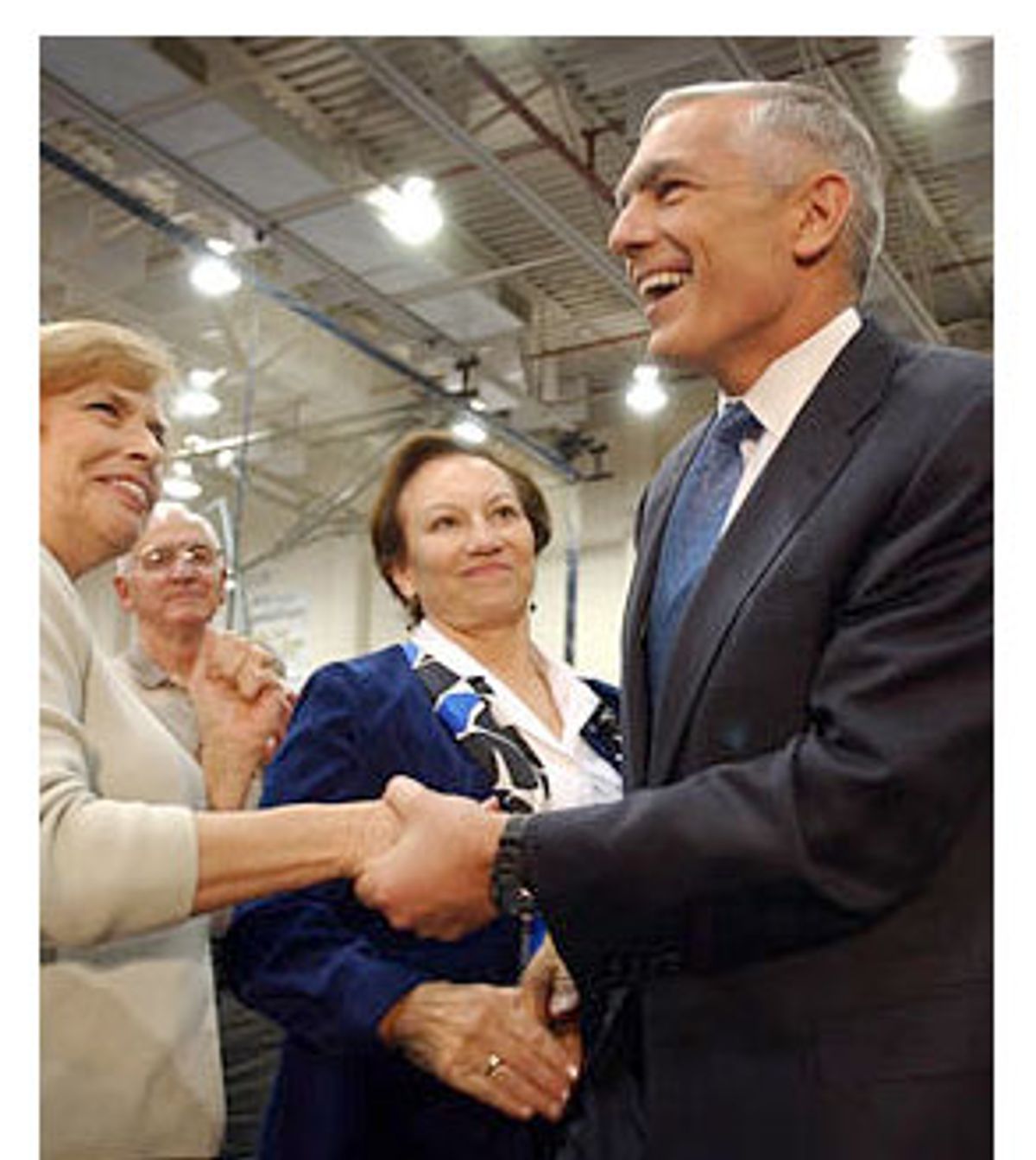
Howard Dean is not the only Democratic candidate who has inspired an army of followers. Wes Clark's ranks are growing, and they include Bush deserters.

  • more
    • All Share Services

The general and his ground troops

Since she found Gen. Wesley Clark, Beatrice Moritz, a Manhattan photographer, has stopped hating George Bush. She’s taking down the full-page MoveOn.org ad she’d taped to her wall, with its scowling picture of the president labeled “Misleader.” Before becoming a Clark volunteer, she’d spent months seething, becoming obsessed with photographing those who were “speaking back” to Bush with their signs at protest marches, incredulous about the nation’s acquiescence to an administration that seemed to her so self-evidently awful. Then Clark turned it all around.

“Now I feel like I have an alternative because Wesley Clark, he’s going to win,” she says. “It makes me feel that I’m not going to waste my energy thinking about all the bad things Bush has done. I don’t hate Bush as a person. I went through a period of that, but I’m more focused now on the very positive experience of supporting a candidate who’s a real president, and I know it’s not just me. I feel it.”

It’s not just her. After a month in the Democratic primary race, Clark’s professional campaign, based in Little Rock, Ark., is just starting to coalesce, but his grass-roots movement, tens of thousands of ardent supporters and volunteers nationwide, is already large and expanding rapidly. Numerically, Clark’s ground troops are not yet any match for Dean’s, but if his momentum continues, they may be soon. In May, there were only a few hundred people registered to attend Clark events through the Internet organizing site MeetUp.com. Now he’s second only to Howard Dean on the site, with 40,100 people registered. (Dean, who pioneered the use of MeetUp as a campaign tool, has 124,800 people signed up.) And even if his followers are fewer than Dean’s, they’re just as fanatical. Clark is igniting a desperate hope in supporters, something they describe in the language of love and religion. He can save us, they say. Over and over, they use the same phrase: “He’s the one.”

Many of Clark’s followers say that while Dean speaks to their rage, Clark, four-star general, intellectual, humanitarian and war hero, speaks to their longing for something higher. “He’s obviously the best man at this time in history,” says Alexandra Richards, a New Jersey stay-at-home mother with a 2-year-old child and an unemployed husband. Figuring that their economic prospects are unlikely to improve as long as Bush is in office, Richards and her husband are considering selling their house and moving to Clark’s home base in Little Rock to volunteer for the campaign full-time. “Dean makes me angry about the present,” Richards writes in an e-mail. “Clark, on the other hand, gives me HOPE for the future. Hope feels better than anger.”

Richards, like several other Clark supporters, was a Deanie until the general entered the race. There’s no statistical evidence showing that Dean’s supporters are peeling off in favor of Clark, but anecdotes abound. “Dean has a whole year on this guy, but I can tell you this, the Dean supporters I know, I’ve suggested that they watch Clark,” says Christopher Dale, a 34-year-old San Diego public relations executive. “When they have checked him out, he’s won all of them over.”

Dale, an independent who says he’s never been involved politically, recently gave Clark $100 and plans to volunteer for his campaign. “There’s something about this guy,” he says. “I just think he’s the perfect antidote to what’s going on in this country.”

For Clark, it will still be an arduous process to translate this passion into an effective campaign organization. Recent American history is littered with candidates who won over devoted legions of citizens, whose races turned into causes, and who then lost to better-funded if less-inspired rivals. Donnie Fowler, who recently quit as Clark’s campaign director, says he’s seen the kind of energy Clark has generated before, in the Jesse Jackson campaigns in 1984 and 1988, and in John McCain’s race in 2000. It was there “with Robert F. Kennedy in 1968, and we saw it with Eugene McCarthy. It’s not unique to Wesley Clark, but it’s unusual and it is refreshing,” he says.

Then he adds, “Did I list a bunch of people who didn’t become president? I did.”

Clark is hindered by a late start, forcing him to give up even trying to compete in the Democratic Iowa caucuses in January, where winning requires an intricate ground-level organization and lots of face time with the state’s citizenry. The political press was unimpressed by his first few weeks on the trail, where he blundered while trying to answer simple policy questions. Even more negative coverage followed Fowler’s departure on Oct. 7, which suggested that Clark’s Little Rock operation was not yet working smoothly. Fowler was said to be angry that the professional political operatives on the Clark team were freezing out the Draft Clark activists who laid the campaign’s groundwork, though there was also speculation that he left because he was about to be demoted.

Meanwhile, a few Clark volunteers have publicly blasted the more conventional direction the campaign has taken. Stirling Newberry, an intense Massachusetts computer programmer who runs the Web site DraftClark.com, remains devoted to Clark and discourses fervently on his virtues, but felt betrayed as the campaign haltingly transformed itself from an insurgency into a more traditional political operation. The day Fowler left, Newberry published an open letter to the Clark campaign saying, “By the time you read these words, the bell will be tolling for Wesley Clark’s candidacy. It will be clear across the country that the campaign of Wesley Clark is nothing more than the Gore campaign with a better candidate — this will mean that activists, the people who can create a field organization that can win Iowa and New Hampshire, will know that this campaign is nothing more than a media creation.”

Even now, the campaign doesn’t have much of a presence in New Hampshire, an important early primary state. “They haven’t announced any leaders for the campaign here in New Hampshire,” says Michael Dennehy, who ran Sen. John McCain’s 2000 presidential campaign in New Hampshire and New England. “That’s campaign 101. If you come up here and make an announcement but cannot follow that up with some endorsement announcements, that is very strange to me. Either they’re not running the campaign they should be, or they’re struggling to find these people to support him, or a combination of the two.”

According to Fowler, the problem is organization, not enthusiasm. “Wesley Clark hasn’t had two years of recruiting foot soldiers,” he says. “He has to rely on this committed band of partisans in an irregular army.”

Yet those partisans’ commitment is uncommonly fierce, and in a crowded field, that matters. “A movement is a very important ingredient in this cycle because these candidates are not well known,” says Donna Brazile, Al Gore’s former campaign manager. Brazile, a loyal Democrat who has decided to sit out the primary fight, says, “The establishment has not blessed any one person. Therefore, because the race is wide open, having a movement will be an asset. Right now, the only two campaigns that exhibit that are the Dean campaign and the Clark campaign. Dean created a movement, Clark was started by one.”

Indeed, as is well known by now, before Clark entered the race, groups of grass-roots volunteers spent months building a Draft Clark movement, securing pledges of donations if the general ran and creating a rough campaign infrastructure.

Before Clark announced his candidacy on Sept. 17, there were reports that former President Bill Clinton was encouraging him, suggesting to many that Clark was being imposed on the party from above. When he bungled his first day on the trail, one insider quoted by ABC’s political weblog “The Note” blamed the party’s leadership, saying, “Why did my party’s best operatives think it would be a good idea to subject their neophyte candidate to the country’s savviest reporters for over an hour? Why have my party’s elders rallied around a candidate who is so shockingly uninformed about core issues and his own positions?”

Yet to Clark’s grass-roots supporters, all this is Beltway ephemera. On Oct. 14, there was a Clark fundraiser for young professionals at Coda, a plush midtown Manhattan nightclub full of red velvet and gold chandeliers. The minimum ticket price was $50. MTV’s Gideon Yago was there doing interviews, and there was an anticipatory frisson in the crowd more reminiscent of rock concerts than political rallies. Clark was ill, but he took the stage anyway, hoarse and beaming, as the crowd cheered, “Wesley! Wesley!”

Right away, he alluded to the kinks in his Little Rock operation, saying “We’re building this ship as we sail out from the harbor.” He urged his followers not to pay too much attention to stories about campaign mechanics. “That’s just process,” he said. “What matters is message.”

That message is getting through, at least to Clark’s growing corps of true believers. The Clark camp has its own grand narrative of the campaign, in which its candidate transcends the triviality of contemporary politics. Jaded Washington journalists often judge candidates by their ability to navigate the semiotic minefield of the press’s own obsessive scrutiny. In her 1988 essay “Insider Baseball,” Joan Didion described the default attitude of most campaign chroniclers: “They speak of a candidate’s ‘performance,’ by which they usually mean his skill at circumventing questions, not as citizens but as professional insiders, attuned to signals pitched beyond the range of normal hearing.”

Clark’s followers feel attuned to something far more epic. In the story they see unfolding, America is at a low point in its history, threatened from without and plundered from within, led by a smug and reckless mediocrity who blithely aids the nation’s implosion. Patriotic moderates hear themselves denounced as traitors and despair that the country has entered a period of inexorable decline.

And then, just when it seems that American greatness has spent itself, into the breach comes a war hero, brilliant and brave, with a Silver Star and a Purple Heart. John Hlinko, a founder of the Draft Clark movement who’s since joined Clark’s campaign staff, says, “He’s the president we were promised as children,” a phrase much quoted among Clark’s fans.

Ironically, Clark’s appeal is due in large part to the same thing that propped up President Bush’s staggering presidency: 9/11. Four years ago, a retired general might not have seemed such a dream candidate, but right now, says Samuel Popkin, professor of political science at the University of California at San Diego and a former Clinton advisor, people feel “a real threat in the world.”

“You look for different things in a president when there are different things in the air,” Popkin says. “When all you wanted was a president who could spend your money, a lot more people were eligible for the office than when you want a president who can protect your life. You would never have been able to get a Bill Clinton during the Cold War. The feeling is that you need a war president, someone who is comfortable managing and handling force and aggression.”

Clark fills that bill — which comes as a pleasant, even euphoric surprise to Democrats accustomed to being pushed around like 97-pound weaklings by chest-pounding GOP musclemen. Popkin points out that historically, the perception of Democrats as weak on national security is a new phenomenon: It started with George McGovern and was exacerbated by the Iran hostage crisis during the Carter administration. “It used to be, we had Roosevelt and Kennedy,” says Popkin. “The missile gap was wimpy Republicans getting pushed around by fast-on-their-feet Russians. Once upon a time, most policemen were Democrats. During World War II, it was Roosevelt who wanted to make it easier for the military to vote.”

And while there may be nothing historically analogous between Clark and Kennedy, much less Franklin Roosevelt, he still seems like a link to a time of muscular Democratic greatness. The general — first in his class at West Point, Rhodes scholar, four-star general, commander of the NATO forces in Europe — stands for excellence, says Newberry. “Bush,” he says, “is the antithesis of excellence.”

Indeed, Clark’s followers circulate stories of his exploits — and the fact that Clark himself hesitates to tell them only stokes their devotion. Tom Junod’s awed August Esquire profile has become an ur-text of the campaign. Junod writes of how, in August 1995, Clark was on his way to Sarajevo with Ambassador Richard Holbrooke when an armored personnel carrier in their convoy plunged off a mountain road.

“In his book, the general describes what happened this way: ‘At the end of the first week we had a tragic accident on Mount Igman, near Sarajevo. [Three members of the team] were killed when the French armored personnel carrier in which they were riding broke through the shoulder of the road and tumbled several hundred meters down a steep hillside,’” Junod writes.

“It is not until one reads Holbrooke’s book, ‘To End a War,’ that one finds out that after the APC went off the road, Clark grabbed a rope, anchored it to a tree stump, and rappelled down the mountainside after it,” Junod continues, “despite the gunfire that the explosion of the APC set off, despite the warnings that the mountainside was heavily mined, despite the rain and the mud, and despite Holbrooke yelling that he couldn’t go.”

Whether or not Clark’s modesty is conscious, it’s an essential part of his persona. At the Oct. 14 fundraiser, he spoke of the draft movement and the support for his emerging campaign, saying, “I know it’s not personal. It’s about changing American leadership.”

He quoted a “friend” — a former Arkansas governor — who told him, “Politics is a blood sport. If you can live without it and sleep at night, don’t do it.” Then Clark said, “But I can’t live without it and sleep at night looking at where this country is going.”

Clark’s campaign slogan, “A New American Patriotism,” may seem like a cheap bit of electoral banality, but it resonates with followers who embrace the white-knight story his campaign has generated about itself. To the general’s devotees, Clark summons up images of Franklin Delano Roosevelt, reviving an exhausted, dispirited nation during the Depression. “We like calling General Clark the ‘Real Deal,’” says Alexandra Richards. “FDR was the New Deal, Truman was the Fair Deal, and Bush is the raw deal.”

Both Clark and Bush appeal to something nostalgic in their supporters, says Newberry, who studies Clark like a rabbi obsessing over the Talmud. “Five hundred years ago Machiavelli said, ‘No republic will long endure unless it refreshes itself at the wellspring of its creation.’ Eisenhower said, ‘We look forward with nostalgia.’ But just as there is always a forward-looking kind of love of tradition, there’s always going to be jingoism, reactionary sentiment and reactionary fervor.” To Newberry, of course, Clark represents the former, Bush the latter.

Clark stirs something even in people who usually don’t fall for mawkish campaign rhetoric. On Oct. 14, Harold Bloom, the venerable Yale humanities professor, cultural conservative and defender of the Western canon, published a remarkable encomium to Clark in the Wall Street Journal’s ordinarily right-wing editorial page with the portentous title “Cometh the Hour.” In it, he references Edward Gibbon’s “The Decline and Fall of the Roman Empire,” and writes, “It is not at all clear whether we are already in decline: bread is still available for most and circuses for all. Still, there are troubling omens, economic and diplomatic, and a hint or two from Gibbon may be of considerable use … We need, at just this time, a military personage as president, one who is more in the mode of Dwight Eisenhower than of Ulysses Grant. In Wesley Clark, we have a four-star general and former NATO commander who is a diplomatic unifier, an authentic hero, wise and compassionate. That Gen. Clark saved tens of thousands of Muslim lives in Bosnia and Kosovo is irrefutable, despite current deprecations by worried supporters of the president. They are accurate only in their anxieties.”

Most of Clark’s supporters aren’t so articulate, but all seem to be tapping into a similar spirit. “It’s sentimental and hokey, but it’s real,” says Mia Tran of the optimism Clark arouses. Tran, a 28-year-old graphic designer from Brooklyn, N.Y., who’d never donated money to a political candidate before, had paid to attend Clark’s Manhattan fundraiser. The day before, she’d attended a Wes Clark MeetUp in a Brooklyn bar with around 50 others.

Before Clark joined the race, Tran looked at Dean, but he didn’t inspire her. “He can’t maintain his cool,” she said. “The Dean thing, a lot of it is about negative sentiment and anger.”

Indeed, while it’s often said that Dean might alienate independents and moderate Republicans with his rage, according to Clark’s supporters, he turns off some liberal Democrats, too. “I’m all for getting people riled up, but I don’t want an angry president,” says Allyn Brooks-LaSure, a 25-year-old Clark volunteer from Washington, D.C. “I want a president who is presidential. I want a president who can get mad and can harness that energy into forward-thinking policies for all Americans.”

Many Clark supporters are grateful for Dean’s steadfast bravery in challenging the president on Iraq when few others were willing, and they appreciate his pugnacity, but they find him exhausting and can’t imagine him charming those who disagree with him. “The thing about Dean, a lot of people could find him unreasonable and a bit shrill,” says Moritz. “He reminds me a lot of the guys I marched with during the antiwar marches. You want to listen to what they’re saying, it’s invigorating, but you also know they are turning off a lot of people by their intensity.”

Dean promises to fight back against the right’s vicious partisanship. Clark’s supporters see their man as someone who can transcend it. “Dean’s rhetoric is not appealing to people who want a healing of the government, a healing of the American people from all this partisan warfare,” says Richards. “I give a lot of credit to Dean for raising the alarm about Iraq, but in order to be elected president, you have to have some sort of credibility with all Americans, not just angry white liberals.”

According to Ruy Teixeira, co-author of “The Emerging Democratic Majority,” Clark’s followers are right to suppose that their man’s appeal is demographically broader than Dean’s. In a post on the Emerging Democratic Majority blog, he analyzes an October Gallup poll to discern “The Demographics of Clarkism”:

“While Clark receives more support than Dean among both men and women, his margin over Dean among women is just 3 points (16 percent to 13 percent), but an impressive 12 points among men (29 percent to 17 percent),” Teixeira points out. “He also beats Dean in every region of the country, but especially in the South (25 percent to 8 percent). Also intriguing is how well he does among low income voters (less than $20,000), clobbering Dean by 26 percent to 5 percent. In fact, Clark bests Dean in every income group up to $75,000. Above $75,000, Dean edges Clark, 26 percent to 25 percent.”

Furthermore, unlike Dean, Clark seems to have significant support from black voters. He’s been treated gently by Al Sharpton and endorsed by Rep. Charlie Rangel, D-N.Y. “When Charlie Rangel speaks up for somebody like General Clark, it speaks volumes in the black community,” says Brazile.

Brooks-LaSure, an African-American who plans to work on communicating Clark’s message to black communities nationwide, points out that when Dean spoke at a black church in South Carolina, the audience was primarily white. Clark, he insists, will appeal to black voters. “The general’s experience growing up in Little Rock, and then in the military, where they boast of having more African-Americans in positions of management and leadership than any other organization in the world, you can tell [working with black people] is not something new for him,” Brooks-LaSure says.

Finally, Clark has support among a constituency that doesn’t relate to Dean at all — those who think that Bush is a basically decent man who’s doing a bad job as president.

At Coda, there was a large contingent of besuited Wall Street types, the kind of people for whom “frat boy” isn’t a damning epithet. What make them so different from Deanies wasn’t their clothes, though — Dean’s movement is certainly not lacking in yuppies. It was their near-total absence of Bush hatred, an absence unusual anywhere in Manhattan and almost unheard of at Democratic events.

A 34-year-old who works for a hedge fund says, “Bush could be doing a better job, but he could be doing a worse job.” One 25-year-old investment banker in a blue suit and gray tie says his support for Bush “ebbs and flows,” and though he thinks the administration’s unilateralism has harmed America’s prestige, he believes the president was acting in good faith. Strident attacks on Bush’s legitimacy, the kind that thrill the Democrat’s activist base, don’t excite him. “I don’t want to vote for a candidate because I loathe the opposition,” he says.

Standing off to the side of the room, Nicomodos Sy Herrera, a 31-year-old Republican lawyer in a well-tailored suit, seemed almost surprised to find himself at a Democratic event. A pro-life hawk who’d been “a big Bush supporter” in 2000, he’d grown alarmed by Bush’s inability to “balance the hard and soft power of the U.S.” Now, he was considering changing his party affiliation in order to vote for Clark in the primary. “Bush was seduced too much by the hard right’s insistence that it had to go alone,” he says. “He made that bed, he has to sleep in it.” Still, while he says he doesn’t think Bush could win him back, he also says Clark is the only Democrat he would support.

“Those are exactly the kind of people you want,” Teixeira says of these Clark fans. “The people who hate Bush 24/7, those voters are not the Democrats’ problem. The Democrats’ problem are the people who say, ‘Goddamn it, he did a pretty good job after 9/11, but he’s really doing a lousy job now.’ That’s the sweet spot. Those are the voters you’re going to need to get in droves.”

Clark’s ability to appeal to these voters is, in turn, attracting pragmatic Democrats who are looking for a winner, not a hero. “The kind of people I tend to talk to by and large tend to have been skeptical of the Dean candidacy while respecting its energy,” says Teixeira. “They’re worried to death about whether Dean can actually beat Bush. These people are very interested in Clark. We need the guy who’s best able to beat Bush. I think he’s probably the guy.”

Yet part of the reason Teixeira thinks Clark can beat Bush is precisely because he has such zealous supporters. “You don’t need to have a movement to get elected president, but you need a movement to get elected president if you’re a Democrat in this situation,” he says.

Besides, some of those first attracted to Clark for reasons of realpolitik find themselves becoming converts to the movement. Moritz says one of the reasons she initially liked Clark is because she thought he could win over people like her Republican father, himself an Army veteran.

Now, she says, “It feels like we’re on a rocket that’s taking on more and more passengers and people are really energized. Everybody finds him so exciting. We’re not doing this just because we want to get somebody else in the White House. Every single person I know who is involved in helping General Clark really, really believes in him.”

Fowler is a little bit wry about the adoration his former boss is generating. “The beginning of a love affair is always the most exciting part,” he says. “Sometimes the love affair lives up to its promise. Sometimes it doesn’t.”

For now, though, Clark’s followers are smitten, and after three years of hate, they say, it feels good to be in love.

Michelle Goldberg is a frequent contributor to Salon and the author of "Kingdom Coming: The Rise of Christian Nationalism" (WW Norton).

Howard Dean responds to Salon

And we respond to his spokeswoman's dismissal of our story about Dean's paid advocacy work

  • more
    • All Share Services

Howard Dean responds to SalonHoward Dean

Howard Dean’s spokeswoman, Karen Finney, has responded to my story on Dean’s turn into paid advocacy work, accusing me of engaging in “lazy journalism.”  I think the adjective is not accurate.

Salon has nothing personal against Dean. But we felt that a liberal champion’s reliance on paid advocacy work reveals something significant about our political culture, and possibly about Dean himself. Finney’s statement is presented here in its entirety, along with my responses.

While there may be fair criticisms to be made, its a sham that Justin knowingly ignored a number of relevant facts because they didn’t fit the premise of the story he wanted to write. Criticism of one’s positions or activities is one thing, lazy journalism is quite another.

On the issue of biologics, one that he’s known and had an opinion on long before he was DNC Chairman. For example, Justin did not mention Gov. Dean spent most of his time during the healthcare debate working with DFA and other grassroots organizations advocating for the public option as one of the most outspoken advocates. During that debate he was very transparent about his position on and support for biologics legislation sponsored by Reps. Anna Eshoo (D-Calif.), Jay Inslee (D-Wash.) and Joe Barton (R-Texas) in the House (H.R. 1548) and in The Biologics Price Competition and Innovation Act introduced by Sens. Edward Kennedy (D-Mass.) and Mike Enzi (R-Wyo.).

Here’s the rest of what he said at the time about a commonsense and fair approach:

“A commonsense and fair approach, similar to the process and timeline currently in place for generic versions of chemical-based medicines, would allow the original developer of the biologic to protect the proprietary data used to develop the medicine for at least 12 years. A shorter exclusivity period would prematurely rob biotech innovators of their intellectual property and destroy incentives to develop new cures. Most firms would be unable to recoup their investments in new medicines, which ordinarily top $1 billion and involve 15 years of research and development. If we discourage investment, we jeopardize the development of the next generation of breakthrough medicines and cures.”

On the issue of the MEK, he is not a paid advocate. He was paid for a handful of speeches, but has not been paid for his advocacy. His focus has been on the human rights issues. In an op-ed on Huffington Post he outlined some of the facts he felt had been ignored in recent articles, but his key point is that there are 3400 unarmed men, women and children currently in Camp Ashraf who should not be left for slaughter after having been promised they would be protected. Here’s an excerpt:

“There are key facts, which have been obscured, omitted or ignored in recent articles written about these 3,400 unarmed people. First, a lot has changed since the MEK was classified as a terrorist organization in 1997. In recent testimony to Congress by Martin Indyk, former U.S. Ambassador to Israel and Assistant Secretary of State for Near East Affairs under Clinton, it was revealed that the motivation behind the ’97 classification was to help open a dialogue with the ruling party of Iran.

Second, in July 2010, the U.S. Appeals Court in Washington DC ruled that the group was actually not given due process in 1997 and ordered the State Dept. to reevaluate the terrorist designation. Notably the governments of France, Britain and the EU have already ruled that the MEK is not a terrorist organization. Currently the only two nations that remain in agreement on what is now a discredited classification are America and Iran.

Third, in 2003 the U.S. military peacefully disarmed the inhabitants of Camp Ashraf. American FBI agents visited Ashraf and questioned all of the 3,400 residents. None were found to be associated with terrorists or terrorism. The US military made a promise in writing that each resident would be protected against outside threats.

Fourth, in 2009, and again in 2011, American troops were ordered to leave the vicinity of Ashraf by the Iraqi Government — then led by Prime Minister Maliki. Iraqi troops went into Ashraf and killed 47 unarmed civilians in cold blood. Most of the hundreds who were wounded were denied medical care as American troops stood idly by just a few miles away.

Fifth, while the residents of Ashraf are currently asking to be re-located to other countries, the plan currently being pushed by Lawrence Butler from the US State would instead relocate them to another area in Iraq and “guarantee” their safety. Yet neither the American or Iraqi governments have thus far kept their word to the residents of Ashraf.

“America gave its word to the MEK that we would protect them. We believe that allowing 3,400 people to be murdered in cold blood and breaking that promise is wrong. We believe that in the end this debate is about America, not the people in Ashraf. America is a country that values freedom and the rule of law. We must keep our word and help the people of Ashraf get out of Iraq. We must support those who peacefully and through democratic means fight for their freedom. If we fail and again stand by as 3,400 unarmed men, women and children, in Ashraf are murdered by the Iranian Government or its Iraqi proxies, we diminish ourselves as a great nation. Its time for America to keep its word to the people in Ashraf.”

My response:

On the issue of biologics, Finney contends Dean has “known and had an opinion on long before he was DNC Chairman.” Finney said as much on background to me, but in my reporting I found no evidence that Dean had weighed in on biologics before 2009, when he joined the D.C. lobby shop McKenna Long and Aldridge. McKenna works for the biotech industry’s trade group. 

Finney did not allude to the facts she presents here when I originally emailed with her. If she had, I would have reported them. Since it’s always possible that I missed something, yesterday I invited Finney to provide a citation for Dean’s involvement on the issue before he was a paid advocate for the industry. She declined to do so.

Remember, the issue here was how long a certain class of drugs — biologics or biopharmaceuticals — would be protected from cheaper generic competitors. Consumer groups wanted a shorter period (five years) while Dean and the industry wanted 12 years of protection. So it’s worth noting that back in 2002, Dean was active in a similar debate — but back then he was arguing in favor of generic competition against brand-name drugs.

“It’s unconscionable how they’re exploiting patent-extension loopholes,” Dean told Forbes, speaking of Big Pharma. He actually founded a coalition to lobby Congress to make it easier for generics to enter the market sooner, thereby lowering prices for consumers.

It is true that the biologics industry is different from the traditional pharmaceutical industry but the fundamental issue is the same. By taking money from the industry, Dean has created the appearance of a conflict of interest.

When it comes to the MEK, Finney argues that “he is not a paid advocate. He was paid for a handful of speeches, but has not been paid for his advocacy.” That seems like a distinction without a difference.

Dean has publicly acknowledged he had never even heard of the MEK until his agent was contacted with a paid speaking opportunity for the group in Paris. (And, remember, the group is known for paying astronomical speaking fees.)

Finney also quotes Dean’s HuffPost column on the MEK and Camp Ashraf. A couple of notes here: First, Dean has misrepresented Martin Indyk’s comments on the MEK, as Indyk himself pointed out in a comment on HuffPost.

The full passage from Indyk’s book on the MEK is both a succinct argument for why the group should be classified as a terrorist group and a refutation of the idea that it was added to the terrorism list purely as (in Dean’s characterization) a way to “open a dialogue with the ruling party of Iran”:

[The MEK] in its early actions had killed Americans. After its expulsion from Iran, Saddam had provided it training bases in Iraq and logistic support for terrorist attacks in major Iranian cities. The MEK returned the favor by helping Saddam crush the Shiite revolt in southern Iraq after the Gulf War. The MEK clearly deserved to be on the terrorism list, but as an anti-Irani­an organizati­on it had managed to gain support from some influentia­l congressme­n through the sophistica­ted political operations of its front organizati­on, the National Council of Resistance of Iran … He­re was one instance when Clinton could show that he applied the same standards to groups that used terrorism against our foes as well as our friends. We hoped it would be perceived in Tehran as a goodwill gesture.

I won’t quibble here with the broad strokes of Dean’s explanation of the situation at Camp Ashraf, where several thousand MEK members are holed up in Iraq. Finney asserts that Dean’s “focus has been on the human rights issues.”

In fact, his advocacy for the MEK has gone well beyond the question of human rights of the residents of Ashraf. Dean has at least twice argued publicly that Maryam Rajavi, one of the longtime leaders of the MEK, should be recognized as the president of the nation of Iran. That’s a remarkable position that is rarely heard even among MEK’s strongest supporters.

Finally, there are two areas in which Dean could be more transparent. As I noted in the story, he sits on the board of advisors of a venture capital fund, Vatera Health Partners, that invests in biopharmaceuticals. But neither Finney nor Vatera responded to my inquiries about when he took the position.

Why does it matter? Because Dean was doing public advocacy for the industry during the healthcare fight in 2009, and, if he was on Vatera’s board back then, that means he had a personal financial stake in the industry, a time when he was seeking to shape his future. I’m not saying he did. I’m saying he should disclose whether he did.

More important, Dean has declined to reveal whom he has worked for in his capacity as a senior strategic advisor at McKenna Long and Aldridge. It is possible that my story, which covered only advocacy work that has occurred in the public domain, understates Dean’s paid advocacy positions.

Continue Reading Close
Justin Elliott

Justin Elliott is a reporter for ProPublica. You can follow him on Twitter @ElliottJustin

The seduction of Howard Dean

The liberal firebrand succumbs to Washington's money culture

  • more
    • All Share Services

The seduction of Howard DeanHoward Dean

Howard Dean has long cultivated an image as the plainspoken doctor who speaks for the left wing of the Democratic Party, a role he still plays as a pugnacious pundit on TV. But since his term as chairman of the Democratic National Committee ended in January 2009, Dr. Dean has taken on a less-noticed role: paid advocate for interest groups that would find few fans among the progressive voters once energized by Dean’s 2004 presidential bid.

Dean may not be the worst of the “buckrakers,” those prototypical capital characters who exploit their name and connections without regard for principle. But his recent political forays seem to have diverged from his trailblazing left-liberal past.

As senior strategic advisor at McKenna Long & Aldridge, a heavyweight Washington lobbying firm, Dean played a prominent role representing the biotech industry during the healthcare bill debate, staking out a position on biopharmaceutical drugs that was decried by consumer groups.

“Gov. Dean was very helpful to us,” biotech CEO Jim Greenwood told a trade publication “As a physician clearly focused on healthcare, a Democrat leader and clearly to left of center, his efforts were impactful.” Greenwood is the head of the Biotechnology Industry Organization (BIO), a trade group that lobbies for the industry in Washington.

Dean is also currently one of the most prominent paid voices in a public-relations campaign on behalf of the Mujahedin-e Khalq (MEK), an obscure and controversial Iranian militant group that is aggressively lobbying the Obama administration to remove it from the official list of terrorist organizations.

Dean arrived in the comfortable K Street offices of McKenna Long & Aldridge shortly after his term as DNC chair ended in January 2009. He had been passed over by President Obama for the secretary of health and human services Cabinet post, and he needed a paying job.

In announcing his appointment, the firm said Dean would “provide guidance to clients, particularly in the areas of healthcare and alternative energy resources.”

Dean has been careful not to register as a lobbyist, a designation that would prompt legal disclosure requirements. Both McKenna and the governor’s spokeswoman declined to reveal which clients he has worked for.

Dean took on a very public role during the 2009 healthcare reform battle, specifically going to bat for the biotech industry — whose trade association is a client of McKenna.  

At stake was how the government would regulate a growing class of drugs called biologics or biopharmaceuticals and their generic competitors. The industry argued for a longer period — at least 12 years — in which expensive brand-name biologics would face no competition from less costly generics. Consumer groups argued that, to keep costs down, the period of exclusivity should be just five years.

Dean jumped into the fight on the side of the industry, writing an Op-Ed in the Hill in 2009 arguing that a “commonsense and fair approach” would be to bar generics for “at least 12 years.”

“If we discourage investment, we jeopardize the development of the next generation of breakthrough medicines and cures,” he wrote, echoing a key industry talking point.

Liberal admirers were disappointed.

“It was devastating to have him involved because of his reputation,” says James Love, director of Knowledge Ecology International, a public interest group that fought for a shorter period of exclusivity. “He’s considered to be independent of industry and on the left, so it was really shocking to us when we first saw this. But there it was.”

Greenwood, the trade group CEO, said at the time that Dean’s work had involved talking to members of Congress about the issue. Dean never registered as a lobbyist, a legal category that involves spending at least 20 percent of one’s time for a client lobbying lawmakers or government officials.

One common dodge on K Street is for former elected officials to work for lobbying firms without actually registering as lobbyists. At McKenna, for example, former Sen. Zell Miller, the conservative Democrat from Georgia, and former Colorado Rep. David Skaggs hold the same title as Dean: “senior strategic advisor and independent consultant.”

Dean is not exclusive in his services. He currently serves on the board of advisors at Vatera Health Partners, a New York-based venture capital fund whose mission is “to support and grow emerging biopharmaceutical companies.”

It’s not clear from the public record how long he has served in the position. But his presence on the Vatera board indicates that he has a personal financial stake in the biopharmaceutical industry.

At the time of the biologics fight on Capitol Hill — which the industry won — Dean told Time that “I wouldn’t do this if I didn’t believe it.”

Dean has invoked the same argument when it comes to his work in support of the MEK, the Iranian militant group. Dean and other luminaries from across the political spectrum have been paid vast sums of money by the group — as much as $20,000 for a 10-minute speech — to appear at events pushing the Obama administration to remove the MEK from the official list of terrorist organizations. 

Dean himself has acknowledged being paid but has not disclosed specific sums.

Critics of the MEK, including the State Department, say the group displays cult-like qualities; it has been led by the same husband-and-wife couple, Masoud and Maryam Rajavi, for decades. They also point to the fact that it killed Americans in Iran in the 1970s and the lack of support for the group among the people of Iran. Among the most enthusiastic supporters of delisting MEK have been neoconservative strategists who believe the group can help destabilize the Iranian regime.

Dean, for his part, has been distinguished by his particularly aggressive advocacy for the MEK. Not only has he argued for delisting MEK in print and in speaking appearances, he has also said that Maryam Rajavi should be recognized as the president of Iran. The Christian Science Monitor reported on a recent trip by Dean to Berlin:

“Madame Rajavi does not sound like a terrorist to me; she sounds like a president,” Mr. Dean said, gesturing toward the MEK leader from the dais. “And her organization should not be listed as a terrorist organization. We should be recognizing her as the president of Iran.”

While Dean has passionately argued he is on the right side of the MEK issue, he acknowledged to the Washington Times that he got involved through his agent.

“I got asked by my agent to go over to Paris to speak to a group I knew nothing about. I spent a lot of time on the Internet learning about them, and then I met them,” he told the paper.

Dean spokeswoman Karen Finney said that, besides paid advocacy work, the former governor spends his time on a range of other activities, including appearing as a paid contributor to CNBC; traveling as a board member for the National Democratic Institute, which promotes democracy around the world; giving paid speeches; teaching a class at Hofstra University; and serving on the board of Extendicare, a Canadian long-term care company. Finney said he also continues to do some work for Democracy for America, a political action committee Dean founded that is run by his brother, Jim.

Whom else does Dean work for as a paid advocate?

In January, he waded into another high-stakes healthcare fight, this one being waged in New York state between foreign medical schools and their American competitors. The issue was whether foreign-trained doctors would have access to hospitals in New York for their residencies. Dean wrote an Op-Ed in the Albany Times-Union, “N.Y. needs its foreign-trained doctors,” that repeated talking points of foreign medical schools, which, Dean’s bio blurb noted, are clients of McKenna Long & Aldridge.

While the firm won’t say whom Dean has worked for, his bio page on McKenna’s website offers some clues.

“Respected for his fiscally moderate policies as Governor, he understands first-hand the severe budget constraints that are challenging state and municipal governments,” it reads. “With an extensive set of contacts nationally, Governor Dean is uniquely positioned to develop partnerships between industry stakeholders and local governments.”

Dean is indeed uniquely positioned: Between his former followers and his current clients, between his idealist liberal past and the cynical culture of K Street, between independence and cooptation.

UPDATE: Read Howard Dean’s response to Salon here.

Continue Reading Close
Justin Elliott

Justin Elliott is a reporter for ProPublica. You can follow him on Twitter @ElliottJustin

Today’s most inane 2012 speculation

Politico's Roger Simon imagines Howard Dean challenging the president

  • more
    • All Share Services

Today's most inane 2012 speculationGovernor Howard Dean, physician and former chairman of the Democratic National Committee, speaks during the "American Technophile: "How Technology is changing Politics, Governance & Healthcare" panel at the Fortune Tech Brainstorm 2009 in Pasadena, California July 22, 2009. REUTERS/Phil McCarten (UNITED STATES BUSINESS)(Credit: © Phil Mccarten / Reuters)

Will Howard Dean challenge Barack Obama in 2012? Politico columnist Roger Simon, who drew Dean from a hat full of cards that he’d written the names of various Democrats on, says probably!

First, Simon lays out the history: Reagan and Clinton were only reelected because they did not face serious primary challenges. But Jesse Jackson almost ran against Clinton, and he would’ve made Clinton lose, because of Whitewater, NAFTA and Troopergate. Thankfully, Rahm Emanuel and Harold Ickes made Jackson not run, thus saving Clinton from being Jimmy Carter.

But will Howard Dean seriously be Obama’s Ted Kennedy? The Speculative 2012 Primary Challenge Column Hat does not lie. Howard Dean is going to run against Obama and lose to the Palin/O’Donnell ticket. Simon proves this with facts:

  • Howard Dean sounded defiant on the phone.
  • “Obama’s people have long been thinking — grimly — about Dean.”
  • “Some of the most influential members of Team Obama do not like or trust Dean and have long feared he would challenge Obama for the presidency if only given an opportunity.”
  • Howard Dean has run for president before!
  • “Young people” and “liberals” like Howard Dean, because of “his pioneering use of the Internet as a political tool.”
  • Obama wants to compromise, which will make the left mad.
  • Howard Dean hates Barack Obama because he did not get a Cabinet position.
  • Howard Dean himself said no one should challenge Obama in 2012 but on the other hand he also said something mildly critical of the White House.

Bam. QED.

Congratulations to Roger Simon for writing a column about the 2012 race that somehow manages to be even dumber than the hundreds of columns about Michael Bloomberg and Sarah Palin.

Continue Reading Close
Alex Pareene

Alex Pareene writes about politics for Salon and is the author of "The Rude Guide to Mitt." Email him at apareene@salon.com and follow him on Twitter @pareene

Harry Reid and Howard Dean: Fox News enablers

This is what happens when Democrats cave in to right-wing fear campaigns

  • more
    • All Share Services

Harry Reid and Howard Dean: Fox News enablersGovernor Howard Dean, physician and former chairman of the Democratic National Committee, speaks during the "American Technophile: "How Technology is changing Politics, Governance & Healthcare" panel at the Fortune Tech Brainstorm 2009 in Pasadena, California July 22, 2009. REUTERS/Phil McCarten (UNITED STATES BUSINESS)(Credit: © Phil Mccarten / Reuters)

Harry Reid and Howard Dean had their reasons for coming out against the Park51 project in lower Manhattan last week. Well, at least Reid, who is locked in a tight reelection campaign in Nevada, did. Dean’s motives are a little harder to discern.

But whatever they hoped to accomplish, one thing is indisputable: Reid and Dean both did an enormous favor to the right-wing fear-mongers who have been pushing the “ground zero mosque” hysteria, equipping them with a compelling talking point for the cable news circuit. Here’s a sampling of how Reid and Dean have been invoked in the past few days, often (but not always) on Fox News:

Rick Santorum (“On the Record With Greta Van Susteren,” Aug. 23):

I suspect Howard Dean and others have been saying this to the Obama administration for quite some time that the arrogance and the dismissiveness of the American public’s opinion on a whole variety of things, including this one, is starting to corrode not just support for him but for the Democratic Party generally and is hurting candidates across this country.

And that’s why you see Harry Reid stepping out and saying what he said. They are walking away from him because he doesn’t seem to care what America thinks, and that is not good news for Democratic candidates across the country. 

Rich Lowry (“Fox News Watch,” Aug. 21)

I think what’s complicated the simple media narrative here, which would ordinarily be, and to some extent, has been that everyone opposed to the project at this particular place must be a bigot, as the fact that President Obama pointedly refused to endorse the wisdom of that location. And you had Harry Reid and Howard Dean coming out and saying they don’t think it’s a good idea to be there. So that’s really complicated. 

Bill O’Reilly (“The O’Reilly Factor,” Aug. 19):

Now, if you’re keeping score, it is Senator Harry Reid and Howard Dean against the mosque. Speaker Nancy Pelosi and the president okay with it. That is a Civil War within the Democratic Party, no matter how they try to spin it. 

Chris Wallace (“The O’Reilly Factor,” Aug. 19):

I think the issue will be a sense that the president and a lot of Democrats, including Nancy Pelosi, we need to discuss what she said this week, that they are out of touch with the mainstream. They’re out of touch with the prevailing opinion in this country.

I mean, you had Nancy Pelosi on Tuesday say that we need to look into the funding of the opposition to the mosque. I mean, to the best of my knowledge, we’re talking about Americans who are exercising their First Amendment right of free speech to say they don’t like the mosque. They think it is as Howard Dean said an affront. 

Clifford May (National Review, Aug. 26):

Mr. Horowitz informs us that the planned Islamic center has become “the prime target of national conservatives who, after years of disparaging New York as a hotbed of liberal activity, are defending New York against a mosque that will rise two city blocks from Ground Zero.”

The hypocrisy! Have they no shame?

Mr. Horowitz was no doubt so busy reporting this big story that he missed the bulletins about Senate majority leader Harry Reid and former Democratic National Committee chairman Howard Dean — no nasty national conservatives, they — also opposing the Ground Zero Islamic project. 

NYC blogger and construction worker Andy Sullivan (CNN, Aug. 20):

ANDY SULLIVAN: Well, I’m familiar about what he said. And it’s kind of profound, actually, Howard Dean, very much the Democrat liberal, being on the side of moving the mosque. I find that pretty moving.

DON LEMON: What’s your response to those who have said that — who think this is a left-vs.-right issue or a conservative-vs.-Democrat issue?

SULLIVAN: Oh, I completely disagree. Just look at — you have got the top Democratic guy, Harry Reid, saying it’s not a good idea to put it there.

And then you have Obama saying, they should have the right to put it there. So, I think this goes beyond left-right, Democratic- Republican lines. 

James Pinkerton (“Fox News Watch,” Aug. 21)

Let’s just focus on the pundit sector. There’s been a chance for them to demonstrate their moral superiority over the average American by taking this enlightened multicultural position. Now that’s fine for the Democrats until they notice that Obama and Harry Reid and Howard Dean were not on board. And now, they’re slamming them too. So they’re living in their little isolated world — ivory tower, where they reign. 

Unknown reply to Juan Williams (“Fox News Watch,” Aug. 21)

WILLIAMS: You can speak out against it if you like, but what I’m saying is the opposition, Chris, is coming from one place, the right wing in the country. It’s coming from Sarah Palin. It’s coming from Newt Gingrich.

(UNKNOWN): And Howard Dean and Harry Reid. 

Rick Lazio (“Hardball,” Aug. 24)

MATTHEWS: You said this is an issue of security. Well, they don’t agree with you.

LAZIO: How about Howard Dean? How about Harry Reid?


Continue Reading Close
Steve Kornacki

Steve Kornacki writes about politics for Salon. Reach him by email at SKornacki@salon.com and follow him on Twitter @SteveKornacki

Heroes, villains and cowards of the so-called “ground zero mosque”

Who's defended religious liberty, who's been too scared to, and who truly hates our founding principles?

  • more
    • All Share Services

Heroes, villains and cowards of the so-called Top left, clockwise: Mayor Michael Bloomberg, Sarah Palin, Newt Gingrich, Sen. Chuck Schumer, Sen. Harry Reid, President Obama

The bizarre, ginned-up controversy surrounding the Park51 project — a proposed Islamic community center, like the 92nd Street Y, including a space for worship, to be built at the site of an old Burlington Coat Factory (which is a store, not a factory) on Park Place in lower Manhattan, near, but not in sight of, the site of the World Trade Center — has exposed not just the blatant Islamophobia (and cheerful willingness to exploit bigotry) of many luminaries of the right, but also the cowardice of many supposed liberals. Just so we know where we stand, and using, as criteria for placement, my own inexact impressions of their public statements, I present the official War Room lists of “ground zero mosque” heroes, villains and cowards.

Heroes

It’s not a particularly hard case to make: The Constitution guarantees the right of the Cordoba Initiative to construct a house of worship on private land without any interference from the government, “Muslims” as a whole did not attack “us” on 9/11, Feisal Abdul Rauf is a well-respected, progressive imam with a history of performing outreach for the Bush administration, and even if the project was a “ground zero mosque,” celebrating its construction would demonstrate an admirable commitment to the founding ideals that we are supposedly fighting for Over There. At a time when Islamophobia appears to be on the rise, in part because xenophobia always tends to get louder during periods of economic uncertainty, liberals and progressives should be forcefully making the case for tolerance and liberty. But only a couple have bothered. Still, we should celebrate them!

Rep. Jerry Nadler, whose district actually includes ground zero, has been a loud and unflinching supporter of the project. He makes the case well, and without tossing in wishy-washy qualifications:

Mayor Michael Bloomberg’s speech in support of the Park51 project has been rightly celebrated as a courageous moral and intellectual defense of religious freedom.

Outside of New York, Sen. Russ Feingold accused mosque opponents of “gutter politics” and affirmed his support for “freedom of religion,” the simple answer that all Democratic politicians and candidates should give. Minnesota’s Al Franken also attacked opponents, and even cracked a joke.

I think the best response for a non-New York politician to give is probably Sherrod Brown’s. Brown said, first of all, that it’s a local, New York issue, which it is, and also said, “We’re not at war with a religion,” which is the sort of thing that needs to be said, constantly, by people with consciences, in order to rebut assholes like Gingrich.

Pennsylvania candidate Joe Sestak has been accused of “dodging” the question, but his answer seems straightforward to me: He believes it’s a New York issue and he supports the Constitution. (He has received the endorsement of Michael Bloomberg.)

Some perhaps surprising heroes include Grover Norquist, who makes the political case for supporting the project, and Ted Olson, a longtime Republican attorney whose wife died on 9/11. Olson forthrightly said, “We don’t want to turn an act of hate against us by extremists into an act of intolerance for people of religious faith.”

Cowards

The coward’s usual formulation of wishy-washy nonsupport is to proclaim that “they have a right to build it, but …” While I’d argue that even if you don’t feel like issuing a spirited defense of the specific project being debated, you can simply stop at “they have a right to build it” and retain some dignity, these politicians seem to think that they have to balance their respect for the Constitution with a healthy dose of skepticism about Muslims and acknowledged sympathy for hysterical opponents whipped up into a frenzy by lying propagandists.

Harry Reid decided to point out that while the First Amendment protects the rights of religious minorities to practice their religion, that doesn’t mean that they should practice it where it might upset someone.

Howard Dean, too, thinks that religious minorities should respect the wishes of majorities of Americans and not go around building houses of worship in places where Americans don’t want them. (Memo to Gov. Dean: One of the reasons so many Americans polled about the subject are opposed to it is because right-wing liars defined the entire debate from Day One. If you’d polled everyone in the nation back in, say, March, and asked, “Should there be an Islamic community center with a pool and an auditorium in lower Manhattan near City Hall and, yes, the WTC site?” I’m guessing it would’ve been a three-way split between support, oppose and don’t give a shit. And even if “oppose” had still won that theoretical poll, it still wouldn’t have been a good reason for the organizers to be more “sensitive” and find a new building.)

Some New York Democrats are just completely punting on the issue. Anthony Weiner refused to say anything about it for weeks, then issued a baffling letter that says nothing. Chuck Schumer, a man who stands no chance of losing reelection, and from whom a defense of religious liberties would’ve been celebrated and important, will only say he isn’t opposed to the project.

Villains

They are mostly the obvious ones: Sarah Palin, Newt Gingrich, Rudy Giuliani — all Republicans with a history of exploiting racial and ethnic tensions and resentments without regard for the consequences.

New York Democrats John Hall, Tim Bishop, Mike McMahon and Mike Arcuri all decided their best shot at reelection was joining the chorus against the project. Cowardice may have inspired them, but Arcuri’s move, in particular, seems more villainous.

Rand Paul, supposed libertarian, thinks Muslims should give money to 9/11 memorials, presumably because of collective guilt, rather than construct community centers in their communities. (His opponent, Jack Conway, is a simple coward.)

Supposed Democrat Jeff Greene proved his independence from the party bigwigs by being grossly bigoted in the name of sensitivity to 9/11 victims he invented, in his head, while mangling the geography of lower Manhattan.:

The proposed $100 million Muslim center offered one such contrast. Greene echoed President Barack Obama’s recent defense of religious freedom but said, “When those families go to mourn their losses, they shouldn’t be looking at a mosque right there.”

(His opponent, Kendrick Meek, merely said he wouldn’t “step in front of a decision that’s already been made in New York City,” which is halfway between cowardly and acceptable.)

The Confused, and Confusing

I think New York politicians have a responsibility to defend the project itself, while I’ll let most non-New Yorkers off the hook for stopping at a defense of the principles involved (as long as they don’t add a Reid-ian “but …”) and an acknowledgment that it’s a “New York issue.” But what about New Jersey politicians?

Well, who can even say where Chris Christie stands. The Republican New Jersey governor was celebrated for seeming to support the mosque, but his statement was actually just a defense of how independent and awesome Chris Christie is with a stupid and nonsensical “pox on both houses” line thrown in.

New Jersey Sen. Robert Menendez supports the Constitution, but then changes the subject to jobs, the economy, etc.

Back in New York, Carolyn Maloney and her primary opponent, Reshma Saujani, both signaled their support for the project, but Saujani (a born panderer) supports it super hard, and claims Maloney only kinda supports it. I’m not convinced by Saujani’s argument, but you can read Maloney’s statement for yourself.

I might need to invent a separate “I think he actually means well but what the hell” category for Gov. David Paterson, who is, I think, trying very hard to be a peacemaker, as part of his “fuck it, I’m out of office soon anyway” tour ’10. But his claims that he will give state land to the developers (which would be constitutionally iffy) and his repeated insistence that he’s meeting with Cordoba Initiative representatives about moving the site (which they keep disputing) are just serving to support the idea that there’s some compelling reason why they should move.

Kristen Gillibrand’s support for the project seems halfhearted and overly cautious, but it’s there.

And, yes, then there’s the president. Had he stopped at his Friday night statement, a simple defense of religious liberty, I’d happily put him in the heroes category. But his Saturday non-clarification, stressing the fact that he doesn’t explicitly support the project, completely muddied the issue. Was it a walk-back? Sort of! But also not quite! His response is a Rorschach test, and interpretations of it necessarily depend on impressions of the president himself.

The heroes list is depressingly short, the cowards and villains lists populated with people I wish weren’t included, and while I understand that defending the project could be interpreted as “politicizing” the issue, I’m still depressed at how few “progressive” leaders are unable to mount simple, surprisingly necessary defenses of the fundamental rights of Americans to worship, or not, as they see fit.

Continue Reading Close
Alex Pareene

Alex Pareene writes about politics for Salon and is the author of "The Rude Guide to Mitt." Email him at apareene@salon.com and follow him on Twitter @pareene

Page 1 of 32 in Howard Dean