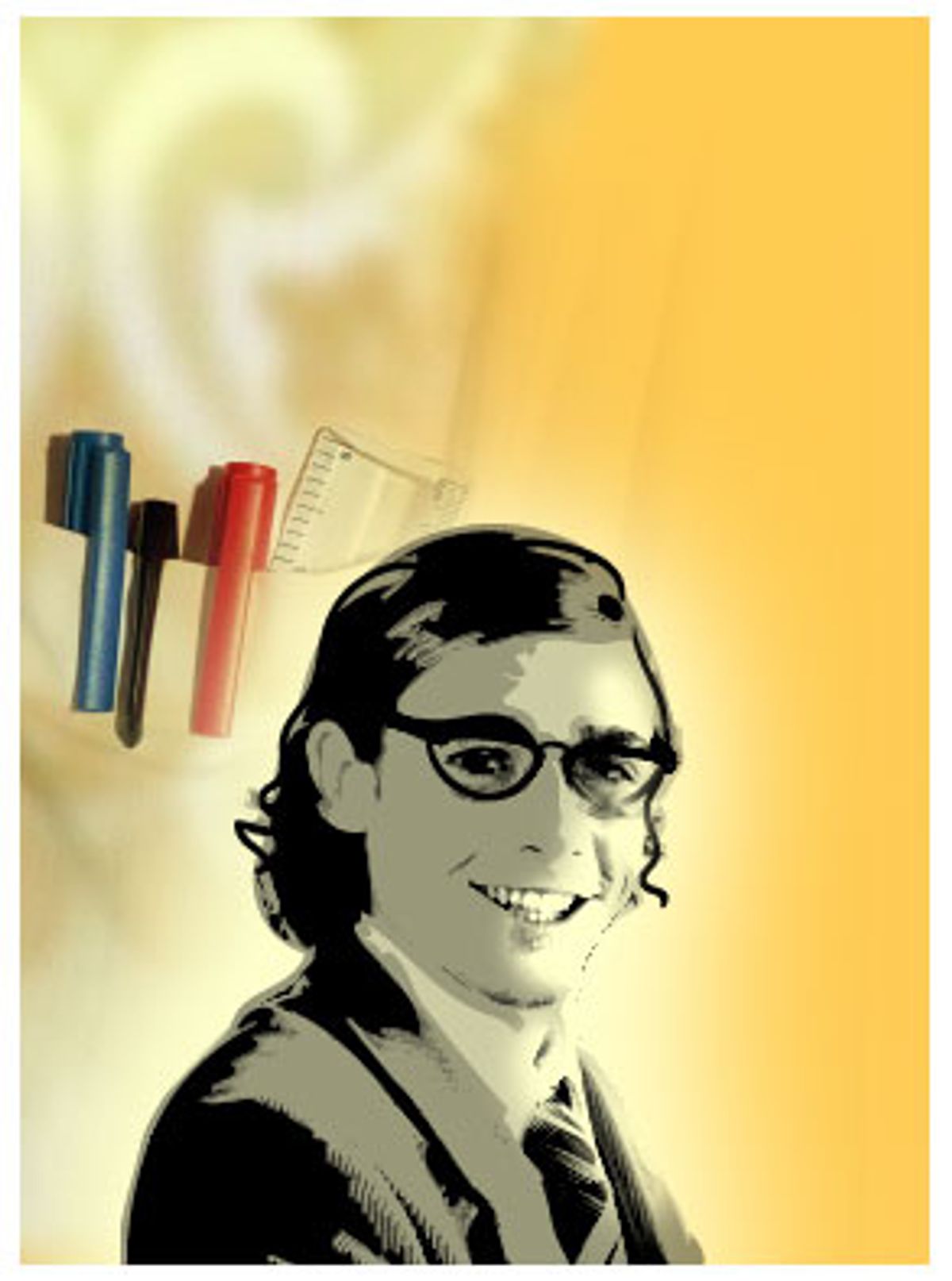
Ian R. Williams

Twilight of the dorks?

Geeks and nerds produced the art and science that define the modern age. But now that everybody's climbing on the dork bandwagon, where's the rage and resentment that fueled their creativity going to come from?

  • more
    • All Share Services

Twilight of the dorks?

At the end of the 1984 classic “Revenge of the Nerds,” Louis Skolnick (Robert Carradine) mistakenly ends up with the beautiful temptress of Pi Delta Pi. Stunned by his sexual resourcefulness, she purrs, “Are all nerds as good as you?”

“All jocks think about is sports,” he replies. “All nerds think about is sex.”

And with that clarion call, dorks all over America began to throw off the shackles that had socially bound them since kindergarten and started to see themselves in a different light. They began to take a little pride in their TRS-80 computers; they banded together to escape dungeons and fight dragons; they even took dodge ball a little less seriously.

It has been a slow climb, but after nearly 20 years, the American dork finds himself sitting atop the cultural heap of history, finally king of the mountain. Think he looks weird? Think his glasses are stupid? The new dork doesn’t care — he prides himself on it.

The bust of the dot-com revolution is misread as a repudiation of technology and the eggheads that came with it. “The end of the nerd as a crossover hit,” proclaimed the New York Times, but the paper of record was being hasty and myopic. The true geeks that hammered out code and designed pages for these companies were the first hired and the last fired, and most of them have found new work, with or without a Foosball table in the lobby. The days of overnight millions are gone, but the American love affair with dorks is set in concrete.

But with this ascent to cultural supremacy may come a price. If dorks are no longer despised, from where will they gain the motivation to create the masterpieces of art and science and technology that define modern life?

It’s important to define what I truly mean by “dork,” just so he or she doesn’t get casually lumped in with “losers,” “burnouts” and “lone psychopath bullies.” To me, the dork is somebody who didn’t fit in at school and who therefore sought consolation in a particular field — computers, “Star Trek,” theater, heavy metal, medieval war reenactments, fantasy, sports trivia, even isolation sports like cross-country and ice skating. I’d also include the Anne Rice obsessed (goths), the car enthusiasts (gearheads), and the seemingly homosexual (gaywads).

Early American poet William Cullen Bryant remarked that “difficulty is the harsh nurse of greatness,” which is the first lesson most dorks learned soon after they started realizing everyone else in the world was in on some secret that they weren’t. Some young dorks generated their quirks from several sources: weird parenting, odd siblings, books around the house — but most fledgling nerds rose from something much more ethereal. Early on, they were just pegged somehow — they might have been weaker, they might have looked a little different, they had glasses, they sucked at sports — but on that day a pheromone was sent forth, a chemical lingering in the social air, perceived by both the dorks and the crowd around them, and it pitched the afflicted into a netherworld that used to take decades (or a lifetime) to undo.

That dynamic is changing. These days, it’s tough to find anybody who doesn’t think they’re a dork. Dork sensibility and “geek chic” have become so prevalent that even the least dorky have glommed on to the title — not just because the digital revolution made heroes out of nerds everywhere, but because adopting the “nerd” label gives a certain street cred to everyone’s early child development. Even if most of it is revisionist history.

Alicia Silverstone: “I’m this weird, dorky girl.” Freddie Prinze Jr.: “I was a dork in high school. I barely even got to go to the prom.” Mena Suvari, Billy Crudup: “I was a dork.” Almost every cheerleader, sorority girl, investment banker, novelist, model or movie star ever interviewed hastens to speak the words. This tends to piss off anyone who actually had their locker defaced, or finally went with their 16th choice to the prom, or used up cases of benzoyl peroxide every week in ninth grade, but it’s a testament to the lasting power and redemption of geekery that everyone claims such fervent membership.

Before MTV chained American music to the mediocrity of the physically attractive, music was once a place where dork bands like Yes, Journey, REO Speedwagon and Devo could find purchase. Now it looks like those days are coming back, with self-proclaimed nerd bands like Weezer, Barenaked Ladies, and Super Furry Animals scoring hits. Moby, Fatboy Slim, and the explosion of techno have inspired a generation of goofy guys angling to be the next electronica sensation by trading bleeps and blops on the Internet. Even OutKast has released a stunning departure from hip-hop, with Andre 3000 appearing on the cover of Vanity Fair in what seems to be an Urkel costume.

Movies are no exception. The four biggest heroes of the last five years have been Neo from “The Matrix,” Harry Potter, Spider-Man’s alter ego Peter Parker, and a fat kid named Cartman. The television has so many shows dedicated to dorks that any cursory view of the cable guide after hours will provide Comedy Central, the Cartoon Network, and several late-night hosts to satisfy your inner nerd. “Saturday Night Live” has the lisping, supercilious “Nick Burns, Your Company’s Computer Guy,” while ads for Sprint and Verizon feature a weirdo in an “X-Files” trenchcoat and a bespectacled dork nasally repeating, “Can you hear me now?”

The new American hero is Jack Black, who fits into the subcategory of dork we called “spazzes.” He’s all rock ‘n’ roll, but in the studied way, like the kids in high school who worshipped the Canadian band Rush. He might have been the first kid you knew who got drunk, but remember, he was also playing “Axis and Allies” at the time. The Britneys and the Christinas may have a stranglehold on what corporate America regards as cutting edge, but ask the cool 13-year-old girls what they’re listening to, and they’ll mention Black’s Tenacious D, Pink, Avril Lavigne and Kelly Osbourne, acts who are less about rebellion and more concerned with misfit empowerment.

But there is a problem in all this. Famous goth Robert Smith said of the Cure, “If we’re selling out arenas, how can we be ‘alternative’?” The same could be said of today’s misfit teens, who get more airtime and cultural attention than they know what to do with. Post-Columbine parents are finally taking their troubled teens seriously, with zero-tolerance policies and heavy-duty counseling stopping most abuse before it gets going. The percentage of American children who are obese has more than tripled in the last four decades, so obviously school sports don’t hold the cachet they once did — nerds are given a pass on dodge ball these days, perhaps because there are much bigger targets standing around.

Dorks have also found each other through the Internet, where a simple search on your undying passion (comic books, astronomy, multiuser dungeons) yields 4,500 like-minded kids dying to talk to you.

What happens when the “harsh nurse of greatness” is replaced by peace and harmony? Most of the world’s best art, best engineering, best cosmological thinking, came from years of nerds not being able to find a date. The typical dork, allowed to stew in his or her own juices, is capable of almost anything.

Who wired America? Certainly not the lacrosse team. Fourteen-year-old college student Alexander Graham Bell didn’t invent the telephone by going to a lot of Tri Delt parties. Eli Whitney locked himself in a cabin until he came up with the cotton gin. It is because of nebbishes like Jonas Salk and Alexander Fleming that you don’t have polio and don’t die when you get the flu. When travel was difficult, 18th century nerds developed efficient trains; tired of always going downstream, 19th century geeks invented steamships. If it weren’t for dorks, America would look like Chile.

Perhaps there’s nothing to worry about. Perhaps childhood sucks so bad, and teenagers are so naturally full of self-loathing, that no complacency will sink in. There will always be that bully around the corner, whether he’s the failing fifth-grader with a moustache, or the U.S. government. It would, however, be a pity if none of us could look back upon our childhood with the kind of anger, resentment, self-pity and desire for revenge that have fueled our greatest work.

Generation gung-ho

Many of the 42 million Americans aged 12-24 think President Bush is "a little dumb," but they are more pro-war than you might think.

  • more
    • All Share Services

In Millerton, N.Y., an old railroad village two hours north of New York City, 18-year-old Andres Vialpando rips tickets for “The Quiet American” at the local theater. Across the street, a group of concerned parents, holding candles and chatting earnestly with passersby, hold a candlelight vigil against the war in Iraq.

To Andres, however, the war remains a simple question of logistics. “I think Saddam should not be dictator of the country,” he says, “I don’t think he’s pushing Iraq in the right direction, and we need to do something. He needs to be taken out.”

Andres is one of the 42 million Americans aged 12 to 24, a collection of kids whose first historical memories were the Rodney King riots, O.J.’s trial, Princess Di’s death, Columbine and, of course, Sept. 11. The members of Generation Y — or the Millennials, if you prefer — are now doing what Generation X did 12 years ago: girding themselves for war. The political names are the same (Bush, Powell, Cheney, Hussein), but the kids are not.

In polls, Generation Y has confounded sociologists by espousing the same pro-war majority opinion shared by the rest of the country. In February 2003, a Gallup Poll reported that 58 percent of teens favored the war (for boys, that number jumped to 66 percent, the same as the population as a whole). “A lot of people are amazed these kids are as supportive as they are,” says Neil Howe, the coauthor of “Millennials Rising” and a social policy advisor in Washington, “because a lot of folks think young people always rage against war.”

For Justin Bock, a wiry 16-year old dispensing popcorn for elderly patrons at the Millerton Moviehouse, war was the obvious option. “It’s a simple decision,” he says. When asked about possible blowback from terrorists on our own soil, he said he thought Saddam Hussein was the bigger problem. “I’m way more worried of an initial strike by Iraq than any terrorist.”

These teens might support military invention simply because they’re so anxious to move on to other subjects. One 17-year-old girl declined to be interviewed about the war, moaning, “God, that’s all we talk about at school.” Indeed, classrooms around the country are studying history in real time. “In English we all wrote President Bush letters about the war,” says Ava Dweck, an eighth-grader from Millerton. “We all got the same letter back, with an 8-x-10 photo of Bush. It said, ‘We’re going to do what’s best for your country, so work hard in school.’”

Even elementary school students are mixing war with reading and arithmetic. Victoria Suber, a constantly smiling, vivacious sixth-grader from the sleepy mountain town of Jasper, Ga., says the subject rarely changes. “We talk about it all the time. That’s all we do in school. We had to watch the [Bush press conference], and our teacher always tells us to make sure we watch the news, and sometimes we have to go to the computer to see articles about what’s going on.”

Victoria’s mother, 33-year-old Elizabeth, tries to keep it in perspective for her. “Last week, Victoria asked me if we were in danger. I told her that terrorists usually like to strike places where lots of people are gathered. Then she stopped and said, ‘How about Atlanta? Grandma lives there!’”

Howe cites results from Time magazine and the High School Class of 2000 Survey, saying no generation has ever had as much appreciation for their elders as the Millennials. Even if they find flaws with their leaders, this is a group that feels that their government has their best interests in mind. In polls, they often have greater trust in America’s institutions than their midlife parents.

“These are kids who are taught to think of themselves as being the sole purpose of community life in America,” Howe explains. “They’ve been surrounded by kinderpolitics, the idea that politicians are constantly saying, ‘Do it for the children.’” The recent list of governmental reforms for kids is endless: The Consumer Product Safety Commission, the National Transportation Safety Board, the Labor, Treasury, and Justice Departments, and even the EPA have passed laws benefiting young Americans. “These kids have been taught, throughout the late ’80s and ’90s, that government is constantly trying to do great things for kids,” says Howe. “Why shouldn’t they like government?”

When asked how his friends at Webituck High School feel about the war, Andres says, “The general consensus is not necessarily pro-war, but they do support Bush,” he says, as he ushers people into the Millerton theater. “They definitely think Bush is a little dumb, but they definitely support him.” Rosie Williams, a 16-year-old attending Santa Fe High School in New Mexico, goes further: “He is aggressively stupid,” she says, “but I don’t think he’s a bad person.” Even 12-year-old Victoria is learning the politics of nuance. “Outside of school, we talk about it. You know, ‘I can’t believe this happened’ and ‘I wish Bush didn’t do this,’” she says. “But I like George Bush. He’s nice.”

Generation Yers aren’t just spending their time pontificating at home; they also make up the lion’s share of the coalition currently racing across the dark skies of the Persian Gulf. While the Special Ops forces are older Generation X vets, the median age on an aircraft carrier is just under 19.

Despite their youth, the new recruits exhibit the confident swagger of their predecessors. Awaiting orders to board a ship bound for the Gulf, 22-year-old Sgt. Jesse Sharron — just back from Afghanistan — talks in gruff, cocksure tones from his barracks near Wilmington, N.C.: “I’ve got guys who were straight-A students in high school, who joined because they wanted to. They had other options, they did well on their SATs, they could have gone to college, but they chose to fight in the military. Our military is 10 times smarter than it’s ever been.” Stats bear him out: 96 percent of military recruits have high school diplomas, up from 75 percent in the mid-1970s.

Of course, not all of Generation Y is psyched to fight; many are capable of deeply felt pacifism. “They’re still connecting 9/11 with Saddam Hussein, when there’s no connection at all,” says Rosie, who displays a level of political sophistication unusual for an 11th-grader. “Al-Qaida has nothing to do with Iraq. I feel like Americans are just being yanked around by the media. This is going to turn into something much bigger and much worse than anyone could have anticipated.”

“We all talk about this, and we all agree that it’s stupid and very scary, actually,” says Ava, while her mother holds a candle at Millerton’s peace vigil. “I think Bush’s decision to go in and occupy Baghdad will kill an unbelievable number of civilians.” Hundreds of miles away, Victoria fears the same. “I feel bad for the people there. I wish we had some way to help them.”

Sixteen-year-old Jasmine Wright, the lone female employee at the Moviehouse, speaks in hushed tones and wears a diamond nose ring. She takes exception to the gung-ho attitude of her make co-workers. “I don’t think that it’s fair that they’re only giving [Iraqi civilians] such a short time to get out of the country, and there are innocent people that are most likely going to get hurt or killed in the process.”

Rosie Williams, of Sante Fe, says her biggest fears are rooted in generational camaraderie: “The thought of my peers, the boys and girls I’ve grown up with and love, the thought of them fighting a war scares me to death.” Many her age share that sentiment: On March 6, 300 high schools and colleges participated in a nationwide Books Not Bombs demonstration coordinated by the National Youth and Student Peace Coalition. Hundreds of other schools planned their own rallies.

Yet despite the creeping uncertainty of the times, these kids remain bullish on the future. Says Victoria, “I think it will only be a short war. Then Saddam won’t hurt any more people.” Adds Ava: “We’ll get through it. In the very long term I think it will be like, ‘Wow, I can’t believe we did that. That was stupid.’”

Continue Reading Close