Race

Left Coast brawl

In San Francisco, America's most liberal city, a gay progressive, a Green, a Clinton liberal and a labor favorite are battling to succeed legendary Mayor Willie Brown.

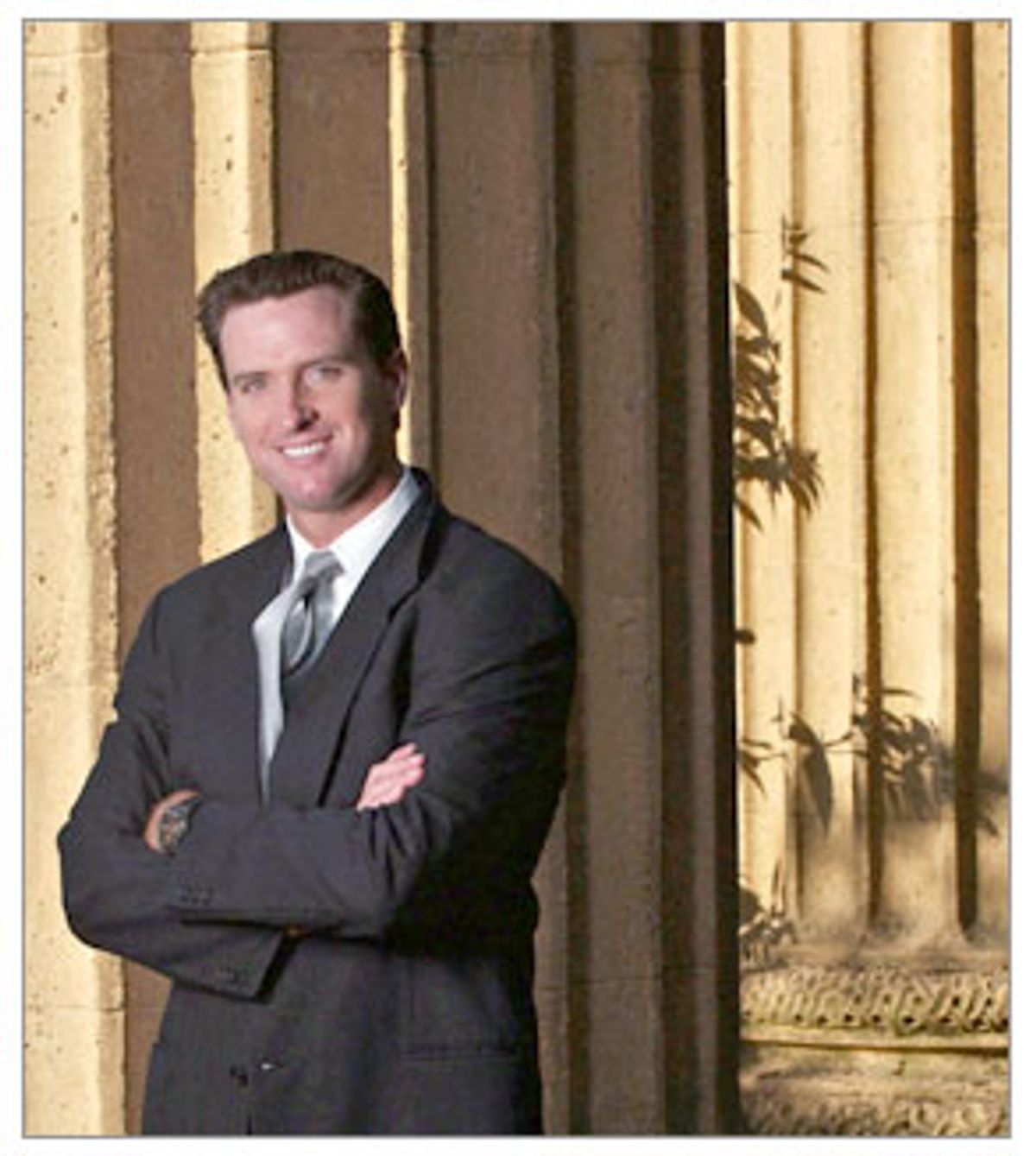
Moments before San Francisco Mayor Willie Brown delivered his final State of the City address Tuesday morning in the glorious City Hall rotunda, its gilt-trimmed arches glinting in the autumn sunlight, tall, dark and beleaguered Supervisor Gavin Newsom swept in from a side entrance and eased his lanky, well-clothed frame into a front-row center seat. Lately it’s looking like Newsom, who’s been endorsed by Brown, will have a harder time sweeping into the mayor’s office when his patron vacates it in January.

Despite Brown’s backing and a $2.4 million war chest; despite sponsoring a homeless-aid reform ballot measure last year that won almost 60 percent of the vote and — briefly — made him look invincible; despite a sprawling, well-oiled field operation that spent more on payroll taxes last quarter than two leading candidates managed to raise in the same period; despite youth — he’s 36 — money, good looks, some good ideas and the support of a wide swath of the city’s rich and famous (and some regular folk too), Newsom is stuck in the polls at around 35 percent, leading the pack of mayoral wannabes by a sizable margin but nowhere near the 50 percent plus one he’d need to avoid a runoff. So next Tuesday’s election is just a prequel to set up the real race, between Newsom and whoever finishes second. But now the December runoff, which used to seem like a formality on the way to Newsom’s inaugural, is shaping up to be a fierce battle between the moderate Newsom — who’d be a liberal in most cities but who’s savaged as a right-winger here — and whichever left-leaning candidate is still standing after Tuesday’s election — if the lefties haven’t torn each another apart by then, that is.

“I’ve done three different polls and they had three different candidates coming in second,” says veteran pollster David Binder, who’s working for business groups and ballot initiative sponsors, not a mayoral campaign. “The race for second is clearly tightening.” It’s clear that nobody — including Newsom — has yet assured a majority of voters he or she can revitalize the city after the tech bust, solve its grim homeless crisis, shore up its flagging tourist trade or force its warring ethnic groups to get along. This is by far the nation’s most liberal city, says Rich DeLeon, San Francisco State University urban politics expert, “but even on the left there’s a strong strand of civic pride. People want this to be a city of greatness, and they want a mayor who can rev the city up again.” So far, no candidate quite seems up to the challenge.

The struggle for second place, and for the right to wear the mantle of the left into battle with Newsom, is bad news for Supervisor Tom Ammiano, who ran an amazing last-minute write-in campaign against Brown in 1999, riding a wave of anger at dot-com gentrification — remember young white tech lords evicting whole families from Mission District flats? — getting roughly 49,000 votes and forcing the lordly incumbent into an unexpected runoff, which Brown won. Ammiano’s been the left’s presumptive standard-bearer ever since.

But then former Supervisor Angela Alioto jumped in and split labor, while Treasurer Susan Leal, a liberal Latina lesbian, challenged Ammiano’s appeal as the gay candidate. And in August, on the eve of the mayoral campaign filing deadline, Ammiano backer, Board of Supervisors president and Green Party leader Matt Gonzalez stunned the city, and many of his friends, by diving into the race, insisting that while he’d endorsed Ammiano early, he’d come to the conclusion that the former teacher, stand-up comedian, gay rights leader and school board member simply couldn’t beat Newsom. The first time I talked to Gonzalez about his decision, just after he declared, he told me it wasn’t about Ammiano’s politics. “I’m not running because Tom isn’t progressive enough,” said the 38-year-old Gonzalez, a good-looking, bass-playing, former public defender of Latino descent who’s got a neo-Beat appeal. “I’m telling people, if you like Tom and you think he can win, vote for him.”

That was then. A couple of weeks ago the Green leader sent out The Mailer That Shook the Mayor’s Race, comparing himself, Ammiano and Newsom, and concluding that Ammiano, the dean of the local left, was closer to Newsom, its favorite whipping boy, than to Gonzalez. Ammiano allies went ballistic. “The left is split and angry,” longtime gay activist Robert Haaland wrote in a bitter, widely circulated e-mail. “The mailer … is just more evidence of that bloodbath that has occurred … At the end of the day, the ends of Matt’s campaign do not justify the means.”

Now it’s a nasty free-for-all. “I feel bad for Tom,” says Angela Alioto. “I mean, when is Gonzalez going to start attacking Gavin Newsom? All he’s done is bash Tom.” If you believe Alioto feels bad for Ammiano, she’s got a pretty red bridge to Marin she’d like to sell you. In recent weeks Alioto’s sashayed past the brawling lefty men to win key endorsements that Ammiano took for granted, including from unions and the city’s oldest alternative newspaper, the San Francisco Bay Guardian. (The Guardian endorsement was mainly the handiwork of publisher Bruce Brugmann, who overruled angry Ammiano and Gonzalez lovers on his staff, proving that freedom of even the alternative press belongs to those who own one.) According to many polls, Alioto and Gonzalez are now vying for the No. 2 spot, while the flagging Ammiano campaign, running out of money, fights to stay relevant, and Susan Leal, who still has a sizable war chest, fights to stay alive. (Republican former police chief Tony Ribera has no chance — some think he’s just setting up to run for supervisor on the west side of the city against board conservative Tony Hall — nor do a handful of lesser-known candidates.)

As if that wasn’t enough turmoil on the left, Gonzalez backer Supervisor Chris Daly threw a hand grenade into the race last week when, while serving as acting mayor during a Brown trip to Asia, he used his mostly ceremonial power to appoint two supporters to vacant posts on the city’s powerful Public Utilities Commission, bypassing two Brown appointees who were awaiting swearing-in. If Gonzalez is the local left’s cool theoretician, detached and intellectual, Daly is its mad bomber, a 31-year-old whose first act as supervisor was to get into a shouting match with the mayor (who’s 38 years his senior) that almost turned physical. Daly’s brazen PUC move was either a sign that the left is feeling its oats, or that chaos begets chaos, or maybe both, but one thing is clear: The reign of Mayor Brown is about to be over, and no one has a clue what comes next.

That’s particularly true on the left, where the Gonzalez campaign raises the question of whether the Green Party is the left’s future or its undoing. Critics say Gonzalez is playing trademark Green politics, savaging a progressive ally and, inadvertently, making way for someone more conservative. But his supporters insist he came along in the nick of time, to energize a coalition of the disaffected, breathe new life into the race and “stop the coronation of Gavin Newsom,” in Gonzalez’s words, in the coming election.

The scholar of the local left, Rich DeLeon, isn’t so sure. “I have this creepy déjà vu feeling that it’s 1991 all over again,” DeLeon says. That’s the last time the San Francisco left self-destructed, turning on its former champion, then-mayor Art Agnos, for the crime of compromising with the business community on development during an economic downturn and not stroking enough tender lefty ego in his contentious four years as mayor. Alioto ran against Agnos (“I have no regrets about that,” she told me this week. “He closed a health clinic I cared about”) but that time around the Bay Guardian (whose clip-and-take-to-the-polls voting guide delivers lots of lefty votes) endorsed former Sheriff Richard Hongisto. An out-of-his-league pro-business police chief, Frank Jordan, squeaked into the mayor’s office while the lefties squabbled. (He squeaked out four years later, defeated by Willie Brown.) “I’m a Green Party member myself, and I admire Matt Gonzalez,” says DeLeon. “But the question is did he move too soon, and risk dividing, not uniting, progressives?”

So if it’s 1991 all over again, does that make Newsom Frank Jordan? DeLeon’s not mean enough to float that comparison. But clearly the surprise of the mayor’s race is how vulnerable a candidate Newsom is turning out to be. Right now, though, they all look a little like Frank Jordan: flawed candidates who, even if they win, won’t win, exactly; it’s more like they’ll be the only one standing when the others lose. The question hovering above the race is who can be trusted to run this troubled “city of greatness,” in DeLeon’s formulation. I change my mind every day, and I’m sure I’m not alone.

Listening to Brown’s last big speech in the majestic City Hall rotunda — which the mayor restored either as a great gift to the people of San Francisco, according to his backers, or as a $300 million monument to himself, in the eyes of detractors, who used to call it the “Taj Ma Willie” — it was hard not to notice that a political era was passing, but a new one hasn’t yet dawned. It’s a little bit dark politically in San Francisco right now.

Love him or hate him, Brown rescued the city from the Lilliputians of local government in 1995, uniting a coalition of labor and downtown business, blacks, gays and Asians, neighborhoods and developers. Then he ran San Francisco the only way he knew how: imperially, with a populist twist, as a last hurrah for a certain kind of old-time municipal machine. He knocked heads to end planning gridlock and pushed through stalled development projects. The rich got richer, including some of his friends, but he shared the wealth for a while by expanding the city’s payroll and presiding over the great dot-com boom.

He’ll be remembered for presiding over that boom — and bust — and for unapologetically backing pro-development policies that awakened the slumbering left four years ago. His most important legacy may be remaking the waterfront, yet the gorgeous Embarcadero rings a still-troubled downtown, where sad, sick homeless folks and sometimes-menacing panhandlers run rampant. Still, even though I’ve criticized Brown over the years, I find myself thinking this fractured city is going to miss his hand on the rudder, not to mention his role in pulling together our warring tribes with his charisma and singular racial appeal. Once his coalition united blacks and Asians; now they’re squabbling bitterly. The ugliest battle in the city isn’t the mayor’s race but the fight over how students are assigned to public schools — specifically whether school assignments should promote diversity by sending kids to far-off neighborhoods, or favor kids who live close to their schools. And school-board Greens are joining Chinese parents, many of whom are conservative, who are angry at having to send their kids across town to integrate academically weak black-and-Latino-dominated schools, in trying to topple the imperious but capable African-American superintendent, Arlene Ackerman. Ackerman is backed by Brown, but it’s not clear even Brown can save her.

The mayor’s State of the City speech Tuesday offered a snapshot of the looming leadership vacuum. There was Brown behind a lectern, on the landing of the graceful central stairway, while the supervisors sat below him like impish schoolboys (and they are virtually all boys: District elections, which were supposed to usher in new, progressive, representative city government, just happened to bring in 10 men, all but two of them white, and one black woman, Sophie Maxwell). Newsom sat quietly in the center — he’s the good schoolboy — while to the mayor’s left the impish Daly and Gonzalez whispered to one another and fidgeted, as Tom Ammiano sat beside them, smiling and making nice with everybody. Ammiano has tried to take the young left’s revolt against him in stride. “Yeah, I’m angry, but I don’t have time to be angry,” he told me shortly after Gonzalez declared. “I get their impatience. I’m 61, they’re all in their 30s. It’s the father thing — and I’m sure they always wanted a gay, queenie father.” One of Ammiano’s problems with appearing mayoral is that he’s almost pathologically nice; no one fears him. But none of his rivals have gravitas, either; Gonzalez probably could, except he shuns such old-fashioned trappings of power.

And yet, for all of Brown’s gravitas and power, he can’t simply hand the reins of the city over to Newsom. He hasn’t even been able to unite the storied Brown-Burton machine behind his candidate — his longtime friend, State Sen. John Burton, is backing Alioto, and so is his buddy Joe O’Donohue from the powerful Residential Builders’ Association. Even though Brown endorsed Newsom, you get the feeling that he doesn’t entirely trust him. Plus the mayor’s got a mischievous streak himself and he can’t help messing with young Gavin. When Gonzalez entered the race he quipped that he “made Gavin look stiffer,” which was projected on a wall during the Gonzalez kickoff party in September. Brown is not known for false modesty, but the last time we talked, when I suggested he ought to be able to bring Burton and O’Donohue on board for Newsom, he told me he simply couldn’t. “There’s an observation of Gavin as being unreliable. So I can’t go to Joe O’Donohue or John Burton and say, you can’t do this. They have too many examples of unreliability.”

What some call “unreliability,” of course, others call independence, and there’s a way that Brown’s occasional public distancing may help Newsom, in a town where the mayor is a polarizing figure, loved by many but hated by more than a few. Newsom has bucked Brown, who appointed him to the board in 1997 (he’s since been reelected), on several key votes, and recently said he’d replace the mayor’s choice for police chief. And despite the left’s depiction of Newsom as the creation of evil, monolithic business leaders, business doesn’t entirely trust him either. Financier, philanthropist and liberal Republican Warren Hellman is backing Leal. Newsom is a little bit too young and — to his credit — too much of a synthesizer and triangulator, in the Clinton mode, for any one group to monolithically back him. His decision to support a ballot measure increasing the local minimum wage, for instance, probably cost him some business support.

I’ve always sort of liked Newsom, liked his wonkiness. His campaign Web site reads like a think-tank site, with policy papers on every imaginable topic; last time we talked he was pushing his plan for a local Earned Income Tax Credit for San Francisco’s working poor, an underappreciated New Democrat priority, even in the face of a budget deficit. When I was profiling Matt Gonzalez for San Francisco magazine, the Green Party leader kept needling me that I was giving him a hard time — asking tough questions about his late decision to run — because I have a dark political secret: I’m a Bernal Heights lefty who’s soft on Ammiano (he lives blocks away and represents my district). I have a dark secret, all right: It’s that I like Ammiano, but before Gonzalez joined the race, I was torn between him and Newsom (I still haven’t gotten over Alioto’s challenging Agnos in 1991, and Leal’s campaign just never added up for me). I covered Newsom’s “Care not Cash” initiative last year and found myself persuaded by some of its logic: It would have slashed the cash grant the city gives the homeless from roughly $350 to $59 — all around San Francisco, other counties have done something similar, making us a magnet for general assistance recipients — and put the money into housing and services, creating a $14 million revenue stream for supportive housing at a time of budget cutbacks.

But mostly I hated the campaign against Care Not Cash, which was really a campaign against Newsom, in which nasty lefty know-it-alls hit him with pies, threw stink bombs into the restaurants he owned, papered the town with fliers printing his home phone number and demonized him mostly because they could. It was a thuggish kind of politics that disgusts me, and I blamed its practitioners for marginalizing someone who isn’t a villain, who doesn’t have horns, who had been a champion of drug treatment and a smart mind and decent vote on human service issues, whose crime it was to see the problems of poverty and social services differently from the advocacy community.

Yet lately I’ve had to admit Newsom deserves some of the blame, too. His new initiative, Prop. M, which bans aggressive panhandling, seems to be an exercise in divisive politics. I met with Newsom shortly before he put it on the ballot, and it was one of those days you could see the angel and the devil on his shoulders, whispering in each ear. Some liberal supporters of Care Not Cash — most notably Human Services chief Trent Rhorer, who helped write it — were opposing the new measure, which would ban “aggressive panhandling” — physical contact, verbal threats, following someone who says no — plus add new limits: no begging at bus stops, on median strips, in parking lots. It also would take the city’s most Draconian laws — technically, begging is illegal in San Francisco — off the books, which let Newsom pitch it as another hybrid, left-right solution. But nobody was buying it. “I think Gavin truly did Care Not Cash as a way to help people,” Rhorer said in April. “But I worry that there’s no way you can really say this measure will do that. I mean, call a spade a spade: If you want to make the streets cleaner for businesses and tourists, do it. But don’t bill it as compassion.”

Newsom was irritated by the criticism from friends, but he seemed chastened by it. “We don’t need a divisive campaign right now,” he admitted. Then he did his sanctimonious schoolboy thing: “Look, if you want to say, ‘So what if we lose another few hundred people on the street,’ fine. If you want to say, ‘So what if people feel insecure going to their parking lot and confronting a guy with a golf club asking for money’ — well, OK. If you want to say, ‘Society’s cruel and capricious.’” The next week, a judge struck down Care Not Cash on the grounds that only the Board of Supervisors can set welfare-grant levels, not voters, and suddenly Newsom was moving forward with his panhandling plans. You could watch as his board colleagues’ obstinacy hardened his stance. Newsom and Brown challenged the board to follow the will of the voters and implement the homeless reform legislatively, but they refused, Gonzalez and Ammiano making common cause with conservative Tony Hall, who hated the measure because it increased spending on services.

I understood Newsom’s political reasoning on Prop. M, but I didn’t like it. I think the measure polarizes the city even more, and proves that Newsom’s political advisors convinced him he didn’t need to look to his left for votes. That’s why I think it’s good for the city — and for Newsom’s soul — that he has a vital challenge to his left, even if — maybe especially if — he gets elected anyway in December.

But right now it’s looking like he can’t start measuring for new drapes in Brown’s office quite yet. And the late surprise is Gonzalez’s surge. Only a few weeks ago he was in fourth place, usually in single digits, in every poll I heard about, even his own. Now a Binder poll getting a lot of hype has him in second with 16 percent of the vote, way behind Newsom. But if he makes the runoff, it’s a whole new race. Gonzalez would seem to be the candidate Newsom should fear most (though some in his camp deny it); no doubt his opposition-research team has a hard drive full of Alioto’s vulnerabilities, and nobody, not even Ammiano supporters I’m talking to lately, thinks the lefty supervisor can beat Newsom in December. But can Gonzalez?

He thinks so. Clearly, his campaign is the most interesting game in town, relying on nightly parties and pub crawls and bringing in a wave of young, turned-off bohemian do-gooders who are otherwise cynical about politics. I like his campaign, and I mostly like Gonzalez, despite an off-putting detachment that can feel like arrogance. I liked him a lot when he debated Newsom last October over Care Not Cash. His arguments were political, not personal, and despite the viciousness of the anti-Newsom campaign he was careful to say that he liked and respected his colleague, that they’d worked well together before and would again. It took a certain amount of courage.

Now, of course, he uses Newsom as a punching bag, and there’s a ruthlessness about him that seems new and maybe inevitable in someone who wants to be mayor, but off-putting in someone who claims he’s about a new kind of politics. It was on view, in a small, petty way, just the other night, when Green Party guru Michael Moore was in town, and he asked Gonzalez for Newsom’s phone number, so he could call him from the stage and humiliate him in front of hundreds of adoring lefties for beating up on the poor with Care Not Cash. Gonzalez hesitated, but then he phoned his pal Chris Daly and got the number, according to the Chronicle, and Moore made his prank call. There was something amusing but sort of bullying about it that just didn’t feel like Gonzalez. But then I don’t know him very well.

Then came Daly’s PUC bombshell. Gonzalez insists he didn’t know about it, and that’s actually believable. But so far, he’s stood by Daly, refusing to promise Brown one of the eight supervisors’ votes he’ll need to overturn the appointments. At first other lefties were balking, too. But then Brown did something extraordinary in his State of the City address. Declaring that the PUC “should never be politicized,” he withdrew his appointments and promised to consult with the Board of Supervisors on a new list of candidates. The move prompted a thunderous standing ovation, and it was amazing to see the 69-year-old titan, who normally smites his enemies, extend a kind of olive branch. But Daly stood firm, insisting he wouldn’t withdraw his appointments despite Brown’s gesture.

It’s become a lefty cliché that Daly borrowed a page from the wily Brown’s political playbook with his PUC move, but in fact Brown’s backroom maneuvers have always been more audacious, like siding with Republicans to become Assembly speaker in 1980. And in the end, the master may well best Daly this time around, too. Although Daly has been insisting Ammiano is still supporting his PUC picks, after Brown’s offer to compromise, the supervisor suggested he might back the mayor, and others began to peel off too. It would have to feel good to Ammiano to decide to pay back Daly, his former ally, for defecting to Gonzalez. Now the question is: Will Gonzalez stick with Daly? And if he does, will it cost him a shot at Brown’s job?

“It could decide the race,” says Rich DeLeon, who calls Daly’s move “outrageous and stupid” — and remember, DeLeon counts himself on the left. “It could be like that Frank Jordan stunt, remember, when he appeared naked in the shower with those DJs?” I do remember — in the end, Willie Brown’s masterful politics didn’t land the decisive blow in 1995; Jordan did himself in, by agreeing to shower with some shock jocks just before the runoff. Small things are only decisive when they crystallize a worry voters have — in that case, it was that Jordan wasn’t mayoral, even after four years as mayor. Sticking with Daly could prove to voters that Gonzalez is tough enough to be mayor; or it might prove he can’t be trusted to run a city of greatness that’s beloved by the left, not just by business leaders and society types.

So Tuesday’s race won’t decide who’s mayor, but it will decide who leads the left, which is important in a city as liberal as San Francisco. Traditionally, what’s described as the left is the political bloc that favors rent control and limits on downtown development, backs municipalization of public power, and opposes limits on aid to the poor and homeless. They make up no more than a quarter of the city’s voters — a 2000 survey by David Binder found that 42 percent of San Franciscans describe themselves as “liberal/progressive,” 39 percent as moderate and 15 percent as “conservative” (3 percent were “other” or “decline to state.”) But they serve to pull the local right to the center, and to preserve a little bit of an increasingly wealthy city’s bohemian, egalitarian soul. So the race for second matters. Is a vote for Ammiano or Alioto a way of looking backwards — both are grandparents — while the younger, cooler Gonzalez represents a vote for the future? Will the Green Party’s gumption revitalize the left, or sacrifice its links to labor (which is heavily for Alioto) and local Democrats and isolate it? Tuesday’s results will answer some questions and raise more.

The only thing sure is that Willie Brown’s time is gone, and it’s not clear whose time has arrived. It’s been several years of loss and change: Herb Caen and Giants manager Dusty Baker are gone (Brown and I found common cause in anger at watching him be driven away by the imperial Peter Magowan, unable to do anything about it); the 49ers haven’t gone to the Super Bowl in almost a decade, and probably won’t for a while. The dot-com chimera — We were going to revolutionize media! And make a lot of money doing it! — vanished, and nothing’s replaced it. The tech lords who used to crawl the Mission moved away, but too many Mission families still can’t afford to live there anymore, anyway. San Franciscans can shut down the city protesting the Iraq war, but can’t figure out how to get the homeless off the streets. This is a fragile city, a city on a hill, on an earthquake fault, on a cliff beside a vast ocean. It deserves great political leadership, and it doesn’t quite have it yet.

Joan Walsh

Joan Walsh is Salon's editor at large.

“The Intouchables”: Racial comedy, French style

"The Intouchables" is the biggest foreign-language film of all time. Some critics say it's also racist

A still from "The Intouchables"

Here’s a startling news item: “The Intouchables,” a lively if largely predictable Parisian comedy about a wealthy quadriplegic and his ne’er-do-well immigrant caretaker, has become the biggest international success in the history of French cinema. Indeed, according to some sources — and these things are notoriously difficult to measure on a global and historical scale — “The Intouchables” is now the biggest non-Anglophone film of all time, with a worldwide gross approaching $300 million.

But beyond the business headlines, what’s really fascinating about “The Intouchables” is the way it exposes the gulf in racial attitudes between France and the United States, along with another gulf that’s just as wide, the one that has film critics and cinephiles on one side and popular audiences on the other. Viewers in numerous countries have eagerly devoured this feel-good fable about two men of different races and classes who forge an improbable friendship (dubbed by some wags “Driving Monsieur Daisy”). While the audience for foreign-language film is inherently limited in America, there’s no reason to believe it won’t do well here also. At the same time, heated transatlantic debate has erupted over whether “The Intouchables” traffics in offensive racial stereotypes, with Variety critic Jay Weissberg writing an uncharacteristically angry review that accused the film of “Uncle Tom racism” and compared the Senegalese caretaker character to a “performing monkey.”

When Harvey Weinstein first acquired “The Intouchables” in the wake of its smash success in France, he clearly imagined another dark-horse Oscar contender, in the wake of “The Artist.” The film has racked up audience awards at film festival after film festival, and currently stands at No. 93 on IMDb’s user-generated “Top 250″ list. Omar Sy, the charismatic Afro-French actor who plays Driss, the caretaker, won this year’s César award (the French Oscar equivalent) for best actor, beating out actual Oscar winner Jean Dujardin. But with the looming possibility that “The Intouchables” could spark a divisive, soul-searching racial debate — which was precisely what squelched the Oscar hopes of “The Help” — those expectations have been downplayed. (That isn’t why “The Intouchables” is being released this week, with Weinstein and most of the film-biz aristocracy in Cannes, but the coincidence is oddly useful.)

Let me come clean right now and tell you that I enjoyed “The Intouchables” quite a bit. If you’re looking for a lightweight summer change of pace, with just a smidgen of Continental flair, here it is. Both Sy and co-star François Cluzet (of the hit thriller “Tell No One”) are marvelous, the former playing a guy who’s constantly in motion, both physically and psychologically, and the latter playing a depressed and repressed guy who literally can’t move, but whose real imprisonment has more to do with his spirit than his spinal cord. Don’t go expecting serious French art cinema, please; those who have described this movie as something like a mid-’80s Eddie Murphy comedy dressed up with classy Parisian settings are correct. But here’s the question, and I can’t answer it for you: Is that such a bad thing, in itself?

Once is not enough for a movie that’s made this much money, of course, and Weinstein already has an American remake in the works, possibly to star Colin Firth as stick-up-butt wheelchair dude. The real Eddie Murphy has gotten too old to play the loosey-goosey, pot-smoking sidekick, but there’s no shortage of guys who could do it: Jamie Foxx is the default setting these days, but I’d go for the suddenly hot Kevin Hart from “Think Like a Man.” I’m not claiming it’s aesthetically or sociologically valid to remake a French movie that already feels like a reheated Hollywood throwback, by the way. I’m saying it’s a cruel reality, like Dutch elm disease or Adam Sandler, and there’s no way to stop it.

To get back to the case at hand, I do understand what the haters find so offensive about “The Intouchables.” (The infelicitous English title, by the way, reflects the fact that they couldn’t really get away with calling it “The Untouchables,” could they?) I was pretty taken aback by Weissberg’s vituperative review, and I tend to believe that “Uncle Tom” is one of those expressions that white people should pretty much never use. On the other hand, I can only applaud him for abandoning the balanced, analytical mode of trade-magazine criticism and saying exactly what he damn well thinks. (As for comparing a black man to a monkey — well, I understand what Weissberg was getting at, but it’s an error of rhetoric, the sort of comment that makes nuance and context disappear.) And I know for sure, from hearing friends and acquaintances in and around the movie business complain about this film, that Weissberg is not alone.

I believe that Olivier Nakache and Eric Toledano, the writing-directing duo who made “The Intouchables,” are innocent of any bad intentions. In fact, “innocent” isn’t a bad word overall, for this movie and the worldview it represents. The French may pride themselves on being the most worldly and sophisticated of all people, but the debate in France about race and immigration and multiculturalism — which ramped up sharply after the suburban riots of 2005 — can sometimes sound strikingly naive to American ears. Until very recently, mainstream French opinion has resisted thinking about the nation in anything except homogeneous terms, despite growing Arab and black minorities (both immigrant and native-born) and evident social problems with segregation and discrimination. (The French census, for instance, is prohibited from collecting data on race or religion, so no one really knows how many French people are black or Islamic.)

There can be no question that the characters in “The Intouchables” are stereotypes, in the broad sense. Cluzet’s character, Philippe, is an aristocratic zillionaire who lives in an astonishingly luxurious flat in central Paris. Since being injured in a paragliding accident, he’s lived inside a cocoon of money and privilege, surrounded by antiques and modern art and a bevy of assistants. Sy’s character, Driss, is easygoing, good-hearted, lustful and uncultured, and his passions run toward pretty girls, getting high and vintage American R&B. Philippe hires Driss specifically because Driss doesn’t particularly want the job — he only shows up to get a signature for his benefits card — and feels no pity for Philippe.

Which is actually a pretty good reason. You get where this is going, most likely: Driss is a pretty inept caretaker, at least at first, but is the only person Philippe knows who will relate to him man to man. There’s a bit of borderline-homophobic humor about their enforced intimacy; there are interludes with hookers and fast cars and late-night conversations fueled by booze and marijuana. Driss learns to like Mozart and modern art; Philippe learns to get down with Earth Wind & Fire and gets some valuable tips about chicks. It’s probably fair to summarize this movie as being the story of a paralyzed white man who needs the help of a younger, stronger, more virile black man to reconnect with his own masculinity, and if you want to say that narrative reflects an underlying latticework of racist attitudes, I won’t argue with you. Then there’s the complicating factor that in the real-life story on which “The Intouchables” is based, the caretaker was of Algerian origin, and hence Arab rather than black. (The filmmakers have said they wanted to cast Sy, and built the story around him, but it’s certainly possible to render other interpretations.)

But one can concede all of that while still agreeing with French historian and multicultural activist François Durpaire, who has responded to Weissberg by arguing that the huge success of “The Intouchables” is likely to have positive effects in Europe’s emerging discussion of race and culture, even if the movie relies on crude generalizations. (Durpaire adds that if “The Intouchables” is offensive, so were the “Beverly Hills Cop” movies.) Movies are not meant to be seminars in sociology, after all, and most viewers will receive “The Intouchables” as an upbeat story about two guys from vastly different circumstances who turn out to have a lot in common and help each other, etc., rather than a lesson in racial semiotics.

Perhaps the strongest endorsement for “The Intouchables” has come from aging French ultra-nationalist Jean-Marie Le Pen, who has described it as an allegory about how the future of his nation depends on disenfranchised young immigrants from the suburbs. He thinks that’s a “dreadful” vision, mind you — but, seriously, who knew that guy was so smart?

“The Intouchables” opens this week in New York and Los Angeles, with wider national release to follow.

Continue Reading Close

Can you identify?

Science shows that the only way around some readers' prejudices is to trick them

(Credit: Shutterstock/Salon)

The news of recent research documenting how readers identify with the main characters in stories has mostly been taken as confirmation of the value of literary role models. Lisa Libby, an assistant professor at Ohio State University and co-author of a study published in the Journal of Personality and Social Psychology, explained that subjects who read a short story in which the protagonist overcomes obstacles in order to vote were more likely to vote themselves several days later.

The suggestibility of readers isn’t news. Johann Wolfgang von Goethe’s novel of a sensitive young man destroyed by unrequited love, “The Sorrows of Young Werther,” inspired a rash of suicides by would-be Werthers in the late 1700s. Jack Kerouac has launched a thousand road trips. Still, this is part of science’s job: Running empirical tests on common knowledge — if for no other reason than because common knowledge (and common sense) is often wrong.

A far more unsettling finding is buried in this otherwise up-with-reading news item. The Ohio State researchers gave 70 heterosexual male readers stories about a college student much like themselves. In one version, the character was straight. In another, the character is described as gay early in the story. In a third version the character is gay, but this isn’t revealed until near the end. In each case, the readers’ “experience-taking” — the name these researchers have given to the act of immersing oneself in the perspective, thoughts and emotions of a story’s protagonist — was measured.

The straight readers were far more likely to take on the experience of the main character if they weren’t told until late in the story that he was different from themselves. This, too, is not so surprising. Human beings are notorious for extending more of their sympathy to people they perceive as being of their own kind. But the researchers also found that readers of the “gay-late” story showed “significantly more favorable attitudes toward homosexuals” than the other two groups of readers, and that they were less likely to attribute stereotypically gay traits, such as effeminacy, to the main character. The “gay-late” story actually reduced their biases (conscious or not) against gays, and made them more empathetic. Similar results were found when white readers were given stories about black characters to read.

What can we do with this information? If we subscribe to the idea that literature ought to improve people’s characters — and that’s the sentiment that seems to be lurking behind the study itself — then perhaps authors and publishers should be encouraged to conceal a main character’s race or sexual orientation from readers until they become invested in him or her. Who knows how much J.K. Rowling’s revelation that Albus Dumbledore is gay, announced after the publication of the final Harry Potter book, has helped to combat homophobia? (Although I confess that I find it hard to believe there were that many homophobic Potter fans in the first place.)

Absurd as this tactic may sound, many publishers are already kind of doing it — and catching hell. Although the term “whitewashing” is most often used to describe film and TV adaptations in which white actors are cast as characters who were people of color in the original book, something similar also happens with book graphics. Novels about black or Asian characters have been given cover art that features white people.

Controversies over cover-art whitewashing, and other attempts by agents, editors and publishers to downplay or even eliminate minority characters, have roiled the world of young adult literature in recent years. The author Justine Larbalestier (who is white) wrote a YA novel, “Liar,” with a black heroine in 2009, but her publisher insisted on using a photograph of a white teenager for the cover. Larbalestier took their disagreement public and the ensuing scandal persuaded the publisher to back down. Ursula K. Le Guin, a revered science-fiction and fantasy author who has often chosen dark-skinned people as her protagonists, has had to put up with seeing them depicted as white in cover art and film adaptations for decades.

Publishers argue that they’re only trying to make sure their authors’ books find the widest possible audience. What they mean is that a certain percentage of white (or straight) readers will summarily conclude a book isn’t for them if the face on the cover fails to resemble their own. Sad to say, the publishers are probably right about that. While the readers in the Ohio State study didn’t get to choose the stories they read, many of them were deciding how much to invest in the protagonist and his experiences — how much to identify — on the basis of his sexual orientation or race.

Authors, fans and observers are rightly disgusted by the practice of cover-art whitewashing. It shouldn’t have to be that way. But some commentators on the controversy seem to think that if publishers act as if race or gender or sexual orientation isn’t a factor in what many people decide to read, somehow it will simply stop being a factor. This seems unlikely. If it were so easy to rid people of their prejudices, the world would already be a much pleasanter place. It takes regular exposure to different types of people in the course of everyday life — at school and in the military, the workplace and the neighborhood — plus a whole lot of time and peer pressure to wear bias down.

Well, it takes that — and maybe the magic of storytelling? The readers in the Ohio State study did become more understanding of gay and black people after they were (let’s not put too fine a point on it) tricked into identifying with them. This type of sleight-of-hand is something only a non-visual medium like prose fiction can pull off. It can firmly lodge readers inside an imaginary person’s head without ever showing them his or her face. In Neil Gaiman’s “Anansi Boys,” for example, the narrator never explains that all the principle characters are black, and each reader will come to that realization at a different stage in the narrative. It’s Gaiman’s way of tweaking the very common readerly assumption that defaults all major characters to white unless their race is otherwise specified. (And sometimes not even then, as quite a few young fans of “The Hunger Games” demonstrated by being astonished when a supporting character, clearly described as black in the novel, was played by a black actress in the film.)

Of course, not all readers are white or straight, and the ones who aren’t deeply appreciate novels that advertise the diversity of their characters. It’s about time they got heroes and heroines who looked like them, and novels that speak to their distinctive experiences. They have been identifying with characters across the boundaries of race, gender and sexual orientation from time immemorial, and are masters of the art, but understandably they’d like to give their ninja skills a rest. Furthermore, there are also white readers who prefer variety in their fiction or are deliberately trying to correct the imbalances of the past.

Nevertheless, if you believe, as many Americans have since the days of the Puritans, that books ought to morally improve their readers, then maybe there’s a place for a little judicious whitewashing in the writing and publication of fiction. It has literally been demonstrated to change hearts and minds, at least for a while. That’s more than many consciousness-raising efforts — including righteous lectures delivered by the enlightened — can say.

Further reading

Ohio State University’s research blog on the study of the experience-taking while reading stories

The Booksmugglers blog on notable recent instances of book-cover whitewashing in YA.

Ursula K. Le Guin writes for Slate about the changes made to the race of major characters in the TV adaptation of her “Earthsea Trilogy.”

Hunger Games Tweets, a Tumblr compiling and discussing the response of some fans to the casting of a black actress as a supporting character in the film version of Suzanne Collins’ novel.

Continue Reading Close
Laura Miller

Laura Miller is a senior writer for Salon. She is the author of "The Magician's Book: A Skeptic's Adventures in Narnia" and has a Web site, magiciansbook.com.

Whitewashing, a history

From "Tiffany's" to "Khan," we look at Hollywood's illustrious tradition of casting white actors in non-white roles SLIDE SHOW

View the slide show

The extraordinary box office success of "The Hunger Games" has launched a heated discussion of Hollywood's peculiar habit of casting white actors in nonwhite roles. Why does this happen? We decided to turn to a very important studio chief for answers -- channeled here by comedian (and "Daily Show" correspondent) Aasif Mandvi.

All I have to say is that whitewashing has been going on since as long as Hollywood has existed — it’s a tradition — and rather than non-white people complaining about it, they should embrace it. It will make going to the movies so much easier and more fun. But there are just a few things you need to understand.

First, stop watching movies as ethnic people and start watching them as white people. There’s nothing that white people like more than seeing other white people in movies and on television. When you go to the movies with your ethnic “judgment” eyes, you miss my point. Watch as a white person, and suddenly your outrage turns to understanding and laughter.

Take a minute to walk to your limousine in my Gucci shoes, and you’ll realize that I’m just trying to make people smile. Mickey Rooney with buckteeth and a crazy accent in “Breakfast at Tiffany’s”? It’s so much funnier than finding a real Chinese actor just talking like himself. Then you’d have to get a screenwriter to actually write genuinely funny lines for that character. You get so much more comedy bang with buckteeth and a funny accent. I mean, it made me laugh. Many people, including myself, were also convinced that Charlton Heston truly was a Mexican/Native American/Egyptian/Ape who talked to God. And I think I convinced a lot of Asians that Genghis Khan really did look like John Wayne back in the ’60s. “Short Circuit” was one of my biggest hit movies and I was completely convinced that Fisher Stevens was Indian. Who knew he was a Jewish guy from New York? That accent was spot on!

My point is, I’m not the bad guy. I’m just the rich guy. When you look at it through my studio executive lens, you understand how important it is that both white people and non-white people believe that Indians, Asians, Mexicans and Arabs are truly just white people in brown makeup. I don’t like thinking that way. I just don’t have the luxury not to. I’m a businessman. White people spend more money on shit than anyone else. (Except on fast food, which is mostly blacks and Mexicans … at least that’s what I have heard. I’m a vegan.) So hey, non-Caucasians, stop buying tacos and start buying Cadillacs.

White people are also cheaper to light than dark-skinned people, and just so you know, you the moviegoer end up paying for that extra cost. Sometimes it’s just too unbelievable to cast an ethnic actor. I turned away a lovely Indian actress once who auditioned for the role of a hobbit. I mean there are no Indian hobbits. Audiences would never believe that.

Now, look: I am trying to do the right thing. America has changed and Hollywood should attempt to portray a truer depiction of the ethnic diversity that makes up this country. The fact that many television shows now hire a certain percentage of non-white actors is a step in the right direction, right? I am even prepared to make a deal with you ethnic people out there. Every time you let me cast a non-Caucasian character with a Caucasian actor, I will give you two or three non-white actors in smaller supporting roles. Why not lead roles? Because I’m trying to make a living here. I have spent a lot of time and money throughout history convincing everyone that white is normal. I have even convinced non-white people that white is better, prettier, smarter, stronger, and that only white people can truly be the heroes. Everyone has bought into it, and now you want me to just abandon all my hard work? OK, I will make an exception for some of you non-whites: If you are a hot Latina, you can be the lead. Why? Because white guys want to fuck Jennifer Lopez.

Here are a few more key elements to remember when watching a movie the way white people have been programmed to react. Laugh at the funny accents, because they are funny. Ignore the source material; I’m making movies, I don’t give a shit about staying true to your comic books. And … hold on! Why the fuck is Idris Elba playing a Norse God!?

To view a slide show of Hollywood’s egregious moments in white-washing, click on the link below — and share your own most memorable moments in the comments. (Slide show by Max Rivlin-Nadler)

View the slide show

Continue Reading Close

Aasif Mandvi is an actor and writer who appears as a correspondent on "The Daily Show with Jon Stewart." He also co wrote and stars in the film "Today's Special" and will be appearing this summer in the films "Premium Rush" and "Ruby Sparks."

Black politics, reinvented

Across the country, polished African-American outsiders are upsetting the political machine. An expert explains how

Cory Booker (Credit: AP/Julio Cortez)

Cory Booker’s failed 2002 campaign for mayor of Newark heralded a new type of black politician. Booker was an outsider with Ivy-league credentials who was trying to unseat a veteran urban politician who had made a name for himself during the civil rights movement. Like other “new black politicians,” Booker’s appeal granted him entry to the political world and helped him circumvent long-standing black democratic machines. But what does this process, which has been repeated everywhere from Washington to Alabama, tell us about our country’s changing attitude towards race — and politics?

In her new book, “The New Black Politician,” Andra Gillespie follows the career of Cory Booker, from his start as a lawyer and community organizer through his successful run for mayor and his reelection, in order to illustrate what separates the new generation of black politicians from other black leaders before them. These new black politicians seek to create the same multicultural coalition that propelled Barack Obama to the presidency, but many lose their black support and fade from the political scene.

Salon spoke with Gillespie about racial electability, Cory Booker’s senate prospects, and what black politicians have in common with Will Smith and Tyler Perry.

How have new black politicians used what you call “elite displacement” to win elected office?

It’s a theory that’s transferable to other minorities as well, be they racial or religious — basically, groups that have experienced stereotyping in the past and have been marginalized because of these stereotypes. Elite displacement is what happens when an older generation of politicians who have largely come to power despite the stereotypes levied at them have a new generation of leaders, who are more assimilated into mainstream culture and who don’t necessarily wear the same type of ethnic or racial veneer as their predecessors, now running against them — particularly in cities where the majority is from that same racial group. What I’m interested in is how these young politicians break through. They normally have not been socialized within the institutions in that community. They’re outsiders to that community, and they’re trying to figure out a way to break into politics when all the traditional paths to power have been shut off.

What elite displacement describes is the practice by which these young African-American politicians try to circumvent the black political establishment to reach office for the first time. What they take advantage of is their access to mainstream institutions and culture, and they use that as their calling card. They may not get the support of the older black congressman, the city council, or the local political bosses, but they have access to mainstream media and their friends who have money, and they use that to amass a resource that can overwhelm the existing structure of the black political community.

Part of the reason they get so much interest and their story is so compelling is because people think of these older black politicians in terms of stereotypes. They are viewed as corrupt, ineffective, criminal and incompetent — not quite up for technocratic leadership. And this younger group of politicians, because they bring the right qualifications and pedigree to the table, fit the bill. They fit the archetype of what white audiences want to see black leaders look like, which would be very well-spoken, not talking about race all the time, and having credentials from the right schools, and that gives them a certain cache which makes their story very compelling. It helps them get on television and helps them attract volunteers to come from outside the communities to help them out. In my book, I explore the consequences of this strategy. It’s very hard for young black politicians to develop a deep connection to their constituency. Does their strategy help them build a broader base of support? Does it help them win over some of their critics, who will still hold on to some positions of power? And what does this portend for long-term governance?

One of the things in African-American communities that should be noted is that there are tons of problems. African-American representation of those communities have not ameliorated those problems. In the 40 years of black government in Newark and similar cities, you still see high rates of unemployment, high dropout rates and very paltry health indicators. The idea that putting blacks in power will act as a panacea, will help blacks improve their physical and emotional health standing, is not really true. The subsequent question becomes: Are these new black leaders the magic bullet to gain on the progress of political equality that was achieved in the 1960s?

How are civil rights leaders — the politicians who emerged from the civil rights movements — limited in their ability to govern and seek higher office?

Part of this has to do with the moment that they were elected to office. They were elected because of demographic changes in the communities in which they lived. As early as the 1930s, there was a mass exodus of whites from the cities to the suburbs because of deindustrialization, but it was hastened by the riots in 1967. The white and black middle class left, leaving a city that was predominantly African-American. So the demographics of the city gave the opportunity for a black politician to win elected office. But there were other things that happened. Just because blacks were able to win positions in the city doesn’t necessarily mean that blacks in the ’70s, ’80s, and ’90s were going to be able to win statewide office. There’s no state in the United States that is majority African-American. It creates a very hostile environment for blacks to be able to run for higher office. On top of it, there is evidence to suggest that even when blacks have held positions of power or leadership, they haven’t always been taken seriously. Earlier generations couldn’t do what President Obama has done. You can look at members of Congress who couldn’t even get their hair cut in the capitol, couldn’t eat at the dining hall where all members of congress were allowed to eat. There was still a caste system that wouldn’t even let them dream of being president.

What is a “black political entrepreneur”? Which politicians embody this term?

A black political entrepreneur is a type of young black politician who is most likely to use elite displacement. They are the type of politician who is de-racialized and who doesn’t have demonstrable ties to the black political establishment. They would be the type of person who would not be a child of the civil rights movement and wouldn’t be the mentee of a civil rights politician. We’re not talking about Jesse Jackson Jr. or anyone who inherited their political role. A black political entrepreneur is different from other types of black politicians because they have very progressive political ambitions. They are clearly itching to run for higher office. You can look at them and say, “That’s a senator, or a governor, or maybe even another president.” Black political entrepreneurs are the ones who take the most risks when running for office. They usually try to challenge older black politicians for power when most others would argue that it’s ill-advised. If you contrast Cory Booker with former Tennessee congressman Harold Ford Jr. , for instance, Harold Ford Jr. inherited a congressional seat. Black political entrepreneurs challenge strong incumbents for power instead of waiting their turn.

You compare black political entrepreneurs to Will Smith and civil rights politicians to Tyler Perry.

I’m not talking about ambition. I’m talking about crossover appeal, the degree to which people are de-racialized, and where their power comes from. Will Smith built his acting career as someone who started off in hip-hop but never had a hard edge. He was, arguably, on the cornier end of the hip-hop spectrum. When he moved into Hollywood and became an A-list star, everyone knew he was African-American, but he wasn’t cast as a black actor. He was a comedic actor, an action hero. He was somebody who wasn’t threatening and whom everybody loved. And because of that, he was able to build this amazingly successful Hollywood career.

Tyler Perry, on the other hand, is somebody who, if you look at his net worth, has done better than Will Smith, but who has been unabashedly black in terms of self-presentation and the types of projects that he’s chosen. Today, people pay attention to him in Hollywood because he was the highest-grossing actor in Hollywood last year. But he’s made that money almost solely in the African-American community. He’s been able to be successful in this niche market, and people take him seriously because he’s made a lot of money, but he’s still on the margins. The fact that he’s based in Atlanta and that he’s regularly panned by movie critics proves he’s not fully mainstream. He needs to be contended and dealt with because you cannot deny his success. There are black people who have problems with how he presents his characters. People think Madea is a stereotype and that his television show is also a stereotype. Will Smith and Tyler Perry are very powerful in their own right, but they get their currency from very different sectors of the American public, and that helps to contribute to their persona.

You provide some examples in the book of where, while vigorously campaigning against the incumbent, new black politicians end up reinforcing some negative stereotypes. 

If you look at how the story usually gets framed in the media when the black political entrepreneur runs against the black incumbent, it’s usually cast in stark terms. Good versus Evil. It also gets cast as the anachronistic civil rights warrior going against a fresh person who doesn’t wear race on their sleeve. Given some of the stereotypes that exist of blacks in terms of their intelligence and corruption — and sometimes admittedly, the connection of some of these incumbents to corruption and incompetency — it ends up reinforcing stereotypes of the average black leader. The stereotype is that they should not be trusted, that they can’t lead. New black politicians continually reinforce the stereotype because they keep talking about the incumbents in those terms.

The consequence of this is twofold. In these minority communities — places where the black political entrepreneur is usually not needed — you will see the black constituencies rally around the incumbent because they believe the attacker is racially motivated or that the fight has a classist tinge to it. They are very resistant to having their leaders attacked.

Usually the younger black politician has something very valuable to offer their community. But eventually this notion that “this person is so much better than other black leaders” ends up being constraining for the black political entrepreneur. He or she gets held to incredibly high expectations. It becomes about how fast they can commit to change. And it reinforces the idea of the black political entrepreneur as a “magical black person,” as a black superhero. And the black superhero is the foil to the black villain — instead of transcending stereotypes, we end up reinforcing them. I think the notion of the black political entrepreneur as a black superhero who is going to save inner-city communities from blight and destruction ends up reifying this notion that normal black people are too stupid to run their communities and hold office. This ends up hurting everybody. If the black political entrepreneur can’t turn a community around very quickly, then it ends up looking bad for him, and it ends up reinforcing the idea that black people cannot govern themselves.

Do you see a backlash against black political entrepreneurs happening? I think of Adrian Fenty losing his reelection race for Mayor of D.C. 

Absolutely. What’s really interesting about de-racialization theory, which underlies a lot of my work, is the strategy of black politicians reaching out beyond the black community to try to create a multiracial electoral coalition. People have always been concerned about the multiracial coalition falling apart because you can’t help but avoid race. We saw that happen with David Dinkins in New York City. Dealing with the Crown Heights riots and the Big Apple boycott, we see what would be a traditionally democratic voting bloc fall apart over race. One of the underlying assumptions of de-racialization is that black voters support black politicians. That’s a little harder to untangle when you have black-on-black elections where blacks are running against one another. And the assumption is that the two black candidates split the black vote, and the de-racialized new politician makes it up with the non-black vote.

What we’ve seen with Booker’s first mayoral race and Adrian Fenty’s loss is that you can lose enough of the black vote to lose an election. It’s a question of what the sweet spot is. Black political entrepreneurs should be comfortable not winning over some blacks. It’s just a question of how many black votes you lose. In Adrian Fenty’s case, he lost too much of the African-American vote. It then becomes a question of why. It wasn’t because of his technocratic leadership, because by all accounts he was a great leader. He left D.C. in better shape in 2010 than when he received it in 2006. He underestimated the extent to which style would be important and the extent to which people had a problem with Michelle Rhee. Style becomes really important. People don’t think that it should be important, but it is.

Black political entrepreneurs have national political ambitions. You can afford to lose some of the black vote, but if you alienate too much of it, you can lose a statewide election, which is what happened when Artur Davis ran for the Democratic nomination for Governor of Alabama in 2010. Black political entrepreneurs, at the end of the day, are still very very dependent on black votes. You can’t alienate the black voters, even when you disagree with them, and you can’t come off as disrespecting them or condescending to them. Especially if they would have been sympathetic and voted for you, if only you hadn’t disrespected them.

It strikes me that these politicians are setting themselves up for disappointment by promising so much change and progress during their campaigns. 

I don’t know if you’re setting yourself up for failure, but I would warn black political entrepreneurs to tone down on the messianic rhetoric and to try to separate themselves from it, because it puts undue pressure on them. One of the things that I wanted to do in the conclusion of the book is to address the aspiring Cory Booker’s out there. I want them to understand that there are consequences, both positive and negative, for every type of political decision one makes. I’m not here to tell anybody, “No.” If you’re running against somebody who you truly think is incompetent, then you should point that out. But you should definitely be more circumspect in how you criticize them, and you should do it in the most respectful way. Booker learned that between his two campaigns. They toned down the stupid rhetoric a lot between the elections because they realized how much it harmed them.

Another thing I would tell budding Cory Bookers is to really assess the resources they have at their disposal. There are people who want to be black political entrepreneurs but who don’t really have access to the Stanford and Yale and Oxford alumni directories the way Booker does. They might not have friends in high places. They might not have the same fundraising capacity. It might not make sense to use the elite displacement election strategy if you don’t have the resources. Booker could overcome a lot of the negative externalities that come with elite displacement because he had this very, very deep base in mainstream culture. If other people don’t have that, because they didn’t go to Yale or Harvard, then you might want to cultivate a different sort of persona.

Where does Cory Booker go from here?

This is my observation: At one point, it looked like people were toying around with the idea of running him for governor. But, based on the decision last year to create the Federal PAC, I surmise that now they’re looking more at Frank Lautenberg’s senate seat. I think that’s a great idea. I think Booker would be a great senator. He could have the potential, with some longevity, to have a huge impact on the Senate. He could be Ted Kennedy-esque. As long as New Jersey residents are comfortable with both of their senators not being white (and hopefully no one brings that up or reminds them of it), then that’s actually really cool. If Cory were sitting with me right now and asked me, “Andra, what should I do?” I would tell him to go run for the Senate, without hesitation.


Continue Reading Close

Max Rivlin-Nadler is an editorial fellow at Salon.

Why protesters curse cops

New stats about the NYPD's racist tactics show why some Occupiers chant "F*** the police."

(Credit: Reuters/Andrew Kelly)

Attitudes toward the police are the source of innumerable disagreements and divisions between those who’ve participated in Occupy-related actions in the past half year. From Oakland, Calif., to New York “Fuck the Police” marches regularly snake through the streets, while in early encampments chants of “We are the 99%, and so are you!” would ring out invitingly to surrounding police officers. (Unsurprisingly, anti-police sentiment increasingly outweighed support for police as more and more Occupy participants felt the jab of billy clubs and the sting of tear gas.)

It’s beyond the purview of these paragraphs to explain the many reasons someone might take to the streets and shout “fuck the police!” However, as a new report from the New York Civil Liberties Union confirms, the consistently racist practices of the NYPD should make fierce anti-police sentiments understandable, even for those who find such an attitude unpalatable.

Using the NYPD’s own statistics, the NYCLU report highlights what they describe as a “two-tiered” policing system, in which black and Latino New Yorkers receive very different treatment from whites. Perhaps the most shocking finding of all: There were more stops of African-American young men in 2011 than there are African-American men living in the city — and nine out of 10 of those stopped had committed no crime.

In nearly half of New York’s 76 police precincts, black and Latino New Yorkers accounted for more than 90 percent of those stopped; in almost all precincts black and Latinos accounted for more than half of stops. Furthermore, frisks, which are only supposed to take place if police suspect someone is carrying a weapon, occurred far more often if the person stopped was black or Latino, even though white people were found more often to be carrying weapons. The report also notes that despite the 600 percent increase in stop-and-frisks under Mayor Bloomberg, the number of guns recovered has not increased proportionately.

“This cannot stand. Real people’s lives are in the balance. Whole generations of boys and girls are growing up afraid of the very people that are supposed to be keeping them safe,” Donna Lieberman, executive director of the NYCLU, told press on Wednesday.

Is it a surprise, then, that in a march of 5,000 predominantly non-white New Yorkers organized to call for justice for the murdered Trayvon Martin, with Occupy support, that chants moved smoothly from “We are Trayvon Martin!” to “Fuck the Police!”? The greater surprise should perhaps be why more people don’t feel angry at the NYPD. Of course, many will continue to disagree with anti-police marches. However, when statistics on policing show what the NYCLU’s Lieberman called “a tale of two cities,” disagreements should only arise over tactics to redress this system; it seems there’s an overwhelming case for fury at the police.

In a statement, NYPD spokesman Paul Browne defended police practices, saying that “stops save lives” and that New York has this year seen a record low for murders. He said that it is “the safest big city in America,” which prompts the question: safe for whom? When vast swaths of New York’s population live in constant fear of being harassed by a well-armed, uniformed gang — and that this fear is largely contingent on a person’s skin color — this strikes me as the sort of safety I have no interest in maintaining.

Continue Reading Close

Natasha Lennard covers the Occupy movement for Salon. A British-born, Brooklyn-based journalist, she has been covering Occupy Wall Street since before the first sleeping bag was unrolled in Zuccotti Park. One of the first journalists arrested at an Occupy action, she has managed to enrage Andrew Breitbart, Rush Limbaugh and Glenn Beck. You can follow her on Twitter (@natashalennard), and email her any Occupy updates/videos/ideas to natasha.lennard@gmail.com

Page 1 of 78 in Race