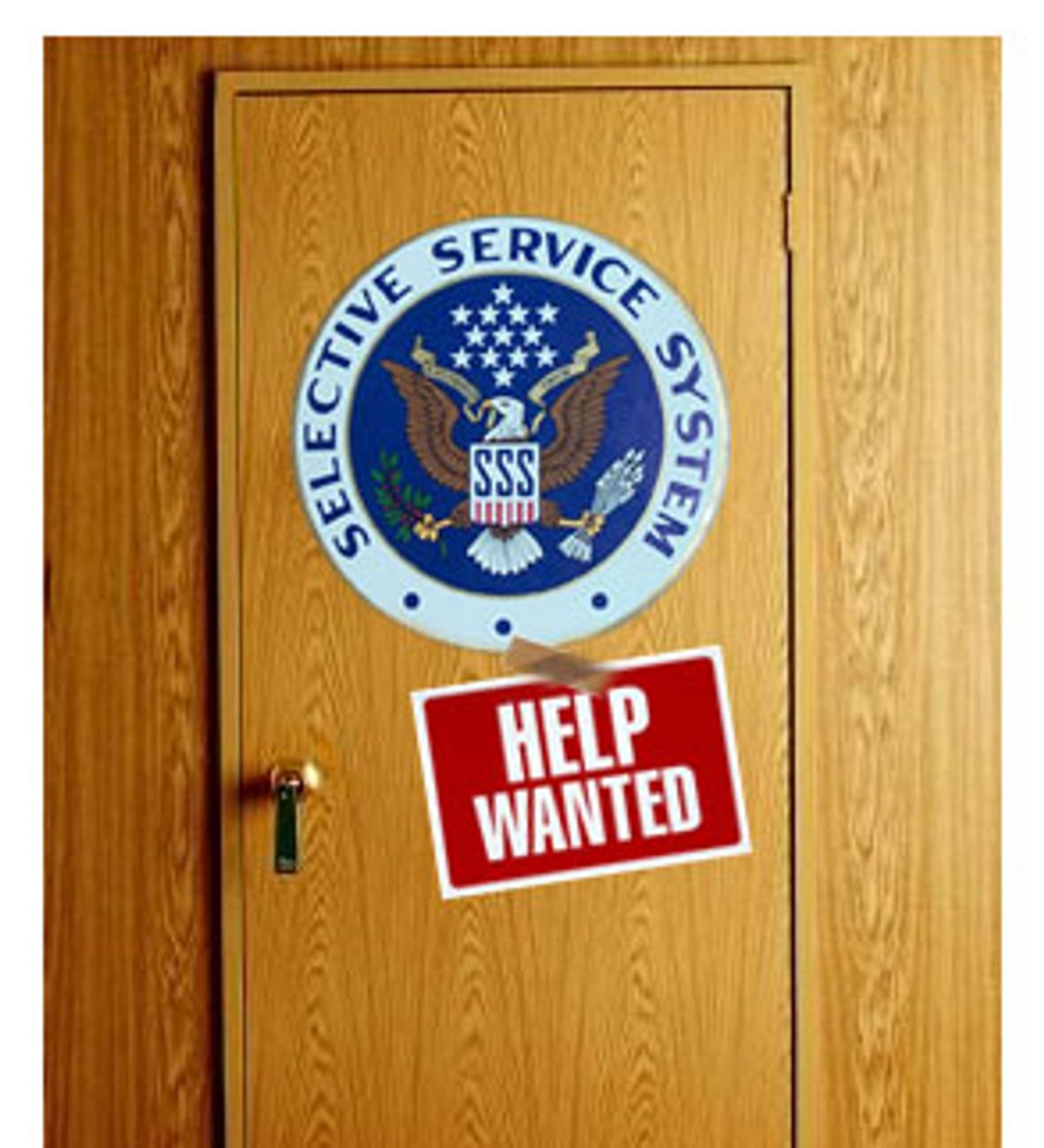
The community draft boards that became notorious for sending reluctant young men off to Vietnam have languished since the early 1970s, their membership ebbing and their purpose all but lost when the draft was ended. But a few weeks ago, on an obscure federal Web site devoted to the war on terrorism, the Bush administration quietly began a public campaign to bring the draft boards back to life.
"Serve Your Community and the Nation," the announcement urges. "If a military draft becomes necessary, approximately 2,000 Local and Appeal Boards throughout America would decide which young men ... receive deferments, postponements or exemptions from military service."
Local draft board volunteers, meanwhile, report that at training sessions last summer, they were unexpectedly asked to recommend people to fill some of the estimated 16 percent of board seats that are vacant nationwide.
Especially for those who were of age to fight in the Vietnam War, it is an ominous flashback of a message. Divisive military actions are ongoing in Iraq and Afghanistan. News accounts daily detail how the U.S. is stretched too thin there to be effective. And tensions are high with Syria and Iran and on the Korean Peninsula, with some in or close to the Bush White House suggesting that military action may someday be necessary in those spots, too.
Not since the early days of the Reagan administration in 1981 has the Defense Department made a push to fill all 10,350 draft board positions and 11,070 appeals board slots. Recognizing that even the mention of a draft in the months before an election might be politically explosive, the Pentagon last week was adamant that the drive to staff up the draft boards is not a portent of things to come. There is "no contingency plan" to ask Congress to reinstate the draft, John Winkler, the Pentagon's deputy assistant secretary for reserve affairs, told Salon last week.
Increasingly, however, military experts and even some influential members of Congress are suggesting that if Defense Secretary Donald Rumsfeld's prediction of a "long, hard slog" in Iraq and Afghanistan proves accurate, the U.S. may have no choice but to consider a draft to fully staff the nation's military in a time of global instability.
"The experts are all saying we're going to have to beef up our presence in Iraq," says U.S. Rep. Charles Rangel, the New York Democrat. "We've failed to convince our allies to send troops, we've extended deployments so morale is sinking, and the president is saying we can't cut and run. So what's left? The draft is a very sensitive subject, but at some point, we're going to need more troops, and at that point the only way to get them will be a return to the draft."
Rangel has provoked controversy in the past by insisting that a draft is the only way to fill the nation's military needs without exploiting young men and women from lower-income families. And, some suggest, by proposing military service from middle- and upper-class men and women, Rangel may be trying to diminish the odds of actually using them in combat. But Rangel is hardly alone in suggesting that the draft might be needed.
The draft, ended by Congress in 1973 as the Indochina War was winding down, was long a target of antiwar activists, and remains highly controversial both in and out of the military. Most military officers understandably prefer an army of volunteers and career soldiers over an army of grudging conscripts; Rumsfeld, too, has long been a staunch advocate of an all-volunteer force.
According to some experts, basic math might compel the Pentagon to reconsider the draft: Of a total U.S. military force of 1.4 million people around the globe (many of them in non-combat support positions and in services like the Air Force and Navy), there are currently about 140,000 active-duty, reserve and National Guard soldiers currently deployed in Iraq -- and though Rumsfeld has been an advocate of a lean, nimble military apparatus, history suggests he needs more muscle.
"The closest parallel to the Iraq situation is the British in Northern Ireland, where you also had some people supporting the occupying army and some opposing them, and where the opponents were willing to resort to terror tactics," says Charles Peña, director of defense studies at the libertarian Cato Institute. "There the British needed a ratio of 10 soldiers per 1,000 population to restore order, and at their height, it was 20 soldiers per 1,000 population. If you transfer that to Iraq, it would mean you'd need at least 240,000 troops and maybe as many as 480,000.
"The only reason you aren't hearing these kinds of numbers discussed by the White House and the Defense Department right now," Peña adds, "is that you couldn't come up with them without a return to the draft, and they don't want to talk about that."
The Pentagon has already had to double the deployment periods of some units, call up more reserves and extend tours of duty by a year -- all highly unpopular moves. Meanwhile, the recent spate of deadly bombings in Baghdad, Falluja and other cities, and increasing attacks on U.S. forces throughout Iraq have forced the U.S. to reconsider its plans to reduce troop deployments.
Those factors -- combined with the stress and grind of war itself -- clearly have diminished troop morale. And many in the National Guard and reserves never anticipated having to serve in an active war zone, far from their families and jobs, for six months or longer. Stars and Stripes, the Army's official paper, reports that a poll it conducted found that half the soldiers in Iraq say they are "not likely" or are "very unlikely" to reenlist -- a very high figure.
Consider that the total enlistment goal for active Army and Army reserves in the fiscal year ended Oct. 1 was 100,000. If half of the 140,000 troops currently in Iraq were to go home and stay, two-thirds of this year's recruits would be needed to replace them. And that does not take into consideration military needs at home and around the globe.
"My sense is that there is a lot of nervousness about the enlistment numbers as Iraq drags on," says Doug Bandow, another military manpower expert at Cato. "We're still early enough into it that the full impact on recruiting/retention hasn't been felt."
The Pentagon, perhaps predictably, sees a more hopeful picture.
Curtis Gilroy, director of accession policy at the Department of Defense, concedes that troop morale is hurting. "There are certainly concerns about future reenlistments. Iraq is not a happy place to be," Gilroy says. "[But] I think a certain amount of that is just grumbling. What we're interested in is not what people are saying, but what they do." So far, he reports, reenlistments and new enlistments remain on target.
Beth Asch, a military manpower expert at the Rand Corp. think tank, agrees that current retention and new enlistment figures are holding up. But she cautions that it may be too soon to know the impact of the tough and open-ended occupation in Iraq. "Short deployments actually boost enlistments and reenlistments," Asch says. "But studies show longer deployments can definitely have a negative impact."
While she thinks it is unlikely that the military will have to resort to a draft to meet its needs, Ned Lebow, a military manpower expert and professor of government at Dartmouth College, is less confident.
"The government is in a bit of a box," Lebow says. "They can hold reservists on active duty longer, and risk antagonizing that whole section of America that has family members who join the Reserves. They can try to pay soldiers more, but it's not clear that works -- and besides, there's already an enormous budget deficit. They can try to bribe other countries to contribute more troops, which they're trying to do now, but not with much success. Or they can try Iraqization of the war -- though we saw what happened to Vietnamization, and Afghanization of the war in Afghanistan isn't working, so Iraqization doesn't seem likely to work either.
"So," Lebow concludes, "that leaves the draft."
Purely in mechanical terms, a draft is a complicated and difficult thing to get off the ground. It would require an act of Congress, first, and then the signature of the president. Young men are already required to register with the Selective Service system, but if the bill were signed into law, it would still take half a year or more to get the new troops into the system. Federal law would require the Selective Service to immediately set up a lottery and start sending out induction notices. Local draft boards would have to evaluate them for medical problems, moral objections and other issues like family crises, and hear the appeals of those who are resisting the draft.
Under law, the first batch of new conscripts must be processed and ready for boot camp in 193 days or less after the start of the draft.
But if the mechanics of the draft are difficult, the politics could be lethal for Bush or any other top official who proposed it.
Already, the American public is almost as split today over the war in Iraq as it was about the war in Indochina nearly four decades ago, though not yet as passionately. But a new draft would likely incite even deeper resentment than it did then. In the last war fought by a conscript army, draft deferments for students meant that nobody who was in college had to worry about being called up until after graduation, and until late in that war, it was even possible, by going to grad school (like Vice President Dick Cheney), to avoid getting drafted altogether. In the Vietnam War era, college boys could also duck combat, as George W. Bush did, by joining the National Guard.
But that's all been changed. In a new draft, college students whose lottery number was selected would only be permitted to finish their current semester; seniors could finish their final year. After that, they'd have to answer the call. Meanwhile, National Guardsmen, as we've seen in the current war, are now likely to face overseas combat duty, too.
"If Congress and Bush reinstitute the draft, it would be the '60s all over again," predicts Lebow. "It's hard to imagine Congress passing such a bill, but then, look how many members of Congress just rolled over and played dead on the bill for $87 billion for Iraq and Afghanistan."
New York Rep. Rangel and Sen. Fritz Hollings, D-S.C., introduced companion bills in the two houses of Congress to reactivate the draft last January, at a time when Bush was clearly moving toward an invasion. While both bills remain in the legislative hopper, neither has gone anywhere.
Even among those who think the public might support a draft, like Bandow at the Cato Institute, few believe Bush would dare to propose it before the November 2004 election. "No one would want that fight," he explains. "It would highlight the cost of an imperial foreign policy, add an incendiary issue to the already emotional protests, and further split the limited-government conservatives." But despite the Pentagon's denials, planners there are almost certainly weighing the numbers just as independent military experts are. And that could explain the willingness to tune up the draft machinery.
John Corcoran, an attorney who serves on a draft board in Philadelphia, says he joined the Reserves to avoid the draft during the Vietnam War. Today, he says, the Bush administration "is in deep trouble" in Iraq "because they didn't plan for the occupation." That doesn't mean Bush would take the election-year risk of restarting the draft, Corcoran says. "To tell the truth, I don't think Bush has the balls to call for a draft.
"They give us a training session each year to keep the machinery in place and oiled up in case, God forbid, they ever do reinstitute it," he explains.
"They don't want us to have to do it," agrees Dan Amon, a spokesman for the Selective Service. "But they want us to be ready to do it at the click of a finger."
Shares