James Franco

“The Company”

Robert Altman's surpassingly beautiful ballet movie feels lighter than air -- but in fact it's the great director's most tender and memorable film in years.

  • more
    • All Share Services

Robert Altman has been moving large casts of characters smoothly through his movies and orchestrating passages of overlapping dialogue for so long now that he has often seemed as much choreographer as director. So it’s fitting that he’s gotten around to making a dance movie. “The Company,” filmed with members of Chicago’s Joffrey Ballet, must be the least flossy movie ever made about the world of dance. Ballet and modern dance haven’t been particularly well served by the movies. There was Carroll Ballard’s film of the Maurice Sendak-designed “Nutcracker,” but mostly there are fragments: the Roland Petit ballet that opened “White Nights,” and Mikhail Baryshnikov and Gregory Hines’ Twyla Tharp-choreographed duet in the same movie; and the few precious moments of Baryshnikov dancing in the otherwise appalling “The Turning Point.”

That stinker was pretty typical of the way the movies have always approached high art — with genuflection and blandishments about the discipline and sacrifice to which the artiste must submit. Who needs it? I’d have traded all of it for the moment from the 2000 “Center Stage” where the statuesque Zoe Saldana uses the point of her toe shoes to stub out a cigarette. That image from a throwaway teen movie was connected to the details of real life in a way that movies about art rarely are. Who the hell can appreciate any art if you’re made to feel that becoming an artist is joining the priesthood?

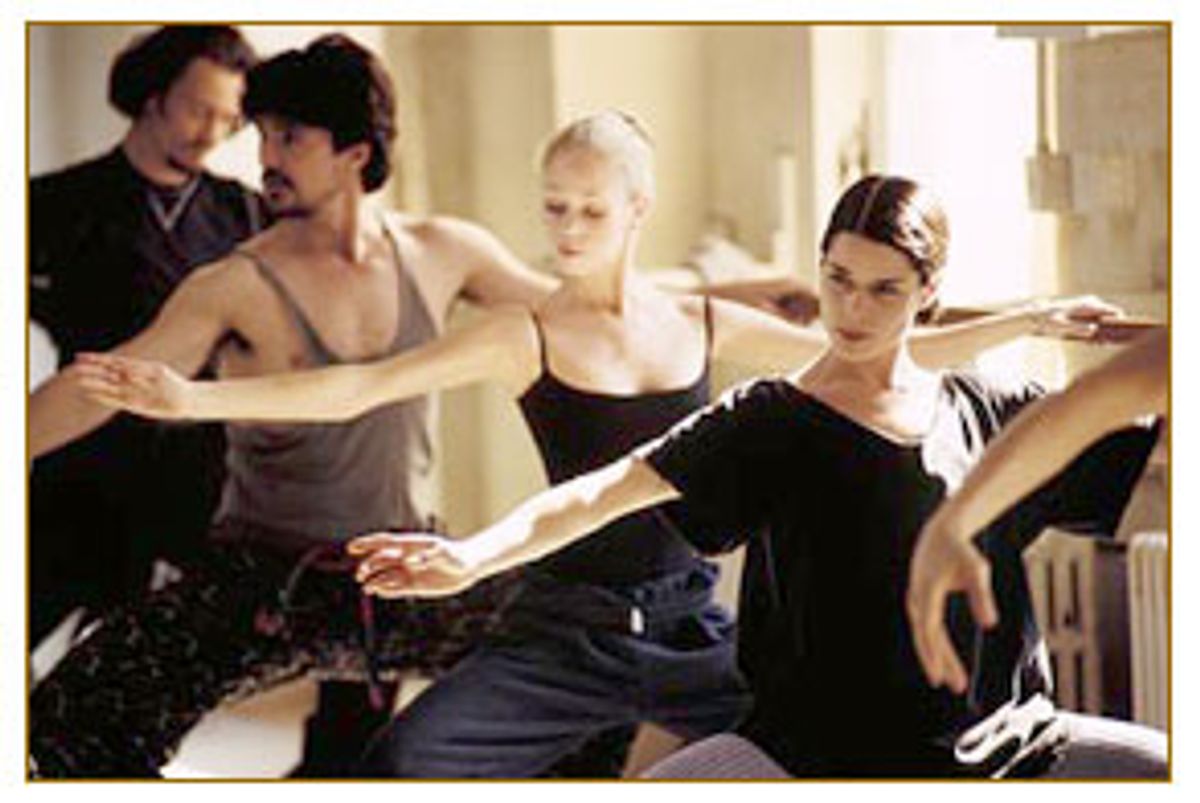
“The Company” has no more time for preachments about the nunnery of “the dahnce” than Altman’s “Vincent and Theo” had for preachments about the priesthood of art. “The Company” isn’t fevered and tortured the way “Vincent and Theo” was. It isn’t about the agony of making art but about the pleasure of it. In this case, that pleasure is inseparable from the nearly sexual excitement of young people finding out what amazing things their bodies are capable of. Altman’s movie is lighter than air, but it’s also one of the most fluid expressions of his technique. You could say that it’s all grace notes, but I prefer the description of my Salon colleague Stephanie Zacharek, that it’s all pulses. A choreographer distills everything to movement; Altman distills the meaning of “The Company” to the movement.

Altman has never had any use for the theatrical method of introducing movie characters. It isn’t surprising that he has no use for the conventions of backstage drama. The familiar plot strands in Barbara Turner’s script — the overbearing stage mother of a promising dancer, the young male dancer whose pushy mentor is jeopardizing his career, another young dancer who’s shuttling from one crash pad to another — are deliberately introduced so they can be left dangling. In conventional terms, nothing happens in “The Company.” We watch the young dancers of the Joffrey rehearse, get picked (or not) for performance, fall in love, injure themselves, deal with their families, work their part-time jobs.

When a dancer snaps a tendon demonstrating a move in rehearsal, Altman doesn’t do what another director would, shifting the scene to the hospital while the company breathlessly awaits news of her condition. The girl is taken away to be cared for, her replacement is chosen and rehearsals continue. That’s the reality of a dance company, not some ballet equivalent of “42nd Street.” Nothing happens in “The Company,” but only if you consider a master director’s ability to put life on-screen nothing. At moments “The Company” recalls the work of the French director Jacques Rivette, whose long, seemingly inconsequential movies give the great gift of allowing audiences to live in, and savor, each moment.

Altman has always been a weird mix of humanism and cynicism. For all his ability to plumb the contradictions of his characters, he’s always been susceptible to the caricatures of the adolescent wiseass. He hits a jarring note here in the scene where a dancer relates an anecdote about a relative’s recent suicide, but for the most part “The Company” is one of the most celebratory movies he’s ever made. Altman seems completely seduced by the young dancers on-screen. How could he not be? At 78 he’s still working with an eagerness and vigor most filmmakers never attain. In the director’s statement accompanying the press kit, Altman says, “On a daily basis and in the most impossible and dramatic terms, dancers face what we all face: biological clocks and the force of gravity telling us NO. Yet for some part of their working lives dancers literally prevail over those forces. The fact that they (like the rest of us) will all ultimately be trumped by time doesn’t diminish or compromise their efforts.”

For years now Altman has prevailed over not just his own biological clock but the forces that want to ground any independent-minded director working in American movies. Somehow, maybe through sheer stubbornness, he’s kept making movies his way. Even at its most hit-and-miss, his career represents one of the least compromised that any major filmmaker has ever managed in this country.

One of Altman’s tricks has been to deceive us with characters who seem like utter fools (like Geraldine Chaplin in “Nashville”) only to have them say things that are anything but foolish. Here, as the director of the Joffrey, Malcolm McDowell spouts arty little pensées. He’s the essence of every “resident genius” coasting on his associations and the showy panache of his dedication to art. This is one of those guys who knew just everyone (you expect him to talk about taking tea with Pavlova), who keeps his underlings at his beck and call and slyly hands them all the problems that arise, all the while insisting that he’s the man in charge.

He seems to have no idea of the nuts and bolts of a performance, always swooping in to change bits and pieces of a dance, no matter that the clock is ticking and the movements have to be set. (I attended a college with a fairly renowned dance department, and the head of the department was always wandering into rehearsals a night or two before opening, insisting on lighting changes.) It’s a hilarious caricature. But at the end of one of his speeches — the old saw about how young people today can’t understand what the ’60s were really like — he says, “Thinking the movement is not becoming the movement.”

That could be a summation of the way Altman has always gambled on instinct — even here, in the midst of a movie about one of the most disciplined of arts. Altman knows when not to interfere. He allows us to observe rehearsals, the painstaking process by which phrases of movement cohere into a dance. And then, just as his movies have always done, he erases all the evidence of that work with the seeming effortlessness of the final product.

The dance sequences in “The Company” are among the most dazzling ever put on film. Altman and his cinematographer, Andrew Dunn, allow us to experience each performance from both sides of the footlights, to both watch the movement and be in it. The film opens with Alwin Nikolais’ “Tensile Movement,” in which the dancers move among ribbons strung out across the stage and then dance in perfect synchronization with large elastic bands framing their four splayed limbs, changing size and shape to correspond to their movements. The film ends with Robert Desrosiers’ “Blue Snake,” a silly, storybook extravaganza with bright colors that are pretty to look at, though the visual clutter tends to upstage the dancers.

It’s a slight miscalculation because, dancewise, the movie reaches its peak midway through with the Lar Lubovitch pas de deux to Rodgers and Hart’s “My Funny Valentine,” played on piano and cello by Marvin Laird and Clay Ruede and danced by Neve Campbell and Joffrey dancer Domingo Rubio. I don’t think it’s too much to say that this is one of the most surpassingly romantic sequences ever put on film. Every cliché you’ve ever heard about dance being a metaphor for sublimated lovemaking might have been invented to talk about this scene.

To the accompaniment of what must be the most achingly melancholy of American standards (Altman uses different versions of the song throughout the movie, in somewhat the same way he used different versions of John Williams’ theme in “The Long Goodbye”), Campbell and Rubio play out a scenario of seduction and rapture and heartache in movements that are as simple and suffused with feeling as Lorenz Hart’s lyrics are. Dance, along with music and movies, is the most ephemeral of forms, and you can’t help thinking of the longing that great vocalists have put into the line “Stay, little valentine, stay,” as you watch the exquisite and all too fleeting beauty of this dance. Altman heightens the drama of this outdoor performance by adding the rumbling of a looming thunderstorm. It’s as if God couldn’t abide this moment of human perfection without adding His own complementary touch.

Altman gives this sequence the perfect coda, cutting between Rubio rehearsing alone in the studio and Campbell’s Ry returning to her apartment and crying — who knows why? Maybe because her moment of triumph is over. Whatever the reason is, Altman doesn’t spell it out. What registers in the scene is seeing each dancer alone after the union they achieved onstage. The conception and editing of the sequence (by Geraldine Peroni) suggest the sequence in Jean Vigo’s film “L’Atalante” where the separated newlyweds dream of embracing each other in their sleep.

Neve Campbell had previous dance experience and trained with the Joffrey for this role. She also wrote the film’s story with Barbara Turner and is one of the producers. After her fine performances in “The Craft,” “Wild Things” and “Panic,” it shouldn’t still be necessary to defend Campbell as an actress, but there are plenty of people, some of them critics, who still regard her as a “TV actress” or a teen idol. (You run into the same thing with Michelle Williams and Katie Holmes.) Campbell is no more the star here than anyone else (the title of the movie is, after all, “The Company”).

She fits as beautifully into Altman’s ensemble as she does among the Joffrey dancers. Her solo in “Blue Snake” is the one moment in the ballet where we’re not distracted from the dancing by the design elements. Ry is the focus of the movie’s preoccupation with the beauty of youth, and that particular look of Campbell’s, her air of bruised expectancy, adds a touching element to the film’s casual lightness. Altman doesn’t use Ry, who works as a bartender in the off-season, to illustrate the difficulty of a dancer’s life — probably because at her age, having a crappy part-time job is part of what being an artist is all about. The bloom of youth is the same thing here as the bloom of creativity, the excitement of being on your own and making your own friends and choices.

There’s a funny moment when a dancer who rents out space on the floor of her cramped apartment to other dancers who need places to crash goes creeping among the sleeping bodies in her living room, trying to solicit a spare condom. The lives of the dancers look pretty good to Altman, even with the disappointments and injuries, because they have the freedom to work. The struggles will come later; Altman lets them relish their ambition.

He’s just as affectionate in his treatment of young love. Ry’s involvement with Josh (James Franco), a young man she meets in a bar, is sketched in a series of seemingly tossed-off scenes that capture their comfortable intimacy. We don’t see much more than the two of them watching TV or making breakfast or Ry coming home late from her bartending job to find Josh sacked out on the couch after preparing her a surprise New Year’s Eve dinner. Here, as elsewhere in the movie, by showing us the textures of these lives instead of just the drama, Altman has made a very evocative movie. It’s not until after you’ve seen it that the substance in the movie’s lightness becomes apparent.

It’s one of the mysteries of movies that directors sometimes express more of themselves and more of the themes that preoccupy them in what seems like their lightest movies. Howard Hawks never went deeper into the camaraderie of makeshift communities than he did in “Rio Bravo” and “Hatari!”; George Cukor gave the most polished demonstration of his casual elegance in “Pat and Mike”; Woody Allen finally made the serious comedy about love and death he had always wanted to in “Manhattan Murder Mystery.”

“The Company” feels as light as those movies, even though it’s the flip side to Altman’s most turbulent film, “Vincent and Theo,” which was about the agonies of the artist who defies commerce. “The Company” is about the glories of the artists who defy time. The dancers in “The Company” achieve what the racehorses in “Seabiscuit” failed to — they express the astonishing poignancy of creatures whose strength and fragility are inseparable.

Altman, who has defied time more than any filmmaker can be expected to, is in total harmony with them. The measure of that harmony is in the recurring motif of the love affair between Campbell and Franco: The sight of the two of them mouthing to each other across crowded rooms. For a director who has always delighted in the babble of overlapping dialogue, it must have been a pleasure to find two characters who can communicate above the surrounding din.

Charles Taylor is a columnist for the Newark Star-Ledger.

James Franco: I’ve done the work

In an interview with a longtime collaborator, the actor/artist/writer defends -- and explains -- his genre hopping

  • more
    • All Share Services

James Franco: I've done the workJames Franco and Carter (Credit: AP/Wikipedia)

Carter is my double. Whatever I’m thinking, Carter has thought about it too. He’s a great collaborator because we never argue; we just groove on each other’s ideas. We met at the end of 2007 and did a film in Paris called “Erased James Franco.” I played James Franco. We did another project with mannequins and mustaches and motorcycles called Double Third Portrait. We wrote and created images for a children’s book called “Hellish.” He helped me come up with the idea of acting on “General Hospital”; he helped come up with the idea for “Three’s Company” as a dramatic movie. We did another film together, “Maladies”; it’s about US, Catherine Keener plays him. In “Maladies,” the two characters make a pact that if one of them dies the other will finish the dead person’s work.  I would be honored to make such a pact with Carter because he understands me better than most. He has taught me most of what I know about art. Now we’re planning a book of poetry. — James Franco

I spend a lot of time alone, working in my studio, with a radio and nothing else — making art. I didn’t have much experience or interest collaborating on creative endeavors with anyone until I started making things with James. I appreciate his zest and drive to work on many things at once and at all times, 24/7. It is inspiring and it is good. Art and more art. Working with James creatively continues to be a special experience for me. I tried erasing him but it looks like I used the wrong side of the pencil. I’ll keep trying. – Carter

James Franco, Carter and I met in room 407 at the Bowery Hotel in lower Manhattan. The building is rumored to be haunted and over the course of our conversation we used a glow-in-the-dark Ouija board to contact spirits and answer interview questions. We wore formal attire, wigs and sunglasses. The curtains were drawn for a dim seance.

I. I Be Your Mum

I was talking to one of the bellboys about people’s experiences with hauntings in this hotel, and he told me about all this footage he’d seen from cameras here. Things moving on their own.

James Franco: Oh, right. Yeah.

Carter: Surveillance cameras?

Surveillance cameras.

JF: Well, I have to say, I stayed here when we were doing press for “Pineapple Express,” and I was feeling fine, and then I got into the room, and — didn’t you visit? That was that night!

C: Yeah. We were up at the corner…

JF: I just felt so depressed that night. Everything was good, going well —

C: And then I showed up. [Laughs.]

JF: No, but after you left I felt so bad to the point where I was calling Seth Rogen, and I never call him. He wasn’t answering, and I was calling him to get some support or something because I was feeling so bad about myself. And I was like, What is going on? And then I went down in the morning and was like, Does anyone ever complain about this place being haunted? And I don’t even think that way, but I woke up in the morning thinking I was just haunted. And then I went down and they were like, Yeah, there’s that graveyard in the back. This is built on the one of the oldest graveyards in Manhattan.

C: That was possession, it sounds like.

JF: Then I have another haunted hotel story. Do you have any?

C: I don’t have a haunted story, but when I was a kid, I was missing for a few hours, and my parents were freaking out. It was the middle of the summer, and I went outside — I was probably about seven or eight — and I was in the yard, and I remember being really tired in the afternoon. I never take naps, even to this day, but for some reason I must’ve fallen asleep on the lawn, right next to the house. My parents were looking for me for like three or four hours. I woke up, and I’m right there, and I see my mom and she’s crying, and she’s like, “Where have you been? We’ve been looking for you everywhere!” I’m like, right here. I was like right there the whole time. Apparently they couldn’t find me. It was just like missing time.

JF: Where’d you go?

C: I don’t know. I wish I could tell you.

Let’s ask the Ouija board.

JF: Is that what we’re going to ask? We’re going to ask the board?

Yeah. Where did you go?

JF: Okay. So how do we do it?

You’re supposed to ask very clear questions, it says.

C: Okay, I’ll ask the very clear question. Very queer question.

A very queer one.

C: So you put your hands here.

JF: Both hands or one hand?

C: Both.

I think both, yeah. Let me light one of the — [lights a candle]

JF: Okay, I’ll ask the question. Where did Carter go in 1978 for those few hours in that afternoon? [Pauses, speaks in a whisper] Then what do we do?

We’re supposed to wait a few minutes.

C: [Whispering] If we put too much weight on it …

JF: [Whispering] You just touch lightly?

[Whispering] Maybe ask it a yes or no question first.

C: Is there anyone here that can answer us? Yes or no?

JF: [Whispering] Are we doing this right? Because the board’s moving.

C: Oh my God, it is.

JF: The board’s moving. Are we doing this right?

C: No, the board is moving.

JF: I think we gotta stick the board down.

Yeah, do we have some tape?

C: You’re not pressing on it, are you? Because if you have too much weight on it, it’s gonna slide.

You have to be very gentle, I think.

JF: Put some wet toilet paper under it? Right?

The table’s gonna be disgusting.

C: Okay, let’s try it again.

JF: Oh, do we do one finger?

I think you do two each.

JF: Are there instructions? Can somebody read the instructions?

C: I think you’re just supposed to do what you feel.

[Laughs.] That’s what it says in the instructions.

C: Okay. Is there anyone here that can answer our questions?

JF: Then we touch really lightly.

I don’t think it’s working…

C: W?

JF: W. E.

That’s an E?

C: H?

JF: H.

C: WEHS.

WEHSU

C: WEHSU. Well, ask WEHSU a question.

JF: Wehsu is listening. Alright. I’ll ask that question again, and then we’ll go to something else. Where did Carter go when he was a kid in that yard in the mid-seventies?

JF: I. B. R. Holy cow. M. IBRM?

[still moving] IBRMUM

JF: I be your mum!

Does that mean anything to you?

C: No.

II. Very Boring and Conceptual

So what was the other haunted hotel experience?

JF: Okay, so I was getting ready to do this movie down in New Orleans that Nicholas Cage was going to direct, called Sonny. And we were just out there getting ready to prepare. We weren’t shooting yet. Eventually Nick bought a huge house and that’s where we shot and he lived, but this was just preparation, so we all stayed in a Hotel called the Bourbon Orleans right on Bourbon Street. And he was getting ready to do this movie that eventually Keanu Reaves did, but for a while Nick Cage was signed on, called Constantine, about this character that just talks to dead people, or something. He was getting ready to do Constantine, and he heard that this hotel was haunted and had once been this nunnery. There were two rooms that were supposed to be especially haunted. So Nick took one, because he wanted it — he wanted an encounter with a spirit. And so I was like, screw it, I’ll take the other one. Supposedly my room had belonged to a nun that had killed herself — had, I think, hanged herself. So it was in the day. I went in, and it was a tiny little room and the bed filled half the room, and then there was a bathroom and a closet. I went in, put my bag on the bed, and it was completely quiet. And then a minute later I hear whoosh, like this rushing water in the bathroom. And I go in there and the sink is on full blast, and it hadn’t been that way when I walked in. And I knew I asked for a haunted room, so I was like — just in case — “Hi, if there are any spirits here, I’m on your side, and I don’t mean any harm.” And I tried the faucet to see if it was loose, if it would get that way by accident, and it wasn’t like that. And then I thought, Oh, maybe it’s a tourist thing — like the haunted hotel. Like they have some switch that will turn the faucet on. But it wasn’t. I asked some of the maids and they really didn’t know anything about that room, but they were like, oh, there’s a confederate soldier that haunts the halls. And he likes blondes. He bothers the blondes.

C: Nice.

How’d they know it was a confederate soldier?

JF: I guess he’d been decapitated there, or something. Or maybe people had seen him or something. Nothing ever happened again in that room, but the funny thing about New Orleans is that people just talk about ghosts differently there.

C: Like it’s normal.

JF: You go into any restaurant, and they’ll be like, yeah, this place is just haunted. There’s a ghost in the attic, or whatever.

Voodoo floats around down there.

C:  Were you scared in the room?

JF: No, not really. I remember watching a documentary about Heidi Fleiss in that room.

C: That’ll switch the mood.

JF: Well, because I was playing a male prostitute.

C: I remember. It was a good movie. I liked it. Thumbs up.Let’s talk about “Erased James Franco.” What were you trying to erase in that film?

C: Did you see it?

No, I never got to see it.

C: No one’s seen it.

I don’t know where to see it.

C: You can’t really see it anywhere.

JF: How are you going to show it again, Carter?

C: It’s actually showing right now in Vienna. But you can only see it if it’s showing in a gallery or a theater.

JF: Do you ever want to release it?

C: I think at some point, because a lot of people ask about it, but I like that it’s like a Warhol film that you can’t really find. No one ever sees Warhol films. They just talk about them.

Yeah. It’s the idea of the film that’s important.

C: Because they have this knowledge of them, and most people haven’t seen half of them, unless you really, really seek them out. A lot of people think they know a lot about them, and then they see them and it’s completely different than you expected.

C: I think your question about “Erased James Franco”—

JF: It changed me.

C: I always tell you that it’s going to be the film that people remember you by.

JF: I don’t know if that’s true. [Laughs] But it changed me.

C: Fifty years. Mark my words.

What are you erasing? Are you erasing the old roles?

JF: Originally, I think the “erased” thing comes from the very early concept that changed a bit. That it was based on Erased de Kooning by Rauschenberg, and it was going to be a truly erased performance, that I would sit there in a chair, and give a full feature length performance in my head, but only ten percent would come to the surface.

C: We did a test, and the test is fucking awesome. It was like two little tests that I did on my tiny camera — I think I probably sent it to you. It’s James in my studio doing what he just described  —reliving scenes that he had done already, in previous films, but not allowing him to move at all — his body. Or his voice. It’s so great when I think of it, because it is boring as shit — nothing’s happening. But when you talk about what is happening and then you watch it again, it’s exhilarating.

So the idea was, in the same way that Erased de Kooning had little remnants of the original showing through,  remnants from James’ previous performances are showing through?

C: Yeah.

JF: But what Carter was talking about was — I think this is how it went down — I was like, conceptually, that’s really interesting. I like that. But you were talking about how you wanted to show it, in a gallery, but you want people to watch the whole thing.

C: I want people to sit and watch it.

JF: And I said, well, this seems more like a video that you put on the wall and then people would watch 30 seconds of.

C: I didn’t want that. I still don’t.

JF: Right. So then we started thinking about, Okay, how do you expand it, that’s when it expanded to multiple films, but also on particular things in those films. Like, you wanted to focus on parts of a performance that normally don’t get emphasis, so things like eating, or drinking.

C: Picking up the phone. Walking.

JF: Yeah, talking on the phone is just expositional stuff. Walking through doors. Reading. Writing. So you looked through all those films I did and looked for all those—

C: Those really boring parts. Very boring and conceptual. And then that’s what we redid; just the boring parts.

JF: But then you brought in some emotional scenes, too.

C: Some, yeah. I made you sit up a little bit. But at some point we have to go back and make the true original.

JF: It was kind of like the character I was playing was suffering some unnamed thing in a way. And if you want to read a narrative into it, it has a lot, and it made me realize the narratives of all of the films that I’ve done, when they’re mixed up they kind of make sense, or they’re kind of the things that would recur. I did a lot of films where the character had issues with his father or is struggling to be creative, or that kind of thing. Carter said you should allow 10 percent of the acting to come to the surface. This is the way he described it: you want to give a good performance — it’s as if you’re trying to give the best performance—

C: But you’re not allowed to.

JF: So it kind of seems that the character is a little drugged or something, or a little out of it.  But because we know we’re redoing films that I’ve done before, it’s like the character’s aware that it’s a performance, and we know it’s a recreation, but he’s also kind of engaged with it and into it. And so that awareness makes these cliché subject matters kind of alive again, because of that awareness. Like how many movies have you seen where the son’s like, “Dad, you don’t understand me!” But if the character’s aware that he’s doing a kind of cliché scene, then it becomes something different.

III. Shit Gets Cut.

A lot of artists talk about art as a form of channeling. I feel like most artists, especially as they get older, get to a point and they think something more than themselves is happening. It’s not just discursive thinking or preparation. So I wonder if, with the ghost metaphor, if you ever think that that’s going on in your work. This kind of possession.

C: It just kind of steers itself? I think all art is different. There’s so many different kinds of art. You’d ask some artists that, they’d have no idea what you’re talking about — they don’t care about that kind of thing. But I do. I feel that. I feel there’s always been this one long line of what I’ve been doing, whether it’s painting or drawing or film or sculpture, and they’re all very related. What those lines are I couldn’t tell you. I could probably hit on some, but they’re for me to discover over my lifetime.

JF: Well also in “Maladies” there’s some of that, right? A lot of talk about predecessors and Melville, and you gave me—

C: That sketch?

JF: You gave me that sketch, and you said, This is the character, this big whale.

C: Yeah. I think that note was really helpful.

JF: It was.

Did you feel like you needed to steer the performance in a direction it wasn’t going?

C: No, I wouldn’t say that. I just felt it was partly my fault. I’m very unclear directing someone.

JF: So you thought saying I was a whale would clear it up? [Laughs.]

C: Yeah, I thought it would. It did the trick. It just adds more smoke to the room.

Is there any other way to articulate what the whale was about?

C: The character in the beginning was supposed to have in the very beginning — and we did — have an unknown ailment, a malady. And I never told you what that was, and I never knew myself, and I still don’t, but I knew it was a conglomeration of all these mental ailments rolled up into one, manifested in your character in your film. And that’s what you portrayed.

JF: Right. But when you said you were a whale, it was like he’s got all this inside him, and he’s traveling around, and nobody really understands him. And then I was like, Oh, I see. He’s trying to communicate. And his art is a way of trying to communicate, it’s just that nobody can really understand.

C: Right. There’s like a haze in front of trying to communicate with other people.

JF: But it’s crazy how long that thing was being developed, though. Remember, we started talking about it after “Erased James Franco,” and for a while it was called Gay Rapist.

C: No, it was called GR for Gay Rapist, because we didn’t want to offend anyone.

JF: Because Gawker had done this headline that I was a gay rapist. And actually in the early stages it had a lot of the elements. It was going to be two artists of different types. And that’s how we got talking about soap operas. That’s how I went on “General Hospital,” is we were talking about” Maladies,” and we were like, Oh yeah, maybe there’s a Soap Opera thing. And then you were like, What if you really went on a soap opera?

As preparation for the role?

JF: No, it was just kind of an idea at that point.

C: Yeah, and then it just kind of happened.

JF: And then I was like, You know what, my manager represents Steve Burton, who is like, the biggest soap star on “General Hospital.” Maybe I could get on a soap opera. And they were really excited about it.

And you’re going on again, right?

JF: Yeah, I’m going to go back. I have big plans.

Is the Franco character on “General Hospital” a collaborative creation between you two?

C: I didn’t have anything to do with it. I think it was just a conversation that I started that just sort of turned into — I think you at one point you asked about the role?

JF: Yeah! You helped with that and were like, what should the role be? And then the character in GR was supposed to be a little crazy. And I told them, make him an artist and make him a little crazy.

C: And they did.

JF: And then we used, as the character’s soap opera, we used episodes from “General Hospital” on the TV in Maladies. Right?

C: For a split second. Because what was hard is that “Maladies” takes place sometime in the early ’60s. The footage from “General Hospital” obviously looks very contemporary, so we tried to find a piece that didn’t look like it was just shot this year. I think we pulled it off. But I liked that shifting of time; the film takes place in the ’60s, but it’s also referencing a real character that lives now.

It would really seem from an outsider’s perspective that you guys are working with several levels of stuff, but it also sounds like it’s all accidental, the way it came together, the way you talk about it.

JF: No, I think with those projects it was like, oh, here’s an idea. Let’s followup on that. And then the projects built on each other in cool ways.

C: And little things stay. Like if you’re talking about an idea, it doesn’t mean that you do one hundred percent of the idea. A vestige of it sticks. “Maladies” is very much like that. It’s just all these things that we’re talking about. There’s always a vestige of something in all these notes that sticks, even though it doesn’t look like it’s all really hardcore planned out.

JF: And then when I was on the “General Hospital” set, you came one time and we shot some stuff there. I did a scene where basically Gena Rowlands in—

C: Woman Under the Influence.

JF: We couldn’t use it because the script changed. Why did that change?

C: Who the fuck knows at this point? Shit gets cut. Shit gets cut! You want to be realistic, and you want to be able to step outside of yourself for a second, and you want people to go into a theater and sit down and watch this. Let’s be realistic and whittle it down to an hour and a half.

JF: Now, why did you want to do it that way?

C: What way?

JF: Why did you want it to be in theaters where some people would buy tickets for it, rather than be it a piece that people would play in the gallery?

C: Because, first of all, it’s a challenge to make a narrative film like that that people will watch. It’s really, really, really hard to do. So it was a challenge for me. Secondly, I just wanted an audience. I wanted more people to be able to see it, but also have an audience come see something that’s a little more challenging for them, too.

When you say challenging, what do you mean?

C: Well, the narrative isn’t…

Linear?

C: Yeah, well, it is. Because we worked really hard at getting it to that point. Really hard. The challenge is for people to sit down and watch something that’s a little more loose and wide open.

This divide, too, is something I wanted to ask you about, because both of you now are coming at it from different approaches – art and film. I wonder if there’s some imaginary line, if not just in your heads, between making art and what you might call entertainment. And the way you’re talking about it, it sounds like there is, like you’re pushing yourself toward entertainment.

C: Well any art you’re making to entertain people if you want to show it to them, whether it’s in a gallery or a movie theater. There’s always some level of entertainment. I mean there has to be. But, certainly, if you have “Erase James Franco” on one end of the spectrum, and then you have something on the other end, which is “Maladies.”

JF: Like Carter says it’s always got to be a little bit entertaining. Like, I want stuff that’s gonna be intriguing. Even if you don’t want to make boring art, there’s something still interesting about Andy Warhol’s boring films. You’re still like, Oh, that’s great. Conceptually, it’s exciting. And a lot of the art I do is derived from film, it’s just that I’m not trying to sell tickets with the work. To me, that is one of the big divides — the way the work is distributed and seen and recoups its costs. With film there is more of a responsibility to entertain. If people are actually going to buy tickets, it’s just a different kind of thing. There’s a different kind of expectation. You can set it up as an “art film,” but I really have to prepare them for what they’re going to watch. When we showed “Erase James Franco” at MoMA, it was perfect because it’s a theater, but it’s at MoMA, so if it doesn’t have a super strong narrative, it’s okay. The audience wasn’t going there to watch “Jaws.”

Right, the context is—

JF: A lot of the work I do with the art world is photography or videos or film that do also have narratives, but it’s a change to tell things and to break the rules — break narrative rules, break the rules that your art needs to look great. It actually can be more about the concept, and you can do things in such a way that you shoot on video, and it doesn’t necessarily look the best, and maybe that’s kind of the point — that it doesn’t. Whereas if I direct a film that I know is going to go to theaters, you usually want the technical aspects of it to be of a certain level. Then again, I’ve done two feature films since NYU, one based on a poet, Hart Crane — an obscure poet — and then one about the late actor Sal Mineo. Now, I know those subjects are not going to be blockbusters, but we made it for a responsible price, and we did it in such a way so it didn’t cost a lot of money. They’re both period pieces — you know Hart Crane lived in ’20s New York — but there are plenty of buildings with facades here that are of that period or earlier that you just go and frame, and you frame everything else out. And it looks great.

So you would say the main difference, then, is money, between the two.

JF: That’s one of the differences. I think one of the things you have to think about is people say, Oh, most mainstream movies are so dumb, and they do the same thing over and over again. Yeah, they do. Partly because they don’t have any imagination, but partly also because they’re investing tons of money and so they want to recoup their investments. So they play it on the safer side. They play it to what has worked. That’s why somebody like Danny Boyle — yeah, he’s playing in the world of entertainment, but he also likes to do movies that challenge you, so he doesn’t accept a $100-million dollar budget movie. He’ll do $20-million dollar movies, even though he could do the biggest movies around, because he wants a little bit more of the freedom to make challenging movies.

C: Even 20′s a lot.

Did you feel that kind of pressure on “Maladies”?

C: You mean to get something in to make money?  No. I just felt really lucky to have people that supported the project that just really wanted us and me to do what we wanted to do. I mean, really lucky. I don’t know what’s going to happen with “Maladies,” but if we’re lucky, people will see it and we’ll make money back.

IV. Set-up, Set-up, Punchline

How did the “Three’s Company” video piece come about?

JF: I want to ask this thing a question, though.

We’ve been neglecting it.

C: Ouija?

JF: Can we ask it a question about John Ritter?

C: First of all, we should thank him for being a great actor and really funny on “Three’s Company.” Thanks, John Ritter.

All: Thanks, John Ritter.

C: I don’t know. How old was he when he died? Forty-seven? Forty-eight? Fifty?

JF: Okay. I got one. John, did you sleep with Suzanne Somers?

[Pause as they wait.]

C: Oh, he’s going to “No.”

JF: No! Holy cow! All right.

C: Alright, let’s see if he slept with Don Knotts.

JF: [Laughs.] Okay.

C: Okay, John, with no disrespect, did you sleep with Don Knotts? He’s attractive, though.

[Pause.]

JF: I think it’s going to “no.”

John didn’t have a very active sex life.

JF: John, did you feel fulfilled as a performer?

[Pause.]

JF: Dude, I’m not even touching it.

I’m not, either.

C: Yes.

JF: Yes!

That’s good to hear.

JF: Alright. John is a nice spirit…. anyway, somehow we got the idea that, what if “Three’s Company” was a feature? And then we were like, What if we just take three episodes and put them together and redo them and that’s an hour and a half? We had that idea in the car.  And then last summer I was in Vancouver, and the Sundance new frontier section called and they asked, do you want to bring something?

And we did two things. We used the first six episodes — and maybe they still do this, I don’t know —  they did a super abbreviated season in the first season just to see if it would work, so they only did six episodes. The first episode is where they’ve just thrown a party because their old roommate that you’d never met just got married and is leaving them, and they need a new roommate, so they just threw her a goodbye party, and then they go in the bathroom in the morning, and they’re all hungover, and the Jack’s in there. And they’re like, [In shrill falsetto.] Who are you? And Jack’s like, What’s going on? I fell asleep in the bath, and they’re like, Alright, get out of here. And then he’s like, Okay, but I’ll make you guys breakfast to say thanks, or something like that. And he goes and makes breakfast and he’s training to be a chef.

C: Oh, that’s right. He’s a chef.

JF: He’s in cooking school. And then they’re like, Wow, you’re such a good cook — I wish you could be our roommate. But I guess it’s back in the days when the landlord wouldn’t allow a man to be a roommate living with women. And they didn’t like any of the prospects that were coming, and they were like, All right, I have an idea. Just pretend you’re gay, and then you can be our roommate. Then there are all these horrible, dated gay jokes that Mr. Roper would say. Like really not funny. Like really bad. Those were the first six episodes that  establish the format of the show, and Larry wasn’t even in there yet, and so we took those first six episodes and we projected them on a big screen at NYU and then took four cameras and shot it like it was a documentary. One camera would follow one character, and then another would follow another character, and one was going all over the place, and then one did a weird frame shot of crotches. And then we took all that stuff and then rerecorded all of the dialogue. So then I played Jack and Mrs. Roper, and then somebody else played Chrissy, and then we augmented the voices and then turned it into a drama. Because that was the idea — that we were going to always do it as a drama.

C: With the exact lines, but not as comic.

JF: It was really hard, because you realize that the show is set up like, Set-up, set-up, punchline. Set-up, set-up, punchline. It’s just always that. So it’s hard to work against that, but we did. And then we thought, maybe we’ll do an additional piece and we’ll take three episodes from the height of the show, right before Suzanne Somers started fighting over her contract. I think the fourth season was the best. Larry was in full swing. Suzanne was still there. So we took three episodes from the height of the show and then filmed them in a hotel in Vancouver, because it strangely looked like their set. The thought was it will be an installation. We’ll build a space at Sundance where it’s the living room set, because that’s where most of the show takes place. And back in the day, when the show was on, nobody had internet, so most people would be sitting with their families watching the show in their own living rooms, watching these characters in their living rooms. It was this weird mirror. So we thought, let’s pull the mirror through the screen, and we’ll make the set their living room, and the audience will come and sit in their living room and watch the show. And so we projected on all four walls, and the audience would be sitting there between all the characters. And it wasn’t like just the show projected on the four walls — because we had filmed different characters, it’s like, Chrissy’s on one side, Janet’s on the other, and the audience is truly in the middle of the set. I think it worked out well, and we’re presenting it at Terence Koh’s Asian Song Society.

How did you two meet?

C: Through art. Through painting.

JF: Yeah. I bought one of Carter’s paintings.  I went and visited your studio. And then soon after that—

C: “Erased James Franco.”

JF: Yeah. You asked if I would do the piece with you.

C: I remember meeting you and asking if I could do the piece with you and I remember thinking, this guy’s going to think I’m insane. I remember you coming in and talking really loud. You were just sitting right next to me talking really loud.

JF: Shut up.

C: And I remember thinking, why is he talking so loud? I was thinking about it the next day, and I thought actually it worked pretty good. He got my attention, and I was listening to him. Why was he talking so loud? There must be something I don’t know about. And then I tried doing to people, and it worked pretty well. You just go like this: [Loudly] Yeah, so, we’re going to use the Ouija board, and we’re going to get some stuff out of it. And then we’ll work further on it.

JF: That’s not like me at all. I really did that? In your studio?

C: In my studio.

JF: Wow.

Do you buy a lot of artwork?

JF: I did, but I don’t anymore because I go to school. I work less, and I need to spend my money on school and supplies.

What kind of art did you buy?

JF: Yeah. Yeah.  Richard Prince, Ed Ruscha. I got a Chris Burden thing. A Glenn Ligon, and a coupler Carters.

So you both work in a lot of mediums, but what’s interesting is that coming from your position, James, people are surprised to hear that you’re interested in art and writing, and maybe resistant to the idea that that could be possible — that someone could be successful and artistically fulfilled doing all these different things. Whereas I think in the art world that’s been going on for a long time. I mean, you had artists in the ’70s making paintings and videos and sculpture, but even now, there’s still this resistance in the general world to a person being a Jack of all trades.

JF: Well, I think you get it from both sides, at least initially. I mean, people get used to it. The people that I care about, like certain galleries, they’re going to show my work, so what do I care if Gawker doesn’t like it, Perez Hilton doesn’t like it. Because I come from the film world, which has a lot more commentary from cheap blogs, they’re only going to read it on the surface level; they’re not going to put any effort into investigating what I’m trying to do, or the fact that I’ve had as much training, and I’m at RISD, and I’ve had as much training as any artist that’s established. You can’t say that I’m just moonlighting or cashing in on celebrity. I’ve done the work. But those people that comment on just the surface level of things are not going to make any effort. Then there will be people in the art world who also feel like, What that fuck is this guy doing here? So I get it from both sides, a little bit.  It’s not like I’m not doing it to make more money, I’m not doing it to improve my career. I’m doing it because it’s the only outlet where I can do certain kinds of things that I want to do. And then over time, it won’t be anymore the actor that’s trying to be whatever — they’ll just get used to it.

I think that’s what my dissertation will be about. The way that different mediums and disciplines can be translated into each other, and what can be translated, what can’t be translated, what the boundaries are, how they blend. There are certain traditions of Ekphrasis, or film adaptations of a novel, so in some ways there’s a long tradition of it. We get things from so many sources now. I’m interested in works that blend a lot of different mediums and disciplines. And for me, that’s one of the fruitful things about working with Carter. “Maladies” is a film, but it involves writing novels, acting — not only with actors playing characters, but one of the characters is also an actor — and it involves painting. I’m interested in how they can all be tied up or frame each other.

Or maybe disprove each other in some ways, too.

JF: Yeah. Certainly. Certainly. And there are things that they each do better than the others. Movies are always going to be more visual — it’s always going to be more vivid than what somebody can write in a novel, but in a novel you can also suggest multiple readings, where in a movie, it’s a little harder because it’s images and it’s a little more concrete. Poetry is never gonna do narrative better than a novel, but it can do lyrical moments better than a novel. So, it’s just looking for those differences.

C: Martin Mull — the actor who was in “Roseanne”? You know, he was a painter.

This interview originally appeared in The Believer. To read more Believer stories, or to subscribe, visit www.believermag.com.

Continue Reading Close

Five pop culture items we missed

Today's catch: "Star Trek" slash fic, James Franco "art" brings down wrath of gods on gallery, and more!

  • more
    • All Share Services

Five pop culture items we missedCan you feel the love tonight?

1. Slash-list of the day: “The 10 hottest pieces of ‘Star Trek’ Slash Fiction” on Ranker.com includes a bizarre hat-tip to Worf/Wesley Crusher stories. That’s basically worse than furry porn, and as blasphemous as imagining a Khal Drogo/Bran Stark scenario. 

2. Sign that James Franco is a force of evil of the day: His “art” show, called “High/Low, Rob Lowe” apparently offended the gods so much that they deemed to destroy the Asia Society Gallery, the venue that Franco-stein had chosen to besmirch the art world.

3. Worst remake of the day: Man, and just when I thought the “Lone Ranger meets the werewolves“  was going to Bruckheimer this week into oblivion, we hear Ridley Scott is taking the helm of a “Blade Runner” do-over. OK, but will it have ghost Indians like Obi-Wan Kenobi?

4. Method acting of the day: Anne Hathaway watched a bunch of videos of cats on YouTube to prepare for her role as Catwoman in “The Dark Knight Rises.”  That’s so weird; I didn’t know that I had also been spending the last four years of my life preparing for a Christopher Nolan film.

5. “Office” family reunion of the day: Josh Groban will be guest-starring as Ed Helms’ brother on the NBC comedy next season. The dad from “7th Heaven” will be playing Mr. Bernard Sr., and the mom from “E.T.” will be his wife. Happy family!

Continue Reading Close

Drew Grant is a staff writer for Salon. Follow her on Twitter at @videodrew.

Pop Torn: 10 pieces of cultural ambivalence

This week we're on the fence about: Mister Rogers spin-offs, more Sarah Palin TV and terrible John Wayne analogies

  • more
    • All Share Services

Pop Torn: 10 pieces of cultural ambivalenceGuess which one of these things makes us the most uncomfortable?

TGIAugust, am I right guys? I cannot wait for summer to be over and for it to be cold again, because you know what they make children say in the Pledge of Allegiance: “Winter is coming.” While we’re still dealing with the warm weather, though, how about a roundup of all the cultural news that makes you feel like you just don’t know what to feel anymore?

1. Jesse Eisenberg in Dostoyevsky adaptation: It sounds crazy, but making “The Double” into a movie might actually be a good idea. Very Charlie Kaufmanesque. Maybe Michael Cera can play his doppleganger?

2. Connor Ratliff is old enough to be president: Well, I’m sold on this guy’s campaign. If only the rest of politics were this easy.

3. Requirements for Professor James Franco’s NYU class: Must be able to transfer poetry into film.  Preferably poetry Dr. (he has a doctorate by now, right?) Franco wrote himself. And also he gets to direct the movie. And star in it. Everyone gets an A!

4. A Mister Rogers spin-off series?: “Daniel Tiger’s Neighborhood” will feature the son of Roger’s puppet “Tiger,” as well as other beloved characters from the original PBS show. Except now they are all grown up, aren’t puppets and really have nothing to do with the original. You’d think PBS would pretend it came up with its own idea for a program, but I guess not.

5. Everything Sarah Palin touches gets its own spin-off show: First her hair salon,  now this program called “H8R,” which involves pairing a celebrity with someone who despises them.  This is what happens when network execs get together over a cocaine brunch and come up with a new idea, so on second thought, let’s stick to the Mr. Rogers’ show.

6. Nicki Minaj’s nip-slip on “Good Morning America”: I love when they call these things “wardrobe malfunctions.” As if your outfit was a robot suffering from circuit damage.

7. Doug Hutchison and child-bride ask America for money to “promote” themselves: You know what? I called this. Just give these awful people their own reality show already: You know that’s what this country really wants to see.

8. John Wayne’s grandson makes great analogies: Brendan Wayne on comparing Harrison Ford to his granddaddy: “It’s like comparing Kobe Bryant with Michael Jordan. It’s like saying, ‘Obama is our generation’s Washington.’ Just let him be Obama.” AND GIVE HIM BACK HIS FAMILY!

9. “Rise of the Planet of the Apes” garners rave reviews from critics: How is that humanely possible? Unless…the apes have already begun their infiltration of our society???? I for one, welcome our gorilla overlords.

10. The best of the week’s viral videos, explained: If you don’t know who Gabe and Max are, just be aware that they are very good at talking about the Internet, especially the part of the Web that involves dancing animals on YouTube.

Continue Reading Close

Drew Grant is a staff writer for Salon. Follow her on Twitter at @videodrew.

“Rise of the Planet of the Apes”: Can James Franco make peace with chimps?

Never mind the star's flat performance in this reboot prequel; Andy Serkis is awesome as our future ape ruler

  • more
    • All Share Services

A still from "Rise of the Planet of the Apes"

So I guess this is James Franco’s new hipster performance-art career strategy, post-Academy Awards edition: Disappear behind an ape mask in an August B movie. No, I know, I know — that’s not actually Franco in the prosthetic/animatronic/digital/motion-capture/whatever get-up as Caesar, the genetically juiced-up chimp who becomes the leader of a simian rebellion in “Rise of the Planet of the Apes,” a curious attempt to re-reboot the venerable sci-fi franchise. That would be Andy Serkis of Gollum fame, midway through one of the strangest Hollywood acting careers since Peter Lorre’s, who damn well steals the whole movie as the charismatic ape genius.

My point is that Franco, although he’s the putative star of “Rise of the Planet of the Apes,” might as well not be in the movie at all. Neither his ample charm nor his acting chops are much in evidence, and his character, Will Rodman, a research scientist for a San Francisco pharmaceutical firm who develops a miracle Alzheimer drug with unforeseen side effects, is an utterly generic science-fiction protagonist who could have been played by your average Canadian-via-L.A. casting-call hunk with the right jawline and clear vocal delivery. Never mind original “Planet of the Apes” star Charlton Heston, who for better or worse was always a distinctive screen presence; in this movie Franco seems to be channeling somebody like James Franciscus, who starred in 1970′s “Beneath the Planet of the Apes,” the second film in the series. (That would be the one in which the entire world is destroyed — whoops! Spoiler alert!)

I mean, the guy is actually called Will Rodman, for God’s sake, which speaks to why I kind of enjoyed “Rise of the Planet of the Apes” despite its evident silliness and the fact that nobody’s likely to remember it three weeks from now. It may seem obscene to refer to a movie with a reported budget of $90 million as a B picture, as I did earlier. But director Rupert Wyatt, writers Rick Jaffa and Amanda Silver, and quite likely Franco too, seem devoted to recapturing or updating the high-camp, drive-in intensity of the original “Apes” films (which were also mid- to high-budget productions, thanks to all the complicated makeup and sets). Maybe I’m grasping for redemption amid a fundamentally mediocre film, but I detect a level of deep-game postmodernism to the straightforward and unironic sci-fi plot of “Rise of the Planet of the Apes.” The screenplay never winks at the audience (or hardly does) and the actors play the archetypal characters — flawed but noble scientist, concerned girlfriend, greedy corporate executive, sadistic ape handler — completely straight. But apparently none of these people have ever seen this kind of movie before, and are utterly baffled when their Faustian bargain goes bad.

This movie does not fit into the internally inconsistent time-paradox narrative of the 1968-73 “Apes” franchise (because nothing could) and, thankfully, has nothing to do with the 2001 Tim Burton “Planet of the Apes” remake (which made a mysteriously large amount of money, considering its terribleness). Instead it’s an attempt to reboot the entire franchise from scratch, beginning with the 21st-century events that will presumably lead to the downfall of human civilization and the ascendancy of our ape overlords. I’m surely not the only viewer who rooted for Serkis and his fur-covered mates the whole way through this movie, and indeed I suspect that Wyatt and his collaborators are counting on some of that. If Franklin J. Schaffner’s 1968 original — which really is pretty terrific — and its muddled sequels came heavily laden with civil rights-era racial symbolism, then “Rise of the Planet of the Apes” is trying to cash in on species-level planetary anxiety. Sure, we elected a black guy as president (and look how well that’s been going!), but given the global scale of economic inequality and ecological catastrophe, maybe some other form of animal life should get a turn running the place.

Wyatt is a British director who makes his first Hollywood foray here with mixed results, but “Rise of the Planet of the Apes” starts with a literal bang. We see a female chimp captured in Africa, shipped to California and injected with Rodman’s Alzheimer-killing virus, whereupon she becomes wily enough to craft an ingenious escape, burst into the evil pharmaceutical company’s boardroom and be shot dead by a security guard. Unbeknown to the company’s shark-suited, smooth-talking head (played by David Oyelowo, and I guess making the villain both black and English communicates some 21st-century-ness), Rodman rescues the chimp’s unborn baby, a male who displays prodigal tendencies from birth. This of course is Caesar, played at different times by a high-tech puppet, a digital effect and by Serkis in a chimp suit, and in all guises he’s the most compelling character.

All the other actors and characters are simply following the script’s inexorable progress from one plot point to the next, but Serkis/Caesar is continually making hurtful discoveries about the world and his stranger-in-a-strange-land role in it. There’s a great scene when Rodman and his eye-candy girlfriend (a nothing role for Freida Pinto) take him to visit Muir Woods, an enclave of redwoods just north of San Francisco. (It isn’t Muir Woods, of course; most of the film was shot around Vancouver.) On their way back to the car, Caesar has a hostile encounter with a German shepherd, and then refuses to get into the back of Rodman’s Jeep Wagoneer. (Now, that hunk o’ junk vehicle, all by itself = hipster affectation.) “Am I a pet?” he signs resentfully to Rodman, sliding into the back seat. “What is Caesar?”

Maybe the writers already knew about the Nim Chimpsky experiment of the ’70s, but in any case there are odd parallels between this film and James Marsh’s recent documentary “Project Nim.” A chimpanzee is isolated from his own kind and raised by an arrogant, Pygmalion-esque scientist, who teaches him to communicate with humans but ultimately betrays his trust. Fortunately, Nim was a normal chimp, not a genetically engineered mutant more intelligent than humans, or else we’d all be his slaves now. Like Nim, Caesar is eventually sent to live at a gruesome facility for captive primates, where, embittered by prison life, he hatches a plan for simian society’s Great Leap Forward to total planetary dominance.

Actually, these near-wordless scenes in ape jail, where Caesar gradually bends the facility’s alpha chimp and resident gorilla to his will, and convinces them to rise up against the tyranny of their cruel and small-minded keeper (Tom Felton, aka Draco Malfoy from the “Harry Potter” series), are without doubt the funniest and most exciting portions of “Rise of the Planet of the Apes.” A movie like this doesn’t want too much nuance, and at least in this section Wyatt stops trying to convince us that humans aren’t all bad and that apes aren’t out for bloody revenge. See, overall Caesar is depicted as a triangulating moderate who just wants some kind of ape autonomous zone adjacent to human society, and to that I say yawn. What’s the second movie going to be about? The internal dramas and workplace romances of a team of pot-smoking ape-human United Nations peacekeepers?

Wyatt stages a nifty and largely satisfying final showdown between rampaging apes and California Highway Patrol officers on the Golden Gate Bridge, but by that point the conflicted nature of “Rise of the Planet of the Apes” is causing real problems in the suspension-of-disbelief department. What I mean, I think, is that the original series began with such a patently ludicrous time-traveling, post-apocalyptic premise that plausibility became irrelevant, whereas this film begins in an all too boring present tense and never escapes it far enough. It’s hard to tell what’s tougher to swallow: the chain of unlikely coincidences that will supposedly end with the tiny and persecuted chimpanzee species supplanting ours at the top of the ecosphere, or the idea that this OK-but-forgettable late summer flick will launch a zillion-dollar movie empire.

Continue Reading Close

James Franco’s long-con of sexuality and fake art

The actor leaks gossip about his love life in order to keep us from paying attention to his avant-garde scams

  • more
    • All Share Services

James Franco's long-con of sexuality and fake artActor James Franco attends the opening night premiere of "Howl" at the 2010 Sundance Film Festival on Thursday, January 21, 2010 in Park City, Utah. (AP Photo/Peter Kramer) (Credit: Peter Kramer)

James Franco may be the greatest Icarus metaphor in celebrity culture today. After a great wave of interest in the actor/artist/student/teacher/whatever for the past two years, the media has slowly turned on the handsome renaissance man ever since he bombed as co-host of the Academy Awards.

Franco responded by going into hiding: deleting his Twitter account, sequestering himself to work on his new album with Kalup Linzy and his various academic pursuits, and generally staying away from the burning spotlight that seared his wings. But today … today James Franco has reemerged, resplendent in gossip and new artistic endeavors. Turns out, he hasn’t learned anything at all in the past three months. Welcome to Franco 3.0.

In order for anyone to pay attention, Franco had to make a big splash, and that means sacrifice. The actor confirmed that he’s split from girlfriend Ahna O’Reilly after five years, blaming the breakup on the long-distance strain since James moved to the East Coast. In the August issue of Playboy, Franco says:

“We’d been living together in L.A., then I came to New York to go to school for two years … Then I signed up for more school at Yale. I think that was it for her.”

Franco’s relationship with O’Reilly has never really been part of his public image, in part because the “Milk” star seemingly wants to maintain a sexually ambiguous persona. Though he told the Advocate that he’s “not gay” (and then told the L.A. Times that “maybe I’m just gay“), he’s definitely left the door open for speculation. Besides participating in performances with drag artist Linz , and his NYU film “The Feast of Stephen” (in which a young boy fantasizes about having sex with school bullies), Franco has played a multitude of homosexual characters, most recently Allen Ginsberg in “Howl.”

So it comes off as a media-savvy move for Franco to announce his breakup on the same day he also admits to having a man-crush on Robert Pattinson, an otherwise innocuous piece of bro-humor that now takes on a possibly deeper meaning. Or maybe not! If there’s one thing James Franco loves, it’s to keep fans guessing about his sexuality, which he then claims (rightly so) is irrelevant to how his work should be viewed.

But it’s a sleight of hand: As long as everyone is discussing how not important James Franco’s sexuality is, then they’re not paying attention to the fact that he just sold a piece of invisible art for $10,000. Part of his fundraising project to create a Museum of Non-Visible Art, Franco just parted with a piece called “Conceptual — Fresh Air,” his most expensive item of nonexistence. The buyer, Aimee Davison, endorses it as “social media art” (what???), but then admits, “I sensed that Franco’s project was controversial and I wanted to participate in the controversy and possibly benefit from it.”

Truly, I feel like we should be outraged at this flagrant capitalization on nonexistent art, though I guess it’s better than the time Franco cut Brad Renfro’s name into his arm and called that art. This whole con is as reprehensible as his pursuit of faux degrees from legitimate universities. And in true Franco style, it’s conceptually interesting, but executed in a half-assed, lazy way that no one except a celebrity could get away with.

But more important: Do you guys think James Franco is gay or what?

Continue Reading Close

Drew Grant is a staff writer for Salon. Follow her on Twitter at @videodrew.

Page 1 of 8 in James Franco