King Kaufman

Sports 2003: The year of behaving badly

To be a fan you had to look past the surface-level depravity to see the true, deep, real depravity underneath. But every once in a while, there were rewards.

  • more
    • All Share Services

Sports 2003: The year of behaving badly

The year in sports was one of bad behavior, malfeasance, wrongdoing.

There were errors, screwups, bad calls and sour notes, same as always, and all that was mixed as usual with the uplift and glory that sports are so good at providing. In that way, 2003 wasn’t unique.

But there was also evil. There was behavior so foul that thinking sports fans had to ask themselves just what kind of enterprise it was they were supporting with their money, their time and their emotions. 2003 was an awful year to be a fan.

There’s lying, cheating, stealing and worse in all walks of life. In any culture, bad behavior is part of the story. But for the year in sports 2003, bad behavior was the story.

It started and ended innocently enough, with football officiating snafus, a terrible pass interference call that decided the national college championship game, an uncalled penalty that cost the New York Giants a chance at a win in the playoffs, a controversy that had a majority of fans, according to polls, grumbling about the choice of teams in the upcoming college title game. The stuff of barstool debate, no big deal.

But between those teacup tempests a scandal that began with murder swept over Baylor University, and before it was over the actions of basketball coach Dave Bliss were revealed to be so depraved as to make even the year’s unusually dense crop of college sports misbehavior seem quaintly innocuous. Bliss’ attempt to derail the investigation into the killing of Patrick Dennehy, his own player, in order to protect his dirty program made the many on-field controversies in 2003 seem downright folksy in comparison. (Carlton Dotson, Dennehy’s former teammate, has pleaded not guilty to the murder and awaits trial in Waco, Texas.)

Bliss resigned after an assistant coach taped him trying to persuade Baylor assistants and players to lie and say Dennehy had been dealing drugs to pay for his tuition, an attempt to cover up illegal payments made to Dennehy in lieu of a scholarship. The subsequent investigation turned up a host of NCAA violations at Baylor, a perennial basketball loser. Given Bliss’ willingness to defame the memory of his own player to protect a losing program, it’s almost impossible to imagine the lengths to which he might have gone to protect a winner.

The shameful episode at Baylor dwarfed the pedestrian amorality of the rest of the sports world, even in a year when the college ranks were defined by scandal:

  • Washington football coach Rick Neuheisel was fired for illegally participating in a high-stakes NCAA basketball Tournament pool.
  • New Alabama football coach Mike Price was fired before he ever coached a game for cavorting expensively with strippers during a trip to Florida, which violated a morals clause in the contract he hadn’t even gotten around to signing yet.
  • Iowa State basketball coach Larry Eustachy was fired after pictures emerged of the coach drinking with and kissing undergraduates at a postgame party in Missouri.
  • Georgia basketball coach Jim Harrick, who left scandal in his wake at Rhode Island and UCLA, was fired, as was his son and assistant, Jim Jr., for financial and academic fraud.
  • St. Bonaventure president Robert Wickenheiser resigned after it was revealed that he had personally approved the transfer of a junior college basketball player who had a welder’s certificate, not an associate’s degree. St. Bonaventure was stripped of six victories and barred from the Atlantic 10 tournament and Bonnies players made national headlines when they boycotted the last two games of the season to protest the NCAA’s punishment of the entire team for the single ineligible player. Coach Jan van Breda Kolff was fired. Just before the new basketball season began, Bill Swan, chairman of the university’s board of trustees, committed suicide.
  • As the year ended, scandal was swirling around the Missouri basketball program because of dismissed player Ricky Clemons. His former girlfriend — whom he had pleaded guilty of assaulting early in the year — told the Kansas City Star that Clemons received money, clothing and extra tutoring from the school. This came in the wake of Clemons injuring himself in an all-terrain vehicle crash during a Fourth of July party at the house of university president Elson Floyd at a time when Clemons was in violation of curfew at the halfway house where he was serving his sentence for the assault. Floyd, who is under pressure to resign, says Clemons lied to him about the curfew. Later, with Clemons jailed for the remainder of his sentence, he told the wives of Floyd and an associate athletic director that he and other players had been paid. Tapes of those phone conversations were released under a sunshine-law request. The NCAA is investigating.
  • Ohio State running back Maurice Clarett also got into trouble with a vehicle, in his case a car he’d been driving, which was broken into. He reported $10,000 in clothing and stereo equipment stolen, but later admitted that he’d exaggerated the amount and the car had been “borrowed” from a Columbus dealer. Next came reports that the star player had been given special treatment academically. He was first suspended and then dismissed from the team, and is reportedly considering whether to challenge NFL rules that prevent players from entering the league until three years after their high school graduation, which would keep him out until 2005.

    While Clarett balanced on the very thin line that separates college and pro sports, two stories dominated the latter, especially in the second half of the year. Both were particularly depressing.

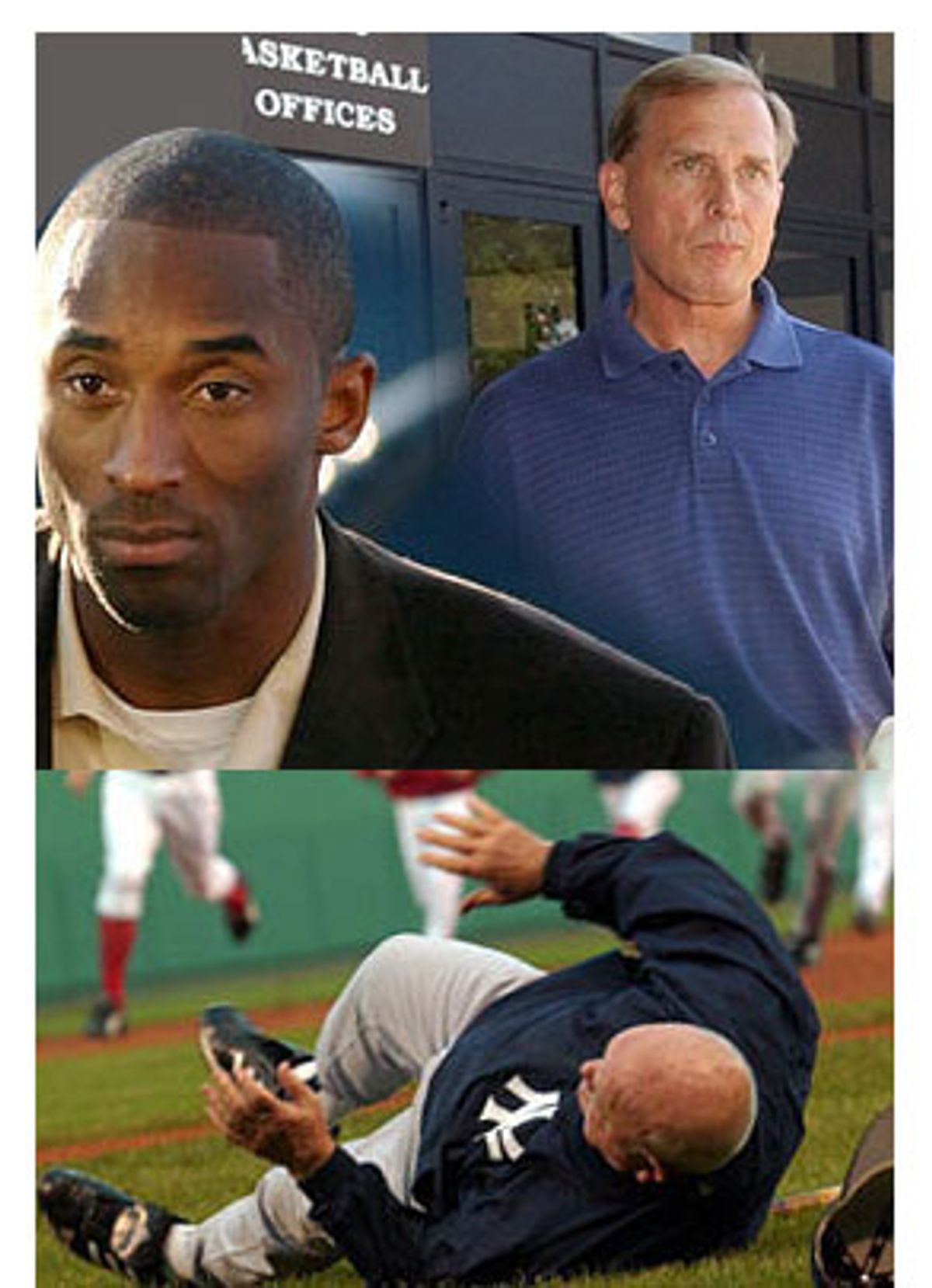
    One of the sporting world’s most popular stars, Kobe Bryant, was accused of rape in Colorado. He denies it, saying the sex he had with a 19-year-old hotel employee was consensual. He ends the year shuttling between his job with the Lakers and court appearances in Eagle, Colo., where he faces trial next year. Even if he’s cleared of the rape charge, the facts that have already been established in the case — that the superstar cheated on his very young wife, the mother of his very young child; that even after seven years with the Lakers, he’s remained aloof and unable to be one of the guys; that he’s shown little apparent remorse for the way his legal troubles have affected the team, opening the season with a bizarre verbal attack on Shaquille O’Neal — have forever diminished his appeal.

    And in a story with far broader consequences, a parade of superstars including Barry Bonds and Jason Giambi testified in front of a federal grand jury investigating the Bay Area Laboratory Cooperative (BALCO), a Burlingame, Calif., dietary supplement company suspected of providing the newly discovered designer steroid THG to athletes. Four Oakland Raiders and dozens of other high-profile athletes are reported to have tested positive for THG, which in October was declared an unapproved new drug by the Food and Drug Administration.

    THG was uncovered by the U.S. Anti-Doping Agency, which polices drug use by Olympic athletes, after an anonymous track coach sent a used syringe to the agency, which reverse-engineered a test to reveal the previously unknown drug. The coach said the contents of the syringe came from BALCO, which BALCO owner Victor Conte denies.

    The THG revelation roughly coincided with news that more than 5 percent of major league baseball players had tested positive for steroids in anonymous testing, which triggered a clause in the collective bargaining agreement: Players will be systematically tested for steroids beginning in 2004 and punished if they test positive. This was all in the same year that witnessed the ephedra-related death of Orioles pitcher Steve Bechler.

    Though the 5-7 percent figure released by Major League Baseball was far lower than the level of steroid use alleged by Ken Caminiti, Jose Canseco and David Wells in recent years, it and the THG revelations confirmed many fans’ long-held suspicions that steroid use is a common, mostly undetected fact of life in professional and Olympic sports. Where once fans had to learn about split-finger pitches and zone defenses to stay current, now they must be experts in pharmacology, a class for which — much like salary “capology” — most never signed up.

    But using illegal steroids isn’t the only way to cheat. Another beloved superstar disappointed his public this spring when Sammy Sosa’s bat shattered in a game, revealing an illegal cork filling. Sosa apologized, saying he’d grabbed a batting practice bat by mistake — an excuse few who have ever handled a bat for a living went on record as believing — served his suspension, and returned to have a fine, cork-free season. But the incident cast a shadow for many fans over Sosa’s prodigious home run output of the last six years, even though it’s doubtful that corking a bat actually increases a hitter’s power.

    Bad behavior was so prevalent this year that it even carried over into the next life. The children of the baseball legend Ted Williams squabbled over the disposition of his remains, leading to the dismally comic image of the slugger’s disembodied head sitting on a shelf in a new-age cryonics facility in Arizona. The steady stream of late-night talk-show jokes about the situation disproved the old saw that dying is easy, comedy is hard.

    A few of the cast of characters who found themselves in hot water in 2003 for offensive or inappropriate comments were shooting for comedy, but most were simply expressing themselves, which is all the more depressing.

    Football players Jeremy Shockey and Garrison Hearst and executive Matt Millen made or shouted homophobic statements. Mike Tyson, who denies that he raped Desiree Washington, a crime for which he served prison time, said he now wishes he had. Cubs manager Dusty Baker and radio host cum football commentator Rush Limbaugh made ignorant racial comments.

    Golfer Vijay Singh sounded like a petulant 2-year-old, at best, when threatening to withdraw from a tournament at which Annika Sorenstam — a girl! — had been invited to play. Masters chairman Hootie Johnson sounded about the same in his continued public whizzing match with activist Martha Burk over allowing women to become members at Augusta National. Burk didn’t come off looking much better.

    And then there were those who let their actions do the talking. Randall Simon of the Pittsburgh Pirates playfully whacked a woman in a racing sausage costume with a baseball bat in Milwaukee. Bill Romanowski of the Raiders — one of the four reported to have tested positive for THG — not so playfully beat the tar out of teammate Marcus Williams, sidelining him for the season and prompting a lawsuit. During a playoff game, elderly, rounded Yankees coach Don Zimmer took a less than sane run at Red Sox pitcher Pedro Martinez, who had just beaned Yanks journeyman Karim Garcia, and Zimmer paid for it with a body slam to the turf.

    He stood nearly alone among the bad actors in apologizing later and appearing to mean it.

    Even Pete Rose, that old gambler, reemerged, the debate about whether he should be reinstated to baseball and elected to the Hall of Fame rising to the level of both an ESPN mock trial and rumors that Rose had reached an agreement with commissioner Bud Selig. It was as though Rose were brought onstage to remind us that misbehavior’s not a new thing, misbehavior started long ago.

    The Portland Trail Blazers, meanwhile, seemed to exist solely to remind us that it’s alive and well in the present.

    But it wasn’t all darkness. Championships were won, legends begun and ended, reputations polished, brilliant performances turned in.

    Septuagenarian baseball trouper Jack McKeon came out of retirement to lead the Florida Marlins from a dismal start to a dashing World Series upset of the Yankees, the bigger upset being that the club wasn’t broken up at the trading deadline. Along the way the Marlins, especially rookie flash Dontrelle Willis, rejuvenated star catcher Ivan Rodriguez and McKeon, reminded us that hardball can be a mess of fun.

    And so did the Chicago Cubs and Boston Red Sox, who both tantalized their fans by falling just short of the World Series. The Red Sox, a rough-and-ready bunch that scored runs in bunches, may have been the most entertaining team of the year in any sport as they fell one win short of the Series, where they would have had a chance at their first championship since 1918, when Babe Ruth was their star. In the end they were beaten in extra innings by a far lesser figure, Aaron Boone, who won the pennant with a home run that will take its place in the one-sided history of the Sox-Yankees rivalry.

    Cubs fans, without a title since 1908 or even a pennant since 1945, shook their heads and muttered about curses after Walkman-wearing fan Steve Bartman entered the language by trying to catch a foul ball that Cubs outfielder Moises Alou had a chance of snaring in Game 6 of the National League playoffs. The Cubs, five outs away from the pennant, melted down and blew their lead in that game, then lost Game 7 to the Marlins. But since Bartman only did what any fan would do, he’s not on our list of the year’s misbehavers. And neither is Cubs shortstop Alex Gonzalez, the real culprit for Chicago’s collapse in that fateful eighth inning for booting a crucial ground ball. He can thank Bartman for Cubs fans not wanting his head on a platter, but his was a physical error, not a bad act.

    The Tampa Bay Buccaneers hardened into a juggernaut at playoff time in January, culminating in a Super Bowl dismantling of the Raiders that was nothing short of breathtaking. But both teams wheezed through the 2003 season.

    Goalie Jean-Sebastien Giguère put the Anaheim Mighty Ducks on his back and led them to an improbable Stanley Cup Finals berth, where they lost in seven games to the New Jersey Devils, the masters of a defensive system largely responsible for NHL hockey becoming nearly unwatchable in recent years. It’s not unwatchable outside, though, at least according to the 57,000 fans who showed up last month in Edmonton at the first outdoor regular-season game in NHL history, one that seems likely to signal the start of a trend.

    Andy Roddick emerged as an American tennis superstar. Michael Jordan’s career ended, with a fizzle more than a splash, and then he was unceremoniously fired as an executive by the Washington Wizards, but we did get the odd flash of greatness. Eric Gagne of the Los Angeles Dodgers had a nearly perfect season as a relief pitcher. Albert Pujols of the St. Louis Cardinals had a third straight astonishing year at the start of his career. Barry Bonds had something of an off year for him, though it was still better than most of the years almost anyone else ever had, especially considering he put it together while dealing with the final illness and death of his father, Bobby.

    The Connecticut women’s basketball team, led by Diana Taurasi, had its win streak ended at 70 but still won its second straight NCAA title, and underdog Syracuse rode freshman Carmelo Anthony to the men’s crown. Rice won its first NCAA championship of any kind when it took the College World Series.

    The nice story of the year was David Robinson, elder statesman and upstanding citizen, winning the NBA championship with his San Antonio Spurs in his last season. Robinson served as a complement to the brilliant Tim Duncan, also a model of comportment and the Spurs’ leader.

    But the basketball story of the year was LeBron James, first as a barnstorming, nationally televised high school star, then as the top draft pick of the Cleveland Cavaliers. The 18-year-old was the flag bearer for what might be called the Year of the Child. Because of him regular-season high school games were nationally televised for the first time. He’s a pro now, but the practice has carried over to the new season. Michelle Wie made the cut in six of seven LPGA tournaments and Freddy Adu signed a multimillion-dollar contract to play for D.C. United of Major League Soccer. They’re both 14. ESPN televised nearly the entirety of the Little League World Series, the preteen players approaching both the games and the surrounding media crush like pros. Mark Walker signed a shoe contract with Reebok. Mark Walker is 3.

    James has so far been a delight, living up to his advance notices and revitalizing a long-moribund franchise in every sense other than, so far, wins and losses. But even King James edged close to a life of sporting crime. He flirted with suspension or banishment throughout his senior year of high school, obviously benefiting as he was from his status as a star athlete. The $50,000 Hummer his mother managed to buy him will be a part of his legend long after it’s been replaced by several generations of much pricier rides.

    But the memory of 2003 that we should carry into the future is that of the Detroit Tigers, who in their bumbling way provided the best example of what’s good about sports when sports are good. Thanks to years of incredibly bad management, this team was so thin on talent that it spent the entire season rocketing toward a record-setting level of futility, the most losses in the modern history of baseball, more even than the 1962 New York Mets, who fell 120 times and became literally synonymous with losing.

    But it didn’t happen. With six games to go, two against the Kansas City Royals and four against the Central Division champion Minnesota Twins, the Tigers were 38-118 and had to go 4-2 just to tie the ’62 Mets in the loss column. (The Mets were rained out twice and finished 40-120.) The Tigers had to go 5-1 to avoid the record books. They’d lost 10 straight games, all by at least two runs and all but two of them by at least four. It had taken them 24 games to collect their most recent five wins. In short, this was not a team capable of winning five times in six games.

    They beat the Royals twice and won the opener against the Twins before losing for the 119th time, one shy of the record. On the second to the last day of the season, they fell behind 8-0, then rallied to win on a wild pitch in the bottom of the ninth. They won again in the season finale to avoid the record. It was the most inspiring rally of the year, even though the games were entirely meaningless in the standings.

    Watching the Tigers celebrate as though they’d won the World Series, especially after that penultimate game, offered a lesson for sports fans depressed by this year of malefaction and delinquency: No matter how bad things get, sports can still provide those amazing moments of joy, release and celebration.

    It was a necessary lesson, because in 2003, things got really, really bad.

  • Continue Reading Close

    The Year in Sanity: Jim Joyce

    His blown call cost Armando Galarraga a perfect game. But from the moment he realized his mistake, he was golden

    • more
      • All Share Services

    Topics:

    The Year in Sanity: Jim Joyce** CORRECTS PERFECT GAME TO WEDNESDAY, NOT TUESDAY ** Home plate umpire Jim Joyce calls a strike during the first inning of a baseball game between the Detroit Tigers and Cleveland Indians in Detroit Thursday, June 3, 2010. Tigers pitcher Armando Galarraga lost his bid for a perfect game with two outs in the ninth inning on a disputed call at first base by Joyce on Wednesday night. (AP Photo/Paul Sancya)(Credit: Paul Sancya)

    Armando Galarraga was a journeyman Detroit Tigers right-hander who shocked the baseball world on June 2 by throwing a perfect game against the Cleveland Indians. Except, of course, the game wasn’t perfect, because with two outs in the ninth inning umpire Jim Joyce called Jason Donald of the Indians safe at first base when Donald clearly should have been called out to end the game.

    Galarraga responded with a you’ve got to be kidding me smile for the ages, then retired one more batter for a one-hit shutout. He later said he hadn’t argued because he was in shock.

    But it was Joyce’s response that turned this terrible tale into one that’s almost heart-warming. Not as heart-warming as a journeyman pitcher tossing a perfect game, mind you, but pretty toasty.

    Having asked to see the video replay after the game, an emotional Joyce spoke to reporters: “It was the biggest call of my career and I kicked it. I just cost that kid a perfect game,” he said. “I missed it from here to that wall. I had a great angle, and I missed the call.” He also asked to speak to Galarraga, apologized to him and hugged him. Offered the next day off by his superiors, Joyce declined, saying he was ready to face what he assumed would be a hostile reaction from the Detroit crowd.

    This eminently reasonable, grown-up reaction stood out because baseball umpires are ordinarily cloistered. They have what amounts to lifetime tenure. They don’t face reporters, rarely admit mistakes publicly and are not held accountable for their actions in any way that’s visible to the players or public. Don’t like that call? Replays showed the ump got it wrong? Tough.

    Galarraga said he’d forgiven the umpire, and Joyce’s response to his error has been widely praised beyond baseball. He’s become a go-to example of how to handle mistakes in politics, religion and — especially because his straight-forward behavior came in the midst of BP’s oil-spill debaclebusiness.

    Less than two weeks after the blown call, ESPN surveyed major league players for their opinions about umpires. Their overwhelming choice as the best in the business: Jim Joyce.

    Continue Reading Close

    Why I’m against baseball’s instant replay

    The technology won't necessarily rob the game of heart, but it definitely won't fix what's wrong

    • more
      • All Share Services

    Topics:

    Why I'm against baseball's instant replayThe Major League Baseball instant replay display is shown in the umpires room before the National League baseball game between the Philadelphia Phillies and Chicago Cubs in Chicago, Illinois August 28, 2008. REUTERS/Steve Green/Pool (UNITED STATES)(Credit: Reuters)

    For the third straight baseball postseason, umpires have been making critical, high-profile mistakes in game after game, and there’s a growing drumbeat among media and fans that Major League Baseball has to do something about it. And not just any something, but one specific something: instant replay.

    The entire conversation about umpiring has been predicated on the assumption that the only solution to the problem is a technological one, which is fascinating — and maybe just a little troubling — because everyone in the conversation knows two things: There are acres of room for improvement that has nothing to do with technology, and the technology itself is far from perfect.

    We know from other sports, especially NFL football, that video replay is hardly perfect. Putting aside the unnecessarily long delays that accompany video replay in the NFL, it’s a simple fact about video that it does not always provide conclusive evidence of what happened. Camera angles can be as deceptive as the naked eye.

    And more important, the NFL’s replay system is a laboratory of unintended consequences. Introduced for the same reason many people want to introduce replay to baseball — to put an end to egregious officiating mistakes — it has become the lord of officials. It has changed the way officials call games. Refs now err on the side of the reviewable call, or make no call at all so replay can be possible. They have changed the way they call fumbles and completions. Watch an old NFL game from before replay and you’ll be struck at the difference in officiating and rules interpretation.

    People will argue over the specifics of those last two paragraphs, but there’s no one familiar with replay who doesn’t know that replay is far from perfect, that despite — I would say because of — replay being entrenched in the NFL for years, officiating is still such a problem that a huge number of fans can convince themselves that a recent Super Bowl was fixed by the refs.

    Yet the only anti-replay argument that ever sees the light of day is the Luddite one: Instant replay would rob baseball, that most human of games, of an essential human element.

    That’s a valid argument, but it’s a religious one. No one is ever going to be argued off of it, and if you don’t buy it, you’re not going to be talked into it.

    But it’s interesting that the argument against it goes like this: Instant replay might not be perfect, but it’s better than what we have now, so we should use it. That argument ignores a vital question. Is instant replay better than some other solution?

    If you’ve been around as long as most of the people who are in the most public part of this argument — media figures and baseball officials — technology has been a series of miracles in your life. You can carry a supercomputer in your pocket that connects you to anywhere in the world all the time? Are you kidding? I’m not even 50 and I remember when it was a big deal that someone could leave you a taped message when they called your house — the only place you could have a phone — and you weren’t there.

    Got a problem? Technology can probably fix it, and if not, just wait a little. It’s coming. Marvelous times.

    But I think we sometimes forget that technology isn’t the only fix, and it isn’t always the best one, and not just for squishy reasons having to do with idealizing human error. Human error is a bad thing, and technology is often fantastic at doing away with it. But it can also do away with some good human things, like judgment and holistic problem solving.

    Think about law enforcement for a moment — and sports officiating is essentially law enforcement. Which is more effective at fighting crime, an elaborate system of video surveillance or a program of job training, substance abuse education and treatment, community investment and so on? Or if that’s too liberal-sounding for you, focus in tighter. If you’re a parent, which is more effective at getting your kids to behave like solid citizens, spy cams around the house or engaged, loving parenting?

    If you wanted to design a system that would result in poor umpiring, you would design Major League Baseball’s system. It’s positively medieval. Umpires essentially have lifetime tenure. They are sequestered from the media and answer only to a review system that is as secretive as it is pointless, since it hardly ever results in umpires losing their jobs. Instant replay won’t change that lack of accountability.

    “We never know why or when they are fined, or reprimanded or held accountable,” Oakland A’s pitcher Brad Ziegler told ESPN’s Amy K. Nelson last week. “Any time a player is punished, suspended or sent down to the minors, the public knows about it. It would be a lot easier to communicate with umpires if everyone was held to similar standards. Our statistics as players are a lot more quantifiable than the umpires’.”

    I am something of a Luddite when it comes to instant replay, not because I’m anti-technology — I have a long-distance line to New York in my pocket, and the call is free? Score! — but because I think baseball has been smart about being slow to change over the last century-plus. Replay would suddenly, irreversibly alter a game that has a pretty good history of solving its problems without radical, game-altering solutions.

    I don’t believe baseball should absolutely avoid instant replay because instant replay is evil. I believe it should try to tackle the organizational problems that are leading to the poor umpiring rather than slap an electronic band-aid on them.

    Nelson’s ESPN story is about a planned winter meeting between the grumbling players association, baseball officials and the umpires. Nelson describes such a meeting as “rare,” which is a problem right there. Shouldn’t the three parties involved in this major issue for Major League Baseball talk to each other more than rarely?

    It’s a good step. I’m not too hopeful it’s going to lead to a new era of transparency and reform. No one from the umpires or Major League Baseball would comment for the story.

    Continue Reading Close

    Hard times? TV can be your lottery ticket

    If you can get your sob story on the tube, you're gold. But what about the other millions of desperate Americans?

    • more
      • All Share Services

    Topics: , ,

    Hard times? TV can be your lottery ticketA food line at the Community Kitchen in Harlem

    A tweet from NBC reporter Ann Curry:

    Ok, here’s a smile: update on our doc on recession/poverty. I love America

    http://bit.ly/btt50h

    Here’s the text you get when you “share” the video report Curry’s tweeting about:

    Overwhelming response to Dateline’s poverty report

    A development to the story we brought you about struggling families in Ohio who have been pushed over the edge by this recession. ††There’s been a response from people wanting to help.

    http://bit.ly/btt50h

    So it’s that old TV thing. NBC does a story on “Dateline” about families struggling through the recession in rural Ohio, and letters and donations and job offers come pouring in from all over the country.

    The retired Air Force vet has “job offers in Pennsylvania, Virginia, Arizona, Iowa.” Someone sent him $5,000. A woman reads through tears from a letter she’s received: “In a couple of weeks I will be able to send you some money to help with expenses. I hope this letter raises your spirits and that you know I really do care. Most of all, you have a friend in me. You are going to be OK, and so are your children. I will be thinking of you, sweetie, and praying that lots of other people send you much-needed money.”

    She says, “It’s really hard to believe that someone you’ve never met could actually care that much.”  

    The food pantry lady has gotten 500 phone calls and donations from Texas, California, Florida, Iowa, Massachusetts, Maine and Canada. She says, “I just can’t even describe how good it feels to know that there are so many people out there that really do care.”

    This is absolutely par for the course, it’s what happens every single time there is a sob story on the TV, but here’s the thing: People don’t care. They just respond to what’s on television.

    There are folks right down the street in Texas, California, Florida and Iowa who need food and basic supplies. There are good, capable people, some of them retired military, right down the street in Pennsylvania, Virginia, Arizona and Iowa who are looking for work. And, after NBC’s report, those people still need the basics and are still looking for work. And those people who sent the heartfelt letters and the donations and the job offers likely never moved a muscle for those people down the street.

    A guy who drove to the food pantry with a Hefty bag of donations tells the food pantry lady, “Cincinnati Ohio’s thinkin’ of ya,” and she gives him a big hug. Really, guy who drove 170 miles to Lottridge to find someone to give your Hefty bag of stuff to? Because where were you and the rest of Cincinnati before NBC aired its report?

    Curry, who is among the best in the business and whom I don’t mean to beat up on, gets “a smile” out of this, as she should. She did a good piece about people who are struggling, her viewers responded in overwhelming fashion and the people she reported about are deeply moved by their good fortune.

    If you focus in tightly enough, it really is a wonderful thing. That a relatively tiny group of people in Ohio actually did get a lot of help they weren’t going to get without that TV report. It was like a little miracle, and you’d have to have a hard heart indeed not to be touched by the young mom reading the letter or the hardworking food pantry lady who is suddenly able to provide so much more help to so many more people. I love America too.

    But back your view out to the larger picture and what you see is something much more depressing.

    Obviously, the people who sent money and goods and job offers had both the means and willingness to help their neighbors in need, but instead they helped some people they saw on TV. Now, I suppose it’s possible that every one of them, from the donor of $5,000 to the Hefty bag guy from Cincinnati to the job offerers in Pennsylvania, Virginia, Arizona and Iowa, is doing just as much for lots of other people closer to home and not on the TV.

    I would just be willing to bet a lot that they aren’t.

    What Curry’s story suggests is that the generosity of the American people can solve the problems of a lot of folks who need help — as long as they can get on TV. Getting on TV is a lottery ticket, and the depressing part of it is that if you’re in trouble, your chances of getting on TV are about the same as your chances of winning the lottery.

    What about all the desperate people who didn’t have a TV network drop out of the sky into their local food pantry? How do we turn their story into “a smile”? Because there are clearly people out there willing to help. There just isn’t enough TV to go around.

    Continue Reading Close

    Worst! Calls! Ever!

    Slide show: Umpire Jim Joyce's error ruined Armando Galarraga's perfect game. How does it stack up against history?

    • more
      • All Share Services

    Topics: ,

    Worst! Calls! Ever!Dallas Stars Brett Hull (22) raises his arms after scoring the game winning goal on Buffalo Sabres goalie Dominik Hasek in the third overtime of Game 6 to win the Stanley Cup Finals in Buffalo, NY, Sunday, June 20, 1999. (AP Photo/Charles Krupa)(Credit: Associated Press)

    Umpire Jim Joyce’s blown call Wednesday night, which cost Detroit Tigers pitcher Armando Galarraga a perfect game, is already the stuff of legend. Was it the worst blown call in history?

    It was the worst blown call in Jim Joyce’s history, that’s for sure. And surely the worst in Galarraga’s until-now ordinary baseball career. Because it merely affected a line in a record book — Galarraga would have been the 21st pitcher in MLB history to throw a perfect game, dating to 1880 — it lacks the historical heft of the greatest officiating mistakes.

    View the slide show

    Remembering Ernie Harwell

    To know the longtime voice of the Detroit Tigers, through the radio or in person, was to love him

    • more
      • All Share Services

    Topics: ,

    Remembering Ernie HarwellFILE - In this Oct. 3, 1993, photo, Detroit Tigers broadcaster Ernie Harwell pauses during a break in the action in the Tigers' baseball game against the New York Yankees at Yankee Stadium in New York. The Tigers say Harwell has died. He was 92. (AP Photo/Paul Hurschmann, File)(Credit: AP)

    The best three days I ever spent on the clock were the three days I spent in Detroit with Ernie Harwell, the longtime voice of the Detroit Tigers, in 2002, his last year in the broadcast booth.

    Harwell died Tuesday at 92, eight months after announcing that he had terminal cancer that he would not treat. John Lowe of the Detroit Free Press, in what will surely be the definitive obituary, quotes Harwell at the time: “I’m ready to face what comes. Whether it’s a long time or a short time is all right with me because it’s up to my Lord and savior.”

    I grew up not listening to Ernie Harwell but to the man who replaced him in the Brooklyn Dodgers booth in 1950, Vin Scully. I hadn’t come to know Harwell until 1999, when baseball broadcasts were still streamed online for free and Harwell had returned to the radio side after five years on TV. Like generations of Michiganders, I quickly fell for his warmth, his charm, his knowledge of the game, his old-timey broadcast voice.

    When he announced that 2002 would be his last season, I wanted to write about him, so I got in touch with him through the Tigers, asking if I could come to Detroit for a few days, hang out with him, shadow him. A day or so later there was a voicemail message. That incredible voice was right on my phone! I saved it for as long as I could. I wish I still had it:

    “King, this is Ernie Harwell from Detroit. I don’t know that there’s much to write about me, but sure, come on up.”

    I had planned to write about a fundamental shift in the way people follow baseball, about how Harwell was one of the last of the old radio men who were identified with a team as much as any player, often more than any player. Now, with most games on TV, far more games on national TV, larger squads of announcers and the Internet providing more baseball information than any one person could ever absorb, fans weren’t dependent on that one broadcaster to serve as the conduit to their team.

    Yes. Well, it seemed interesting in my head. A little of that stuff made it into the piece, but after about 10 minutes with Ernie Harwell, I knew that my story couldn’t be about anything but Ernie Harwell.

    It’s hard to talk about what kind of guy Ernie Harwell was without sounding like you’re talking about a guy on the night of the day he died. But it was just as hard when he was still alive. I spent three days with him, and he was unfailingly kind, generous, cheerful, energetic, positive and humble. And not just with me. At 84 years of age, he was tireless, making sure as he roamed the ballpark — which he did a lot — that every fan who wanted a moment with him — and there were many — got the moment he or she wanted.

    I talked to a lot of people about Ernie Harwell that summer, and in the eight years since then I’ve talked to more people about him and I’ve heard and read many things said about him, and I’ve never heard a hint that the man I came to know in those three days wasn’t the genuine article. It may be that there has never been an unkind word said about Ernie Harwell.

    Jon Miller, the ESPN and San Francisco Giants announcer, was hurrying across a field when I sidled up to him asking if I could talk to him for a minute. He kept walking as he asked what I wanted to talk about. “Ernie Harwell,” I said, and he stopped on a dime. All of a sudden, I had his attention and he grew animated as he told stories about Ernie.

    Mike Shannon, the longtime St. Louis Cardinals broadcaster, was pressed for time just before a game one day but he told me to sit in the press box and wait for him. Minutes before the first pitch, he leaned out the door of his radio booth. “Where’s the guy who wanted to talk about Ernie Harwell?”

    Ty Cobb liked Ernie Harwell, for crying out loud. Ty Cobb didn’t like anybody.

    “He’s so generous with his time,” I wrote back then, “that a reporter in town for three days to research a story on him confesses on the third day that he’s just about run out of questions to ask.” That reporter was me, of course. We were sitting in an empty broadcast booth in the Comerica Park press box when I told him that. He looked out at the field for a few seconds, then started throwing out some suggestions, things I might want to ask about.

    It sounds silly to say, but after spending time with Ernie I told myself that I would try to be a better person, more generous, more cheerful, more optimistic, more kind. More like Ernie Harwell. I failed miserably at this, of course, but I’ve returned to that thought fairly often over the years, and I like to think I’ve moved just a tiny bit in an Ernie-like direction.

    Here’s the story I wrote about Ernie. I think I worked harder on it than on anything I’ve ever written. I did things I never do. I made outlines, wrote things on index cards and arranged and re-arranged them.

    I swung for the fences, wanting to do justice to the living legend and the time I’d had with him. I used a flamboyant structure, organizing the piece around Ernie’s call of a single game, weaving his epic story between snippets of a thoroughly ordinary contest between two lousy teams, the Tigers and the Kansas City Royals.

    I’m not sure it worked. But you don’t get to hang out with the greats that often, and it’s less often that you end up liking them. I wasn’t going to write just another piece about Ernie Harwell in his last year.

    A few days after it ran he sent me an e-mail thanking me for the piece. “Best thing that’s ever been written about me,” he wrote. I’m sure he said that to every single person who ever wrote a story about him. And here’s the thing: I’m sure he meant it every time.

    Continue Reading Close

    Page 1 of 111 in King Kaufman