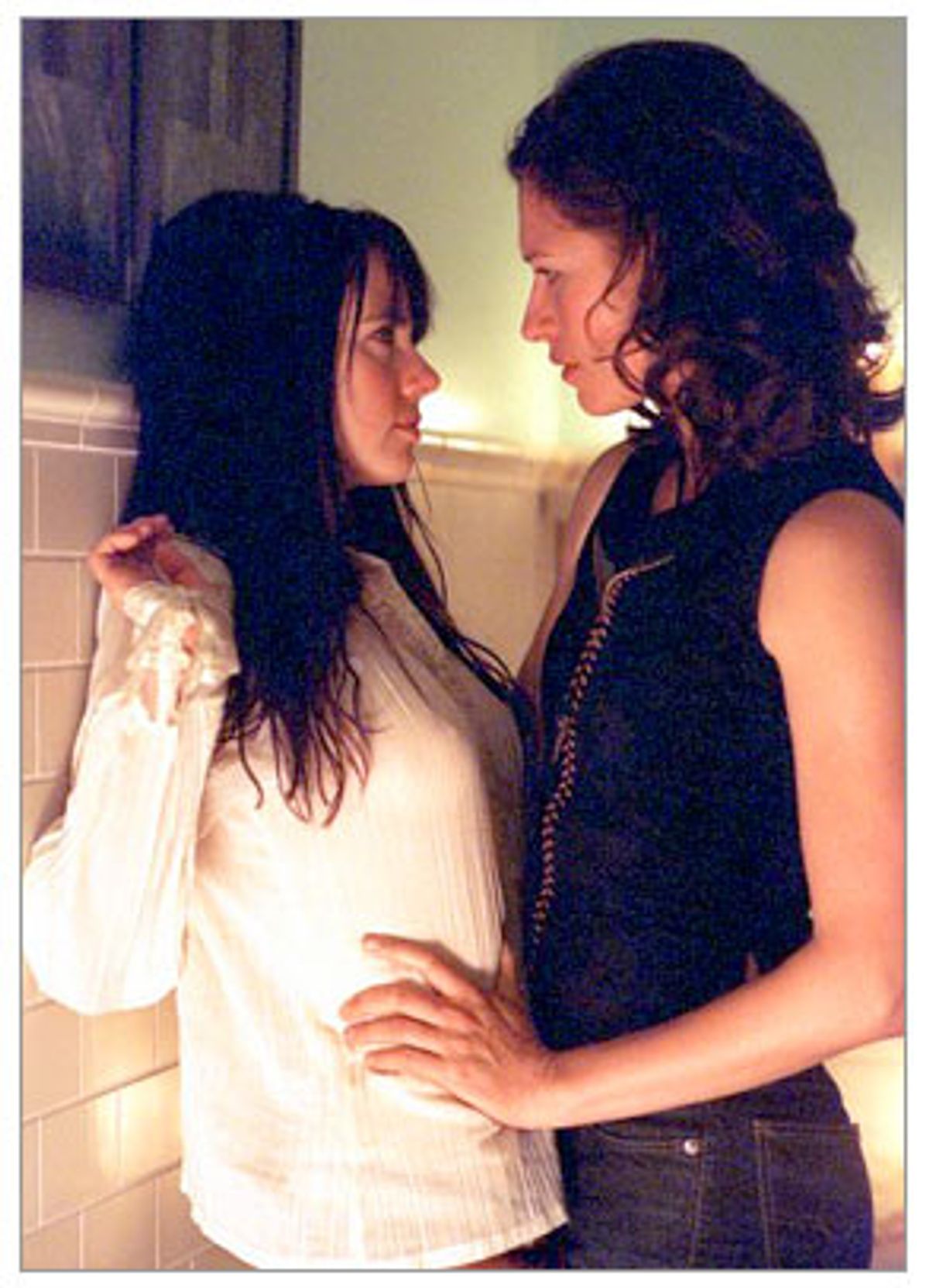
When you think of Los Angeles, do you think of palm-tree-lined streets, quaint craftsman homes, and sun-drenched coffee shops filled to the brim with scorchingly sexy lipstick lesbians?
No? Well, you may not know it, but there’s a utopia of highly evolved, wildly beautiful gay women in Los Angeles, depicted vividly in Showtime’s new drama “The L Word” (Sundays at 10 p.m.). These women spend their days gossiping over herbal tea or reading each other’s short stories or descending on a country club to determine the sexuality of a certain tasty sous-chef. From gorgeous coffee shop owner Marina (Karina Lombard) to pro tennis player Dana (Erin Daniels), each one of these women is slim, stylish, creatively fulfilled and emotionally well-balanced. Thus, any drama must arise not from flaws or limitations or, god forbid, anxieties specific to lesbians, but from the world outside their warm utopian microcosm.
Thus, longtime couple Bette (Jennifer Beals) and Tina (Laurel Holloman) are both young and beautiful with minor relationship challenges that aren’t remotely specific to a relationship between two women. Although they’re trying to have a baby together, neither shows any ambivalence when parents disapprove or when sperm donors back out, except when it takes the shape of a cookie-cutter, one-size-fits-all emotional unavailability. Another character, the free-wheeling Shane (Katherine Moennig), beds a steady stream of women, promises she’ll call, and then doesn’t; she’s like any stud we’ve seen before, except she’s really, really nice about it. The only truly dysfunctional character on the show, Jenny (Mia Kirshner), is engaged to a man, but is having an affair with a woman, and won’t admit the truth to herself or to her fiancé. She’s only messed up, we’re led to believe, because she’s trapped in the wrong life.
“The L Word” throws in plenty of zany “Sex and the City”-style antics that make comparisons to that show inevitable even without Showtime’s ad campaign (“Same Sex, Different City,” the slogan goes). But “The L Word” seems so intent on representing lesbians in a flattering light it winds up in a toothless nowhere land of cute quips and flat characters. While the show’s primary focus is on realistically depicting the lives of a diverse group of lesbians, these characters feel remarkably similar to each other, mostly because outside of their surface identities — magazine writer, gallery curator, athlete — they don’t seem to have unique traits, perspectives or problems that might draw us in. Quarrels are resolved politely without further exploration, and tense dialogue melts into pleasantries, glossing over major conflicts. Even when Bette and Tina aren’t getting along, they act like a dreamy pair. Shane and Dana clash amiably but never discuss anything of real weight. The only scenes that feel dangerous and real are the ones that involve straight couple Jenny and Tim (Eric Mabius), presumably because there’s no need to pull punches.
The show also circumnavigates any and all clichés associated with lesbians. It’s understandable that they might not want to populate their coffee shops and bars with big women sporting crew cuts and biker boots, or explore such clichés as the much older woman seducing the younger woman, or the lesbian who suddenly marries a man in order to escape her fears of existing in a marginalized realm. But by completely sidestepping anything that might seem remotely stereotypical (or negative), they end up with stories that feel a little dishonest and not nearly textured or involved enough to keep our interest. All people, gay, straight and bi, are far more flawed and conflicted than the writers of this show are willing to admit.
Why didn’t Showtime take its cue from a show like “Six Feet Under,” which manages to explore a wide range of characters struggling for happiness against difficult circumstances? Creator Alan Ball takes an unflinching look at the perils of straight married couples, gay couples, older women, artists, teenage girls and others without shying away from their sometimes awkward and embarrassingly demographic-specific troubles, from Keith’s annoyance with David’s camp-happy friends to Nate’s restlessness with his ultratraditional role as a new father and husband.
All relationships are challenging in their own peculiar ways. Even fluffy “Sex and the City” isn’t afraid to cast a harrowingly harsh light on the heterosexual female. So where’s the woman afraid of introducing her butch girlfriend to her parents? Why not have just one character who’s not a Size 6 or under? How about one woman who’s ambivalent about how she could ever fit in with the lesbian scene? Daniels played this role in the pilot, but they inexplicably made her far less confused and cynical in subsequent episodes. Now that she’s made her choice (women), she suddenly has a consistently sunny disposition, is madly in love, and the only thing causing her real trouble is her handlers, who don’t want word to get out that she’s gay. It’s a difficult situation, so why does Dana have to handle it all so perfectly? After she brings her faux-boyfriend to an event instead of her girlfriend, she later apologizes profusely and promises her girlfriend that she’ll come out. What about those individuals in the spotlight who absolutely refuse to come out, for fear of the impact it might have on their careers? How do they ever find love, or handle it when they do? Wouldn’t that make for a more challenging and, consequently, far more dramatically compelling story line?
If your show is primarily focused on sexuality, as “The L Word” is, it really doesn’t make sense to make the source of every conflict over sexuality external. Either broaden your scope (“Six Feet Under” isn’t just about death, and “The Sopranos” focuses more on married life than on the mob) or deepen your portrayal with a more courageous, unflinching exploration of your subject, warts and all. Because the real disappointment of “The L Word” lies in its wasted potential. A whole universe of rich, complicated characters and fresh plotlines could be mined here. Now and then, when a scene or a bit of dialogue breaks past the surface to deeper, richer groundwater swirling underneath, you catch a glimpse of the possibilities of this unique landscape.
Yet, by refusing to delve into anything confusing or difficult that’s specifically associated with relationships between two women, “The L Word” feels like a fantasyland, imagined and utterly weightless. While you can’t blame them for their self-protective stance, ironically, by keeping their characters locked up in a sunshiney utopia of idealized traits and whitewashed scenarios, the creators of “The L Word” prevent us from understanding or feeling for these women at all.
Sarah Jessica Parker as Carrie Bradshaw (Credit: HBO)
When those inevitable reboots of beloved franchises come around, die-hard fans and newcomers get a chance to return to the roots of a character and glimpse the glory yet to be. They’re all about how one becomes a legend — and they’re wildly successful. Spider-Man. Superman. Batman. Carrie Bradshaw.
Wait, what?
It’s true — this week, the long-threatened “Sex and the City” prequel — “The Carrie Diaries” — got a green light from the CW.
Based on Candace Bushnell’s successful “Carrie Diaries” and “Summer in the City” novels, the as-yet-uncast series will follow the ’80s-era Connecticut high schooler Carrie Bradshaw through her youthful explorations of friendship, romance and the occasional Big Apple adventure. It will be up to producers to determine whether this Carrie will be more like the character in the Bushnell books – a girl with siblings and a doting father – or the character she became through a long-running HBO series and two big-budget movies.
Maybe the real question is how Carrie Bradshaw has managed to keep her manicured talons in the public imagination as long as she has. Because Carrie Bradshaw is not the female equivalent of Batman. Sure, she’s a loyal pal, but have you ever watched the series? Carrie is not endearingly flawed the way that all great characters must be. She’s a full-on pain in the ass, easily the least likable member of her famed quartet. She’s fiscally irresponsible; she’s whiny; for a sex columnist, she is way too prissy about anything not vanilla enough for her tastes. And frankly, aside from the shoes, her wardrobe is tragic. How has this self-obsessed suckhole of need who bullied Big about commitment all those years managed to endure as an icon, the female any other woman with strappy heels, a laptop and a diaphragm must inevitably find herself compared to?
In “Sex and the City’s” later years, its three ostensible supporting characters evolved the most — becoming mothers, becoming parental caretakers, battling infertility and illness. Carrie remained frozen in time, the one who dumped her career for one man and then waited for another man to rescue her, the one who, well into her 40s, was still referring to her friends as “girls.” But the Carrie her fans tend to remember is the sassy gal about town, going to fabulous parties and dating a slew of ridiculously hot men. And that’s the allure. It’s not where Carrie wound up — just another middle-aged wife of a rich man – but who she once was. A woman with the potential to be anything.
Carrie Bradshaw still represents the small-town girl yearning for adventure in the big city, the one who believes that once she gets there, she will transform from the dowdy figure in her high-school yearbook into the toast of the town. That’s why this origin story might actually work. The immaturity that would be as much a trademark as her petulant cosmo sipping in later years suits a character who is, in fact, supposed to be immature. Weren’t all of Carrie’s “I couldn’t help but wonders” followed by something that sounded straight out of the mind of a 16-year-old anyway?
In her nascent form, there’s a little bit of Carrie in every girl who’s ever dreamed beyond her ZIP code, who ever said, “I have got to get out of this place.” And in that regard, Carrie does have something grand about her. Not Spider-Man grand, but still. Grand enough for the CW, anyway.
Vincent D'onofrio on "Law and Order: Criminal Intent."
“Law and Order: Criminal Intent” certainly had some hubris this week, making a “Spider-Man: Turn Off the Dark”-like musical the scene of the crime and placing “Sex and the City” star Cynthia Nixon in the center of suspicion as a drunken Julie Taymor stand-in. “Icarus,” the season finale, is set in a world where “Turn Off the Dark” already exists, so there are various references to both its massive flop and Taymor’s illusions of grandeur. In the opening scene, we see a bleached-blond sitcom star absolutely ruining Nixon’s vision!
No Cobb salad for her! She needs a drink!
Who is that shady Bono wannabe who accompanies Mark on the sing-along? And what kind of song is that anyway? None of these questions are answered in the next scene, where Mark is eulogized with an equally terrible number called “Hubris” from the fake “Icarus” musical, which Vulture point out is also a dig at Taymor, since “the programs for ‘Turn Off the Dark’ included a section about the “hubris” of Arachne.”
Did we mention Patti Smith was also in this episode? The singer wanted to make this her TV debut since she watches L&O in different languages while on tour to “dispel the loneliness“? Maybe next season, “Criminal Intent” can have an episode about her.
Carrie Bradshaw: one of 20th century television's most iconic figures.
June 3, 2001: Carrie Bradshaw and her three best friends hit HBO’s run … er … airways once again, beginning the fourth season right as Sarah Jessica Parker’s character was turning the big 3-5. “[It's] a landmark age for women,” Parker said during an interview about the episode, (titled “The Agony and the Ex-Tacy,” woof), “It makes her think about choices she makes and what she doesn’t want to repeat.”
But it wasn’t just aging wombs that were being counted down on “Sex and the City.” As they embarked on their fourth season, the show had definitely found itself a niche in women who both related and longed to live the lives of the lawyer, the writer, the sexpot, and the Connecticut princess in New York. But it was also an HBO show, straddled in a time slot right after “The Sopranos” and before a quirky new dramedy called “Six Feet Under” premiering that spring. Over the years, these women would struggle to stay relevant; not only in the dog-eat-dog NYC where young waifs ruled supreme, but as television characters whose lives were just a tad more frivolous than the Soprano’s or the Fishers’.
And you know what? They pulled it off. Say what you will about “He’s Just Not That Into You“ or Liza singing “All the Single Ladies” in that terrible movie sequel; “Sex and the City” had — has!– one of the largest influences on popular culture, specifically because it didn’t market itself as an HBO show. (You know what I mean, everyone who canceled their subscription after “The Wire” ended.) The issues touched on by Carrie and co. weren’t all schmaltzy girl stuff either: not only did it earn a place in Time’s top 100 list of best television shows alongside its heavyweight network brethren, but I know just as many straight guys who enjoy the show as much as I do. I’m not an obsessive fan and I never think which character I would be (Samantha…no, Charlotte! No…who is that one that fell out of a window at a cocktail party?) but I can appreciate the clever writing, if not the constant yapping about shoes and dinner reservations. Sometimes I thought those women would have been happiest if they were all engaged to Patrick Bateman. But then I realize I’m just bitter, because collectively I don’t think I’ve had four close female friends over the course of my life. Let alone in New York City. Bitches be scheming.
So love them for what they were or hate what’d become of them, it’s impossible not to see the “SATC” franchise as a force to be reckoned with — and by extension, the women themselves. Look how far these ladies have come: from New York to Abu Dhabi and back again. And hey, if the price is right, maybe one day you’ll see Carrie, Samantha, Charlotte, and Miranda toasting their 80th birthdays in space with a bunch of zero-gravity pink martinis and hunky, underage guys.
How much better would Gabriel García Márquez's book be if it was about shopping??
“Chick lit” is one of the most depressing terms I can think of in the publishing industry. Then again, I don’t know that much book-selling jargon, so there are probably worse ones (“Magical tweenism?”), but that phrase — applied to frothy writing about “modern” women (and their love lives) – is almost a derogatory term, implying the type of fluffy romance masquerading as post-post-post-new-wave feminist spiel. Yet for some reason, agents are encouraging female writers to think about chick lit marketing when writing their first books. I mean, no one is denying that the genre has mass appeal. But you know what else had mass appeal? “Two and a Half Men.” And Hitler.
In response to this “lowest common denominator” mentality, editors over at the satiric women’s culture and fashion site The Gloss created an amazing slide show of how some of history’s greatest fiction books would look if they were “chick lit”-ed up. So Hemingway’s classic “The Old Man and the Sea” becomes “The Old Man and the C-Word,” with the blurb:
A saucy tale of gender discrimination set in the fast-paced world of fishing! Santiana is considered too weak and womanly to be a serious fisherman — partly because she hasn’t caught anything in 84 days, but mostly because she’s a woman! Will she be able to reel in a giant marlin and win the respect of her village? What about reeling in her handsome fellow fisher, Manolin?
All of the examples in the slide show are painfully funny, especially for those of us who actually read “The Devil Wears Prada” or “The Nanny Diaries” and are mortified that whole sections of bookstores are now relegated to this non-genre.
In a show of female writer solidarity (and also because I thought it’d be a funny exercise), I asked The Gloss editor in chief Jennifer Wright to help me do the opposite: I sent her slightly altered titles from famous chick books, and she’d have to summarize of the novel as if it was an esteemed piece of literature.
These were the titles I came up with:
“He’s Just Not That Hebrew”
“The Last Confession of a Shopaholic”
“Sax and the City”
“Bridget Jones’ Cowrie”
“The Devil Wears Pravda”
“Twilight, Big City”
And here’s what Jennifer created for descriptions:
One of the epic, heartbreaking works of our generation, “He’s Just Not That Hebrew” begins in economically depressed Germany of the 1930s. Amid the young men proclaiming their status as cameras, an Orthodox Jewish woman pines for a soft-spoken painter. His name? Adolf Hitler. He is not that into her. As time goes by, her quest for romance becomes a quest for survival.
————————————————————————————–
Often called “requiem for the American dream “The Last Confession of a Shopaholic” traces the slow devolution of a shopaholic. When Birkins can no longer fill the empty holes in her heart — as holey as the $1,625 Balmain T-shirt she uses to clean her 4th floor walk-up apartment’s toilet — the ever unnamed shopaholic slowly succumbs to a crippling Diet Coke addiction. Ultimately she’s forced to rediscover the soul she thought she’d sold — but, alas, all too late.
————————————————————————————–
Told entirely in the second person future tense, “Sax and the City” follows an aspiring jazz musician with a devilish morality in a City of Angels. As Cary constantly tries to overcome his provincial Midwestern upbringing, he’s drawn ever deeper into LA’s erotic, Nietzsche obsessed underworld. Long story short? He kills his landlady. With a saxophone.
————————————————————————————–
Sometimes likened to “The Goat: Or, Who Is Sylvia and My Dog Tulip,” “Bridget Jones’ Cowrie” explores the curious bond between woman and beast. Resigned to her spinsterhood, Bridget Jones pads through the house wearing one shoe and an increasingly decaying Sloane Street wedding dress. That is, until she finds her truest friend, the noble snail. A tale of human idealism that reaffirms that all that is slimy does glitter, albeit in its own slug like way.
————————————————————————————–
“The Devil Wears Pravda”: Much like Mikhail Bulgakov’s “The Master and the Margarita,” “The Devil Wears Pravda” explores the ramifications of the Communist regime upon the individual. With wit and subtle satire “The Devil Wears Pravda” examines the life of a homeless teenager — Andi — in 1918 Moscow. Shunned by society and forced to clothe herself entirely (and shabbily) in the revolutionary newspaper of the period, a chance encounter with Alexander Shlyapnikov precipitates her rise to power as one of the most beloved Soviet writers of the period. Her rags turn to riches, but in the process, does she become the Devil?
————————————————————————————–
“Twilight, Big City”: Runner up for the 1986 Booker Prize, Edward is a wunderkid “vampire” on an eternal search for Bolivian Marching powder in Manhattan. Bela is the stony-faced girl working the coat check at Tunnel who refuses to be sucked into his world. As her affections are ultimately captured by a biker “werewolf,” Edward wonders about life after the apple.
I don’t know about you, but I would buy all these books in a heartbeat if they were real. Certainly an improvement over the originals.
(The author chose to use a pen name for this piece.)
Six and a half years ago, my first and only marriage detonated after only 14 months. My ex-husband, a recovering alcoholic with, it turned out, much bigger mental problems, left in a spectacularly sudden and cruel fashion. He said he’d never been attracted to me, and he told lies about me to his family and friends, and he left. I was lucky, empirically, to get off this easy and only lose a little over three years of my life to the debacle, but the shock of it was deeply traumatic and I was shattered. I was 34.
That winter was one of the wettest in Los Angeles history. It poured and poured, reflecting my own relentless floodgates of pain and confusion. I cried, I screamed, I beat pillows. I found an apartment and moved, and cried and screamed some more. I went to work each morning and spent my days working with foster kids in the inner city, and then I returned to my little apartment and spent the evenings watching the rain and crying.
After a couple of months, I logged into Netflix looking for a critically acclaimed show to help me feel something different — something better, maybe, or at least more complex — preferably a show with at least four or five seasons out on DVD and ready for rapid absorption. I found “Sex and the City.”
I’d seen one episode out of context a few years before but hadn’t felt drawn in. That was it for my knowledge of the show. Well, that, and I’d spent a couple of years having heads turn on me in L.A. restaurants owing to the fact that I have short red hair. That had been weird. That was all I knew of the show. So, yeah, I was late to the party, but at that dark moment in time, a show about love, sex and the triumph of female friendship seemed like a fair bet to help my eyes readjust to the possibility of good in the world.
For the next three months, I worked, gazed out at the rain, and lay on my couch watching Carrie, Miranda, Charlotte and Samantha. Their mistakes and missteps became mine. Their survival became mine. Through their lives, I slowly and tentatively started living again. For a while, they felt like my closest friends. I feel embarrassment saying so; they are fictional characters, obviously, not friends. But they saved my life. Those girls saved my life.
Watching Charlotte yearn for a fairy tale broke my heart open. Watching Miranda’s brittle boundaries soften through experience helped me find compassion for my own intimacy fears. Watching Samantha’s adventurousness coupled with a refusal to compromise herself gave me strength. And watching Carrie’s quest for fulfillment, tempered and frustrated by the presence/absence of Big, helped me step back up and date again, however tentatively.
And that’s saying something. What real life brought me via my ex-husband would never have happened on “SATC.” Fans would have cried foul for the bleakness of that true story, so far outside of the chaotic-but-survivable continuum of the show. To this day, my emotional scars remain somewhat crippling. I haven’t let anyone get close to me since, not really. But without the inspiration of those characters’ courage, resilience and love — pure, vulnerable love, for themselves and for each other — I’m not at all certain I’d even bother trying.