Music

Wouldn’t it have been nice?

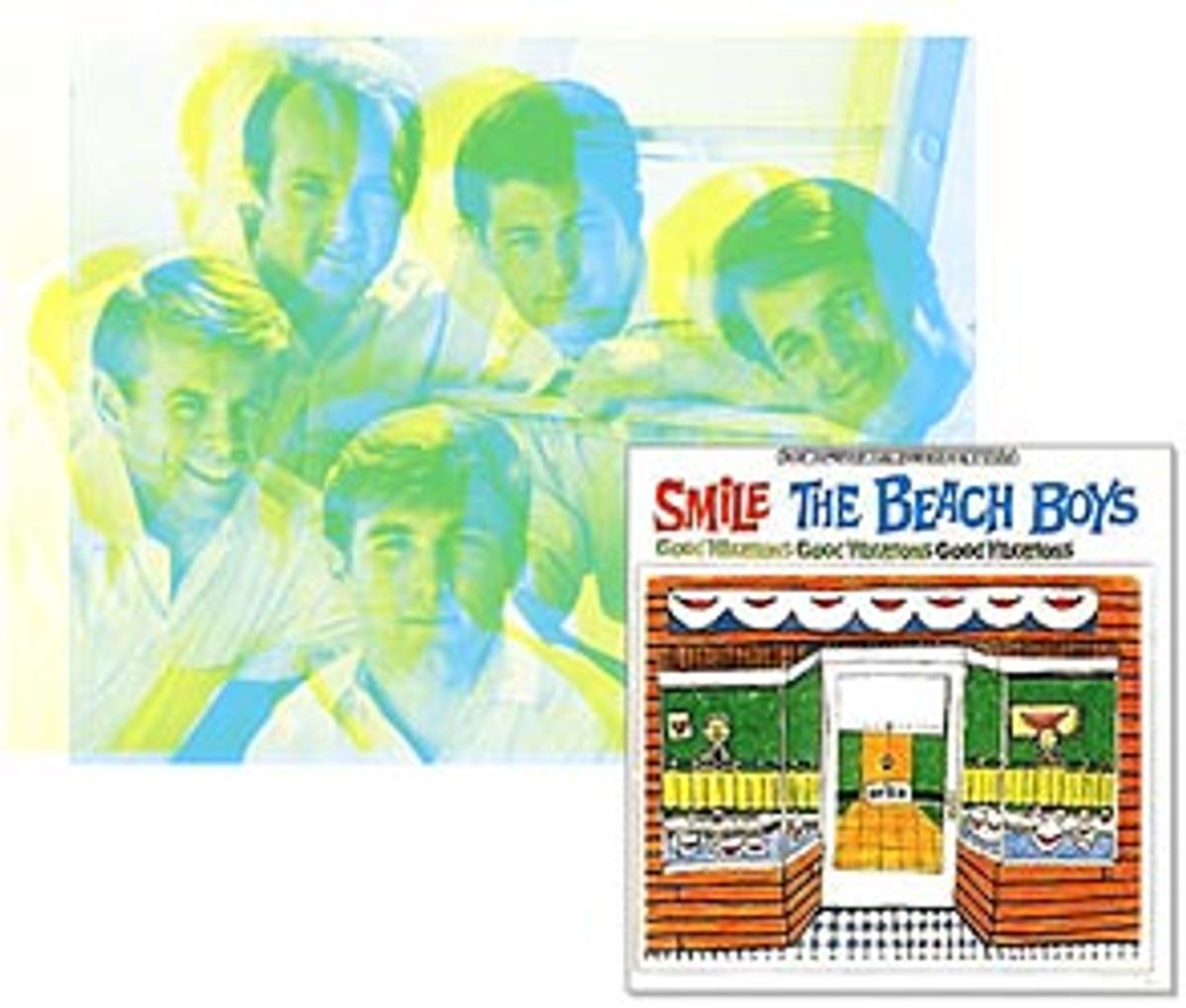
Last week, Brian Wilson performed the Beach Boys' unreleased album "Smile" for the first time. How did the 1966 concept LP become the stuff of myth, anyway?

  • more
    • All Share Services

Wouldn't it have been nice?

Had it been completed in 1966 as planned, “Smile,” the Beach Boys’ legendary unreleased album, would have begun with a song called “Prayer”: a minute and a half of wordlessly angelic brotherly harmony, pure and rising. The band’s leader, Brian Wilson, called “Smile” his “teenage symphony to God,” and despite the mess that his abandoned masterpiece became, there’s no mistaking “Prayer.” The song is an invocation. It must be the beginning, or it must not be at all.

According to “Look! Listen! Vibrate! Smile!” — Dominic Priore’s exhaustive sourcebook of clippings and “Smile” arcana — Wilson began tracking “Prayer” several days after beginning the “Smile” sessions in earnest in October 1966. Most of that summer had been devoted to the 18 studio dates that yielded the Beach Boys’ classic “Good Vibrations,” Wilson’s triumphant so-called pocket symphony, which — in turn — had followed the “Pet Sounds” LP, the ethereally tender response to the Beatles’ “Rubber Soul” that he had crafted in early 1966.

All in all, 1966 was a busy year for Wilson. By the end of it, however, “Prayer” wasn’t finished. It wouldn’t be until November 1968, when it was completed for a different Beach Boys album, “20/20.” And though Wilson promised Capitol Records that “Smile” would be ready for release on Jan. 1, 1967 — cover art was prepared and the label began a promotional campaign — it wasn’t finished by the end of that year, either. Nor, for that matter, by the end of that decade, the three that followed, or even the century.

Eventually, the “Smile” reels leaked, and over the years a network of Beach Boys geeks have traded reconstructed versions of the LP like Deadheads exchanging live tapes. Those fan versions, along with the many promises of “Smile’s” true completion — it was a stipulation of the band’s contract with Reprise Records in the early ’70s, and tracks were unearthed for a possible touch-up in the late ’80s — make it difficult to know what tense to describe the album in. The past (“Smile” contained several ambitious song-suites co-written with lyricist Van Dyke Parks…) is too etched in stone for an album never finished; the present (“Smile” is rock’s first concept album, pre-dating “Sgt. Pepper”…) too inaccurate. It is a poetic irony of grammar, then, that the only appropriate voice is the future perfect.

But now, “Smile” is taking a big step toward the present tense. Last Friday, in London, Wilson performed the album for the first time in front of a live audience. He will repeat the performance in a tour through Europe over the next few months and, in the fall, the United States. Wilson and the 18-piece band that backed him received a five-minute standing ovation after their London performance, but they are playing against history. Wilson’s voice is no longer what it once was, and the brotherly harmonies literally do not exist anymore. His brothers are dead (Dennis, via a drunken drowning in 1983; Carl, from cancer, in 1998) and Wilson is estranged from the other two founding Beach Boys (cousin Mike Love amid a snarl of songwriting legalities, and former neighborhood friend Alan Jardine in a lawsuit over remarks made in Wilson’s ghostwritten 1991 autobiography — “Wouldn’t It Be Nice?” — produced under the watch of Wilson’s then-Svengali psychiatrist Eugene Landy).

Then again, except for their vocals, the Beach Boys barely played on “Smile,” anyway. The later-named Wrecking Crew, a conglomeration of Hollywood’s best session musicians, including drummer Hal Blaine and bassist Carol Kaye, performed the music. Mike Love was especially opposed to the project, deriding Wilson’s “drug music” at every turn, urging Brian to stick with the successful girls ‘n’ cars formula. The wound of their leader’s seemingly abandoning them at their peak still festers — leaving the Beach Boys family in a deep decades-long feud of love, money, death and sex — and will make difficult any stand-alone release of the original sessions.

Internal band strife is only one explanation for why “Smile” never got made. Wilson’s struggles with addiction (to drugs, to food), the Beach Boys lawsuit against Capitol Records for back royalties, and their attempt to start to their own label and install a studio in Brian’s mansion also played a role. Somewhere, “Smile” got lost. That somewhere was probably inside the song “Heroes and Villains.”

“Heroes and Villains,” most likely, would have followed “Prayer.” Though it was eventually issued in shortened form as a follow-up single to “Good Vibrations,” the song began as something grander. Some versions of the story have it taking up 18 minutes and filling the projected LP’s entire first side. In every possible way, it was symbolic of the album’s successes and failures.

“Heroes and Villains” was one of several song umbrellas conceived by Wilson and Parks. Structurally, it was a surreal comic opera, with intertwining musical and lyrical themes that drew on American history and popular melody. Realistically, it was a collection of song fragments with repeating motifs, such as “Bicycle Rider,” whose “Bicycle rider see, see what you’ve done / To the church of the American Indian” chorus evoked Manifest Destiny and the blues number “C.C. Rider” in one trippy breath. As he did with “Good Vibrations,” Wilson wrote “Heroes and Villains” in sections, planning to assemble them later. He never did.

Lewis Shiner, in his novel “Glimpses,” about a time-traveling stereo repairman who can conjure the great lost rock albums by visiting their sessions, posits that Wilson had a moment of true inspiration with “Smile” and simply lingered too long in capturing it.

“Glimpses” is an exhilarating read, and absorbing oneself in books like Priore’s and Shiner’s is a good way to begin to understand what the album might have been. From there, a true “Smile” fanatic intent on unearthing the possibilities of the past might — in one obsessive burst — pour through the accumulated bootlegs, listen with Wilson and Parks’ concepts in mind, match melodies to ideas like an archaeologist reassembling a crumbled pediment, feed the remains into the computer, and chop and paste for hours, naming the different sections based on lyrics and scenes (“In the cantina…”) and jury-rigged classifications (“American pastoral”), until “Smile” eased its way back into existence.

“It was getting to me psychologically,” said Mark Spano, an audio engineer who put together his own “Smile.” “I started to feel very frustrated. And if I was getting down, I could only imagine what Brian must have felt.” Spano called on all his expertise to make his version of “Smile.” “Pitch correction, time compression, whatever it took, I had to do it, just to see if it could be done.”

Listening to the “Smile” sessions is a revelation. It’s startling to suddenly realize that one can actually hear Wilson at work in stunning stereo fidelity, the music warbling like a time machine in reentry as the reel-to-reel flutters on and off at the end of each segment. The sections flit by, melodic idea after melodic idea — cinematic fantasias, folk songs, barbershop vocal arrangements — Main Street USA rendering itself in vivid psychedelic color. “Smile” is the album you’d want with you while doing serious drugs at Disneyland. But who would want to do that? Nonetheless, “Smile” makes the prospect alluring.

Paul Williams, who — as a teenager — founded the pre-Rolling Stone rock magazine Crawdaddy and visited Wilson in Los Angeles over Christmas 1966, explains the genesis of the “Smile” myth, which he helped perpetuate in his magazine and his book “How Deep Is the Ocean?”: “I think that the basic enthusiasm of people like [writer] Richard Goldstein and me and others who heard parts of ‘Smile’ when it was being recorded [was over] the beauty of individual small pieces, movements, of music that Brian had executed in parts in the studio. [They were] breath-taking and inspiring.”

Williams, who went nearly 20 years between his initial encounter with “Smile” and his next hearing of the tapes, says he is “happy with … fragments that were not attempts to actually be an album sequence, though I totally empathize with and respect fans [who compile their own versions of the album]. It’s part of the game, like Mr. Potato Head: Here are the pieces, now make your own ‘Smile.’ It’s partly as though everybody’s given a few of the elements and then they’re told, ‘This was intended to be something great,’ and they naturally project what it could be based on their enthusiasm for what they’ve heard.”

They likely also project their notions of what a great album should be, fitting (and forcing) the “Smile” tracks over ideas of album flow that didn’t yet exist in 1966: what should be positioned where and how. If somebody thinks a great album should segue from track to track, with a quiet song at the end of Side 1, then — by golly — his “Smile” will segue from track to track with a quiet song at the end of Side 1 (probably “Wonderful”).

With file-trading protocols like BitTorrent making it easier to distribute new editions of “Smile” en masse, and technologies like Apple’s GarageBand making it easier to recombine them, one can easily imagine one’s own “Smile” being sent out into the world and finding its way back. It gives literal meaning to the fairly hokey quote Wilson added to the back cover of “Smiley Smile,” the half-assed album the Beach Boys put out instead of “Smile” in 1967 (“a bunt instead of a grand slam,” admitted Carl Wilson): “The Smile That You Send Out Returns to You.” “Smile,” then, is a reflection of what makes listeners happy, which is what Wilson intended to begin with.

But Wilson, who has in recent years been playing with the ’60s pop revivalists the Wondermints, has been reluctant to perform material from “Smile” himself. “He said it reminded him of a bad time and just didn’t want touch it,” says Wondermints multi-instrumentalist Probyn Gregory. “Finally, we started sneaking a few of the songs into the set, easing them in.”

Then, last fall, Gregory says, “Van Dyke Parks and Brian got together and finished up some of the fragments and added some things. They put some melodies to unfinished tracks, and words to some things that hadn’t had words put on them. And it all sounds like it’s a part of the piece, part of the period.”

Gregory is reserved about the prospects of making a definitive “Smile” record. “I was against the recording of ‘Pet Sounds Live!’ for the same reason,” he asserts. “No one will ever sound like the Beach Boys. We’re trying to be as faithful as possible, but please don’t compare us vocally to the Beach Boys, or to the Wrecking Crew, or to the sound of those microphones, or anything [Brian] did down at Western Recorders back in the old days.”

To the extent that battles can ever really rage between dorks lovingly obsessed with music recorded nearly 40 years ago, the battle over “Smile” does so. In addition to threads on discussion boards like the Smile Shop, Jeff Turrentine weighed in on Slate: “No band of touring musicians and singers, even one as talented as the group that backed up Wilson in 2000, will come close to capturing the magic that these kids from the ticky-tacky suburbs of Los Angeles were able to achieve in the studio [then]. To return to this now-mythic collection of songs is to gild the rarest, wildest lily in pop music. ‘Smile’ is dead; long live ‘Smile.’”

Paul Williams disagrees. “If you are not imprisoned by your own or other people’s expectations, [the old material] is just a jumping-off place for creative work,” he says. “Brian is, on the face of it, completely free of any of the pressure that could have been on him over the years regarding ‘Smile,’ because — just as for any other artist — when he’s doing something as a live show, he’s free to do with it whatever comes to him and whatever works for the show right now. Of course, in doing that, he also gets to discover what the music is for him right now, and that directs him towards the freedom to [possibly] make a record out of it.”

“Smile” and its story appeal to fans for many reasons. It is drama spread over nearly 40 years. The stakes are high: Somebody tried to achieve something momentous and didn’t. One fears “Smile” because he fears failing at his own life’s work. But that fear exists only for the same reason that “Smile” attracts him to begin with: Everything about it reeks of potential energy. One fantasizes of getting to the brink of achievement, but one is equally terrified of collapsing there, suddenly unable to do what had once been second nature. If people project notions of what a great album should be, then Brian Wilson becomes the avatar for it, one’s own fortunes lashed to his journey. It’s difficult not to root for him.

If “Smile” were to be released tomorrow, it would likely be a blip on the cultural radar. “Frankly,” Paul Williams says, “I’m not sure what impact ‘Sgt. Pepper’ would have if it were released today, just because contexts change. ‘Smile’ was a project that was sincerely and earnestly the next step in a body of work. It was specifically the next step in a sequence that we’d heard as ‘Pet Sounds’ and ‘Good Vibrations.’ I think that it’s inevitable that there will be a lot of good music in ‘Smile’ in whatever form it takes. Obviously, that doesn’t guarantee sales, but I think it’s just natural that it will be listened to respectfully by a lot of different people, most significantly musicians.”

Yo La Tengo‘s Ira Kaplan owns an edition on colored vinyl. “Man, it’s everything,” raves Will Cullen Hart, founding member of the Wilson-devotee collective the Elephant 6 Recording Company and current leader of the Circulatory System. “Conceptually, the musical stuff [is amazing], the idea of the sections, each of them being a colorful world within itself. [Wilson's] stuff could be so cinematic and then he could just drop down to a toy piano going plink, plink, plink and then, when you least expect it, it can just fly back into a million gorgeous vocals. Of course, you’ve got Van Dyke Parks’ lyrics…”

Williams observes, “It’s ironic that we’re talking about the [first] great album that never was at a time that the very form of the pop album is itself falling on hard times.” While this is certainly true, the return of the single has also brought the return of the producer, with musicians such as Timbaland and the Neptunes entering the spotlight. Wilson is a precursor to them just as much as to today’s indie rockers, working so successfully as he did (for a time) within the California scene’s studio system, employing every modern tool at his disposal.

Ultimately, “Smile” is a patriotic album. The Beach Boys were a patriotic band. But “Smile” oozes with a different kind of patriotism, calling on American nostalgia the same way the Beatles employed music hall on “Sgt. Pepper.” Despite celebrating an America that was great then and is, goshdarnit, great now, it points a ring-bejeweled finger toward a blissfully ethereal future with Uncle Sam as spirit guide. Profoundly uncynical, if “Smile” were to be released now with the attention it would have received in 1966, it might be deeply relevant as an album to rally behind for malcontent liberals accused of being America-haters for their beliefs.

Had it been completed in 1966 as planned, “Smile,” the Beach Boys’ legendary unreleased album, would have ended with a song titled “Surf’s Up.” It still might — preferably one that weds Brian’s 1966 transcendent solo vocal to backing tracks and an ending finished by Carl in 1971. The song crests gorgeously before swooping down to a lone Brian: “Surf’s up, mmmmhmmmhmmm, aboard a tidal wave…,” all the longing in the world — of an individual, of a member of a family, of an American — somehow evident in that middle “hmm.” And then the Beach Boys are singing, all of them, absorbing Brian’s lead in a levee-breaking swirl of harmony. If the opening to “Surfin’ USA” posited the United States as a coast-to-coast ocean, then the ending to “Surf’s Up” — and “Smile” — posits the wave that will make it so and pulls us out to sea with it.

Jesse Jarnow is a writer, artist and musician in Brooklyn, N.Y.

Trust me on this: David Bowie’s “Hunky Dory”

The Old 97's singer credits Bowie's brilliant "Hunky Dory" for rescuing his adolescence and inspiring his career

  • more
    • All Share Services

Trust me on this: David Bowie's (Credit: Benjamin Wheelock)
This is the second story in the Trust Me On This series, which runs through Father's Day. You can read the other entries here.

Dear Kiddos,

Hey, you turkeys. Listen up. I need you to listen for five minutes. I’m going to impart a little wisdom. You can take it or leave it. For what it’s worth, I’d rather you took it.

The advice is this: David Bowie’s “Hunky Dory” is a perfect album, and, since perfect albums are a rare commodity, it is worthy of deep and repeated listenings.

I’m listening to “Hunky Dory” as I write this. How many times have I listened to this, my favorite record? Like a million? And it never gets old.

I discovered “Hunky Dory” by accident. I was a sad, lonely little kid. Eleven years old and obsessed with Joan Jett, another artist I imagine you kids would enjoy. Back then, the radio was still a real thing that people listened to, believed in and learned from. I stayed up past my bedtime one Saturday night during the Christmas holiday to listen to a weekly show called “The King Biscuit Flower Hour” featuring a concert by my secret girlfriend, Joan Jett. At the end of the set, she played a cover of a song that would forever change the course of my budding musical tastes, “Rebel Rebel.” As it turned out, “Rebel Rebel” would never be one of my favorite Bowie tunes, but I could detect, within its lyric, a narrative voice to which I could relate. Like really relate.

I was a latchkey kid, a thing that no longer exists. Both of my parents worked, so every weekday after school, I had a few hours wherein I could do whatever the heck I wanted. What I usually wanted to do was go to Half Price Books & Records. The next Monday, released from the grim confines of Armstrong Elementary, I walked to Half Price where I found exactly one David Bowie album. I brought home “Hunky Dory,” marveling at its weird, androgynous cover. In those pre-Internet days, one was always left with questions. Is that David Bowie on the album cover? Is that person a guy or a lady? Is it a painting or some sort of artsy photo? Is this even rock ‘n’ roll, or is it some other kind of music, the name of which has been kept a secret from me?

It was just that, some other, new kind of music. New to me, anyway. This album, recorded when I had been less than a year old, opened doors for me. And I thought I caught a glimpse of my own future. My family’s house on Gillon Avenue was empty when the needle dropped on Side A. “Changes,” turned up to top volume, was my anthem from the first line of the first verse. “Still don’t know what I was waiting for,” indeed. This was what I had been waiting for. Putting up with all the cruel dullards in my grade school, all the teachers and coaches, all the stupid kids and mean adults, had been almost unbearable. Suddenly, I wasn’t alone.

“Hunky Dory” is not a kids’ record, but there is certainly a preponderance of imagery relating to childhood. “Changes” speaks of “these children that you spit on.” “Oh You Pretty Things” has the song’s object driving his “mama and papa insane.” In “Kooks,” the singer begs his own kid to stay, reassuring the lucky little guy that “we believe in you.” At the time, I needed to hear that sentiment.  I went back to it over and over again throughout the difficult years of adolescence. David Bowie was not my dad, but he was there in a pinch.

As the album goes on, it gets weirder. And deeper. And darker. “Quicksand” offers up an epic take on the human experience, turning on a phrase that would echo dangerously throughout those most perilous years of my youth, “knowledge comes with death’s release.” I didn’t understand, but I did understand, if you catch my drift. These were meditations on the difficulty of everyday life, and the insane nature of our very existence. Heavy, beautiful stuff.

Antidotes appear in the record’s latter portion. “Happiness is happening/dragons have been bled … fear’s just in your head,” Bowie proclaims in the goofy-but-right-on “Fill Your Heart.” Then he proceeds to introduce the listener to Andy Warhol and Bob Dylan. And then comes “Queen Bitch,” wherein we meet Bowie’s longtime foil, the most underrated guitarist in rock history, Mick Ronson. The riff in “Queen Bitch” hints at what is to come on Bowie’s next LP, “The Rise and Fall of Ziggy Stardust and the Spiders From Mars,” Bowie’s breakthrough album, but “Hunky Dory” is still pre-fame Bowie at his folkie best.

Finally, he leaves us with the epic poem that is “Bewlay Brothers.” As an 11-year-old, I played it repeatedly in an attempt to decipher this song’s meaning. I wrote out the lyrics in my journal, hoping to make sense of them. To no avail. I did know that something had gone horribly wrong, there was madness and sadness, and then the record was over. Just like that.

Again and again, I listened. Memorized. Marveled. Sang along. When I could take it no longer, I found a guitar teacher and learned how to do these things myself. Well, not exactly these things, but my own version thereof. My early songs were such a pale imitation of early-’70s Bowie, that I could have been sued — had anyone ever heard my early songs. It’s quite possible that I spent the whole of my teenage years singing with an English accent. As they say, mistakes were made.

I never got over Bowie. Especially “Hunky Dory.” Many of his other records have remained favorites: “Low,” “Ziggy Stardust,” “Station to Station.” But “Hunky Dory” was my first love. I caught a lot of grief for my borderline-obsessive Bowie fandom. Kids at school used it as ammunition in their attacks on my masculinity. Did I care? Sure. Did I care enough to throw Bowie under the bus and pretend to withdraw my admiration for this artist who set me on the path I knew I was destined to follow? Hell no. David Bowie was and is my hero.

Listen, kids: I want you to hear “Hunky Dory” because I think you will love it. Like I said, it’s a perfect record, and how often do those come along? But the real reason I want you to listen to “Hunky Dory” is because, in its 11 tracks, you will find the clues that will lead you to an understanding of me, your dad. You’ll see signposts pointing the way to the path I chose in life.

Making music for a living isn’t easy. Many things about it are tough as hell: The touring and its requisite absences; the self-absorption; the occasional financial insecurity; the mood swings one attributes to the “artistic personality.” This life, however, is what I was made for. This calling is the only one I’ve ever known. I’m not curing cancer or solving the global hunger crisis. I’m making music. But there is a certain hazy nobility in that vocation. Somewhere, an 11-year-old kid may be putting on an album of mine and discovering that the universe isn’t a meaningless jumble of coincidences, that there is purpose to be found in these three-minute constructions of music and lyrics. Some small but elegant meaning.

Heck, before you guys came along, that was all I had. The great thing is that now I have everything.

Continue Reading Close

Rhett Miller is the lead singer of the Old 97s. His latest solo album, "The Dreamer," will be released on June 5.

Illustrating the ’60s music revolution

How one book captured the spirit and art of the cultural transformation -- as it was happening

  • more
    • All Share Services

Illustrating the '60s music revolution
This article originally appeared on Imprint.

Imprint“When did music become so important?” That’s Don Draper from last week’s “Mad Men,” set in 1966. Later in the episode he turns off “Tomorrow Never Knows,” from the Beatles album “Revolver,” and walks out of the room.

art: Rick Griffin

There’s something happening here, but you don’t know what it is — do you, Mr. Draper? One year later, Rolling Stone magazine will make its debut, followed soon by “Rock and Other Four Letter Words.”

“Rock,” a 250-plus-page Bantam paperback, was published in January 1968 and subtitled “Music of the Electric Generation.” It was one of the first books of its kind, chronicling a cultural revolution that was still in the midst of its own creation. Crammed with black-and-white portraits of bands and musicians, it’s part oral history, part visual LSD trip. One of its fold-out spreads has an intricate, circuitlike diagram that connects over a hundred names, from the Butterfield Blues Band, the Beach Boys, and the Byrds to Busby Berkeley, Brubeck and Bach.

The editor-designer was a writer named J Marks. The photographer for most of the images was Linda Eastman, who went on to work for Rolling Stone and — oh, yes — marry Paul McCartney.

By the sheer force of its graphic presentation, ”Rock and Other Four Letter Words” conveys the mid-1960s music scene’s spirit, vitality and relevance.


Continue Reading Close

Protest music’s odd conservative turn

A 100-track, four-CD Occupy collection assembles generations of icons. So why does it sound shapeless and safe?

  • more
    • All Share Services

Protest music's odd conservative turn

“In this hour of the ever-changing season, may our tears not douse the fire in our hearts.”

That’s a guy named Michael Pless singing “Something’s Got to Give.” Even without hearing the song, you can surely imagine the essential elements: Plaintive acoustic strumming, an earnest vocal, and an air of polite outrage to match the stilted syntax and hoary platitudes. Welcome to “Occupy This Album,” the collection of protest-minded songs released by Occupy Wall Street. Sprawling across four CDs and a slew of bonus digital tracks, this behemoth set includes 100 (why not 99?) new and previously released tracks from artists representing a range of generations, genres, backgrounds, settings, and styles. Folkies join hands with rappers; ominous post-rock marches alongside peppy radio pop. There’s spoken-word poetry, tribal percussion, earnest singer-songwriter fare. Even a bit of jazz.

Especially with Occupy reaching a crossroads in summer 2012 — a time when it needs to reassess its ideals, its accomplishments, its methods and its artifacts — “Occupy This Album” plays like a state-of-the-field survey of the protest song. From Jeff Mangum covering the Minutemen to the anonymous drum circles that soundtracked the demonstrations in real time, music has been a constant presence in the movement, although it’s not quite clear what role it has played. The new album portrays a movement with a broad scope and an admirably varied constituency, but the same criticisms that have been leveled against Occupy can also be applied to “Occupy This Album:” There is general unease but no clear direction forward. There is outrage but no plan. There is deep feeling but no clear message.

Ostensibly, there should be something on “Occupy This Album” for everyone to love, but that also means there is more than enough here for everyone to hate. It’s an unwieldy tracklist, almost daring you play it front to back. Of course, it’s pointless to review a 100-track release the same way you would approach a studio album, where functionality and some sense of logical progression are crucial. But there’s no consistent development of political or musical ideas weaving these songs together, nothing to link them or to justify this particular sequencing. As a result, “Occupy This Album” cannot make a statement as an album. In one sense, this release mirrors the leaderless ethos of the movement, which stridently preserves the democracy of the demonstrations. While that idea has certainly energized the Occupy protest, it makes for an amorphous blob of music and a messy, often frustrating listening experience.

But they mean well, right? It’s a charity album after all, with each disc sold separately and with all proceeds benefiting Occupy directly. You’d probably be better off contributing directly to the cause and just making your own mix of politically minded music. You might even have some of these songs in your iTunes already, although why you’d want to include Lucinda Williams’ drippy “Blessed” or Mogwai’s interchangeable “Earth Division” is beyond me.

The music that actually is new — that purports to find direct inspiration in either the righteousness of the demonstrators or the plight of the 99 percent — is generally unimaginative, hokey, disappointingly safe. Most of these artists address these economic issues either through narrative or through high-minded rhetoric. The latter produces the most lackluster results: Jackson Browne’s “Which Side Are You On?” which he has been touting for several months now, turns out to be political white noise, a gentle fist bump to the like-minded that barely puts across either side of the debate. At least it’s better than My Pet Dragon’s epiphany on “Love Anthem”: “Only love can save us now.” To their credit, they sing it like they might actually believe it.

The storytellers have more success, if only because they’re willing to entertain a bit more grit, a bit less blind hope. Featuring Joan Baez and Steve Earle, James McMurtry’s “We Can’t Make It Here” sounds downright curmudgeonly as it surveys the state of the working class in an economy that regularly sends its manufacturing jobs overseas. The song, however, goes a bit overboard when the trio decry litterbugs and graffiti artists.

One of the true standouts among these 100 tracks is Richard Barone’s ditty “Can I Sleep on Your Futon?” about a veteran-turned-singer who couch-surfs from one generous soul to the next. The verses are specific and soulful, as through he’s derived them explicitly from lived experience, and in that regard, the song could function as commentary on the music biz. But Barone stumbles over that massively awkward chorus, “Can I sleep on your futon?” It’s hard to imagine a crowd of protesters singing along.

If there is one overarching theme here, it is, vaguely, “history.” The past informs and even defines this music. Even the very idea of this type of compilations seems like a throwback to the CD’s heyday in the 1990s, when seemingly every charity, from NARAL to the Red Hot Organization, had its own release. It’s an impression reinforced by much of the music, especially hip-hop tracks by Born I Music and George Martinez & the Global Block Collective, whose lyrics and beats sound like they were scavenged from 1994. (For a better example of how hip-hop can address political themes, check out Killer Mike’s new track “Reagan.”)

Of course, there is a lot of folk music on “Occupy This Album.” That style has proved one of the most politicized musical forms of the 20th century, as lefties in the 1930s and 1940s adopted labor songs as battle cries. Clean-scrubbed, buttoned-up folkies like the Kingston Trio had some chart success in the 1950s, but they were quickly rendered obsolete by the Village bohemians reimagining the music as a vehicle for countercultural sentiments. That’s the model so many Occupyers are reverently appropriating, never suspecting that it might not be a natural fit for 21st-century dissent. The folk revivalists of the 1960s drew from the past as well, but took pains to update the music to the times: The mere fact that Dylan wrote new songs in this old style was revolutionary, alienating an older generation of folkie purists.

“Occupy This Album” obviously represents a counterculture, but too many of the artists are too caught up in role playing the past, which seems like an especially boomer enterprise. Michael Moore (yes, that Michael Moore) performs the most chipper version of “The Times They Are A-Changin’” imaginable, one that seems wholly unaware of the gritty realities of 2012, much less of 1964. (The less said about his skiffle version of the song, a hidden track on disc four, the better.) Perhaps the one artist who understands how to plumb history for present-day relevance is Loudon Wainwright III, whose wry “The Panic Is On” updates an 80-year-old tune originally penned by Hezekiah Jenkins (the cover originally appeared on Wainwright’s album “Ten Songs for the New Depression”). It’s an unusual artifact from the early 1930s, but there’s a sneaky observation about class disparity that sounds more disgusted and potent than anything else on the album.

Perhaps the worst thing that can be said about “Occupy This Album” is that the music is deeply conservative. There are so few moments that grab your attention or make you see the world differently. When Occupy already seems to be in danger of losing momentum, it’s hard to say whether the movement has failed to inspire these artists or the artists have failed to document the movement.

Continue Reading Close

Donna Summer: Disco diva and rocker

If you only knew the singing sensation by her 1970s smashes, you barely knew her at all

  • more
    • All Share Services

Donna Summer: Disco diva and rocker

There is so much about Donna Summer that we didn’t know… and not just the cancer that took her life. Let’s start with her relationship to rock. Summer is quite understandably known as a disco singer, and quite rightly so. It was disco that made her, and she, as perhaps disco’s highest profile performer, who helped to shape the genre. But like a number of other disco artists — Nile Rodgers and Bernard Edwards of Chic, the vocal trio Labelle and Chaka Khan all come to mind — Donna Summer was also a rocker. Yes, she grew up singing gospel, but she began her professional career as a ’60s rocker. She would describe this as her Janis Joplin phase, and she did indeed sing in a group that performed at the Psychedelic Supermarket — Boston’s version of Bill Graham’s Fillmore. She then went on to play a hippie in the Munich production of the rock musical “Hair,” and sported an enormous Afro inspired in large part by her hero, the black radical activist, Angela Davis. Although the disco music that she made with producers Giorgio Moroder and Pete Bellotte, and engineer Harold Faltermeyer provoked a fierce backlash from some aficionados of rock, this was a foursome that, as critic Dave Mash pointed out, functioned as a rock band, one in which Summer played a pivotal role as singer and songwriter. And then there is her singing. Listen to her hit “Hot Stuff,” and tell me that Summer could not sing rock.

Summer, who was strikingly beautiful, made some very steamy — some would say X-rated — music, most memorably with her first hit, 1975’s “Love to Love You Baby.” With Summer’s groans, moans and gasps powering the track, it broke new ground in its sexual explicitness. Promoted by her record company in explicitly sexual terms, and giving performances that made Tina Turner’s look tame, Summer soon found herself tagged the “Linda Lovelace of pop music.” She had seen this coming. In fact, she had not wanted to be the singer on that track, and agreed only to record the demo, and only then in a blackened studio where she sang, imagining that she was Marilyn Monroe giving herself over to orgasmic ecstasy. After producer Moroder convinced her to let him use her vocal, her record label president, seeing its bedroom potential, demanded a long-playing version that left the media debating whether the singer came 22 or 23 times. Rock critic Robert Christgau poked fun at the record with a review that consisted of three questions, “Did you come yet? Huh? Did you come yet?” Other reviews were more disparaging. But “Love to Love You Baby,” like much of her music, put female desire front and center in a way that it wasn’t in most rock music. Indeed, Summer’s music is inseparable from second-wave feminism’s emphasis on women’s sexual empowerment.

There is so much to say about Summer, who could have been a full-fledged personality had she not been pigeon-holed and dismissed as a disco tart. I was once on a radio program with her and, believe me, she was nobody’s fool. She described the “star-making machinery” as well as anyone. After she had already became famous she told Rolling Stone that her career sometimes felt like “this monstrous, monstrous force, this whole production of people and props that you’re responsible for, by audiences and everything that rules you until you take it upon yourself to be a machine… And at some point a machine breaks down.” Fame, she observed, diminished her, making her feel like nothing so much as a “commodity.” After falling into a debilitating depression and attempting suicide, she took control of her life again through Christianity.

In a way, I think one hears Summer confront her own commodification on her marvelous record “Bad Girls.” Although the music in the final, released version suggests otherwise, Summer isn’t celebrating prostitution on “Bad Girls.” Rather, she is confronting what she shares with those streetwalkers. “Now, you and me are just the same,” she sings.  And if Summer sounds unusually exuberant as she yells out to a john, “Hey, mista, have you got a dime?” perhaps it’s because Summer understood what it meant to be made into a commodity and reduced to a seductive whisper. Tellingly, in a television interview some years later, Summer noted that “Bad Girls” marked the moment when she stopped being an object and became a subject. Let’s hope that in her death she inspires more writing that fully acknowledges the intelligent subjecthood of this disco diva and kick-ass rock and roller.

Continue Reading Close

Alice Echols, a professor of English, and the Barbra Streisand Chair of Contemporary Gender Studies at the University of Southern California, is the author of four books, including "“Hot Stuff: Disco and the Remaking of American Culture."

Donna Summer, Queen of Disco, dies at 63

The "Last Dance" singer passed away after a battle with cancer

  • more
    • All Share Services

Donna Summer, Queen of Disco, dies at 63

NEW YORK (AP) — Disco queen Donna Summer, whose pulsing anthems such as “Last Dance,” ”Love to Love You Baby” and “Bad Girls” became the soundtrack for a glittery age of sex, drugs, dance and flashy clothes, has died. She was 63.

Her family released a statement Thursday saying Summer died and that they “are at peace celebrating her extraordinary life and her continue legacy.”

Summer gained prominence during the disco era of the 1970s, and released a number of albums that have reach gold or platinum status, including the multiplatinum “Bad Girls” and “On the Radio, Volume I & II.” Her No. 1 Billboard Hot 100 hits include “Hot Stuff” and “MacArthur Park.”

Her sound was a mix of genres, and helped her earn Grammy Awards in the dance, rock, R&B and inspirational categories.

She released her last album, “Crayons,” in 2008. She also performed on “American Idol” that year with its top female contestants.

Page 1 of 284 in Music