Dirty Dancing

“Dirty Dancing: Havana Nights”

Hot stars notwithstanding, you won't have the time of your life at this thin, overedited take on the '80s classic.

  • more
    • All Share Services

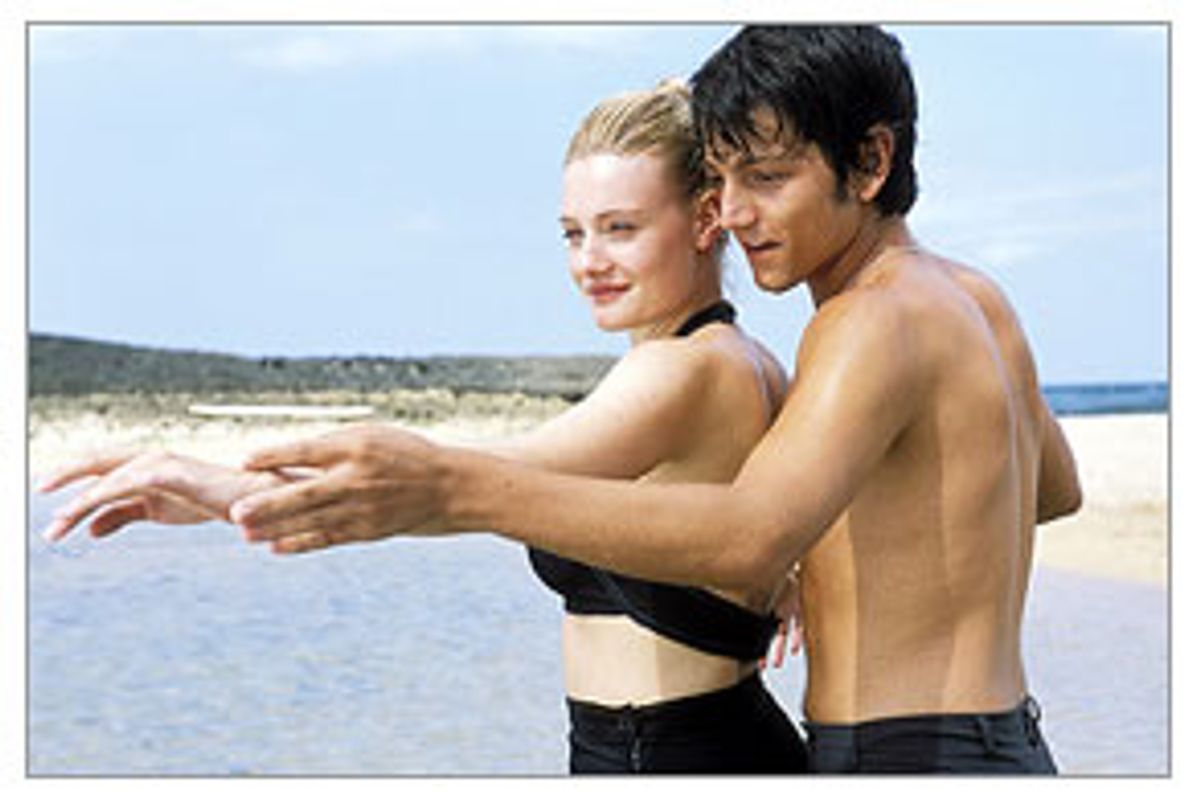
If you go to “Dirty Dancing: Havana Nights” to enjoy the sexiness of the two young leads, Romola Garai and Diego Luna, you’re not likely to be disappointed.

In last year’s charming and overlooked film version of “I Capture the Castle,” Garai gave a subtle performance as a young girl coming to terms with what used to be called her “womanly desires.” You could see the transformation in the change of her carriage over the course of the movie, from slightly hunched-over to a self-assured upright bearing. Here, as the American daughter of a Ford executive relocated to Havana in the fall of 1958 (right before the revolution that drove Batista out of the country and put Castro in power), she gets to enact another young woman’s sexual blossoming.

Garai’s Katey is a bookworm (it’s always the bookworms who effect the ripest transformation) who falls for Javier (Luna, one of the stars of “Y Tu Mamá También”) a busboy at the luxury hotel where she and her family live. As in the first “Dirty Dancing,” the change comes from dance. Javier teaches her Latin dancing and his exhortations to “feel the music” become the means out of her cocoon.

One of the reasons this pair is so charming together is that Garai looks physically imposing next to the puppyish Luna. Her figure isn’t “womanly” or any of those other polite metaphors for big, but she’s no sylph either, and she’s got an inch or two of height on her costar. Garai has curves and when the movie gets her out of her cardigans and school uniform and into snug strapless dresses, she looks fantastic.

The movie, perhaps with its eye on the PG-13 rating, is unnecessarily coy about Katey and Javier’s lovemaking, but there’s a nice chemistry between Garai and Luna nonetheless — the kind tinged with the adolescent flush of our first taste of sex. Garai’s line readings rise and fall on the quality of the lines, which at best are adequate, but she’s an engaging presence, and Luna, with his sideways smile and slightly sleepy eyes, charms by underplaying — Javier is happy just to drink Katey in, and you can’t blame him.

Garai and Luna carry “Dirty Dancing: Havana Nights” on their shoulders, and they have to, because in almost every other way, it’s a slipshod piece of work. As with the original, the story is essentially about a good girl who falls for a boy considered her social inferior though who, in fact, is much more a gentleman than the well-brought-up boys she’s supposed to be dating. (The American boy Katey briefly dates, played by Jonathan Jackson, is the type of preppy noodle who looks like his spine has been replaced with seersucker, and his arms by an octopus’ tentacles. He’s blobby and persistent.)

The screenwriters, Boaz Yakin and Victoria Arch, avoid what was worst about the first “Dirty Dancing.” In that movie, Jennifer Grey’s Baby was screenwriter Eleanor Bergstein’s idealized view of her own teenage self, and the picture turned into a princess fantasy in which Baby had to be proved smarter than everyone else around her. (That’s what the movie was enjoyable in spite of.)

Yakin and Arch (those names look like a law firm that advertises on late-night TV) have avoided making Katey the font of all wisdom. But they’ve also avoided coming up with a plot that’s more than a series of flashcards, or writing scenes that go on long enough for the characters to develop. We find out everything we need to know about the characters the first time we see them. Katey’s relationship with her younger sister (Mika Boorem) barely exists — so we don’t know what they’re upset about when there’s a rift between them.

The back story in “Dirty Dancing: Havana Nights” is the past of Katey’s parents, played by Sela Ward and John Slattery, champion ballroom dancers who gave up competing for a settled-down, upper-middle-class life. Katey’s mother resents having given it up, and that’s part of what she objects to when her daughter takes up with Javier. The resentment mothers feel at their daughters for taking the chances they never did is not one you’d expect to see explored in a pop movie. But as written, Ward is just the uptight villain.

Then, given her rigid performance, you can’t imagine Sela Ward being anything else. Ward is waxy here in the manner of Joan Crawford and Lana Turner in their later matron roles, and her eyebrows appear to have come from a dissected tarantula. The actress plays the whole movie with such a smug, superior look on her face that I kept hoping a band of Castro’s rebels would drag her off and hold her for ransom. You can’t understand why anybody in her family puts up with her, though it may be partially explained by the fact that the role of the good sport has come to be John Slattery’s specialty (he fulfills the same function in “Mona Lisa Smile”). An affable actor, Slattery deserves better.

The plot construction here is especially lazy. The whole movie is built toward the dance competition that Katey and Javier enter. The movie gets to it, only to toss the whole climax away with the advent of the revolution. “Dirty Dancing: Havana Nights” tiptoes around the politics involved. It’s an honorable choice on the screenwriters’ part to have Javier say he wants to stay in hopes that the revolution will improve life for him and his family. That’s what a Cuban in his position would likely have felt at the time, and it would have violated the character to have had him speak with hindsight about what Castro’s revolution became. But not wanting to look like they approve of Castro, the screenwriters make Javier’s brother, who actively supports the revolution, the equivalent of Batista’s thugs — and that’s a convenient way out.

The movie might have withstood all this if the director, Guy Ferland, had just allowed us to bask in the dancing. But the dance sequences, choreographed by JoAnn Jensen, have been edited, by Scott Richter and Luis Colina, with no sense of allowing us to actually watch the dancers. The first time Katey goes into a Cuban club, the mass of sweaty, grinding dancers filling the screen suggests the teeming liveliness of a Romare Bearden canvas, and it’s just about the only time we’re allowed to look at dancers and see their whole bodies. The dance sequences look as if they’d been edited in the chop shop where Javier’s brother takes apart stolen cars. There’s no sense of either the rhythms of the dancers’ bodies or the rhythm of performance. It’s just cut, cut, cut. And, probably in the studio’s hopes of selling the soundtrack, Latin music that would have been appropriate to the period has been replaced by contemporary Latin sounds that throw you right off the movie’s setting. (It’s a safe bet that nightclub performers in 1958 Havana didn’t exhort the crowd to “Represent!”)

The original “Dirty Dancing” was no model of film craftsmanship, but it was a hugely enjoyable pop fantasy that at least took the time to flesh out its story and to allow us the pleasure of watching the dancers (maybe because the director, Emile Ardolino, had worked in the theater). Next to “Dirty Dancing: Havana Nights,” the first picture is like something out of the golden age of Hollywood. About six months ago I saw the trailer for this movie and it looked like such a lush, romantic daydream I couldn’t wait to see it. Having sat through it, I still feel I’m waiting to see it, after having sat through a much longer trailer.

Charles Taylor is a columnist for the Newark Star-Ledger.

Dirty Dancing: The Corner’ingation of Baby

"Dirty Dancing" -- the newly released silent version.

  • more
    • All Share Services

This latest from Team Tiger Awesome is a bit of a stretch from their A.C. Slater obsessions. But we enjoyed watching it a lot. Dare I say it, but I think we might’ve had the time of our lives.

Seinfeld considers crawling back

Another season isn't out of the question; Dylan's made a stone saint. Plus: Crudup and Pitt to be Coppola's Beat boys, and Danny Bonaduce wrecks his boat and hits his head!

  • more
    • All Share Services

The return of “Seinfeld”?

Well, possibly not for a while, but Jerry Seinfeld says reviving the four whiniest characters in TV history is not completely out of the question.

“That’ll be a possibility once all four [of our] careers are definitely in the toilet,” Seinfeld tells TV Guide.

And while some of his erstwhile costars have been doing their parts to make old Jerry a man of his word, Seinfeld himself says he’s been kicking back and enjoying his own reruns.

Since the show went off the air, he says, “I’ve gotten to watch the show myself a little bit, which I never did during the nine years … In fact, when people come up to me now and say, ‘You know, I never saw your show when it was on, but I’m really getting into the reruns,’ I always say, ‘Yeah, me too.’”

I’m sure there’s a “master of his own domain” joke in there somewhere …

- – - – - – - – - – - -

No business like monkey business

“It’s flattering to be asked to be a chimp, because you know they haven’t cast you for what you look like.”

Helena Bonham Carter, looking on the bright side of her simian turn in “The Planet of the Apes,” in Premiere.

- – - – - – - – - – - -

St. Dylan?

How many roads must a man walk down before he gets immortalized as an angel atop a famous Norwegian cathedral?

The answer to that question is still blowing in the wind, but one art-world mystery has just been cleared up. Kristofer Leirdal, the sculptor who carved the statue of St. Michael atop Norway’s 12th century Trondheim cathedral, has confirmed that he based the winged saint’s face on Bob Dylan’s when he carved it back in 1969, something many had suspected all along.

“It’s true that I was inspired by Bob Dylan and his features when I made St. Michael,” Leirdal recently told the press. “I saw that singer as a representative of American opposition to the Vietnam War. I thought it was appropriate to have a great poet on top of the tower.”

Dylan is said to be “honored” by the tribute.

Grandma Zimmerman, currently spinning in her grave, could not be reached for comment.

- – - – - – - – - – - -

Takes one to know one

“You’re one mean lady.”

Anne Robinson on how Mike Tyson recently greeted her at a ballgame.

- – - – - – - – - – - -

Juicy bits

They had the time of their life … and now they’re bringing “Dirty Dancing” to Broadway. Or at least that’s apparently the intention of the 1987 film’s screenwriter, Elizabeth Bergstein. According to Playbill Online, Bergstein has adapted the script into a stage musical and will begin workshopping it in August and September. It’s still not clear when it will hit the Great White Way, but if Bergstein has her way, this show will be bigger than Jennifer Grey’s old nose.

Speaking of adapting something with a beat … Francis Ford Coppola is all set to produce a film based on Jack Kerouac’s “On the Road.” According to Variety, Billy Crudup is slated to play Kerouac, while Brad Pitt will take on the Neal Cassady role, Dean Moriarty. Mr. “Batman” Joel Schumacher will direct. On the road in the Batmobile? Now that I’d like to see, man.

Maybe he should have taken the bus. Former “Partridge Family” star and current radio talker Danny Bonaduce is recovering from a boating accident on Wednesday evening. According to the Associated Press, the accident happened on Bonaduce’s luxury boat, “Bonaduce,” in shallow waters near Venice, Calif. And while the actor suffered only a minor head injury, damage to his boat was estimated at $10,000. Whoa, that guy’s got one tough noggin.

Cover your ears, Justin. Male model Bryce Durand, who steams up TV screens with Britney Spears in her video “Don’t Let Me Be the Last to Know,” is holding forth on your girlfriend’s face-sucking prowess. “She’s a really good kisser,” Durand tells Bop magazine. “I always felt she was very relaxed.” Easy, boy.

- – - – - – - – - – - -

Miss something? Read yesterday’s Nothing Personal.

Continue Reading Close

Blue Glow

Salon's TV picks for Labor Day Weekend, Sept. 1-4, 2000

  • more
    • All Share Services

Series

On Making the Band (9:30 p.m. Fri., ABC), O-Town heads to Cancun to chill out, but one of the boys comes home with a broken heart. Backstory (5:30 p.m. ET/9 PT, Sat., American Movie Classics) looks at the making of the WWII epic “The Longest Day.” The movie follows. The updated The Outer Limits (8 p.m. Sun., Showtime) ends its run with a 90-minute finale featuring a liberal’s most terrifying nightmare: Supreme Court Justice Charlton Heston. E! True Hollywood Story (9 p.m. Sun., E!) does some dirty dissing about the making of “Dirty Dancing.” Moesha (8 p.m. Mon., UPN) opens its sixth season. With the future of UPN up in the air, black sitcoms may soon be homeless. As Chris Rock said on his recent season opener, “we could go from ‘Moesha’ to ‘no-esha’.” Biography (8 p.m. Mon., A&E) kicks off “Batman Week” with a new episode titled (no kidding) “Adam West: Behind the Cowl.”

Specials

Former “Talk Soup” guy John Henson hosts The Television Show (10 p.m. Sat., ABC), a special/pilot that spotlights weird bits and bloopers from TV around the world. Quentin Tarantino’s 1997 crime drama Jackie Brown (8 p.m. Sun., FX) restored Pam Grier to much-deserved leading lady status. Robert DeNiro, Samuel L. Jackson and Robert Forster costar in this adaptation of Elmore Leonard’s “Rum Punch.” Great soundtrack. Nathan Lane plays tour guide for a trip along Venice’s Grand Canal on the latest installment of Great Streets (9 p.m. Sun., PBS, check local times). It’s Labor Day and you know what that means: Jerry! The 35th annual Jerry Lewis Telethon (Sun. and Mon., check local times and stations) does its thing to benefit muscular dystrophy. The incomparable Jerry — his hair is now so brilliantined, it looks like a black plastic wig — and Ed McMahon host. Why spend the traditional end of summer outdoors when you can draw the curtains and go on a TV binge? There’s a 10-hour ER marathon (beginning 9 a.m. Mon., TNT) and a four-hour Facts of Life marathon (beginning 8:30 p.m. Mon., Nickelodeon). The two-hour documentary Child Stars: Their Story (9 p.m. Mon., A&E) gives everyone from Jackie Cooper to Patty Duke to Fred Savage to Malcolm-Jamal Warner (and probably a couple of “Facts of Life” girls as well) the chance to vent about their traumatic experiences as the idols of millions.

Sports

Baseball:
Braves at Astros (8 p.m. Fri., Sat., TBS)
Mariners at Red Sox or regional action (1 p.m. Sat., Fox)
Cubs at Giants (4 p.m. Sat., Fox)
Expos at Reds (10 p.m. Sat., FX)
Mariners at Red Sox (1 p.m. Mon., ESPN)
Mets at Reds (1 p.m. Mon., ESPN2)
Yankees at Royals (8 p.m. Mon., ESPN2)
Pirates at Dodgers (9 p.m. Mon., ESPN)

Football:
Ravens at Steelers, Colts at Chiefs or Jaguars at Browns (1 p.m. Sun., CBS)
Cardinals at Giants, Panthers at Redskins, Buccaneers at Patriots or 49ers at Falcons (1 p.m. Sun., Fox)
Eagles at Cowboys (3 p.m. Sun., Fox)
Jets at Packers, Chargers at Raiders or Seahawks at Dolphins (4 p.m. Sun., CBS)
Titans at Bills (8:30 p.m. Sun., ESPN)
Broncos at Rams (9 p.m. Mon., ABC)

Friday Talk

Rosie O’Donnell (syndicated) Stone Phillips (rerun)
David Letterman (CBS) D.L. Hughley
Chris Rock (HBO) “Divorce Court” host
Jay Leno (NBC) Tom Cruise, Tracey Ullman (rerun)
Conan O’Brien (NBC) Nathan Lane, Rachel Dratch (rerun)
Craig Kilborn (CBS) Marlon and Shawn Wayans (rerun)

Continue Reading Close

Joyce Millman is a writer living in the Bay Area.

Queen Amilambada

"Dirty Dancing, the franchise." And, yes, fries do come with that shake.

  • more
    • All Share Services

Thought “Dirty Dancing” was as much a thing of the past as Jennifer Grey’s old nose? Think again.

Last week, at the Cannes Film Festival, Artisan Entertainment and Miramax Films announced plans to make “Dirty Dancing 2,” a sequel to the 1987 flick that had us all humming “(I’ve Had) The Time of My Life” for way too long.

But don’t expect a nostalgic trip back to the Catskills, circa 1963. Oh no. This time the action will take place in present-day South Beach and be spiked with a Latin Miami twist.

According to Variety, Ricky Martin and Natalie Portman are in talks to reprise Patrick Swayze and Grey’s twinkle-toed roles. It’s also rumored that Swayze will make a cameo appearance.

So why the Forbidden Dance? Why now? “‘Dirty Dancing’ is a cultural touchstone and a phenomenal franchise property,” opined Miramax co-chairman Harvey Weinstein.

Just so long as the Lambada doesn’t make a comeback.

- – - – - – - – - – - -

Holy Father

“He thinks this makes him God.”

Jeremy Sisto on why his father’s tickled to bits that he landed the role of Jesus in a CBS miniseries.

- – - – - – - – - – - -

When the cat’s away 

Speaking of proud papas … Does Michael Eisner know what his son’s mouse is up to?

According to The Hollywood Reporter, the Disney CEO’s son Eric Eisner is launching Romp.com, a raunchy Web site featuring photos of scantily clad babes as well as live-action and animated features that make “South Park” look polite.

Eric, 26, says his decidedly un-Disneyesque project is A-OK with Eisner, Sr. In fact, he says, his daddy thinks it’s funny, not to mention “a successful business venture.”

And, in the end, isn’t that what good family entertainment is all about?

- – - – - – - – - – - -

Toss this man a lifeline

“It’s become my life. I want vindication. It’s affected my sleep. All I think about is that question. I just think about it over and over.”

– Former “Who Wants to Be a Millionaire” contestant Robert Gelbman, who is suing the game show’s producers for $2 million claiming he was eliminated by a “vague and ambiguous” question, in the New York Post.

- – - – - – - – - – - -

Juicy bits

Is the Artist Formerly Known as a Squiggly Glyph hurting for cash or what? Prince is opening his Paisley Park Studios to the public for a week starting June 7 (his 42nd birthday). But a glimpse of the workspace won’t come cheap; only fans willing to fork over $70 apiece (for a tour, a party and special appearances by “as-yet-unnamed guests,” but not the man himself) will be admitted. “He’s been wanting to do this for a while,” Paisley Park official Jacqui Thompson told the Minneapolis Star Tribune last week. “He never tells us why.”

Milos loves Monica! In an interview with the German paper Die Welt last week, Milos Forman (the man behind biopics “Man on the Moon” and “The People vs. Larry Flynt”) was asked who he’d like to examine in his next flick. “Monica Lewinsky,” he replied. “She has character.” Get out your kneepads, Courtney Love.

Holy matrimony! Yet another celebrity couple got married last week. Noah Wyle and his blushing bride, makeup artist Tracy Warbin, got hitched in a vineyard in Los Olivos, California, last Saturday. Guests included Wyle’s “ER” costar Eriq LaSalle and Lou Diamond Phillips, who reportedly treated his fellow celebrants to a heartfelt rendition of “La Bamba” during the reception. Blame the wine.

The gassy truth leaks out? Malcolm McDowell recently told Scotland’s Daily Record that Stanley Kubrick originally intended to cast Mick Jagger and the Rolling Stones in “A Clockwork Orange,” but cast McDowell because he had a special talent. “Stanley loved the fact that I could belch on command. I used it a few times in the film and in subsequent films,” said McDowell. “When you have a talent like that, you get it out whenever you can. It should be on my CV.” You know, I’m suddenly feeling a little dyspeptic myself …

Continue Reading Close

Movies in heat

Films used to erotically seduce us; now they tend to sedate instead. First of two parts.

  • more
    • All Share Services

Movies in heat

In a long, charged sequence in “Dirty Dancing,” the working-class hunk Johnny (Patrick Swayze) is teaching the pampered teenager Baby (Jennifer Grey) how to dance.

At one point he’s behind her and, with one hand on her bare belly, he uses the other to raise her arm up behind his head in a passionately nuzzling posture. Then he releases her arm and lets his free hand trail down her side, tracing her underarm and the outside curve of her breast. Baby bursts into laughter. And every time he attempts the move, the squirmy, eager girl gets the giggles. She just can’t contain herself.

Finally, after a few stern, almost disgusted looks from Johnny, Baby manages to keep a straight face. Her eyes twinkle softly, and her movements and breathing slow down — Baby has found her groove. Only now can the dance lesson proceed.

“Dirty Dancing” is the movie equivalent of a dopey juvenile novel, but it has a number of such primal scenes, and when it opened in 1987 it quickly became a surprise hit. Theaters were jammed with beaming, liquefying women of all ages, many of whom saw the movie over and over. What excited and pleased them wasn’t just images of great pecs, fab butts and poppin’ energy. It was the movie’s portrayal of a young woman opening up to her deep sensations of lust and desire (and perhaps also the fantasy that she could come into her own, sexually, in a matter of weeks).

These days I think the culture of moviegoing has developed an incurable case of Baby’s giggles. Too often when at the movies, I feel the way I feel when I look at the local magazine stand — blinded by overbrightness, as though the whole world had gone on Prozac.

All this sexiness and so little eroticism. What happened? Eroticism has always been a wonderful motor force for moviegoers and moviemakers. Older readers will remember the sultriness in movies from the teens through the ’80s. Silent-era stars such as Theda Bara and Clara Bow had it — Bow’s most famous movie was called “It,” and erotic allure and vivacity was what “it” referred to.

Clark Gable radiated a gloating dangerousness; Cary Grant embodied, in Pauline Kael’s words, “the perfect date.” And Marlene Dietrich made her very first appearance in an American movie, the 1930 Josef Von Sternberg film “Morocco,” dressed in a man’s suit, showing off exotic cheekbones and singing a slow, insinuating song. She kissed a female customer on the mouth, tipped her hat rakishly and disappeared into the shadows, leaving audiences to look forward to what ambiguous delights she might purvey next. It was a moment of Mayan/deco splendor the equal of the ornate movie theaters of that era.

Even jungle fantasies did their best to give eroticism form. In 1932′s “Tarzan, the Ape Man,” Johnny Weismuller’s build and swimming prowess are still impressive. In his loincloth, and with his hairless chest, this Tarzan is a genuine hunk. He has a heavy-lidded, sexily coiffed beauty, and his command of the animal kingdom has its allure.

Maureen O’Sullivan’s Jane is ladylike and practical. When she’s kidnapped, she’s pawed, poked and hauled around by the ape man and his animal friends; her dishevelment and wet-eyed looks of distress are very suggestive. She and Tarzan grow comfortable with each other when they horse around together in a river. She’s never felt so physically at ease as she does with this man-beast; for a moment, she bobs there in his arms, amused and aroused that he can’t understand a word she says.

There’s a dissolve, and the next time we see Jane, she’s lying on a branch above a stream. Her hair is askew, her hands weave the air and water idly, and she’s comfortable in her hips in a new kind of way. The image has a comic dreaminess — it’s one of the best movie images of post-coital satisfaction. Everything about Jane is smiley and relaxed; everything about her says, “So that’s what it’s all about.”

The way black-and-white photography stylizes movie action may help explain why so many movies of the ’30s have the quality of erotic reverie. But even in the 1950s, when color grew commonplace, directors and cinematographers knew how to use magazine layout-like compositions and designer-kitchen colors to stamp the eyeball in ravishing ways.

Hitchcock’s 1954 “Rear Window” is full of images worthy of being isolated and turned into movie posters. Grace Kelly, with perfect blond hair and red lips, wears black and white chiffon and, later, a memorable mint-colored suit; she spends the whole movie trying to seduce James Stewart.

Skeptical at first that anything’s amiss across the courtyard, she’s resourceful and twinkly once her imagination is touched, and almost impossible to shock. She’s like an enchanting child whose sweetness leads you to believe that she’s an innocent — yet, moments later, you stumble in on her playing sex games with a neighbor boy. The boundary between the innocent and the dirty simply doesn’t exist for her. She’s socially proper and privately amoral at the same time, as though that were perfectly natural; she’s as open to the pleasure of illicit thoughts as the biggest lecher, and has a secret pride in that fact.

At one point she brings over to Stewart’s apartment a tiny suitcase and announces that she’s going to spend the weekend. When she pops the suitcase open, revealing a fluffy pile of silky and satiny nothings — you can almost smell the gentle perfume she’s sprinkled on them — she gives Stewart a softly quizzical look. It’s the slyest, most charming image of a woman (boldly and demurely, proudly yet shyly) revealing her pussy to a man that I know of.
European stars such as Jean Gabin, Jeanne Moreau and Marcello Mastroianni introduced several generations of Americans to the seductiveness of the downbeat and the fatalistic. The 1960s can also boast Anna Karina and Angie Dickinson, Federico Fellini and Claude Chabrol.

And then there’s 1967 and the moment near the end of “Bonnie and Clyde” when Warren Beatty and Faye Dunaway realize they’re surrounded by the law; they manage to give each other a “you’ve been the world to me, baby” look the instant before the bullets begin to tear them apart. The 1970s were almost dementedly full of movie sex: 1971′s “McCabe and Mrs. Miller’s sultry, opiate-filled mood; the obvious and classic “Deep Throat” (1972) and the buttery “Last Tango in Paris” (1973) are a few examples. And in 1978, “Saturday Night Fever” showed how sexy dancing could be and how frustrated young men could get in the back seats of their cars.

Even the bad old Reagan/Bush 1980s and early 1990s yielded a generous, potent crop of erotic movies: David Lynch’s “Blue Velvet,” for instance, as well as Mike Figgis’ “Internal Affairs,” and Stephen Frears’ “Dangerous Liaisons.”

In the Clinton years, for whatever reasons, movie eroticism has become scarce. This is a peculiar moviegoing time. There have been a few pictures that have made a point of capturing and purveying eroticism — Taylor Hackford’s “Devil’s Advocate,” for example, had a reckless, overheated extravagance (and also helped introduce two promising young blonds, Charlize Theron and Connie Nielsen). The French have come through with some movies that have a shimmer: examples include “Mon Homme,” “Un Coeur en Hiver” and “Romance.” The straight-to-video underground still delivers the occasional treat. The Italian vampire movie “Cemetery Man,” for example, is worth digging up for its trash poeticism and zanily morbid fervor.

But what’s sold to us now and praised as sophisticated often couldn’t be more anti-erotic. “American Beauty”? I appreciated the voyeurism and teen nudity, but could have done without the anti-suburbia scolding. “Boys Don’t Cry” did deliver Chloe Sevigny bare breasted and trembling for a minute or two, but made you pay a high price — you spend the entire movie dreading the final rape/beating/murder. “Exotica” was “Showgirls” for high-minded depressives. Neil LaBute’s specialty seems to be taking the joy out of everything, in a corrosive, NC-17 kind of way.

Has there been a recent movie you’ve wanted to attend primarily in the hope of encountering some intriguing eroticism? Examples such as “Eyes Wide Shut” and “How Stella Got Her Groove Back” — effective or not — haven’t been numerous.

Another puzzle of recent years is: Why have the movie critics been treating movie sex and eroticism so flippantly? Can eroticism really be of so little importance to them? What, for heaven’s sake, do they go to the movies for? But perhaps they really aren’t all that interested or their editors don’t want them to go on about the subject. Or perhaps I’m an exception. If it weren’t for movie eroticism, I might well be an average suburbanite, and an occasional moviegoer.

Because of movie eroticism, I’ve been a dedicated moviegoer for 30 years. I can enjoy an action/adventure pic, or an indie, or a comedy. OK, seldom an indie. (And, God knows, never a Chinese film.) But I’m always, always hoping to stumble across some resonant sexiness. I’m fascinated by the way certain shots and situations work, whether for me or for other people.

I’m amazed and tickled at how much mental energy I can spend wondering about such questions as, What happened to Debra Winger’s special lustiness? And what became of the inkily perverse Jenny (“Near Dark”) Wright? Ever since seeing last year’s surprise Ashley Judd hit, “Double Jeopardy,” I’ve been thinking more than anyone ought to about that movie’s couple of moments of female nudity. The picture is a suspense number for McCall’s subscribers, the equivalent of a Mary Higgins Clark novel. (And women generally are turned off by nudity — as a movie executive once said to me, “Men will drive 10 miles out of their way to watch a woman take her clothes off. Women are more interested in how a man wears his clothes than in how he looks without them.”)

So how did “Double Jeopardy” deliver some nudity without alienating the middle-class women in its audience? Does nudity become acceptable when the rest of the movie caters expertly to their preferences? Did they take it as a bit of enjoyable spiciness? I don’t know.

I do know that heterosexual men and boys, given a camera, will within minutes start to plot ways of shooting women getting undressed. For all the propaganda encouraging us to believe that women can look at men in the same way men eye women — of course they can, but do they in practice? — I know of only a couple of movies where a female filmmaker looks at men with this kind of insistent gusto: Leni Riefenstahl in “Olympiad” and Kathryn Bigelow in “Point Break.” My theory is that most women tend to enjoy imagining themselves as the star who reveals herself to the camera, while most men tend to enjoy imagining pointing the lens.

Is there a better way to explain why the covers of both men’s magazines and women’s magazines so often feature beautiful women? An underseen movie that takes some of this into account is Karen Arthur’s 1987 (those ’80s!) “Lady Beware,” starring Diane Lane. A reworking of Hitchcock from a woman’s point of view, it isn’t a triumph as a thriller — have you noticed that women generally don’t show the same passion for the mechanical and the suspenseful that men often do? But it’s full of unusual moments of feminine bodily self-awareneness. The beauty, vulnerability and sensuality that Arthur and Lane put onscreen is a convincing display of female power. Why haven’t feminist movie critics made more of this film?

If I remain an eager moviegoer after all these years, it’s largely because of my pleasure in watching female performers. I sometimes fall in love with them a little; I develop imaginary relationships with them, and wonder about their careers and their acting choices. I’m exasperated by, yet fond of, the way some actresses will protect themselves in big commercial movies, yet will give their all for art. At the moment, I’m taken by (among others) Judd. I enjoy her talent, her beauty and her several personas — she’s part down-to-earth regular gal, part I’ll-do-anything starlet, part serious-artist wannabe.

In “Normal Life,” Judd played a crazy working-class woman — a frigid cock-tease — and spent a good part of the movie naked. Has her “Double Jeopardy” audience seen “Normal Life”? Unlikely. And how would they react?

I adore Joely Richardson above all current actresses, and pray for the day when the version of “Lady Chatterley’s Lover” that she filmed under Ken Russell’s direction becomes available in the States. Until then, memories of her angular eccentricity, her wit and her flesh from “Drowning by Numbers” will have to do.

Patricia Arquette, another current favorite, didn’t get naked onscreen until Lynch’s truly awful 1997 “Lost Highway.” Was it the Lynch mystique that persuaded her? In the film’s one scene of loony genius, a thug holds a gun to Arquette’s head as she stands before a repulsive Mafia chief. Without a word, she understands what’s expected, and slowly disrobes; at first she’s fearful and resentful, then she starts liking it. The scene is like a creepy embodiment of what the director-actress or audience-actress relationship, can sometimes seem to be all about, and a touching reminder of how actresses sometimes triumph over the prying eyes of the men around them, and over their own self-consciousness, too.

Arquette wore her hair blond in “Lost Highway” — do actresses feel more comfortable doing nude scenes as blonds? Do directors prefer to put blond hair on their naked actresses? Mulling over such questions, my head spins; I’m happy.

Continue Reading Close

Ray Sawhill works as an arts reporter for Newsweek.

Page 1 of 2 in Dirty Dancing