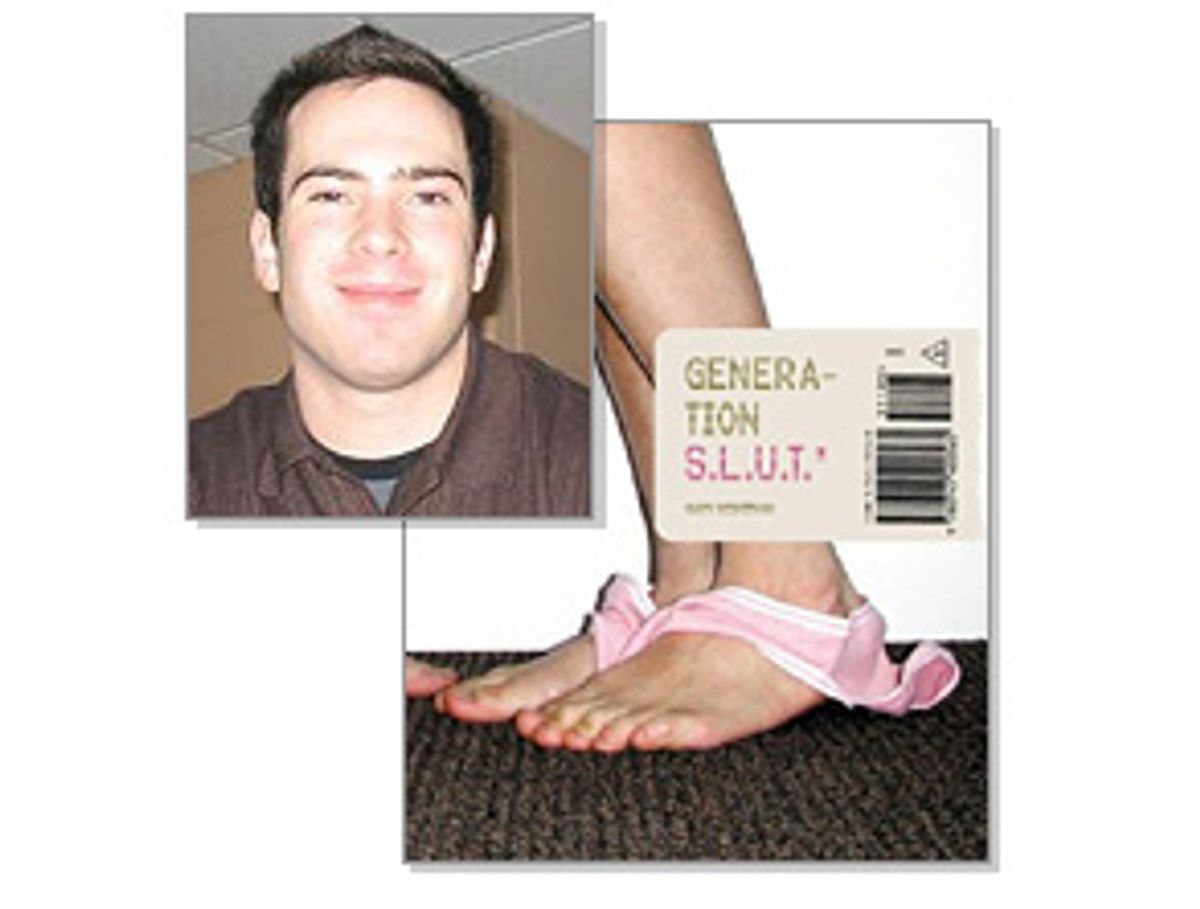
Last week, MTV Books/Pocket Books released "Generation S.L.U.T.," the second book by 21-year-old writer Marty Beckerman. And while his name may sound like that of a guy who tees off with your grandfather on the Coral Gables golf course, Beckerman is actually making his young living as the chief whistle-blower on his own Generation Y, chronicling its sexual excesses and perversions in extremely frank and intimate detail.
Beckerman grew up in Anchorage, Alaska, where he wrote his first book, "Death to All Cheerleaders: One Adolescent Journalist's Cheerful Diatribe to Teenage Plasticity," a collection of pieces from his column in the Anchorage Daily News, at 17. Now a contributor to the New York Press and a junior about to graduate early from American University, Beckerman was once named one of Teen People's "Ten Teenagers Who Will Change the World."
Perfect for those who don't remember a world without MTV, "Generation S.L.U.T." ("sexually liberated urban teens") is written in a graphic, chopped-up format that brightly hammers home its angry message again and again: that American teens are boffing like bunnies, and hating themselves and each other because of it.
Beckerman has written a fictionalized story about self-loathing, bed-hopping, gang-raping high school students in Anchorage, Alaska, which occasionally morphs into a comic strip. Woven between the short fictional chapters is the diary of Marty Beckerman, high school student, with entries like, "My Unforgettable [Almost] Prom Date With a Dirty Rotten Whore." Then there are a handful of quotes from real teenagers like 19-year-old "Jonathan R.," who told Beckerman, "I don't have anything against having sex with drunk girls ... if she says 'yes' she says 'yes.' And if she's too drunk to say 'no' ... Well, basically she's saying 'yes.'" The whole thing is riddled with statistical buckshot about rape and suicide rates, and quotations snipped from articles (including several from Salon) that reinforce the fear that teenagers are not in school but instead in their parents' beds cutting themselves while engaging in anal sex.
It's enough to make parents either reconsider the educational potential of nunneries, or scratch their heads and wonder if we haven't heard this kind of alarmism before -- in less graphic terms, perhaps. Salon talked to Beckerman from his dorm room in Washington, and asked him to clarify a few things.
You sound stressed. What's bothering you?
I'm a junior, but I'm graduating this year. The book's coming out, and then there's graduation stuff and then figuring out what I'm doing next. It's a pretty stressful time, to be honest. This is my big shot to be a 21-year-old author.
Why is it so important to you to be an author at 21?
I've always wanted it: I started writing humor for the Anchorage Daily News when I was 15. I was a teenage Dave Barry fan. My columns were wacky, but I guess pretty popular in the teenage Anchorage community. I got fired from the paper a couple of times, once for asking a 13-year-old cheerleader what it felt like to be a urine stain on the toilet seat of America. I was 17 or 18 then and I was reading more extreme authors, like Hunter Thompson and Craig Kilborn on "The Daily Show." I was trying to emulate that in print -- that vicious stuff. I fancied myself a shock humorist.
Was that the inspiration for your first book?
Yeah. "Death to All Cheerleaders" was a collection of all the shock stuff I wrote. Then I went to college and saw college life -- one constant orgy of booze and sex and pleasure seeking, which is fine every once in a while.
And are you judging that pleasure seeking in "Generation S.L.U.T."?
It isn't meant to be an anti-sex book or about making better choices and sexual responsibility. It's supposed to start a discussion within Generation Y about why things are the way they are. This is not a book for parents, not a book for religious leaders or reviewers or social critics or anyone other than teenagers and college students.
Why did you write it?
I think something's really missing for American youth. I mean, other generations have had it too -- Fitzgerald in the 1920s, Bret Ellis in the '80s -- but I think something's different with this one. We grew up in prosperity, with no war until now. The whole of Generation Y is one that doesn't really search for anything meaningful or substantial.
But other generations -- like the baby boomers, or even kids in the '80s -- grew up in relatively peaceful prosperity.
Well, in the '80s there was the threat of nukes and shit all the time. And before the Vietnam War it seemed like the world was black and white: America is good, everyone else is bad. But then there were young American soldiers being sent over there to die for a meaningless cause, and it moved the country toward relativism -- they realized that absolutism had flaws. Generation Y was raised by relativists -- we were a generation raised with no morals.
Your argument is that increased relativism and the encouragement of individuality left you without morals?
Well, we were raised with some values.
Like learning to see everyone as equal?
Right. But there are thongs for preschoolers, while 50-year-olds are trying to be 16 again with Botox and cosmetic surgery and boob jobs. The whole atmosphere has bred some really bizarre and morbid results.
So what is your own morally corrupt existence like these days?
I'm a 21-year-old boy. I have a girlfriend. I have sex with her. I have had one-night stands, I like to drink, I like smoking. I'm not against these things. It's like McDonald's: a fun and delicious treat if you go every once in a while. But if you're going every single meal you're a disgusting piece of crap.
How sure are you that you are really having more sex than previous generations? Isn't it possible that people are just more open about their sexual activity now?
Well, the birth control pill probably did change everything. Now, by the end of high school, 80 percent of kids have had sex. It's supposed to be making us happy. And sex does make people happy. It's one of the cool things about life -- get your fuck on! But instead of freedom and liberation, why has it led to so much sadness and emptiness?
But isn't it possible that teenagers are sad because they're teenagers? Do you really think they are sadder than ever before?
Sure, everybody is sad when they're a teenager -- and I should say that I am really insecure here talking about teenagers, because I'm not one anymore. Right now I'm trying to go to Baghdad for a book on why nations go to war. Talking about teen sex -- it feels like my heart's not really in it. I feel like "Generation S.L.U.T." covers it pretty well. I don't talk to teenagers on a daily basis anymore. I can't be spokesperson for teens nationwide, because I haven't been a teen for years now. "Generation S.L.U.T." is a sweet goodbye kiss to adolescence.
How much of the book is based on your own actual experiences?
Everyone asked that about "Death to All Cheerleaders" -- what was my beef against cheerleaders? Had I dated some cheerleader who broke my heart? But that was just a rant when I was 17 and I saw cheerleaders as the epitome of all the energy I saw in high school kids my age, wasted on jumping in the air and shouting slogans about school spirit. "Generation S.L.U.T." is about a time when you have no perspective. When getting dumped or touching a girl's boob for the first time is an event of cosmic proportions. It's a book for popular kids who hate themselves. There are certainly autobiographical overtones to this book, but I wouldn't say it's ripped straight from my life.
And what is your next project, exactly?
It's called "Jew-boy Goes to Hell: Young America in World War III," in which I visit Baghdad and Tehran and Kabul and Jerusalem and the West Bank. The publisher hasn't signed on the dotted line yet. It's a really expensive project. But it's about how the war on terror will affect Generation Y, because we care more about bongs and PlayStation than the future of planet earth.
So your Jewish identity seems to play a big part in your life and your work.
One time around 11th grade when I was starting to question religion, I went to the rabbi and asked, "Why do we believe in this thing we can't prove?" And he couldn't answer me. He said, "Well, that's what I believe." It pissed me off so much. Now I'm a lifelong agnostic, but the people I know who are religious have more stable lives. I can't say the solution is God, because look at the Catholic Church, for Christ's sake!
Yeah, you're pretty free with the ethnic and religious slurs in "Generation S.L.U.T."
I have been accused of being a racist by people -- including my girlfriend -- but stereotypes are really funny and the more we make fun of them, the better. Generation X was raised on p.c. religion. "South Park" completely obliterated that.
And what about your aggression toward the feminist movement, which you seem to blame in the book for many of your generation's problems?
Feminists wanted it both ways -- they wanted to see the end of men seeing women as something to be protected and cared for. But at the same time they wanted men to see women as -- I don't want to say "superiors," but almost religiously. How do I put this into words? Once women and girls were not seen as special, and men treated them as equals, like they would other guys, not caring for them and not treating them well, they didn't like it. Men don't see them as clean and pure, but as a means to an end, a nice little fuck-hole.
But in your work, it's not just a matter of not being special anymore. You describe them as dirtier than the men, who are doing exactly the same things.
Guys don't see themselves as dirty. In the New York Times I was quoted about a year ago in an article by Alex Kuczynski. Her premise, and it had a lot of validity to it, was that because of genetics, the male tendency is to spread as much seed as possible, while women have a limited number of eggs during their lifetime. Previous generations tended to be more monogamous, but now the birth control pill has conquered nature. Now there is no stigma to the pill; girls take it just to improve their complexions. If guys don't feel filthy it's because historically that's what men do, we are genetically conditioned to act this way. For girls it's still new and not built into the social construction.
So is "Generation S.L.U.T.'s" gang rape a comment on women's sexual behavior, or is it a chronicle of the type of thing you claim actually happens at high schools?
I'm not saying it happens at every school in the nation, but sure, it happens. I went through a very dramatic breakup at college, and that probably soaked into a lot of the fiction.
Were you in the middle of your nasty breakup when you wrote the gang-rape scene?
Yes, part of the bitterness from the breakup poured into the book. I had already written the gang-rape scene, so I wasn't thinking that I was gang raping my ex or anything.
Do you consider yourself a misogynist?
I don't consider myself a misogynist. But at the same time, I'm not going to play along with this p.c. lens of how you can view women and how you can't view women.
What did your girlfriend think of the book?
She liked it, even though she didn't want to be around me for a couple days after she read it.
What is your relationship with your parents like?
I'm close to my parents; they're always involved in my life. My dad is an eye doctor; my mom is a child psychologist. Sometimes they're overprotective. They don't support my trip to Baghdad. They see no reason why I would want to do that. Sometimes I wish they would stop being such Jews.
What do they think of the book?
My father has read the book. He likes it, but said that some of it goes too far. My mom's going to need to be pumped up with Thorazine before she reads a single word. "Don't write about teen sex, Marty! Why don't you write about bunnies?" Fuck bunnies! They fuck each other, Mom -- fuck shaft in the pussy hole!
Shares