Al-Qaida

Rebirth of a nation

In the aftermath of the Madrid bombings, the election in Spain changed the European dynamic in the war on terror.

  • more
    • All Share Services

Topics:

Rebirth of a nation

The shattering defeat of the conservative Spanish government by the Socialist Party, with its promise to withdraw Spanish troops from Iraq and end Spanish support for the Bush doctrine, was a striking sequel to the terrible act of terror that struck Madrid. What happened at the polls on Sunday in Spain, however, can only be understood by retracing a half-century of Spanish history.

Generalissimo Francisco Franco, victor in the 1936-39 Spanish Civil War (with a great deal of help from his allies Hitler and Mussolini), was a survivor. He abandoned his German and Italian friends as the fortunes of war turned against them, and he lived on as head of an authoritarian regime until his death in 1975. His regime was near collapse in 1959, but was saved by cash and support from the Eisenhower administration. The generalissimo may have garroted and jailed the opposition, clubbed strikers and kept women in medieval legal bondage, but he was, after all, reliably anticommunist. He offered the U.S. airports and ports to defend the Christian West.

By the time Franco died, Spain had dramatically changed. For its younger citizens, Che Guevara and Robert F. Kennedy were heroes. The young women who earlier were confined to convent schools went to universities in miniskirts. The aging dictator was seen as an unlovable patriarch whose time had come and gone. The church, meanwhile, was led by the great Vatican II cardinal, Tarracon. After one of Franco’s speeches about increases in prosperity the cardinal said, “Spain has produced more of everything except justice.” I asked a Spanish friend what it was like in 1975 as Franco lay dying. He said, “All you need to know is that in the entire country, there was not a bottle of champagne to be had in the stores.”

The transition to parliamentary democracy was remarkably quick. The younger and middle-aged elites of the old regime recognized that Spain could not be deemed European unless and until it cast off fascism. In February of 1981, the irreducible fascists in the army seized Parliament and attempted a coup. After initial hesitation, the king put himself at the head of the nation and ordered the generals back to their armories. The coup was denounced at once by the European governments. (English Prime Minister Margaret Thatcher was especially firm.) The U.S. secretary of state, Alexander Haig, said that it was an internal Spanish matter on which he would not comment. U.S. forces in Spain had been confined to their bases that day, before the seizure of Parliament. Many Spaniards wondered on which side the U.S. had been so neutral.

Democratization continued. Many exiles had returned, and Spanish culture marvelously came to life (think of the films of Pedro Almodóvar and the novels of Manuel Vazquez Montalbán). The country achieved in a decade what took the Western Europeans a generation. They learned to live on the edge of the modern age. In 1982, the great party of the Spanish Republic, the Socialists, won the election under Felipe Gonzalez. The Socialists instituted a Spanish welfare state like the other European countries, but their main achievement was to consolidate the cultural Europeanization and democratic ethos that make Spain a vital modern nation. There were plenty of problems: A segment of the Basque movement that had been so active against Franco demanded total independence, and used terror. The Socialists employed repellent methods against them, death squads, which eventually came to light to undermine the Socialists’ moral credentials. There was, too, corruption among Socialist officials, and a series of very public scandals. It is to Spain’s credit that the scandals were public, but they certainly dampened the exaltation of the first decade of freedom.

In 1996, Jose Maria Aznar became prime minister as head of the Popular Party. The party was, as most modern parties are, a coalition. It included older elements distinctly nostalgic for the black-and-white (mostly black) days of Franco, liberal Christian Democrats and followers of Opus Dei (the half-secret conservative Catholic movement), high finance, entrepreneurs and technocrats. Its voters were drawn from the vastly enlarged urban middle class. Educated thanks to the Socialist expansion of higher education, their aging parents taken care of by the new social security system, they forsook the party that had made their prosperity possible. The Popular Party was very much in the tradition of the Spanish right; it insisted on a centralized Spain, sought to limit the federalism written into the constitution, and refused any negotiation at all with the Basque movement. Indeed, it treated the moderate Basque Party as no better than the independence movement — and so undercut the chance for a peaceful compromise. Economically, the Popular Party launched a speculative boom visible in ever more housing construction at ever higher prices — and a stock market surge.

The Socialists in 2000 warned that the government’s failure to make long-term social investments — in education, health services and research — would cost Spain dearly. They were right, but their own project floundered. Their internal conflicts, serial changes in the leadership, and inability to find a suitable successor for Gonzalez led to a loss of energy and support among the unions, the young and the educated. Their electorate gradually receded to the groups most in need of social protection: the elderly and the poor. The continuing support of the critical intelligentsia hardly made up for losses in the larger cities.

Aznar won again, and with an absolute majority, which went to his head. He became increasingly contemptuous of the opposition, of his critics in the media, and of civil society. When in 2002 the oil tanker Prestige foundered off the Atlantic Coast in a gigantic ecological disaster, the government refused to accept responsibility for its incompetent management. Aznar’s policies in education (a return to obligatory religious instruction, at the limits of constitutional legality), immigration (grudging where not xenophobic), and the economy (systematic deregulation) moved from liberal Christian democracy toward a fundamentalism of the right. He shocked many Spanish sensibilities by using L’Escorial, Phillip the Second’s monument to himself, to stage the wedding of his daughter (complete with his friend, the Italian prime minister and conservative vulgarian Silvio Berlusconi in striped pants and a visibly pained royal family as guests.) Spain is a country of old social distinctions with a sense that these ancient inhibitions have outlived their usefulness. Many in the public thought they detected in their prime minister the soul of a parvenu.

Certainly there was something frenetic about Aznar’s enlistment of Spain in the “war on terror” and the invasion of Iraq. He had a major role in obtaining the signatures of Tony Blair and Berlusconi for the letter of loyalty to the U.S. drafted by an obliging CIA agent — a letter that enraged French Prime Minister Chirac and German Chancellor Schroeder and marked a large success for the Bush White House. Europe had been split.

Aznar refused parliamentary debates on the veracity of the claim that Iraq had weapons of mass destruction, denounced his critics as disloyal to the West and to Spain. His U.N. ambassador and his foreign minister read from a Bush script with dogmatic certainty. When on Feb. 15 last year over a million citizens took to Madrid’s streets to join the worldwide protest, there was one episode of violence. As the police encircled the protagonists, they were instructed by the Interior Ministry to let them go — they were, obviously, provocateurs. Aznar’s visits to the Bush ranch and the White House, his speech before the Congress (or rather, before congressional staff), meanwhile increased his sense of self-importance. Aznar believed that he had made Spain, through the Bush connection, a major world power. The fact is, he separated his nation from its erstwhile European allies and evoked the suspicions of the Latin American nations. He also threw away, with astonishing casualness, Spain’s legacy of close relations with the Muslim nations.

Aznar is, clearly, not devoid of a political sixth sense. Something told him not to run again, and he turned over the party to the more conciliatory figure of Mariano Rajoy. But the arrogance of Aznar and some of his ministers disfigured the campaign. The state TV channel was about as objective as Fox News: The journalists working there made their discontent known.

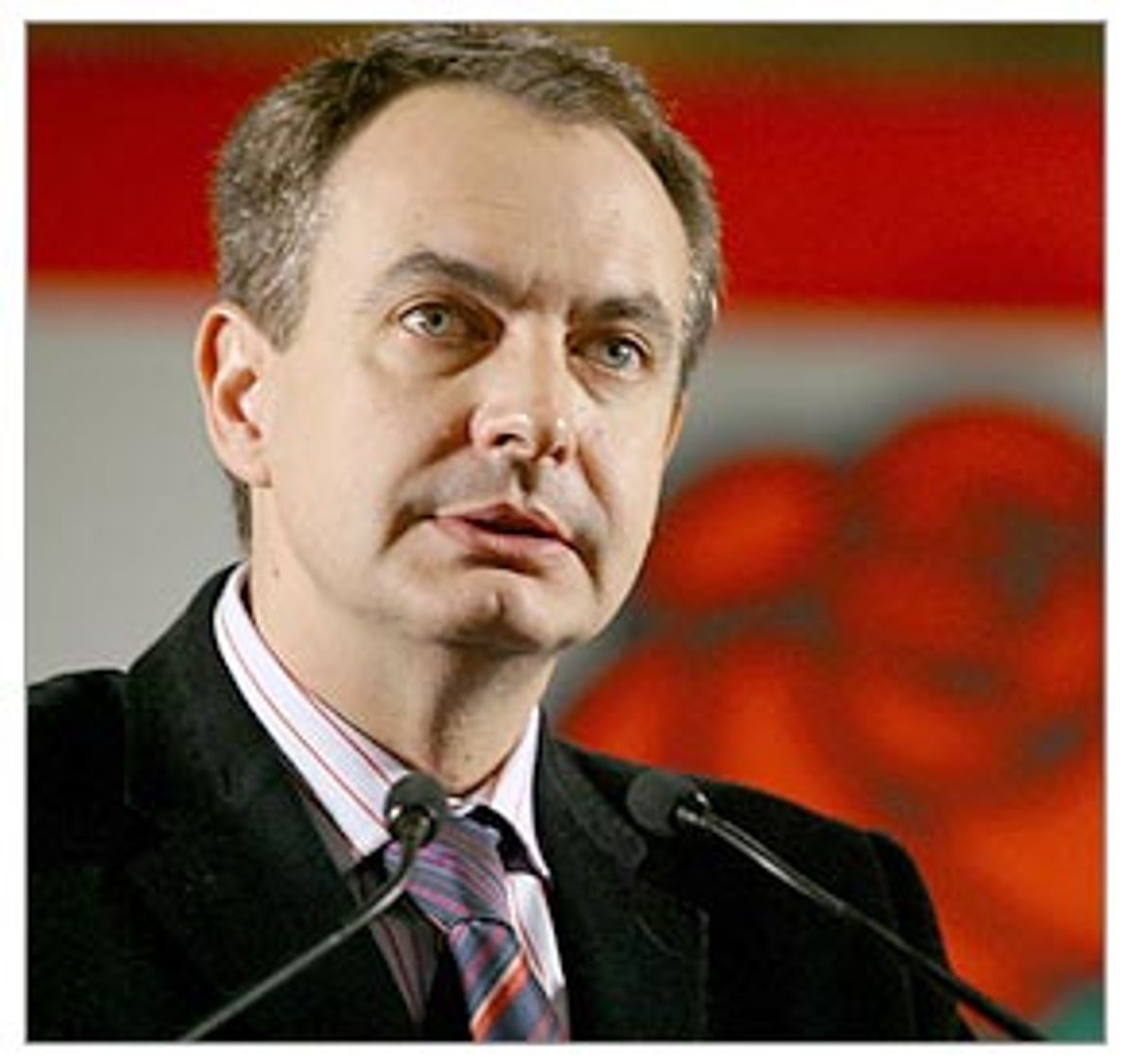
The Socialist campaign was doggedly consistent. Party leader Jose Luis Rodriguez Zapatero stuck to three themes. Spanish troops would be withdrawn from Iraq and the nation returned to a European foreign policy with a renewal of its close ties to France and Germany. Eleven percent unemployment and underinvestment in the future would be attacked by a comprehensive program of social investment. An open style of governance would be his method of conducting public business. Zapatero was intelligent, conciliatory and focused.

Like many others, I wondered if he had the necessary aggression to be a leader. Zapatero, the youngest member of Parliament when elected at age 26, was the protégé of Felipe Gonzalez. Clearly, the old master knew what he had. Zapatero dismayed many of his own partisans and the entire left when he said he would not claim the prime ministership if he did not attain more votes than the government’s candidate.

By the middle of last week, the game seemed over. The polls suggested that the government would lose its absolute majority, but still win the election (the figures gave it around 41 percent and the Socialists 36 or 37 percent). Aznar, too, knew what he had when he named the gentlemanly Rajoy his successor: He was distinctly less threatening and irritating than Aznar himself. The Socialists (I talked with a number of persons who will now be ministers) were resigning themselves to another four years of opposition. The government’s left and liberal critics in the media were hopeful that Rajoy would change the atmosphere, which they found detestable under Aznar. His hints and his own turns of phrase even led to hope that he would deemphasize the Bush alliance and move again toward Europe.

Then the catastrophe intervened, early in the morning of Thursday, March 11. Commuter trains filled with ordinary persons — those who, in fact, had no cars with which to drive to work, namely immigrants, workers and students — were blown up. As Madrid fell into chaos, the government announced that the culprits were the Basque separatist group ETA. Aznar himself telephoned the major newspapers to insist that the government knew this for a fact — twice he called El Pais, the nation’s most prestigious paper and one rather critical of him. The foreign minister instructed the ambassadors to tell foreign governments that this was what the government knew.

However, a vigilant citizen near one of the stations from which the trains had come noticed a van parked by men who were wearing ski masks on a mild March day. It was in the van that the police found detonators as well as a Quranic tape. A telephone in a backpack that contained unexploded bombs provided more clues. As millions took to the streets to protest on Friday, the intelligence agencies were already closing in on Islamist suspects. The government repeated the ETA story — despite an ETA denial. The public officials involved spoke to Cadena Ser, the radio station owned by the El Pais group. Cadena Ser broke the story, evoking a great deal of abuse from the official media and the sobriquet “wretched” (“miserables”) from the interior minister. The minister spent much of Friday and all of Saturday repudiating his earlier pronouncements.

Saturday, the day before the election, is by law a day of reflection — without campaigning of any kind. Mobilizing by cellular phone, thousands gathered in front of the Popular Party’s offices. The first hundreds who came were told by the police to leave and were asked for their identity cards. The crowd grew and the police formed a cordon around the building and did nothing. The crowd’s slogans were clear: “We will not vote until we know the truth” and, more to the point, “Your war, our deaths.” This was the taunt directed at both Aznar and Rajoy when they voted in Madrid the next morning. There were demonstrations of the same kind in front of the PP’s offices in every major city. In the election, participation was 8 percent greater than four years ago. The additional voters were first-time voters and former Socialist voters who had abstained in recent elections or had moved to the Popular Party.

In the final tally, the Socialists increased their share of the vote from 34 percent in 2000 to 42 percent in 2004; the Popular Party decreased from 44 to 37. The Socialists gained 39 seats, and are 12 short of an absolute majority; the Popular Party lost 35. The Socialists actually gained 3 million votes, the Popular Party lost 700,000. Zapatero has the authority of the largest vote total ever recorded in democratic Spain.

Clearly, the Popular Party rightly feared that attention to an Islamist attack would remind the public of its responsibility for war on the side of the United States. Its subsequent attempts at deception were politically suicidal — the work of leaders in the grip of panic. It enraged many in the public, recalled the government’s arrogance in the recent past, and offended a populace that had good reason in familial memory to take democracy seriously. The distrust of the Popular Party, heightened by its response to the bombing, also reminded the citizens of their other grievances, economic and social. Zapatero’s straightforwardness, originally depicted as boring, now became attractive.

Zapatero will be dependent upon votes from the smaller formations for his parliamentary majorities, but there is little doubt that he will obtain these. In his first press conference, he declared that the Spanish troops would indeed leave Iraq unless the provisional authority was replaced by a U.N. authority and Iraqi self-rule. He declared that Spanish foreign policy will now have three central points. One is to be a revival of the European connection, strengthening of the European Union and the European social model. The second is Spain’s special relationship to Latin America, where the president of Argentina has already expressed his delight at the Socialist victory. The third is the United Nations as a framework for relations between the developed and impoverished worlds. (Presumably, Spain’s U.N. ambassador, who was on Fox TV on Sunday evening pronouncing the election a triumph for terrorism, will be moving on. I rather like the old gentleman: He reminds me in dress and manner of an oblivious actor successfully playing the part of an official of the Franco regime, who hasn’t been told Franco has died.)

The obstacles in the Socialists’ path are many. The presumed responsibility of the Islamists for the attack may increase tensions, which are already considerable, between the Spanish population and the large numbers of Muslims living legally and illegally in Spain. Zapatero’s break with the “coalition of the willing” is sure to excite Bush’s retaliation, direct and indirect, open and covert. Nevertheless, Zapatero has had the courage to proclaim the break. At his press conference, he remarked that Blair and Bush were wrong about Iraq and he invited them to engage in self-criticism. His courage and determination align him with France and Germany and leave Berlusconi, already in serious difficulty on many fronts, exposed to still more domestic criticism.

George W. Bush, Condoleezza Rice and their servants in the American media have shown a curious view of democracy, never ceasing to praise the “courage” of foreign leaders who obey not their own electorates but the White House. Perhaps this display of Spanish independence will contribute to the education of the American public, which has been told to believe that other nations are to be taken seriously only when they are appendages of Bush’s policies. In his campaign, Zapatero openly expressed the belief that the world would be better off with a President Kerry in office. Clearly, U.S. interference in the affairs of other nations has now generated the sort of reciprocity that Americans will have to learn to live with.

Back to Spain. William Faulkner remarked that in his native South the past wasn’t over: “In fact, it isn’t even past.” Spain, too, is a society with an enormous amount of historical memory. The Popular Party is not a gang of fascists. However, its hypernationalist ideology, its authoritarianism, and its self-righteous lying were nonetheless unpleasant reminders of the past. People were reminded that Aznar’s grandfather had a very successful career under Franco. Zapatero’s was an officer in the Republican army, executed after being taken prisoner. When the crowds gathered in Madrid on Friday, there were two main chants. One was “Spain, united, will never be defeated.” The other was, “The people, united, will never be defeated.” The two Spains of 1936 seem still to be there.

Zapatero has said that he wants to be prime minister for all, and in a gracious concession speech, Rajoy promised to work with him in the national interest. Perhaps it has taken the impact of terror to open this as a possibility. But the election has already changed Spain and the dynamic in Europe, and given Americans reason to reflect on their possibilities.

Continue Reading Close

Norman Birnbaum is Professor Emeritus at the Georgetown University Law Center. His most recent book "After Progress, American Social Reform and European Socialism in The Twentieth Century" is an Oxford University Press paperback. He has just returned from Spain.

Khalid Sheikh Mohammed gets his way

Obama officials insisted the terror mastermind receive a military tribunal this week, but their arguments are bunk

  • more
    • All Share Services

Topics: ,

Khalid Sheikh Mohammed gets his wayDetainees at Guantanamo Bay (Credit: Reuters)

A military guard will be on each arm of Khalid Sheikh Mohammed as he is led into a courtroom on Saturday to be arraigned for a second time before a military commission at Guantanamo Bay. He went through the same process in the same courtroom on nearly the same charges almost four years ago in the closing months of the Bush administration. The fact that President Obama chooses now, six months before voters choose between him and Mitt Romney, to restart what some have dubbed “the trial of the century,” using a second-rate system of justice he had ordered stopped at a facility he had ordered closed, makes an unflattering statement about the timidity of his leadership and the malleability of his principles.

Apologists for the tarnished military commissions, like Attorney General Eric Holder and the sixth and current chief prosecutor Brigadier General Mark Martins, acknowledge that our regular federal courts are best suited for terrorism trials. Holder told an audience at Northwestern University in March:

Simply put, since 9/11, hundreds of individuals have been convicted of terrorism or terrorism-related offenses in Article III courts and are now serving long sentences in federal prison.  Not one has ever escaped custody.  No judicial district has suffered any kind of retaliatory attack. These are facts, not opinions.  There are not two sides to this story. Those who claim that our federal courts are incapable of handling terrorism cases are not registering a dissenting opinion – they are simply wrong.

After singing the praises of the federal courts – which really have been swift, severe and successful in comparison to the six and-a-half dubious trials completed over the past decade at Guantanamo – Martins and Holder pivot to polishing the image of the tarnished military commissions they argue are well-suited for a small category of cases. Martins told an audience at Harvard in April:

It is perfectly reasonable to ask why – with concurrent jurisdiction over offenses that can be characterized as both federal civilian crimes and violations of the law of war and with comparable procedural protections – we should invest great energy and resources in military trials. The answer is that there is a narrow but important category of cases in which the pragmatic and principled choice among the lawful tools available to protect our people and serve the interests of justice is a reformed military commission.

Beltway bureaucrats are prone to using buzzwords to shade the truth. For example, rather than saying “yes, it makes us look bad when we lock people away in prison for a decade without a trial,” some might soften it up by using more subtle Beltway language: “The optics are not optimal.”  The word “pragmatic” has become a favorite of the spinmeisters. In truth, being pragmatic has become a synonym for being a wuss. When a bureaucrat capitulates instead of confronting barriers standing in the way of doing the right thing, and then cites the barriers as an excuse for choosing the easier path, he is lauded for making the “pragmatic choice.” Others might say he simply wussed out. President Obama has been “pragmatic” far too often on national security choices in his first three years in office.

There is nothing pragmatic or principled about undermining America’s reputation as a champion of the rule of law and a supposed model for the world to follow. The apologists for Obama’s decision to embrace military commissions call attention to similarities between the commission rules and the rules in federal courts, and they claim those rules are essentially the same. They argue that the two systems are virtually identical and that trial observers will find trials in the two forums nearly indistinguishable. In some things, however, close is just not good enough. An O’Doul’s looks like a beer and has a beer-like flavor, but a real beer drinker would never argue that an O’Doul’s is virtually indistinguishable from a Sam Adams. Just as a near-beer is not practically the same as a real beer, neither is near-justice the equivalent of real justice. The apologists may think they are fooling the rest of the world when they say at long last military commissions do real justice, but they are wrong.

Holder and Martins justify the need for a second-rate military commission system by talking up the alleged realities of the battlefield that they say make it impracticable for troops to worry about doing rights advisements and establishing a chain of custody for evidence while in the midst of a war. Their general principle is entirely valid … but also totally irrelevant in the cases they intend to prosecute before military commissions. Few of the 779 men ever held at Guantanamo were captured by members of the U.S. armed forces and even fewer still were apprehended on the battlefield as that term is commonly understood by ordinary human beings. Khalid Sheikh Mohammed, for instance, was rousted from a sound sleep and arrested in Rawalpindi, Pakistan, by the Pakistani Inter-Services Intelligence Directorate based on information developed by our civilian Central Intelligence Agency. Abd al Rahim al Nashiri, the alleged USS Cole bomber, was apprehended in Dubai, a bustling global business center in the United Arab Emirates that no one considers a battlefield. Hambali was arrested near Bangkok, Thailand, by Thai authorities and later turned over to the CIA. The truth is that not a single one of the 14 so-called high-value detainees was captured by members of the U.S. armed forces on a battlefield; in fact, none were even apprehended in Afghanistan. The perception of some inexperienced 19-year-old Army private trying to read Miranda rights to a captured al Qaeda fighter while hunkered down in a foxhole with bombs exploding nearby and bullets whizzing past overhead is a canard.

Military commission apologists should have the integrity to stand up and tell the public the truth about the small category of cases they believe are best-suited for the second-rate procedures of the tarnished military commissions. The truth is the reason the apologists want a second-rate military commission option is because of what we did to the detainees, not because of what the detainees did to us. This is not about the exigencies of the battlefield and the problems our soldiers face trying to fight a war; this is about torture, coercion, rendition and a decade or more in confinement without an opportunity to confront the evidence – abuses that would have us up in arms if done to an American citizen by some other country – that make the tarnished military commissions uniquely suited to try and accommodate the small category of cases where we crossed over to the dark side. A military commission may be a justice-themed theatrical production – complete with a script, actors, a sound stage and costumes that create a passable courtroom-like atmosphere – but beneath that facade is a ‘heads we win, tails you lose’ charade where, as the government admits, even if a KSM or a Nashiri is found not guilty he returns to a cell to continue serving what is likely a life sentence. That should not inspire anyone to wave the flag and shout USA! USA! in celebration of our vaunted exceptionalism.

Lloyd Cutler was the youngest member of the prosecution team in the trial of eight Nazi saboteurs captured, convicted by a military commission and executed in a span of six weeks in the summer of 1942. He wrote an op-ed in the Wall Street Journal on December 31, 2001, nearly 60 years after his military commission experience ended and 10 days before the first detainees arrived at Guantanamo Bay. Mr. Cutler said that how we prosecute alleged al Qaeda terrorists will say as much about us as it does about al Qaeda. He warned that success will be judged by our ability to show the world that justice is in fact being done.

Had we heeded Mr. Cutler’s advice back in 2001 we would not be where we are now in 2012, fumbling along more than a decade later still trying to mold a second-rate process to fit around sets of bad facts we created when we turned our backs on the law and our values.  In normal practice, cases are developed to conform to the court. Here, because of how we mistreated some of the detainees, we are trying to develop a court to conform to the cases. We are setting an example for the world, but not a good one.

Continue Reading Close

Morris Davis was chief prosecutor for the military commission at Guantanamo Bay, Cuba, from 2005-2007. He is a retired U.S. Air Force colonel and a member of the faculty at the Howard University School of Law in Washington, D.C.

“You Don’t Like the Truth”: Our first look at a Gitmo interrogation

A bewildered Canadian teenager goes to Guantanamo Bay in this disturbing look inside the War on Terror

  • more
    • All Share Services

Topics: , , , , , , , ,

A still from "You Don't Like the Truth"

In the wake of the extrajudicial killing of American citizen Anwar al-Awlaki and several other people in Yemen this week, we’re faced (once again) with the realization that the United States Constitution has become a largely meaningless totem. It gets waved around enthusiastically by people on all sides of the political spectrum whenever it seems to serve their interests, but nobody pays much attention to what it actually says. Presumably President Obama, the military-intelligence establishment and the mainstream media are declaring Awlaki a special case. Thanks to the secret provisions of secret laws, he was deprived of all the rights of citizenship and not subject to the ordinary rule of law that extends back not merely to the Constitution but to the Magna Carta (at least).

Some similar exemption must also be made for the Canadian citizen Omar Khadr, who was 15 years old when he was found, badly injured and barely alive, after a 2002 firefight between U.S. troops and Taliban forces in Afghanistan. (Khadr’s father, an al-Qaida supporter and fundraiser, had apparently dropped him off at a Taliban compound a few weeks earlier.) Based on what we see in the painful, revealing documentary “You Don’t Like the Truth: 4 Days Inside Guantánamo” — the first film to show actual interrogation footage from inside the secret American military prison at Guantánamo Bay, Cuba — Khadr became a sort of ritual sacrifice by the Canadian government, an offering to its American allies and/or overlords. His case became a hot political issue north of the border, where Canadians pride themselves on a society that is more egalitarian, and more civilized, than that of their American neighbors.

Following a Canadian Supreme Court decision, most of Khadr’s seven-hour interrogation at Gitmo by CSIS officers — the approximate Canadian equivalent of the CIA — has been declassified, and veteran lefty documentarians Luc Côté and Patricio Henríquez use that claustrophobic, low-resolution 2003 footage as the basis for “You Don’t Like the Truth.” That sounds like something the interrogators might have said to Khadr, but it isn’t. It’s what he tells them after realizing they don’t want to hear his allegations that he was tortured by American forces, and that all his supposed confessions about knowing Osama bin Laden and attending al-Qaida barbecues were made up on the spot, to stop the pain.

You won’t see Khadr suffer physical torture on these surveillance tapes, although the interrogators rely on time-honored tactics of psychological abuse, alternately berating him and plying him with Big Macs. You will see a teenager who speaks idiomatic North American English, and who is obviously relieved to see fellow Canadians, whom he naively assumes have come to help him. And you’ll see him go through a near-total breakdown, sitting alone in the room weeping for his mother, after he realizes that no one cares about what happens to him and that he’s only interesting to his interrogators as long as he keeps making up stories about Osama and al-Qaida.

I have no idea whether Khadr actually threw a grenade that killed a U.S. Delta Force soldier, as was alleged after his capture. (Khadr has consistently denied it, and photographic evidence suggests that he had been shot through the back and was out cold before the soldier’s death.) But the Canadian interrogators barely mention it, and it feels suspiciously like an inflammatory distraction, thrown in mostly to alienate all possible North American sympathy. At best it’s an ancillary question. If Khadr was a genuine military combatant, then he can’t be prosecuted for killing an enemy soldier in battle. Furthermore, he would have to be considered a child soldier under international law, which theoretically immunizes him even for war crimes. Convicting him on such charges, as the government eventually did in a secret court on secret evidence, required the finding that he wasn’t a soldier but a civilian terrorist (even though he was supposedly linked to two organizations, al-Qaida and the Taliban, with whom the U.S. government has repeatedly said it’s at war).

Côté and Henríquez intersperse brief and highly effective interview segments between snippets of the interrogation tape, with subjects ranging from former U.S. military officers (including Khadr’s lawyer and psychiatrist) to former Guantánamo inmates (including Moazzam Begg, now a leading British activist for other detainees) to Khadr’s mother and sister (wearing full-face Islamic veils) to Damien Corsetti, the much-demonized former soldier who knew Khadr as a guard at Bagram. What comes through repeatedly is that questions of law and reason, or guilt and innocence, played no role in the case of Omar Khadr. He was a vulnerable and confused kid whose own government turned its back on him, which made him a perfect candidate to become one of the few Gitmo detainees convicted of something. He was 15 when he was captured, and will be 31 when he (supposedly) gets out.

“You Don’t Like the Truth: 4 Days Inside Guantánamo” is now playing at Film Forum in New York, with more cities and dates to follow.

Continue Reading Close

U.S. officials: Al-Qaida ops chief killed by CIA

Top Pakistani operative dead after drone strike earlier this week

  • more
    • All Share Services

Topics: ,

A top al-Qaida operative was killed earlier this week in Pakistan’s tribal areas, U.S. and Pakistani officials said Thursday. The death landed another blow against the besieged terrorist network.

The man killed was Abu Hafs al-Shahri, whom two U.S. officials describe as al-Qaida’s chief of operations in Pakistan.

Though his name is little known beyond intelligence circles, Al-Shahri is described as dangerous by both the Pakistani and U.S. officials, who spoke on condition of anonymity to describe classified counterterrorist operations.

He was apparently killed by a CIA drone strike in Pakistan’s lawless tribal areas, though officials would not describe the method since the program is classified. A drone strike was reported by locals on Sunday night.

The officials say al-Shahri worked closely with the Pakistani Taliban to carry out attacks inside Pakistan, and was also a contender to assume some duties of al-Qaida’s second in command, Atiyah Abd al-Rahman. Al-Rahman was killed by a CIA drone strike in late August.

U.S. officials believe they can cripple the core al-Qaida organization if they take out the top four or five figures, following the killing in May of al-Qaida chief Osama by Laden by Navy SEALs. Eight of the network’s top 20 leaders were killed this year alone, according to the Pentagon’s undersecretary for defense intelligence, Michael Vickers, in remarks this week. Vickers predicted that with sustained counterterrorist operations, “within 18-24 months, core al-Qaida’s cohesion and operational capabilities could be degraded to the point that the group could fragment and exist mostly as a propaganda arm.”

But Vickers and CIA director David Petraeus said al-Qaida’s offshoots will remain a serious threat to the U.S.

A Pakistani intelligence official says Pakistani operations chief al-Shahri was a Saudi national, who had lived in the tribal regions of Pakistan, bordering eastern Afghanistan, since 2002.

One of the U.S. officials said the same individual is No. 11 on Saudi Arabia’s top-85 most wanted terror suspects, where his full name is listed as Osama Hamoud Gharman Al-Shihri. The official said the same person is No. 68 on Interpol’s most wanted list, where his name was spelled “Al-Shehri” and his birthdate was listed as Sept. 17, 1981.

Al-Shahri engaged in liaison mainly with Pakistan’s Tehrik-e Taliban Pakistan to conduct coordinated attacks against targets inside Pakistan, one of the U.S. officials said. But al-Qaida also inspired the Pakistani Taliban to undertake its first known overseas attack, when a U.S. based operative tried and failed to detonate a car bomb in Times Square last year.

Al-Shahri’s killing was first reported by NBC News.

Al-Qaida’s senior planner of global terror operations, Adnan Shukrijumah, remains at large.

AP writer Matt Apuzzo contributed from Washington, and AP writer Riaz Khan contributed to this story from Peshawar.

Continue Reading Close

U.S. accuses Iran of “secret deal” with al-Qaida

Administration says Iranian government provides money and recruits for attacks in Afghanistan, Pakistan

  • more
    • All Share Services

Topics: , ,

U.S. accuses Iran of FILE - This Monday, Aug. 3, 2009 file photo released by the official website of the Iranian Supreme Leader's office, shows Iranian President Mahmoud Ahmadinejad, right, delivering a speech after Supreme Leader Ayatollah Ali Khamenei, seated at left, formally endorsed him for a second term as President during an official ceremony in Tehran, Iran. As Iran's capacity to build nuclear weapons grows, intelligence assessments from nations that follow Tehran's atomic progress discern increasing indecision and squabbling by its leadership on whether to make such arms - and if so, how overtly. Most suggest Ahmadinejad is more circumspect. But an intelligence summary shared recently with The Associated Press sees Supreme Leader Ayatollah Ali Khamenei as the more cautious of the two and says the Revolutionary Guard is benefiting from the dispute, with some of the authority normally exercised by the president devolving to it. (AP Photo/Office of the Supreme Leader, File) ** EDITORIAL USE ONLY, NO SALES ** EDITORS NOTE AS A RESULT OF AN OFFICIAL IRANIAN GOVERNMENT BAN ON FOREIGN MEDIA COVERING SOME EVENTS IN IRAN, THE AP WAS PREVENTED FROM INDEPENDENT ACCESS TO THIS EVENT(Credit: AP)

The Obama administration accused Iran on Thursday of entering into a “secret deal” with an al-Qaida offshoot that provides money and recruits for attacks in Afghanistan and Pakistan. The Treasury Department designated six members of the unit as terrorists subject to U.S. sanctions.

The U.S. intelligence community has in the past disagreed about the extent of direct links between the Iranian government and al-Qaida. Thursday’s allegations went further than what most analysts had previously said was a murky relationship with limited cooperation.

David S. Cohen, Treasury’s point man for terrorism and financial intelligence, said Iran entered a “secret deal with al-Qaida allowing it to funnel funds and operatives through its territory.” He didn’t provide any details of that agreement, but said the sanctions seek to disrupt al-Qaida’s work in Iraq and deny the terrorist group’s leadership much-needed support.

“Iran is the leading state sponsor of terrorism in the world today,” Cohen said in a statement. “We are illuminating yet another aspect of Iran’s unmatched support for terrorism.”

Treasury said the exposure of the clandestine agreement would disrupt al-Qaida operations by shedding light on Iran’s role as a “critical transit point” for money and extremists reaching Pakistan and Afghanistan.

“This network serves as the core pipeline through which al-Qaida moves money, facilitators and operatives from across the Middle East to South Asia,” it said..

Treasury said a branch headed by Ezedin Abdel Aziz Khalil was operating in Iran with the Tehran government’s blessing, funneling funds collected from across the Arab world to al-Qaida’s senior leaders in Pakistan. Khalil, the department said, has operated within Iran’s borders for six years.

Also targeted by the sanctions is Atiyah Abd al-Rahman, appointed by Osama bin Laden as al-Qaida’s envoy in Iran after serving as a commander in Pakistan’s tribal areas. As an emissary, al-Rahman is allowed to travel in and out of Iran with the permission of government officials, the statement claimed.

The sanctions block any assets the individuals might have held in the United States, and bans Americans from doing any business with them.

No Iranian officials were cited for complicity in terrorism. The others targeted were Umid Muhammadi, described as a key planner for al-Qaida in Iraq’s attacks; Salim Hasan Khalifa Rashid al-Kuwari and Abdallah Ghanim Mafuz Muslim al-Khawar, Qatar-based financial supporters who’ve allegedly helped extremists travel across the region; and Ali Hassan Ali al-Ajmi, a Kuwait-based fundraiser for al-Qaida and the Taliban.

The action comes a day after the top U.S. commander for special operations forces said al-Qaida is bloodied and “nearing its end,” even as he warned that the next generation of militants could keep special operations fighting for a decade to come.

Navy SEAL Adm. Eric T. Olson said bin Laden’s killing on May 2 was a near-fatal blow for the organization created by bin Laden and led from his Pakistan hide out. He said the group already had lost steam because of the revolts of the Arab Spring, which proved the Muslim world did not need terrorism to bring down governments, from Tunisia to Egypt.

Treasury’s public allegations against Iran may reflect part of a strategy to expand the pressure on smaller, less well-established offshoots of al-Qaida as the weakening of the group’s leadership threatens to make its activities more disparate. Washington already has re-focused much attention on al-Qaida’s Yemen-based branch, which has attempted to bomb a U.S.-bound jetliner and cargo planes in recent years.

But the exact nature of Iran’s relationship with al-Qaida remains disputed in Washington, with different branches of the intelligence community disagreeing about whether Iran is supporting al-Qaida as a matter of policy, according to one U.S. official. The official spoke on condition of anonymity to discuss intelligence matters.

Some hardline militants backing al-Qaida, members of Islam’s majority Sunnis, see the Shiite Islam dominant in Iran as heretical, and they view Tehran’s regional ambitions as a greater threat than the West. Sunni insurgents in Iraq have used car bombs and suicide attacks against Shiite targets, killing thousands since 2003, as well as targeting Shiite militias allied to Iran.

Since 2001, Iran has appeared a somewhat reluctant host for senior al-Qaida operatives who fled there after the U.S. invasion of Afghanistan, keeping them under tight restrictions. After an initial period of cooperation with the West, Iran now seems to be a more comfortable haven even if it remains on the edge of al-Qaida’s orbit.

Western officials point to the release earlier this year of an Iranian diplomat who was held for 15 months after being kidnapped by gunmen in Pakistan.

In negotiations for the diplomat’s freedom, they say Iran promised better conditions for dozens of people close to Osama bin Laden who were being held under tight security. These included some of the terror chief’s children and the network’s most senior military strategist, Saif al-Adel.

Still, the life of the al-Qaida-linked exiles in Iran continues to be very much a blind spot for Western intelligence agencies. Few firm details have emerged, such as how much Iran limits their movements and contacts.

Continue Reading Close

What should we believe about al-Qaida?

Too much of what we "know" about bin Laden and the terrorist group he led comes from anonymous U.S. officials

  • more
    • All Share Services

Topics: , , ,

What should we believe about al-Qaida?

Almost everything we learn about Al-Qaida and Osama bin Laden these days is coming from anonymous U.S. officials.

Wednesday, for instance, U.S. officials told us via The Washington Post that Al-Qaida was on the verge of being totally wiped out. The comments echoed earlier ones from Defense Secretary Leon Panetta, the former C.I.A. director, who earlier said that only a couple dozen more Al-Qaida militants needed to be killed before the war was over.

Last week the officials were talking to the Wall Street Journal. They told the paper that Al-Qaida would likely be shifting the focus of its attacks to Western targets outside of the United States. They said this was because it had become too difficult for them to strike inside the United States.

The Wall Street Journal said the U.S. officials had come to this conclusion based on evidence gleaned from flash drives found in the compound where bin Laden was killed. Much of the information we are learning about bin Laden and Al-Qaida, in fact, is said (by U.S. officials) to be coming from those flash disks, as well as a computer.

It was from the computer, for instance, that U.S. officials learned that bin Laden liked porn. Everyone ran with that story. It was great story. Not only was it sure to drive traffic, combining two of the most searched items on the internet these days (porn and bin Laden), but it also tweaks the legacy of a man who claimed that a strict adherence to Islam is what guided him in his global campaign of terror.

It is reminiscent of the news, also released by U.S. officials, immediately following the raid that led to bin Laden’s death that, in a vain attempt to protect himself, bin Laden used his wife as a human shield. Not so heroic. That detail turned out to be false. As was news that bin Laden was armed.

The news that bin Laden liked porn also came from U.S. officials. They leaked it anonymously to Reuters and then everyone else reported the Reuters report (including GlobalPost). In fact, all the details about the raid, what transpired and what was found after, has come from U.S. officials.

The New York Times reported on May 6 that the details surrounding the raid and the discoveries that followed have been fluid in their accuracy. It partly blamed a ravenous media, itself included. But it also blamed a desire by the United States to spin facts in order to diminish bin Laden’s legacy.

Was the revelation that bin Laden liked porn part of that spin? What about everything else we are learning from U.S. officials? Is that spin too?

If it’s not spin, all the reports surely play into the hands of the U.S. government. Not only did the Wall Street Journal story infer that our defense measures are working but it justified our continued pursuit of Al-Qaida militants all over the world, both through the war in Afghanistan and the ramping up of drone attacks in Yemen and Somalia.

The Washington Post story, meanwhile, suggests that we have been successful in Pakistan, where drone strikes have been plentiful, but Al-Qaida remained strong in Yemen, where the U.S. plans to increase its use of unmanned drones.

Other things we learned recently about bin Laden: He was planning an attack on the 10-year anniversary of Sept. 11, he had a “direct” role in the planning of the July 7 bombings in London, a belief that runs counter to previous reports, and he was actively planning any number of other attacks as well — all according to “U.S. officials.”

If you say so.

Continue Reading Close

Page 1 of 48 in Al-Qaida