Globalization

How India is saving capitalism

For one Silicon Valley company, hiring Indian programmers wasn't about greed, it was about survival. A special report from Chennai, globalization's ground zero.

  • more
    • All Share Services

How India is saving capitalism

In an auditorium on the Chennai campus of the Indian Institute of Technology, Brian Behlendorf is stumping before 200 engineering students. The pony-tailed founder and CTO of the Silicon Valley start-up CollabNet is here, ostensibly, to talk about open-source software. The event has been organized by the Indian Linux Users Group-Chennai; the 30-year-old Behlendorf, who coordinated the growth of the hugely successful Apache Web server project in its early days, is one of the heroes of the open-source movement.

But he’s also an executive of an American company that has outsourced a significant part of its operations to India, placing him at the center of the firestorm that has erupted in the United States over the globalization of white-collar jobs. So he can’t avoid addressing the issue of what has really brought him to the subcontinent, even as he adds his own unique twist to the debate.

“Outsourcing is a sensitive topic in the U.S. for political reasons,” Behlendorf says. “But the open-source community has been doing outsourcing since the beginning.” Programs like Apache and Linux and many others, he argues, were developed by thousands of volunteers from around the globe — an example of massively outsourced labor. In a sense, the move by Western corporations to outsource programming operations to developing nations isn’t just about cutting costs, it’s about adopting a new software development model.

Behlendorf’s audience is receptive to his remarks. It is made up of students from one of India’s most elite engineering institutions — a school that’s harder to get into than Harvard, a school so competitive that its tens of thousands of applicants are known as “aspirants.” The men, who make up the majority, are dressed in button-down oxfords and belted khakis, the women in flowing salwar kameez. There’s only a smattering of geeky T-shirts: “2001 Welcome to Linux: It’s now safe to turn on your computer,” reads one.

After Behlendorf has finished speaking, the students come up to the podium to pepper him with questions. When he finally leaves the stage, a dozen engineers follow him out into the humid night, intent on spending every possible moment with him until he disappears into the car that will take him back to his $130-a-night room at the Sheraton. Then, the students walk away into the dark, a loose group scattered below a jumbled canopy of banyan, neem, mango, tamarind and eucalyptus trees populated by dangling wild monkeys.

Behlendorf isn’t here in Chennai for the second time in 10 months just to spread the open-source gospel. He’s here because the boom in offshoring is resulting in a tight labor market — in India. In the topsy-turvy logic of globalization, it’s Behlendorf who’s here to court the engineers: highly educated, technical talent that costs a fraction of what it commands in the U.S. Recruiting such talent is becoming an ever more competitive endeavor for companies looking to join the offshore flood.

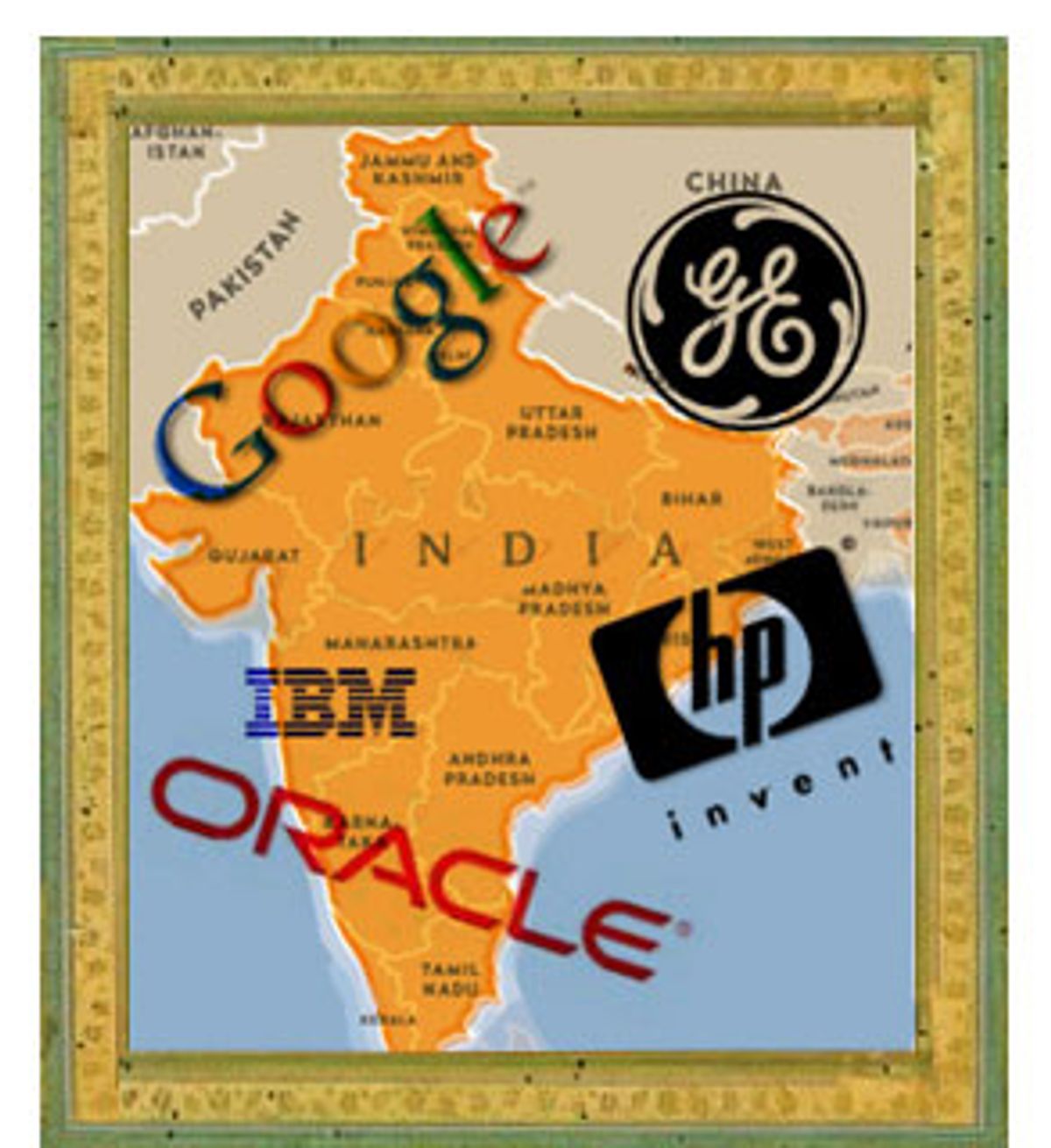
In the U.S., the rush to outsource labor internationally is increasingly being seen by workers as an us-vs.-them zero-sum game. As they watch one corporate behemoth after another — IBM, GE, Oracle, HP, Google — send significant portions of their operations offshore, their agitation is burgeoning into a political hot-button issue. According to a new Gallup Poll, 58 percent of Americans say that outsourcing will be “very important” when they decide their votes for president. And 61 percent say that they are concerned that they, a friend or a relative might lose a job because the employer is moving work to a foreign country. Analysts’ estimates that 3.3 million jobs are likely to be lost to outsourcing by 2015, and that 14 million are vulnerable to foreign competition, have turned India into the new Japan in the imagination of American workers: an ominous economic threat to their livelihoods. Despite assurances from economists that the furor is so much protectionist alarmism, the nagging question remains: How can you compete with a worker who makes a 10th of your salary?

But for Behlendorf and CollabNet, the outsource-or-not-to-outsource challenge is no cut-and-dried case of greedy American corporations sending jobs overseas. Behlendorf, as befits his open-source roots, is an idealist. Taking a global perspective, he believes that spreading the wealth internationally is good for the world in the long run. He and his fellow executives want CollabNet to be a truly global company, with no distinction made between employees in one country or another. But even more to the point, CollabNet’s main product, SourceCast, is a set of software tools that facilitate development among teams of programmers working in different locations.

In other words, CollabNet’s developers, both in the U.S. and India, are hard at work writing code that makes it easier for workers on opposite sides of the globe to work together effectively. CollabNet even “eats its own dogfood,” as the saying goes, using its main product as the development environment for writing the SourceCast code.

One important market for SourceCast: corporations that outsource.

CollabNet’s story is symbolic of a larger truth about the globalization of white-collar jobs — particularly those in the technology sector. If Silicon Valley now faces an uncertain future as a center for software development, the seeds of that uncertainty were planted not in India or China or the Philippines, but right at home. The build-out of the Internet and the tremendous advances in computer technology over the last decade have opened up new passageways between disparate economic realities. And no one has embraced one of the central premises of the Internet age — easy interconnection between everybody — more than software engineers. The immense strength and vitality of the open-source software phenomenon is a clear testament to that.

It wasn’t so-called “Benedict Arnold” CEOs or greedy shareholders or even the ruthless laws of economics that crafted these new virtual workplaces where job performance is measured purely by your output on the screen, no matter where you log on from. Technological innovation and investment opened up the doors for coders in India and China and everywhere else. It is one of the tremendous ironies of the digital era that the easy flow of capital and labor to every inch of the globe, made possible by the superhuman efforts of American and European programmers, has ended up wreaking havoc on the job security of those very programmers.

Got a problem with that, Silicon Valley? Don’t blame India, and don’t blame the CEOs. Blame yourself.

If you pick up a phone in CollabNet’s office in Chennai and dial a Brisbane, Calif., extension, you can reach the West Coast via VoIP Internet telephony, no long-distance call required. It’s a hotline from one economic reality to another.

In Chennai, day laborers do road construction on the clogged city streets by hand without benefit of bulldozers or cranes, working with pickaxes and shovels at the rate of $4 U.S. a day. The traffic veering around their stooped, sweaty forms is a writhing choke of belching open-air auto-rickshaws, cars, motorcycles and scooters. Barefoot bicyclists brave the squalls, often with red, blue, yellow and green jugs strapped to the back of their bikes: water.

There’s such a severe shortage of water here that while the wealthy buy theirs commercially and have it delivered to their homes in trucks by the tankful, their servants — the legions of drivers and cooks and maids and guards — wait in line for more than an hour each day to receive their own subsidized rations.

Walking the ragged sidewalks here means dodging not only the other pedestrians and stray dogs, but one-man-band businesses that have annexed scraps of pavement: a tailor sits behind an ancient sewing machine in the middle of the pavement, open for business.

And yet, on the same streets where child beggars wade into traffic, putting their cupped filthy hands to their mouths to plead for food, billboards advertising “Business Process Outsourcing” broadcast an entirely different set of possibilities. Glimpses of it are visible in the dilapidated local airport, where it is 80 degrees Fahrenheit at night with no air conditioning (except for ceiling fans — which are all turned off), but there’s a room of smudged, gray PCs where travelers can check their e-mail. And you can hear it at a charity benefit, where the famed Odissi dancer Sonal Mansingh teases the posh audience with a “Message from Krishna!” jab when their mobile phones persist in interrupting her performance.

Past the street vendor selling vegetables from a wooden cart, and the men in flowing kurtas, an elevator takes you up to CollabNet’s offices on the third floor of Trimex Towers on Subbaraya Avenue. Past the guard at the front door, what’s shocking is not how different the office here is from the corporate headquarters back in Brisbane overlooking the San Francisco Bay, but how fundamentally similar it is. You’re greeted with a setup that could be any start-up in Mountain View or Sunnyvale: rows of cubicles filled with guys in their 20s — and a few women — dutifully engrossed in their computer monitors.

There’s a sport to picking out the superficial differences between CollabNet’s two offices: In Chennai, the bathroom doors are marked “ladies,” “gents” and “executive.” In Brisbane, the receptionist wears a trendy pink Paul Frank T-shirt with a signature monkey cartoon on the front over jeans with a rainbow-colored stripe up the side. In Chennai, the receptionist sports an elegant salwar kameez with a flowing dupatta scarf draped down the back — casual wear by local standards.

In Brisbane, the lunchroom is stocked with a Galaga arcade game, a foosball table, a serve-yourself fridge full of soft drinks and a pantry bursting with granola bars. In Chennai, a servant delivers sweet south Indian coffee and cookies, and workers take coffee and tea breaks both morning and afternoon.

But the deeper into the work environment you get, the more the two offices appear identical at the most critical level: the technology. On their desktops, the developers and Q.A. (quality assurance) engineers here use the same tools as do the coders in Brisbane. Call it virtual, if you must, but in a very real sense, they are working in the same environment.

The real CollabNet workplace is not in Brisbane or Chennai, it’s in the packets of information zipping across the Net, whether via instant messaging software or e-mail or through the features of the SourceCast collaboration software. All that really matters is who is online at any given time. In this Web-based development environment, notification is by e-mail, the browser is the interface and deploying means giving someone else a URL.

There are advantages to such virtuality, says Behlendorf. “Instead of having a conversation in person, you have the development over e-mail. If you have a conversation in person, you’re lucky if someone takes notes. On an e-mail forum that stuff is always recorded. It’s always available for searching.”

Add a lot of cheap bandwidth to the mix and anything is possible. “During the [dot-com] boom a lot of telcos were laying a lot of cable across international lines. The cost of getting a T1 or a T3 to the other side of the world is no longer prohibitive for most companies,” says Behlendorf. “There’s actually a glut.”

Now, someone is always working at CollabNet. “Any time of the day or night, 24/7, 365 days a year, people are on our IRC [chat] channels,” brags Chris Clarke, 34, a director of engineering, who works out of Brisbane.

CollabNet is unusual in the outsourcing/offshoring debate in that the product it is selling is explicitly aimed at aiding the work of collaborating programmers. But the merging of offices across time zones and international borders is, on a global scale, a consequence of the advances in computer and telecommunications technology. Outsourcing, viewed from the technological perspective, is not surprising, nor is it necessarily exploitative. It’s just what happens when you connect the world together.

CollabNet’s arrangement between its U.S. and India offices is not technically outsourcing, in the sense of a particular company task being contracted out to another company. Everyone in the Chennai and Brisbane offices is a CollabNet employee. On the company’s intranet, the directory shows the names and faces of employees in Chennai, India; Brisbane, Calif.; and Chicago, Ill., intermingled in an alphabetical index of who works here — wherever “here” is.

CollabNet has brought its offshore workers into the company, which in an unfortunate parlance of the Indian software industry is known as running a “captive” facility. There are no third-party buffers separating the workers in Chennai from the employees back in Brisbane, aside from the fact that they are paid on scales that are orders of magnitude different.

CollabNet even put the programmers in its offshore facility to work on its core business: writing the SourceCast software. While Q.A. testing is mostly located in the Chennai office, development work now occurs both in the U.S and in India. Programmers in both places not only work on the same projects, they literally modify the same files of code.

How did CollabNet get here? The reasons are a mix of pragmatism and idealism. In late 2002, the business environment for a small technology company looking to expand was brutal. CollabNet had been through layoffs but, paradoxically, what the company really needed was more people — a lot more people.

“We just needed more arms and legs to be able to provide the robustness that the product needed to have,” says CEO Bill Portelli.

“What we were capable of doing with the people on staff was not what we needed to win business,” says Behlendorf.

In fall 2002, Portelli says, he was receiving three solicitations a month from outsourcing companies, up from a rate of about one every other month just a year before. E-mails and follow-up phone calls poured in: “We’ll help you do this, cheaper, smarter, faster!” (Now, he gets about a dozen such offers a month.)

But the more the company explored these outsourcing options, the less it wanted to pursue them. Behlendorf objected to what he dubs the “fast food” model of services outsourcing: writing a specification, sending it to another company with developers offshore, and waiting weeks for the code to come back. Would this result in software the company wanted? As a pioneer and veteran of the inclusive, open-source world, Behlendorf just found the idea distasteful.

“I wanted a team there that felt like they were CollabNet,” he says.

Jack Repenning, 51, a senior software engineer in the Brisbane office, puts the power dynamics of the traditional outsourcing relationship in stark terms: “Enterprise offshoring is a kind of colonialism, like growing pineapples in the Philippines or bananas in Hawaii. It’s very demeaning and counterproductive: Do this and shut up.”

CollabNet wanted to seed collaboration among all its developers, as opposed to creating a two-tiered model of service provider and client. It’s a model taken directly from the open-source world. “This year, you’ll call it outsourcing, but in a few years, you’ll call it global development, where there are locations everywhere,” says Jason Robbins, a developer who was the 10th employee at CollabNet when he worked for the company remotely from Southern California. “And you won’t think of breaking off a chunk of development with limited risks and management responsibilities for another second-class team to do. Instead, development organizations will think of it as a global employee pool,” says Robbins, now a lecturer at the University of California at Irvine.

This was the model that CollabNet was preaching to its customers and prospects: If they couldn’t make it work themselves, did they have any business selling it?

There was another, even more pragmatic reason to avoid the subcontracting-out style of outsourcing. Despite a reputation as a low-cost alternative, outsourcing services still come at a premium, since you’re paying a middleman to hire and manage the remote office of cheaper labor. If you can pull it off yourself, in the long run, it’s even less expensive to run your own shop.

So, instead of hiring the work out, CollabNet decided to merge with an existing software company, Enlite Networks. Enlite was incorporated in Delaware, with management in Mountain View, Calif., and a few key developers in Plano, Texas. But by far the majority of its coders, some 31 programmers, were in Chennai. From its inception in 1999 Enlite was organized around the assumption that work would flow back and forth between the U.S. and India.

The company product — a project management tool — was folded into SourceCast. “They were not doing low-level work out there,” says Behlendorf. “They were doing J2EE, heavy database stuff, the same kinds of things that you have people doing out here.”

In early January 2003, when the company told the developers in Brisbane about the acquisition, the fallout was immediate and predictable. “A lot of people thought most of the engineering staff was going to lose their jobs,” says Dan Rall, 26, a senior software engineer.

At an engineering offsite in the Marin Headlands, soon after the announcement, a “V.C.-type” speaker came in to put the company’s move into a larger economic context, developer Leonard Richardson, 24, remembers.

“He talked about how the agricultural economy had become the industrial economy, which in turn had become the knowledge economy. Someone asked him what comes next, after outsourcing takes its toll on the knowledge economy. He said that if anyone had any ideas he was interested in hearing them,” says Richardson.

Kevin Maples, another programmer, dubbed this vague notion the “I don’t know, you think of something” economy.

The developers in Brisbane weren’t the only ones who were worried. The Enlite engineering team in Chennai was also apprehensive. Here they’d been developing their own product, explains Muthu Krishnan, one of Enlite’s U.S.-based founders. What exactly would they be doing for this CollabNet company? And what would these American executives in California expect of them? Programmers who had been writing code were put on the relatively less interesting task of testing software for bugs.

CollabNet had almost no QA department back in Brisbane, and this was an easy way to get an immediate benefit from the merger: The engineers in India would find bugs while the U.S. developers slept. Plus, it would help the engineers in India get up to speed on the product. Still, going from writing code to testing can only feel like a demotion.

The story of how CollabNet has striven to integrate its Indian and American engineers offers an illuminating test case in the evolving drama of globalization and its impact on the world’s labor force. Along with the usual merger upheavals, the company had to surmount the perpetual barrier of a 13-and-a-half-hour time difference, and vast cultural differences as well. And no matter how enlightened the management, there’s no getting around the economic facts. Indian programmers cost less; therefore it makes economic sense to hire them. Even for the most highly valued programmers in Brisbane who support what their company is attempting to do, that equation still chafes.

The 40 some-odd programmers, quality-assurance engineers and customer support staffers who work in CollabNet’s two-floor outpost in Chennai are mostly in their mid-20s. By mid-2004, the managers here hope to recruit about 15 more of them. The market for their skills has become so heated in Chennai that headhunters brazenly call them up in their cubicles to solicit their services, dangling pay hikes of 30 percent.

“A programmer with two or three years of experience gets a salary of more than a big government official who had to struggle to get to that level,” explains P.V. Gopinath, 41, a development manager. And Chennai, a southern port city formerly known as Madras, is sleepy compared to Bangalore, with considerably less job-hopping and salary inflation; it’s an Austin, Texas, to Bangalore’s Silicon Valley.

For these programmers, a job working for an American company like CollabNet is a ticket to the good life — and a lot of long hours. When 29-year-old Venkat, an engineer who once worked Q.A. but now fixes the bugs he found as a tester, first started working with the CollabNet developers in Brisbane, he would work from 2 p.m. to midnight, so he’d have more time to chat with his remote colleagues in the chat rooms. But despite the late nights, he says, “I.T. [information technology] improves your lifestyle. You make more money. You have more satisfaction.” But he adds, “You don’t get a lot of holidays to go around and enjoy it.”

Ramaswamy Subbaroyan, 34, a senior software developer who worked for 18 months in Boston for another company on an H1B visa, says that the rise of the I.T. industry in India has “put a lot of money in middle-class people’s pockets.” And the lifestyle that an I.T. job in India brings beats the ones back in the States. “Once you reach the middle level with 10 to 12 years experience, life is pretty good here, compared to people in the U.S. with 10 to 12 years experience.”

But, he says humbly, the developers in the U.S. are superior: “The best programmers are still in the U.S. It’s more of a do-it-yourself, self-starter culture.” But he sees that changing in India, where a government job used to seem attractive because of the decades of job security it could offer. “Young people are cutting loose,” he says. “They’re not bothered by job security.”

The same is not true for American programmers.

Since the merger, the programmers in Brisbane have not been axed en masse, as some had feared, but in the last year there have been some layoffs of individuals. And some developers have gone from coding almost all the time into very different roles; they’ve been put to the task of training and mentoring the staff in India. “You have to be a people leader, and not just sit in your small cube working on stuff,” says Muthu Krishnan, one of Enlite’s original U.S.-based founders. It’s a real-life version of the advice that venture capitalists and economists have for American programmers who are concerned about their own prospects: Move up the food chain.

That means more documentation and lots of late-night sessions answering questions on chat. One insomniac Bay Area developer who happened to be online a lot was on the receiving end of so many of these queries that he started getting small tokens of thanks in the mail from his colleagues in India. One present was a small plaque with a formal declaration of friendship.

But moving from writing code to encouraging and managing a team of coders remotely is not for everyone. “I was a technical lead, but I didn’t want to lead a team remotely. I didn’t want to stay up all night bringing people along,” says Michael Stack, who quit to work at another software company. “I remember interviewing someone long-distance over the phone, and just thinking. ‘This doesn’t work.’ Interviewing is one of the most important things you do in a company. Trying to get a reading off of somebody off a bad phone line, I was at a loss.”

“Their jobs changed or are changing,” says Sandhya Klute, a director of engineering in Brisbane. Although she was hired eight months ago, well after the merger, Klute found herself still trying to reassure the 22 engineers here that they wouldn’t be irrelevant as soon as the developers over in India got up to speed on the product.

Klute, who worked for Hewlett-Packard for 21 years as a middle manager, argued: Why would the company hire a new manager in Brisbane if they were just going to get canned? But she also struck a tough-love note: “The reality is we don’t have to like it. Just look outside, it’s happening in every other company.”

Perhaps the most challenging aspect of the merger has been ironing out workplace culture issues. In Chennai, programmers call their managers “sir,” and lofty job titles command respect. A tester wouldn’t feel comfortable disagreeing with the CTO or a V.P. But in Brisbane, programmers treat each other as peers and respect is accorded based on contribution — a style that comes directly out of the open-source world of software development.

So it’s hard for a 26-year-old technical lead in Brisbane to understand why a programmer in Chennai might be too intimidated by him or just too shy to ask a lot of questions that could speed the training process along. “They can’t just pop on over to my desk and ask me a question,” says Dan Rall, 26, a senior software engineer. “But if they could, would they?”

No wonder that when Behlendorf spoke to those IIT students in Chennai his biggest piece of advice to them was to not be shy about participating. “I understand there are big cultural differences,” Behlendorf told them. “The culture here is a lot more polite,” but it’s by jumping into the sometimes-bruising online fray that you can contribute and build your reputation.

“We don’t get as much work out of them as we wish we did,” says Repenning. Is the culprit the cultural mismatch? Are the American developers still not communicating clearly enough? Do they need to write more documentation? Is it the stupid time zone problem? Or do the developers there just need more time to ramp up? Or some combination? Repenning is not sure.

“You find yourself spending about equal time worrying about them moving up the value chain to take your job, and wishing that they would move up the value chain faster so they could do their jobs,” says Repenning, who now leads a team of four engineers in Chicago and two in Chennai.

On the American side, the tension of working in a shrinking job market can make the cross-cultural interactions uneasy.

“This industry is having a hard time. Friends are losing jobs. Sitting beside someone who makes a 10th of what you do, it’s a pressure you feel,” says Stack, the American developer who left CollabNet to work for another company. “On the surface, all goes along swimmingly, but there is an underside not being discussed. That colors your interaction no matter how you might dismiss it.”

Rall, a tech lead, is obviously proud of how fast some of his team’s Indian engineers have adapted to their new roles at CollabNet — such as Venkat, whom he dubs “a total star.” And he says that some of the fears of job loss in Brisbane have abated over time. But he still wonders what the company’s new deal means to American engineers just a little younger than he is, who are just getting out of school:

“A 21-year-old who just got out of school here with $100,000 in debt, what did he get for that debt? What does he have to look forward to now?” says Rall. “We don’t hire those people anymore. We only hire senior engineers.” He’s not the only one wondering, since in the U.S. the the number of unemployed college graduates has recently surpassed the number of unemployed high-school dropouts.

- – - – - – - – - – - -

It’s morning in the CollabNet office in Chennai, and Behlendorf has just come in after staying up until 4 a.m. in his hotel room at the Sheraton answering the flood of e-mail from California that arrives after dinner in India, when it’s 9 a.m. back in Brisbane. This is his second visit to Chennai in the past 10 months, and he thinks he’s already seeing signs of change in the streets. There’s less litter. Road conditions seem to be improving — at least there’s a lot of construction on them. He’s optimistic that the influx of Western capital is playing a role in helping improve things here.

In the early 1990s, Behlendorf was the founder of SF Raves, the San Francisco mailing list that launched countless all-night underground parties in the name of “community.” He still deejays until dawn. Is this the man American workers are thinking of when they rail against “Benedict Arnold executives” sending “our jobs” overseas?

Behlendorf says that CollabNet could have hired 10 people back in San Francisco for what the India office costs them: That’s a ratio of about 4 to 1. But he thinks that wouldn’t have been enough people to make the company’s product succeed.

“We saved the jobs of the people who are employed in San Francisco by hiring people here [in India],” he says. “I don’t know that we would be around as a company if we hadn’t done that. What was the right thing to do, morally?”

Goodbye, Davos man

Pundits haven't realized it yet, but the age of economic globalization is over

  • more
    • All Share Services

Goodbye, Davos manRobert Rubin (Credit: AP/Cliff Owen)

Now and then there are moments that clarify major trends in politics. Such a moment occurred recently, when François Hollande, the Socialist candidate for the French presidency, agreed with the French far right on the need to further limit immigration to France:  “In a period of crisis, which we are experiencing, limiting economic immigration is necessary and essential.” For his part, Hollande’s opponent Nicolas Sarkozy criticized immigration in his first electoral run and as president of France has denounced deregulated markets.

This is not just a French phenomenon, nor is it limited to immigration policy. In most of the world’s advanced democracies, the egalitarian left and the nationalist right are growing in strength among voters. After three decades in which apostles of financial deregulation, offshoring and immigration liberalization dominated the capitals of major Western countries, the pendulum is swinging in the other direction.

You would never know this from the prestige press, which is owned by billionaires and populated by upscale journalists, many of whom were able to begin their journalistic careers as unpaid interns thanks to affluent parents. According to the consensus in the elite media, history runs in one direction toward the merger of national economies in a single global free market, the elimination of borders for labor and the relaxation of restrictions on the free movement of capital. Any moves in the opposite direction represent dangerous backsliding that can only be motivated by racism and xenophobia and that threaten to produce new Hitlers and Mussolinis and trade wars leading to world wars.

But the voters of the industrial democracies are not listening to the elite transatlantic chattering class.  The late political scientist Samuel Huntington coined the term “Davos Man,” after the World Economic Forum at Davos, Switzerland, to symbolize the post-national, anti-populist global elite. Davos Man still exists, but he is in danger of going the way of Neanderthal Man. The Davos vision of a dawning post-national free market utopia was cracked by the al-Qaida attacks on Sept. 11, 2001, and then shattered by the global financial crash of 2008. Free market globalism continues to be the  orthodoxy in elite economic and journalistic circles, but in politics it has been in retreat for years. It is increasingly clear that libertarian globalism was never the wave of the future, but merely a temporary blip in history between the fall of the Berlin Wall in 1989 and the fall of the twin towers in 2001.

Consider the case of immigration policy. In every advanced nation, including the United States, governments under pressure from voters have moved to tighten up surveillance and control of immigrants, for reasons of national security and protection of the wages and cultures of their citizens from real or imagined threats. Parties of the center-left as well as of the center-right have adopted positions on immigration that would have been considered far-right in the globalist 1990s. America’s Democrats and the Labour Party of Gordon Brown have been forced by voter sentiments to carry out tough immigration policies that elite pundits of the left, right and center have denounced to no effect.

In the world economy, the major trend of our time is the rise of nationalist state capitalism, not the disappearance of national economic boundaries that was predicted by the prophets of globalization like Thomas Friedman following the end of the Cold War. When the world economy collapsed in 2008, leading industrial countries rushed to bail out national firms like America’s GM and Germany’s Opel, giving the lie to the claim that major corporations no longer had national identities. Instead of liberalizing its economy as it developed, China has made its state-owned companies more rather than less important. Most of the world’s energy companies, and a number of major shipping and aerospace industries, are state-controlled. The response in the U.S. has been growing economic nationalism, which is tapped by presidential candidates like Obama and Romney who call for defending and promoting American industry — at least when they are running for office.

It is true that protectionist policies have been limited during the Great Recession, compared to the Great Depression of the 1930s. But this arguably reflects the interests of working-class voters rather than the triumph of libertarian globalist ideology. A dwindling majority of wage earners in advanced industrial countries work in manufacturing industries that can be offshored to other countries. Most work in the nontraded domestic service sector. Only a few of them need to worry that their jobs will be sent abroad, but it is rational for many to worry about immigrant competition within their own countries for local service sector jobs. At the same time, the working class in Western democracies benefits from low prices for imports. It is perfectly rational, therefore, for working-class Americans or Europeans to be more concerned about immigrant competition than about trade. On another front, the deregulation of finance, the centerpiece of Clinton Treasury Secretary Robert Rubin’s global economic strategy, is being slowly but inevitably reversed, in the aftermath of the global crisis to which financial deregulation contributed. Unwilling to wait for global agreement on financial regulation, nations are unilaterally re-regulating the financial industry within their own borders. The result will be to reverse much of the financial globalization of recent decades and replace it with a patchwork of different national financial systems.

The Balkanization of global finance along national lines will be accelerated in the decades to come as many governments choose to deploy moderate inflation to burn away much of the public and private debt built up during the Great Recession, as the alternative to politically unpopular spending cuts and tax increases. What is known as “financial repression” — forcing national banks and, through them, national savers to accept government bonds whose value is being eroded by deliberate inflation — is a policy that is helped by a degree of segregation of national banking systems from the world economy. In the future, countries pursuing debt reduction by means of moderate inflation will find it attractive to partly re-nationalize their financial systems for this purpose alone. Most retirees in advanced industrial nations depend primarily for their retirement income on inflation-adjusted public pensions like Social Security, not on private savings. As a result, financial repression will hurt economic elites the most, while doing little harm to the working-class majorities in the U.S., Canada and Europe. Even as nationalism further fragments the global economy along national and regional lines, populism will redraw the map of domestic politics in one country after another, including the United States. Nationalist populists who break with the elite libertarian consensus, even those who, like Ross Perot, are centrist rather than far-right, are routinely demonized by the pundits of the mainstream press, whose moderate libertarian orthodoxy reflects the values and class interests of the owners of the media. But while populist outsiders are marginalized in the media and usually fail at the ballot box, their issues are often co-opted by mainstream conservative and progressive parties, the way that populist opposition to illegal immigration has been co-opted by establishment parties throughout the West in the last decade.   

Votes clearly count, even in plutocratic America. If American public policy reflected the objectives of the 1 percent, then long ago there would have been relaxation of border enforcement and amnesties for illegal immigrants, the privatization or means-testing of Social Security and Medicare and further deregulation of finance. On all of these issues, however, the oligarchic consensus is losing at the ballot box, if not in the editorial pages.

Davos Man is not dead, but he is on life support.  The libertarian globalist moment in world history is over. Free market globalism peaked in the late 1990s, before the rise of al-Qaida and Chinese-style state capitalism, when it appeared briefly that the Reagan-Thatcher version of capitalism represented the future. Most of our politicians and pundits are still living in the mental world of the 1980s and 1990s, but the future has arrived and it is not what libertarian globalists predicted.

Here and there, trade and immigration liberalization will continue, when it serves the interests of particular nations or particular pressure groups. And it will always be important, even in a partly renationalized world, to resist nativist bigotry and misguided forms of protectionism. Even so, the fading vision of inevitable progress toward the free flow of money, goods and labor across national boundaries was never anything more than a utopian fantasy, like the Marxist dream of international fraternity in a socialist world.  Capitalism in some form, partly private and partly statist, will endure. But less than a generation after the fall of the Berlin Wall, libertarian globalism has joined communism on the dust heap of history.

Continue Reading Close

Michael Lind’s new book, "Land of Promise: An Economic History of the United States", will be published in April and can be pre-ordered at Amazon.com.

The secret to making American workers competitive

Despite GOP claims, big business won't bring us more and better jobs. Obama should outline how the government will

  • more
    • All Share Services

The secret to making American workers competitive (Credit: AP)
This originally appeared on Robert Reich's blog.

Who should have the primary strategic responsibility for making American workers globally competitive – the private sector or government? This will be a defining issue in the 2012 campaign.

In his State of the Union address, President Obama will make the case that government has a vital role. His Republican rivals disagree. Mitt Romney charges the president is putting “free enterprise on trial,” while Newt Gingrich merely fulminates about “liberal elites.”

American business won’t and can’t lead the way to more and better jobs in the United States. First, the private sector is increasingly global, with less and less stake in America. Second, it’s driven by the necessity of creating profits, not better jobs.

The National Science Foundation has just released its biennial report on global investment in science, engineering and technology. The NSF warns that the United States is quickly losing ground to Asia, especially to China. America’s share of global R&D spending is tumbling. In the decade to 2009, it dropped from 38 percent to 31 percent, while Asia’s share rose from 24 to 35 percent.

One big reason: According to the NSF, American firms nearly doubled their R&D investment in Asia over these years, to over $7.5 billion.

GE recently announced a $500 million expansion of its R&D facilities in China. The firm has already invested $2 billion.

GE’s CEO Jeffrey Immelt chairs Obama’s council on work and competitiveness. I’d wager that as an American citizen, Immelt is concerned about working Americans. But as CEO of GE, Immelt’s job is to be concerned about GE’s shareholders. They aren’t the same.

GE has also been creating more jobs outside the United States than in it. A decade ago, fewer than half of GE’s employees were non-American; today, 54 percent are.

This is all good for GE and its shareholders, but it’s not necessarily good for America or American workers. The Commerce Department says U.S. based global corporations added 2.4 million workers abroad in first decade of 21st century, while cutting their U.S. workforce by 2.9 million.

According to the New York Times, Apple Computer employs 43,000 people in the United States but contracts with over 700,000 workers abroad. It makes iPhones in China not only because of low wages there but also the ease and speed with which its Chinese contractor can mobilize their workers – from company dormitories at almost any hour of the day or night.

An Apple executive says “We don’t have an obligation to solve America’s problems. Our only obligation is making the best product possible.” He might have added “and showing a big enough profits to continually increase our share price.”

Most executives of American companies agree. If they can make it best and cheapest in China, or anywhere else, that’s where it will be made. Don’t blame them. That’s what they’re getting paid to do.

What they want in America is lower corporate taxes, less regulation and fewer unionized workers. But none of these will bring good jobs to America. These steps may lower the costs of production here, but global companies can always find even lower costs abroad.

Global corporations — wherever they’re based — will create good jobs for Americans only if Americans are productive enough to summon them. Problem is, a large and growing portion of our workforce isn’t equipped to be productive.

Put simply, American workers are hobbled by deteriorating schools, unaffordable college tuitions, decaying infrastructure and declining basic R&D. All of this is putting us on a glide path toward even lousier jobs and lower wages.

Get it? The strategic responsibility for making Americans more globally competitive can’t be centered in the private sector because the private sector is rapidly going global, and it’s designed to make profits rather than good jobs. The core responsibility has to be in government because government is supposed to be looking out for the public, and investing in public schools, colleges, infrastructure and basic R&D.

But here’s the political problem. American firms have huge clout in Washington. They maintain legions of lobbyists and are pouring boatloads of money into political campaigns. After the Supreme Court’s Citizen’s United decision, there’s no limit.

Who represents the American workforce? Organized labor represents fewer than 7 percent of private-sector workers and has all it can do to protect a dwindling number of unionized jobs.

Republicans like it this way, and for three decades have been trying to convince average working Americans government is their enemy. Yet corporate America isn’t their friend. Without bold government action on behalf of our workforce, good American jobs will continue to disappear.

Continue Reading Close

Robert Reich, one of the nation’s leading experts on work and the economy, is Chancellor’s Professor of Public Policy at the Goldman School of Public Policy at the University of California at Berkeley. He has served in three national administrations, most recently as secretary of labor under President Bill Clinton. Time Magazine has named him one of the ten most effective cabinet secretaries of the last century. He has written 13 books, including his latest best-seller, “Aftershock: The Next Economy and America’s Future;” “The Work of Nations,” which has been translated into 22 languages; and his newest, an e-book, “Beyond Outrage.” His syndicated columns, television appearances, and public radio commentaries reach millions of people each week. He is also a founding editor of the American Prospect magazine, and Chairman of the citizen’s group Common Cause. His widely-read blog can be found at www.robertreich.org.

World on the verge of a nervous breakdown

Capitalism's ceaseless quest to cut costs made us more jittery in 2011, and there's no relief in sight.

  • more
    • All Share Services

World on the verge of a nervous breakdownItalian equities shape American realities (Credit: Tony Gentile / Reuters)

For those looking for signs of how globalization has woven the world into a web of unexpected vulnerability, 2011 offered a bumper crop.

An earthquake in Japan sent the global auto manufacturing industry into a conniption.

A flood in Thailand drastically reduced supplies of computer hard drives, forcing even a titan like Intel to swiftly reduce revenue forecasts.

State-subsidized solar panel production in China crushed a U.S.-subsidized solar start-up, thereby igniting a Washington political scandal.

It is child’s play to find further examples. The underlying reality is that unexpected consequences make everyone nervous. Sensibilities are on hair trigger. Just two weeks ago, the New York Times captured the new jitteriness in a single quote. In a story reporting how U.S. stock traders were increasingly setting their alarm clocks for the middle of the night, in order to absorb the latest news from Europe as soon as it started to break, one stock analyst, Michael Mayo, complains in a tone of bemused wonder: “Who would have thought we would have to be looking at Italian sovereign debt yields to figure out what Morgan Stanley’s stock will do?”

For those who haven’t been living and dying on every twist and turn of the European financial crisis, some unpacking of that sentence may be in order. Most modern governments routinely auction some form of state-backed bonds or other securities in order to raise cash. If the bond investors aren’t excited about the opportunity — let’s suppose, just for argument’s sake, that they’re afraid the Italian economy is about to collapse — then Italy must offer a higher interest rate, or yield, on those bonds to attract buyers. The higher the yield, the more negative the bond market’s judgment is assumed to be.

But for most of November and December, the health of Italy’s debt sales became not merely a judgment on Italy’s economic health and fiscal stability, but a swiftly translated proxy for investor sentiment about the state of all Europe. If Italy ran into real trouble, so the theory went, France and Germany would soon be swept into the vortex. And a European recession would obviously be bad news for the rest of the world. So one unsuccessful auction in Rome becomes immediate cause for bearish sentiment in New York and Tokyo and Shanghai.

And no one wants to be caught more than one nanosecond out of the loop. If the orders go out to sell or buy, you want to get there first. Since now, more than ever, bad news travels fast, everyone’s got to be quick on the trigger.

It doesn’t seem healthy, but we’re going to have to get used to it. Volatility and vulnerability are built into the infrastructure of our modern world. The jury may still out on the chaos theory question of whether a single butterfly flapping its wings in Botswana can cause a typhoon in the Philippines, but we now know without a shadow of a doubt that the relative success or failure of a troubled European government’s attempt to raise cash can send instant shock waves across financial markets across the globe.

And we know, intimately, that it doesn’t take much to set off a cascade of trouble — after the great global crash of 2008, traders everywhere are in a state of permanent PTSD. Beyond the obvious surface connections between markets — that European recession slowing U.S. economic growth — there are abundant linkages beneath the scenes that are obscure and hard to unravel, interconnections woven by complex derivatives and hedging strategies and computer-driven high-speed trading algorithms that instantly translate woe in one market to panic in another.

The inescapable conclusion: Our modern high-tech markets, in which more money than ever before swirls around the globe in a blink of an eye, are better at transmitting panic and fear than anything heretofore created by humans. If civilization is supposed to imply progress, then something has gone very awry: In the second decade of the 21st century, our infrastructure is increasingly fragile, increasingly prone to disruption. The sword of Damocles hangs above everyone’s head, and the thread that keeps it from falling is fraying perilously thin.

What is perhaps most fascinating about this state of affairs is how it has arisen as a consequence of global capital’s relentless quest for lower operating costs and greater efficiency and flexibility. The better we get at extending supply and production chains across the globe, the more vulnerable those chains become to a disruption at any given point. The faster we enable the transmission of information around the world and through the financial markets, the more volatile those markets become, as every new headline sends a different trading signal.

The marvelous shipping ports of the West Coast, able to transport unthinkable quantities of goods from ship to train or truck via their state-of-the-art cranes, offer a perfect example. We’ve never been so good at moving stuff around. But shut down one of those ports for a week, and we’re suddenly stuck. There’s nowhere else for all that stuff to go!

We’re going to see more of this in the future, rather than less. Climate disruptions will increase in frequency and severity, influencing commodity prices and immigration flows and insurance-industry profit margins. Higher prices for fossil fuels will complicate those transportation logistics — a single shock in Saudi Arabia would blast through economies everywhere. The temptation to hit the panic button will become increasingly irresistible.

Our systems need more redundancy, and our temperament would benefit from a heaping dose of prudence. But it’s hard to see where the encouragement to change our ways will come from. Because if there’s one thing that’s even more clear than the emergence of a constantly-on-the-verge-of-a-nervous-breakdown global economy, it’s that, for the most part, our political systems are not up to the task of dealing with these challenges.

Which, of course, just increases our overall sense of antsy powerlessness. As individuals, we’ve never been so much at the mercy of events that play out thousands of miles away, and we are remarkably unable to do anything about it.

And here comes 2012, which will witness a U.S. presidential election, crunch time for the European fiscal union, a potentially slowing Chinese economy, more weather disruptions, and a whole bunch of stuff that we have no idea is coming. If 2011 was the year when globalization’s downside became impossible to ignore, then 2012 will likely raise the ante by another order of magnitude.

Continue Reading Close
Andrew Leonard

Andrew Leonard is a staff writer at Salon. On Twitter, @koxinga21.

The “American Century” has ended

The Great Recession, the Arab Spring and the euro crisis show how global relations are fundamentally shifting

  • more
    • All Share Services

The Barack Obama, Moammar Gadhafi and George Papandreou (Credit: AP)
This originally appeared on TomDispatch.

In every aspect of human existence, change is a constant.  Yet change that actually matters occurs only rarely.  Even then, except in retrospect, genuinely transformative change is difficult to identify.  By attributing cosmic significance to every novelty and declaring every unexpected event a revolution, self-assigned interpreters of the contemporary scene — politicians and pundits above all — exacerbate the problem of distinguishing between the trivial and the non-trivial.

Did 9/11 “change everything”?  For a brief period after September 2001, the answer to that question seemed self-evident: of course it did, with massive and irrevocable implications.  A mere decade later, the verdict appears less clear.  Today, the vast majority of Americans live their lives as if the events of 9/11 had never occurred.  When it comes to leaving a mark on the American way of life, the likes of Steve Jobs and Mark Zuckerberg have long since eclipsed Osama bin Laden.  (Whether the legacies of Jobs and Zuckerberg will prove other than transitory also remains to be seen.)

Anyone claiming to divine the existence of genuinely Big Change Happening Now should, therefore, do so with a sense of modesty and circumspection, recognizing the possibility that unfolding events may reveal a different story.

All that said, the present moment is arguably one in which the international order is, in fact, undergoing a fundamental transformation.  The “postwar world” brought into existence as a consequence of World War II is coming to an end.  A major redistribution of global power is underway.  Arrangements that once conferred immense prerogatives upon the United States, hugely benefiting the American people, are coming undone.

In Washington, meanwhile, a hidebound governing class pretends that none of this is happening, stubbornly insisting that it’s still 1945 with the so-called American Century destined to continue for several centuries more (reflecting, of course, God’s express intentions).

Here lies the most disturbing aspect of contemporary American politics, worse even than rampant dysfunction borne of petty partisanship or corruption expressed in the buying and selling of influence.  Confronted with evidence of a radically changing environment, those holding (or aspiring to) positions of influence simply turn a blind eye, refusing even to begin to adjust to a new reality.

Big Change Happening Now

The Big Change happening before our very eyes is political, economic and military.  At least four converging vectors are involved.

First, the Collapse of the Freedom Agenda: In the wake of 9/11, the administration of George W. Bush set out to remake the Greater Middle East.  This was the ultimate strategic objective of Bush’s “global war on terror.”

Intent on accomplishing across the Islamic world what he believed the United States had accomplished in Europe and the Pacific between 1941 and 1945, Bush sought to erect a new order conducive to U.S. interests — one that would permit unhindered access to oil and other resources, dry up the sources of violent Islamic radicalism, and (not incidentally) allow Israel a free hand in the region.  Key to the success of this effort would be the U.S. military, which President Bush (and many ordinary Americans) believed to be unstoppable and invincible — able to beat anyone anywhere under any conditions.

Alas, once implemented, the Freedom Agenda almost immediately foundered in Iraq.  The Bush administration had expected Operation Iraqi Freedom to be a short, tidy war with a decisively triumphant outcome.  In the event, it turned out to be a long, dirty (and very costly) war yielding, at best, exceedingly ambiguous results.

Well before he left office in January 2009, President Bush himself had abandoned his Freedom Agenda, albeit without acknowledging its collapse and therefore without instructing Americans on the implications of that failure.  One specific implication stands out: we now know that U.S. military power, however imposing, falls well short of enabling the United States to impose its will on the Greater Middle East.  We can neither liberate nor dominate nor tame the Islamic world, a verdict from the Bush era that Barack Obama’s continuing misadventures in “AfPak” have only served to affirm.

Trying harder won’t produce a different result.  Outgoing Secretary of Defense Robert Gates caught the new reality best: “Any future defense secretary who advises the president to again send a big American land army into Asia or into the Middle East or Africa should ‘have his head examined,’ as General MacArthur so delicately put it.”

To be sure, Freedom Agenda dead-enders — frequently found under K in your phone book — continue to argue otherwise.  Even now, for example, Kagans, Keanes, Krauthammers and Kristols are insisting that “we won” the Iraq War — or at least had done so until President Obama fecklessly flung away a victory so gloriously gained.  Essential to their argument is that no one notice how they have progressively lowered the bar defining victory.

Back in 2003, they were touting Saddam Hussein’s overthrow as just the beginning of American domination of the Middle East. Today, with Saddam’s departure said to have “made the world a better place,” getting out of Baghdad with U.S. forces intact has become the operative definition of success, ostensibly vindicating the many thousands killed and maimed, millions of refugees displaced, and trillions of dollars expended.

Meanwhile, al-Qaeda in Mesopotamia remains in the field, conducting some 30 attacks per week against Iraqi security forces and civilians.  This we are expected not to notice.  Some victory.

Second, the Great Recession: In the history of the American political economy, the bursting of speculative bubbles forms a recurring theme.  Wall Street shenanigans that leave the plain folk footing the bill are an oft-told tale.  Recessions of one size or another occur at least once a decade.

Yet the economic downturn that began in 2008 stands apart, distinguished by its severity, duration and resistance to even the most vigorous (or extravagant) remedial action.  In this sense, rather than resembling any of the garden-variety economic slumps or panics of the past half-century, the Great Recession of our own day recalls the Great Depression of the 1930s.

Instead of being a transitory phenomenon, it seemingly signifies something transformational.  The Great Recession may well have inaugurated a new era — its length indeterminate but likely to stretch for many years — of low growth, high unemployment and shrinking opportunity.  As incomes stagnate and more and more youngsters complete their education only to find no jobs waiting, members of the middle class are beginning to realize that the myth of America as a classless society is just that.  In truth, the game is rigged to benefit the few at the expense of the many — and in recent years, the fixing has become ever more shamelessly blatant.

This realization is rattling American politics.  In just a handful of years, confidence in the Washington establishment has declined precipitously.  Congress has become a laughingstock.  The high hopes raised by President Obama’s election have long since dissipated, leaving disappointment and cynicism in their wake.

One result, on both the far right and the far left, has been to stoke the long-banked fires of American radicalism.  The energy in American politics today lies with the Tea Party Movement and Occupy Wall Street, both expressing a deep-seated antipathy toward the old way of doing things.  Populism is making one of its periodic appearances on the American scene.

Where this will lead remains, at present, unclear.  But ours has long been a political system based on expectations of ever-increasing material abundance, promising more for everyone.  Whether that system can successfully deal with the challenges of managing scarcity and distributing sacrifice ranks as an open question.  This is especially true when those among us who have been making out like bandits profess so little willingness to share in any sacrifices that may be required.

Third, the Arab Spring: As with the floundering American economy, so with Middle Eastern politics: predicting the future is a proposition fraught with risk.  Yet without pretending to forecast outcomes — Will Tunisia, Egypt and Libya embrace democracy?  Can Islamic movements coexist with secularized modernity? — this much can be safely said:  the ongoing Arab upheaval is sweeping from that region of the world the last vestiges of Western imperialism.

Europeans created the modern Middle East with a single purpose in mind: to serve European interests.  With the waning of European power in the wake of World War II, the United States — gingerly at first, but by the 1980s without noticeable inhibition — stepped in to fill the void.  What had previously been largely a British sphere now became largely an American one, with the ever-accelerating tempo of U.S. military activism testifying to that fact.

Although Washington abjured the overt colonialism once practiced in London, its policies did not differ materially from those that Europeans had pursued.  The idea was to keep a lid on, exclude mischief-makers, and at the same time extract from the Middle East whatever it had on offer.  The preferred American MO was to align with authoritarian regimes, offering arms, security guarantees and other blandishments in return for promises of behavior consistent with Washington’s preferences.  Concern for the wellbeing of peoples living in the region (Israelis excepted) never figured as more than an afterthought.

What events of the past year have made evident is this: that lid is now off and there is little the United States (or anyone else) can do to reinstall it.  A great exercise in Arab self-determination has begun.  Arabs (and, arguably, non-Arabs in the broader Muslim world as well) will decide their own future in their own way.  What they decide may be wise or foolish.  Regardless, the United States and other Western nations will have little alternative but to accept the outcome and deal with the consequences, whatever they happen to be.

A Washington inhabited by people certain that decisions made in the White House determine the course of history will insist otherwise, of course.  Democrats credit Obama’s 2009 Cairo speech with inspiring Arabs to throw off their chains.  Even more laughably, Republicans credit George W. Bush’s “liberation” of Iraq for installing democracy in the region and supposedly moving Tunisians, Egyptians and others to follow suit.  To put it mildly, evidence to support such claims simply does not exist. One might as well attribute the Arab uprising to the 2010 Deepwater Horizon oil spill in the Gulf of Mexico.  Those expecting Egyptians to erect statues of Obama or Bush in Cairo’s Tahrir Square are likely to have a long wait.

Fourth, Beleaguered Europe’s Quest for a Lifeline:  To a considerable extent, the story of the twentieth-century — at least the commonly-told Western version of that story — is one of Europe screwing up and America coming to the rescue.  The really big screw-ups were, of course, the two world wars.  In 1917 and again after December 1941, the United States sent large armies to deal with those who had disturbed the peace.  After the first war, the Americans left.  After the second, they stayed, not only providing soldiers to safeguard Western Europe, but also rejuvenating the shattered economies of the European democracies.

Even with the passing of a half-century, the Marshall Plan stands out as a singular example of enlightened statecraft — and also as a testimonial to America’s unsurpassed economic capacity following World War II.  Saving continents in dire distress was a job that only the United States could accomplish.

That was then.  Today, Europe has once again screwed up, although fortunately this time there is no need for foreign armies to sort out the mess.  The crisis of the moment is an economic one, due entirely to European recklessness and irresponsibility (not qualitatively different from the behavior underlying the American economic crisis).

Will Uncle Sam once again ride to the rescue?  Not a chance.  Beset with the problems that come with old age, Uncle Sam can’t even mount up.  To whom, then, can Europe turn for assistance?  Recent headlines tell the story:

  • Cash-Strapped Europe Looks to China For Help
  • Europe Begs China for Bailout”
  • “EU takes begging bowl to Beijing”
  • “Is China the Bailout Saviour in the European Debt Crisis?”

The crucial issue here isn’t whether Beijing will actually pull Europe’s bacon out of the fire.  Rather it’s the shifting expectations underlying the moment.  After all, hasn’t the role of European savior already been assigned?  Isn’t it supposed to be Washington’s in perpetuity?  Apparently not.

Back to the Future

In the words of the old Buffalo Springfield song: “Something’s happening here.  What it is ain’t exactly clear.”

American politicians stubbornly beg to differ, of course, content to recite vapid but reassuring clichés about American global leadership, American exceptionalism and that never-ending American Century.  Everything, they would have us believe, will remain just as it has been — providing the electorate installs the right person in the Oval Office.

“To those nations who continue to resist the unstoppable march of human, political and economic freedom,” declares Republican presidential candidate Jon Huntsman, “we will make clear that they are on the wrong side of history, by ensuring that America’s light shines bright in every corner of the globe, representing a beacon of hope and inspiration.”

“This is America’s moment,” insists Mitt Romney.  “We should embrace the challenge, not shrink from it, not crawl into an isolationist shell, not wave the white flag of surrender, nor give in to those who assert America’s time has passed….  I will not surrender America’s role in the world.”  With an unsurprising absence of originality, the title of Romney’s campaign “white paper” on national security is “An American Century.”

Governor Rick Perry’s campaign web site offers this important insight: “Rick Perry believes in American exceptionalism, and rejects the notion our president should apologize for our country but instead believes allies and adversaries alike must know that America seeks peace from a position of strength.”

For his part, Newt Gingrich wants it known that “America is still the last, best hope of mankind on earth.”

The other Republican candidates (Ron Paul always excepted) draw from the same shallow and stagnant pool of ideas.  To judge by what we might call the C. Wright Mills standard of leadership — “men without lively imagination are needed to execute policies without imagination devised by an elite without imagination” — all are eminently qualified for the presidency.  Nothing is wrong with America or the world, they would have us believe, that can’t be fixed by ousting Barack Obama from office, thereby restoring the rightful order of things.

“Is America Over?” That question adorns the cover of the latest issue of Foreign Affairs, premier organ of the foreign policy establishment.  As is typically the case with that establishment, Foreign Affairs is posing the wrong question, one designed chiefly to elicit a misleading, if broadly reassuring answer.

Proclaim it from the rooftops: No, America is not “over.”  Yet a growing accumulation of evidence suggests that America today is not the America of 1945.  Nor does the international order of the present moment bear more than a passing resemblance to that which existed in the heyday of American power.  Everyone else on the planet understands this.  Perhaps it’s finally time for Americans — starting with American politicians — to do so as well.  Should they refuse, a painful comeuppance awaits.

To stay on top of important articles like these, sign up to receive the latest updates from TomDispatch.com here.

Continue Reading Close

Andrew J. Bacevich is professor of history and international relations at Boston University. His latest book is "Washington Rules: America's Path to Permanent War".

How to solve the corporate tax problem

Our globalized economy creates too many loopholes for multinational firms. It's time to push for a universal system

  • more
    • All Share Services

How to solve the corporate tax problem (Credit: AP/Mary Altaffer)
This originally appeared on KeriAnn Wells' Open Salon blog.

The United States is teeming for tax reform. Obama speaks eloquently of the rich “paying their fair share” while Republicans pledge never to raise taxes. Warren Buffett is taxed less than his receptionist. Occupiers rally for the 99 percent, while Tea Partyers rally behind 9-9-9.

Meanwhile, 25 of the Forbes top 100 companies paid their CEOs more than they paid Uncle Sam in 2010. Some of the big names are GE, Prudential and Verizon, all of which paid their CEOs well over $10 million, but paid no income tax whatsoever.

That’s right, they paid nothing. This is especially strange since the U.S. recently surpassed Japan as the country with the highest corporate tax rate, weighing in at 35 percent.

But the rate doesn’t tell the whole story. Current rules for multinational corporations (MNCs) allow companies to defer income earned in other countries, effectively paying no taxes at all until the money is returned to the U.S., or “repatriated.” Companies can defer income indefinitely, and are currently salivating at the prospect of a tax holiday that would allow repatriation at a meager 5.25 percent. In the last holiday of 2004, higher corporate margins did not lead to more jobs.

Beyond deferrals, MNCs also can deduct taxes paid to foreign governments from their U.S. tax burden, and can even offset credits earned in high-tax countries onto income earned in low-tax countries.

These complex tax provisions are easy for some firms to exploit, especially if they have lots of tax attorneys. Last year, Bloomberg exposed Google’s fancy tax-avoidance technique known as the “Double Irish” and the “Dutch Sandwich.” (No, it is not a fun game of jump-rope.) While selling America’s intellectual property rights to overseas subsidiaries, Google aligned loopholes in four countries’ tax codes, ultimately reducing its total tax burden to 2.4 percent. In fairness, Google’s CEO made a measly $313,219.

This tendency of MNCs to find complementary loopholes among countries harkens back to the pre-globalization era, when multistate companies would shift operations to the lowest-tax states. The race to the bottom of tax revenues was relieved when states pooled their collective bargaining power to create more consistent tax rules.

To end the race to the bottom, states adopted a new approach to taxation. Known as formulary apportionment (FA), companies divide their total tax burden among host states based on the percentage of sales (and sometimes payroll and property) located in each state, rather than on the elusive headquarters’ location. The apportionment approach increases simplicity (which businesses love) and increases tax revenue (which governments love.) That’s what we call a win-win.

Of course, firms would not be happy with the change if it increased their tax burden. A shift to FA could be paired with lower tax rates to be revenue neutral, so America would no longer have the highest corporate tax rate. Policies designed to be revenue neutral, however, should err on the side of the Treasury, especially if we truly want to reduce the deficit.

The best global scenario is for all countries to adopt apportionment, so that MNCs would have one general tax rule to follow, rather than the current system where MNCs have different rules for every country in which they operate.

In the short term a truly global policy is unlikely. But the EU is now considering moving to apportionment, creating an opportunity for the U.S. to collaborate with Europe. We may even be able to leverage a U.S./EU partnership into a larger OECD policy. Basing taxes on sales would create a reasonably level playing field among all adopting countries. It’s time the private sector stop holding all the bargaining chips.

Even in the less ideal event that the U.S. adopt apportionment unilaterally, we would be at a competitive advantage for start-ups, since companies could avoid being doubly taxed on domestic sales. This would likely spur other countries to adopt FA. Some supporters of FA include Jason Furman, Deputy Director of the Obama Administration’s National Economic Council, and even Larry Summers.

FA would create jobs by removing existing incentives to shift production overseas. Increases in corporate tax revenue would allow the U.S. to invest in education and infrastructure, both known job creators. We would also have more capital to invest in new technology and innovation.

FA would prevent firms from exploiting international loopholes, ensuring that they pay their fair share. In this recession, we need to transfer more of the tax burden to corporations and their wealthy stakeholders, currently the only remaining untapped reserve of revenue. The middle class has been squeezed dry.

In fact, while most of us have seen our incomes grow less than 2 percent per year since 2000, the wealthiest 1 percent saw their incomes grow over 10 percent every year. This inequity has finally percolated into widespread demonstrations and unrest. The time is now for redistributive action.

Continue Reading Close

KeriAnn Wells is a Master of Public Policy Candidate at the University of California, Berkeley.

Page 1 of 385 in Globalization