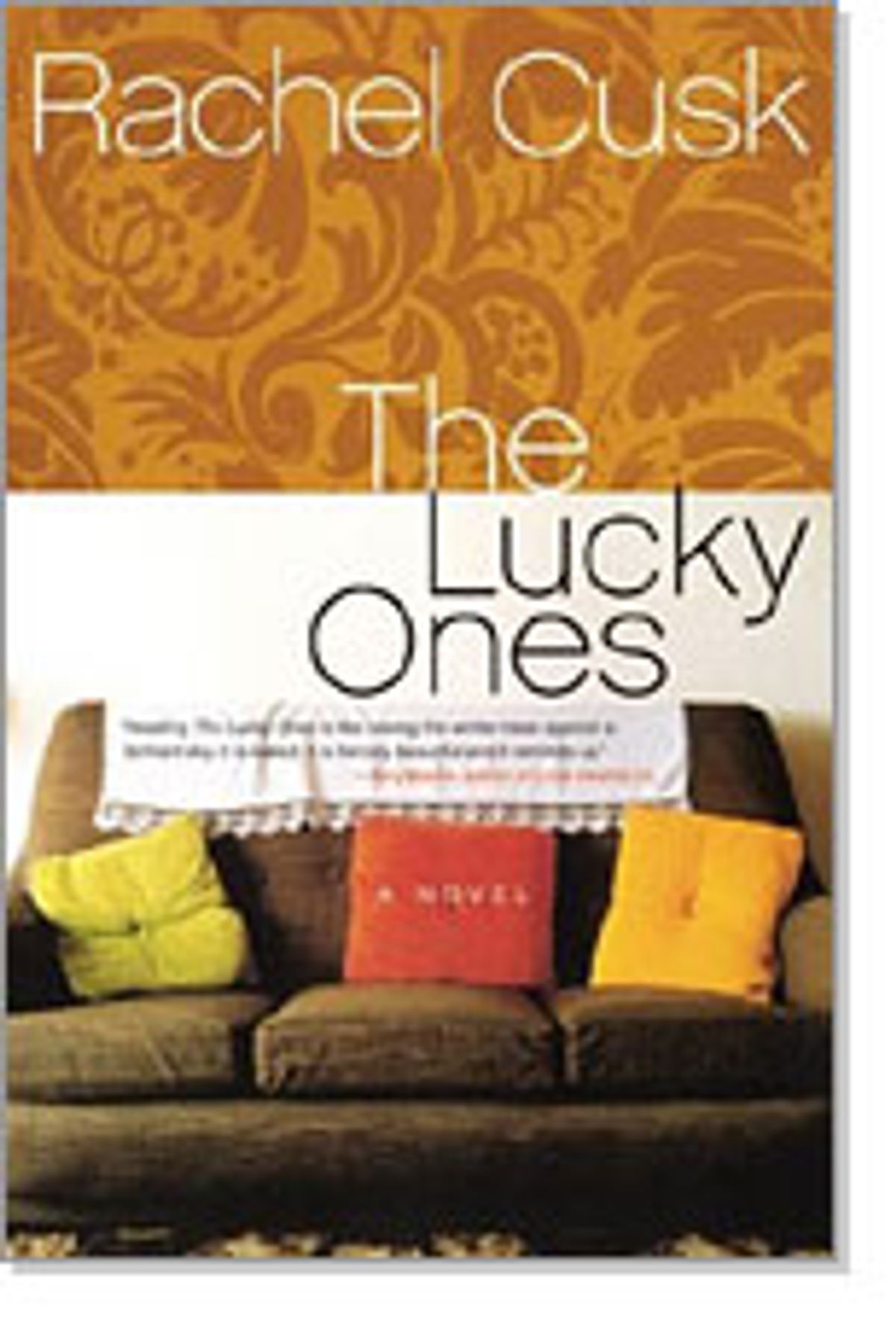
Rachel Cusk's newest novel, "The Lucky Ones," seems at first like an exercise in contradictions. The book's structure seems more like a loosely connected short-story collection than a novel, and the people it describes -- starting with a wrongly accused mother about to give birth in prison -- hardly seem lucky. But as one moves through Cusk's elegant, assured prose, it becomes clear that the book embodies both title and type in very a deliberate way.
Cusk creates a small set of characters whose inner lives and shared turmoil are played out mostly within the polite swamp of the English middle class. The book is mostly set in and around Ravensley, a tiny English country village; the inner landscape it explores is the rough terrain between parents and children. It plays, too, with the elastic and very relative notion of what it means to be lucky.
The novel begins with the story of Kristy, an expectant mother still in the early months of a 10-year prison term. Her pregnancy is her great pride and source of hope; it insulates her from the experience of the place: "She was the only person in this prison who had something. The other women's bodies were flat and lonely: punishment brutalized them, wore them out, because there was no giving here, no life, just time being taken away. Because of the baby, Kristy still lived in time." Through a series of remembrances, we get the idea that she is innocent of the murder charge that has sent her here, and that she is the victim, at least in part, of class stereotypes and misunderstanding.
Through Kristy's story, we learn of Victor Porter, her lawyer, and his wife, Serena, who writes a popular newspaper column about family life. It is their story that gives the rest of the novel a thread. Victor is dying of cancer, and his illness progresses steadily through the various stories; Serena's column is mentioned at some point by almost every character we meet along the way. The book ends again with Kristy, though this time she is connected to another character, completing the loop.
Beyond Victor's story, there is little here to speak of in terms of concrete plot. As we move from story to story -- the novel's structure is reminiscent of the films of Robert Altman or Paul Thomas Anderson -- Cusk seems mainly concerned with having characters express their entire lives through small, often mundane stories. This is not to say their stories are insignificant -- marriages crumble, people die, babies are born and taken away. Each of the five chapters that comprise the book is given to a particular story, varying in tone and voice. Only one, the third chapter, is written in the first person, from the perspective of one character's unnamed sister. The majority of "The Lucky Ones" is given over to small exchanges and private tragedies, but without the narrative structure of a "typical" novel. Reading the book is somewhat akin to playing some version of the "Six Degrees of Separation" game, or surfing through someone's Friendster profile -- everyone is connected to everyone else in obscure ways.
Despite all this, "The Lucky Ones" could hardly be said to be about the Great Web of Life that weaves us all together, or some similar cliché. The overlapping connections here are mostly a formal matter; the real ore of the book is the narration of interpersonal experience, its power in the sharpness and insight of Cusk's writing. She is a master at evoking the occasional strangeness and confusion of consciousness. Martin, whom we follow in the second chapter, thinks back on a vacation with his wife and feels "he had experienced those moments it seemed to him now unconsciously; it was as if his awareness were something of a very recent provenance, a new blight. He could not think without knowing that he was thinking, could not be without this sense that he was witnessing himself from a critical distance."
Cusk's characters are sharply aware of the obscure dynamics of interacting with one another, observant of the subtle dimensions of family relationships. Her crowning achievement here is the character of Mrs. Daley, an anxious mother of grown children whose peculiar mixture of stubbornness and decorum may remind some of the British series "Keeping Up Appearances."
It may sound as if this book makes for heavy reading, and while in places there is much darkness, there is also much humor here, particularly in the section with Mrs. Daley. "The Lucky Ones" is a small masterwork, a bright gem that illuminates the extent of Rachel Cusk's considerable abilities.
Shares