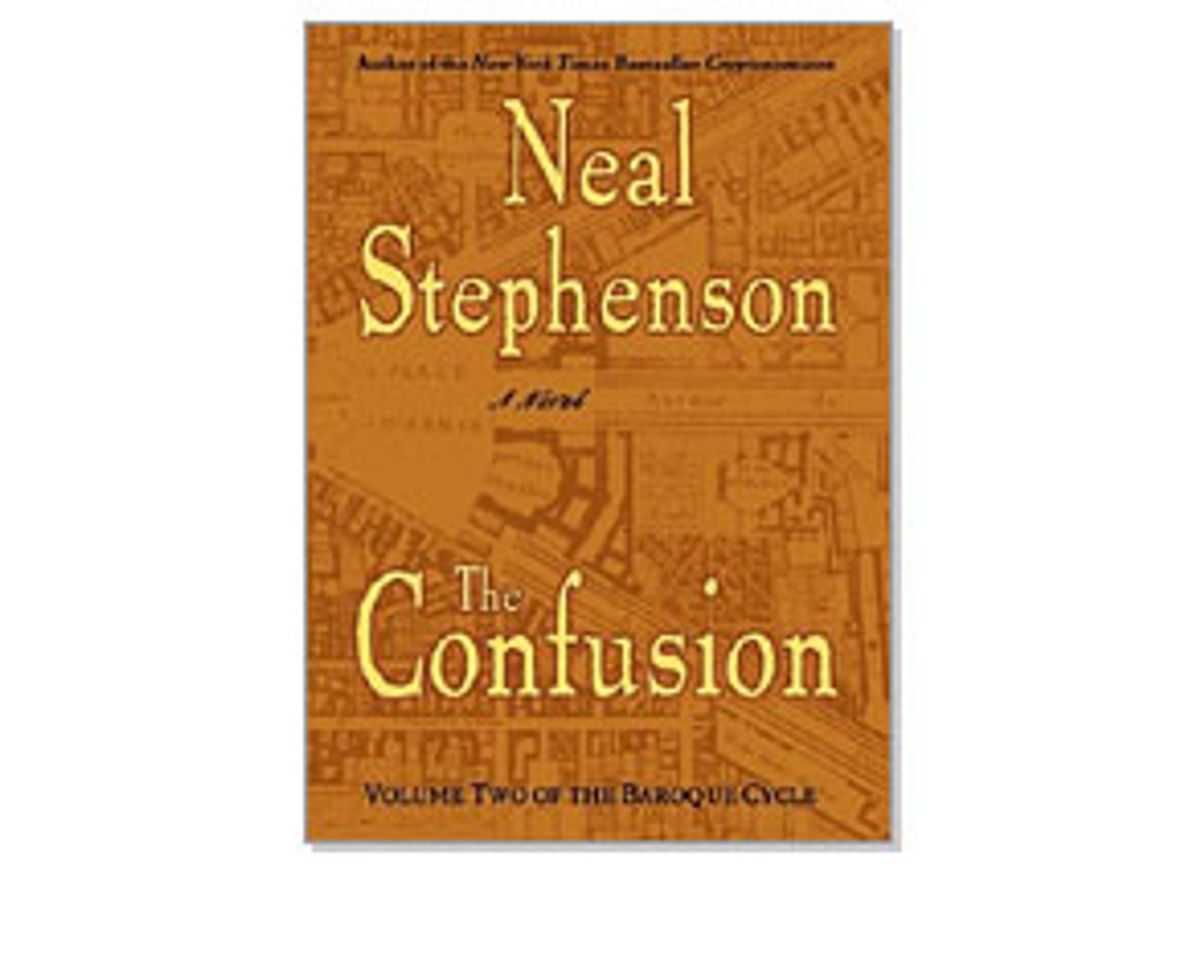
The arrival of "The Confusion," the second installment in Neal Stephenson's mammoth "Baroque Cycle" saga, presents some problems for a reviewer. No one is going to tackle this 800-page volume who hasn't already read, and enjoyed, the first, "Quicksilver."
But if you didn't like the first installment, oppressed by its seeming plotlessness, its profusion of minutiae about life during the late 17th century, and its endless disquisitions on Puritan religious life and the genealogical interconnections of European royalty, then no matter what the reviewer says about the second, you're still unlikely to give it a go. One is tempted, then, to merely repeat the quick and dirty summary offered by a reviewer at the geek news Web site Slashdot: "if you liked 'Quicksilver,' this one is better; if you didn't, don't bother." 'Nuff said.
But maybe there is a third category -- readers who were frightened by the lukewarm reviews of "Quicksilver" and have been waiting, nervously, to hear reports on "The Confusion" before diving in. Readers who require clear evidence that there is, actually, a plot, before they will commit to a project that, when finished, will be about as long as Proust's "Remembrance of Things Past" and will include almost as many digressions and side journeys.
Plunge away! "The Confusion" finally does start to connect the dots, and where "Quicksilver" bogged down, "The Confusion" leaps nimbly forward, like the hero Jack the Vagabond King, hopping from crocodile head to crocodile head as he attempts to survive the Trial of Ordeal ordained by the Ceylonese pirate Queen Kottakkal. But be forewarned, the entire "Baroque Cycle" is for those who are unafraid of complexity, delight in overabundance, and are willing to wallow in Stephenson's excess. Because, when it comes to excess, Stephenson has a lot to share.
"The Confusion" is split equally between the exploits of Jack, and Eliza, the slave-turned-Duchess-of-Qwghlm, both of whom were key players in "Quicksilver." There is far less of Daniel Waterhouse, the natural philosopher, would-be computer programmer, friend of both Isaac Newton and Gottfried Wilhelm von Leibniz, the mathematical geniuses who figured so prominently in Vol. 1. Consequently, in "The Confusion" there is less pondering of the structure of the universe, the meaning of God and free will, and a hell of a lot more action.
When last we left Jack, he was dying a painful syphilitic death while chained to an oar as a galley slave. It does not in any way spoil the book to note that Jack is back, and neither dead nor insane, since his new adventures start on Page 1. But even to summarize his travel itinerary in "The Confusion" requires nearly a novella; Jack spends quality time bouncing around the Mediterranean, stealing gold in Cairo, laboring as both a peon and a king in India, gallivanting in Japan and the Philippines, and being imprisoned in Mexico. Our boy Jack, he gets around.
If one could argue that "Quicksilver" was about the birth of the scientific method and the application of Reason to unlocking the mysteries of existence, then one could also say "The Confusion" is about money. Money, from the gold and silver mined by the Spaniards in the New World, to the letters of credit used to broker major transactions in the Old. Money, as a concept breaking free of hard currency, but also in its concrete essence -- as with "Cryptonomicon," the novel that the "Baroque Cycle" is a prequel to, the fate of a trove of gold bullion is central to everything that happens.
For while Jack is zipping around the world as if lashed to a globe-trotting roller coaster, Eliza is immersed in French court intrigue and experimenting with the new forms of finance that are maturing in this early Enlightenment era. The Enlightenment, it turns out, wasn't just the birthing ground of modern science and mathematics, but also of modern finance. Stephenson is as fascinated with the evolution of the concept and practice of "credit" as he is with the sword-and-piracy shenanigans of Jack. And he is equally fanciful in his treatment of both.
The application of excess to everything he contemplates, a kind of writer's Midas touch that is essential to his success, is Stephenson's calling card. At one point Eliza is entrusted by the French court with brokering the purchase and delivery of timber for the purpose of building up the French Navy. This requires a detailed discussion of the convoluted evolution of a system of credit between merchants in the city of Lyon, as well as a description of the obstacles faced in attempting to ship timber down the river Loire. One would think this a dry subject, but it becomes an exercise in madcap mayhem in Stephenson's hands, a primer in the establishment of financial systems, and a farce.
Stephenson has always excelled at pushing to the limits of absurdity. Hiro Protagonist, the pizza delivery man who kicks off "Snowcrash," Stephenson's great breakthrough novel, has access to pizza delivery technology that is deliciously ludicrous in its complexity and conception. What Stephenson seems to be telling us throughout the "Baroque Cycle" is that the actual way things really happened -- the way systems of credit were created, or timber delivered -- is just as kooky as anything that a fabulist could concoct out of the wild speculation of his or her own mind.
And yet, there are also signs in "The Confusion" that reality is being bent out of shape in ways that are more akin to Stephenson's past as a science fiction writer than his present as a historical novelist. Not least is the recurring involvement of the immortal Enoch Root, and the spooky plans that Isaac Newton has for the very special gold he and his cabal of alchemists are obsessed with. There is a gathering sense of mystery, of conspiracy, and anticipation of even greater things to come.
And through it all, so, so much happens. Kidnapping, murder, torture, war, poison, treachery, romance and despair: It is a romp, and for those who enjoy it, the prospect of a third, concluding volume due to arrive this October is an opportunity for salivation.
Shares