
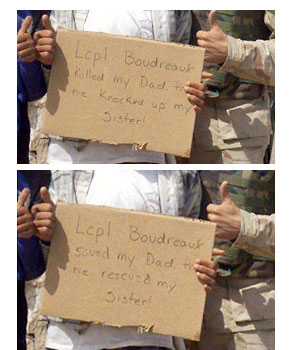

In early April, Ibrahim Hooper, the communications director for the Council on American-Islamic Relations (CAIR), received a mysterious photograph in his e-mail in box. The picture shows a white man dressed in military uniform standing with two dark-skinned boys in what appears to be a desert setting. Behind them is a ramshackle structure, perhaps a cabin or a makeshift bunker. The man and the boys are under this structure’s lean-to roof, posing, happily, for the camera. The man grins, the boys smile shyly, and all flash a thumbs-up sign. Despite their apparent mirth, however, something is amiss with the scene. One of the boys is holding up a piece of cardboard on which, in black marker, is scrawled a chilling message: “Lcpl Boudreaux killed my dad. then he knocked up my sister!”
Although the picture contains no clues to the scene’s location or date, to Ibrahim Hooper and CAIR — an Islamic rights group that opposed the war in Iraq — the story the image told seemed clear: The photograph shows an American soldier ridiculing two Iraqi children by making them hold up a sign they don’t understand, CAIR concluded. “If the United States Army is seeking to win the hearts and minds of the Iraqi people, this is the wrong way to accomplish that goal,” Nihad Awad, CAIR’s executive director, said in a press release issued on April 2.
In response, the military, which determined that the soldier in the picture was a Marine reservist — Lance Cpl. Ted J. Boudreaux of Thibodaux, La. — launched an investigation. News of the probe sparked a small outcry against Boudreaux; his local newspaper said he had “embarrassed himself, the Marine Corps and, unfortunately, his home state.”
But the anti-Boudreaux fulmination appears to be have been, at the very least, premature, because nobody can determine whether the picture CAIR received is authentic. Boudreaux has told the Marines that the photo is not real. And, indeed, just as the military’s investigation got underway, several other versions of the picture began popping up online. Some were obviously doctored — one version, posted on a Usenet newsgroup, has the boys holding a sign that reads, “We wanna see Jessca Simpson!” But at least one other picture found online appears just as real as the image CAIR received — and this one has the boys holding a sign with a decidedly friendlier message: “Lcpl Boudreaux saved my dad. then he rescued my sister!”
Which picture is the real picture? It appears impossible to tell — even experts in digital imaging are cautious in venturing a guess.
The Boudreaux story illustrates, once again, the emerging weakness of photography in a digital age. There was a time when photographs were synonymous with truth — when you could be sure that what you saw in a picture actually occurred. In today’s Photoshop world, all that has changed. Pictures are endlessly pliable. Photographs (and even videos) are now merely as good as words — approximations of reality at best, subtle (or outright) distortions of truth at worst. Is that Jane Fonda next to John Kerry at an antiwar rally? No, it isn’t; if you thought so, you’re a fool for trusting your own eyes.
Some photographers welcome the new skepticism toward images; it’s good that people are learning not to automatically believe what they see, they say. But many fear that we’re losing an important foothold on reality. Without trustworthy photographs, how will we ever know what in our world is real?
“One of the founders of Doctors Without Borders once said, ‘Without a photograph there is no massacre,'” says Fred Ritchin, a professor of photography at New York University. “You can say Tiananmen Square happened — there was a video, there was a massacre. But if we typically disbelieve the evidence of a photograph, then when the Chinese government says there’s no massacre, what are you going to hold up against that?”
CAIR received its version of the Boudreaux picture in an e-mail from a subscriber to its listserv — in other words, someone who likely shares the group’s point of view regarding the war. Beyond that, CAIR has no idea where the picture came from. Yet the group’s press release reads as if CAIR is certain of the photograph’s authenticity. Nowhere does CAIR suggest that there may be some reasonable explanation for the scene in the picture, or that the image could be a complete fabrication. Instead, the group’s director implores the government to “take action to let military personnel know that such offensive behavior harms America’s image and will not be tolerated.”
Did CAIR jump the gun? Perhaps. But it’s hard to blame the group; this is the power of a photograph. Maybe CAIR could have been more cautious, but as Rabiah Ahmed, a spokeswoman for the group, points out, CAIR has no way to determine whether a picture was doctored. And caution is hard to summon when you’re faced with something so real. Since before the war in Iraq began, CAIR has been warning that an invasion would “harm our nation’s image and interests in the Middle East and throughout the Muslim world.” Now, here was a picture that appeared to prove just how American soldiers were hurting our standing in the Muslim world. Of course CAIR believed it was true.
This is how it goes with pictures. The Internet, many of us know, is mostly garbage. You’re not supposed to believe anything you see online. CAIR probably knows that. Still, every so often a picture or a video pops up on the Internet that is so compelling — so unbelievable — that you can’t help but believe it. You want to believe it. You want to believe that George W. Bush (or Bill Clinton) didn’t have sense enough to remove the lens cap before looking through a pair of binoculars. You may want to believe that Tom Daschle pledges allegiance to the flag with the wrong hand, or that Bush reads books upside down. A series of pictures that appears to show the Israeli police summarily executing a Palestinian may confirm your worst fears about Israeli justice; if it does, you’re going to believe what you see. And if you already suspect that the American military is doing much more bad in Iraq than good, your reaction to a picture of a Marine cruelly mocking Iraqi children will be predictable. You would, as CAIR did, err on the side of it being true.
In an age in which a picture is never quite what it seems to be, the opposite reaction — one of complete skepticism when faced with a photo you desperately hope is fake — is also evident. Immediately after CAIR sent out its press release, right-wingers at the Free Republic discussion site began picking the picture apart, looking for flaws in its design. Some pointed out that the soldier appeared to be wearing Army fatigues, which didn’t fit with the Marine Corp’s ranking of lance corporal. Many also said that the text on the sign seemed digitally manipulated. “I’m no handwriting expert, but this writing appears a bit too curvilinear for someone who’s a native user of the Roman alphabet,” one person wrote. But beyond anything in the image, for many Freepers the biggest clue that the picture was fake was that CAIR was saying it was real. The Freepers don’t trust CAIR; why should they trust a picture that it says it received by e-mail?
Several Freepers created their own doctored versions of the photograph in order to show how easily digital images could be manipulated. But all of their home-brew photos were pretty much obviously doctored. Indeed, of all the alternate versions of the Boudreaux picture to show up online, only one (besides CAIR’s version) seems believable — the one that claims that Boudreaux “saved” the boy’s dad and “rescued” his sister.
The source of this image is a mystery. It seems to have first been posted on Image Dump, a site that allows people to submit pictures for others to rate. The picture was posted anonymously, but was accompanied by this caption: “Grateful Kurdish children thank a marine, Lcpl Boudreaux. An obviously doctored version of this photo with an offensive statement clumsily pasted on has been floating around the internet as part as some sort of cowardly smear campaign. Let’s hope Boudreaux gets to tell his story and how he helped this family.”
The caption is signed by someone who calls himself doggod91. Doggod91 seems to be the same person who runs a blog called Heretic 2004, a site that espouses a curious blend of political positions. The proprietor is a fan of John Kerry and an opponent of Bush, but he’s also a critic of “pacifists,” of Palestinians, and of antiwar types in general. Interestingly, doggod91 also likes Photoshop tricks.
Several experts, including those in Salon’s art department, could not say definitively which picture — doggod91’s or CAIR’s — was real. Some believed that the one with the “positive message” was authentic; others believed just the opposite. Almost everyone suggested that both could be fake.
The Marines say they have called in the Naval Criminal Investigative Services for help in the investigation of the picture, and detectives there could finally get to the bottom of the story. Digital forensics is said to be a new science, but there has recently been much interest in the detection of forged digital pictures, and some tools provide hope in the effort to pin down fakes. For instance, Hany Farid, a computer scientist at Dartmouth College, has been developing ways to analyze the actual code that makes up a digital photograph in order to check its authenticity; altered images can look quite different, statistically, from natural images, Farid has found. Other researchers have come up with algorithms for detecting when one part of an image has been copied and moved over another part of an image, a popular method of forging pictures. (See a PDF of this research here.) It’s possible that NCIS could use any of these — and probably even more advanced — techniques in finding the truth behind the Boudreaux picture.
But until there’s a formal conclusion, your decision on the photograph would seem to come down to whom you trust. Doggod91 did not respond to several e-mail inquiries sent to the address posted on his blog, so it’s impossible to tell where he found what he calls “the real picture.” But given his politics, believing that doggod91’s photograph is authentic is at least as difficult as believing that CAIR’s is authentic, and you are free to choose whichever version of reality you’re happier with. This is perhaps the ultimate message in the controversy surrounding the Boudreaux picture: In the digital world, a picture isn’t assessed on its own terms. You are no longer responsible for believing your own eyes; only if you trust the person who produced the photograph should you conclude that it shows what it purports to show. Otherwise, you can guiltlessly dismiss it as a fake.
To some photographers, the new age of photographic uncertainty is an unsettling development. “My work is about witnessing my time and events,” says Ken Light, a veteran photojournalist and a lecturer at the University of California at Berkeley Graduate School of Journalism. “My career as a photographer has been based on seeing America through a lens that is critical of institutions and of the culture.” Among other things, Light has photographed the Texas death row, the poverty-stricken Mississippi Delta, and migrant workers crossing the Mexican-American border. His pictures are powerful precisely because they’re credible, because they’re real. If you’re a supporter of the death penalty, you can read 10,000 words on the horror and loneliness of death row and still come away unmoved, dismissing the whole thing as one subjective writer’s bluster. Stubborn as you might be, though, perhaps just this one Ken Light picture of a 21-year-old waiting for execution will jar you from your settled view. This is what attracts Light to photography. It’s difficult to shake criticism that comes through a camera, he says, because “people sense a deeper truth in photographs” than they do in other media.
But Light worries that the truth we see in photographs will diminish in a digital age. He has two nightmares: First, that fake pictures will be mistaken for true pictures, rattling the political discourse. But a scarier proposition for him is that, in the long run, people will start to ignore real pictures as phonies. When every picture is suspect, all pictures are dismissible, Light fears, and photography’s unique power to criticize will decline.
Light recently found himself at the center of his first nightmare. An old picture he took — a 1971 shot of John Kerry at an antiwar rally in Mineola, N.Y. — was swiped from the Web site of Corbis, Light’s photo agency, and seamlessly stitched with another picture from Corbis, photographer Owen Franken’s 1972 photograph of Jane Fonda at a rally in Miami Beach, Fla. Nobody knows who did it, but whoever it was had a good eye for doctoring. The composite photo, showing a thoughtful, appreciative Kerry next to a fired-up Fonda, was given a border, a headline, a caption and an Associated Press credit; it looks like an authentic newspaper clipping showing Kerry closely associated with Hanoi Jane, a woman hated by many of the veterans who support Kerry.
The composite image spread around the Internet with lightning speed, even catching the attention of some in the media; on Feb. 13, the New York Times reported its existence, describing the picture in detail but noting that its origins were “unclear.” It didn’t take long for Light, Franken and sites like Snopes.com — dedicated to debunking Internet rumors — to show that the picture was fake. Eventually, the record was set straight. As Light later wrote in the Washington Post, “The Internet has come as close as it gets to a correction. If you use a search engine to look for my Kerry picture now, you’ll find the hoax explanations before you see the photo itself.” But it still took some time to put things right, and perhaps too much time — what if the picture was found online just weeks before the election? Fred Ritchin, of NYU, has a specific case in mind: “Seriously, what if there’s a picture of one or another political candidate in bed with a woman who’s not his wife two days before the election?” he asks. What if its authenticity was impossible to determine quickly? (Ken Light still has the original negative of his Kerry photo, but modern photographs, taken on digital cameras, might not provide this handy way of proving which is really the “original” picture.) How would society deal with such a political earthquake?
If a doctored photo ever does lead to the defeat of a political candidate or some other disaster — puts the wrong guy in jail, say — one immediate consequence might be a quick decline in the trust we have in pictures. And to Light and Ritchin, people in awe of the power of photography, this is a terrifying thing. In the absence of trustworthy photos, says Ritchin, “The institutions in power will increase their power.” Then he adds, “Look at Rodney King. For years and years there was brutality in the LAPD. It wasn’t until the video came out that we all knew about it, because we saw it.” Light echoes that idea. “It’s one thing when it’s a silly photo, but when it’s massacres, executions, all those things, it becomes very dangerous. How do newspapers know when they see something if it’s real or not? Let’s say I’m at a newspaper and I get this picture of this cop beating up this guy, which could be a great picture. But what if it isn’t real? Should I run it?”
There are already signs that our trust in pictures is slipping away. People used to get fooled all the time by nude pictures of celebrities online, says Ed Lake, also known as the Fake Detective, a man who dedicates much of his time to pinning down the fakery behind purported naughty pictures of people like Gillian Anderson and Sarah Michelle Gellar. (Lake was the subject of an entertaining profile in Wired recently, titled “These Are Definitely Not Scully’s Breasts.”) Now, Lake says, “Most of the e-mail I get is about real pictures. Now they automatically think it’s fake.” David Mikkelson, who, with his wife, Barbara, runs Snopes, said something similar. Many times when people ask Snopes to review photos, the pictures turn out to be real, Mikkelson says. What’s actually wrong with the pictures are the descriptions that are added on to them online, sometimes out of malice but mostly just as a guess. “The pictures were thrown out on the Internet and people have no idea what they mean, so they just make up a description,” he says.
While photographers like Light and Ritchin aren’t pleased that the Internet has caused the public to question every picture, there are some photographers who would welcome the public’s wary eye when it comes to pictures. For too long, these photographers say, pictures have been burdened by a need to provide a level of fidelity with the real world that is actually beyond their reach; pictures need to be liberated from this constraint, they plead. “Photography is only the medium that is a witness to itself,” says Pedro Meyer, a celebrated Mexican photographer who leads a movement that embraces, rather than eschews, digital manipulation. “Photographs say, ‘You can trust me because I am.’ What other medium does that?”
Meyer would like photographs to be treated like any other bit of information — in an ideal world photos would be given as much credence as words. “We don’t trust words because they’re words, but we trust pictures because they’re pictures,” Meyer said in an interview with Wired several years ago. “That’s crazy. It’s our responsibility to investigate the truth, to approach images with care and caution. People need to realize that an image is not a representation of reality.”
Meyer is remarkably sanguine in the face of Ritchin’s nightmare scenario — how will we ever know a massacre has occurred if we don’t have believable photographic proof? “If you take my logic of using photographs along the same line of thought as using words, then look how easy it becomes,” he says. “What do you do with text? You have to have other sources to confirm that something happened; if you don’t have other sources to confirm something, you can’t conclude it happened. Now enter into the picture this fact — over the last 12 months there have been more cellphones with cameras sold than all other cameras, digital or analog combined. Cameras are becoming ubiquitous. We have the possibility for the first time to cross-reference everything, something that was never done before. It doesn’t matter if the picture is a shitty little picture, it’s a reference.” And if you have enough references, it doesn’t matter if one person doctors an image; if a hundred — or maybe a thousand — cellphones say a massacre occurred, it probably happened.
In a cross-referenced, constantly photographed world — a thing that might scare you but that is probably becoming inevitable — we would probably have better proof of what actually happened in an important event than we do today, Meyer says. A single photographic image is important, Meyer says, but we can’t rely on it to tell a whole story. The Rodney King video was important, but we should note that it did not in fact prove anything about the LAPD. In court, the police officers accused of beating King were acquitted, despite the video. The video may have been horrific, but jurors, at least, seemed to decide that it didn’t convey the whole truth of what occurred that night. The video was just one slice of reality; the jury seems to have considered other things at least as important as the pictures — what happened before the camera was snapped on, what happened outside of the camera’s field of view, what happened in people’s minds.
And in the end, it’s perhaps this sense of caution that we need to bring to the mysterious photograph of Lance Cpl. Boudreaux. As Snopes’ Mikkelson says, “Whether or not the photographs are real in a physical sense is only part of the story.” The rest of the story is what happened outside the frame, what the Marine and the boys and whoever took the picture (whichever picture is real) were thinking at the time. Why are they there, near that hut? Why is the kid in the Real Madrid T-Shirt not as happy as the boy with the sign? Is the whole thing a joke? If so, who is in on the joke? Does one of the boys know what’s on the sign? Are the boys being made fun of, or is the soldier, or are we? “You can’t know what’s going on without knowing the rest of the story,” Mikkelson says.
