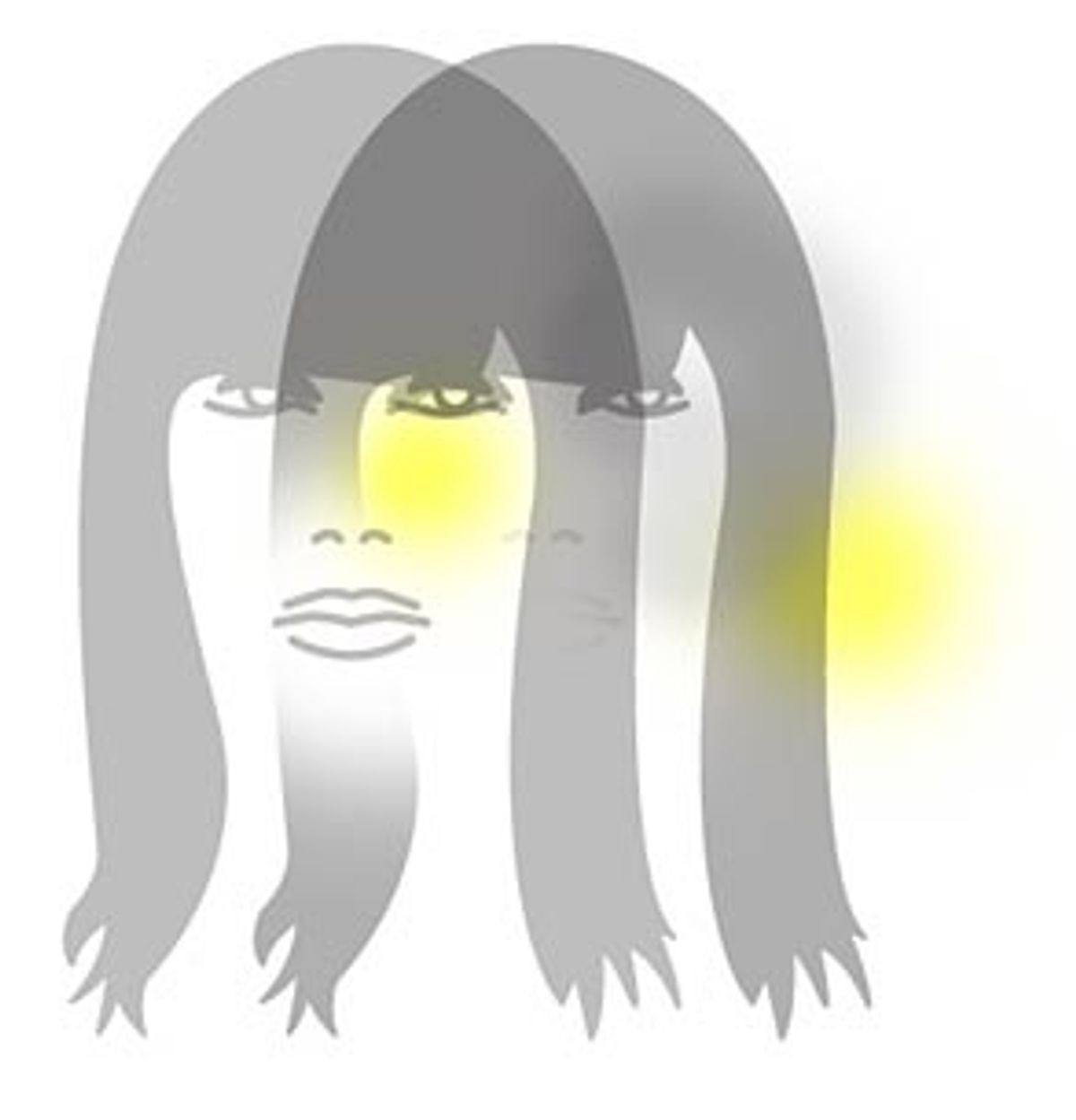
I've been a human specimen going on twenty years now, ever since my sister and I were twelve, when my parents enrolled us in California State University's Twin Study. Every four years the two of us, along with several hundred other pairs of identical twins from California, meet in the same depressing chain hotel in Fresno to be tested, prodded, and poked. "YOU ARE SPECIAL!!!" begins the notice for every one of these meetings. Whoopee. I'm special. Not because of anything I've done, no, of course not. I'm special because I'm genetically identical to another person, a person I haven't seen in four years, since the last meeting of the California Twin Study.
Shall I enumerate the many hates associated with this event? First, I hate the hotel. In particular, I can't stand the central atrium; it gives me a bad eighties feeling -- of wine bars, terrycloth sweatbands, neon flamingos. It reminds me of that horrible era (between the first and second meeting) when Samantha and I were in our early teens and it was first becoming clear that we were not the same. Of course, we were identical genetically; what's more, we shared a placenta; but inside, in our brains, souls, and hearts, we weren't the same. This became apparent slowly, even though I knew what Samantha was going to say before she said it, and I knew which boys she'd like before she met them, and we always got up at the same time in the night to pee, among other uncanny similarities. Second, I hate the rooms, with their big, smoked glass windows overlooking the swimming pool. The glass heats up in the sun and then ticks all night as it cools. I hate the bar, tucked in a dark hole under the escalator, smelling of smoke, though smoking is forbidden in California bars. That's third. Fourth, I hate Fresno, a sad, crumbling town, surrounded on all sides by endless rows of crops, like an island in a vegetable sea. I hate the twin researchers, who for the most part are cheerful and kind, dorky in the way of tenured academics -- ten years behind in fashion -- and who do not have dark doubles, I'm sure of it. But most of all, what are we on, six? Yes, I hate seeing Samantha, my twin sister, once every four years.
"Then don't go." This advice comes from Ivan, my new husband. "If you dread seeing your sister, don't torture yourself. Stay home."
"That's a good idea," I reply with conviction, though I've already bought our plane tickets and reserved a suite in the horrible hotel. "What about the money?"
"They can shove it," says Ivan. He's older than me by fifteen years, solid and rich from practicing contract law all day long in a high-rise building. Every morning he shaves his mostly bald head so that it's totally bald. I find him handsome, in a sinister way. Of course it's true that he may not be the most benevolent person in the world. But he's kind to me. And there is much to be said for a man like Ivan, a man who can make me feel very safe even while driving very fast.
"What about science?"
"Fuck science." Ivan sits on the bed and puts on his shoes. A well-dressed man, a successful man, maybe even a little ruthless. I try not to think about that too much, but I come across the evidence. A nasty, anonymous letter in the mailbox. A stone through the front window. And then there's his son, Jason, from his previous marriage, who stays over with us one weekend a month. He is, as far as I can tell, a complete monster. But maybe this has nothing to do with Ivan. Thirteen is never a good age.
"I already bought us plane tickets," I confess.
"Okay, if that's what you really want," says Ivan, putting his jacket on, then coming closer and putting his arm around me. "We'll go together." I follow him down the stairs. In the hall he picks up his briefcase, kisses me on the forehead, and sails out the front door. I stand in the doorway in my bathrobe, waving like a nineteen-fifties housewife. "Call Lana," he yells back, "and let her know the details."
This is the moment I love, right after Ivan leaves for work. I love our big house with the old hardwood floors that gleam like honey in the sunlight. I love the eight thousand dollar couch in the living room, with its thick down cushions and velvet upholstery. I love the mesquite wood table in the hall where we pile our mail. I love having it all to myself and knowing that nothing, nothing can ruin our life. Our safe, comfortable, happy life. Later in the day, I call Lana, Ivan's secretary, and tell her about the trip to Fresno. Lana keeps Ivan's schedule, business and social, and has since before we met.
"He has Jason that weekend," she says.
"Shit."
"So go by yourself."
"I don't want to go by myself," I say. And then, to my surprise, I say, "I want him to meet my sister. Can't Jason switch weekends?"
"Jason cannot switch weekends."
"Are you sure?"
"Honey," Lana lowers her voice, "you should see the divorce agreement. It's like a phone book."
"Oh," I say. I can well imagine. I have, after all, seen my prenuptial. "Then what should we do?"
"Give me your flight number," replies Lana, "I'll get Jason a ticket too."
- - - - - - - - - - - -
YOU ARE SPECIAL!!!
OVER THE TWENTY-YEAR LIFESPAN OF THE CALIFORNIA TWIN STUDY, WE'VE GATHERED VITAL INFORMATION THAT HAS BEEN OF GREAT BENEFIT TO THE FIELDS OF SCIENCE, SOCIAL SCIENCE, AND MEDICINE. SOME OF THE DATA WE'VE COLLECTED FROM OUR PARTICIPANTS HAS BEEN USEFUL IN OUR UNDERSTANDING OF:
WE ARE DELIGHTED BY YOUR CONTINUING PARTICIPATION IN THE CALIFORNIA TWIN STUDY AND LOOK FORWARD TO SEEING YOU AT OUR NEXT MEETING.
The following weekend will be dizygotic, fraternal twins, the control group. Our weekend is monozygotic, identical twins, the freaks. Already the hotel lobby is filled with pairs of people in their thirties who look either somewhat or exactly alike. Sometimes it's the same face on different bodies -- one twin is fatter than the other, or one twin has taken up body building. Often it's the same face with different hair color, hair length, facial hair, hair anything. One twin is an Elvis impersonator -- need I say more? Then there are the twins who look exactly the same. It's strange to see them milling around the lobby, talking in pairs or greeting each other with bear hugs. Like most people, I'm not used to seeing identical adults. They all look gigantic. Twinning is something that one encounters in children or babies, little girls with matching dresses, adorable boys with matching caps; adult twins seem aberrant, even to me. Yet here we are. Some of us even move the same way, or use the same gestures. Our brains are wired up the same. It's a trick of genetics, a dirty trick.
I go to the registration desk at the far end of the god-awful atrium and pick up my name tag. It says MZ: AMANDA 173. That's me, Monozygotic Amanda.
"Has MZ Samantha 173 picked up her tag yet?"
The clerk tells me that she has not. It's perpetually up in the air, of course, whether Samantha will even show up for these weekends. But she always has. She generally needs the money.
Jason and Ivan are on the lobby couches, ignoring each other. "This place sucks," Jason says. Indeed, the hotel remains as noxious as ever, though they've painted the exterior pink since my last visit.
"Maybe you'll like the swimming pool!" I smile brightly.
Jason smiles back. "Gee whiz, Mom, maybe I will!"
"Don't call her Mom," Ivan says.
"Why not? I thought you'd be happy if I called her Mom."
"Enough. Just quit it."
Ivan is in a suit. Ivan is always in a suit. Jason is in baggy shorts that seem to be swallowing his beanpole frame -- all knees and elbows. He carries his belongings in a paper bag with the name of a health food store on it. In this sad detail I see a thumbnail sketch of his mother, a harried, distracted, slightly overweight woman Ivan ditched around the time he met me. Jason is also carrying a skateboard and a headset CD player turned up so loud that I can hear it once the elevator doors close. If I'm not mistaken, there's a woman screaming the words "fuck the pain away" into his ears.
"What's with all the stupid farms?" Due to the CD player, Jason is yelling.
Ivan stretches the headphones away from his head. "That's where your food comes from," he tells him. "Where did you think?"
Jason looks like his dad, but softer, moppish, due to his age and also the fact that he has hair -- which is greasy and falls into his eyes. I don't know how he manages to be simultaneously sullen and hyper -- it's some trick he does with hormones and Clearasil. In the elevator, I can feel him staring at my breasts. I'm relieved when the doors open. We all tromp down the hall. Lana has managed to exchange our suite for two adjoining rooms. Ivan ushers Jason into his room and shuts his door. Our room sports an intriguing blue theme. Blue bedspread. Blue carpet.
"A romantic weekend in Fresno," says Ivan, pulling me close, "just the three of us."
We've only been married six months so Ivan does a lot of this, pulling me close and so forth. I like it, of course; I love his aftershave. Though at this moment I find myself less appreciative of Ivan and more focused on an idea: I want to show him off to Samantha. Oh God. See how normal I am? See how nice and rich and stable and normal? Without a knock, Jason barrels through the door and jumps onto our bed. He's wearing his swim trunks, and his skinny back is dotted with acne. He rolls onto his back in a kittenish way. "Does your sister look like you?"
"Pretty much. Her hair is usually different." I don't say anything about our breasts, of course. Mine are bigger. I had an operation.
"Hey Dad, don't you think that's weird?"
"No."
"I think it's weird."
Ivan adopts a weary tone. "Okay Jason, why do you think it's weird?"
"Well, you married her. Maybe you'll be attracted to her sister. Maybe you'll want to grab her ass like you're always grabbing Amanda's."
"Enough!" shouts Ivan. "Get out of here. Go to the pool." He chases Jason out and slams the door to the adjoining room.
He just wants your attention, I say to myself, but I don't say it to Ivan. I'm not about to intercede on the little monster's behalf. Ivan takes some work out of his briefcase and settles into a chair. He hasn't come along on this trip just for pleasure -- that wouldn't be like Ivan. He has some business to do in Fresno, some deal with some client or some building or some pile of money. Ivan doesn't bother to explain the mechanics of his firm's doings to me. I find this slightly romantic, as if he's working for gangsters. While he skims his papers I give the registration desk one more call. No, Monozygotic Samantha 173 has not checked in. Not yet.
My sister and I used to have better days. That's one thing the twin researchers don't ask us about, though they ask us about many things -- our habits, states of mind, loves, and incomes -- and they take our blood and measure our brainwaves and so forth. But they don't ask about watching early morning cartoons together, laughing at all the same parts, or running apace through the oaks behind our house, or the perfectly synchronized water ballet routines we made up as little girls. They don't ask what it's like to wake up to one's own double image, realizing you've both just had the same dream about the ocean swallowing the shoreline. They don't ask about the intimacy, the incredible, terrifying intimacy. Or what it's like when it's gone.
- - - - - - - - - - - -
I feel restless, so I go down to mill about with the other twins in the lobby. Samantha is nowhere in sight. The Elvis and his non-Elvis twin are sitting on a couch, leafing through a photo album. My stomach is bothering me, so I go to the bar and order a glass of milk.
The bartender is puffy but pretty, an overfed farm girl in a polyester vest. She answers me with a "What?"
"Milk."
"What?"
"Milk."
We go back and forth about four times before I add, "It comes from cows." The researchers don't ask about this either. Do people understand you when you speak? The bartender tells me that I'll have to try the coffee shop. Instead, I wander out of the hotel, to the cavernous entryway -- a ribbon of sidewalk crouching under a huge concrete awning. And there is Samantha, sitting in an idling Impala, a boxy number from the sixties. She's smoking a cigarette and chewing gum, her hair streaked blond and clumped, like she's been driving all day. I guess she's been waiting for me. She slides over and opens the passenger door.
"Come on."
I get in and she puts the car in gear. That's all it takes -- just stepping off the curb, into a car, and it's the two of us once again.
"You know what I don't get?"
No hellos, no catching up. It's always like this.
"I don't get why there are no dog petting zoos." She rolls down the window and lets her arm hang out. "Then nobody would have to be responsible for one full time. We could just pay our money and go into a yard full of really nice, fluffy golden retrievers and dachshund puppies or whatever."
"Someone would have to clean up all the shit," I say.
"Not me. I paid my money."
I think about it. "That's actually kind of a good idea. There could be a cat section too."
Samantha tosses me a pack of cigarettes. I put one in my mouth but don't light it. It feels so easy, to just fall into things with Samantha. It feels so easy to just be half of her and let her be half of me. Everything else begins to get dimmer. I half-think of Ivan, back in the room, leafing through papers. I half-think of the twin researchers, sharpening their pencils, waiting to interview us in the morning. Question: Do people understand you when you speak? Answer: Only my sister.
"Check this out, up here on the left," she says. "Hair sperm."
There's a strip mall with a haircutting place called "Hair & Perm" beside the road; the ampersand has been placed unfortunately close to the word "perm."
"That's really funny."
"You always say 'That's really funny' instead of laughing."
"I know, because you always complain about it."
I lean against the car door and look over at Samantha. She's blonder than I am, which is new, and certainly grubbier, wearing jeans and a tank top vs. my tasteful little linen suit. As always, she has our long legs and thick hair and golden skin that tans out to a flat brown. We are nice-looking girls -- it's hard to mess that up. Though some years it seems like Samantha is trying her best to. She keeps her eyes on the road. I check her arms. They look muscular. Not bad, like they were last time, bruised with track marks.
"Do you think, since there's no aesthetic plan in the suburbs, like there was in Haussmann's Paris or Vienna or wherever, that this planlessness is Zen?" Samantha chucks her gum out the window. "Do you think the suburbs, with their lack of human design, are an expression of God's plan?"
"Well, a lot of suburbs are planned. There are master-planned communities, like Brasilia and all those retirement towns in the Sunbelt."
"I would like to be a slave in a master-planned community."
"That might be good for you."
"I could break out my leather underwear." Samantha has piloted us out of Fresno's dying downtown and into its thriving sprawl. The suburbs here look the same as the suburbs anywhere in the country -- the same stores, the same chain restaurants serving the same chain food. We're not the only clones.
"You know what I really wish?" There's a tremor to Samantha's voice. "I wish I lived in a world where nobody knew how they felt about anything."
"Really? That's weird. What would a world without feeling be like?"
"It wouldn't be a world without feeling," Samantha explains, "it would be a world where no one knew how they felt. No reflection. No self-reflection."
"No unhappy feelings."
"No guilt," says Samantha. "People would just do things and then feel really satisfied with themselves."
I think of Ivan, his brow serene after a day of cutthroat litigation. "You know how you just meet some people, and after five minutes you can tell they've never felt guilty their whole lives?"
"Boys!" she says.
"Yeah, for one, boys. Grown men. They're happy being jerks."
"And then we're all, 'I'm sorry, I'm sorry! I'm sorry everything isn't perfect. I'm sorry I'm not Shirley fucking Temple making everyone happy with my little face.'" Samantha is excited now, steering with one hand and smoking with the other.
"It's pathetic."
"I wish I had a cock. I read an article that said PMS killed Sylvia Plath."
"You've gotta admit, Sylvia Plath killed Sylvia Plath."
"Oh no. I don't gotta admit anything." Samantha grins at me, a too-big grin. Something is going on. We are in for a Samantha Moment. Samantha loves dramas, big, small, whatever. When we were kids, Samantha would always beg me to go first, but when it came time she'd throw an arm across me and bolt forward, itching to do something daring or stupid or just strange. Now she stops in the middle of a suburban neighborhood, in front of a row of identical houses with tiled roofs, typical Taco Bell-style architecture. I notice that Samantha has a piece of paper in her hand. It says:
FOUND: PUG
And then there's an address.
"Are you coming with me?"
"I guess."
Samantha leads the way to the front door of the house. She rings the bell and a middle-aged woman answers wearing the modern-day version of the apron: a sweat suit. Samantha smiles and begins to speak. Even to me, she sounds sincere. This has always been her great talent -- convincing people. She can talk her way into and then back out of any situation. I think it's what enables her to live without any fixed address or steady job, though I'm not really sure how Samantha lives these days.
"We lost him about four days ago," Samantha says, facing the woman squarely, looking her in the eye. "We had guests and they left the gate open."
"We found the dog five days ago," the woman says. She has a plain Midwestern face, no makeup; a practical face without time for foolishness.
"Monday?"
"Yes."
"That's when we lost him."
The woman seems suspicious of Samantha, but then she uncrosses her arms and half smiles -- she wants to believe. She wants to be taken in. "We thought it was a female."
"Yes," Samantha is loose, seamless when she lies, "I know, it's confusing. When we got her my sister kept saying she looked like a him, so finally we just named her Him." Samantha laughs. "Everyone gets mixed up."
What can the woman say to this? It's so ridiculous, I expect her to slam the door in our faces. But Samantha has something I don't have, something the researchers can't quantify -- charisma. I find it maddening.
The woman goes inside and comes back with a pug dog wheezing on the end of a red leash.
"Him!" exclaims Samantha. The dog trots over and licks her hand.
She thanks the woman and turns to usher the pug down the walk. It waddles to the car and hops in the front seat like an old hand. I have to shove it over to sit down. The dog looks around placidly, its froggy eyes bulging, its skin hanging around its compact body. It starts to pant.
"Check it out," she says, "these things cost about a thousand dollars new."
"Is that really your dog?"
Samantha looks at me and says, "That's really funny."
"No, really."
"It's your dog," she says. "I got it for you."
"I don't want it."
"Why not?"
"I just don't."
"Okay, fine. Then it's my dog." Then she puts her face in her hands and begins to sob.
Around 80 percent -- apparently that's my chance of having it too -- whatever Samantha has, bipolar disorder or borderline personality disorder or schizophrenia or depression or mania. Except she doesn't seem to have any of these things. Not really, not typically, according to the researchers -- well, according to a particular researcher, Kevin, a bearded sociology professor I captivated one evening at the hotel bar a couple of meetings ago. It's truly amazing, what an amicable one-night stand can accomplish. He's been my man on the inside ever since, a steady source of information. About me, of course, but mostly about Samantha.
"Samantha is just volatile," Kevin explained, at the last meeting. I wasn't married yet but he was; he had made it clear that our "romance" was over. That made me laugh. "It's not necessarily an illness."
"But how can she be so volatile when I'm not?"
"Well," he stroked his little beard, "the interesting thing we've learned is that monozygotic twins raised apart -- in different environments -- still have about 50 percent of their personality traits in common."
"Fine." I'm always impatient with Kevin's professorial tone -- just because he's the researcher and I'm the subject doesn't mean he's a genius and I'm a dolt. "Then twins raised in the same environment must have even more."
"That's the fascinating thing. Twins raised together also have about 50 percent of their personality traits in common." He raised his eyebrows -- a significant look.
"Okay, professor. Meaning what?"
"Well, most identical twins don't like to hear this, but we attribute the 50 percent variation to the fact that they were raised together." "Oh, I see. That 50 percent is us trying to be different from one another."
"Exactly. Trying, on some level."
"We stake our spot. I'm the good twin. Samantha's the evil twin."
"I wouldn't call Samantha evil, personally. She's prone to substance abuse. You may be too. She's more creative."
I reflexively cringed. I'd been hearing about her creativity my whole life.
"Okay. So I'm the boring one, and she's the scarf-dancer."
"Basically."
I remember thinking about this while Kevin chewed handfuls of bar peanuts and gazed around the room. He was short, with narrow hands and a baby face. The beard was a nice try, but even that couldn't deactivate his graduate-student air. The bartender had carded him.
"What if we had been one person? With our genetic sameness, but just one of us, without the other to react to. What would that person be like?"
"That's what happens to everyone else," Kevin said. "But you're a twin."
"Right," I said. "I'm special."
- - - - - - - - - - - -
Samantha and I drive back downtown without speaking, though she keeps crying for a while. She turns the car around under the concrete awning, then sits there behind the wheel, eyes red, staring at the instrument panel.
"Are you coming in?
"Maybe later." She keeps her hand on the pug dog's head. It's wheezing through its little stoved-in nose. I wonder if she'll ever get over this. I wonder if she's ever gotten over anything in her whole life.
"It's just not a good time for a pet right now," I tell her.
"No, that's fine." Samantha waves her hand.
"Call me in my room. I want you to meet my husband."
"You got married?"
"Yes, of course. I would have invited you if I'd known how to reach you."
"You got married? My God. Why?"
"Love," I say, but somehow it doesn't sound quite right.
Samantha keeps petting the pug. Something about her seems about ten years old. This makes me want to throttle her.
"Do you want to know why I'm naming her Diego?"
"Okay."
"Because she's bug-eyed and fat and a communist, like Diego Rivera."
"How do you know she's a communist?"
"The red leash. And she was free."
That night I lie in bed with Ivan's arms around me, listening to the hotel windows ticking. I don't know what happened to Samantha. She never called.
- - - - - - - - - - - -
If a statement is true or mostly true, as applied to you, blacken the circle marked T. If a statement is false or usually not true, blacken the circle marked F. If a statement does not apply to you, make no mark on the answer sheet.
1. I like mannish women.
2. If I could get into a movie without paying and be sure I was not seen I would probably do it.
3. The top of my head sometimes feels tender.
4. If I were a reporter I would very much like to report news of the theater.
5. Horses that don't pull should be beaten or kicked.
6. It's only natural for me to note the color of my bowel movements.
7. There is something wrong with my sex organs.
Every year, they give us the same ridiculous, ancient psychological test, the Minnesota Multiphasic Personality Inventory, and every year I try to pick answers I know Samantha will not pick. After all, we're supposed to have only fifty percent of our personality traits in common. And yet every year, according to Kevin, Samantha and I pick the same answers to virtually every question.
I'm struggling with number 4: "If I were a reporter I would very much like to report news of the theater." For me, the answer is F, I hate the theater. It's too slow. Samantha, though, always liked plays and even worked on one or two during high school, when she wasn't busy smoking pot with her stoner friends. But there's something about this question -- the way it feels like a pale attempt to sniff out homosexual tendencies -- that makes me think that Samantha would mark F in an attempt to be subversive, even though her true answer is probably T. Yes, that's it. I decide that Samantha will answer F; therefore I will answer T. My hand hovers above the bubble marked T. But wait! Since we always choose the same answer, I realize that this time I should invert my reasoning process now, at the last minute, and flop over to F.
F is the answer.
I answer each question via this rather laborious process, with the last-minute flop.
Afterward, I come across Kevin in one of the long, carpeted hallways of the hotel.
"Ninety-seven percent!" he says, holding up his hand for a high five. "Same as last time!"
"Damn it."
Kevin grabs my hand and veers into me. He keeps coming until he's backed me into a windowless room containing a table and a soda machine. Kevin looks at me. I look at Kevin. His narrow fingers are gripping my hand like squid tentacles.
"You two certainly are interesting."
I've become used to a kind of abstracted fondness from Kevin, so I'm surprised by his unstable, nonacademic demeanor -- magnified by a spray of wild eyebrow hairs I've never noticed. I wonder whether they've sprouted due to advancing age -- or did he give up trimming them? I ponder this while Kevin clutches me. Clearly, he's making some sort of play for me.
He leans in closer. "I could tell you things about your sister."
"Go ahead."
"I can't."
"Why not?"
"I signed a confidentiality agreement."
I laugh. "That never stopped you before." I pull my hand away.
"Yeah, well," he crosses his arms over his chest, "that was then. Things are different now."
"Why are you acting like this?"
"Like what?"
"Like you want to fuck me."
The blood rushes to Kevin's cheeks. "I never said that."
"You didn't say it."
"It's not that," he mops his sleeve over his face, "it's just this thing with my wife." He lets out a long sigh. "Our relationship is kind of rocky right now."
"I'm sorry to hear that."
"It's just this thing." Kevin stares at the floor. "I love her. I do. It's just that she won't perform certain sexual acts ..."
"Okay, stop."
"I really want to get this off my chest."
"I don't want to hear it."
"Amanda," Kevin extends a hand toward me -- tentacle fingers, imploring and threatening.
"What?" I'm already halfway around the table and heading for the door.
He has dark circles under his eyes. "You're so pretty," he says, in a rancorous tone.
I slide past him, into the hall.
- - - - - - - - - - - -
During the break for lunch, I find Ivan lounging by the pool. He looks relaxed and tan, splayed out with a Business Week by his side. He has lots of hair on his chest -- the emblem of the alpha male. Though quite a few people are using the pool, all the nearby chaises are empty. I attribute this to Ivan's formidable air; he carries it with him like a force field. But there are moments when it evaporates. Like when he plays the piano.
"Where's Jason?" he says.
"I have no idea."
"I thought you took him shopping."
"I didn't take him shopping. Why do you think I took Jason shopping?"
"Because you said so," Ivan replies.
"When?"
"A little while ago."
"I didn't say that."
"Yes you did."
Oh no. I think I see what is going on here. But Ivan would never fall for it. Besides, Samantha hasn't tried this for a long time, not since my high school boyfriend, Brian, the football player, bought himself a baby blue convertible.
"That wasn't me. That was my sister."
"Oh," Ivan says mildly, as though I'd just pointed out an interesting item floating in the pool.
"Don't you know me?"
"Of course I know you."
I feel so angry -- I don't think I've ever been so angry at Ivan. "She doesn't even look like me. Her hair is streaked, she smokes, she's thinner, she acts all ... whacked out. Ivan! Look at me."
He looks at me, calm and patient, the man I married. Solid. The man who flies off the handle at everyone except me.
"This is me. I'm not her. Look at me. My breasts are bigger."
"Your breasts?"
"Ask Jason. He knows."
"Amanda, what do you expect? If you girls are up to tricks like that -- identical twins," he squints at me through the sun. "Any jury would find me innocent."
"I'm not up to anything."
"You said you'd take him shopping." He closes his eyes and settles his bald, bronzing head on a rolled-up towel. "Somebody took him away, thank God."
"It wasn't me."
"I know."
"She's not me."
"Of course she's not."
Of course. Everyone thinks we're the same. Why should I expect Ivan to be any different? We even think we're the same. That's why we can only stand to see each other once every four years. Who wants to watch her identity be swallowed by her genetic double? I certainly feel the poorer for it. The only people who seem to profit are the researchers. They get to learn whether we both stutter or get cancer of the pancreas; they get to learn whether we both marry swarthy plumbers or enjoy table tennis. They seem so sure that twins hold clues to the mystery of identity: what depends upon threads of DNA winding and unwinding in our cells, and what do we glean from the world? Kevin and his friends are trying to study what makes each of us us -- but not us per se, not the twins. We're the freaks. They want to know what we mean for normal people. Why do normals divorce, sicken, hate licorice, refuse to perform certain sexual acts? Is it genetics or environment? As if the data could ever tell us why we feel the way we feel.
I order a drink and settle into a chaise. After a while, Samantha shows up. She's riding Jason's skateboard, with the pug laboring at her side. Poor Diego. I don't know what she was bred for, but it wasn't running. Jason trots along behind them. Under his curtain of bangs, his face looks different.
"Check out my shirt!" He points at his chest where the words DESIGNATED DRIVER stretch across in big, iron-on letters. I grasp what it is about his face: he's smiling.
Samantha jumps off the skateboard and plops down beside me. "All these thrift stores around here are unbelievable. We found the greatest stuff." She reaches into a plastic bag and pulls out a green bowling shirt. On the back it says SEVENTH DAY ADVENTIST DENTISTS.
"That's really funny."
"Want it? It's one of a kind."
"Yes." I'm surprised by myself, because usually Samantha is the one who wears the thrift store shirts. But I can't pass this one up. "I hear you met my husband."
"Uh huh."
"He thought you were me."
"He did?" Samantha looks surprised.
"Did you tell him that?"
She looks like she's tasted something sour: this is our lying face. "I don't think so."
"It's a yes or no question."
Samantha is leaning back next to me on the chaise, curling and uncurling Diego's tail. Jason has pulled up a chair beside her. He gazes at her with adoration. He says: "Hey Dad!"
Ivan, sunbathing and half-asleep, grunts.
"Samantha took me to this restaurant where we ate balls of raw meat!"
"It's Armenian," she explains.
"We fed some to Diego."
"She liked it." Samantha is wearing a bikini top and jeans. She's as brown as maple syrup and has muscles all up and down her arms and shoulders. I guess she's been going to the gym.
"You shouldn't eat raw meat." Ivan's eyes are still closed. "You'll get cholera."
"Samantha did it."
He looks up. "That's bright. If she jumped off a cliff, would you follow?"
Jason cocks his head. "Maybe."
"Beautiful. I'm going in the water." Ivan ambles off and wades into the pool, holding his magazine above his waist.
As soon as he's gone Samantha turns to me, her hands folded in her lap. "Your husband is intimidating. His aftershave smells like money."
"That's because it's expensive," I snap. Diego is leaning against my leg. I bend down to pet her. Something is bothering me. Something is bothering me a lot.
"Samantha, why can't you be my stepmom?" Jason says, right on cue.
"She's your stepaunt," I tell him. "You can call her Auntie Sam."
"Don't call me Sam," she says. "She's saying that because I hate it."
"You should wear sunscreen," I tell Samantha, "you're too tan." I can feel us falling into something; our rhythm -- it's like loneliness and the antithesis of loneliness at once. And it really is like falling, exciting or terrifying, depending on what's below. I don't think there's any stopping it. I say: "Kevin has a hate-crush on me."
"Who's Kevin?"
"The one with the little Lenin beard." I pick up Diego and put her in my lap. She starts licking my hand.
"Right, with the funny eyebrows. Did you engender the hate, or is it women in general?"
"What's a hate-crush?" Jason asks.
I ignore him. "I think his wife engendered the hate. But now it's directed at women in general."
"What are you guys talking about?" Jason looks at us sideways. "Is this your secret twin language?"
"No!" we both say, in unison.
Samantha turns to Jason. "A hate-crush is when a man likes a woman a lot, so he's mean to her."
For some reason, this makes Jason blush. "I thought that was over in third grade."
"No," Samantha says. "Sadly, no. Promise me you won't do it. It's extremely uncool."
"Okay," Jason says.
"Be nice to the girls you like. Even if it's a little scary."
He's nodding, really soaking it in. It occurs to me that Samantha may be changing the course of his entire life.
She holds up the nametag that says MZ SAMANTHA 173 and tries to pin it to her bikini strap. "I don't have anywhere to put this."
"That's what you get for not wearing a shirt."
"Wait," Samantha smiles, "check this out." She takes the pin and pushes it through the tough skin of her outer elbow. She fastens the clasp. It stays there as she flexes her arm.
"Wow," says Jason.
"That's disgusting," I say.
"Come on," she tells Jason, putting on her sunglasses, "I have an appointment on the inside." They gather their things and go into the hotel. It takes me a while to realize she's left Diego with me. Samantha never has been very good at taking care of things.
- - - - - - - - - - - -
No one has asked for my opinion of the California Twin Study, but if anyone did I'd say they should stop doing all the things that make us feel like rats. The lines of colored tape in the hallways that usher us from room to room are especially inane, and after certain tests we are offered doughnuts -- why not lumps of cheese? Then there is the underlying philosophy to all this testing, that any information we may be given is too much information. So I go into a room, I lie on a padded table, and a woman in a white coat tapes ice-cold electrodes to my head. When I ask her what they're for, she says, "Taking measurements." When I ask what kind of measurements, she says, "Important." Then she leaves me in the half-darkened room, with instructions to relax. But I know what they're doing: measuring my brainwaves to see if they match Samantha's.
For a while I try to think my own, idiosyncratic thoughts; then that seems too Samantha-like, so I go for some dull, average thoughts; then I realize this is the same road I went down with the personality test. I don't have any of this figured out anyway. I don't know how much of me is a part of her no matter what. We grew up together. We're the same genetically. Maybe the desire to be singular is just another thing we share, and somewhere, in some other room, Samantha is lying with wires attached to her head trying to think thoughts that I wouldn't think. Finally, I give up trying to be original and fall asleep on the table. Almost immediately I begin to have the dream: The ocean swells, enormous waves sparkle in the sun and rise above the beach. Then, the entire shoreline is swallowed up -- houses, cars, cliffs, beach umbrellas -- they're all washed away, and all that's left is a great expanse of blue water: nothing. Everything.
After the session, I find Samantha sitting on the carpet in one of the long hallways, slumped over a line of yellow tape. She's crying.
I sigh. "What's wrong now?"
"You're married." She wipes the snot off her face. It's a nice face, somehow prettier on Samantha (I even got Kevin to admit this), more transparent and broad. It's a little icier on me, with a knot between the eyebrows.
"So what?"
"You're just ... normaller."
"You say that like it's a good thing."
"It is good. You're the good one, remember?"
I laugh. "Okay, let's get this out in the open once and for all. True or false: I have a tender spot on the top of my head."
"True!" Samantha touches her part. "Right here. It drives me crazy!"
I touch my own head and am surprised to find I have a tender spot there too. I try another. "True or false: I would certainly like to beat a crook at his own game."
"True! Wouldn't you?"
"Yes. Do you always answer them truthfully?"
"Of course." Samantha sniffs. "How about you?"
"I try to pick whatever one I think you wouldn't."
She laughs at this. "Then you must switch it."
"Yes." I feel dispirited. Of course Samantha knows all about me and my ways.
"You always did love to lie," she says.
"You left the dog with me."
"I did?"
"I'm not keeping it."
"I know."
I look at her, her face red from crying. I can't remember the last time I cried. Even Ivan, when we got married, became a little teary. But not me. I'm the stable one.
- - - - - - - - - - - -
At the end of the day, Kevin locates me and apologizes. His eyebrows are smoother and he looks embarrassed. Too much work, he explains, shoving his hands into his pockets. Way too much coffee. Then, as a peace offering, he tells me what it is he's learned about Samantha: she's pregnant. And, in the grand tradition of the California Twin Study, no one has mentioned this to her.
He doesn't know if she knows.
I think about this through dinner and afterward, in our rooms, where Jason refuses to settle down. Ivan tells him he can call for room service, he can order Nintendo with the remote, but he keeps jumping on his bed like a little boy while Ivan repeats "Jason" in a threatening tone.
"So what do you think about Samantha?" I lean up against the doorjamb between our rooms. "She's kind of a loose cannon, isn't she?" "
She's okay," Ivan says. "Jason!" Jason jumps higher. Hanks of greasy hair stream upward from his head. Ivan looks at his watch. "She's not as unpleasant as you described."
"I" -- Jason jumps once on each word -- "like, her, more, than" -- his face is turning red -- "either, of, you."
"For God's sake, stop that," Ivan says.
"You should have seen her before. She's reformed or something. She used to be even more, I don't know, disturbed. She took drugs."
"She didn't seem that disturbed to me," says Ivan.
Jason is now making a va sound with each jump, like a car that won't turn over.
"You can tell she's nothing like me, though, can't you?"
Ivan laughs. "Well, there are similarities."
"I can tell," Jason chants.
"Excuse me, I was asking your dad."
"Boy, can I."
"Okay Jason. I'm asking your dad."
"Jason, stop that right now," Ivan roars.
"He isn't going to stop."
"Jason!"
"He isn't going to stop until you quit telling him to."
"Jason! I said now!"
I go back to our room and turn on the TV. Finally, Ivan comes in, shuts the door to the adjoining room, and bolts it. I can hear the squeak squeak of Jason jumping on the bed for a while, even as Ivan eases me down on our own bed and starts pulling off my blouse. He lies beside me and unclasps my bra. Jason has quieted down, but then he starts knocking at the door. Lightly, at first, but then he's pounding and crying "Dad" in a scared voice. I guess thirteen isn't really that old. Two or three years ago, he would have been too young to leave without a babysitter. I guess I should feel sorry for him. But mostly I feel annoyed.
"Jesus," says Ivan. He excuses himself and slips into Jason's room. I brace myself for another round of screaming but don't hear anything for a long time. Then I hear Ivan's voice, very faintly, coming through the door. He's not yelling. He's singing.
- - - - - - - - - - - -
Here's what I know: life is ordinary. Dreams, sickness, joy, grieving, loving our children -- everybody experiences these things. Everyone is full of goodness and dark longings. We all have the capacity for sacrifice, for betrayal, for wildness. Everybody has woken up one morning and said to themselves, I want everything, everything, now, now, but we grow up. It goes away; the longing to take the whole world inside ourselves, to make every second count, to live many lives. We spend our days lost in activity. We marry rich men who can never fully know us, and we like the idea. Or -- what? We end up like Samantha -- with our feelings smacking us like waves, over and over, half-drowning us, never getting a chance to learn to swim, never even being smart enough to get out of the water. I know. That could have been me.
I ask Kevin if it could be me again.
"I'm not sure what you mean," he says. He's sitting surrounded by papers, questionnaires, file boxes -- he'll spend the rest of the year working on this weekend's data.
"I mean could I be like Samantha? Could I be volatile? Could I run around claiming dogs that aren't mine and crying at everything, could I charm thirteen-year-old boys, could I eat raw meat -- that kind of thing."
"Well," Kevin says, "you are like Samantha. If anyone could, it would be you. But ..."
"But what?"
"You aren't her."
"Not right now. But I have been."
- - - - - - - - - - - -
Sunday evening, after we've finished the last of the tests, Samantha and Diego and I take another ride in her Impala. We drive out into the farmland, through rows of vegetables fanning out from the road, lettuce and peas and tomatoes and cotton, squash and soybeans, all growing fat in the California sun. The plants look beautiful, but they're all sprayed down with toxic chemicals. The migrant workers get sick from working with them, or so I've read.
I ask her to pull over beside a field of cherry tomatoes. They're hanging off the stalks like green pearls, and the air is spiked with their pumpkin smell. All that produce, all that ripening -- it's an incredible abundance, and it fills me with hunger. We sit there in silence as the engine cools down.
"Ivan's not that nice, is he?" Samantha gazes through the windshield at the tomatoes. "Jason says he's an asshole."
"Jason's thirteen."
"Yeah, but he's not an idiot."
I consider this. "Ivan's not that bad. He can be an asshole, obviously. He doesn't take any shit. He's rich and successful and feels he deserves all that and more."
"How is that?"
"It's steady. It's very calming."
"It sounds kind of great."
Diego's head is in my lap. She's snoring. Already I know Samantha and I are thinking the same thing.
"Does he always wear that aftershave?"
"Every day."
"I like it."
"So do I."
I smile and pull my dress off over my head. Samantha watches me with almost no expression -- just a little disbelief around the corners of her eyes. Because usually she's the one, with her Samantha Moments, who changes everything. But not this time. I take off my bra and pantyhose and hand them to her.
Samantha starts to giggle. Then she takes off her bikini top and ripped jeans and passes them over. She hands me her cigarettes. She smoothes down her hair and puts on my linen sundress, my beige ostrich sandals. Now we're both giggling. We used to do this all the time, back when we had the same dreams. Sometimes we'd do it for just a few hours, but other times we kept it up for days, months even. I would be Samantha, and she would be Amanda. I would be creative and spontaneous, and she would be methodical and calm. I'd carry her books and take her tests and use her toothbrush and sleep in her bed. No one knew. Even our parents were utterly fooled. We thought they deserved it for dressing us alike, cutting our hair the same, taking us to the same piano teacher, who taught us the same pieces to play at the same recitals. There have been times, over the years, when I've even wondered if we ever switched once and forgot to switch back.
Maybe I've been the volatile one all along.
"What do I need to know?" Samantha asks.
I have it all laid out: I open the ostrich purse. "Here are my credit cards," I say. "This is the code to our alarm, these are the keys to the house, here's my driver's license. This is my address book, with our friends' names highlighted, and my calendar with birthdays and anniversaries indicated. This is where I take yoga," I hand her a flyer, "usually on Tuesdays and Thursdays. This is my smoothie punch card. I like the Femme Boost."
"What else?"
"Kevin told me you're pregnant."
Samantha laughs. I have no idea what this means. For once, I have the giddy sensation of having absolutely no idea what my sister is thinking. And I don't want to know.
But she does say, "You don't have to do this for me."
"I'm not."
We switch places and I drive my sister back to the hotel. She leans back in the passenger seat, an arm hanging out the window into the warm California sky. I'm surprised to see how good she looks in my linen dress. Conventionalism suits her remarkably well. She looks calmer, more focused, now that she's inhabiting my skin. You don't miss the breasts, either. No one will ever know. Except Jason, of course.
I stop the car in front of the lobby. Samantha bends over and kisses Diego so that I'm staring at the tender spot on the top of her head.
"Goodbye, Amanda," I say.
"Goodbye, Samantha," she replies. And then without a glance back she slams the door and walks off, wobbling slightly on her heels, until she's swallowed up by the revolving smoked-glass doors.
I put the car in gear and turn it around, Diego at my side, and drive off, crying, into the vegetable sea.
- - - - - - - - - - - -
"Twin Study" originally appeared in the Spring 2004 issue of Zoetrope: All-Story, the award-winning fiction magazine published by Francis Ford Coppola. For more information about Zoetrope: All-Story, which was recently selected as a finalist for the 2004 National Magazine Award for Fiction, please visit the Web site. Zoetrope is offering Salon readers an exclusive subscription offer. Subscribe online with the discount code 4SAL44 and receive free the two issues that won recognition from the National Magazine judges (Spring and Summer 2003). Zoetrope is where the great writers of tomorrow are published today.
Shares