Music

Ode to Billy Joe

Billy Joe Shaver lost his wife and his mom the same year his beloved son died of an overdose. He never made any money, and he lives in obscurity in Waco, Texas. But the man Willie Nelson says "may be the best songwriter alive today" is still keeping on.

  • more
    • All Share Services

Ode to Billy Joe

In an early scene from a new documentary about his life, Billy Joe Shaver is dressed head-to-toe in denim and standing on the linoleum of his kitchen floor. He looks, as he always does, like he just came in off the ranch, and he takes a slug from a plastic gallon jug of water that he pulled from the refrigerator. “I usually just drink from this,” he says to the camera. “Ain’t nobody else here.”

Shaver, the original country music outlaw, is alluding to the fact that his mother, wife and only son have recently died, leaving him, at age 64, almost entirely alone. The film, “The Portrait of Billy Joe,” debuted in March at the South by Southwest Film Festival in Austin, Texas, where Shaver’s reputation as a songwriter preceded him — as did his Job-like biography of trials and tribulations. That the film, currently making the festival rounds across the country and overseas, was produced by Robert Duvall and directed by Duvall’s girlfriend, Luciana Pedraza, added to the buzz around the sold-out screening.

The 57-minute film is affecting and surprisingly funny, largely because Pedraza chose her subject well. She allows Shaver to tell his story in long, self-effacing monologues without cuts to interviews of famous friends or music critics. Where the film occasionally falls short in providing context for Shaver’s life and career, it compensates with remarkable intimacy.

Shaver admits in the film that his dreams of stardom died years ago, but the documentary is part of a growing recognition that Shaver has been overlooked for too long. In the liner notes to his posthumous box set, Johnny Cash writes that Shaver was his favorite songwriter, while Willie Nelson claims in a blurb accompanying the documentary that Shaver “may be the best songwriter alive today.” The love-fest transcends generations: Longtime fan Kid Rock recently volunteered to produce Shaver’s next album.

Still, you may be forgiven for wondering: Who the hell is Billy Joe Shaver?

I’ve spent a lifetime, making up my mind to be
More than the measure of what I thought others could see
Good luck and fast bucks are too far and too few between
There’s Cadillac buyers and old five and dimers like me

– From “Old Five and Dimers Like Me,” 1973

Shaver lives in a tattered two-bedroom house outside of Waco, Texas, with a rusted wheelbarrow in the yard and a handwritten sign taped to the front door that reads: “Do Not Disturb: I Have Not Slept in Two Days.” He wrote that sign three years ago after his only son and lead guitarist, Eddy, died of a heroin overdose, and every late-night honky-tonker in Central Texas felt the need to stop by and pay his condolences. He’s kept it there ever since.

The house, a low-slung brick structure with a creaky front-porch swing, sits about 20 yards from Interstate 35 on the south side of town. Known these days as the breeding ground for apocalyptic cults and homicidal basketball players, Waco is actually a city of 100,000 or so working-class folks, where Sunday-morning piety is matched by reckless carousing in beer joints on Friday and Saturday nights. Shaver is not famous here: He says his neighbors don’t even know that he is a musician — or, if they do, they don’t care to talk about it much.

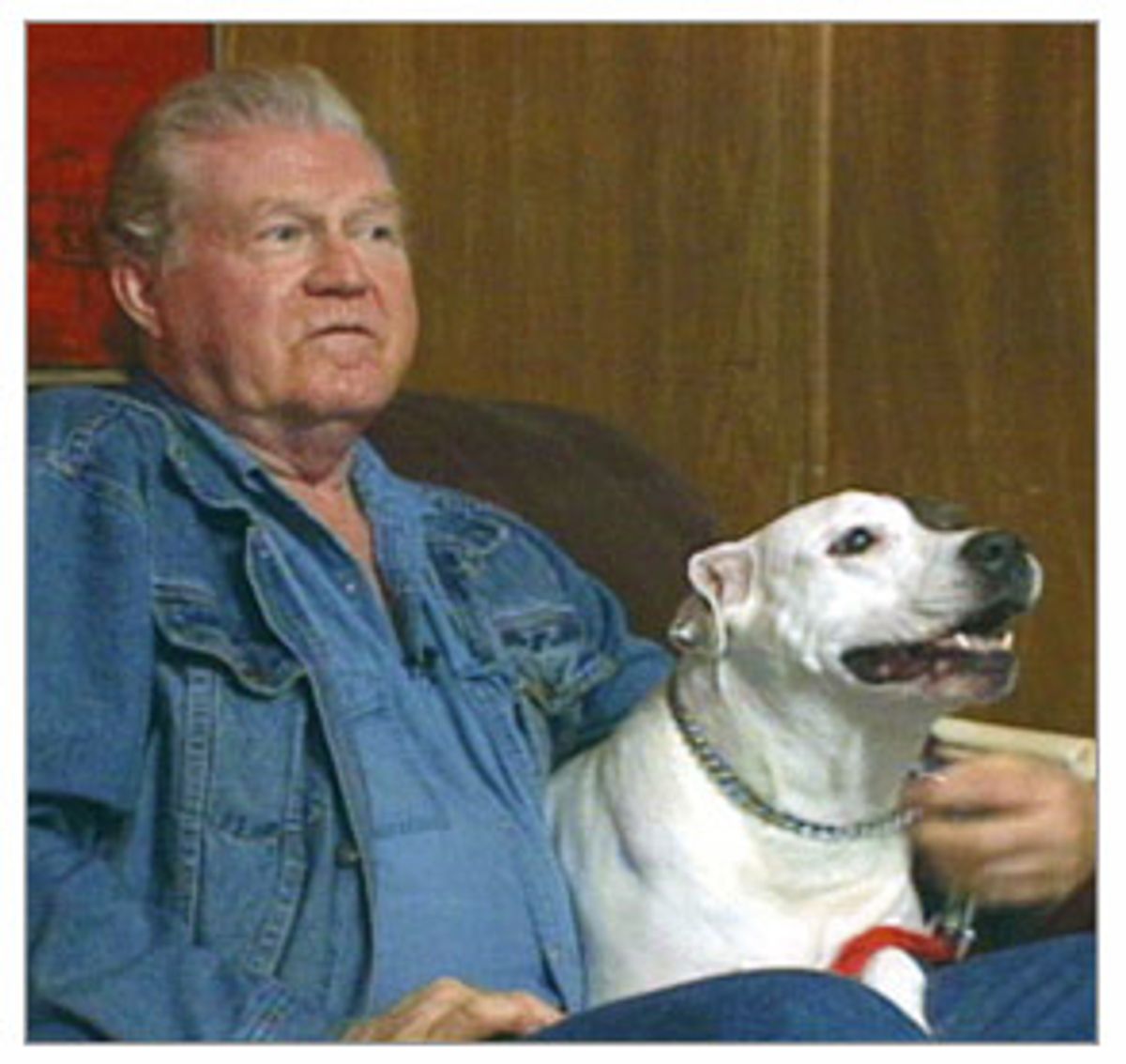
Shaver greets me at the front door with an explanation about the sign and a warning to avoid sudden movements around his two pit bulls. It’s clear from the disarray in the living room that the dogs have been using the sofa and recliner as chew toys, and blood droplets on the floor mark the site of a recent tussle. To discourage this behavior, he reads to them from the Bible. “They say if you read the Bible out loud, it’ll scare off all the bad spirits,” he says, a grin spreading across his broad face as he rubs Shade, the younger and meaner of the two. “My dogs, they got some bad spirits in ‘em.”

Shaver’s face, carved by years in sun-drenched fields and smoky bars, is drawn and tired — he’s been battling pneumonia — but he laughs easily and often until the subject turns to his family. In 1999, the same year he lost his son, his wife and mother died of cancer. He stands before the mantel that holds their pictures and acknowledges that he has not yet recovered from the terrible trifecta of that year. He spends most holidays, including last Christmas, alone at home with his dogs.

“I’m lonesome, yeah,” he says. “I don’t do much of nothing around here really. I don’t fish or hunt or anything anymore. I just write songs.”

There are thousands of them, jotted down on notepads or sung into a microcassette and stuffed into a box in the back room. He’s been writing since he was 8, and he’d be doing it even if the dogs were the sum total of his audience. The process is cathartic, as if by documenting his traumas they will somehow start to make sense. Dozens of artists, including Elvis, Johnny Cash and the Allman Brothers, have covered his songs even though they are unabashedly autobiographical. The lyrics, like the man, are entirely unvarnished. After a concert not long ago, a man approached Shaver and told him that he was John Steinbeck’s son and that Steinbeck was a big fan. In retrospect, it seems unlikely — Steinbeck died before Shaver released his first album — but not inconceivable. Both writers share an affection for the dispossessed and forgotten, even if Shaver’s temperament is significantly more rowdy.

In 1973, Waylon Jennings used nine Shaver songs to create “Honky Tonk Heroes,” the seminal album that Country Music Television recently ranked as the second-best country album of all time. But Shaver’s influence stems as much from his attitude as his music. “Without Billy Joe, there wouldn’t have been a Waylon, at least not a Waylon as an outlaw,” says Kinky Friedman, an acclaimed songwriter before he became a best-selling mystery novelist. He says Shaver “was the Che Guevara and Waylon was the Fidel Castro who got all the money and the power.”

Indeed, thanks to a succession of bad contracts, bad choices and bad luck, Shaver is far from financially secure.

“I don’t know what [record companies] do with that money, I really don’t,” he says. “Don’t much care, really. Songs mean more to me than money. If I heard one of my songs on the radio and I didn’t write it, I’d have a fit. I’d give everything I own just to have written that song. They’re little time capsules, and when I sing ‘em I almost feel like I’m there.”

Taken together, those time capsules form an outline of his life: the hardscrabble childhood, the hard-living honky-tonking and the drama of recent years. It’s all there — sometimes explicitly, sometimes obscured in the verse. But when he tells his story over hamburgers and tater tots at a nearby greasy spoon, he goes even further back: “My father actually tried to kill me when I was inside my mother.”

Put snow on the mountain, raised hell on the hill
Locked horns with the Devil himself
Been a rodeo bum, a son of a gun
And a hobo, with stars in my crown

– From “Ride Me Down Easy,” 1982

Shaver’s father, Buddy Shaver, was a violent bootlegger who beat his wife and left her for dead in a backwoods pond. He thought she was running around on him even though she was seven months pregnant with Billy Joe at the time. She recovered from the beating, but refused to raise that man’s son and left soon after Billy Joe was born. He was raised by his grandmother in Corsicana, Texas, a small town of about 20,000 about an hour southeast of Dallas.

As soon as he could understand, his grandmother steeled him to the reality of their situation: There is no Santa Claus, she told him, nor anyone else who is going to give you something for nothing. She would walk him down to the general store where the proprietor, with a wink, promised to give them groceries on credit if the boy would sing a few songs. And he would, standing on a cracker barrel believing he was literally singing for his supper.

His grandmother died when he was 12 and his mother, by then a honky-tonk waitress in Waco with a new husband, reluctantly took him back. As he grew into a man, he displayed a wild streak that would make his father proud. He dropped out of school after eighth grade, hitchhiked around the country working odd jobs, and eventually joined the Navy. Not surprisingly, his stint in the military was short-lived: He was kicked out for punching an off-duty officer, so he went back to Waco.

At 21, he met Brenda Tindell, who was 17 and pregnant when they married later that year. She was as headstrong as he was, if not more, and they made a rambunctious pair. Eventually, they would divorce twice, marry two more times, and break up and get back together more times than they could count.

Brenda’s family owned a ranch, so Shaver worked there breaking horses, but also worked in a sawmill to support his young family. He played guitar and wrote, but a music career was nothing more than a distant dream. He was building a book of songs that he thought were better than what he heard on the radio but, by his mid-20s, he had yet to perform a single one of them in front of an audience. He spent most of his time in bars fighting with men who took a second glance at Brenda, and there were plenty of them.

Then, in 1966, at age 27, he mangled his right hand when it got caught under a blade at the sawmill. He drove himself to the doctor, where they took parts of three fingers and barely saved his arm. Shaver got divorced for the first time shortly thereafter, in part because Brenda thought he was an idiot for cutting his fingers off and in part because she thought his fantasy of becoming a big-time songwriter was one of the most ridiculous things she’d ever heard. He hopped a cantaloupe truck headed to Nashville, Tenn., and set out to prove her wrong.

The devil made me do it the first time
The second time I done it on my own

– From “Black Rose,” 1973

The late 1960s and early 1970s were the heyday of the Grand Ole Opry in Nashville. The music was heavily produced and overtly commercial, saccharine pop far removed from country music’s origins in the blue-collar confessionals of Jimmie Rodgers and Hank Williams. Male singers wore sequined suits and kept their hair short, and their songs were thematically and politically conservative. A few iconoclasts, like Willie Nelson and Kris Kristofferson, chafed at the system but generally met with stiff resistance from label execs.

Shaver fared even worse. For his first several years in Nashville, he slept in his truck and washed dishes to make ends meet. Eventually he opted to make an impression with Harlan Howard, a prolific songwriter who wrote Patsy Cline’s “I Fall to Pieces” and had 15 songs in the top 40 in 1961 alone. In 1968, Shaver drove a motorcycle onto Howard’s front porch and announced, “My name’s Billy Joe Shaver and I’m the greatest songwriter in the world!” Howard replied, “Hell, I thought I was,” but after a quick listen, he sent Shaver over to Bobby Bare with a recommendation. Bare was an established songwriter and performer who collaborated with Shel Silverstein, among others, and had a reputation for appreciating unconventional talents. He gave Shaver a job writing songs for $50 per week.

For three more years, Shaver scraped to get by, living out of his truck and gobbling amphetamines so he could stay up all night writing. When he ran out of money, he’d drive back to Texas to work construction for a while and then head right back to Nashville when his pockets were full. He got several songs recorded — Kristofferson put Shaver’s “Good Christian Soldier” on his first album — but after more than five years he was still looking for the proverbial big break.

It came in 1972, when Waylon Jennings overheard Shaver playing some songs in a trailer before a concert in Dripping Springs, Texas. (The show featured a mix of country, rock and folk performers in a field outside of Austin — two years later, Willie Nelson adopted the concept as his annual Fourth of July picnic.) Impressed by what he heard, Jennings agreed on the spot to record a collection of Shaver’s songs about restless cowboys and no-account boozers. But Jennings got wrapped up in other projects and, after six months of waiting, Shaver was desperate. He tracked Jennings to a Nashville studio, where he was partying with an assortment of groupies and bikers and ostensibly recording an album.

When Jennings heard Shaver was waiting, he sent a messenger out with a $100 bill. The message was clear: Take the money, small-timer, and quit bugging me. Shaver sent a message back: Shove your $100 up your ass.

When Jennings emerged from the booth accompanied by two bikers, Shaver pounced. “Waylon,” he yelled, “I don’t care if you do an album of my songs or not but you’re going to listen to them now or I’m going to whip your ass in front of everybody.”

The bikers started toward Shaver, relishing the idea of tearing this hayseed to shreds, before Jennings talked them down. He hustled Shaver into a nearby room, and said, “Hoss, don’t ever do something like that again. You could’ve gotten killed.”

Shaver pulled out his guitar and played three songs. Jennings was hooked. Over the objections of the RCA brass, he made those songs the centerpiece of his next album. The record was called “Honky Tonk Heroes,” after the title of one of Shaver’s songs. Of the 10 tracks on the album, Shaver wrote nine. Eventually selling more than 5 million copies, it became the touchstone of the Outlaw movement, which infused country music with a rock ‘n’ roll attitude and provided the blueprint for a series of performers to follow, including Jerry Jeff Walker, David Allan Coe and Hank Williams Jr. (The movement’s next great record, Willie Nelson’s “Red Headed Stranger,” came out two years later.)

It also made Shaver a commodity. He reconciled with Brenda, who came to Nashville with their son, Eddy. Shaver recorded three solo albums in the 1970s, all of them critically acclaimed but commercially disappointing. It didn’t help that he was with a different record company for each record, and each went out of business within a year of the record’s release. Still, he was a sought-after performer and fans would stuff $100 bills in his shirt just for showing up at a club. Now that he could afford to, he spent most of his time drinking, snorting and brawling his way around Nashville, reinforcing his reputation as the wildest of the Texas outlaws.

“It was like the Old West,” Shaver says. “It seemed like there was always somebody coming to town looking to prove they were tougher than me.”

Other songwriters revered him, and worried about him. Tom T. Hall voiced his concern with a song, “Joe, Don’t Let Your Music Kill You,” and Kristofferson weighed in with “The Fighter,” saying: We measured the space between Waylon and Willie/ And Willie and Waylon and me/ But there wasn’t nothin’ like Billy Joe Shaver/ Where Billy Joe Shaver should be.

By 1979, Willie, Waylon and Kris were well on their way to becoming legends, while Shaver was strung out and barely hanging on. He burned out for good when an angel appeared at his bedside after a long night of partying. It didn’t say anything, he recalls, just sat there shaking its head. He wasn’t sure if it was a hallucination or a vision, but he took the hint and drove off in his pickup. That night, while wandering the cliffs above the Narrows of the Harpeth River, he came up with the phrase, “I’m just an old chunk of coal, but I’m gonna be a diamond someday.” That became the title of one of his most enduring songs. (John Anderson took it to No. 1 in 1981 and Johnny Cash later told Shaver that he sang it to himself each morning during a stint in rehab. It is also featured in the powerful closing scene of Pedraza’s documentary.)

Shaver moved back to Texas the next day, quit drinking and confused the hell out of the music establishment. “It hurt me professionally, but I most likely would have died if I’d stayed. I had to walk away from it,” he says now.

Shaver spent the next decade cleaning up and reordering his life. With little fanfare, he released three more solo albums and played around Texas with his son, Eddy, who had learned his guitar chops from Allman Brother Dickey Betts. Father and son formed an indelible bond. They called themselves Shaver, and Eddy’s wailing solos gave the band’s tunes a jolt of energy.

In 1993, the duo produced a rollicking roadhouse album, “Tramp on Your Street,” that earned critical raves. They released two more albums in quick succession — one of which, “Unshaven: Shaver Live at Smith’s Olde Bar,” was produced by Brendan O’Brien, who had worked with Pearl Jam and Stone Temple Pilots — and a whole new generation of fans was turned on to Shaver’s tunes. He was sober and playing music with his son.

That seems a lifetime ago now, the days before Brenda got sick and everything fell apart.

I went up on the mountain and looked down upon my life
I had squandered all my money, and lost my son and wife

– From “Try and Try Again,” 1998

It was 1997, and Shaver was in Louisiana, acting like a movie star. Duvall, who first met him in the late ’80s while shooting “Lonesome Dove” around Austin, gave him a speaking part in “The Apostle.” It’s easy to see why Duvall is drawn to Shaver. Take Duvall’s character in “The Apostle” and merge it with the self-destructive country singer he played in “Tender Mercies” and you’ve got a decent rendering of Shaver.

Duvall set him up in a suite, so Shaver invited Brenda to come stay with him. They were divorced for the second time, but he’d heard she was not doing well. When she showed up overweight and grumpy, he forced her to go to the doctor: She had advanced rectal cancer, which required multiple surgeries. Shortly thereafter, when her diagnosis became terminal, they married for the third time. Shaver put his career on hold and stayed with her, cleaning out the wound in her side and holding her hand as she slowly died.

“It was rough, man, but I was glad to do it,” he says. “I loved her, you know? We both realized we loved each other, after all that time of bouncing back and forth.” (Other times, Shaver says he wonders if Brenda truly loved him, a doubt exacerbated by a cache of letters he found after she died. He says he asked her before she died, and she merely smiled at him.)

At the same time, Shaver’s mother, who lived across town in Waco, was also suffering from cancer. Within a month, Brenda died at the age of 54 and Shaver’s mother, Victory, died at 80. As hard as the loss was for Shaver, it was harder for Eddy, who was already outpacing his father’s hard-living footsteps. After his mother died, Eddy started shooting heroin. One stint in rehab didn’t take. Shaver says he wanted to enroll Eddy in a new treatment center, but Eddy’s new wife wouldn’t allow it.

In late December of 1999, Eddy signed a contract with an Austin-based label to record a solo album. On New Year’s Eve, while celebrating his new deal, Eddy overdosed and died in a Waco motel room. He was 38.

That night, Shaver was scheduled to play with Eddy at Poodie’s Hilltop, a bar outside of Austin owned by Willie Nelson’s road manager. Nelson, who’d lost a son to suicide on Christmas Eve several years before, filled in on guitar. When I ask Nelson about it, he chooses his words slowly, careful to protect a private moment between friends. “It was as sad as you can imagine,” he says.

When our time has ended
And our race is over, run
We will melt into the likeness of our own beloved ones

– From “Son of Calvary,” 1998

Roseanne Cash, who knows of such things, once wrote that “at the heart of real country music lies family.” It’s certainly the heart of Shaver’s music today. His recent songs are consumed with his performance as a father, husband and son. His last album, “Freedom’s Child,” features a song, “Day by Day,” that might be his most personal to date. It tells the story of his family in nine verses, and it’s so personal that Shaver has yet to perform it live. When I reach him by phone at his home in Hawaii, Kristofferson says it is the best exposition of family grief he’s ever heard. And then he recites the lyrics from memory: There’s many a moonbeam got lost in the forest/ And many a forest got burned to the ground/ The son went with Jesus to be with his mother/ The father just fell to his knees on the ground.

“The simple eloquence of that thing is just heartbreaking,” Kristofferson says.

Shaver’s continued brilliance as a songwriter, when most of his peers are retired or simply singing the same old hits night after night, is drawing notice. In 2002, in Nashville, he received the Lifetime Achievement Award from the Americana Music Association, and stunned the assembled audience by announcing that it was the first award he’d ever received for his music.

Though he considered retiring after Eddy died, he eventually turned the other way and now works more than ever. He’s on the road more than 200 days this year, despite suffering a heart attack onstage several years ago that culminated in a quadruple bypass. “I’m happiest when I’m playing,” he explains. “It’s a departure from the ordinary, I guess.”

He is working on the songs for his next album with Houston-based Compadre Records, and plans to go into the studio with Kid Rock later this year.

Pedraza, an Argentina native, met Shaver eight years ago on the set of “The Apostle.” She says she was captivated by the songs he played for the cast and crew, even though she does not consider herself a country music fan. “His music really moved something inside me,” she says. “I just had to know: Who was this man who writes these amazing songs?”

The message of the film, she says, is the lesson of Shaver’s life: perseverance and survival.

“You have to keep trying in life. The challenge is what you do with what you have. I find him a very humble guy, without bitterness, when he has every right to be bitter. His life could be so much more tragic. He takes it for granted but you have to have a lot of strength to come through all that.”

Shaver is becoming something of a Hollywood favorite. Luke Wilson cast him in his upcoming film “The Wendell Baker Story” and has become a regular at Shaver’s shows, frequently with other celebs in tow. Wilson didn’t show for the after-party for the documentary at an Austin restaurant, but Duvall and Pedraza welcomed Dennis Hopper, Janine Turner and a crowd of about 100 other friends.

Despite a voice sore from four days of traveling around the state promoting the film, Shaver played an energetic 90-minute set with his band, dancing and waving his chocolate-brown cowboy hat in the air. Those who know him well agreed that he was in better spirits than he’d been in some time. “I want to thank Robert and Luciana for everything they’ve done for me,” he said during his final encore. “I feel like a new man. I don’t know if it’s a better one, but at least it’s a new one.”

Trust me on this: David Bowie’s “Hunky Dory”

The Old 97's singer credits Bowie's brilliant "Hunky Dory" for rescuing his adolescence and inspiring his career

  • more
    • All Share Services

Trust me on this: David Bowie's (Credit: Benjamin Wheelock)
This is the second story in the Trust Me On This series, which runs through Father's Day. You can read the other entries here.

Dear Kiddos,

Hey, you turkeys. Listen up. I need you to listen for five minutes. I’m going to impart a little wisdom. You can take it or leave it. For what it’s worth, I’d rather you took it.

The advice is this: David Bowie’s “Hunky Dory” is a perfect album, and, since perfect albums are a rare commodity, it is worthy of deep and repeated listenings.

I’m listening to “Hunky Dory” as I write this. How many times have I listened to this, my favorite record? Like a million? And it never gets old.

I discovered “Hunky Dory” by accident. I was a sad, lonely little kid. Eleven years old and obsessed with Joan Jett, another artist I imagine you kids would enjoy. Back then, the radio was still a real thing that people listened to, believed in and learned from. I stayed up past my bedtime one Saturday night during the Christmas holiday to listen to a weekly show called “The King Biscuit Flower Hour” featuring a concert by my secret girlfriend, Joan Jett. At the end of the set, she played a cover of a song that would forever change the course of my budding musical tastes, “Rebel Rebel.” As it turned out, “Rebel Rebel” would never be one of my favorite Bowie tunes, but I could detect, within its lyric, a narrative voice to which I could relate. Like really relate.

I was a latchkey kid, a thing that no longer exists. Both of my parents worked, so every weekday after school, I had a few hours wherein I could do whatever the heck I wanted. What I usually wanted to do was go to Half Price Books & Records. The next Monday, released from the grim confines of Armstrong Elementary, I walked to Half Price where I found exactly one David Bowie album. I brought home “Hunky Dory,” marveling at its weird, androgynous cover. In those pre-Internet days, one was always left with questions. Is that David Bowie on the album cover? Is that person a guy or a lady? Is it a painting or some sort of artsy photo? Is this even rock ‘n’ roll, or is it some other kind of music, the name of which has been kept a secret from me?

It was just that, some other, new kind of music. New to me, anyway. This album, recorded when I had been less than a year old, opened doors for me. And I thought I caught a glimpse of my own future. My family’s house on Gillon Avenue was empty when the needle dropped on Side A. “Changes,” turned up to top volume, was my anthem from the first line of the first verse. “Still don’t know what I was waiting for,” indeed. This was what I had been waiting for. Putting up with all the cruel dullards in my grade school, all the teachers and coaches, all the stupid kids and mean adults, had been almost unbearable. Suddenly, I wasn’t alone.

“Hunky Dory” is not a kids’ record, but there is certainly a preponderance of imagery relating to childhood. “Changes” speaks of “these children that you spit on.” “Oh You Pretty Things” has the song’s object driving his “mama and papa insane.” In “Kooks,” the singer begs his own kid to stay, reassuring the lucky little guy that “we believe in you.” At the time, I needed to hear that sentiment.  I went back to it over and over again throughout the difficult years of adolescence. David Bowie was not my dad, but he was there in a pinch.

As the album goes on, it gets weirder. And deeper. And darker. “Quicksand” offers up an epic take on the human experience, turning on a phrase that would echo dangerously throughout those most perilous years of my youth, “knowledge comes with death’s release.” I didn’t understand, but I did understand, if you catch my drift. These were meditations on the difficulty of everyday life, and the insane nature of our very existence. Heavy, beautiful stuff.

Antidotes appear in the record’s latter portion. “Happiness is happening/dragons have been bled … fear’s just in your head,” Bowie proclaims in the goofy-but-right-on “Fill Your Heart.” Then he proceeds to introduce the listener to Andy Warhol and Bob Dylan. And then comes “Queen Bitch,” wherein we meet Bowie’s longtime foil, the most underrated guitarist in rock history, Mick Ronson. The riff in “Queen Bitch” hints at what is to come on Bowie’s next LP, “The Rise and Fall of Ziggy Stardust and the Spiders From Mars,” Bowie’s breakthrough album, but “Hunky Dory” is still pre-fame Bowie at his folkie best.

Finally, he leaves us with the epic poem that is “Bewlay Brothers.” As an 11-year-old, I played it repeatedly in an attempt to decipher this song’s meaning. I wrote out the lyrics in my journal, hoping to make sense of them. To no avail. I did know that something had gone horribly wrong, there was madness and sadness, and then the record was over. Just like that.

Again and again, I listened. Memorized. Marveled. Sang along. When I could take it no longer, I found a guitar teacher and learned how to do these things myself. Well, not exactly these things, but my own version thereof. My early songs were such a pale imitation of early-’70s Bowie, that I could have been sued — had anyone ever heard my early songs. It’s quite possible that I spent the whole of my teenage years singing with an English accent. As they say, mistakes were made.

I never got over Bowie. Especially “Hunky Dory.” Many of his other records have remained favorites: “Low,” “Ziggy Stardust,” “Station to Station.” But “Hunky Dory” was my first love. I caught a lot of grief for my borderline-obsessive Bowie fandom. Kids at school used it as ammunition in their attacks on my masculinity. Did I care? Sure. Did I care enough to throw Bowie under the bus and pretend to withdraw my admiration for this artist who set me on the path I knew I was destined to follow? Hell no. David Bowie was and is my hero.

Listen, kids: I want you to hear “Hunky Dory” because I think you will love it. Like I said, it’s a perfect record, and how often do those come along? But the real reason I want you to listen to “Hunky Dory” is because, in its 11 tracks, you will find the clues that will lead you to an understanding of me, your dad. You’ll see signposts pointing the way to the path I chose in life.

Making music for a living isn’t easy. Many things about it are tough as hell: The touring and its requisite absences; the self-absorption; the occasional financial insecurity; the mood swings one attributes to the “artistic personality.” This life, however, is what I was made for. This calling is the only one I’ve ever known. I’m not curing cancer or solving the global hunger crisis. I’m making music. But there is a certain hazy nobility in that vocation. Somewhere, an 11-year-old kid may be putting on an album of mine and discovering that the universe isn’t a meaningless jumble of coincidences, that there is purpose to be found in these three-minute constructions of music and lyrics. Some small but elegant meaning.

Heck, before you guys came along, that was all I had. The great thing is that now I have everything.

Continue Reading Close

Rhett Miller is the lead singer of the Old 97s. His latest solo album, "The Dreamer," will be released on June 5.

Illustrating the ’60s music revolution

How one book captured the spirit and art of the cultural transformation -- as it was happening

  • more
    • All Share Services

Illustrating the '60s music revolution
This article originally appeared on Imprint.

Imprint“When did music become so important?” That’s Don Draper from last week’s “Mad Men,” set in 1966. Later in the episode he turns off “Tomorrow Never Knows,” from the Beatles album “Revolver,” and walks out of the room.

art: Rick Griffin

There’s something happening here, but you don’t know what it is — do you, Mr. Draper? One year later, Rolling Stone magazine will make its debut, followed soon by “Rock and Other Four Letter Words.”

“Rock,” a 250-plus-page Bantam paperback, was published in January 1968 and subtitled “Music of the Electric Generation.” It was one of the first books of its kind, chronicling a cultural revolution that was still in the midst of its own creation. Crammed with black-and-white portraits of bands and musicians, it’s part oral history, part visual LSD trip. One of its fold-out spreads has an intricate, circuitlike diagram that connects over a hundred names, from the Butterfield Blues Band, the Beach Boys, and the Byrds to Busby Berkeley, Brubeck and Bach.

The editor-designer was a writer named J Marks. The photographer for most of the images was Linda Eastman, who went on to work for Rolling Stone and — oh, yes — marry Paul McCartney.

By the sheer force of its graphic presentation, ”Rock and Other Four Letter Words” conveys the mid-1960s music scene’s spirit, vitality and relevance.


Continue Reading Close

Protest music’s odd conservative turn

A 100-track, four-CD Occupy collection assembles generations of icons. So why does it sound shapeless and safe?

  • more
    • All Share Services

Protest music's odd conservative turn

“In this hour of the ever-changing season, may our tears not douse the fire in our hearts.”

That’s a guy named Michael Pless singing “Something’s Got to Give.” Even without hearing the song, you can surely imagine the essential elements: Plaintive acoustic strumming, an earnest vocal, and an air of polite outrage to match the stilted syntax and hoary platitudes. Welcome to “Occupy This Album,” the collection of protest-minded songs released by Occupy Wall Street. Sprawling across four CDs and a slew of bonus digital tracks, this behemoth set includes 100 (why not 99?) new and previously released tracks from artists representing a range of generations, genres, backgrounds, settings, and styles. Folkies join hands with rappers; ominous post-rock marches alongside peppy radio pop. There’s spoken-word poetry, tribal percussion, earnest singer-songwriter fare. Even a bit of jazz.

Especially with Occupy reaching a crossroads in summer 2012 — a time when it needs to reassess its ideals, its accomplishments, its methods and its artifacts — “Occupy This Album” plays like a state-of-the-field survey of the protest song. From Jeff Mangum covering the Minutemen to the anonymous drum circles that soundtracked the demonstrations in real time, music has been a constant presence in the movement, although it’s not quite clear what role it has played. The new album portrays a movement with a broad scope and an admirably varied constituency, but the same criticisms that have been leveled against Occupy can also be applied to “Occupy This Album:” There is general unease but no clear direction forward. There is outrage but no plan. There is deep feeling but no clear message.

Ostensibly, there should be something on “Occupy This Album” for everyone to love, but that also means there is more than enough here for everyone to hate. It’s an unwieldy tracklist, almost daring you play it front to back. Of course, it’s pointless to review a 100-track release the same way you would approach a studio album, where functionality and some sense of logical progression are crucial. But there’s no consistent development of political or musical ideas weaving these songs together, nothing to link them or to justify this particular sequencing. As a result, “Occupy This Album” cannot make a statement as an album. In one sense, this release mirrors the leaderless ethos of the movement, which stridently preserves the democracy of the demonstrations. While that idea has certainly energized the Occupy protest, it makes for an amorphous blob of music and a messy, often frustrating listening experience.

But they mean well, right? It’s a charity album after all, with each disc sold separately and with all proceeds benefiting Occupy directly. You’d probably be better off contributing directly to the cause and just making your own mix of politically minded music. You might even have some of these songs in your iTunes already, although why you’d want to include Lucinda Williams’ drippy “Blessed” or Mogwai’s interchangeable “Earth Division” is beyond me.

The music that actually is new — that purports to find direct inspiration in either the righteousness of the demonstrators or the plight of the 99 percent — is generally unimaginative, hokey, disappointingly safe. Most of these artists address these economic issues either through narrative or through high-minded rhetoric. The latter produces the most lackluster results: Jackson Browne’s “Which Side Are You On?” which he has been touting for several months now, turns out to be political white noise, a gentle fist bump to the like-minded that barely puts across either side of the debate. At least it’s better than My Pet Dragon’s epiphany on “Love Anthem”: “Only love can save us now.” To their credit, they sing it like they might actually believe it.

The storytellers have more success, if only because they’re willing to entertain a bit more grit, a bit less blind hope. Featuring Joan Baez and Steve Earle, James McMurtry’s “We Can’t Make It Here” sounds downright curmudgeonly as it surveys the state of the working class in an economy that regularly sends its manufacturing jobs overseas. The song, however, goes a bit overboard when the trio decry litterbugs and graffiti artists.

One of the true standouts among these 100 tracks is Richard Barone’s ditty “Can I Sleep on Your Futon?” about a veteran-turned-singer who couch-surfs from one generous soul to the next. The verses are specific and soulful, as through he’s derived them explicitly from lived experience, and in that regard, the song could function as commentary on the music biz. But Barone stumbles over that massively awkward chorus, “Can I sleep on your futon?” It’s hard to imagine a crowd of protesters singing along.

If there is one overarching theme here, it is, vaguely, “history.” The past informs and even defines this music. Even the very idea of this type of compilations seems like a throwback to the CD’s heyday in the 1990s, when seemingly every charity, from NARAL to the Red Hot Organization, had its own release. It’s an impression reinforced by much of the music, especially hip-hop tracks by Born I Music and George Martinez & the Global Block Collective, whose lyrics and beats sound like they were scavenged from 1994. (For a better example of how hip-hop can address political themes, check out Killer Mike’s new track “Reagan.”)

Of course, there is a lot of folk music on “Occupy This Album.” That style has proved one of the most politicized musical forms of the 20th century, as lefties in the 1930s and 1940s adopted labor songs as battle cries. Clean-scrubbed, buttoned-up folkies like the Kingston Trio had some chart success in the 1950s, but they were quickly rendered obsolete by the Village bohemians reimagining the music as a vehicle for countercultural sentiments. That’s the model so many Occupyers are reverently appropriating, never suspecting that it might not be a natural fit for 21st-century dissent. The folk revivalists of the 1960s drew from the past as well, but took pains to update the music to the times: The mere fact that Dylan wrote new songs in this old style was revolutionary, alienating an older generation of folkie purists.

“Occupy This Album” obviously represents a counterculture, but too many of the artists are too caught up in role playing the past, which seems like an especially boomer enterprise. Michael Moore (yes, that Michael Moore) performs the most chipper version of “The Times They Are A-Changin’” imaginable, one that seems wholly unaware of the gritty realities of 2012, much less of 1964. (The less said about his skiffle version of the song, a hidden track on disc four, the better.) Perhaps the one artist who understands how to plumb history for present-day relevance is Loudon Wainwright III, whose wry “The Panic Is On” updates an 80-year-old tune originally penned by Hezekiah Jenkins (the cover originally appeared on Wainwright’s album “Ten Songs for the New Depression”). It’s an unusual artifact from the early 1930s, but there’s a sneaky observation about class disparity that sounds more disgusted and potent than anything else on the album.

Perhaps the worst thing that can be said about “Occupy This Album” is that the music is deeply conservative. There are so few moments that grab your attention or make you see the world differently. When Occupy already seems to be in danger of losing momentum, it’s hard to say whether the movement has failed to inspire these artists or the artists have failed to document the movement.

Continue Reading Close

Donna Summer: Disco diva and rocker

If you only knew the singing sensation by her 1970s smashes, you barely knew her at all

  • more
    • All Share Services

Donna Summer: Disco diva and rocker

There is so much about Donna Summer that we didn’t know… and not just the cancer that took her life. Let’s start with her relationship to rock. Summer is quite understandably known as a disco singer, and quite rightly so. It was disco that made her, and she, as perhaps disco’s highest profile performer, who helped to shape the genre. But like a number of other disco artists — Nile Rodgers and Bernard Edwards of Chic, the vocal trio Labelle and Chaka Khan all come to mind — Donna Summer was also a rocker. Yes, she grew up singing gospel, but she began her professional career as a ’60s rocker. She would describe this as her Janis Joplin phase, and she did indeed sing in a group that performed at the Psychedelic Supermarket — Boston’s version of Bill Graham’s Fillmore. She then went on to play a hippie in the Munich production of the rock musical “Hair,” and sported an enormous Afro inspired in large part by her hero, the black radical activist, Angela Davis. Although the disco music that she made with producers Giorgio Moroder and Pete Bellotte, and engineer Harold Faltermeyer provoked a fierce backlash from some aficionados of rock, this was a foursome that, as critic Dave Mash pointed out, functioned as a rock band, one in which Summer played a pivotal role as singer and songwriter. And then there is her singing. Listen to her hit “Hot Stuff,” and tell me that Summer could not sing rock.

Summer, who was strikingly beautiful, made some very steamy — some would say X-rated — music, most memorably with her first hit, 1975’s “Love to Love You Baby.” With Summer’s groans, moans and gasps powering the track, it broke new ground in its sexual explicitness. Promoted by her record company in explicitly sexual terms, and giving performances that made Tina Turner’s look tame, Summer soon found herself tagged the “Linda Lovelace of pop music.” She had seen this coming. In fact, she had not wanted to be the singer on that track, and agreed only to record the demo, and only then in a blackened studio where she sang, imagining that she was Marilyn Monroe giving herself over to orgasmic ecstasy. After producer Moroder convinced her to let him use her vocal, her record label president, seeing its bedroom potential, demanded a long-playing version that left the media debating whether the singer came 22 or 23 times. Rock critic Robert Christgau poked fun at the record with a review that consisted of three questions, “Did you come yet? Huh? Did you come yet?” Other reviews were more disparaging. But “Love to Love You Baby,” like much of her music, put female desire front and center in a way that it wasn’t in most rock music. Indeed, Summer’s music is inseparable from second-wave feminism’s emphasis on women’s sexual empowerment.

There is so much to say about Summer, who could have been a full-fledged personality had she not been pigeon-holed and dismissed as a disco tart. I was once on a radio program with her and, believe me, she was nobody’s fool. She described the “star-making machinery” as well as anyone. After she had already became famous she told Rolling Stone that her career sometimes felt like “this monstrous, monstrous force, this whole production of people and props that you’re responsible for, by audiences and everything that rules you until you take it upon yourself to be a machine… And at some point a machine breaks down.” Fame, she observed, diminished her, making her feel like nothing so much as a “commodity.” After falling into a debilitating depression and attempting suicide, she took control of her life again through Christianity.

In a way, I think one hears Summer confront her own commodification on her marvelous record “Bad Girls.” Although the music in the final, released version suggests otherwise, Summer isn’t celebrating prostitution on “Bad Girls.” Rather, she is confronting what she shares with those streetwalkers. “Now, you and me are just the same,” she sings.  And if Summer sounds unusually exuberant as she yells out to a john, “Hey, mista, have you got a dime?” perhaps it’s because Summer understood what it meant to be made into a commodity and reduced to a seductive whisper. Tellingly, in a television interview some years later, Summer noted that “Bad Girls” marked the moment when she stopped being an object and became a subject. Let’s hope that in her death she inspires more writing that fully acknowledges the intelligent subjecthood of this disco diva and kick-ass rock and roller.

Continue Reading Close

Alice Echols, a professor of English, and the Barbra Streisand Chair of Contemporary Gender Studies at the University of Southern California, is the author of four books, including "“Hot Stuff: Disco and the Remaking of American Culture."

Donna Summer, Queen of Disco, dies at 63

The "Last Dance" singer passed away after a battle with cancer

  • more
    • All Share Services

Donna Summer, Queen of Disco, dies at 63

NEW YORK (AP) — Disco queen Donna Summer, whose pulsing anthems such as “Last Dance,” ”Love to Love You Baby” and “Bad Girls” became the soundtrack for a glittery age of sex, drugs, dance and flashy clothes, has died. She was 63.

Her family released a statement Thursday saying Summer died and that they “are at peace celebrating her extraordinary life and her continue legacy.”

Summer gained prominence during the disco era of the 1970s, and released a number of albums that have reach gold or platinum status, including the multiplatinum “Bad Girls” and “On the Radio, Volume I & II.” Her No. 1 Billboard Hot 100 hits include “Hot Stuff” and “MacArthur Park.”

Her sound was a mix of genres, and helped her earn Grammy Awards in the dance, rock, R&B and inspirational categories.

She released her last album, “Crayons,” in 2008. She also performed on “American Idol” that year with its top female contestants.

Page 1 of 284 in Music