Andrew Cockburn

Ahmed Chalabi’s failed coup

The U.S. raids his home and headquarters in Iraq to foil his plot.

  • more
    • All Share Services

Ahmed Chalabi's failed coup

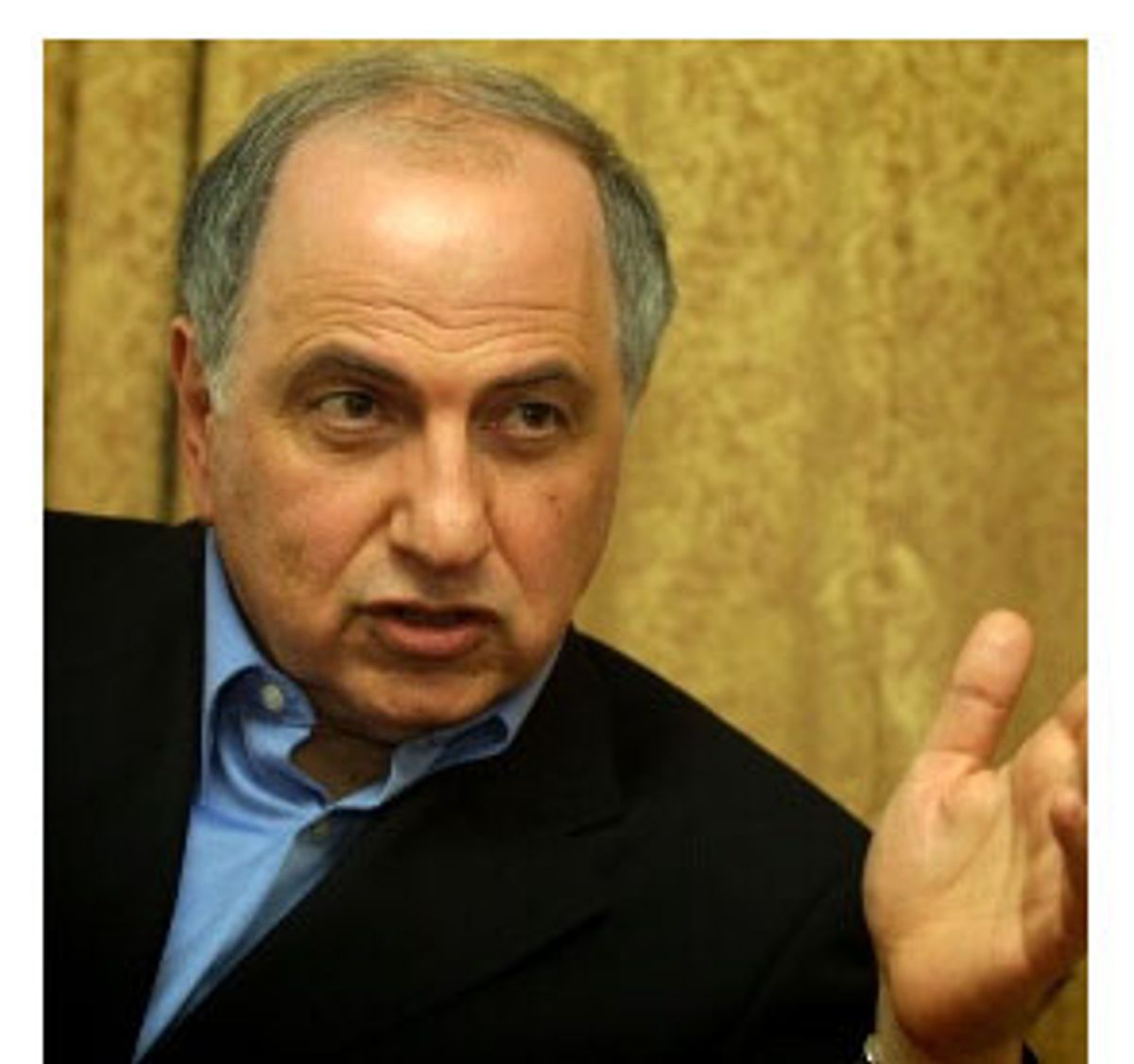
The U.S. command in Baghdad raided Ahmed Chalabi‘s home and headquarters in Baghdad at dawn today. U.S. soldiers put a gun to his head, according to his nephew Salem Chalabi, the Associated Press reports. Chalabi aides blame the CIA and Paul Bremer, head of the Coalition Provisional Authority.

Why did the Bush administration turn against its former favorite Iraqi? Almost certainly because it realized that Chalabi, maddened by the realization that he was being excluded from the post-June 30 hand-over arrangements, was putting together a sectarian Shiite faction to destabilize and destroy the new Iraqi government. “This all started since [U.N. envoy Lakhdar] Brahimi announced that Chalabi would be kept out of the new arrangement,” says an Iraqi political observer who is not only long familiar with Chalabi himself but also in close touch with key actors, including U.S. officials at the CPA and Iraqi politicians.

“Ahmed is gathering groups to bring this new government down even before July 1. He is in a very destructive phase, mobilizing forces to make sure the U.N. initiative — due to be announced in 10 days — fails.” Chalabi has reportedly been inflaming his recruits with reports that veteran Algerian diplomat Brahimi is part of a Sunni conspiracy bent on undermining the rights of Iraqi Shiites to hold power in Iraq.

Some of his followers are drawn from the faction of the historic Shiite Dawa Party that has been excluded from “official” politics by the occupation authority and that has been giving support in the streets to Muqtada al-Sadr. Others, however, are prominent in Iraqi politics, most notably Ayatollah Mohammed Bahr al-Uloom, a former chairman of the Iraqi Governing Council usually described as a “moderate” Shiite cleric. Bahr al-Uloom is also father of the minister of oil, Ibrahim Bahr al-Uloom, one of Chalabi’s key allies and a potentially very profitable liaison. Two other members of the Governing Council are also considered close adherents of Chalabi, who recently inaugurated the Supreme Shia Council, modeled on a similar entity that flourished in Lebanon during that country’s bloody civil war. Among other entities included in the council are Iraqi members of Hezbollah.

“His dream has always been to be a sectarian Shia leader,” says the Iraqi political observer of his old friend Chalabi. “He knows that, sooner or later, Muqtada al-Sadr is going to be killed, [and] that will leave tens, hundreds, of thousands of his followers adrift, looking for a new leader. If Ahmed plays the role of victim after [today's raid], he can take on that role.”

U.S. disenchantment with Chalabi has been growing since it dawned on the White House and the Pentagon that everything he had told them about Iraq — from Saddam Hussein’s fiendish weapons arsenal to the crowds who would toss flowers at the invaders to Chalabi’s own popularity in Iraq — had been completely false. Some months ago King Abdullah of Jordan was surprised to be informed by President Bush that the king could “piss on Chalabi.” Fanatic neoconservatives like Richard Perle and Michael Rubin may have continued to champion Chalabi, insisting that the United States should have imposed him as Iraq’s ruler right after the invasion, but elsewhere in Washington his stock has been dropping like a stone.

This week the Pentagon finally cut off his $340,000 monthly subsidy. Chalabi himself has been denouncing the U.S. occupation since last fall, partly in an effort to win some credibility with the Iraqi masses. In private, his aides spoke of occupation administrator Bremer as an “anti-Arab and anti-Muslim who doesn’t understand a thing about Iraq,” but Chalabi was not yet ready to cut all ties. Only when it became apparent that the United States was giving full support to Brahimi, who in turn made no secret of his contempt for Chalabi, a convicted embezzler who faces a 22-year sentence in Jordan (Brahimi’s daughter recently married a Jordanian prince), did Chalabi’s rhetoric turn viciously sectarian. At the same time, he began preparations to destroy the political structure that the United States is desperately trying to assemble. As Chalabi’s old acquaintance told me today, “I think the U.S. moved against him because they realized he is a gambler, ready to bring it all down.”

When Rummy tried to nuke Russia

In an excerpt from his new biography of the former secretary of defense, Andrew Cockburn explains how the true Donald Rumsfeld emerged during secret war games.

  • more
    • All Share Services

When Rummy tried to nuke Russia

After George H.W. Bush won the 1988 presidential election, there was, as usual, ill-informed speculation that Donald Rumsfeld would be offered a senior cabinet post. One of those who paid attention to the rumors was Milt Pitts, the longtime presidential barber, who was summoned to give the president-elect a trim soon after the victory. “Pitts had always liked Rumsfeld,” a former White House official explained in recounting the ensuing conversation.

“I’ve heard that Don Rumsfeld might be secretary of defense,” said Pitts brightly as he snipped away. “Have you heard that, Mr. Vice President?”

“No, Milt,” said Bush in a low, chilly voice. “I haven’t heard that.”

Rumsfeld himself was ready to settle for something less. Writing to congratulate Bush on his victory, he stated that he would “like to be your Ambassador to Japan.” An official in the Bush transition office processing such requests found that the letter had already been reviewed at a high level. Scrawled across it were the words “NO! THIS WILL NEVER HAPPEN!! GB.”

Rumsfeld was offered no position in the administration of George H.W. Bush.

A few months after the inauguration, Donald Rumsfeld was invited to play the role of president of the United States in an exercise devised by a Washington think tank. In this scenario, “President” Rumsfeld was intent on securing congressional approval to go to war. “I don’t care what you tell them,” he barked at White House chief of staff Ed Markey, “just get over to Capitol Hill and make them do it, and make sure there are no constraints.”

“It was an exercise devised by the Center for Strategic and International Studies [CSIS] to study the functioning of the War Powers Act,” remembers Markey, a liberal Democratic congressman from Massachusetts. “We acted out roles. I accepted the role of Chief of Staff because I figured that was my only shot at the job.” Rumsfeld may have felt the same way. At the age of fifty-seven he appears to have concluded that if he could no longer realistically aspire to be president, he could at least act the part.

By all accounts “President” Rumsfeld played his role in that 1989 exercise for CSIS with great gusto, raging at the obdurate Congress and deploying the “White House spokesman” (played by the venerable broadcast journalist Daniel Schorr) to maneuver the press into supporting his martial position. But this Washington exercise was a comparatively lighthearted affair compared to Rumsfeld’s role in games that were far more elaborate, and deeply secret. Well away from journalists and others lacking highly restricted security clearances, he could perform not merely as a chief executive, but one faced with the awesome responsibility of waging nuclear war.

The games were designed to test a program known as COG, Continuity of Government, and they concerned the ability of the government to continue to function during and after a nuclear attack. Everything about these exercises was secret. “There are seven levels of classification used in the government,” one former senior Pentagon official told me when I raised the subject. “You are asking about the most secret level of all.” Plans to enable the government to survive a nuclear attack dated back to the early days of the cold war, when vast bunkers were excavated in the countryside around Washington in which the various organs of government could take shelter. At least one of these, in the rural Virginia town of Culpeper, was even supplied with Barbie dolls for the diversion of officials’ children sitting out the war underground. Over the years these efforts became ever more elaborate, and of course vastly more expensive. A major development occurred in the early 1980s, when Ronald Reagan was sold not only on the notion of a missile defense shield, but also on the practicality of fighting a prolonged strategic nuclear war, lasting up to six months. This decision lent added emphasis to the need for keeping the machinery of government going amid the radioactive ruins.

In consequence, the money allocated for COG began to soar to previously undreamed-of heights. A prime architect of the revised system has disclosed to me that the budget hit $1 billion a year by the end of Reagan’s first term. Lending intellectual weight to this costly initiative was Andrew Marshall, an influential defense intellectual who had first crossed paths with Rumsfeld when he was secretary of defense. Early in the Reagan years, Marshall predicted that a “weakening” Soviet Union might lash out in a surprise nuclear attack, thus necessitating the extensive facilities in which Rumsfeld was invited to exercise his post-apocalypse leadership skills.

Marshall and others had long maintained that the Soviet strategy involved “decapitation” of the US leadership and that therefore some of the first warheads would land on Washington, very possibly obliterating the president and other senior officials. COG planners therefore began training teams of individuals experienced in national security matters who would be ready to take over and resurrect some sort of government. The teams were divided up by function, one for the Defense Department, one for the State Department, a third for the White House and so on.

This highly secret program was known as Project 908, and among the individuals earmarked to take power when disaster struck was Donald Rumsfeld. Every so often he would disappear from his Chicago office, leaving no word of where he was headed, or why. Once off the map, he would be moved on a military transport to one of the secret headquarters created as part of the COG network. There, for several days, he would be immured in artificial caverns, staring at electronic displays streaming data of disaster and confusion, sleeping on cots and subsisting on the most austere rations. As often as not, players who had been brought to the locations on planes with blacked-out windows had no idea where they were. A participant in one exercise recalled that “we knew we were in the South, because the people serving the food had Southern accents, but that was all.”

Rumsfeld loved these games. There were others who were frequent players in the exercises, notably Dick Cheney. “Cheney and the others often had other priorities,” recalls the former Pentagon official. “Rumsfeld always came.” He wasn’t just trying to organize a devastated country. He was fighting World War III, or at least simulating what nuclear theory suggested such a conflict would be like.

Herein lies an aspect of Rumsfeld’s career — and character — that remained deeply buried even after word of his participation in the COG exercises leaked out. Faced with the most awesome choices a simulated environment could present, placed in a situation that was designed and advertised as a rehearsal for what might one day be terrifyingly real, Rumsfeld had one primary response. He always tried to unleash the maximum amount of nuclear firepower possible.

The teams taking part in the game were presented with two main tasks: reconstitution of some sort of working government, and retaliation against whomever had inflicted the disaster. The first of these, reconstruction, was generally considered the most urgent. But this part, according to fellow players, did not interest Rumsfeld. “He always wanted to move on to retaliation as quickly as possible,” recalls a former senior official in the office of the secretary of defense, “he was one who always went for the extreme option.”

A former participant, enlisted to take the role of a senior national security official, described how his “war” began with a limited Soviet attack in Europe. “It seemed quite possible to defuse the crisis,” he recalled, stressing that the State Department “team,” was working to avoid an all-out thermonuclear exchange. Rumsfeld, however, had a different agenda. From the outset, this participant remembers, the once and future defense secretary was determined to “launch everything we had left” at the entire communist bloc, Russians and Chinese together.

The individual playing the part of secretary of state, however, a canny retired diplomat, was no less determined to stop Rumsfeld obliterating several million people. Using every tactic and stratagem he had learned over the course of a long career, the diplomat waged bureaucratic warfare over the postnuclear communications system linking the secret hideouts. As an added note of realism, the State Department official playing the role of deputy to the “secretary” evidently thought that his real-life career would be enhanced by supporting Rumsfeld, and therefore did his best surreptitiously to undermine his notional superior. Even so, the diplomat ultimately prevailed. The northern hemisphere survived. Rumsfeld, deeply chagrined at having lost the argument, never forgave his antagonist.

Of course, immured in the COG bunkers, Rumsfeld and his fellow players were not enacting anything based on real experience (apart from familiar routines of bureaucratic backstabbing). Nuclear conflict existed only as a game. In fact the theorists who worked on nuclear strategy were fond of quoting what they called game theory. No one had the slightest idea of what might actually happen in a nuclear war. Even the known “facts” were anything but. Plans based on tidy predictions of the explosive power or “yield” of various weapons, for example, were belied by tests in which the results often varied wildly from forecasts, as did the accuracy and reliability of intercontinental missiles, which were never tested in operational conditions. Such awkward realities never featured in nuclear war planning, let alone the scenarios concocted by the nuclear theoreticians for the games.

Hopefully, we will never know how any politician, let alone Rumsfeld, would act when presented with the option of launching nuclear weapons in real life. Unfortunately, we do know how Rumsfeld reacted to the option of attacking a country with conventional forces and overthrowing its government. We shall be examining the invasion and occupation of Iraq in later chapters, but it is worth comparing Rumsfeld’s behavior in the COG games with his performance in a real war. As we shall see, the casual, maybe even irresponsible decisions taken in that war reflect attitudes and reactions better suited to an elaborate game, from which real-life costs and consequences are excluded.

Insofar as the COG games gave the illusion of reality, they taught Rumsfeld and his fellow players some dangerous lessons, particularly when the fall of the Soviet Union induced some changes in the usual scenarios. Although the exercises continued, still budgeted at over $200 million a year in the Clinton era, the vanished Soviets were now customarily replaced by terrorists. The terrorism envisaged, however, was almost always state-sponsored. Terrorists were never autonomous, but invariably acted on behalf of a government. “That was the conventional wisdom,” recalled retired air force colonel Sam Gardner, who has designed dozens of war games for the Pentagon and related entities. “Behind the terrorist, there was always something bigger, and the games reflected that.”

There were other changes too. In earlier times the specialists selected to run the “shadow government” had been drawn from across the political spectrum, Democrats and Republicans alike. But now, down in the bunkers, Rumsfeld found himself in politically congenial company, the players’ roster being filled almost exclusively with Republican hawks.

“It was one way for these people to stay in touch. They’d meet, do the exercise but also sit around and castigate the Clinton administration in the most extreme way,” a former Pentagon official with direct knowledge of the phenomenon told me. “You could say this was a secret government-in-waiting. The Clinton administration was extraordinarily inattentive, [they had] no idea what was going on.”

Excerpted from “Rumsfeld” by Andrew Cockburn. Copyright © 2007 by Andrew Cockburn. Reprinted by permission from Scribner, an imprint of Simon & Schuster, Inc.

Continue Reading Close

The rise of the new Iraqi “tough guy”

Old CIA asset and Iraqi Prime Minister Iyad Allawi comes to Washington to convince Americans that contrary to reality, all is well in Iraq.

  • more
    • All Share Services

The rise of the new Iraqi

As he left Baghdad, Iraq, for appearances at the United Nations in New York and before a joint session of Congress in Washington, Iyad Allawi was seen on Iraqi TV flourishing a bandaged hand. News quickly flashed around Baghdad that this was not the result of enemy action. Bawling out an underling, Iraq’s handpicked “interim” prime minister had bashed his fist so hard on the table that he had broken a bone.

That is not the least of Iyad Allawi’s self-inflicted wounds. Accepting the poisoned chalice of appointment by the occupying power as their man in Iraq, he must now live with the consequences of a policy that has already reduced Iraq to ruins.

To those who know Allawi, news that his violence had extended to self-mutilation came as no surprise. While soft-spoken and polite to outsiders, he likes to rain abuse on underlings, cultivating an image of toughness that goes down well both with those Iraqis who nurture nostalgia for the days when Saddam made the electricity work and with his next-door neighbors at the U.S. embassy, who are gratified that they have found a “tough guy,” as President Bush calls him, who will do as he is told.

Some Iraqis were experiencing Allawi’s firm hand even as he accepted Iraqi “sovereignty” from former Coalition Provisional Authority chief L. Paul Bremer just before the latter scurried out of town in late June. These individuals were discovered in the compound of the Iraqi interior ministry being viciously tortured by policemen as a result, apparently, of an Allawi initiative to crack down on “crime.” The Oregon National Guardsmen who made the discovery gave the victims first aid, while holding the torturers at bay and awaiting further instructions. The order that flashed from the U.S. military high command was unequivocal: Return the prisoners to Allawi’s men and let them get on with the job.

Obviously those innocent Oregonians had not understood the nature of Allawi’s mission, which was to put an Iraqi face on U.S. rule in Iraq, carrying out orders without deviating from orders emanating from the U.S. embassy. Thus situated, Allawi is right under the watchful gaze of John Negroponte, who knows a thing or two about administering subject territories behind the misleadingly bland title of “ambassador.”

Infamously, from 1981 to 1985, Negroponte was the Reagan administration’s proconsul in Honduras, which was then putatively ruled by the carefully selected and suitably nasty “strongman” Gen. Gustavo Alvarez. The task at hand was to crush by any means necessary the Sandinista regime next door in Nicaragua, using Honduras as a base for the exercise. To that end there could be no nonsense about democracy in Negroponte’s fief. Instead, Hondurans were treated to rule by torturer and death squad, exactly the instruments now required in Iraq, which is doubtless why this sinister apparatchik was selected for his present post.

Iyad Allawi, meanwhile, is no less perfectly cast in his role, given his lifelong record of serving the needs of various shadowy patrons. He acknowledges having been on the payroll of six intelligence services over the years, principal among them the British, Saudis and CIA — not to mention his original patrons in Saddam Hussein’s Baath Party. Among the attributes that has recommended Allawi to his patrons is his readiness to tell them what they have wanted to hear, which, in the 1990s at least, consisted mostly of ever more fanciful tales about goings-on in Iraq. Sometimes his willingness to oblige by supplying bogus intelligence reached ludicrous proportions. On April 1, 1995, for example, while Allawi’s Iraqi National Accord organization was headquartered in Amman, Jordan, the Arabic newspaper Al Hayat ran an April Fool’s Day report that Saddam had decided to have himself cloned and had already had his son Uday cloned to test the procedure. A journalist visiting Allawi’s office made joking reference to the story, only to be instantly informed that “we were first with that intelligence — we sent it to Washington weeks ago.”

Experiences such as this did not disenchant the paymasters in London and Washington. Even the unmitigated disaster of Allawi’s attempt to mount a coup against Saddam in 1996 did not cause them to fall out of love. On the contrary, they reached for Allawi for further fictions when needed. Hence it was Allawi’s organization that furnished news that Saddam had biological weapons on 45-minute standby, the ludicrous claim so eagerly broadcast by Prime Minister Tony Blair as a justification for war.

Returning to Baghdad in the wake of the U.S. Army last year Allawi sat quietly while his hated rival (and cousin) Ahmad Chalabi steadily lost the support of his erstwhile patrons in Washington. While Chalabi’s simultaneous efforts to rebuild his family fortunes were high-profile, Allawi stands back from the trough. In fact the cousins’ long-standing and bitter political enmity extended to the business sphere, including a nasty squabble over who garnered the potentially very profitable Iraqi agency for the Swiss oil trading giant Glencore. (Allawi eventually won.)

Finally, last June, the old Baathist came to his reward, when he was appointed as “interim prime minister.” (The non-interim variety is due to be installed sometime in 2006 once an elected assembly has ratified a new constitution.) Among the tableaux vivants mounted by the U.S. to assure the world that sovereignty had passed to Iraqis was the arraignment of Saddam Hussein in front of an Iraqi judge. The U.S. military command packed the courtroom with military personnel, ejected the only Iraqi journalist who had gained admission and, despite the orders of the judge, confiscated audiotapes of the proceedings. For Iraqis, the message was clear. Sovereignty in Iraq still came out of the barrel of an M-1 Abrams tank gun.

Allawi himself, no fool, may understand that the only way to garner legitimacy in the eyes of Iraqis is to indicate an independence from the U.S. But he also knows perfectly well that something nasty happens to Iraqis on the American payroll who turn against their sponsor — and if he forgets, he only has to look at what happened to Ahmad Chalabi. Thus, when Negroponte vetoed Allawi’s sensible effort to offer amnesty to resistance fighters, he promptly caved. Nor has he shown any reluctance to pursue the disastrous war on two fronts, confronting both Sunni insurgents in Fallujah and Shiite adherents of Muqtada al-Sadr. Meanwhile, the vicious and ruthless insurgency swamps the occupation in a tide of blood. Hundreds have died this month alone, while the U.S. hastily diverts to security $3 billion originally intended, at least in theory, to better the lives of ordinary Iraqis.

That is why Allawi’s mission to the U.S. this week is so important, at least for George Bush. He must help convince Americans to disregard the facts and accept the notion that all is well in Mesopotamia. Yesterday our Iraqi client showed that he knows what is expected of him, dutifully declaring, “We are winning, we are making progress in Iraq, we are defeating terrorists.” Iraqis know better, but who cares what they think?

Tomorrow, Allawi is hosting a press conference in New York for Arab journalists. All questions must be approved in advance.

Continue Reading Close

A man for all intrigues

Iyad Allawi, the new choice to lead Iraq, isn't Ahmed Chalabi -- but that's about the only thing to commend this wily member of the old-boy, CIA-sponsored exile club.

  • more
    • All Share Services

There could be no more perfect evidence of the desperation among U.S. officials dealing with Iraq than the choice of veteran Baathist and CIA hireling Iyad Allawi as prime minister of the “sovereign” government due to take office after June 30. As one embittered Iraqi told me from Baghdad on Friday: “The appointment must have been orchestrated by Ahmed Chalabi in order to discredit the entire process.” He was not entirely joking, given the fact that Chalabi joined the rest of the Governing Council in voting for Allawi despite their long and vicious rivalry.

Though he is Shiite, Allawi was once upon a time an active Baathist, a member of Saddam Hussein’s political party, and is thought to enjoy much support among the officer corps of the old Iraqi army, and by extension among many former Baathists and influential Sunni. Indeed, there are reports that the reason Ahmed Chalabi, the neoconservative favorite, urged his friends in the White House to dissolve the army last year — a decision now acknowledged to be the most disastrous of the occupation — was Chalabi’s fear of the support enjoyed by his rival (and cousin — everyone in Baghdad is related) within the military.

Allawi cut his political teeth as a strong-arm Baathist student organizer before being dispatched by the party to London to run the Iraqi Student Union in Europe. Apart from the Iraqis he dutifully monitored, other Arab students with whom he came in contact were of considerable interest in Saddam’s Baghdad, since they tended to be drawn from elite circles in the Middle East. They were also of more direct value to Allawi personally, garnering him a fruitful array of connections in Saudi Arabia and elsewhere, which he then used with great effect in various business enterprises in the region. By the late 1970s he had become wealthy.

However, Allawi never lost his taste for the intrigue of intelligence operations and the company of intelligence officers. Soft-spoken, eloquent and persuasive, always ready to hint at a powerful connection or make a promise, he proved adept at telling them what they wanted to hear in language they could understand. In 1978, this mutual affection almost proved fatal. By that time, Allawi had reportedly entered into a relationship with the British security services, who were naturally keen to have a willing and well-informed source in the large and faction-ridden Arab student community in London. Word of this relationship reached the suspicious ears of Saddam’s secret police, the Mukhabarat, who dispatched a team armed with knives and axes to Allawi’s comfortable home in Kingston-upon-Thames to deal with the problem in summary fashion. Bursting into his bedroom, the assassins hacked at him as he lay beside his sleeping wife and were prevented from finishing the job only by the fortuitous appearance of his father-in-law, who happened to be staying in the house. The would-be killers ran off and the badly injured Allawi lived to make more money and pursue his connections with British intelligence.

At the time of the 1991 war, Allawi scented the interest of Saudi intelligence and joined forces with his fellow ex-Baathist, Salih Omar, in producing the Voice of Free Iraq. The pair soon fell out, however, reportedly because of a dispute over a $40,000 check from their Saudi paymasters. Omar gradually faded from sight, while Allawi retained control of the group they had founded, the Iraqi National Accord (Al Wifaq), into which he steadily recruited former Baathist Sunnis, and was soon back in London, awaiting fresh clients. He found them among his old connections at British intelligence, MI6, and, a few years later, the CIA, which was simultaneously funding Ahmed Chalabi’s exile organization, the Iraqi National Congress (INC).

“The two were supported by different factions at the agency,” recalls one veteran of the Iraq program. “Iyad Allawi was the more likable of the two; he didn’t act the grand pasha like Chalabi used to. But there was no there there — he didn’t have anyone inside Iraq. It was like recruiting a White Russian [pro-Czarist] to overthrow Stalin in 1938.”

Nevertheless, in 1996 the CIA invested its hopes in a coup against Saddam plotted by Allawi and his INA group. It proved a total bust, perhaps because INA officials in Amman, Jordan, boasted of its imminence to a Washington Post reporter. Whatever the reason, Saddam rounded up all the conspirators he could get his hands on, while sending derisive messages to the CIA reporting his victory.

Licking its wounds, the CIA harbored dark suspicions that Chalabi had betrayed the coup to Saddam, while Allawi went unpunished for his failure. Though his public reputation suffered from the undiluted stream of abuse broadcast by Chalabi’s efficient propaganda machine, he retained his supporters both at CIA headquarters in Langley, Va., and at MI6.

Just as Chalabi did, Allawi, in his quiet way, supplied the requisite quota of misinformation on Saddam’s WMD to justify the Bush-Blair war program. The infamous lie about Saddam’s ability to deploy biological weapons in 45 minutes that Blair put out in his dossier came from Allawi’s organization.

When Coalition Provisional Authority head L. Paul Bremer handed out patronage rewards to the motley group of expatriates assembled in the Governing Council last year, Allawi secured the important plum of chairmanship of the Defense and Security Committee. His nominee became minister of the interior (though there were some awkward questions asked when 19 billion dinars of ministry money mysteriously turned up in a private plane at Beirut airport, unencumbered by a satisfactory explanation as to what it was doing there.) Thus Allawi is well placed in the “power ministries” with oversight of the nascent military and police. (Ali Allawi, the current minister of defense, is a cousin of Iyad’s, as well as being Ahmed’s nephew, but is generally considered to be his own man.)

Behind the scenes, Allawi and Chalabi have been waging a ferocious struggle for the spoils of power, particularly in the oil sector. Although Chalabi was able to get control of key posts at the powerful ministry of oil, Allawi scored a significant victory when his nominee managed to secure the agency for the oil trading giant Glencore, which had formerly been on close terms with Chalabi. In response, the Chalabi forces swore to ensure that Glencore could not buy Iraqi oil, an embargo that may change now that Iyad Allawi is becoming prime minister.

In recent days, Allawi and Chalabi joined forces, along with other former expatriate politicians, to prevent the nomination of Hussein Shahristani to the post of prime minister. Shahristani, a devout Shiite, would have been an inspired appointment. A man of extraordinary courage and integrity, he once told Saddam Hussein to his face that Iraq should not build a nuclear weapon. Predictably, he was tortured and put on trial for espionage, in the course of which he blithely insulted Saddam’s parentage. He spent 10 years in solitary confinement in Abu Ghraib. “I probably survived execution because I was there on the direct orders of Saddam,” Shahristani once told me. “And he simply forgot to sign my death warrant.” He escaped disguised as a prison guard during the 1991 war after suborning a trusty who unlocked his cell and helped him flee.

Finding refuge in Iran, Shahristani refused to move on to comfortable exile in the West, preferring instead to stay in Iran and organize aid for otherwise friendless Iraqi refugees as well as the resistance inside Iraq itself. His unshakable independence eventually drove the Iranians to force him to move to London.

Returning to Iraq immediately after the war, Shahristani eschewed the trappings of power and cash rewards sought by other returning exiles and even refused to enter the U.S. Green Zone headquarters on the grounds it was occupied territory. He soon earned the trust and respect of Ayatollah Sistani. But that was not enough to protect him from self-interested intriguers like Allawi, Chalabi, and the representatives of the Islamist parties SCIRI and DAWA. “The Islamist Shia said they wouldn’t take someone who wasn’t one of them, which Shahristani is not, and the secular Shia said they wouldn’t have someone who is religious, meaning Shahristani,” explains a despondent Iraqi official and Shahristani supporter.

The United Nations, charged with coming up with the new government, was taken by surprise by Allawi’s selection. U.N. envoy Lakhdar Brahimi said he “respects” the decision and is willing to work with Allawi, according to U.N. spokesman Fred Eckhard. But the world body was less than effusive about the choice. “Let’s see what the Iraqi street has to say about this name before we decide to write it off,” Eckhard said. Brahimi, who is not permitted to leave the U.S.-controlled Green Zone in Baghdad, has previously confided to friends that he feels immense pressure from the U.S. to endorse its choice.

Having settled on a prime minister, National Security Council aide Robert Blackwill, who has the Iraq portfolio, and Brahimi will soon announce the Iraqi president. As of Friday evening, the hot favorite was a senior member of the powerful Shammar tribe named Ghazi al Yawar, who is distantly related to Saudi Crown Prince Abdullah and who has spent many years in Saudi Arabia. However, the former favorite, courtly octogenarian Adnan Pachachi, who sat beside Laura Bush in her box at the State of the Union address, is reported to have edged back into the running and may still stand a chance. No one is asking the Iraqi people who they want, at least not yet.

Continue Reading Close

Raiding Iraq’s piggy bank

If the Bush administration is truly committed to the nation's sovereignty, it should let Iraqis retake control of their own oil revenues.

  • more
    • All Share Services

Raiding Iraq's piggy bank

As the occupation of Iraq dissolves further into bloody chaos, the colonial overseers in Baghdad are keeping their eyes fixed on what is really important: Iraq’s money and how to keep it. Whatever apology for a “sovereign” Iraqi government is permitted to take office after June 30 — and U.N. envoy Lakhdar Brahimi admits in private that he “has to do” whatever the Americans tell him to do — the United States is making sure that the Iraqis do not get their hands on their country’s oil revenues.

We are talking about big money here: Iraq’s oil exports are slated to top $16 billion this year alone. U.N. Security Resolution 1483, rammed through by the United States a year ago, gives total control of the money from oil sales — currently the only source of revenue in Iraq — to the occupying power, i.e., the United States. The actual repository for the money is an entity called the Development Fund for Iraq, which in effect functions as a private piggy bank for Paul Bremer’s Coalition Provisional Authority. The DFI is directed by a Program Review Board of 11 members, just one of whom is Iraqi.

In case anyone should be moved to challenge this massive looting exercise in the courts, President Bush followed up the May 2003 resolution with Executive Order 13303, which forbids any legal challenge to the development fund or any actions by the United States affecting Iraq’s oil industry. Since then, the Iraqi oil ministry, famously secured by the U.S. military during post-invasion riots and looting, has been kept under the close supervision of a senior U.S. advisor, former ExxonMobil executive Gary Vogler.

Now, whatever President Bush or his officials may spout in public about the transfer of power being a “central commitment,” there is absolutely no intention in Washington of changing the arrangement concerning oil revenues. Queried on this crucial topic, the CPA has stated that it will continue to control the revenues beyond June 30 “until such time as an internationally recognized, representative government of Iraq is properly constituted.” Whatever entity is unveiled for June 30, it apparently will not fit these requirements, so the hand-over date is, essentially, meaningless.

The development fund is not solely dependent on oil money — of which it had collected $6.9 billion by March. Under the terms of 1483 the DFI also took over all funds — $8.1 billion so far — in the U.N.’s oil-for-food program accounts (Russian and Chinese support for the resolution was bought by agreeing to keep the oil-for-food racket running for a few more months); various caches of Saddam Hussein’s frozen assets around the world, amounting to $2.5 billion; and further cash left behind by Saddam inside Iraq, estimated at about $1.3 billion. The money is kept in an account at the Federal Reserve Bank in New York.

In theory, these vast sums were to be spent in an open, transparent manner solely for the benefit of the Iraqi people. But how can we be sure they have been? Along with the development fund, there was meant to be a supervisory group, the International Advisory and Monitoring Board — made up of officials from the World Bank, International Monetary Fund, U.N. and Arab Fund for Development — to oversee where the money goes. However, according to a trenchant report from the Soros Foundation-funded group Iraq Revenue Watch, which has been keeping an informed eye on the Iraq boondoggle, because of dogged resistance by the occupation authorities, combined with bureaucratic sloth by the IAMB, the board got its first look at the books only this March, 10 months late. Needless to say, there are no Iraqis on the board, though two have recently and reluctantly been designated as observers.

Free from independent scrutiny, the DFI piggy bank has disbursed $7.3 billion. For months Bremer’s merry men refused to disclose even the most minimal information on where the money was going, and even now the CPA releases only the most generalized breakdown, for example: “Restore Oil Infrastructure — $80,197,742.82.”

Assuming that line item is accurate, that would be money paid to Halliburton — which as it happens is a fine example of how the piggy bank has been used by the administration to get around irksome constitutional restrictions on government spending without congressional approval.

Late last year, when the stench of Halliburton contracts for Iraq became so strong that even Congress noticed, the $18.4 billion supplemental appropriations bill for Iraqi reconstruction specifically forbade the award of any contract worth more than $5 million that had not been competitively bid. This might have put a spoke in the Halliburton wheel, except that the CPA simply reached into the DFI to pay Dick Cheney’s old company.

There has been no protest from Congress over this egregious flouting of its fundamental role as controller of the government’s checkbook. No one should be surprised, however, given that there is specific legislation on the books — passed over fruitless objections from Democrats — exempting the CPA from any investigation by the Government Accounting Office or any requirement to appoint an inspector general, as mandated for all government agencies in a 1990 law.

For most of the past year, Iraqis have complained about ill treatment and torture meted out by the army of occupation. No one paid much attention until the Abu Ghraib photographs became public. Over the same period, in several visits to Iraq, I heard Iraqis complaining with equal vehemence about the generalized corruption of the occupiers — corruption that extends from the top right down to ordinary soldiers robbing Iraqis of cash and valuables during house searches and vehicle checks, and military and CPA officials at every level demanding bribes and kickbacks.

These complaints get the same brushoff treatment as the torture and abuse victims at Abu Ghraib got until what was happening at the prison became widely known. A photo of CPA officials giving the thumbs up and pointing to their wallets might make a difference. In the meantime, don’t expect the administration to give Iraqis their money back anytime soon.

Continue Reading Close