Dick Cheney

Bush’s see-no-evil man in Baghdad

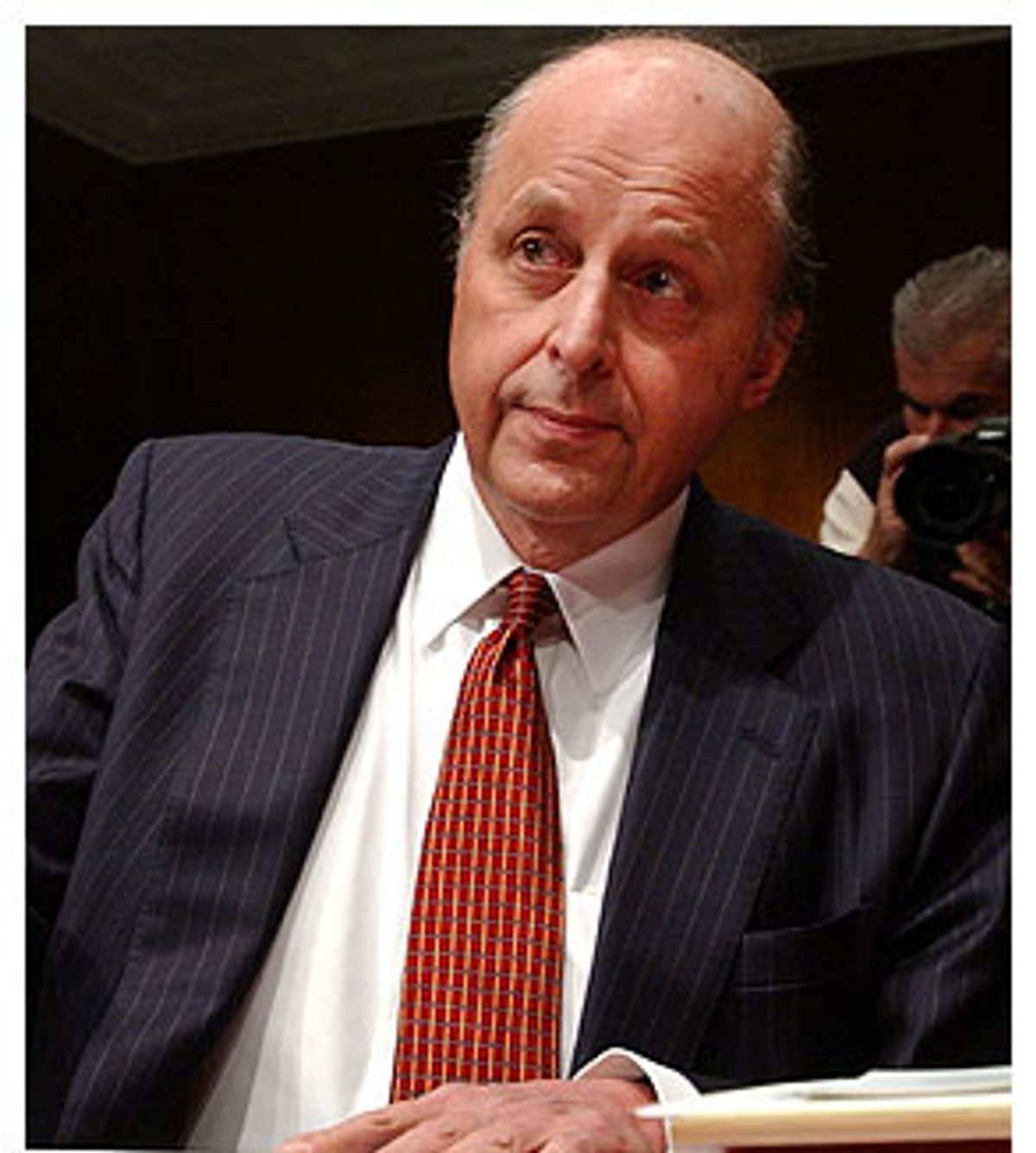
John Negroponte, the new ambassador to Iraq, proved usefully blind to the horrors perpetrated by the Honduran government in the '80s. But after Abu Ghraib, he won't be able to cover up this dirty war.

  • more
    • All Share Services

Bush's see-no-evil man in Baghdad

Ahmed Chalabi is gone from the Pentagon’s hall of heroes at last. But John Negroponte is still on track to become the Bush administration’s viceroy as U.S. ambassador to Iraq come the transfer of sovereignty scheduled for June 30. What sort of diplomatic post is it going to be? Recent history provides some very strong pointers. And they suggest that the abuses exposed at Abu Ghraib prison could be, rather than an aberration, a warm-up for fun and games yet to come.

The same veteran cold warriors who provided a respectable political shield for the armies of Honduras, El Salvador and Guatemala in their slaughter of thousands of Maya Indians 20 years ago have been painstakingly put into place to provide acceptable cover for the “pacification” of Iraq following the June 30 transition to supposedly democratic rule.

The previous careers of some of the key Bush officials appointed to oversee policy in Iraq leave little doubt about how far they are willing to go. In the past they have gone that far and beyond, without limit. They have countenanced, covered up, excused and turned a blind eye to the killing of hundreds, even thousands, including the indiscriminate murder of women and children. It is an indisputable matter of public record.

The selection of Negroponte, most recently the U.S. ambassador to the United Nations, has been presented in the U.S. media as a triumph of moderation and internationalism in the Bush administration’s quavering policy toward Iraq. Negroponte’s key qualification for his new assignment is supposedly his success in working with diplomats from other nations at the U.N.

But Negroponte above all else is an old Central America hand from the darkest chapter of the Reagan administration’s policy of confronting, containing and eventually rolling back left-wing guerrilla movements in the 1980s. He was U.S. ambassador to Honduras from 1981 to 1985 and oversaw the growth of U.S. military aid to the viciously repressive military government from $4 million a year to $77.4 million a year. Flouting an act of Congress, he created a covert scheme to funnel money to the Nicaraguan Contras through Honduras. Speaking of Negroponte and other U.S. officials working with him, a former Honduran congressman said, “Their attitude was one of tolerance and silence. They needed Honduras to loan its territory more than they were concerned about innocent people being killed.”

Negroponte supervised the construction of the El Aguacate air base, the Abu Ghraib prison of its time, which critics charged was being used as a secret torture and murder center. It is also where Contra rebels were trained to fight Nicaragua’s Marxist Sandinista government. In August 2001, excavations confirmed that the supposedly wild and paranoid rumors about torture at that prison were true. The remains of at least 185 people, including two Americans, were discovered there.

It is also a matter of record that Negroponte took no action to rein in, let alone expose, the activities of the Honduran armed forces’ own special intelligence unit, Battalion 3-16. Indeed, he helped conceal its murderous activities, reportedly including the killing of U.S. missionaries, from Congress. Battalion 3-16 was trained by advisors from the CIA and the Argentine junta.

In 1981, 32 Salvadoran nuns and other women who fled to Honduras after the assassination of Archbishop Oscar Romero were “disappeared” while Negroponte was ambassador. He asserted he knew nothing about it. But in 1996 Jack Binns, President Carter’s ambassador to Honduras, told the Baltimore Sun that the women were tortured and thrown from helicopters to their deaths by the Honduran secret police. Rick Chidester, a U.S. Foreign Service officer serving in the embassy under Negroponte who submitted the 1982 report to the State Department on the human rights situation in Honduras, said that he was ordered to remove all mention of torture and executions before it was sent to Foggy Bottom.

In 1982, the State Department’s annual human rights report on Honduras, prepared by Negroponte, found “no evidence of systematic violation of judicial procedures” and praised the country’s dictator, Gen. Gustavo Alvarez. The next year’s report was even more positive, observing that there are “no political prisoners in Honduras.” In 1988, the Inter-American Commission on Human Rights reported that “there were many kidnappings and disappearances in Honduras from 1981 to 1984 and that those acts were attributable to the Armed Forces of Honduras.” The CIA inspector general’s heavily classified 1988 report said “the Honduran military [had] committed hundreds of human rights abuses since 1980, many of which were politically motivated and officially sanctioned.” It noted that Negroponte actively discouraged U.S. Embassy officers from reporting these abuses.

When Negroponte was nominated by President Bush to be ambassador to the United Nations, Sen. Christopher Dodd, D-Conn., the most knowledgeable member of the Senate Foreign Relations Committee on Latin American affairs, said: “Based upon the Committee’s review of State Department and CIA documents, it would seem that Ambassador Negroponte knew far more about government-perpetuated human rights abuses than he chose to share with the committee in 1989 or in Embassy contributions at the time to annual State Department Human Rights reports.”

Clearly, such a U.S. ambassador in Baghdad would not turn squeamish if either Chalabi, the Rumsfeld team’s former favorite, or some lucky future “strongman” — yet to be plucked from obscurity — took such hard actions to stabilize Iraq.

Ironically, there are striking parallels between the background of Negroponte, who has devoted his life to rolling back the scourges of Central American rebels and now extremist Islamists, and the background of Chalabi, the convicted super-bank swindler who faces 22 years of hard labor if he ever makes the mistake of setting foot again in Jordan, where he was convicted of looting the Petra Bank.

Negroponte, like Chalabi, is the product of a sophisticated and cosmopolitan world of wealthy Mediterranean wheeler-dealers who made it big in Reagan-era Washington by promoting ruthless crusades in Third World countries that had suddenly become hot pawns for would-be master strategists.

Chalabi came from an elite Iraqi family that grew immensely wealthy under the sham democracy fostered by Britain in Iraq from the 1920s to the military coup of 1958. His family’s fortune and his own intellectual brilliance got him into MIT, where he did very well.

Negroponte’s father was a shipping tycoon from Greece. John was born in London, and the family migrated to the United States. Their wealth and Negroponte’s own gifts propelled him to Exeter and Yale. He rose like a rocket in the Republican sphere of Washington in the 1970s and 1980s. As an aide to Henry Kissinger, who was President Nixon’s national security advisor, Negroponte proved his bona fides as a tough guy of the right by attacking Kissinger as too soft on the North Vietnamese during the Paris peace talks.

Another man turns out to be the political and bureaucratic mentor and enabler of both Negroponte and Chalabi: the man who directed and protected the anything-goes counterinsurgency policies in Latin America in the 1980s, and who was rapidly advanced by the team of Dick Cheney, Donald Rumsfeld and Paul Wolfowitz to play a similar role for Iraq 20 years later — our old friend Elliott Abrams, now senior director for Near East, Southwest Asian and North African affairs on the National Security Council.

Abrams, in the classic neocon style, is a “phony tough,” to use the term coined by late, great columnist Stewart Alsop about the inept Watergate plotters led by Nixon. In Iraq as in Latin America, such people eagerly boast of their “realism” and “ruthlessness” — the latter of which is only too apparent in their willingness to condone or provide political cover for human rights abuses.

For ideologues like Abrams, operators like Negroponte and Chalabi are essential. They can actually do the dirty work of dealing with tyrants and torturers face to face. The Negropontes of the world, of course, are not torturers themselves; they do not have to be. Their history is to protect and reassure with respectable political cover the people who are.

Abrams at first glance would appear to have zero qualifications for his latest assignment on the NSC. He has never even pretended to be a Middle East expert. But like Negroponte, Abrams turned a blind eye to human rights violations and the Geneva Conventions and chose to ignore, even deliberately mislead, Congress in his drive to cover for U.S. allies that did the dirty work of torturing and slaughtering to pacify key regions of Central America two decades ago. In the Iran-Contra scandal, Abrams pleaded guilty to two counts of lying to Congress, and was pardoned by President George H.W. Bush.

In his years as assistant secretary of state dealing with Latin America in the Reagan administration, as David Corn wrote in the Nation in 2001, “One Abrams specialty was massacre denial. During a ‘Nightline’ appearance in 1985, he was asked about reports that the US-funded Salvadoran military had slaughtered civilians at two sites the previous summer. Abrams maintained that no such events had occurred.” In fact, as Corn continued, in 1993 a U.N. truth commission “examined 22,000 atrocities that occurred during the twelve-year civil war in El Salvador” and “attributed 85 percent of the abuses to the Reagan-assisted right-wing military and its death-squad allies.”

Why has the notorious Central America A-team been reassembled 20 years later to oversee the pacification and supposed transfer of sovereignty in Iraq? Before the revelations of the abuses in Abu Ghraib prison, no one in the mainstream U.S. media would have dared raise — and most would not even have dreamed of — the possibility that behind the rhetoric of turning Iraq into a shining city on a hill for the rest of the Middle East, some U.S. policymakers and their think-tank acolytes might be prepared to unleash policies that would not be for the squeamish, to put it mildly.

No doubt it shocked the old Central America hands when the Abu Ghraib prison abuses blew up into a national political scandal that catalyzed the plummeting of President Bush’s approval ratings. The well-documented torture and massacres in Central America, on a vastly greater scale, never came close to setting off a fraction of this furor. Nor did they occur after an immensely controversial war in which hundreds of Americans have died, or involve ordinary U.S. enlisted soldiers, G.I. Janes as well as G.I. Joes. And the unfortunate Maya Indians did not have al-Jazeera and other TV networks beaming their sufferings straight to the wider world.

Had Abu Ghraib never been exposed, and had Ahmed Chalabi managed to avoid finally exhausting the patience of his indulgent Pentagon protectors, he might eventually have taken over as prime minister of a supposedly democratic Iraq and imposed, to his heart’s content, all the “tough but necessary” measures he advocated in his Aug. 31, 2003, Washington Post Outlook section article. Chalabi urged a crackdown: “Coalition forces need to move quickly to arrest and question thousands of people” (the names of whom his Iraqi National Congress would provide).

“Some of these steps will cause disruption to innocent people and will spawn some short-term resentment towards the coalition, but they must be taken,” Chalabi wrote. Then, presumably, Ambassador Negroponte in Baghdad, backed by the National Security Council’s Abrams in Washington, would have heard no evil and seen no evil.

Even now, it is probably a safe bet that Rumsfeld, Wolfowitz and others are still hoping to come up with some plausible and presentable strongman for Iraq, convinced that if he is given a free hand to do the dirty work he deems necessary, the tidal waves of Sunni and Shiite rage alike will soon be made to go away.

There is one important difference between today’s Iraq and Middle East and Central America 20 years ago. It was one thing for a handful of U.S. intelligence operatives and special operations officers and troops bred to discretion and secrecy to work in the shadows with our allies then. It is quite another thing when entirely decent U.S. soldiers — we still don’t know how many — are encouraged or ordered to carry out such abhorrent activities on a major scale themselves.

The dirty war of Abu Ghraib is out of the bottle, and Abrams and Negroponte will not be able to provide the kind of politically acceptable cover for tough measures they specialized in long ago, which the practitioners of the Central American model were confident would also pacify Iraq. Negroponte will head to Baghdad come July as an enabler without, for once, having a strongman to enable — and without the reliable Honduran Army to do the dirty work. But those methods could only work in the shadows, not in unrelenting light. He arrives at his post in Baghdad with the whole world watching.

Martin Sieff is chief news analyst for United Press International in Washington.

Two nasty Republicans say nice things about Newt

First Dick Cheney, then Rudy Giuliani suggests Gingrich may be the toughest candidate in the GOP field

  • more
    • All Share Services

Two nasty Republicans say nice things about Newt Former New York Mayor Rudy Giuliani, left, and Newt Gingrich (Credit: AP)

What does it mean that two of the nastiest men in the Republican Party are saying nice things about Newt Gingrich? On CNN Monday night Dick Cheney warned the GOP not to “underestimate” Gingrich, and lavished praise on the disgraced House speaker for his formidable political skills.

Today, also on CNN, former New York Mayor Rudy Giuliani likewise had kind words for Gingrich, arguing he’s more electable than Mitt Romney in a race against Barack Obama.

“My gut tells me right now as I look at it that Gingrich might actually be the stronger candidate, because I think he can make a broader connection than Mitt Romney to those Reagan Democrats,” Giuliani told Piers Morgan. “You won’t have this barrier of possible elitism that I think Obama could exploit pretty effectively.”

With a straight face, Giuliani explained why charges of “elitism” wouldn’t fly against Gingrich. “One of the strengths he has is he’s got a common touch, he’s able to talk to people, he comes from a poor family, understands poverty from that point of view. He doesn’t come from the American elite. It’s going to be hard to paint him that way. There are a lot of other ways you can paint him, but you can’t paint him that way.”

You can’t? The man with the half-million-dollar Tiffany credit line? The guy who wants to do away with “truly stupid” child labor laws? The one who thinks the poor lack a work ethic? The “historian” who earned just under $2 million from Fannie Mac and took in another $37 million for his healthcare think-tank? The candidate whose tax plan overwhelmingly favors the super-rich? How many ways is Giuliani wrong there? More ways than he and Gingrich have wives between them.

Can we also acknowledge there is no such thing as a “Reagan Democrat” anymore? There are white working-class people who now permanently vote against their own class interests, and they’re Republicans, not Democrats. Then there are white working-class people who are understandably sometimes confused about which party represents them, because Democrats have spent so many years sucking up to Wall Street and playing down their populist past. Some of those voters — the ones who are public workers, or union members, or close to retirement and listening to proposals to raise the eligibility age for Social Security and Medicare — are starting to realize that they have become the GOP’s latest scapegoat, the 21st century welfare queens, and they’re taking another look at Democrats. Some white working-class voters stayed Democrats. But the Reagan Democrat analysis hasn’t made sense for a long time.

Finally, I love the fact that Gingrich and Giuliani have six wives and two marriage annulments between them. Add in Donald Trump, who seems to be leaning toward Gingrich too, they can start a Three Wives Club. Way to go, family values party!

I’ll be talking about the latest on the GOP field with Ed Schultz and Ezra Klein on MSNBC’s “The Ed Show” at 8 ET.

Continue Reading Close
Joan Walsh

Joan Walsh is Salon's editor at large.

Cheney urges “a quick airstrike” against Iran

Mr. Torture thinks President Obama should risk war to recover a downed drone. Plus: Nice words for Newt!

  • more
    • All Share Services

Cheney urges Dick Cheney (Credit: AP)

Once again, CNN philanthropist journalist Erin Burnett has used her show to give voice to the voiceless, to seek out the powerless to offer opinion on the day’s news. She debuted her show “OutFront” in early October by mocking Occupy Wall Street and defending the industry that destroyed the economy.

On Monday night Burnett gave a platform to a man almost as loathed as his Wall Street buddies, former Vice President Dick Cheney. And Cheney, predictably but contemptibly, took the opportunity to bash President Obama for not authorizing “a quick airstrike” to retrieve a predator drone that was recently downed in Iran.

Cheney told Burnett:

The right response to that would have been to go in immediately after it had gone down and destroy it. You can do that from the air. You can do that with a quick airstrike, and in effect make it impossible for them to benefit from having captured that drone. I was told that the president had three options on his desk. He rejected all of them. [...]

They all involved sending somebody in to try to recover it, or if you can’t do that, admittedly that would be a difficult operation, you certainly could have gone in and destroyed it on the ground with an airstrike. But he didn’t take any of the options. He asked for them to return it. And they aren’t going to do that.

The former vice president has been insulting Obama  since Inauguration Day, insisting his policies will make the country “less safe.” Two months into his administration, Cheney charged that the new president “is making some choices that, in my mind, will, in fact, raise the risk to the American people of another attack.” He’s accused Obama of “half measures” and “dithering” on foreign policy. And more than once he’s criticized the president for not taking a tougher stance on Iran.

Even after Obama authorized the successful mission to kill Osama bin Laden, who Bush and Cheney essentially let run free thanks to their discretionary war with Iraq, Cheney wasn’t happy. “I still am concerned about the fact that I think a lot of the techniques that we had used to keep the country safe for more than seven years are no longer available. That they’ve been sort of taken off the table, if you will.”

So Cheney’s carping is nothing new. But suggesting that the president launch “a quick airstrike” to retrieve the downed drone is ridiculous, even for Cheney. There’s no such thing. Cheney has to know that any new U.S. incursion, following on the drone discovery, would sharply escalate tension with Iran, and to do that to recover a drone isn’t at all worth the risk.

It was left to CBS Early Show co-anchor Rebecca Jarvis this morning to ask the follow-up question Burnett did not: “Would not, though, an airstrike on Iran have potentially led us into a war with them?”  Cheney replied:

Well, if you look at what Iran has done over the years, they’ve been the prime backers of Hezbollah, of Hamas, the bombing of the Marine barracks in Beirut in 1983 that cost us 241 American lives. These were Iranian-supported ventures. It’s not as though they haven’t already committed acts that some people would say come close to being acts of war.

For us to go in and take out the drone that crashed would have been, I think, a fairly simple operation, and it would have denied them the value of the intelligence they can collect by having that aircraft,” he said. “But the administrative basically limited itself to saying, ‘Please give it back,’ and the Iranians said no.

ThinkProgress made a good catch: When a U.S. spy plane ventured into Chinese airspace in April 2001 and crashed with a Chinese fighter jet, the Bush-Cheney administration wound up apologizing in order to get 11 soldiers released from Chinese custody.  They didn’t send in “a quick airstrike.”

For the record, Cheney sounded bullish on Newt Gingrich in 2012, though he hasn’t endorsed anyone formally. “I wouldn’t underestimate him,” Cheney said, praising Gingrich’s political skills. “The thing I remember about Newt, we came to Congress together at the same time, ’78, and when Newt showed up, he said, ‘We can become the majority. We can take back the House of Representatives. We hadn’t had the House since the 1940s. And initially, none of us believed it, but he was persistent. And he was tenacious. He kept it up and kept it up and kept it up. And finally by ’94, he’s the newly elected speaker of the House of Representatives with a Republican majority.” Cheney declined to describe the way Gingrich crashed and burned in the years that followed. You’ve got to count that among the nicest things anyone who’s worked with Gingrich has said about him during the whole campaign. Stay tuned.

Continue Reading Close
Joan Walsh

Joan Walsh is Salon's editor at large.

Dick Cheney interviewed by Liz Cheney at “Ideas Forum”

The Atlantic Magazine's celebration of Washington's power elite culminates in a pleasant father-daughter chat

  • more
    • All Share Services

Dick Cheney interviewed by Liz Cheney at Former Vice President Dick Cheney, accompanied by his daughter Liz, addresses the Washington Ideas Forum on Thursday. (Credit: AP/Manuel Balce Ceneta)

This week, the Atlantic Media Co. held its “Washington Ideas Forum,” one of many regular events held for Washington’s political elite to gather and congratulate themselves for having so many ideas. The Atlantic — which also publishes a monthly magazine, I’m told — throws these pricey orgies of self-regard each year, in Washington and Aspen. One of the big “ideas” presented at this year’s forum was actually a pretty old one: that no matter how awful and criminal certain people’s behavior is in office, they will never, ever be kicked out of the Washington elite.

That’s why the forum hosted Henry Kissinger, this big idea’s mascot. And that’s why the forum ended with an interview with former Vice President Dick Cheney, who has a memoir to promote. Cheney was joined onstage by his daughter and co-author, Liz Cheney, who is devoting herself to whitewashing her father’s legacy of torture and death and shooting old men in the face.

They were technically being “interviewed” by a third party — a journalist! — but for some reason most of the question-asking was actually done by … Liz.

“Were you really secretly running things?” Liz Cheney asked.

“No,” her father said.

As proof, he cited the fact that President Bush once had Cheney’s dog banned from a section of Camp David.

This gentle interrogation seems to have struck certain high-profile Atlantic contributors as a bit silly but on the other hand it would be much harder to get big names to attend these things if they were worried someone might call them out for being a war criminal. (Hot tip for the International Criminal Court: Try sending out invitations for a sham “Ideas Festival”?)

The forum also hosted former Pakistan leader Pervez Musharraf, an actual former dictator. (But one of the “good ones”!)

Continue Reading Close
Alex Pareene

Alex Pareene writes about politics for Salon and is the author of "The Rude Guide to Mitt." Email him at apareene@salon.com and follow him on Twitter @pareene

Guy who wants Obama to read less fiction not as concerned about Cheney’s reading list

Tevi Troy says the former Vice President may not have read much nonfiction, but he did meet with guys who write

  • more
    • All Share Services

Guy who wants Obama to read less fiction not as concerned about Cheney's reading list

Remember Tevi Troy, the Republican “former senior White House aide” who criticized Barack Obama at the National Review Online for reading well-reviewed novels instead of Jonah Goldberg’s “Liberal Fascism” and other conservative book club selections? He’s back with another of his wonderful posts about the reading habits of prominent politicians. This time, he’s talking Dick Cheney.

Dick Cheney’s memoir apparently mentions a lot of books he read and enjoyed. Mostly books about wars and frontier settlers and so on. Good Republican books. But the Washington Post’s nonfiction book editor notes that Cheney doesn’t mention reading anything while actually in office as vice president:

Noticeably missing from the pages of Cheney’s memoir are references to books examining the big issues of our day — issues of crucial importance during his tenure with the Bush administration. From his memoir, it is impossible to know if he took any counsel at all from the estimable books of the past decade on national security, terrorism, torture, Islam, domestic surveillance. He remains opaque to the end.

This seems sort of like a defensible version of the weird criticism Troy leveled at President Obama, right? (As Troy wrote of Obama: “the near-absence of nonfiction sends the wrong message for any president, because it sets him up for the charge that he is out of touch with reality.”) So does Troy agree with the Post on Cheney? No. No, he does not:

When it comes to the books Cheney read as vice president, though, Cheney is indeed less forthcoming about the titles. He does, however, list a variety of thinkers and writers with whom he met while in office, including Fouad Ajami, Bernard Lewis, Nathaniel Philbrick, Jay Winik, Edmund Morris, David McCullough, Charles Krauthammer, and Victor Davis Hanson. In addition, while Cheney was vice president, there were public reports that Cheney read a number of books with contemporary policy implications, including Natan Sharansky’s The Case for Democracy, Elliott Cohen’s [sic] Supreme Command, and Winik’s April 1865 (interestingly, President Bush was reported to have read all three of those as well). I am sure that neither of these lists depicts the totality of what Cheney was reading and to whom he was speaking, so I guess by some measure he does remain “opaque.” But the list of at least some of the outside influences Cheney looked to during his vice presidency was available and out there, both within and outside Cheney’s memoir, if one had chosen to look for them.

He may not have been reading serious nonfiction about contemporary issues, but he met with Charles Krauthammer! That is basically the same thing, right? Reading an “estimable book” on Islam is surely a waste of time when you can just call up Victor Davis Hanson for a chat.

So for Cheney’s reading list we’ve got those all-important “meetings” plus two historical war books and one foreign policy manifesto that plainly reinforced Cheney’s already extant biases. I can see why self-proclaimed presidential reading expert Troy was “somewhat bothered” by that Post piece that made the same argument he made about Obama two weeks ago except not as stupidly.

Turns out this Troy character may not actually be a serious scholar of the history and meaning of presidential reading, and may, in fact, just be some random shameless right-wing think tank hack!

Continue Reading Close
Alex Pareene

Alex Pareene writes about politics for Salon and is the author of "The Rude Guide to Mitt." Email him at apareene@salon.com and follow him on Twitter @pareene

The Cheney Regency

In his new book the former vice president disses his boss -- and boasts of power

  • more
    • All Share Services

The Cheney RegencyClockwise from upper left: Dick Cheney, George W. Bush, Condoleezza Rice and Colin Powell

Give the old vizier his due. Richard Cheney is the most influential and radical political leader of his times. The former vice president’s new autobiography, assertively titled “In My Time,” tells at least part of the story. The fuller telling of his biography will have to come from guilty aides, declassification of key documents, and possibly a future war crimes tribunal. In the meantime, what the man wants to tell us in the here and now is interesting enough.

Cheney’s memoir — by turns implacable, misleading and frank — presents strong evidence that he served as de facto co-president of the United States from the morning of Sept. 11, 2001, until late 2006. Certainly, the book demonstrates that no vice president in American history has ever wielded such influence — some would say control — of the levers of power in Washington.

His radicalism is served proudly. “I wanted to make sure the governor understood my record was not moderate,” he writes about an early meeting with Texas Gov. George W. Bush.

The Cheney Regency featured a canny bureaucratic mandarin waging war in tandem with a passive chief executive, who shared his views but his not skills. There is nothing comparable in the history of the American presidency. Some sympathizers have discerned the hand of God in Bush’s presidency. Cheney, a less sentimental observer, gives more credit to himself.

Bush, his nominal boss, while occasionally lauded for his “courageous” decisions, cuts an unobtrusive and unimpressive figure in Cheney’s life. The first important political decision that Cheney attributes to Bush was selecting him as his vice-presidential running mate. “Dick, you’re the solution to my problem,” Cheney repeatedly quotes Bush as saying.

About Bush the man, Cheney has nothing to say. Nothing about his struggle with alcoholism, his troubled relationship with his father, his extensive record of two terms as governor of Texas, or his efforts to define a “compassionate conservatism.” Such irrelevant details do not interest Cheney who focuses relentlessly on power.

Chronologically, the next important decision that Cheney attributes to Bush came on Sept. ll as the White House confronted reports of hijacked airliners flying into buildings. The president, he writes, 

“approved my recommendation that they [Air Force pilots] be authorized to fire on a civilian airliner if it had been contacted and would not divert … When the president came on the line I told him about the shootdown order.”

This is a fib, if not a lie, as a careful reading of the 9/11 Commission report indicates. While the report’s language is tactful, senior commission staffers certainly had their doubts that Cheney ever spoke to Bush about the order before it was given. The evidence supports their doubts.

That pattern recurs in Cheney’s book: The chain of command appears to function normally while the vice president shapes crucial decisions. As the Bush White House pondered how to respond to the attacks in September 2001, for example, Cheney recalls offering sage advice: “I suggested to the president that it would be useful to make certain that [Secretary of Defense] Rumsfeld had assigned priority to planning for possible military action against Saddam.” Rumsfeld’s plans would be put into action in Iraq 18 months later.

When British Prime Minister Tony Blair came to Washington in 2002 to ask the White House to support a U.N. resolution against Saddam, Cheney disagreed — and assumed he had Bush’s assent. “I knew the president was no more interested than I was in an endless round of inspections and deception in Iraq,” he writes.

As the preparation for war intensified in the early 2003, Prince Bandar, the Saudi potentate, came to Washington skeptical that Washington was really going to invade Iraq. Cheney says he met with Bandar, who was reassured.

“I conveyed the message to the president. He met with Bandar the following Monday.” End of story. Bush’s conversation with Bandar has no importance in Cheney’s account — and perhaps in reality.

After the destruction of Saddam’s regime in March 2003 and Bush’s reelection, in 2004, Cheney felt so secure in his power he starts omitting Bush from his ambitions altogether. “I felt strongly that a major change was needed in the national security team,” Cheney writes. “Getting a new secretary of state was a top priority.”

It is safe to say that no vice president in American history has dared use such presumptuous language about the composition of a presidential cabinet. Cheney’s target Colin Powell soon resigned — though he claims he planned to all along.

About Iraq’s descent into violent chaos from 2003 to 2006, Cheney is mostly silent. Not surprisingly, he does not address the human toll: the awful civilian deaths or the massive displacement of Iraqi Christians, and the impoverishment of millions. He shrugs off the worldwide revulsion generated by the revelations of torture at Abu Ghraib. He offers occasional paeans to fallen U.S. soldiers, but more often he calls attention to his own influence in ways that seem condescending to his patron.

As the White House was forced by failure to consider a new policy in 2006, Cheney still tried to impose his will. When Bush’s aides prepared a presidential speech about the dismal situation in Iraq that did not include the word “victory,” Cheney proudly reveals that he intervened with the speechwriters — and literally put the talismanic word in the president’s mouth. Even Bush’s critics have stopped retailing such tart anecdotes about the former president. Cheney has not.

Not coincidentally, Bush broke with Cheney about this time. In November 2006, Bush fired Rumsfeld without asking for the vice president’s opinion. For the first time in five years, Bush started making key decisions on his own.

Cheney’s account turns petulant at this point. After 2006, no one in the Bush administration (besides Cheney) can do much good. The new Secretary of Defense Robert Gates mistreated two top generals. Secretary of State Condi Rice was so eager to reach an agreement with North Korea she issued a public statement that was “utterly misleading.” And President Bush had failed by acting on her recommendations, not his.

“The process and the decision that followed seemed so out of keeping with the clearheaded ways I had seen him make decisions in the past,” he writes with surprise.

What had changed was that Cheney no longer dominated the process of presidential decision-making on foreign policy. He was merely the vice president. His reign was over but his pride remained. Like the man or not, the possessiveness of his book’s title is deserved. From 2001 to 2006 was Dick Cheney’s time. 

Continue Reading Close
Jefferson Morley

Jefferson Morley is a staff writer for Salon in Washington and author of the forthcoming book, Snow-Storm in August: Washington City, Francis Scott Key, and the Forgotten Race Riot of 1835 (Nan Talese/Doubleday).

Page 1 of 99 in Dick Cheney