Books

Heavenly creatures

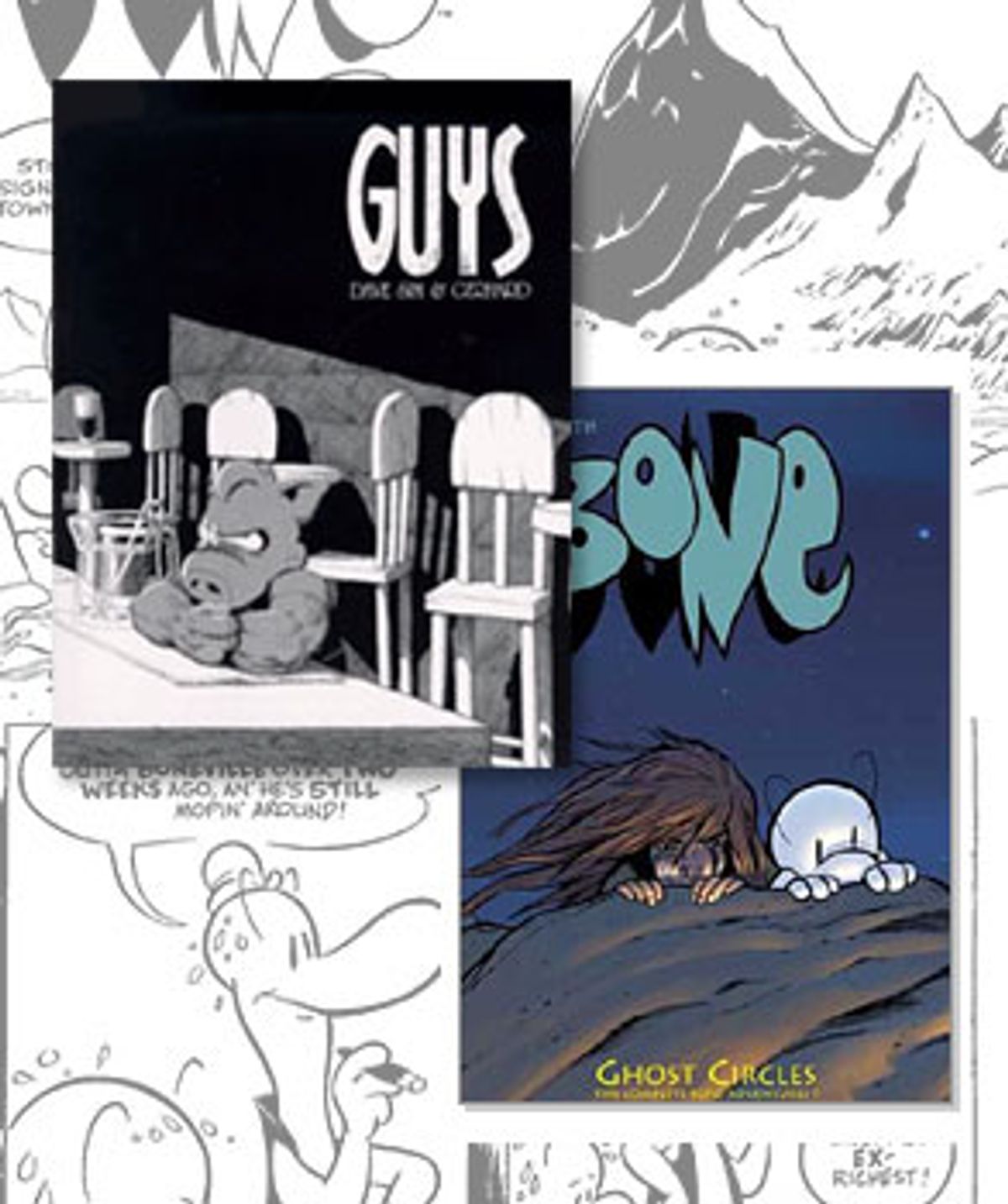
Jeff Smith's "Bone" and Dave Sim's "Cerebus" defined a comics era -- and helped make funny animals cool again. With both these epic series ending, the comics world is at a crossroads.

  • more
    • All Share Services

Heavenly creatures

In the ecosystem of modern comic books, funny animals are the endangered species. Superheroes still make up most of the population, but thanks to the rise of “literary” graphic novels, creatures of different colors — war correspondents, lovelorn slackers and self-obsessed cartoonists — roam alongside the men and women in tights. But the art form’s increased respectability undercuts some of its youthful fun. Whole menageries of talking critters — screw-loose squirrels, lucky ducks, li’l devils, amorphous shmoos — are going extinct.

Overall the old funny-animal comics make no great loss, having mostly been cheap knockoffs of Disney properties or Saturday morning TV characters. But some ingenious creations did spring onto the scene, like Carl Barks’ classic Donald Duck comics and R. Crumb’s ribald adventures of Fritz the Cat. Two lesser-known yet landmark titles — one accessible to all readers, the other forbidding and definitely not for kids — have unfolded in recent years in extended but self-contained, novelistic story lines, and will conclude within months of each other. Dave Sim’s “Cerebus” finished its staggering 6,000-page, 300-issue publication in March, while Jeff Smith’s “Bone” completes its more modest but still impressive 55-issue run this month.

Jeff Smith’s Bone cousins don’t look like bones, but rather like half-pint, pie-faced humanoids — distant kin to Walt Kelly’s Pogo the Possum or Casper the Friendly Ghost, perhaps. And Dave Sim’s Cerebus should not be confused with Cerberus, Hades’ three-headed guard dog in Greek mythology. Instead, “Cerebus” chronicles the exploits of a talking aardvark who drinks heavily and has a penchant for violence, one-liners and messianic tendencies.

“Bone” and “Cerebus” share superficial similarities. They’re both drawn in black-and-white and self-published by their creators. In both, quirky, anthropomorphic beings shed light on mankind’s foibles and virtues. Both books extend their lives outside the comic shops through hefty, trade-paperback reprint volumes available at bookstore super chains. The 16th and last “Cerebus” collection, “The Last Day,” chronicles the aardvark’s final hours and publishes this month, while Smith will sandwich all 1,300 pages of “Bone” between two covers in a volume due to publish in July.

But beneath the surface, “Bone” and “Cerebus” prove to be so different, they’re almost like photographic negatives of each other. “Bone” celebrates optimism and narrative simplicity, while “Cerebus” embraces cynicism and experimentation worthy of a mad scientist. Sim and Smith started as comrades in arms, yet their relationship soured into one of the industry’s strangest feuds. “Bone” and “Cerebus” mark opposite ends of the comic-book spectrum in tone and complexity. Their heroes aren’t technically human, but you can place virtually all modern graphic novels somewhere between them.

Smith’s “Bone” may be the most friendly and engaging comic book of the past decade. Since 1991, Smith has written and drawn the adventures of the three Bone cousins: good-hearted mensch Fone Bone, happy-go-lucky goofball Smiley Bone and greedy, hot-headed Phoncible P. “Phoney” Bone, who needs constant rescuing when his get-rich-quick schemes go awry. The “Bone” saga begins with the trio fleeing their never-seen home of Boneville and discovering “a deep, forested valley filled with wonderful, terrifying creatures.” Recurring characters include an enigmatic, cheroot-chomping red dragon; a farm girl named Thorn who becomes Fone Bone’s unrequited love; and ravenous, none-too-bright Rat Creatures, the book’s answer to Wile E. Coyote. Fone Bone’s exclamation “Stupid, stupid rat creatures!” became a comic shop catchphrase.

Throughout “Bone,” Smith demonstrates a graceful command of unappreciated comic-book styles. The early issues include scary chases as dynamic as anything drawn by action-obsessed artists like Frank Miller (of “The Dark Knight”), but prove essentially comic and sunny. Smith’s sharp characterizations and clean drawing style reflects his love of the “Pogo” and “Peanuts” strips and especially Barks’ “Donald Duck” tales, which took the Donald and his zillionaire uncle, Scrooge McDuck, on adventurous treasure hunts in exotic locales. Even the name Fone Bone pays homage to the late Don Martin, penciler of Mad magazine’s most outlandishly elastic cartoons.

“Bone” began as a fantastical, freewheeling romp — one of the first extended story lines depicted “The Great Cow Race” — but it gradually yet seamlessly turned into a dark, sprawling fantasy epic. Recent issues have found the Bones on the wrong end of a massive siege akin to the Helm’s Deep sequence of “The Lord of the Rings: The Two Towers.” The Bones and Thorn learn that she’s not only the heir to a fallen kingdom, but possibly the decisive figure in an apocalyptic battle between good and evil. In Tolkien terms, she’s like Frodo and Aragorn wrapped up in one.

“Bone” is also more sophisticated than it first appears. In the story arc “Rock Jaw: Master of the Eastern Border,” Smiley and Fone Bone protect a bunch of cute woodland creatures from the title character, who resembles a big cat from Disney’s animated “Jungle Book.” Yet Rock Jaw has not just wicked claws, but also a Manichean worldview that sets off a debate over the purpose of life — in between bona fide cliffhangers. In the “Ghost Circles” story line, evil magic turned the lush valley into a blasted wasteland, against which the Bone cousins’ capacity for loyalty and humor provide the only human element.

Even when Smith pours on the mystical hoodoo a little thick, the funny but multifaceted characters keep the tale on a solid footing. More than any other current comic title, “Bone” deserves — and could support — the kind of popular attention that elevated Harry Potter from the rank and file of children’s books. “Cerebus,” on the other hand, will never be more than a cult success, since it’s such an iconoclastic project — not just in comics, but in all of mass media — that it defies categorization. Call it “satire” by default. Dave Sim began the book in 1977 as a spoof of “Conan the Barbarian” comics that replaced the longhaired muscleman with a 3-foot, sword-swinging, talking aardvark. “Cerebus” initially made hay from the incongruity of a deadpan, self-centered “earth-pig” playing the macho hero.

But Sim had bigger ambitions for the book than anyone could imagine, and by 1979 had announced, at the age of 23, that “Cerebus” would be a self-contained story of 300 issues — the “War and Peace” of comic books. Sim parodied modern politics by taking Cerebus from mercenary to diplomat to, in the 25-issue “novel” “High Society,” the elected prime minister of a fictitious, preindustrial nation (that bears a passing resemblance to Sim’s native Canada). The subsequent book “Church and State” ran twice as long (about 1,100 pages) to illustrate the abuse of religious authority as Cerebus became pope of a Catholic-style church. By the end of “Church and State,” a character prophesied that in the final issue, the eponymous aardvark would “die alone, unmourned and unloved.”

The artist known as Gerhard designs the book’s intricate backgrounds (which look far more solid and tangible than most comic drawings) while Sim scripts the book and draws the characters. “Cerebus” shows the talent and vision to rival any of the stars of the current comic books scene, including Alan Moore and Neil Gaiman. As a restless, anything-goes stylist, Sim proves equal parts theatrical stage manager, cinematic cameraman and comedy-club impressionist. Recurring characters include ersatz versions of Groucho Marx, Mick Jagger and the Three Stooges, reinterpreted for Cerebus’ milieu but with their vocal and visual traits captured with hilarious accuracy. Sim has also offered poignant, realistic portraits of late-career F. Scott Fitzgerald, Ernest Hemingway and Oscar Wilde. The 11-issue “short story” “Melmoth” juxtaposes a near-catatonic Cerebus killing time in a café with an accurate account of Wilde’s last days that works as a kind of historical biography in pictures.

For literally decades, Sim’s aardvark has shown a classic comedian’s gift for slapstick and the slow burn. Yet “Cerebus” proves its most moving generally at the end of its extended story lines, when Cerebus receives some kind of enlightenment instead of worldly power or romantic attachment. The “earth-pig” ultimately proves more tragic than comic: No matter how many epiphanies he has, he can never significantly change his brutal, selfish nature. As a violent, charismatic and funny antihero whose pursuit of power never provides peace of mind, Cerebus resembles few other characters in contemporary pop culture so much as Tony Soprano.

In the late 1980s and early ’90s, Sim became a folk hero for independent comic book artists. He spoke out for creators’ ownership of their work, used “Cerebus” to boost other up-and-coming comics and even ran a 13-page excerpt of “Bone” in 1992. (“You guys are going to love this one,” Sim announced.) Sim has proved resoundingly that one can write, draw and self-publish a monthly comic for 27 years — but not necessarily that one should.

As Sim’s ideas about religion and gender relations changed over time, the setting and characters of “Cerebus” became increasingly unwieldy vehicles for their creator’s personal views. Sim dabbled more heavily in dense textual pieces, including mannered pastiches of Wilde and Fitzgerald’s prose styles. He indulged in metafictional gambits, injecting himself into the narrative to talk directly to Cerebus. He recycled ideas and twice took Cerebus off the earth itself to travel the solar system — which admittedly provided some of the book’s most breathtaking moments.

In reading “Cerebus” over the last 10 years, it became increasingly difficult to separate the work’s wild creativity from Sim’s strident views about women, beliefs that Sim insists on calling “anti-feminism,” while his critics — and most of his dwindling readership — find them indistinguishable from straight-up misogyny. Appreciating later “Cerebus” can be like trying to separate the work of, say, Richard Wagner or D.W. Griffith from their personal beliefs.

But Sim’s comic book isn’t — necessarily — as didactic as Sim himself. By far the book’s most sympathetic and well-rounded role is Jaka, a princess turned dancer and Cerebus’ true love (insofar as he’s capable of love). With one or two exceptions, Sim’s men never prove to be avatars of reason, but Machiavellian plotters, self-absorbed artists or colorful clowns. For all of Sim’s polemics, “Cerebus” comes closer to the equal-opportunity misanthropy of “Gulliver’s Travels” than to the elevation of one gender over another.

Since he began condemning women as emotion-based “devouring voids” and the source of a host of marital and social problems, Sim turned from champion to persona non grata in the comics field, and even had a highly public falling out with Jeff Smith. In a 1999 interview with the Comics Journal, Smith described a weekend visit from Sim, who expounded on his views about women in front of Smith’s wife. “Bone’s” creator claims to have said “Dave, if you don’t shut up right now, I’m going to take you outside and I’m going to deck you” and that the “Cerebus” creator hastily backed down.

But a year after the interview appeared, Sim published an editorial in “Cerebus” calling Smith a liar and challenging him to a three-round boxing match to settle their differences. (Not surprisingly, the challenge coincided with the Ham Ernestway storyline in “Cerebus.”) Smith opted not to box his fellow cartoonist, sent “Cerebus” a letter telling Sim to “get stuffed” and has avoided further comment on the affair. However, in the letters page of “Bone’s” penultimate issue, Smith tipped his hat to Sim and Gerhard for getting to 300: “The troubles between Dave and I are personal, not professional, so congratulations, boys. You did it and you did it on time. I know it took a dedication few artists will ever have.”

Though “Cerebus” tries its readers’ patience in all possible ways, it remains a book that stretched the possibilities of the comic book form further than any rational person could expect. “Bone” doesn’t match “Cerebus” for insane ambition, yet proves about a zillion times more satisfying — not the least by making the devalued “cartoony” comic books seem cool again.

“Bone’s” bittersweet ending inspires the kind of melancholy that accompanies the final chapter of any wonderful piece of escapism, but at least Smith expects to pen further tales in the “Bone universe” in the future. (He next plans to do a limited Captain Marvel series for DC Comics.) In interviews, Sim has said he has no immediate plans to continue with comic books at all, and likens himself to a prisoner facing the end of a 27-year sentence. “Cerebus’” conclusion may leave readers both impressed at Sim’s achievement and relieved that it’s over. In “Cerebus” 121, the Oscar Wilde character’s capper for “Church and State” applies to the culmination of the comic book itself: “The ending was less of a grand finale than a grand finally.” At least “Cerebus,” like “Bone,” gave funny animals a grandeur all their own.

Curt Holman is a freelance writer in Atlanta.

Memorial Day fiction: Are we there yet?

Salon exclusive: At the start of the summer fiction season, new stories from Chris Pavone and Natalie Bakopoulos

  • more
    • All Share Services

Memorial Day fiction: Are we there yet? (Credit: iStockphoto/caracterdesign)

“Are we there yet?”

It’s a dreaded sentence. When it’s spoken by an anxious child from the back seat, it’s enough to make stressed-out parents wish they’d never taken a family vacation in the first place. And even if it’s delivered as a sing-songy punch line, from an impatient partner or spouse on a long road trip, it’s an irritating eye-roller of a joke.

So this Memorial Day weekend — the unofficial start of the summer vacation season, and therefore the summer fiction season — we asked two novelists to reclaim the sentence in a new and adult context. For our latest fiction project, there was only one simple rule: Each story had to include the line “Are we there yet?” in a fresh and surprising way.

Our authors are two people you should be taking to the beach with you this summer. Chris Pavone is the author of “The Expats,” the New York Times best-selling thriller with more satisfying twists than the Pacific Coast Highway. Natalie Bakopoulos is the author of “The Green Shore,” one of 2012′s most anticipated debut novels, a beautiful family drama that is set during another Greek crisis — the 1967 military coup.

To read the stories, just follow the links below:

“Megaphone” by Natalie Bakopoulos

“Almost” by Chris Pavone

Continue Reading Close

David Daley is the senior culture editor of Salon.

“Tubes”: What the Internet is made of

If you think your data lives in the cloud and flies through the air, you're wrong

  • more
    • All Share Services

Andrew Blum

The title of Andrew Blum’s “Tubes: A Journey to the Center of the Internet” is a ricocheting joke. When Alaskan Sen. Ted Stevens described the Internet as a “series of tubes” back in 2006, he was roundly mocked for not understanding the online world despite being chairman of the Commerce, Science and Transportation Committee and therefore instrumental in overseeing it. Stevens may not have known what he was talking about, Blum (a correspondent for Wired magazine) acknowledges, but he wasn’t wrong, either. In writing this account of “the Internet’s physical infrastructure,” Blum found that “one thing [the Internet] most certainly is, nearly everywhere, is, in fact, a series of tubes.”

The average resident of the developed world uses the Internet constantly, contemplating its impact on contemporary life and exploring its numberless delights, temptations and annoyances on a daily basis. Yet, for most of us, any notion of how all this information arrives in our homes and workplaces is weirdly immaterial. Stevens was ridiculed for his hopelessly old-fashioned reference to the physical world and the movement of palpable objects, while smart kids and late-night comics grasped that the Internet has zipped beyond all that to become the disembodied essence of human communication.

Only it’s not, and “Tubes” is about the actual, physical things — many of them tubes — that make up the pathways of the Internet. For all their significance to contemporary life, governance, commerce and industry, these conduits aren’t an alluring topic. Like a lot of important things, they are superficially dull and trivial: bundles of cables; deserted stations ringed in cyclone fencing beside lonely highways; featureless, windowless buildings in old warehouse districts and, above all, rooms filled with metal boxes, blinking lights and cool, dry processed air. This is not the stuff that dreams are made of — and at the same time it is, because dreams of every sort thrive online.

Fortunately, Blum is a smart, imaginative, evocative writer who embraces the task of making his readers feel the wonder represented by these unprepossessing objects. In the Cornish seaside town of Porthcurno, he’s shown a black cable emerging from the floor, “spooled into steel trays the size of merry-go-rounds, like something stolen from Richard Serra’s storehouse,” and pictures the thousands of miles it extends, through the depths of the Atlantic Ocean, all the way back to Long Island, where, in the form of light shining down strands of glass, it will carry home the email he writes to his wife from his hotel room that night. (Another cable, running from Portugal to Africa is a “nine-thousand-mile path of light… that would transform a continent.”) Swathes of cables lifted from beneath the streets of Manhattan by workmen are likened to “giant squid under the streetlights.”

This book is more than a electrical engineering travelogue, however; in the course of his research Blum interviewed representative examples of the people who make the Internet work and a smattering of those who helped build it in the first place. The computer science professor at UCLA who, in 1969, used a phone line to connect that university’s computer network with Stanford’s shows Blum the IMP (Interface Message Processor) used for the task: a file-cabinet-sized box — the first piece of the Internet! — now shoved into the corner of a shabby conference room. He attends a meeting of network operators, the people who, among other things, negotiate the direct, plug-in, network-to-network connections that are the building blocks of the net, and hears a Dutch woman imitating an old-school street hawker: “I have eyeballs, eyeballs, eyeballs. For all of you with content, please send me an email.”

So ingeniously beguiling is Blum’s way of conveying all this that, before you know it, you have acquired a sense of the basic structure of Internet — from old-school exchanges to fiber-optic regeneration stations. The Internet turns out to be not quite what Blum (and a lot of other people, including myself) assumed. “I expected to find a loose arrangement of little pieces,” he writes, expressing an idea probably shared by many of his readers. “It was all supposed to be distributed, amorphous, nearly invisible.” True, information can travel via a variety of routes, but most of the time it makes its way along major thoroughfares. While the Internet doesn’t exactly have a center, it certainly has nodes and backbones where most of the connections are made and the data stored. Blum tried to lay eyes on as many of these as he could.

It wasn’t always easy. Having arranged to visit a brand-new Google data center in rural eastern Oregon, Blum never gets closer to the servers than the lunchroom, and his interviews are supervised so oppressively it’s like taking an official tour of North Korea. (Perhaps ironically, a Facebook center in the same region proved much more open.) For months, Cablevision, his own Internet service provider, dodged his requests for an overview of how data got from their network to his home in Brooklyn. While the more secretive of the organizations he contacted often attributed their caution to security concerns, Blum was skeptical. He compares a stopover at the friendly visitor center at nearby Bonneville Dam to the “Orwellian atmosphere” at Google; both are important, strategically sensitive resources, but only one is shut up tighter than Fort Knox. Blum questions whether it’s wise to hand over “so much of ourselves” to corporations that are not obliged to return the trust.

Part of the utopian romance of the Internet is that it has no weight, no friction, no footprint, no smell. The buzzword of the moment — “cloud” — promises ethereality, pure information, a dream with almost supernatural intimations. Yet as one of Blum’s data-center tour guides explains, “This is the cloud. All those buildings like this around planet create the cloud. The cloud is a building. It works like a factory.” It needs power, raw materials and staff. And its roots are in the earth.

Continue Reading Close
Laura Miller

Laura Miller is a senior writer for Salon. She is the author of "The Magician's Book: A Skeptic's Adventures in Narnia" and has a Web site, magiciansbook.com.

Exclusive: The Paris Review, the Cold War and the CIA

Letters discovered by Salon show even deeper Cold War ties between the Paris Review and a U.S. propaganda front

  • more
    • All Share Services

Exclusive: The Paris Review, the Cold War and the CIA (Credit: Salon)

In 1958, the Paris Review’s George Plimpton wrote his Paris editor with a grand proposal. The Russian author Boris Pasternak had just been awarded the Nobel Prize. But under pressure from the Soviets — humiliated that “Dr. Zhivago” had to be smuggled out of the country — he refused it. “The Pasternak affair has caused such a stir here,” writes Plimpton from the journal’s New York office, “and is in itself an event of such importance in lit’r’y history that we feel the Review somehow should chronicle what has happened…” Writing to Nelson Aldrich, the Paris editor, Plimpton suggests short statements by a “variety of authors asked to comment. What does Sartre have to say on this matter … Aragon, Neruda, Waugh? Here [in New York] we have Niccolo Tucci … digging up statements, mostly from writers who (as he is himself) are refugees from tyranny…” Plimpton goes on to suggest that the Congress for Cultural Freedom, largely and covertly funded by the CIA, might fund brochures to help publicize the issue.

The Paris Review has been hailed by Time magazine as the “biggest ‘little magazine’ in history.” At the celebration of its 200th issue this spring, current editors and board members ran down the roster of literary heavyweights it helped launch since its first issue in 1953. Philip Roth, V. S. Naipaul, T.C. Boyle, Edward P. Jones and Rick Moody published their first stories in the Review; Jack Kerouac, Jim Carroll, Jonathan Franzen and Jeffrey Eugenides all had important early stories in its pages. But as Peter Matthiessen, the magazine’s founder, has told interviewers — most recently at Penn State — the journal also began as part of his CIA cover.

Plimpton’s letter on Pasternak is essential, however, because for many years a small group of journalists has been trying to pry more information out of Matthiessen on the still-unknown extent of the CIA’s role with the Paris Review — and many in particular have wondered what the legendary Plimpton himself knew of the magazine’s CIA origins. Matthiessen’s story has not changed much since it was first revealed in a 1977 New York Times story. But the Review’s archive at the Morgan Library in Manhattan — until now left mostly out of the debate — shows a number of never-reported CIA ties that bypass Matthiessen or outlive his official tenure at the Agency. In fact, a number of editors, Plimpton included, repeatedly courted ties to the Congress for Cultural Freedom. These ties started modestly — ad exchanges, reprints of Paris Review interviews in the Congress’s official magazines — but grew much more robust, including what one editor described as a “joint emploi” where the Congress and the Review would team up to share an editor’s living expenses in Paris and also to share interviews and other editorial content. In its vast quest to beat the Soviets in cultural achievement and showcase American writing to influential European audiences and intellectuals, the Congress may have even suggested some of the famed Paris Review interviews. All of which means that at the dawn of the CIA’s era of coups and nefarious plots, America’s most celebrated apolitical literary magazine served, in part, as a covert international weapon of soft power.

- – - – - – - – - – - – - -

The weaponization of culture starts at Yale. Prof. Norman Holmes Pearson is cited on the Paris Review web site as the intelligence officer who recruited Matthiessen (Yale College, 1950) into the CIA. This fact may explain the subtle cultural politics of the supposedly apolitical Paris Review. Pearson’s career is a mashup of literature and spying. A friend of the modernist poet Hilda Doolittle (aka, “H.D.”), he hired H.D.’s daughter as his secretary. She then became that of his assistant, the CIA’s bogeyman, James Jesus Angleton. After an illustrious record during World War II in the Office of Strategic Services alongside CIA founding light William Donovan and CIA director Allen Dulles, Pearson returned to academe to take charge of Yale’s fledgling American Studies program.

How does covert propaganda or intelligence work link up with American Studies? Answer: Monomania and the Cold War. Consider a letter from Yale’s dean at this time to its president:

From such a study we will gain strength, both individually and as a nation … strength, which we need so badly in our time to face the changing, and in part, hostile world  … This is an argument … for the establishment of a strong program of American Studies at Yale, which in many respects is our most native university … In the international scene it is clear that our government has not been too effective in blazoning to Europe and Asia, as a weapon in the “cold war” the merits of our way of thinking and living … Until we put more vigor and conviction into our own cause … it is not likely that we shall be able to convince the wavering peoples of the world that we have something infinitely better than Communism …

Yale’s American studies “would be ‘positive,’” as one academic has written, “not a matter of preaching against communism, but one of advocacy for the American alternative.” Where the CIA would get into the game — call it cultural propaganda or psychological warfare — it would avail itself of both “positive” and “negative” means, celebrating American cultural achievements on one hand while attacking Soviet ideas and policies on the other. So would the literary magazines created in this period, including the Paris Review.

The need for cultural propaganda — a sort of international American Studies — grew out of an American reaction to Soviet cultural programming in post-World War II Western Europe. It was articulated in an unsigned paper attributed to George F. Kennan, widely seen as the founding father of American “containment,” as well as the State Department’s policy planning staff and founders of the CIA. This thinking eventually spurred the creation, under the new CIA, of the Office of Policy Coordination, under which would emerge the Congress for Cultural Freedom. As Frances Stonor Saunders has written in her landmark “The Cultural Cold War”:

At its peak, the Congress for Cultural Freedom had offices in 35 countries, employed dozens of personnel, published over 20 prestige magazines, held art exhibitions, owned a news and feature service, organized high-profile international conferences, and rewarded musicians and artists with prizes and public performances. Its mission was to nudge the intelligentsia of Western Europe away from its lingering Marxism and communism towards a view more accommodating of the American way.

It later expanded to Asia, Africa and Latin America, and — according to one of its boosters — was “the only outfit … making an anti-Communist anti-neutralist dent with intellectuals in Europe and Asia.” The fact of its CIA origin was kept well hidden, but those working within its vast apparatus knew the rumors attached it to its origins, according to one former staffer.

Though these efforts started with conferences, they soon moved to publishing. In his “Proposal for the American Review,” Melvin Lasky argued for the creation of a magazine to “support the general objectives of U.S. policy in Germany and Europe by illustrating the background of ideas, spiritual activity, literary and intellectual achievement from which the American democracy takes its inspiration.” As Saunders wrote, The American Review was born instead as Germany’s Der Monat. Its equivalent in France was Preuves, edited by Francois Bondy. In the U.K., it would be called Encounter, edited by poet Stephen Spender and Irving Kristol (later replaced by Lasky). All, Saunders reported, would be secretly funded by the Congress for Cultural Freedom. Encounter was born in a planning meeting attended by Michael Josselson (who would covertly lead the Congress for Cultural Freedom for the CIA for most of its life), the composer Nicolas Nabokov (Vladimir’s first cousin), and, from the United Kingdom, by Christopher Montague Woodhouse, a British intelligence officer. Encounter finally launched with an initial grant of $40,000, which came via Julius Fleischman. The yeast and gin heir also served as the most important “quiet channel” for the Congress and was used to funnel CIA money to various organizations and assets. And the Paris Review sought out his patronage from inception.

- – - – - – - – - – - – - – -

“Dear Mr. Fleischman,” writes Peter Matthiessen on Paris Review letterhead sometime before the first issue. “Here at last is a prospectus of the fine new literary review I mentioned to you in June. I sincerely believe … it will be the best literary quarterly since the TRANSITION of the Hemingway-Pound-Gertrude Stein era.” He goes on to request funding and, according to Scott Sherman, writing in The Nation, he got $1,000 from Fleischman. When confronted with this donation, Matthiessen told Sherman it indeed “muddies” the picture of the CIA ties being contained within his short service. The following proposal from Matthiessen to Plimpton, found by Salon in the Morgan Archive, may as well.

In the winter of 1953-54, Matthiessen writes to Plimpton — who had since become the magazine’s public face and, in Matthiessen’s words, its “nominal” head. He offers Plimpton funding largesse in the amount of $20,000 by unnamed backers who would need to be convinced the money could be used to put the Review, beset by funding and communication problems, on “an efficient working basis.” Alluding to its most recent issue (No. 4) having arrived late, annoying advertisers, he asks Plimpton to consider the offer carefully; it would probably require putting Matthiessen back in charge since he would be accountable for the money. The sum of $20,000 in 1953 is the equivalent of around $170,000 today.

In the documentary “Doc,” Plimpton admits that Matthiessen founded the Review as a CIA cover. But Plimpton says that none of the other editors knew this until the 1960s. Matthiessen confirmed that in his Penn State interview, and says it would have been illegal for him to tell them of the agency’s involvement.) “This was right after the war. It was when the CIA was starting up. It was not into assassinations and all the ugly stuff yet,” he adds in “Doc,” speaking to documentarian, Immy Humes. “There were so many guys signing up for the CIA. It was kind of the thing to do.” Matthiessen declined several requests to discuss the Paris Review and the CIA with Salon.

But whether or not Plimpton knew of his old friend’s work as a spy, the other editors’ ties to the CIA through the Congress for Cultural Freedom lasted beyond the John F. Kennedy assassination and the buildup to and U.S. entrance into the Vietnam War. Nelson Aldrich, who began as a Review editor in 1958, writes in his oral history of Plimpton, “George, Being George,” that he left the Review to join the CIA’s Congress for Cultural Freedom. From the Morgan letters, it is clear his work for the two organizations brought them closer, and when he left the Review in 1961, he helped ensure it would be working in concert with the Congress.

Robert Silvers — later founder of the New York Review of Books — writes Plimpton in 1956 that he “greedily” sought out the Congress magazines to reprint the Paris Review’s interview with William Faulkner. Silvers points out, though, that he sought out the Congress this once for the widened readership and would have had no knowledge of whether the money the Review got would go to the interviewer, Jean Stein, or the Review. “I should also make it clear that during these Paris years, I had no idea of CIA or U.S. government funding of the Congress,” he added by email.

The Review had already mastered the highly profitable art of selling interviews for reprints in Congress-affiliated magazines by the time of Plimpton’s Ernest Hemingway interview, begun in 1954 but not published until 1958, in issue No. 18. In the years planning it, Plimpton even suggests a whole Hemingway issue, but Matthiessen pushes for their core mission of launching new writers. Nevertheless, before it was out, the Congress’ magazines already had designs on it. “Lasky is coming to Paris any day now,” writes Aldrich, “and I will give him the H. interview as per instructions. If that doesn’t work, I have already heard expressions of interest from magazines in the countries of our Axis allies … In short, I guess we shan’t have much trouble selling Papa.” Melvin Lasky, one of the brainchildren of the Congress’s magazines, would move that year from editing Der Monat to Encounter. These are the CIA’s magazines in Germany and Japan — Der Monat and Jiyu — and their interest in a long-worked interview with a major American author — a “most native” one at that — would have been, of course, for cultural propaganda (what Joseph Nye will later name “soft power”).

Sales were evidently quite good for issue 18. Aldrich writes to Plimpton and Silvers: “What is the run to be on this issue? Here we can use perhaps a thousand, though that may be overly optimistic. The USIS may repeat their largesse and buy another few hundred copies, but I doubt it. (Did I tell you that they have now bought 460 copies of No. 18 and taken out 10 subscriptions?) As far as possible, this information should remain secret; I tremble to think of Congress discovering such a thing.” The U.S. Information Services is the overseas name for the U.S. Information Agency, founded by President Dwight Eisenhower in 1953 for propaganda purposes. This letter shows that entities like USIS were recognized by some at the Paris Review as government propaganda fronts. Congress would disapprove because, by funding a magazine with a New York office that was distributed in the U.S., it was engaged in propagandizing to the American public, which was illegal.

Along with his work selling reprint rights for the great Hemingway interview, Aldrich jumps at the grand Pasternak proposal. His enthusiasm matches Plimpton’s sense of the event as a major one in “lit’r’y history.” “[W]hat a marvelous coup that will be! I think of huge international mailing drives, droves of publicity.” In this period, anti-communist writers will increasingly find their way into the editorial letters, as well as into the Paris Review’s pages. And, as in issue 18, Hungarian author Arthur Koestler’s “Darkness at Noon,” a critique of Soviet policy and life, was also subsidized by officialdom; 50,000 copies were bought up by Britain’s Foreign Office. Touring with his book, Koestler traveled to the U.S., where he enjoined American radicals to “grow up,” and thus sparked an idea at the CIA that would define its propaganda funding: “Who better to fight communists than former communists?” In the Morgan letters, Aldrich proposes Koestler for an interview as well.

Rewards begin to multiply — direct financial rewards for disseminating American greats like Hemingway and persecuted communists like Pasternak — but also free publicity. Thanks “to the kindness of Francois Bondy of Preuves,” writes Aldrich, “the Review has been raved about at great length in Der Tagesspiegel and a Swiss newspaper … both … as widely read (almost) as the New York Times. Also we had a shorter but just as flattering notice in Preuves. Not surprising since Bondy wrote all three.” What to make of this? Bondy is being secretly paid by the CIA to run Preuves. On top of which he plants stories favoring a CIA-founded and -approved (but not officially funded) magazine. So far, it must be said, the dishonesty is all on the CIA side. The Paris Review is taking fair — and full — advantage.

But this would go further when Aldrich’s plans to return to the States are massaged into a Paris job. He had mentioned a return to his New York bosses, and now — in a letter in his Morgan Archive folder — he writes to Plimpton, “I recently got another job (in the press division) at the HQ of the intellectual Cold War, the Congress of Cultural Freedom. I am happy there, but I don’t know for how long.” He at first holds out hope that he can do both jobs. So does Plimpton. And does “happy there” suggest the jobs have already overlapped?

In July 1960, Plimpton — in another Morgan letter — writes,

I see no reason why it shouldn’t be as possible to collaborate with Blair [Fuller, the next Paris editor and stepson of Allen Dulles’ publisher] as it has been for as many as four or five of us to struggle to agreement here in New York … The financial consideration is trickier. Blair needs and will get that niggardly monthly sum. But if you’re staying on, and you let me know quickly, perhaps I can arrange an additional monthly payment. If you need it, or the remuneration from the Congress isn’t sufficient … then tell me frankly and I’ll see what can be done.

But the Congress apparently has plenty of work for Aldrich. In August he responds, in another Morgan letter, “it is true that I will be working … very busily at the Freedom Fighters Guild.” But whether he does both jobs or not, working for the Congress will be good “for the Review because there is no Congress sponsored magazine in the States, and since I am supposed to see that the various articles and stories published in Encounter, Preuves, Der Monat, etc to 16, there is no reason why any really exceptional fiction should not find its way to us.” With skepticism, he mentions the small salary Plimpton is offering to do double duty, testing the waters — it would seem — and alludes to the contract for the Paris Review’s interview anthology, “Writers at Work.” Plimpton’s early mentoring in monetizing will perhaps inform the Congress as it begins its second decade.

- – - – - – - – - – - – - -

By January 1961, the Pasternak interview is published with a sprawling introduction mirroring the breathless tone of Aldrich’s “coup,” and Plimpton’s grand proposal. Before it ran, Plimpton had asked Aldrich repeatedly about the “portfolio” to run with it. But lacking the writers’ reactions, a Robert Frost interview runs with the Pasternak instead. Looking closely at this letter, I see an asterisk scrawled on the word “variety” — where Plimpton has suggested a variety of writers’ reactions, including from Neruda and other socialists. And at the bottom, another asterisk, with the note, “Only possible variety would be communists + …” There the note is cut. It does not appear to be in Plimpton’s hand.

Notably, Sartre, a socialist, had been rejected for the interviews before. Though he is ever-present in the editorial letters after his condemnation of the Soviets around 1956, the editors had already held an interview with him in hand, which they apparently killed. Matthiessen and Tom Guinzburg, a New York editor and co-founder, voted to hold it until the “literary content” could balance the political.

By 1961, checks are coming in from the Congress on a regular basis. These are for Paris Review interviews reprinted in numerous official Congress publications, as well as subscriptions for the Congress’s Paris office and its offices around the world. Aldrich also tries to take advantage of Congress-sponsored conferences by leveraging them for interviews, and he hopes to reuse pieces rejected by the Paris Review — namely, Carlisle’s pieces — in the Congress magazines.

With Aldrich’s exit now nearing, a Paris editor was needed. This editor was being conscripted to do double-duty for the two organizations. As several of the Morgan letters, never reported on before, indicate, the CIA would augment the meager literary quarterly pay — and the ways to work together had already become multiply evident. The Review was to coordinate the hiring through “friends of the Congress.” The Paris Review’s candidates were Frederick Seidel, the New York poet, and Roger Klein.

In February, Plimpton writes to Fuller and Aldrich:

Fred Seidel has scribbled in a postcard to say that now he’s very interested in the Review job — a somewhat predictable turnabout I might say. The trouble is that while he sat in his tent another candidate has been suggested — one Roger Klein … a brilliant young editor at Harpers. He’s a linguist, would be an excellent choice … for the Congress job which he would need to supplement his PR salary. Very important, he seems genuinely anxious to do the job for both organizations.

Aldrich writes to the New York office in March:

If … you propose [Roger Klein] for the PR and the CCF, I must have a curriculum vitae to show the people here. The language abilities sound auspicious but we’ve got to have more dope on this fellow … After I have seen the curriculum vitae, the best policy would be for him to meet Dan Bell or some other “friend of the Congress” in New York. Having passed that test I don’t believe there will be any objection on this side either to hiring him or to sharing him with the PR.

Aldrich finally leaves, with the prospects for what he calls “joint emploi” up in the air and the Congress looking at other candidates. In late June, Fuller writes the Congress on behalf of the Paris Review: “Nelson Aldrich, having departed for America, we no longer have a direct link to the Congress.” The Congress replies a week later, “Before leaving, Nelson was trying to find out how many interviews have been reprinted in the Japanese magazine Jiyu.” The letter indicates nine: Faulkner, Sagan, Mauriac, Moravia, Hemingway, Eliot, Pasternak, Georges Simenon and Aldous Huxley. The Congress also stipulates that it will pay three times as much for the Pasternak — which is to say interviews with a higher element of the “negative” propaganda (to put it in Yale American Studies terms). The money has been sent, this staffer writes, adding: “Jiyu requests Graham Greene, Somerset Maugham, Kingsley Amis, Henry Green, and Arthur Miller.” But there was one small problem.

Seidel’s tenure — insofar as the Morgan letters show — begins with his articulating this problem in the summer of 1961. He writes Jiyu’s editor, Hoki Ishihara: “Mr. Ivan Kats of the Congress for Cultural Freedom here in Paris has listed for us a number of interviews that you would be interested in publishing. The list mentions several writers we have not yet interviewed…” Arthur Miller, for instance, did not appear in the Paris Review’s interviews until 1966. Maugham, another spy writer like Matthiessen, would never appear in the Paris Review interviews at all. Kingsley Amis would not appear for more than a decade. Aside from Maugham, there is nary a mention of Miller or Amis in the editorial correspondence for this period. What to make of this?

It may of course be the case that, through Aldrich, the two organizations were so close they shared editorial calendars and plans. But again, with Miller and Amis not yet nominated for interview, this would not explain this exchange. Perhaps the Congress was guessing which sorts of interviews might come. Or, perhaps, the Congress on occasion exerted some subtle influence over some of the writers  the Review chose to interview. It would seem to complicate, too, the very notion of the Paris Review as apolitical. Here are some of the West’s “most native” writers — to use Yale’s term — sought after as soft-power diplomats for the Congress’s magazines.

By 1962, the question of direct links and joint employment was apparently back on the table. The Congress’s Irving Jaffe invites Seidel to talk about an editorial assistantship with him and John Hunt. By 1964 the same sorts of requests come for interviews to be translated into Hiwar, the Congress’s “Arab Review,” Jiyu in Japan, and reprints for Sameekha in Madras, and on and on. When Seidel leaves abruptly, requests go back and forth between the Congress’s Anne Schlumberger, Irving Jaffe and Ivan Kats, and the Paris Review’s Patrick Bowles, who takes over for Seidel, or Joan Moseley. The Morgan’s Paris Review/Congress for Cultural Freedom archives show that editorial ties continued at least through 1966, probably until the 1967 revelations of CIA covert influence. That year Neil Sheehan, writing in the New York Times, tied CIA funding to student groups in a front-page story followed by a series tying the Agency covertly to various cultural institutions. The series led to the resignation of editors like Stephen Spender, who claimed that although he had heard rumors, he had never been able to confirm that Encounter was indeed funded by the CIA.

- – - – - – - – - – - – -

So who were Plimpton and the Paris Review editors aligning themselves with in this attempt at joint emploi?

John Hunt, Seidel’s would-be job interviewer and employer at the Congress, worked on a campaign to send Robert Lowell into Latin America as a CIA-embedded poet. In this disastrously farcical incident, recounted by Saunders in “The Cultural Cold War,” Lowell was sent on a 1962 tour of South America to improve the United States’ cultural image (damaged after the CIA overthrew Guatemala’s Jacobo Arbenz in 1954 and invaded Cuba — disastrously — in 1961). Problems came when Lowell’s family made their New England return and he threw away his pills for manic depression. After a battery of martinis, he declared himself “the Caesar of Argentina.” Lowell’s CIA “leash,” Keith Botsford, Lowell declared as his “lieutenant.” “After giving his Hitler speech, in which he extolled the Fuhrer and the superman ideology, Lowell stripped naked and mounted an equestrian statue.” This extended outburst ended with “Lowell … eventually overpowered … wrestled into a straitjacket, and taken to the Clinica Bethlehem, where his legs and arms were bound with leather straps while he was injected with vast doses of thorazine.” (Incidentally, Seidel interviewed Lowell for the Review’s Art of Poetry interviews.) The year after Seidel was invited to meet him in Paris, Hunt would also lead the campaign to deny Pablo Neruda the Nobel Prize.

Daniel Bell was the “friend of the Congress” Aldrich suggested Klein or Seidel meet in New York. He was also a former Fortune editor who used his ties to Henry Luce to ensure friendly media coverage of the Congress, its writers and its arguments. When another unofficial but approved Congress magazine, Partisan Review, was threatened with the removal of its tax-exempt status, Saunders reports that Bell helped secure $10,000 from Luce. Luce thought highly of Partisan Review. “Jason Epstein [of the New York Review of Books] later claimed that ‘what was printed in Partisan Review soon became amplified in Time and Life.’” But Bell also sat on the Congress’s American Committee and voted that the Committee not censure or condemn Senator Joseph McCarthy’s witch hunts or his blacklisting of leftists.

Along with Irving Kristol, Bell essentially invented the neoconservative political movement that would inspire George W. Bush in his disastrous invasion of Iraq. In 1965 — with no gap between their stints in the Congress — their new magazine, the Public Interest, began what would amount to its unrelenting assault on affirmative action and multiculturalism and started propagating its structural contradictions about what government power could or could not achieve. “For the next 30 years, they wrote about … the fact that it was fruitless to think that you’re going to deal with crime [here at home] by attacking the deep social roots of crime [that is, poverty and racism],” Francis Fukuyama told me about the neocons in 2006. “But it could have been applied to foreign policy where something like re-engineering the Middle East in order to democratize it and make it safe from terrorism was a task that by that earlier framework should have been judged as quite unrealistic.” Bell left the magazine, to be sure, when Kristol veered too far to the right.

Josselson would have been the shared candidate’s boss on the CIA side. Aldrich describes the effect of Josselson’s visits to the Paris office of the Congress as a little “flutter” that would come over the place. Along with Spender, Nabokov, and Bondy, Josselson set up Encounter in the U.K., it bears repeating, with Christopher Montague Woodhouse, the British intelligence officer. After Encounter was up and running by June 1953, Woodhouse would have then turned his attention to his other project that year, the overthrow of Iran’s democratically elected President Mohammed Mossadegh. In August, this coup d’etat — conceived by the British over the ouster of British Petroleum, suggested to the Americans and overseen on the British side by Woodhouse — had been the CIA’s first successful overthrow of a foreign government. Spearheaded on the American side by the CIA’s Kermit Roosevelt, it also involved intensive propaganda mixed with the buying off of the Iranian military.

Of course, you could be unknowingly linked to the Congress, or linked, without quite understanding the scale and scope of projects some of the vast secret hierarchy was spearheading. Many writers in this time undoubtedly were linked to this vast apparatus, and some clearly did not know the Congress was the child of the CIA. By taking money for interviews and sharing staff with the CIA’s cultural propaganda wing, it is not as if Plimpton and Aldrich were knowingly toppling governments in Iran or Guatemala, or — this must be said — responsible for those things the people who paid them money would later say or do. The total 1950 budget for psychological warfare — $320 million or so in today’s dollars—would quadruple over the next two years, writes Saunders. The Paris Review’s share of that — the bits I found recorded in the Morgan letters — were crumbs.

But Matthiessen’s claim that he got out of the CIA before the “ugly stuff” is false, if you consider the CIA’s messy exploits in the late 1940s and early 1950s as ugly. Either way, a secret patronage system, paid for by the taxpayer with no public debate, appears to have existed.

And though the Congress magazines were fairly robust in the diversity of work they contained, in some cases you might not get paid if you went structurally beyond the government’s official view. If you sought to serve as a gadfly, as per the role of the Fourth Estate — and emphasized the transgressions of your own side — you were clearly less likely to tap into the patronage. Aldrich describes the thinking then: “The CIA in those years was in very good odor amongst — everybody. It hadn’t disgraced itself in the Bay of Pigs and all the rest. It was an outgrowth, we all knew, of OSS, and it was now arrayed against the Communist menace and it was palpably real in Paris at that time. There was all this talk of tanks on the Vistula ready to conquer Europe, which turned out to be a bunch of bullshit. [But] the powers that be believed it.”

Paul Berman, for one, would see nothing to be ashamed of in the Congress’s role during these times. “I think the CCF did a great thing,” he wrote in an email. “The CIA was stupid to offer secret subsidies —  everything should have been funded openly. Private money could have done it. I don’t think the magazines did anything sinister — on the contrary. They played a noble role in Europe.” In another email he adds, “I find it surprising that anyone still objects to the CCF. Isn’t it obvious that the cause of anti-communism, in its liberal and social-democratic versions, was a very good cause?”

- – - – - – - – - – - – - -

Nevertheless, while the Paris Review was planning a joint emploi with the Congress, other little magazines operating in the 1960s, such as Ramparts and Evergreen Review, alongside their high-caliber literary publishing, were also courageous in their criticism of the surveillance bureaucracy and its ties to the American proposition and the Cold War. Both were surveilled as a result. Evergreen, published out of Grove Press’s offices, was even bombed. Barney Rosset, its editor, suspected the CIA (or Cuban exiles working with the CIA) of the bombing. In the documentary “Obscene,” he said he thought they detested the magazine’s publication of the diaries of Che Guevara, who was caught and murdered by the Agency in 1967.

Did Plimpton know? That question has always been asked with regard to Matthiessen’s CIA service. Immy Humes’s “Doc” makes clear he knew from at least 1966, when Matthiessen told Harold “Doc” Humes, another Paris Review co-founder. But did he know before 1966? Aldrich, for one, thinks he did. “I think he must have known,” he told me. “He and Matthiessen were very tight friends.” To read Matthiessen’s early letter to Plimpton, floating the possibility of unnamed backers, is to ascribe either naïvete or secrecy onto Plimpton.

Yet given the Morgan letters from the early 1960s, the question takes another form: Did Plimpton know the CIA funded the Congress and its magazines, with which he sought ties? Again, he probably did. When Aldrich indicated to Plimpton that he would “tremble” to think what U.S. Congress would do if they found out the U.S.I.S., another foreign propaganda agency, was buying copies of the Paris Review, he demonstrated that he knew the rules of propaganda. Later, in another letter, he calls the Congress for Cultural Freedom the HQ for the intellectual Cold War. From this, he seems to have known, and both letters were written to Plimpton. When I called him, Aldrich said “of course” he [Aldrich] knew the Congress was the CIA. “Everybody knew the rumors.” Then he qualified; he knew “effectively, if not literally.” Why wouldn’t Plimpton?

So by the early 1960s the Paris Review was collaborating with an organization whose covert activities — alongside the overthrow of Mossadegh, which led to the 1979 Islamic Revolution of Ayatollah Khomeini, the hostage crisis and the Rushdie fatwa — had additionally included the fixing of the 1948 Italian elections, propping up the right in Greece the same year (which both might be called soft coups); the ouster of Guatemala’s President Jacobo Arbenz in 1954 (which radicalized Ernesto Che Guevara, who watched the coup); and the events that would lead up to the Vietnam War. None of which is fair to attach to the Paris Review, if not for Matthiessen’s claims that the Review’s ties ended before the ugly stuff, or for Plimpton’s failure to disclose the ties that remained.

Continue Reading Close

A co-founder of Guernica, Joel Whitney is a Brooklyn writer whose work appears in The New York Times, The New Republic, World Policy Journal and The Paris Review

“People Who Eat Darkness”: The disappearing blonde

A true crime story set in Tokyo illuminates the complicated truths behind media cliches

  • more
    • All Share Services

Joji Obara and Lucie Blackman (Credit: Estate of Lucie Jane Blackman)

Lucie Blackman, 21, went out for the afternoon in 2000, phoning her roommate and best friend Louise to arrange a meeting later that night. Lucie never showed up, and within a few days she’d become one of those vanished blondes whose fates fuel headlines and hours of speculative media coverage. She was British, a former flight attendant, and she and Louise were living in Tokyo. They were also bar hostesses, a profession with a very specific meaning in Japan, difficult to explain to foreigners and not entirely clear to the Japanese themselves. Lucie both did and didn’t match the classic Missing Blonde profile, and for a while the mystery of what happened to her threatened to lapse into permanent obscurity.

One thing made a difference: The actions of Lucie’s father, Tim Blackman, who arrived in Tokyo to join his other daughter, Sophie, in publicizing the search and prodding the police. Richard Lloyd Parry, Tokyo bureau chief for the Times of London, covered the case as it unfolded, first over the course of several months while Lucie’s whereabouts and abductor remained unknown, and finally for the six years it took to try the man accused of killing her, Joji Obara. The book Parry wrote about the case, “People Who Eat Darkness,” is an exceptionally perceptive and nuanced look at a terrible crime, one that put nations, institutions and family members at odds, and often into bitter and toxic conflict.

Unlike Truman Capote, author of “In Cold Blood,” the most celebrated true crime narrative of all, Parry is in essence a reporter; this is no “nonfiction novel.” But like Capote, he’s less interested in dishing the eerie or lurid details than he is in exploring the penumbra of the crime, the complex factors that fed into it and the unpredictable effects it had on an ever-spreading network of people. The true crime genre has a (mostly well-earned) reputation for trashiness, but it fascinates for legitimate reasons, as well. Transgression, justice and punishment speak to the very heart of what a society is, how it holds its people together and how they decide who lies beyond the pale.

Because Lucie Blackman was a foreigner, and one employed in an industry that the Japanese view as disreputable, the Tokyo police were inclined to dismiss her disappearance. Bar hostesses get paid to talk to and flirt with customers, and they are expected to go on (paid) dinner dates with them outside the clubs where they work, but it’s an arrangement that usually stops short of actual sex. Nevertheless, the Japanese think of most foreign hostesses as irresponsible, drug-loving backpackers who might well run off without telling anyone or get mixed up with dangerous people. Whether or not a Westerner would call what bar hostesses do a part of the sex industry, for the Japanese, these women belong to that category of “bad” girl who can expect little help or concern from authorities should she get into serious trouble.

Crime is not what it was in Capote’s day. In addition to finding and building a case against the perpetrator — jobs for law enforcement authorities — there’s handling the media, a task usually left to the victim and his or her relatives. Lucie’s father proved, initially at least, to be a master at this. Tim could detach himself emotionally from the horror of his situation and strategize. He was able to capitalize on a G-8 summit meeting being held in Japan around the same time Lucie vanished and parlay it into the intervention of British Prime Minister Tony Blair. Blair publicly asked Japan’s prime minister to front-burner the investigation, and met with Tim and his younger daughter Sophie while he was in Tokyo.

The police, who had been dragging their heels on Lucie’s disappearance, found this development (which made perfect sense in the political context of Britain) flabbergasting. Still, it worked: Lucie, who might have been written off as one of those “disposable” women of dubious virtue, was conclusively cast as an innocent girl, “naive perhaps, out of her depth,” but an adventurous daughter rather than a reckless slut. Tim was driving the narrative, as an electoral campaign manager might put it, and he was good at it. He liked talking to the press, even the tabloid press, and they liked him.

But if Tim was good at telling Lucie’s story, he was less successful at telling his own. Some of the most penetrating passages in “People Who Eat Darkness” concern what Parry refers to as the “script” expected from bereaved parents. Years later, Parry covered a press conference given by the father of another murdered girl and recognized in him “everything the world expected of a man in his situation: broken, helpless, turned inside out by loss.”

Tim, however, was composed, which aroused a formless popular suspicion regarding his sincerity. In similar cases, this uneasiness frequently takes the form of outside observers suddenly deciding that the parents might be implicated in their child’s disappearance or death. Tim, halfway around the world when Lucie vanished, was immune to that, but when he quarreled with the rich businessman funding the private search for his daughter, accusations of self-interest and even exploitation surfaced.

Lucie’s mother, Jane, on the other hand, behaved exactly as a grief-stricken mother is supposed to. In some respects, the truth about her parents’ failed marriage is as unknowable as the events of Lucie’s final hours. Unamicably divorced, Tim and Jane avoided even being in the same room together throughout the crisis. Was Jane, who seems to fall for every kind of supernatural hokum that crosses her path, pathologically vindictive, or was Tim as big a shit as she claimed? Just when you think you’ve made up your mind on that question, a new development comes along to knock you into the other camp.

As for the perpetrator himself, he remains something of a cipher to Parry, who was never able to interview him. Obsessively camera shy, Obara deftly avoided being properly photographed even after his arrest. He was clearly demented, as a long, self-justifying self-published book (disguised as the work of concerned supporters) amply demonstrates. Resolutely confident and unrepentant, Obara was also utterly unlike the vast majority of Japanese criminal defendants. (Parry explains that the justice system there depends almost completely on the ability of police investigators to shame suspects into confessing.) They simply didn’t know what to do with him. The Japanese blamed Obara’s recalcitrant behavior on his Korean ethnicity.

The Blackmans and Obara, Western-style players, descended on a criminal justice system unprepared to cope with them. “The inadequacy of its police force is one of the mysterious taboos of Japanese society,” Parry writes, “a subject that the media and politicians strain to avoid confronting, or even acknowledging.” The blunders of the police were many, but they could also be dogged investigators. Their real problem, according to Parry, is that they are good at dealing with “conventional Japanese criminals,” but when faced with the unexpected, they’re “sclerotic, unimaginative, prejudiced and procedure-bound.”

Obara behaved like a British or American criminal — taking charge of his defense, actively contesting the prosecutors, formulating a counternarrative to account for Lucie’s death. Watching how Japanese institutions responded to him, as well as to the Blackmans’ efforts to influence the investigation, proves fascinating. Since true crime, at its best, serves as a window on what a society cares about — how it constitutes not only what’s right and wrong but what’s sympathetic, reasonable, acceptable and important — the Obara trial was a most illuminating culture clash.

Parry doesn’t, however, forget what lies at the root of this drama: the death of a young woman who, whatever her doubts or flaws, had every reason to hope for a wonderful life. As the investigation would eventually reveal, this tragedy was eminently preventable. The people who tried to tip off the police about Obara were dismissed as not worth listening to. Let’s hope they’re not the only ones to learn from that mistake.

Continue Reading Close
Laura Miller

Laura Miller is a senior writer for Salon. She is the author of "The Magician's Book: A Skeptic's Adventures in Narnia" and has a Web site, magiciansbook.com.

Corporate criminals gone wild

The maker of the documentary film "Inside Job" has a new book excoriating Wall Street -- and President Obama

  • more
    • All Share Services

Corporate criminals gone wildA detail from the cover of "Predator Nation"

“Inside Job,” Charles Ferguson’s Oscar-winning documentary film on how government, Wall Street and academia colluded to deliver us the worst financial crisis since the Great Depression, made a powerful case that something was very very rotten at the heart of the American political/economic nexus. His follow-up book, “Predator Nation: Corporate Criminals, Political Corruption, and the Hijacking of America,” can be considered the legal brief that dots every “i” and crosses every “t” in his argument. A tightly argued, profusely footnoted and deeply enraged castigation of everyone involved, “Predator Nation” isn’t just a factually unchallengeable account of how Wall Street blew up the global economy. It’s a denunciation, a call for justice and a warning: After getting away with the crime of the century, Wall Street still isn’t satisfied.

“If you have already got 96 percent of what you want,” Ferguson told Salon, “why not take the remaining 4? That’s where the culture of American finance is right now, and I think it’s really dangerous for the country.”

For at least 30 years the United States has been headed on the wrong track, handing over more power and wealth to a tiny percent of the American population at the expense of everyone else. But Ferguson’s story isn’t just focused on the greed and recklessness of the elite. It’s also about their criminality. The bankers who wrecked the financial system broke the law. And yet, amazingly, not only have the vast majority of responsible parties not been convicted of any crime — they haven’t even been charged. There have been a few settlements of fraud allegations with the Securities and Exchange Commission and other regulatory bodies and a smattering of slap-on-the-wrist fines, but nothing that comes close to a proper reckoning for the massive hardship and economic destruction that they caused.

Ferguson’s glowering rage spares neither political party. Clinton gets the blame for completing the process of financial sector deregulation, and George W. Bush is lacerated for his general incompetence. But Barack Obama is showered with a particularly aggrieved contempt. Obama, writes Ferguson, came into office with more hope invested in him than in any recent leader, and then proceeded to “betray” and “screw” his supporters by declining to bring Wall Street to account for its misdeeds.

“Predator Nation” hits bookstores on Monday, just in time to cash in on the headlines generated by the latest banking atrocity — JPMorgan Chase’s massively failed derivatives bet.

“Predator Nation” is an angry book. Were you this angry before you started making the film “Inside Job”?

No, I absolutely was not. I remember the first time I got any kind of inkling of what was to come was in August or September 2007, when Charley Morris sent me a copy of a galley proof of his book, “The Trillion Dollar Meltdown.” It was scary and powerful, but I couldn’t bring myself to believe it. I remember calling Charley and saying, “You lay out a very convincing case but really, these people aren’t that crazy, they aren’t that stupid. They are regulated. Can it really be this bad?”

And he said: “You just wait.” And boy, he was right.

It’s not that I thought that investment bankers were like Mother Teresa. I knew that they weren’t. But the degree of nakedness and extremity of the dishonesty and its pervasiveness was a huge shock to me. It turned out that many banks, on a very large scale, and without any disclosure, had created and sold securities with the intent of betting on their failure. And this was done with the knowledge and approval of senior management of all these banks, including the oldest and most traditional.

How do you explain this behavior? How did we get to a point where it was routine for Wall Street bankers to behave in ways that most Americans would consider frankly immoral?

I think this has its roots all the way back in the 1970s and the beginning of the era of deregulation. But there was a kind of inflection point during the five-year period between 1997 and 2003 — the late Clinton and/or early Bush administration — when all the rules just went away. You went from a period, a regime, where people did have at least some concern about going to jail, to a point where everything is legal, and derivatives couldn’t be regulated at all and nobody went to jail for anything. And looking back I would say that this period definitely started under Clinton. You absolutely cannot blame this on George W. Bush.

You say that everything is now legal, but in your book you dismiss Obama’s argument that he could not prosecute Wall Street bankers for criminal behavior because what they did was technically not illegal as “complete horseshit.”

I should be more precise. I should have said, “where everything was perceived as being legal.” There was no perception that, even when you were in fact violating the law, that there would be any legal jeopardy or legal consequence to what you were doing. And that was part of my surprise when I was making “Inside Job.” I really was surprised that people would so overtly and explicitly do things that 20 years previously probably would have gotten them landed in prison.

One can certainly argue that the penalties and prosecutions following the S&L [Savings and Loan] and insider scandals of the 1980s were vastly insufficient. No doubt about that. But there still were consequences. I don’t know whether [junk bond king] Michael Milken would have still done everything he did, if he knew that he was going to spend two years in prison and have about half of his wealth confiscated. Maybe he still would have made that bet, but still, clearly he had a few unpleasant days. And now, nothing, just nothing.

In your book, you have a laundry list of things you believe the bankers could be prosecuted for, everything from securities fraud to perjury to RICO Act violations. And then you point out, more than once, that during the Obama administration there have been no arrests or indictments of any firms or senior executives “related to causing the bubble or the crisis.” What’s your explanation for this? Is it as simple as the Obama administration being captured by the financial sector?

I’m not President Obama’s psychoanalyst, so I can’t speak to what goes on inside his head. But that is what I would say of the Obama administration generally. In the book I go through the list of his personnel appointments and it’s pretty clear.

But how do we square that with the negative Wall Street reaction to bank reform? You devote only one sentence in your entire book to Dodd-Frank, calling it “weak and ridiculously complicated.” But even so, House Republicans have introduced nine bills trying to repeal parts or all of it, Romney is campaigning on repealing the whole thing, and Wall Street hates it and has tried to kill every last part of it. There is clearly antipathy against Obama from the financial sector now, from Jamie Dimon on down, that wasn’t there when he got elected. If he was truly captured, why the antipathy?

Well, there is some antipathy. But he just held a very successful fundraiser at the home of the president of private equity group Blackstone. So the antipathy is not universal.

But you know, when I was in academia and also when I was running a software company I had a fair amount of contact with portions of the financial sector, investment banking industry, and the venture capital sector. And certainly they were already pretty rapacious and pretty politically conservative. But they would never then have said and done the things that they say and do now. I recently was at a dinner in New York City and one of the people there was a very, very successful man who is on the borderline between venture capital and private equity. And this guy went into an extended rant about how he was at a disadvantage because he had to pay 15 percent capital gains taxes. When I was first dealing with venture capitalists in a significant way, the capital gains tax rate was 28 percent, and nobody was complaining. Then they got them reduced to 20 under Clinton, and then later 15 under Bush. Plus, they got a rollover provision so if they took the proceeds of a venture capital investment and rolled it over into a new venture capital investment it was tax-free. At that point, we’ve reached nirvana, what more could there be?

But now we’re in this environment where this guy was loudly and aggressively complaining that he has to pay 15 percent to the government. And if that’s where you’re at, then of course you are going to complain about Dodd-Frank. You are going to complain about everything. If you have already got 96 percent of what you want, why not take the remaining 4? That’s where the culture of American finance is right now, and I think it’s really dangerous for the country.

Do you find it alarming that even after this huge crisis and even with a lot of populist anger on both the right and the left focused on Wall Street, Mitt Romney is running for president while promising to further deregulate Wall Street and repeal Dodd-Frank, and the polls show him neck and neck with Obama?

That is true, but I don’t think that Romney is going to get votes primarily or even secondarily for that. Most of the votes he is going to get will be because he’s religious, he’s against gay marriage, et cetera, all of these allegedly “values” issues — things like that and wanting to reduce taxes. That’s why he is going to get a substantial fraction of the popular vote. The reason he says he wants to roll back Dodd-Frank is not to get votes, it is to get money.

Ninety-nine percent of your book tells a story of how we’ve gotten ourselves into a bigger and bigger mess, and then you’ve got about a page and a half discussing what could be done to fix it. But your solutions — a legitimate third-party alternative, controlling the influence of money in politics, real tax reform, fixing education — it’s just really hard to see how we get from our current problems to those bullet points.

Yes. And we’re not. Not right now. I think it’s going to take things getting worse, either slowly or fast. Either we continue to melt away for another 25 years and then finally people wake up, or there might be another crisis. And maybe that will be sufficient. We’ll see. I don’t know. I’d be interested in your own view of this. I’ve had debates with several of my friends on this question. If Obama had really had the balls to try to do the various kind of things that he’d promised to do, or kinda sorta almost promised to do during his campaign, if he really made an effort, how far do you think he could have gotten in 2009?

At this point, I’m in the camp that believes that American government is completely broken. And we didn’t really find out how broken it was until Obama came in. In your book, you talk about Obama coming in withoverwhelming majorities, but he really only had 60 votes in the Senate from July 2009, when Al Franken was finally sworn in, to January 2010, when Scott Brown took over Ted Kennedy’s seat. And even the things that Obama did get through had to pass muster with a handful of very conservative Democrats. Nebraska’s Ben Nelson had control over the entire government. It’s a completely dysfunctional system. I think Obama severely underestimated what he was facing when he came in, and picked the wrong strategy of trying to go bipartisan, but it’s not as if he had the freedom to do what he wanted that Roosevelt enjoyed when he became president in 1932.

But there are an awful lot of things that the president can do even without the Congress. He didn’t have to choose the people he chose. He didn’t have to choose the attorney general he chose or the head of the criminal division of the Justice Department that he chose. I think that if he had said, I’m going to allocate $500 million to a special prosecutor’s office, and we’re going to find out what the fuck happened here, he could have done that.

There’s some talk now that JPMorgan’s disastrous bet on credit default swaps might lead to tighter regulation. I have to say, it was bizarre to be speed-reading your book while the Morgan news was causing post-traumatic stress flashbacks to the worst days of the financial crisis. Does what happened there fit into the narrative of “Predator Nation”?

I rather think so, yes. Mr. Dimon has long been largely correctly regarded as the best, most judicious, most careful steward of a major global bank. That he and his bank could make a mistake like this does not bode well. One thing that has actually not been widely discussed, somewhat to my surprise, in the commentary about all of this, is that this mistake — which it appears will cost them between $2 billion and $5 billion — this occurred in a very forgiving economic environment. If they made a mistake like this in September 2008, then things could look really quite different.

Does it qualify as criminal behavior?

There is some suggestion of criminality in the lack of honesty on disclosure of the positions and their potential implications. I can’t say; we don’t know enough yet. It certainly is the case that JPMorgan, although more prudent than many other banks over the last decade, has frequently been just as dishonest. It has done a number of extremely unethical things, some of which I mention in the book. So it wouldn’t be a surprise if they had not been forthcoming about this.

Do you think it will make any difference in how banks are regulated?

I fear not. Honestly. I’m sure that Mr. Dimon is momentarily chastised, and that JPMorgan will not be making any similar bets in the next couple of years. But is it going to change the overall posture of bankers and banking and is it going to change the regulatory environment in any significant way? I tend to doubt that. Unfortunately.

So where does this leave us? Your book is filled with a strong sense of personal outrage. How do you personally feel about the prospect that the only thing that could get us out of the mess we’re in is yet another crisis, perhaps even worse than the one we just lived through?

Personally, I am very fortunate. I have a very blessed life. I made some money earlier, I’m basically pretty financially secure. I can’t have private jets and private islands but I don’t have to worry about having a roof over my head or being able to eat well, unlike many people in this country going forward. And I do work that I love. I love making movies, I love writing books. Personally I’m fine.

But the country is not. But this happens to countries. This is not the first country it’s happened to. It’s not even the first time it happened to the United States. We’ll see whether we come out of it. Last time it happened we came out of it, eventually. It took a long time and it was very painful but eventually we came out of it. Will that happen again or not, I don’t know, I honestly don’t.

Continue Reading Close
Andrew Leonard

Andrew Leonard is a staff writer at Salon. On Twitter, @koxinga21.

Page 1 of 985 in Books