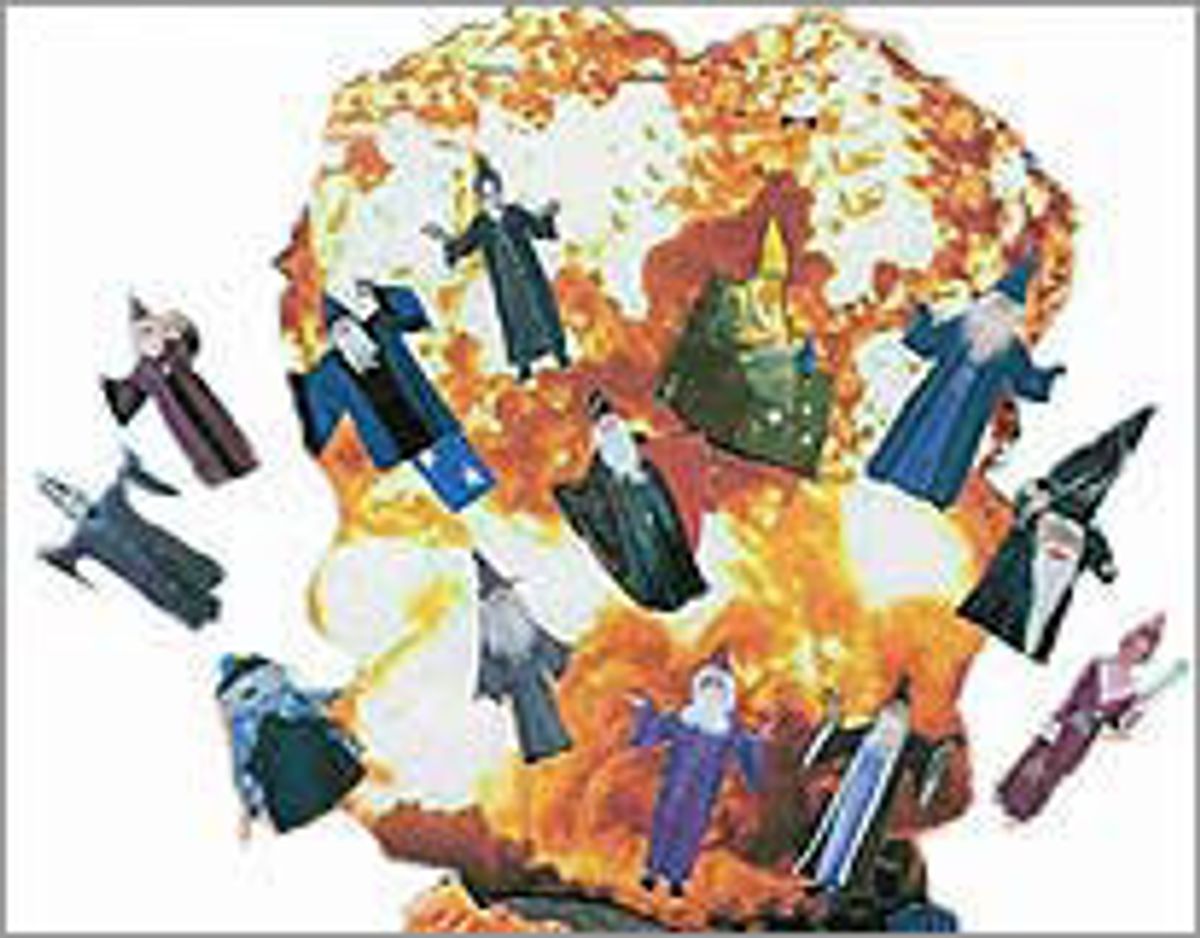
On the day "Harry Potter and the Prisoner of Azkaban" opened, as they say, at theaters everywhere, some 50 people gathered in a concrete-walled screening room in Brooklyn, N.Y., that was the only theater anywhere showing the other new Harry Potter movie, "Wizard People, Dear Reader."
Actually, "Wizard People" isn't a movie, exactly. It was conceived as an audiobook that tells the story -- or rather, a story -- of Harry Potter's first year at Hogwarts Academy. Creator Brad Neely, 27, recorded narration to be played while watching the first Potter movie, 2001's "Harry Potter and the Sorcerer's Stone," on mute. In the projection booth, Myles Kane of the Brooklyn Underground Film Festival, which sponsored the screening along with Stay Free magazine, tried frantically to get the sound and picture in sync using an iPod and DVD player. But the DVD kept starting at the wrong point, or not starting at all. An error message flashed on the screen: "Operation currently prohibited by disc." Stay Free publisher Carrie McLaren chuckled. The screening itself was quite possibly prohibited by law.
"If they wanted to take a hard line on protecting their copyright, they could," said McLaren. "Wizard People" belongs to a small but growing movement -- in the loosest, most accidental sense of the word -- of what she calls "illegal art." D.J. Dangermouse's "Grey Album," which reinvents Jay-Z's "Black Album" through the filter of the Beatles' "White Album," is the most notorious example. "Art that appropriates other work is one of the few taboos that are left," said McLaren. "The more people see something like [Wizard People], though, the more they're going to be inspired to do it themselves."
"That wasn't a consideration," swore Neely, an Austin, Texas, writer/actor/cartoonist/toy store employee. "I hadn't ever thought, Is this wrong? or, Am I championing some sort of idea? I was just like, I'm going to make something funny."
In Brooklyn, the audience was laughing. The DVD had been scrapped for a more reliable VHS tape from Blockbuster, and "Wizard People" was in progress.
[Listen to an excerpt here.]
Neely explained the genesis of this fractured yet oddly literary retelling of "Sorcerer's Stone."
"I was out at a bar with some friends," he recalled. "There was this guy playing pool all by himself with headphones and sunglasses on, and we were just having a really fun time postulating, What could he possibly be listening to? And just out of the blue, I started doing that voice talking like he was listening to a book on tape of 'Harry Potter,' and ad-libbing 'Harry Potter' scenes from what I remembered of the movie."
That voice, as it happened, was a dead-on impersonation of gravel-mouthed, pre-slam poet Steven Jesse Bernstein. Neely doesn't expect many people to get that obscure joke, but doing an impression allowed him to make the narrator of "Wizard People" a character in his own right. "If it was just me taking shots at the movie," he explained, "there's no story there. But now there's this mystery element of, Who is this guy?"
Neely's "naive and sometimes overexcited" narrator tells a story that very closely follows J.K. Rowling's original one. His main departure is in subtly altering the personalities of the main characters and the natures of their relationships. Also, he keeps getting some of the names wrong. You begin to wonder if maybe he's just not paying attention.
The result is very different from the gag-fests of precursors such as "Mystery Science Theater 3000" or Woody Allen's "What's Up, Tiger Lily?" "I didn't want to do 'Mystery Science Theater,'" said Neely. "Anybody can make fun of a shitty movie or get a few good lines in. What I wanted to do was not make fun of the movie" -- which he actually likes -- "but build something around that preexisting thing."
"It seems almost an homage to oral tradition," said McLaren. "Before we had mass media and electronic media, how people entertained themselves was telling stories. And people would tell the same story, but every person would tell it a different way. You'd add certain things, subtract other things, blend in something else, and that in itself is an art form."
In fact, one of Neely's inspirations was a less radical version of this tradition that is still prevalent in the theater world. "Every play has an intended tone," he observed. "But whenever anybody does a production of that, it's fair game" to turn tragedy into farce or slapstick into melancholy, simply by devising new line readings or stage directions. Neely's friends have told him that his remix of "Harry Potter" is more true to the whimsical spirit of the novel than the literal-minded original film. That wasn't his intent, though. He's never read the book. (And at least one serious "Harry" fan disagrees: a 10-year-old boy who wandered into the Brooklyn screening left after five minutes, finding it no less tedious than the art exhibit his mother was looking at upstairs. Neely dissuades children from watching "Wizard People" anyway, rife as it is with "fuck words").
After recording his narration -- improvising each scene a few times until he was happy with it -- Neely began dropping CDs off at Austin video stores. "I said, I want to give this to you guys and you can rent it as a free supplement if anybody comes to rent 'Harry Potter and the Sorcerer's Stone.'" Meanwhile, a friend of a friend got it into the New York Underground Film Festival last March, and word began to spread. McLaren got in touch and posted the audio tracks for free downloading on her Web site, Illegal-art.org, where it keeps company with dozens of more famous copyright-dicey works -- the "Grey Album," Todd Haynes' "Superstar," the 1967 poster "Disneyland Memorial Orgy."
"One thing everybody likes to ask is, Are you afraid that Warner Bros. is gonna come and get you? You know, those guys in black suits?" Neely said. But Stay Free's lawyer assured him that any challenge could be fended off, and Neely is fairly comfortable with the ethics of his art. "I haven't really done a gigantic amount of thinking about it," he admitted, "but I don't think what I did is any kind of wrong. Especially seeing as how I'm not making any flow from it."
That Neely isn't trying to profit from his work is the main reason he's probably safe, though as McLaren pointed out, corporations sometimes do sic their lawyers on people who are just trying to have a little fun. The derivative artworks may not technically be illegal, but most individuals realize that it's much easier to give in than to devote months or years -- and plenty of money -- to a court battle. And the law has impeded "Wizard People" at least a little. The Brooklyn Underground Film Festival could easily have avoided its audio troubles by burning a pre-synced DVD in advance -- and McLaren was eager to give out these goodies at the door. But that would have violated the 1998 Digital Millennium Copyright Act, something corporations always take seriously. Designed to fight piracy, the DMCA has become infamous for just such unintended consequences.
There is another way around the syncing problem, of course. At the next public showings of "Wizard People, Dear Reader" -- in Austin next month, followed by a few screenings in the Pacific Northwest -- Neely will be performing live, having just finished transcribing his voice-over. After that, he'll begin working on his next adaptation, a retelling of "Jurassic Park" (doing the second Harry Potter movie, he said, "would be pretty boring"). He thinks it will pan out, though he's had a few false starts with other projects, including an attempt to turn Mel Gibson's "The Patriot" into a biography of George Washington. "There's a very slim margin of movies that this sort of thing works with," he has come to realize. "It's kind of weird I just luckily picked one the first time that was the best choice."
Shares