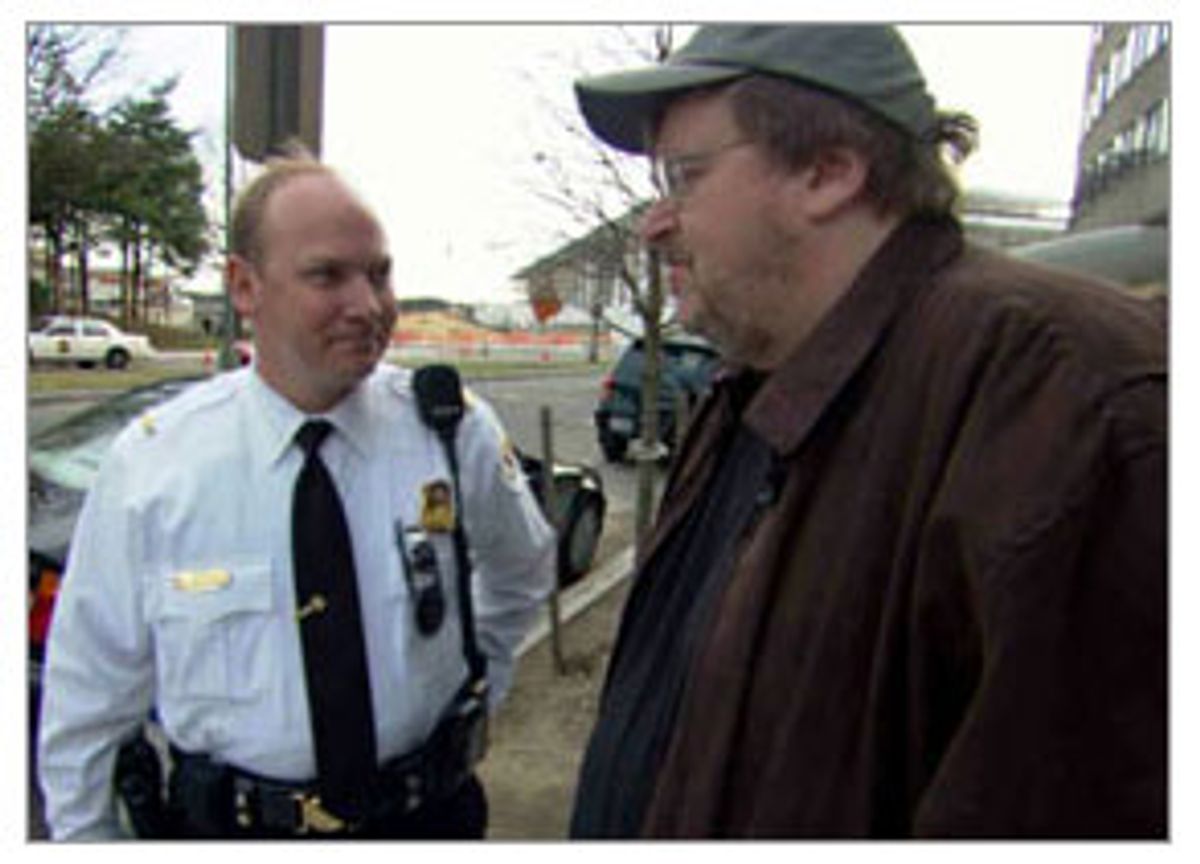
Michael Moore

“Fahrenheit 9/11″: Nay!

Moore's latest has some powerful images that are invariably overwhelmed by his jokey, faux-populist self-righteousness.

  • more
    • All Share Services

People who consider themselves basically in league with Michael Moore’s politics but dislike his movies often feel compelled to defend him as a concept: “He’s a much-needed liberal voice,” goes one argument. “He raises issues that need to be raised, that no one else is raising,” goes another. And now, with the release of “Fahrenheit: 9/11,” Moore’s examination of the presidency of George W. Bush in the wake of Sept. 11, another cogent defense is born: “Republicans have tried to suppress this movie — it must be good!”

Those responses toward Moore have a robotic, “Manchurian Candidate” quality (“Michael Moore is the kindest, bravest, warmest, most wonderful human being I’ve ever known in my life”). Moore’s supporters are quick to impugn the liberal credentials of anyone who criticizes his presentation of the information he digs up (or, in some cases, makes up). For them, Michael Moore is the issues he talks about, so his detractors must be enemies of democratic principles. It’s an old trick, akin to the way Pauline Kael was accused of being insensitive about the Holocaust when she didn’t like “Shoah.”

In the Moore universe, noisy tub-thumping is deemed more valuable than stringent logic; presenting crucial information in a manner that’s irrefutable (by naysayers of any political bent) is much less important than drawing a comfortable little circle in which we’re encouraged to congratulate ourselves for being on the “correct” side, for having the good sense to recognize that our president is “bad” and the Iraq war is “wrong.”

“Fahrenheit 9/11″ is a blend of news footage and filmed commentary that’s occasionally effective, particularly when Moore lets the gathered footage speak for itself. But that doesn’t happen nearly enough: “Fahrenheit 9/11″ has Moore’s sloppy fingerprints all over it — he’s like the mugging moppet who insists on doing a tap-dancing routine during the Thanksgiving pageant, lest the Indians, our forefathers or even the bird itself steal the show from him.

Although he has stated that his aim is to force the election’s outcome by calling attention to the Bush administration’s web of duplicity and deceit, Moore, ever the self-promoter, is the real star of “Fahrenheit 9/11.” I agree with probably 95 percent of Moore’s politics. At the very least, I’m convinced that George W. Bush is the most dangerous president of my lifetime — he long ago superseded even the spurious, deceitful Nixon. But even though I’m part of the choir Moore is preaching to, I can’t help blanching at his approach: In this increasingly treacherous political climate — particularly as we approach an election whose impact may resound more thunderously than any other in recent history — preaching to the choir just isn’t good enough. “Fahrenheit 9/11″ shows evidence of being better researched than any of Moore’s previous films. An article in last Sunday’s New York Times made much of Moore’s hiring former New Yorker fact checkers to vet it. But Moore’s case is undermined by his jokey, faux-populist self-righteousness (a quality the left seems to despise only when it’s exhibited by those on the right) and by the slapdash connections he makes between various facts and events. The issues at stake are too serious for a spotlight-hungry manipulator like Moore to be mucking around with.

If you boiled “Fahrenheit 9/11″ down to a few basic assertions, you’d have to say Moore is on the right track: He states that Bush was never elected in the first place and that, at least partly because of Bush family ties with Saudi oil interests (connections that have been explored by Craig Unger and a few others, but not by most of the press), Saudi Arabia has gotten a free ride in terms of post-9/11 scrutiny. Before the attacks, Bush and his cabinet ignored warnings about the terrorist threat to this country; afterward, he attempted to squelch any independent investigation of the attacks. Furthermore, the Bush administration has exploited the tragedy of Sept. 11 to foster a culture of fear in the United States; our so-called president then roused us fearful Americans into support for, or at least a numb acceptance of, a war that he has justified only with false allegations.

Moore isn’t wrong in considering Bush’s actions grave sins against the American people. The problem is that instead of marshaling his strength to drive home his genuinely good zingers, he bunny-hops across the landscape of his movie, scoring cheap points wherever he can. He uses his smirky, aw-shucks filmmaking techniques to encourage complacency in his audience even when he thinks he’s doing the opposite: To hammer home the point that Bush is a marauding cowboy, Moore gives us a mock-up of the opening credits to “Bonanza,” with Bush’s face superimposed where Lorne Greene’s should be. (The faces of Dick Cheney, Donald Rumsfeld and Tony Blair round out the fearsome foursome.) The screening audience I saw the movie with giggled appreciatively, delighted to see George W. made to look like a buffoon. Elsewhere, hokey hoedown music plays in the background against images of Bush, who’s fond of stomping around in a cowboy hat on his endless Crawford retreats. (Bill Clinton’s enemies often used similar “hick” music to paint him as a dumb rube from the South — but then, the use of country music is the universal signal for “Looky here — a stupid person!”) Moore doesn’t realize that in falling back on the cliché of painting the president as a cowboy, he’s missing the real phoniness: Bush is a New Haven-born blueblood who affected a Texas demeanor.

Moore uses these and other yuk-yuk tactics to poke impish little holes in the Bush persona. But these minor deflations don’t do much to emasculate George W. If anything, they suggest that Moore underestimates him, carelessly characterizing Bush’s smug and reckless disregard for the American people as just a slightly rejiggered version of avuncular, Ronald Reagan-style cluelessness.

“Fahrenheit 9/11″ opens with wordless, slow-motion, off-the-air footage of Bush preparing to go on-camera for his pre-Iraq War address to the American people. His piggy little eyes shift left and right; he looks creepy and untrustworthy — not the type of person you’d want leading your country into war. But Moore rarely trusts in the power of images; he has to talk all over them, figuratively if not literally. He also takes inordinate pleasure in presenting us with facile, simplistic conclusions without having connected the dots. For instance, he stresses the strong connection between George H.W. Bush and the Saudi royal family: The senior Bush is an advisor to the Carlyle Group, a large Washington private equity firm with significant holdings in the defense sector, and with members of the bin Laden family among its investors.

At the very least, that’s the conflict of interest Moore claims it is. But Moore never fits the info nibblets he comes up with on the Bush-Saudi connection into a coherent whole. Moore says that, in the days immediately following 9/11, when not even celebrities like Ricky Martin were allowed to fly, prominent Saudis, including members of the bin Laden family, were secretly hustled out of the United States. He interviews an FBI agent who says that they should have been questioned before they were offered special protection. Here’s the problem: As the New York Times reported last Sunday — ironically, in the piece on the fact checking that Moore claims has gone into the movie — the FBI did interview and clear members of the bin Laden family and, as the 9/11 commission has reported, the flights did not leave before U.S. airspace was reopened. In “Fahrenheit 9/11″ Moore may have been more careful than usual with the facts, but you still can’t help wondering how much he tinkered with them to suit his arguments.

Furthermore, by fixating on the Bush family’s financial interests, Moore fails to take into account some of the subtler and perhaps more sinister reasons George W. pushed for the invasion of Iraq — most significantly, his sense of quasi-religious righteousness (as well as Saddam Hussein’s attempt to assassinate his father). How many times have you heard someone say that the Iraq War is “all about oil”? It would almost be a relief if oil — that is to say, simple greed — were all that the war was about. Whatever is really going on in George W.’s head, and in those of his advisors, is probably infinitely scarier. Not to discount the enormous profits that Cheney’s buddies at Halliburton are reaping, but Bush is surrounded by the likes of Paul Wolfowitz, Donald Rumsfeld and Richard Perle, people who have long been ideologically fixated on Iraq.

When Moore isn’t pounding away at Bush, he’s busy playing the friend of the common man. But as he did in both “Roger & Me” and “Bowling for Columbine,” Moore can’t help acting superior to his on-camera subjects. We meet Lila Lipscomb, a hardworking American of modest means who encouraged her children to go into the military, knowing that it could provide educational opportunities that she wouldn’t have been able to give them herself. Lipscomb is proud of her country and proud of the young men and women who fight for it. At one point, she shows Moore the cross she wears around her neck — it’s a multicolored cross that, she explains, stands for her multicultural beliefs. “I’m multicultural,” she states plainly.

At this moment, the audience I saw “Fahrenheit 9/11″ with snickered over what they must have perceived as Lipscomb’s simplicity. But not long after, we see that Lipscomb’s husband is African-American, and her large, extended family is multiracial. Yet Moore’s audience has already been primed to laugh at the “simple folk” who make up the bulk of this great land o’ ours. Moore’s approach leaves Lipscomb open to ridicule (the same way he used the Rabbit Lady in “Roger & Me” — the woman who sold live rabbits and their byproducts to bolster her meager government income checks — to get laughs).

And then, we learn that Lipscomb’s son has been killed in Iraq — it’s the clincher Moore has been saving. Lipscomb reads her son’s last letter home aloud, and you’d have to be made of stone not to be moved by it. But there’s still a sense that this woman’s deep, raw grief is valuable to Moore primarily because it feeds his purpose: Look at how innocent, regular people suffer during wartime, he seems to be saying, as if the revelation had just occurred to him.

Elsewhere, Moore shows us footage of grievously injured Iraqi children or, more arresting yet, their corpses. Many of these images are graphic, and I don’t believe audiences should necessarily be sheltered from such pictures. But there’s something wily and disingenuously wide-eyed about the way Moore uses these images to make his points about the horrors of war. Similarly, he expresses surprise and dismay that the military recruits heavily among African-Americans, Hispanics and other minorities, as opposed to trying to attract rich kids. Stop the presses! Innocent civilians are killed during wartime; our armed services are made up largely of young men and women to whom our society has offered limited opportunities. Moore unveils these revelations with a flourish, relishing his role as the great teller of truths. What planet, exactly, has he been living on?

There’s plenty in “Fahrenheit 9/11″ to provoke true outrage, including some shameless Halliburton promotional materials touting the service and support that company is providing our armed forces overseas. Most powerful of all is the footage of Bush on the morning of 9/11: After learning that a second plane had hit the World Trade Center and that the nation was under attack, he sat for nearly seven minutes reading “My Pet Goat” to a group of Florida schoolchildren. We scan his face as those endless minutes pass, searching for clues: What is he thinking? What does he suppose he should do? Even here, Moore can’t help indulging in cheap psychological analysis, instead of letting the pictures speak for themselves. Still, there’s no getting around the cloudy befuddlement in Bush’s eyes. The sequence captures the shamefulness of Bush’s ineffectuality.

“Fahrenheit 9/11″ has been surrounded by a handy halo of buzz: First, Miramax’s parent company, Disney, announced it wouldn’t release the film, although it was embarrassed into handing it over to Harvey and Bob Weinstein, who subsequently found distributors for it (Lion’s Gate and IFC Films). The movie’s woes didn’t stop there: Right-winger Howard Kaloogian, a former California state legislator who claims credit for squelching the CBS Ronald Reagan biopic, has spearheaded a campaign to harass and intimidate theaters into refusing to show the film. (MoveOn.org has countered by urging audiences to see “Fahrenheit 9/11″ on its opening day to spur a groundswell of support.)

It’s all terrifically lucky for Moore — you can’t buy publicity like that. But I’d also urge moviegoers to see “Control Room,” Jehane Noujaim’s documentary about Al-Jazeera’s coverage of the Iraq War, a piece of filmmaking that, like Moore’s movie, is antiwar in the broadest sense. But it’s also one that, unlike Moore’s, is well aware of the dangers of self-certainty and easy answers.

I’ve heard even die-hard Moore detractors defend “Fahrenheit 9/11,” claiming that its flaws don’t matter because it speaks to a higher truth. The thinking goes, I suppose, that we need every anti-Bush voice we can get, and Moore, who won an Academy Award for “Bowling for Columbine” and has several bestselling books under his belt, is likely to wield more influence than most other voices coming from the left. What’s more, even though “Fahrenheit 9/11″ isn’t journalism, Moore presents his findings with an air of authority. Moore believes the press has let us down in calling Bush on his fraudulence and falseheartedness, and he’s right. Still, the tradition, craft and standards of journalism have to count for something: Should we really be holding up cheap shots, inference and sloppy reporting as gateways to the truth?

Moore is a very specific and slippery kind of bully: He glides along on his underdog status as if it were a parade float. He professes to feel great compassion for the common man. Yet over and over again, in movie after movie, he invites the audience to chuckle over ordinary people. Why? In “Fahrenheit 9/11″ he lists the countries that stepped forward as members of Bush’s Coalition of the Willing (Palau, Costa Rica, Iceland, Romania, Morocco, and the Netherlands among them), accompanied by funny stock footage of people in costumes of many lands. If Moore is the left’s great spokesman by default, shouldn’t he be using his influence (not to mention his money) to raise the level of political discourse in this country instead of lowering it? Instead we have a filmmaker who manages the feat of getting liberal audiences to laugh at how funny those foreigners are.

Just after 9/11, Moore wrote a publicly circulated letter musing about the meaning and possible causes of the attacks. In the letter, Moore talked out of all 16 of sides of his mouth, first expressing sorrow over the tragedy, then attributing the attacks to Americans’ desire for cheap sneakers, and later intoning wisely, “It’s much easier to get us to hate when the object of our hatred doesn’t look like us.”

But somewhere in there, he also wrote, “Am I being asked to believe that this guy who sleeps in a tent in a desert has been training pilots to fly our most modern, sophisticated jumbo jets with such pinpoint accuracy that they are able to hit these three targets without anyone wondering why these planes were so far off path?”

Well, gosh, Michael — yeah. The lesson learned? Third-world tent dwellers do the darnedest things. It’s a shocking and unpredictable world that we little people live in. At least we have Michael Moore to explain it all for us.

Stephanie Zacharek is a senior writer for Salon Arts & Entertainment.

Michael Moore and the Oscars get it right

The Academy's documentary category has been a horrible mess for years. The controversial new rules can only help

  • more
    • All Share Services

Michael Moore and the Oscars get it right Stills from "The Interrupters" and "Senna"

As multiple media sources have reported over the last two days, under proposed new Academy rules, only films that have been reviewed by the New York Times or the Los Angeles Times will be eligible for the best documentary Oscar. But that’s not the real story, and it’s not nearly as dumb as it sounds.

“Everybody’s getting excited about something that’s not the real headline,” explains filmmaker and blogger AJ Schnack, a co-founder of the documentary-centric Cinema Eye Honors awards. “The headline is that the Academy is making big changes to the way it selects and nominates documentary films, and based on what I know so far, those changes are overwhelmingly positive.”

Perhaps the first thing to understand is that the new docu-Oscar rules, which go much further than eligibility issues, were largely pushed through by Michael Moore, who sits on the Academy’s governing board. The intention behind the changes, including the bizarre-sounding NYT/LAT requirement, is to streamline a notoriously clunky and cliquey nominating process, and to ensure that the Oscar-winning documentary is “truly a theatrical motion picture, because that’s what these awards are for,” as Moore told indieWIRE.

Furthermore, the new rules are meant to minimize the possibility that major, well-reviewed documentaries will be shut out of the Oscar nominations for mysterious reasons, as has happened repeatedly in the past. As Roger Ebert wrote more than 15 years ago, the list of non-nominated documentaries is like an honor roll of classics, from Errol Morris’ “The Thin Blue Line” to Moore’s “Roger & Me,” from Michael Apted’s “28 Up” to Steve James’ “Hoop Dreams.” In recent years, you could add “Fahrenheit 9/11,” “Grizzly Man” and “Waiting for ‘Superman’” to that list. Two of 2011′s best-reviewed docs, James’ “The Interrupters” and Asif Kapadia’s “Senna,” have already been eliminated from consideration this year.

Under the current system, secret committees of 10 or fewer volunteers from the Academy’s documentary branch view groups of films and vote on them, creating the possibility that some tiny knot of dissenters — perhaps one or two voters — can sabotage a film’s Oscar hopes by giving it low marks. “That first round of voting, to go through all the eligible films and get to the short list, just seems really weird,” says Schnack. “You have small groups of people, each of which only views a small portion of the films. Instead of voting for their passions, they can end up voting against what they dislike. I think it’s pretty much true that one person can sabotage a film.”

Under Moore’s proposed new rules — at least as summarized in an admirable explainer by Dana Harris of indieWIRE — the documentary “shortlist,” and later the list of five nominees, will be selected in a vote by the Academy’s entire documentary branch, which reportedly has 157 members. “That restructuring, where the entire branch gets to vote and not just a small committee, strikes me as an incredibly good thing,” says Schnack. “That might be the single biggest change.”

Veteran documentary producer and programmer Thom Powers, who runs the prestigious Stranger Than Fiction series in New York, notes that there are legitimate concerns about exactly who’s in the documentary branch and how they will vote. “That membership remains secret, although if you’ve been paying attention over the years, you can figure out a few dozen of the names,” he says. “It’s valid to wonder whether all 157 members will really dive into the 100-plus films that will qualify. Is this system going to favor the top 15 films that are most talked about and most prominent? One unfortunate thing about that secrecy is that it does favor filmmakers with deeper pockets or more powerful distributors.”

In another major departure from established procedure, the five nominees will then be submitted to the entire Academy membership of 6,000 or so Hollywood professionals for final voting, not just to the specialists of the documentary branch. Under the current system, as Michael Moore puts it, “When people get the award for best documentary and they go on stage and thank the Academy, it’s not really the Academy, is it? It’s 5 percent of the Academy.”

While the decision to use the stodgy warhorses of print journalism as an Oscar-eligibility filter may seem arbitrary and retrograde, it’s an attempt to restore some order to an unwieldy system. The New York Times’ editorial policy is to review every film that plays at least a one-week engagement at a theater in New York City, which nearly matches the current Oscar eligibility rules requiring a New York or Los Angeles theatrical run. (If the Times revises that policy, then the Academy promises to revisit the new rule.) Those films likely to be eliminated under the new rule, like this year’s acclaimed Marine Corps documentary “Semper Fi,” are those that lack commercial distribution or are bound for TV, and play as part of the International Documentary Association’s DocuWeeks festival.

“I’m not that concerned with the eligibility rules,” says Schnack. “They’ve tinkered with those six or seven times in the last 10 years, and somehow roughly the same number of films manage to become eligible.” He points out that while a film like “Semper Fi” would indeed be ineligible for 2011 under the new rules, if it were to find theatrical distribution in 2012 it would receive the required Times review and become eligible next time around. Exactly the same thing applies to another shortlisted film for 2011, the Harry Belafonte documentary “Sing Your Song.” It has played to enthusiastic audiences at film festivals, and will open commercially in New York this week, so it would certainly have become eligible for 2012 under the new rules.

There’s a long tradition of films that are primarily or exclusively intended for television getting Oscar nominations, after meeting the letter but perhaps not the spirit of the eligibility rules. That may well change; I’m not sure, for instance, that Marshall Curry’s “Street Fight,” an Oscar-nominated 2005 film about an infamously dirty Newark, N.J., mayoral election, would meet the new requirements. But that’s an issue in a much broader debate, and the Academy has clearly decided that it wants to honor theatrical films, not TV films. After all, as Michael Moore observes, the television industry gives out its own awards, and if they don’t quite carry the cachet of an Oscar, so be it.

Some voices on the Internet, including respected indie-film blogger Anthony Kaufman, have suggested that letting all Academy members — actors, costume designers, cinematographers and so on — vote for the best documentary will push the awards in an ever more tepid and mainstream direction. Neither Powers nor Schnack sees it in those terms. “It’s called the Academy Awards,” says Powers. “Academy members should get to vote.”

“Look, we love the Oscars because it’s a big, glitzy ceremony with a big gold statue,” says Schnack. “It’s part of Hollywood history and part of documentary film history. Over the years, the winners [in the documentary category] have included Walt Disney and Jacques Cousteau and the Department of the Navy. It’s a crazy, big award, and if we want to be part of it our movies should be judged as movies, by the same standards that apply to narrative films.”

Continue Reading Close

Michael Moore: “America is not broke”

The documentary filmmaker was in Wisconsin yesterday, slamming Republicans for cutting union benefits

  • more
    • All Share Services

Michael Moore:

Michael Moore has a message for Wisconsinites:

Contrary to what those in power would like you to believe — so that you’ll give up your pension, cut your wages, and settle for the life your great-grandparents had — America is not broke.

The claim came at the beginning of a speech delivered by the documentary filmmaker and liberal firebrand at the Wisconsin State Captiol yesterday. Over the course of 30 minutes, Moore railed against Republicans, who he accused of misleading the American public when they claim that government can’t afford to spend money on expenditures like pensions and union wages. You can watch the entire speech below.

Continue Reading Close

Directors of the decade: No. 6: Michael Moore

Whether you love him or want to punch him in the mouth, he is rallying the troops in the rhetorical civil war

  • more
    • All Share Services

Directors of the decade: No. 6: Michael MooreMichael Moore (at right) and former President George W. Bush in a still from "Farenheit 911"

Michael Moore is the only documentary filmmaker besides Ken Burns the average American has heard of, and he’s more of an active presence in American life than Burns, because even when he’s not making or promoting a new film, he’s on TV and the Internet beating the drum for a cause or tormenting the foes of all he deems good and decent. He is a media-age phenomenon as well as a filmmaker, his presence on the pop culture radar screen a life-as-mass-media-performance-art-project in the vein of previous practitioners, some important, others merely shameless: Andy Warhol, Muhammad Ali, Madonna, Norman Mailer, Gore Vidal, Tiny Tim.

And whether you think Moore is a brave soul fighting the power or a self-aggrandizing blowhard who’s mainly selling himself, it’s clear he has a knack for insinuating himself into the head space of all sorts of people — those who have no opinion on him, those who are glad he’s alive, and those who fantasize about pouring a vat of beef stew over his head and tossing him into a pit full of wolverines. I suspect Moore’s highly subjective, emotion-driven filmmaking and his career-long interweaving of self-promotion and self-expression (which started back in 1989 with his anti-General Motors jeremiad “Roger & Me”) will one day be seen as epitomizing aspects of life in this grim, weird decade, just as Hunter S. Thompson’s song-of-myself political writing helped future generations understand the ’70s.

When artists construct such a compelling public face, the art and the artist fuse, even loop back on themselves so that it’s tough to tell where one begins and the other ends. It’s a conundrum the modern artist can’t escape, and maybe shouldn’t; when an artist resists becoming the story, the media and the public tend to decide there isn’t one. Moore knows vastly fewer people would talk about his movies, or even bother to see them, if he weren’t out there on talk shows and in front of his own documentary lens raising hell, cracking wise, taunting the powerful, comforting the powerless and otherwise carrying on like the bastard spawn of Will Rogers and Amy Goodman.

In any event, Moore the director has been politically and artistically (and on the Internet, technologically) vital — not to mention adept at identifying subjects of mass dread and getting films about them into the marketplace right around the time said dread achieves critical mass. In the last 10 years, Moore has addressed the self-perpetuating cycle of fear and violence in America (“Bowling for Columbine“), the Bush administration’s conduct of the war on terror (“Fahrenheit 9/11”) and the arguments in favor of state-run, or at least state-assisted, healthcare (“Sicko”).

Moore’s latest, “Capitalism: A Love Story,” might be the key Moore film, its title serving as an umbrella that shades every other subject he’s tackled. The answer to every “Why?” in a Moore film can be answered, “Because of money.” Its arguments are too fuzzy and its thesis too broad to achieve the level of popular relevance to which Moore has become accustomed; Americans prefer ideas they can hold in their hands. But whatever “Capitalism’s” reception, the fact remains that nobody else is making political films on such basic and important subjects and getting them so widely distributed and discussed.

None of Moore’s films this decade were as prominent as “Fahrenheit 9/11,” because none had a main character as charismatic and polarizing as President George W. Bush. It was the first feature that Moore tried to stay out of, to the extent that Moore can stay out of anything, and I wouldn’t be surprised if his decision was motivated both by a desire to foreground the message rather than the messenger and an entertainer’s understanding that you can’t steal the spotlight from a child, a pet — or W. himself. (Add to that the fact that Moore, who positions himself as the good guy in his own mythic narratives, hadn’t had a truly intimidating adversary since GM boss Roger Smith.)

The prospect of making the president lose reelection, or at least lose sleep, formalized the (often contrived) underdog mantle that Moore has always wrapped around himself like a cape. And it encouraged Moore to spotlight his insult comic’s vicious wit, setting one of the movie’s expository passages about the president’s youth to Eric Clapton’s “Cocaine” and letting Bush’s paralysis in that classroom on the morning of 9/11 play out at length. One rarely sees a documentary whose whole purpose is to tear down another person, and that dubious distinction made “Fahrenheit 9/11″ electrifying — if only to liberals who felt helpless in the face of the president’s political, military and media machines and prayed that somebody somewhere would stand up, say something, do something.

Bush’s brazenness post-Iraq seemed to crank up Moore’s urgency and grandiosity. Around the time “Fahrenheit 9/11″ came out, Moore declared that his goal was nothing less than the electoral defeat — or re-defeat, as the bumper stickers said — of the president (whether the film ultimately hurt or helped the president is an important, but unanswerable question). To achieve that end, Moore paints Bush’s definitive negative caricature, presenting him as a hateful fraud, an ignorant brat playing with mass-murdering toys, a fake macho man whose cornball swagger was purchased with daddy’s money and America’s military might, and a bumpkin prince of darkness whose descent upon the Capitol following the electoral shenanigans of 2000 was a metaphysical as well as political catastrophe. And the film’s opening credits are one of the decade’s most powerful sequences: Bush and his Cabinet being made up for TV appearances while mournful, minor-key acoustic guitar plays in the background is a devastating marriage of image and sound, one that conjures sadness, rage and fear. The sequence is a liberal’s dirge. Democracy is dead, and here are its murderers putting on their war paint and getting ready to finish off the rest of us. (Facing down the president ennobled Moore’s asshole tendencies. His adversary was so powerful and so smug about his power that Moore couldn’t go too far in attacking him – at least not as he did in “Bowling for Columbine,” in which he trespassed on the property of the elderly, unprepared and clearly baffled NRA spokesman Charlton Heston and answered his gentlemanly incredulity with snotty contempt.)

“Fahrenheit 9/11″ was arguably the documentary of the decade, a work that tried to change history as well as describe it and, if not a classic of logical argument, then surely a masterpiece of outrage, propaganda as formally skillful as it was emotionally opportunistic. (Moore’s use of war veterans and their loved ones was the liberal flip side of W. treating uniformed soldiers as TV props to burnish his warrior bona fides.) And it was everywhere in 2004 — in theaters, on TV, on the Web. Even if you hated Moore’s guts and wouldn’t see the movie if your life depended on it, you still ended up reading about it, hearing the film’s merits argued and its errors and distortions catalogued. Moore shows the world what American liberal anger looks like — a furious but ephemeral force that rarely stays roused for long, liberals being notoriously inclined to bitch rather than act unless it’s a presidential election year. Elsewhere this decade he prided himself not just on participating in the national argument, but also on setting its terms. His films supplied liberals with talking points on gun violence, 9/11, the war on terror, healthcare and financial chicanery. His Web site, public speeches and coordinated e-mail campaigns endorse or oppose presidential decisions, political candidates and propose new laws. (Moore’s “Letter From Mike” feature is written, quite effectively, in the jes’ folks style of his movie narration. “It’s not your job to do what the generals tell you to do,” Moore writes, in an “open letter” to President Barack Obama urging him not to add more troops in Afghanistan, adding, “With our economic collapse still in full swing and our precious young men and women being sacrificed on the altar of arrogance and greed, the breakdown of this great civilization we call America will head, full throttle, into oblivion if you become the ‘war president.’” For better or worse, Moore is one of a few filmmakers who could publish such a letter and rest assured that a president (or his people) might even read it.

He’s the enemy the right deserves and probably craves. He is his own self-caricature, and craftier and more gifted than detractors care to admit. He’s a standard-bearer in the rhetorical civil war that Mailer, in 1963′s “The Presidential Papers,” foretold as inevitable fallout from the end of the Cold War — “the war which has meaning, that great and mortal debate between rebel and conservative where each would argue the other is an agent of the Devil.” 

Continue Reading Close

Moore a sign of things to come for Obama?

A prominent liberal breaks, in a big way, with the president over his Afghanistan policy

  • more
    • All Share Services

Moore a sign of things to come for Obama?Filmmaker Michael Moore speaks at a news conference "to challenge President Obama and the Democrats to stand strong on healthcare reform that includes a public option", in Washington September 29, 2009. REUTERS/Molly Riley (UNITED STATES ENTERTAINMENT POLITICS HEALTH)(Credit: Reuters)

On Tuesday night, President Obama is set to announce that he’s sending additional U.S. troops to Afghanistan — about 30,000 of them. Indeed, White House Press Secretary Robert Gibbs said Monday that the president has already given the order, though for now Gibbs wouldn’t say what the actual order was.

Michael Moore, however, wants to stop him. In an open letter published on his Web site Monday, Moore decried Obama’s decision, saying he’ll now be known as “the new war president.” The director wrote:

Do you really want to be the new “war president”? If you go to West Point tomorrow night (Tuesday, 8pm) and announce that you are increasing, rather than withdrawing, the troops in Afghanistan, you are the new war president. Pure and simple. And with that you will do the worst possible thing you could do — destroy the hopes and dreams so many millions have placed in you. With just one speech tomorrow night you will turn a multitude of young people who were the backbone of your campaign into disillusioned cynics. You will teach them what they’ve always heard is true — that all politicians are alike. I simply can’t believe you’re about to do what they say you are going to do. Please say it isn’t so.

It is not your job to do what the generals tell you to do. We are a civilian-run government. WE tell the Joint Chiefs what to do, not the other way around. That’s the way General Washington insisted it must be. That’s what President Truman told General MacArthur when MacArthur wanted to invade China. “You’re fired!,” said Truman, and that was that. And you should have fired Gen. McChrystal when he went to the press to preempt you, telling the press what YOU had to do. Let me be blunt: We love our kids in the armed services, but we f*#&in’ hate these generals, from Westmoreland in Vietnam to, yes, even Colin Powell for lying to the UN with his made-up drawings of WMD (he has since sought redemption).

Here’s the thing, though: Obama wasn’t exactly hiding his position on Afghanistan during the presidential campaign. The war there was often thought of as the “good war” on the left, at least in comparison to the one the Bush administration started when it invaded Iraq. And that meant refocusing resources on Afghanistan.

Still, while it’s pretty clear that Moore’s open letter won’t change Obama’s mind, and that Obama is likely to win a fight with Moore right now, it also appears that the floodgates are opening. With former President George W. Bush out of office, liberals are coming forward to oppose escalation in Afghanistan, and Moore won’t be the last prominent figure from the left to slam Obama over it.

Continue Reading Close

Alex Koppelman is a staff writer for Salon.

Michael Moore and the evils of free enterprise

In "Capitalism: A Love Story," the filmmaker takes to the bullhorn to decry corporate greed -- and promote himself

  • more
    • All Share Services

Michael Moore and the evils of free enterpriseMichael Moore

Michael Moore’s ostensible subject has always been his fury at the injustices wrought against hardworking American citizens. And it’s possible that, in his early days as a filmmaker, that was his true motivation. But 20 years after “Roger & Me,” “Capitalism: A Love Story” proves that Michael Moore’s greatest subject is himself. This is a love story, all right, but it has less to do with the flaws of capitalism than it does with Moore’s unwavering fondness for the sound of his own voice, and for what he perceives as his own vast cleverness.

As with all Michael Moore’s films, that’s not to say he doesn’t have a point, buried in there somewhere amid all the Silly Putty-stretched facts and cartoony music. It’s possible to agree with Moore in theory and still find his tactics sloppy and ineffective (though his zombie-like followers don’t like to allow for the existence of any potential gray areas, maybe because gray areas tend to demand actual thought). In the 2007 “Sicko,” he highlighted some very real, and very dangerous, problems with the U.S. healthcare system. In the 2004 “Fahrenheit 9/11,” he asserted that our then-president was bad for America, and that the Iraq war was wrong. If you’re reading this right now, it’s 99 percent likely that you agree, as I do, with Moore’s basic take on those subjects.

The problem with Moore’s approach is that he reveals these injustices as if he’s just discovered them himself. Similarly, “Capitalism: A Love Story” will be revelatory and helpful to those Rip Van Winkles who slept through the fall of 2008 and the early part of 2009, who didn’t realize that hardworking American people are being pushed out of their homes in record numbers as a direct result of corporate greed. It’s not Moore’s core beliefs that are grating: It’s his consistently wide-eyed approach, his presupposition that you need to adopt an aura of innocence in order to be outraged. In Michael Moore’s world, to be enlightened and outraged makes you one of the elite — better to be an underinformed Everyman, so he can spoon-feed the facts to you and therefore reinforce his own reason for existing.

Moore’s aim here is to prove that capitalism, at least as big business currently defines it, is bad. It wasn’t always thus: Moore includes footage from his own family’s home movies, showing a smiling young Mike enjoying the pleasures of life in Flint, Mich., circa the 1950s. (Moore’s father, who appears in the film, was a longtime G.M. employee.) Moore explains in voice-over that his family wasn’t rich by any means, but they were definitely comfortable: The house in which he grew up had been fully paid for by the time he was in kindergarten; his parents could buy a new car every three years. This is Moore’s way of explaining — and he’s not wrong — that many working people could take part in the capitalism of the ’50s, but capitalism as it’s practiced today is another story.

In his usual hopscotching fashion, Moore goes on to explore numerous instances of corporate greed and its effects on working people: He interviews several young pilots, working for regional airlines, who are trained and entrusted to operate aircraft and yet who barely make enough money to get by. (One of them explains that he had to go on food stamps.) He interviews Peter Zalewski, a scarily slick type who works for a Florida real-estate concern called, in a stroke of brazen forthrightness, “Condo Vultures,” which specializes in matching foreclosed properties with buyers, who resell them for a profit. He decries last fall’s banking-industry bailout, and bemoans the way the recipients squandered the money they received instead of using it to either save endangered jobs or create new ones.

But Moore doesn’t shed any new light on this kind of greed, and his attempts to grab his audience are so strained that they detract from his essential argument. His tactics here include conducting on-camera interviews with families who have just been pushed out of their homes. For understandable reasons, these people are often brought to tears as they vent their outrage and sadness, their sense of loss. In case we’re not getting the point, Moore puts gloppy, sentimental string music on the soundtrack, as if he believes viewers can’t be trusted to grasp the basic horror of the situation on their own. At another point, he marches up to AIG headquarters on Wall Street (it appears to be on a Sunday morning, when no one’s around — Wall Street is bustling on any weekday), declaring to the security guards that he’s there to make a citizen’s arrest of the CEO. The security guards rebuff Moore firmly but politely, as if he were a crazy but harmless old auntie — they’d serve Moore’s purposes better if they were angry or bullying.

Moore does hit a number of crucial points, making note, for example, of the large number of former Goldman Sachs executives who figure prominently in both the current and previous administrations. But he can’t let 10 minutes pass without injecting himself into the conversation: Moore can’t mention the sad collapse of Detroit without taking credit for foreseeing these kinds of problems in “Roger & Me,” as if he’d offered some kind of viable advice that simply hadn’t been taken. He tells us how, when he was a lad, his dream was to enter the priesthood, because he so admired the work of Catholic priests who became involved in the fight for civil rights. This is his way of reminding us how noble his goals are — that all he ever really wanted to do was fight for the little people.

But his respect for the priesthood does make sense in terms of his misguided sense of pageantry. In “Capitalism: A Love Story,” he can’t resist showing himself outside the hallowed halls of Citibank (and Chase, and AIG), trying to gain access and, of course, being refused. Those scenes have become tired staples of every Moore film, a recycled vaudeville act that’s supposed to be funny, surprising or outrageous each time we see it. Scenes like that are necessary to reinforce Moore’s status as an outsider, and his loyal fans, it seems, never get tired of seeing them. At this point, Moore appears to be making movies specifically for those fans — he’s no longer even pretending to try to win over the general populace. With “Capitalism: A Love Story,” he’s preaching to people who have already been converted, 20 times over. As for the others, no matter how loudly he shouts through his bullhorn, he’s not going to get their attention.

Continue Reading Close

Stephanie Zacharek is a senior writer for Salon Arts & Entertainment.

Page 1 of 9 in Michael Moore