I'm fortunate enough to spend a lot of weekends in a house owned by my wife's family in Delaware County, in central New York state. It's a lovely, bucolic region of mountains, rivers and pastures that feels farther away from New York City than 140 miles. It's also one of the poorest counties in the entire state (poorer, for example, than the Bronx.) Two years ago, when the New York Times published a front-page feature story about the effects of welfare reform on the rural Northeastern poor, the reporter picked our town. (Strangely, the Chamber of Commerce doesn't have this article up on the wall.)
Another fact about this county won't surprise you at all, although maybe it should. Despite being an alarmingly depressed area smack in the middle of one of the bluest of all blue states -- with a truly alarming percentage of adults on government assistance -- Delaware County is bedrock Republican. George W. Bush got close to 70 percent of the vote here in 2000. Hillary Clinton swept to an easy statewide victory in the race for U.S. Senate that year, but her opponent, an undistinguished Republican congressman from Long Island named Rick Lazio, won 61 percent of Delaware County's votes. When we briefly considered living up here full time, we had to consider the fact that truly meaningful politics in Delaware County takes place inside the Republican Party. Being a registered Democrat up there is about as functional as voting Green or Libertarian or Socialist Worker.
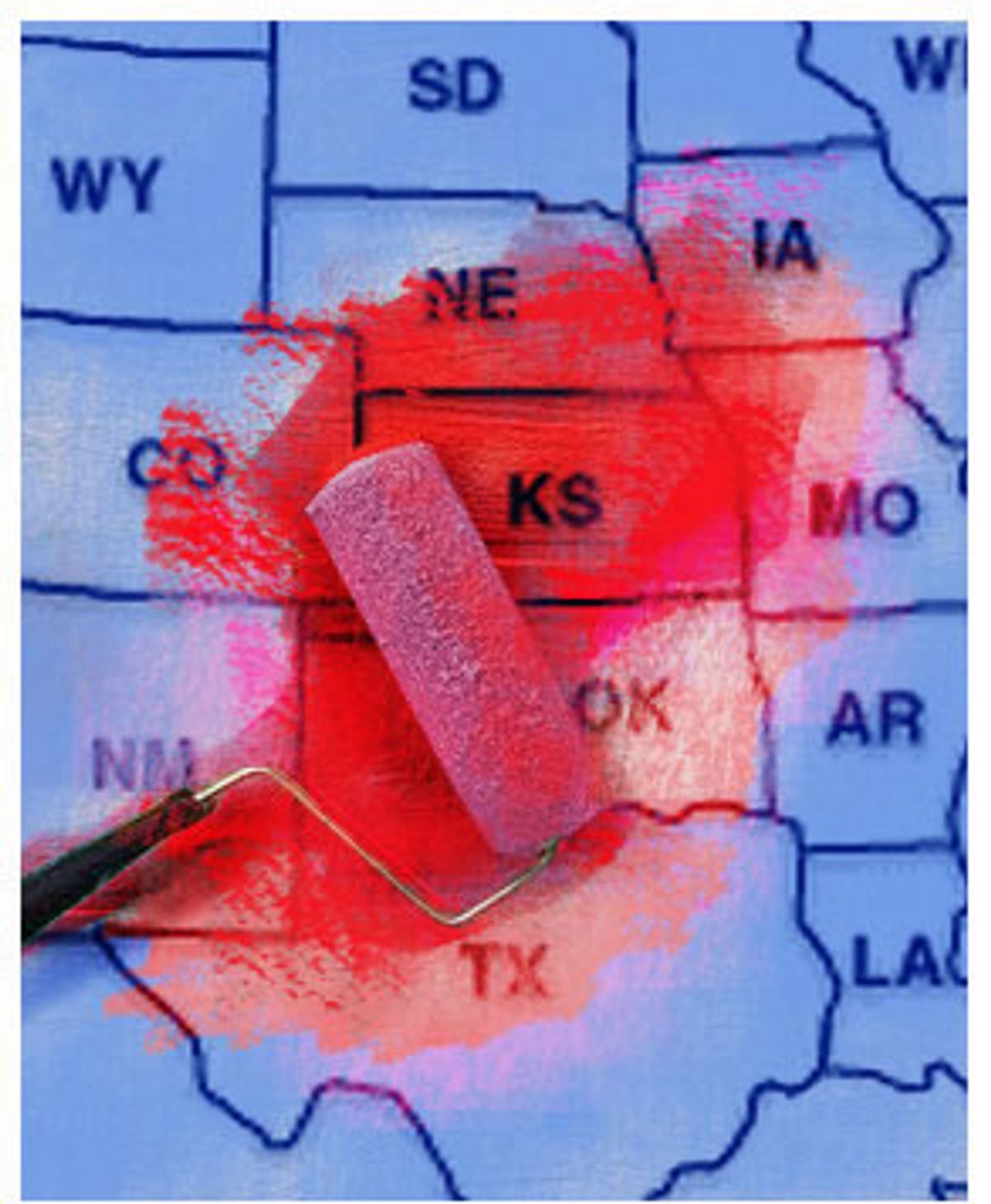
As the writer Wallace Stegner observed, the rural Northeast is the prelude to the American West, and you could argue that the paradox of Delaware County rewrites itself in blazing letters over and over again across the Great Plains and the Mountain West. Nobody thinks it's strange that Nebraska and Nevada and Arizona and Montana vote for right-wing Republicans in election after election, consumed with tax-cutting fervor and a passion to shrink the government, even though it's the massive federal programs of the 20th century -- dams and aqueducts, agricultural subsidies, public lands thrown open to ranching and mining and lumbering -- that supports those states' economies to this day.
And as low-tax, free-market economic orthodoxies have bankrupted family farmers, sucked the life out of almost every small-town Main Street and displaced high-wage workers to Wal-Mart jobs, voters have flocked back to the Democrats, right? Well, not exactly. As cultural critic Thomas Frank observes in "What's the Matter With Kansas?" -- his dyspeptic tribute to his home state -- worsening economic conditions on the Midwestern plains have only driven voters further to the right, into grass-roots antiabortion activism, campaigns against the teaching of evolution, obsessions with cultural indecency and other largely symbolic crusades. The result has been an entire region of the country dominated by an energized, rejuvenated Republican Party that represents the material interests of the powerful and the cultural obsessions of the powerless, that thumps the Bible with one hand and shreds the tax code with the other.
So much has been written about the blue state-red state divide in the last four years that it may seem it has been with us forever. To read the words of David Brooks, the Homer of this quasi-specious conflict, one might think that the latte-swilling, Volvo-driving liberals of the Northeast and the plainspoken, barbecue-chompin' conservatives of the heartland were ancient tribes, sundered from each other and implacably opposed since the Peloponnesian War. (And of course, in Brooks' worldview, the homespun, unassuming tastes of the latter group are presumed to be normative. Hence, George W. Bush deserved to win the 2000 election because he carried the states where real Americans live.)
For Frank (previously the author of "The Conquest of Cool" and "One Market Under God"), what happened in Kansas -- and the rest of middle America -- was in no way natural or inevitable. He sees the conservative hegemony in the Sunflower State and elsewhere in the heartland as a unique product of Republican ingenuity, Democratic inefficacy and the region's innate tendency toward rebellion. Most of all, he believes the question of red and blue reflects the great unmentionable in American politics: social class. When the Democrats dropped any pretense of the working-class populism that had defined their decades-long reign as the majority party of the New Deal, veering first left (under George McGovern) and then right (under Bill Clinton) in search of various patchwork electoral coalitions, a vacuum was created at the grass-roots of American politics.
In the post-Reagan era of Rush, Hannity and O'Reilly, the right has filled that vacuum expertly. Its commentators and candidates have channeled the old working-class resentment against bankers and corporate fat cats into mistrust of an even more shadowy enemy, the "liberal elite" who are responsible, it seems, for mealy-mouthed P.C. rhetoric, foulmouthed rap music, Hollywood movies, teenage sex, school shootings, man-bashing feminism and a laundry list of other social ills, real or imaginary. (As Frank details, the conspiratorial fringe of the populist right buzzes with entertaining theories: Next the liberals plan to ban red meat, prevent white men from breeding, give entire Midwestern states back to the Indians.)
Frank borrows his title from an 1896 screed by Emporia, Kan., newspaper editor William Allen White, who was excoriating his fellow Kansans, believe it or not, for being too far left. That was the year of the legendary presidential contest between Republican William McKinley, who forthrightly represented the big-money interests of the Northeast, and firebrand Democrat William Jennings Bryan, who was, impossibly enough by today's standards, a left-wing populist and a fundamentalist Christian. It was almost a photographic negative of the 2000 election: The inflamed rabble of the plains states flocked to Bryan, but the population centers of the East Coast turned out for McKinley, the sober voice of capitalism. (He was elected, and later assassinated by an anarchist -- don't let anybody tell you America was a more orderly place.)
As Frank writes, turn-of-the-century Kansas was a hotbed of "religious fanatics, crackpot demagogues, and alarming hybrids of the two." Abolitionist John Brown was a Kansan, and Prohibition leader Carry Nation lived there. But more than anything else, Kansas was known for its "periodic bouts of leftism." In Crawford County, Kan., a socialist newspaper had hundreds of thousands of readers, and it was among a handful of counties in the nation to go for Socialist Party candidate Eugene V. Debs in the presidential election of 1912. Kansas had been an ornery place, fueled by ideology, from its very inception -- the state was founded by Eastern abolitionists and "free-soilers" as a bulwark against the spread of slavery.
Frank's freewheeling examination of how and why the left-wing economic populism of the 1890s was transformed into the right-wing cultural populism of today is hilarious, angry and often riveting. It ranges from history to sociology to memoir to old-fashioned street journalism, and despite what you may have read in a thoroughly disgraceful New York Times review, Frank does not mock his fellow Kansans for their political beliefs. If anything, he is awed and amazed by the right-wing activists he meets on his visits home, highly principled and selfless people who have sacrificed much to fight for causes and policies that (he believes) will prove immensely destructive to their own way of life.
Frank is indeed angry that the proud progressive traditions of Kansas have been subverted. And he is angry at America for fostering a political debate that has increasingly become a style competition, a contest to determine which ultra-rich prep-school candidate can strike the most "authentic" pose. But he does not direct his rage at the impassioned (if perhaps misguided) working-class citizens of Kansas. He is angry at the hypocritical Republican politicians who have shamelessly manipulated the politics of class, at the spineless Democratic politicians who seem to have abandoned the struggle for working people, at the media who have compulsively oversimplified the conflict and relied on Brooksian stereotype.
I have certain misgivings about "What's the Matter With Kansas?" Frank barely touches on racial politics and the role of working-class white resentment in discussing the birth of the "Reagan Democrat" and the spread of the conservative backlash. That may not have been a crucial factor in Kansas, but it certainly played a central role in the South and elsewhere. I think he misjudges the danger posed by the antiabortion movement, and the passionate conviction of its activists. (He sees it as largely symbolic and not seriously devoted to the overthrow of Roe vs. Wade.)
But this book is a serious, daring and largely convincing exploration of a question most commentators approach with facile generalities: How did the right conquer middle America and turn the region's populist heritage to its own ends? If Frank is even half right about how and why this happened, the Democratic Party faces much bigger challenges than its quadrennial struggle to triangulate some tedious Kennedy clone into the White House -- in a vast swath of the country, it has lost its only viable constituency, and is in danger of extinction.
Although he's originally from Mission Hills, Kan., in the affluent western suburbs of Kansas City, Frank lived most of his adult life in Chicago -- where he founded the Baffler, the idiosyncratic left journal -- until his recent move to Washington. When I spoke to him by telephone, he was visiting his mother on the North Side of Chicago, and began excitedly describing his recent trip to Kansas, where the new book, it's safe to say, has gotten some attention.
I understand you've been packing 300-seat auditoriums, turning people away in Wichita and Kansas City.
These people, so far, are highly enthusiastic. I've only had one angry conservative show up, and he was a member of the media. The newspapers there are hopping mad about it. They do not address the substantive issues I raise, they just insist that I am insulting to Kansans. Well, here they are! They're at my reading and they don't seem to think that. I'm getting tons of e-mails from people in Kansas, telling me this is their life story. It's very weird for me.
Well, I assume anyone in Kansas who isn't a right-winger would be pretty excited about this book.
There are Democrats in Kansas. There just aren't very many of them. I've now met many Democratic politicians. The former mayor of Topeka, the current mayor of Lawrence.
Well, does the response you got out there change your views any? In the book, you forecast a pretty grim future for Kansas politics.
Yeah, well there's a guy who is running against [right-wing Republican Sen.] Sam Brownback. He's very confident he's going to beat Brownback. That's probably optimistic, but he tells me every farmer he talks to is angry as hell. All these people I talk to agree with the central thesis, that the populist spirit out there has been hijacked by Republicans with these cultural issues, and we've got to get people back on track. Now this is in Wichita, which is going through terrible hard times right now, so there are a lot of people who are receptive to what I'm saying.
Is the Iraq war, with its endless amount of bad news, changing the equation for anybody you meet in Kansas?
You know, the war in Iraq did not come up. That did not seem to be a big issue for these people. That's kind of predictable; the issues that people debate out there tend to be domestic. The Republicans aren't talking about foreign affairs, they're talking about the arrogant college professor who's telling you that evolution is true, even though you don't believe it. People mentioned the war in Kansas City, but that's an urban area that's more tuned in to the national media.
One of the strongest portions of your book is when you reveal that you understand the conservative backlash because you were part of it. It takes a big man to admit to having been a teenage Reaganite.
[Laughter.] What's really funny is that the transition that I made -- I wrote this entire book about how material self-interest has been submerged in this culture. If you think about it, it would've been much more in my interest, coming out of college, to be on the right. If I had stuck with it, I'd be sitting pretty today. Think about the right-wing magazines that are similar to the Baffler. There's a libertarian magazine, same cut size, publishes articles of about the same length. It's edited by quality people, they do a good job. Their circulation is smaller than ours, but everybody that works there has healthcare and generous salaries.
A welfare system for libertarians.
Yes! They go in and out of the think-tank world and the political world. I mean, they just go from one cushy gig to the next.
You quote this great piece of graffiti from your hometown that sums up the late-'70s backlash: "Russia Iran Disco Suck." And then you provide the corollary to that, to explain the way you felt at the time.
Yes. As sucks disco, so sucks Iran and communism. As rocked Van Halen, so rocks Ronald Reagan.
OK, this is a dumb question, but given your personal feelings about Reagan, did you have any emotional or visceral response to his death?
Well, I never like media frenzies. Those are annoying. But yeah, there was a little bit of wistfulness, and I'll describe it to you. I was watching TV and they were running a lot of news footage from that era, the late '70s and early '80s. It was images of the fabled Reagan Democrats, you know, blue-collar guys voting for Reagan. I was thinking about the world that those guys came out of, where 20 percent of the private-sector workforce was in a union, and blue-collar people could live next door to white-collar people. The gap between the social classes wasn't that huge. They loved that world so much, they loved that affluent society. They voted for this candidate who evoked it so well, who talked about it so beautifully. And he killed it. Conservatism killed that world. It's so sad. It's just tragic. What's that old term? One of the great ironies of American history. But this is way beyond irony. It's tragedy.
You're very critical of the whole red state-blue state paradigm that has obsessed us since the 2000 election. Explain what your problem is with it.
Well, there are three things. First of all, the model is politically motivated. It's not real sociology. Second of all, it's very easy to punch holes in it. And third of all, it has a grain of truth to it, that Americans really do need to talk about.
It's of a piece with all the Republican efforts over the years to describe themselves as a party of the working class. You start with Nixon's evocation of the "silent majority." This has basically been the bread and butter of Republican appeals to the blue-collar voters ever since the '70s. Think of Newt Gingrich talking about "normal Americans," or Ben Wattenberg's book "The Real Americans." This is a way of talking about social class without actually talking about class. The people in the red states voted for us, therefore we're the party of the working class. People out in the heartland are our voters.
As for punching holes in it, think of the way people in the blue states are always described. Illinois is a blue state, it went very heavily for Al Gore. You know, they say blue state people drive Volvos and sip lattes and eat sushi and all this sort of thing. And I'm like, "Uh, no, they don't." I lived on the South Side of Chicago, which went for Gore by 80 percent. You can't get sushi there! I knew one guy with a Volvo and he got it used -- it was all beat to hell! It's not that kind of place. Think about people who live in Baltimore, people who live in Iowa. People who live in Kansas City, Kan., which is one of the two counties in Kansas that went for Gore. It's one of the most working-class areas of the state.
When you're trying to make a political stereotype seem like sociology, you say all sorts of silly things. David Brooks, for example, has a lot of ways of dividing the two colors. One of them is that red-state people are supposed to be so earthy that they know what soybeans look like, growing in a field. Blue-state people are not supposed to know about that. But if you look it up, the three states that grow the most soybeans are Illinois, Iowa and Minnesota. All blue states! It's just stereotypes. It's just stuff these people invent. Sometimes these commentators will come right out and say, yes, I am talking about social class. Rich people are snobs who vote for Al Gore, and poor or working-class people are down-to-earth folks who see that George Bush is one of them.
David Brooks says affluent suburbs everywhere voted for Al Gore, and it's just not the case. There are affluent areas that voted for Gore -- we all know that's true. But not all, and probably not even half, although I don't know how you would measure that. Even the examples that he gives are wrong, like the North Shore suburbs of Chicago. The really affluent suburbs went for Bush, voted Republican, like they always do.
And then there's the grain of truth: There is a dramatic reversal that we need to talk about. If you compare it to the electoral map of 1896, when you had a genuine liberal Democrat, William Jennings Bryan, against somebody who openly was the voice of industry and the voice of the capitalist class, William McKinley, the picture was reversed. The heartland, the Midwestern states, went for Bryan en masse, and so did the South. Today these self-same places have switched sides.
That was the election where the populist language was being thrown around. What's the stupid poem about Bryan by Vachel Lindsay? "Smashing Plymouth Rock with his boulders from the West." That's where all our imagery about who the producers are and who the parasites are -- that's where it all comes from. Compared to that, there has been a remarkable shift. So the question of what happened to liberalism in the Midwest is a really good question. We should be thinking about that.
Essentially, you're arguing that the polarities have shifted, but the dynamic is the same. The Great Plains states are in rebellion against what they perceive as an oppressive power. That hasn't changed.
Right, it's the same. The populist spirit is aflame in Kansas, there's no question about it. And elsewhere in the Midwest, and all across the country. That's what the right-wing backlash is all about, harnessing that language of populism and that class anger, but appealing to it in cultural terms rather than economic.
So the perceived oppressor is no longer the capitalist class.
Right, it's the liberal elite. Nobody ever goes out and gives that a solid definition, it's another stereotype. But what that means is professionals and people with advanced degrees. That's the liberal elite.
As you frame it, there's this alliance between the blue-collar workers and the capitalist elite, in which the former -- in political terms -- are eagerly sacrificing themselves for the latter.
That's a very good description. It's an alliance between the money wing of the Republican Party and the foot soldiers who provide the vote; the rank and file who win the elections for them.
There's an element of this that is primarily psychological, or, to use a dangerous liberal-elite word, semiotic. You argue that American politics has become a struggle over the idea of "authenticity."
This is one of the themes that comes up in my other books. Authenticity is the name of the game in the advertising industry and the world of consumer goods. People have been convinced since the 1960s that they inhabit a fake world where everything is plastic and computer-generated and air-conditioned. The idea of the falseness of mass society, as I wrote in "The Conquest of Cool," has become a perma-critique that has been embraced by the advertising industry. Think of the millions of products that are sold with the promise of authenticity, from Starbucks to microbrewed beer. Now Budweiser and Miller are counterattacking; which one of them has the slogan "True"?
This is also how the Republicans sell themselves. They are the voice of authentic Americans, and liberals are in some way deracinated, effete, devitalized, affected, arrogant. David Brooks has a survey where he claims if you poll liberals they like to show off. I don't know where you get a survey like that.
And when you have this contest over who is more authentic, the educated classes are always going to be on the defensive, right?
They're always going to lose. They don't have a prayer in this contest.
It's like they buy into this too. You know, we see John Kerry on the news, pretending to go out duck-hunting. Who is he kidding?
Yeah. Have you noticed that the Republicans are going way out of their way to talk about Kerry's yacht, and the fact that he speaks some French. Whereas Bush is supposed to be a man of the people. By what criteria is this one guy different from this other guy, in any essential way? They're both from almost precisely the same exalted quarter of American life. They're even both members of the same secret fraternity. The fact that we are so obsessed as a society with images rather than substance -- and I'm falling back on cliché here -- is one of the reasons why the Republican appeal to authenticity works. It's one of the reasons they have been able to convince voters to overlook their material interests.
One of the things that might surprise people is that when you go out to Kansas and meet these real working-class, right-wing foot soldiers, these antiabortion activists, these anti-evolution people, you don't dislike them. In fact, you have a certain kind of admiration for them.
Yeah! When I had my colleagues here in Chicago read it, that was something they picked up on right away. Instead of really lambasting these people, who I obviously disagree with, I'm, you know, attracted to them. I think that's really obvious.
They really see themselves as crusaders, and in this funny way they're attaching themselves to the history of the left. It's remarkable how often the antiabortion movement compares itself to the abolitionist movement. They all want to be John Brown, which maybe is specific to the history of Kansas.
That has a particular resonance in Kansas. I mean, it obviously has a resonance everywhere. Slavery was a horrible crime that nobody today is willing to countenance. But Kansas was basically founded as part of that fight, as a free-soil state. Everybody in Kansas knows that. When you go to elementary school in Kansas, that's one thing you come away knowing. They don't talk about Populism. They sure don't talk about the fact that we had a socialist newspaper published in Kansas at one time. But they do talk about John Brown.
You have a whole critique of pop culture that is difficult to summarize, but let's talk more about your sympathy with the right-wing activists. When they bemoan how coarse and cheap pop culture has become, you almost seem to agree, or at least to feel that they have a certain kind of point.
Well, look. I should say this: I started out as a punk rocker, and we try to deal with cultural dissent, genuinely shocking things, at the Baffler. But as I have written about many, many times, so much of the shockery that surrounds us is not genuine. There's no avant-garde about it. It's not the real thing, it's a watered-down capitalist projection. You've seen this argument before, "the commodification of dissent."
The argument I'm making is not that they're absolutely right to be disgusted by our culture -- although when I'm away from the country and I come back and turn on MTV, I'm always like, "Holy shit!" I'm just trying to play up the flagrant contradiction. If you hate this stuff, talk about capitalism! Talk about the forces that do it! I'm focusing on the contradiction there, rather than accepting their argument about obscenity or whatever.
Right, so your real problem is with the kind of cultural-studies intellectual who believes that pop culture really is subversive.
Yes, exactly. The cultural studies people read these products of capitalism as face value. They see fake rebellion as the real thing. To put it in very vulgar terms, that's the argument.
Madonna kissing Britney is somehow actually socially meaningful.
Right, exactly. And the heartland people often see it that way also. I'm saying it's not that, it is as pure an expression of business rationality as is a McDonald's hamburger. This is where I stop being a partisan of one side or another and I'm purely talking about history, and, if you'll forgive me, about social science. We have to understand the way capitalism works and what it does. And that is a subject that is so shrouded in mystification and invective by both the cultural-studies people and their great enemy, the Christian right. Both sides are saying these things are subversive, and I'm saying it just isn't that way.
In some ways, these two movements are weird mirror-images of each other. Because the right-wing backlashers understand themselves as people without agency in the world. They can't ever win, the culture industry never listens to them, and they're surrounded by subversion. And the cult-studs people say everyone has agency, especially when they consume these "subversive" products.
You blame the Democratic Party, to a significant extent, for its own predicament in places like Kansas. You use the phrase "criminally stupid" to describe its strategy and tactics since the 1970s. Explain what you mean.
There are two different errors that were made, and both of them have amounted to jettisoning the working class, so that the working class is no longer the central focus of the party. In the McGovern era they described this as the "new politics." The error of that was apparent at the time, because McGovern went down in flames. The idea was, we'll build a new coalition around students, feminists, environmentalists and so on.
The Democrats are forever trying to come up with some kind of demographic coalition that will get them to 51 percent. They talk about that all the time. That was one of the first efforts to do that, and it was discredited really fast. But the Democratic Leadership Council is, I think, a far more poisonous purveyor of this idea, getting rid of the working class. Or not getting rid of them, but no longer appealing to them as the center of the coalition, the bulwark of the party. Instead, it's suburban professionals or whoever.
Bill Clinton is, in their minds, the great success story for this strategy. He signed off on NAFTA, on welfare reform, on so many other Republican issues. He basically accepted the Reagan agenda on economic issues, whether it was deregulating the banks, doing away with New Deal farm policy, doing away with welfare, deregulating telecom, free trade. In all those ways, he was essentially a Republican. But he fought it out very vigorously on the cultural issues. And according to the New Democrats, this is the way to do it.
They point to Clinton and say, "Look, we won the presidency! We won twice! Therefore this is a great strategy." And I would point out that while they won the presidency, they are no longer the majority party, either in Congress or the nation. That is a staggering reversal. Look, when you and I were growing up, the Democrats were always the majority. It was the party of the working class. Duh! It was the party of the majority. I thought the day would never come that they were no longer in that position. Now, I believe Republicans actually outnumber Democrats in registration. That is staggering.
It has happened because of this strategy. You take people who would be natural Democrats -- because they work in industry, they're blue-collar people -- and you suddenly remove the economic issues from the table. You say, well, the Democrats are the same as the Republicans on those issues now. And all that's left for them to consider are the cultural issues.
I talked to several people in Wichita -- I quote one of them in the book -- who come right out and say, "When the Democrats went with NAFTA, they no longer had anything to offer me, and I started voting Republican." That is a catastrophe.
A friend of mine pointed out that when the Democrats decided they would no longer contest these elections on economic issues -- of course none of these blanket statements are 100 percent true. There are still Democrats who do fight it out on economic issues, and they tend to do all right.
I guess John Edwards would be this year's example.
Yeah, or Howard Dean. They both talked old-school populism. I thought Edwards was great. At least the way he talked was great. Kerry is trying to talk that way now, but it's not as persuasive coming from him. Anyhow, my friend pointed out that when you drop the economic issues, and when the nation's politics are about culture, it pushes down voter participation. Look at the 1920s, when both parties agreed on the economic issues and the fights were about Prohibition and Americanism and these other silly issues that are nonetheless precursors to the things we fight about today.
There are only two natural positions in a two-party system. One party is going to be the party of money, and the other party is going to be the party of numbers. You can only be one or the other, and the Republicans have pretty much got the money sewn up. The Democrats decided, when they made this jump to fighting the culture wars only, that they were essentially giving up on being the party of the majority. They want to contest for the money as well.
They want to be the other party of money.
Yeah, that's right. They want to switch places with the Republicans. This is disastrous! It's a bad idea!
This leaves the Republicans as A), the only party with a grass-roots movement at its base, right? The Democrats haven't had that for decades.
They have little fragmented movements here and there. The labor movement is still out there. It's not as strong as it was, but it still exists.
Yeah, and the environmentalists, the black churches, the Deaniacs. None of those things can be described as the base of the Democratic Party. And B), it leaves the Republicans as the only party with a class-based appeal to working people.
Exactly! That's the critical point.
Maybe it's a perverted class-based appeal, but ...
That is the point of the book. There are several points I hope readers will come away with, but that's the critical one. Democrats have to face up to that. They're so afraid to talk about social class, and anytime they do the Wall Street Journal runs an editorial saying, "No class warfare! We can't have class warfare in American politics." And the Republicans do class warfare all the time. They talk about the liberal elite all the time. They're forever attacking the tastes and habits of the rich.
This is where the Kansas example is so remarkable. The Kansas conservative leaders denounce rich people. They do it all the time. That neighborhood where I'm from, in Mission Hills. They forever lambaste people from Mission Hills! But then, think of what their policies are: They're going to cut my taxes! Well, not me. My dad's. Mine are negligible. But the policies they enact are going to make the people they denounce wealthier than ever. It's an amazing thing, and it's something the Democrats cannot grasp. The Republicans do talk about social class, and they are winning that battle.
Doesn't this piss you off? The party that should be standing up for working people hasn't been doing it, for the better part of 20 years?
I mean, in fairness, some of them do. But of course it pisses me off! I mean, yeah! I was doing a radio interview in Kansas when a Republican state senator phoned in. The host more or less recited my argument to her and said, "You represent a working-class district. And Tom Frank says the free-market policies you support are hurting your own constituents." All she could say was, "Free-market policies -- those are really mainstream. Everybody supports those." I'm like, no they don't. Maybe it's mainstream now, but what about Franklin Roosevelt! Harry Truman! William Jennings Bryan! Our great heroes! Harry Truman was from Kansas City, for God's sake. It's not strange to have doubts about the free market.
You keep meeting these right-wing activists who are such striking and powerful characters. People with pretty extreme-right politics -- they're fighting to close abortion clinics, to ban the teaching of evolution or, you know, basically shut down the school system. And they're remarkable people. They renounce prosperity and personal gain in favor of their idea of righteousness. They choose principle over their own personal interest.
In a different context, it would be very noble.
It's inspiring, if a little bizarre. This used to be what people on the left did, right? Isn't there a lesson we should learn from these people?
I hope so, yes. You've taken the words out of my mouth. What can I say? Of course we should learn from it.
Shares