Music

He is trying to break our hearts

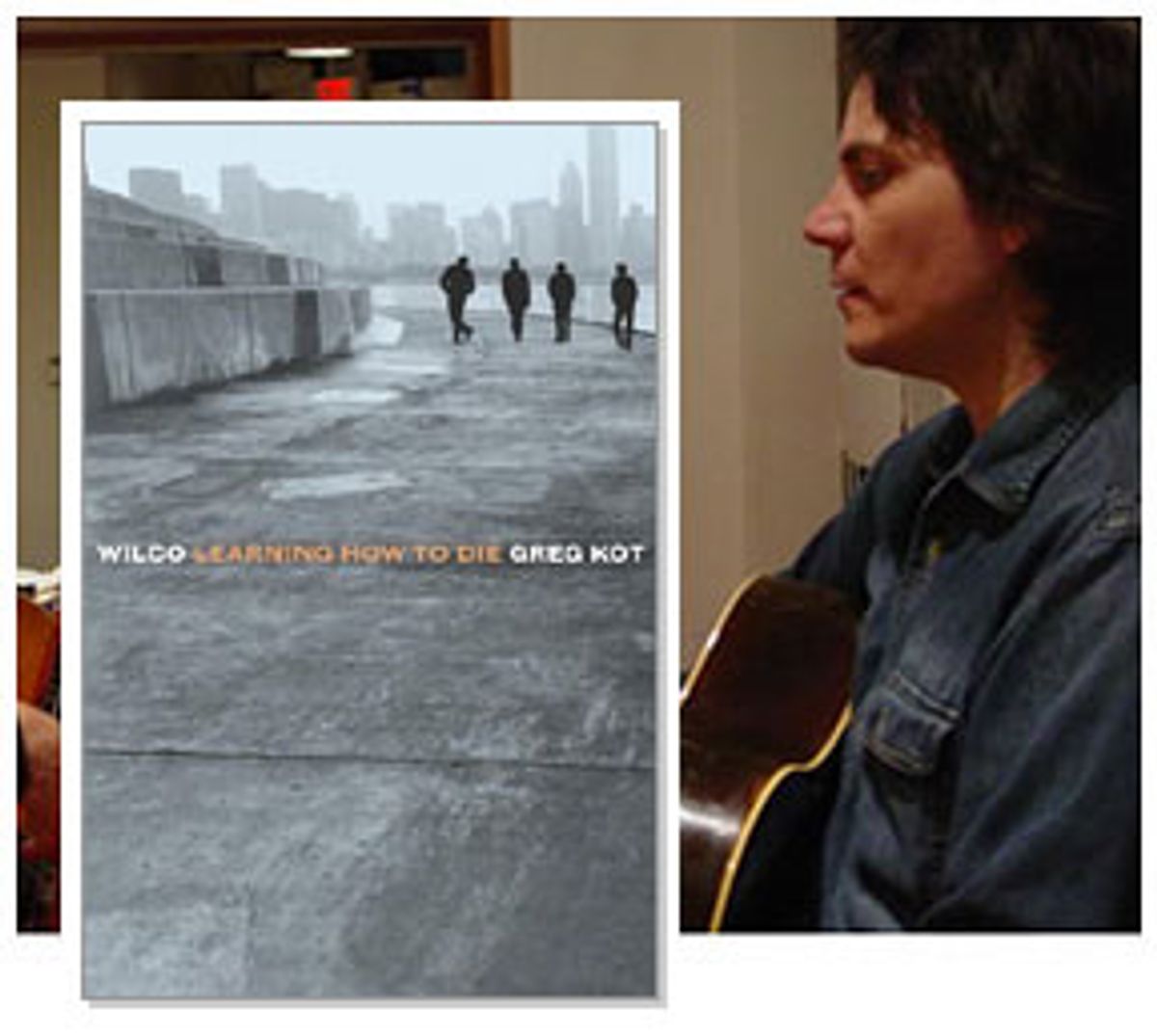
With a new album out and an intriguing new biography spinning the tale of his tormented career, Wilco's Jeff Tweedy looks like the leading American rocker of his generation. Which may tell you something about the state of American rock.

Breaking up is never easy, especially onstage at Irving Plaza in New York.

It was September 1996, during the College Music Journal’s annual conference, and Jeff Tweedy and his band Wilco were headlining. Wilco had not yet been dubbed one of the few American rock bands that matter; that label was cemented when Reprise Records rejected its minimalist masterpiece, “Yankee Hotel Foxtrot” as unworthy of release — it found a new home and was quickly dubbed a classic. In ’96, Tweedy and his Chicago-based band were better known as the torchbearers for the burgeoning alt-country scene built around American bands like the Bottle Rockets, Son Volt, the Silos, Vulgar Boatmen, the Jayhawks, Old 97′s and Whiskeytown, who shouted their barroom choruses while also exploring the softer side of life.

Unapologetically rural in sensibility, they sang about floods (the Bottle Rockets’ “Get Down River”), the road (Son Volt’s “Windfall”), the big city (Old 97′s’ “Broadway”), small towns (Whiskeytown’s “My Hometown”), getting high (Whiskeytown’s “To Be Young”), being bored (the Vulgar Boatmen’s “Drive Somewhere”), and the working poor (the Bottle Rockets’ “Welfare Music”). And they did it with some of the finest, most economical rock songwriting of the last decade. Try to top the Vulgar Boatmen’s “You and Your Sister” or Whiskeytown’s “16 Days.”

Tweedy’s previous band, Uncle Tupelo — formed with childhood pal Jay Farrar — was the spiritual godfather of the alt-country sound; the name of its 1990 debut “No Depression” even morphed into a sort of shorthand for the movement as a whole. (“No Depression” itself is a 1936 Carter Family song, an ode to better times in the afterlife.) By 1996, though, Tweedy found the categorization claustrophobic. At sold-out Irving Plaza that September night, the crowd waited for a roots-rock punctuation to the triumphant night; a “good-time barn-dance vibe,” as Greg Kot puts it in his new rock biography, “Wilco: Learning How to Die.” But Tweedy, as has become his musical custom, had other ideas.

Instead of lassoing the crowd in, Tweedy, anxious to move forward musically with the new, more sophisticated sound that was playing in his head, turned them away with a string of unknown songs from the band’s yet-to-be-released album, “Being There.” The songs, heavy on piano and often hushed with introspection, bore little resemblance to the pop-rock sound fans had grown accustomed to. “About one-third of the way into the set, when it became clearer that this wasn’t going to be Wilco as usual, the fans’ discomfort became palpable,” writes Kot. “What the hell was going on? Tweedy did nothing to dispel the bad vibes.” If anything, Tweedy seemed to take perverse pride in disappointing his loyal fans.

Bounding offstage, Wilco bassist John Stirratt bumped into Joe McEwen, one of the industry’s most respected A&R men, who had signed Uncle Tupelo to its major label contract and represented Wilco at Reprise Records, a subsidiary of Warner Bros. Asked what he thought of the Irving Plaza show, McEwen spat back, “I fuckin’ hated it,” and then charged into the cramped dressing room to confront Tweedy: “It was horrible! It was fucking horrible! The last time I saw you, you guys were on your way to being as good a band as the Heartbreakers!” referring to Tom Petty’s legendary band.

Tweedy seemed dumbfounded. Tom-fucking-Petty, that’s what you think this band is about? In a matter of months, with the release of the ambitious and mostly melancholy “Being There,” it would become obvious to everyone that Wilco was never going to become a feel-good American jukebox the way Petty and his Heartbreakers were in the ’80s and ’90s.

But McEwen’s frustration no doubt echoed the sentiments of lots of Wilco fans, and not just his colleagues at Warner Bros. who, according to Kot’s account, became convinced that if Tweedy thought he’d written a pop hit, he’d find a way to sabotage it the studio.

“I kept seeing them leave a lot more radio-friendly stuff by the wayside,” recalls Sam Jones, who chronicled the band in his acclaimed 2002 documentary, “I Am Trying to Break Your Heart.” “I was incredulous at first. I finally realized that Jeff doesn’t care. He just doesn’t have it in him. All he really wants to be allowed to do is make records.”

Tweedy, an introvert who battles a laundry list of personal demons, has led three musical careers: Uncle Tupelo, Wilco and what we might call Wilco II. Tweedy’s band today bears very little resemblance to the one that came careening out of the Uncle Tupelo split in 1994. Back then the band was still firmly rooted in swinging, pop-filled Midwestern American rock. The Wilco that powered 1995′s “A.M.” as well as 1998′s “Mermaid Avenue,” and the 2000 follow-up “Mermaid Avenue II” (both built around thoroughly modern workings of unearthed Woody Guthrie material), is now gone.

Wilco II, featuring new players, has morphed into something else entirely. Something more thoughtful, more complicated and compelling; an American answer to Radiohead, as the cliché goes. Fans of the original Wilco might respond that it’s also something too precious and earnest, something that flirts with a certain soullessness, a skillful detachment that Tweedy has constructed in the studio. There can be no question that Tweedy is a more accomplished and daring songwriter today than he was 10 years ago; R.E.M.’s Peter Buck calls Tweedy, “one of the best songwriters of his generation.” But is Wilco a better band?

Undoubtedly some enthusiasts have matured musically with Tweedy through every step of his two-decade musical journey. But my guess is not that many of those original Uncle Tupelo and early Wilco fans, itching for a taste of steel guitar, are still onboard for the Wilco II ride and Tweedy’s penchant for hushed, mournful lullabies. Or that, conversely, the band’s new generation of converts find all that much of interest in Tweedy’s back catalog of songs about screen doors, moonshiners, and Acuff-Rose.

That gap is only likely to widen with the release last Tuesday of Wilco’s fifth album, “A Ghost Is Born.” At times purposefully inaccessible, with actual song choruses often hard to uncover, the withdrawn sound of “A Ghost Is Born” sometimes makes the laid-back “Yankee Hotel Foxtrot” seem positively Springsteen-esque in comparison.

Kot’s compelling book paints a vivid portrait for both past and present Tweedy fans. For the uninitiated, Kot, a music writer for the Chicago Tribune, offers up an engaging guide through today’s rock landscape, detailing both the personal and professional pressures Tweedy has faced while steering Wilco.

There’s something strange, though, in reading such a detailed and serious account of Tweedy’s musical career, when you consider that by today’s record industry standards it’s essentially been a commercial bust. Uncle Tupelo enjoyed a sterling, almost mythic, reputation, one that far outstripped its capacity to make money. And while critical acclaim has only ballooned for Wilco, the band’s SoundScan numbers remain underwhelming. Its only real hit, “Yankee Hotel Foxtrot,” has sold roughly a half million copies, or what Usher, today’s R&B king, could probably sell on a really good weekend. (Unlike Usher, however, Tweedy has essentially been locked out of commercial radio.)

Meanwhile, the band’s been the subject of not one, but two documentaries. (Along with “I Am Trying to Break Your Heart,” there was 2001′s “Man in the Sand,” which chronicled the making of “Mermaid Avenue,” a co-venture with British folk singer Billy Bragg.) The national hand-wringing that took place in the music press over Reprise’s decision to part ways with Wilco at times seemed a bit over the top. And my hunch is “A Ghost Is Born” will receive reviews far more glowing than the uneven album deserves.

So there’s a temptation to complain that the Wilco myth-making has gone too far. But when you survey America’s tattered rock landscape today and see how few bands have sustained their careers, and how fewer still take musical chances the way Tweedy has with Uncle Tupelo and Wilco, the attention, and specifically that provided by Kot’s book, represents a welcome appreciation.

In so many ways, the story of Uncle Tupelo is the same do-it-yourself rock ‘n’ roll tale that has played out countless times in American life over the last half-century. It’s about growing up in a dreary small town (Belleville, Ill.), and grabbing on to music like a life raft. In the heart of REO Speedwagon country, Tweedy was a teenage Ramones fan while Farrar worshiped the Sex Pistols. “It [was] like the two visitors from Mars,” said Farrar. “We felt like the only two people listening to that type of music.”

So the guys start a band (picking the name by randomly selecting one noun each from separate columns of possibilities scribbled on a legal pad), win a local following (in this case at a little St. Louis club called Cicero’s), meet up with a horned-rim-glasses-wearing record-store owner who, despite having no experience in management, agrees to help them chart a path in the industry. They make a record in 10 days for $3,500, and then tour cross-country — surviving on revenues from T-shirt sales, not tickets or records — in a 1970 Ford Econoline van that was eventually traded in for $50.

The band paid its dues. “They were touring their asses off,” recalls Jeff Pachman, who signed the little-known band to Rockville Records. “There wasn’t even time to do laundry. So you’d see, Day 1, T-shirt with logo on the font; Day 2, same T-shirt with logo on the back; Day 3, same T-shirt with logo inside out. They were drunk when they played the Continental [in New York] — Jeff fell off the stage and onto a table — and they were great. I hadn’t had my socks blown off by a band like that since the first time I saw the Replacements.”

And just to complete the American music-industry fable, Uncle Tupelo got screwed over by its record company. Much to embarrassment of Pachman, his bosses at Rockville Records, which sold more than 200,000 copies of Uncle Tupelo’s first three albums — a killing for a small indie label — never paid the band a penny in royalties. (In 2003, Farrar and Tweedy won an undisclosed court settlement.)

But what separated Uncle Tupelo from the majority of basement bands who give it a shot was that Farrar and Tweedy created something entirely original and compelling. In the mid-’80s, when they started out, and when rock’s elite were still focused on the Clash’s London and the Talking Heads’ East Village, nothing could have been less cool than covering old Carter Family songs, welcoming a steel guitar, and doing it all without a hint of irony. But Uncle Tupelo didn’t cradle its throwback sound with reverential nostalgic care. The band’s signature start-stop crunch had more in common with the Pixies than the Louvin Brothers.

Farrar and Tweed made for an usual rock pairing, in that both were withdrawn and, during the Uncle Tupelo days, they often appeared uneasy — certainly overly earnest — onstage, where shoe-gazing was the norm. Musically, Tweedy provided the group’s small bouts of buoyancy, while Farrar filled the role of “Grapes of Wrath”-type brooder. Buddy Brian Henneman, the talented front man for the Bottle Rockets, calls Farrar “the griever, a young man who wore an old man’s scars.” As Kot notes, it was the griever’s voice — that once-in-a-lifetime voice — that gave Uncle Tupelo the “blue-eyed soul heaviness,” and demanded that attention be paid from the first note of “Graveyard Shift,” the opening track on “No Depression.” (When the band split, Farrar founded Son Volt, whose stunning debut, 1995′s “Trace,” still stands as the quintessential alt-country record. Farrar, however, has not been able to sustain that quality over the years.)

Today, Tweedy looks back and dismisses a lot of the mythology and “revisionist history” that’s been built up around a band that put out only four records. He’s right; Uncle Tupelo was overrated. The band made just one truly great album, 1993′s “Anodyne,” whose stellar wall-of-guitar tracks like “The Long Cut” and “We’ve Been Had” still stand alongside anything Pearl Jam, Nirvana or the Smashing Pumpkins did in terms of rock’s great rallying cries of the ’90s.

Still, by the time of “Anodyne’s” release, Farrar and Tweedy’s relationship, surprisingly distant even during the good times, became increasingly strained as Tweedy began to write and sing more of the band’s songs. In the liner notes for 2002′s retrospective, “Uncle Tupelo: An Anthology,” Tweedy, retracing his progressively prominent role in the band, mentioned that Farrar “encouraged” him to sing songs. Then Tweedy corrected himself, conceding that Farrar had simply refused to sing any of Tweedy’s songs, so he had to do it himself.

Following the band’s high point, a rapturous, sold-out gig in December 1993 at Tramps in New York, at a time when Nirvana was rewriting the rules of commercial rock radio and it seemed anything — even an Uncle Tupelo hit — was possible, Farrar called the band’s manager, Tony Margherita, and told him Uncle Tupelo was finished. Then Margherita called Tweedy and broke the news to him. With a messy split and an unsupportive music partner behind him, Tweedy would spend the next decade battling record companies and himself. But mostly himself, as he fought addictions, crippling migraines, and the need to purge Wilco of its original members in order to capture the sound he was chasing.

Following the very Tupelo-esque sounding “A.M.,” Wilco delivered the multidimensional (and somewhat bloated) double CD “Being There,” which signaled the band’s inevitable break from alt-country. But to add to fans’ confusion, in 1998 came “Mermaid Avenue,” which sounded like a complete U-turn, harking back to an Americana hootenanny vibe. The project was spearheaded by Guthrie’s daughter Nora, who had unearthed hundreds of her father’s unpublished song lyrics. She handed them over to Bragg and Wilco, whose job it was to create the music and record, not a tribute album, but something more contemporary and unified. What they did was capture pure magic, an album of undeniable charm and appeal.

Here’s how the unassuming centerpiece effortlessly came together: “[Guitarist Jay] Bennett banged out the three chords for ‘California Stars’ in his girlfriend’s kitchen so quickly he was sure he’d lifted them off Springsteen’s ‘Nebraska’ or some other cherished album. When Tweedy heard the demo, he did some tweaking; he accelerated the tempo and took the melody up an octave. In the studio, [drummer Ken] Coomer and [bassist John] Stirratt made it swing, and Wilco knocked out the finished version in two takes.”

Of course, it’s depressing to discover in Kot’s account that tension between Tweedy and Bragg made a joint tour in support of “Mermaid Avenue” impossible, and that their respective managers often ended negotiations in trans-Atlantic shouting matches. The dysfunction hit its zenith when Wilco and Bragg appeared at the same New York festival, the 1998 Guinness Fleadh, but played separate sets promoting the same album.

But by that point there was tension everywhere, as Wilco I began to collapse. First to be shown the door was sideman Bob Egan. Soon Coomer and guitarist Bennett would be given their walking papers.

And then came the damaging — both musically and emotionally — recording of “Summer Teeth.” Writes Kot: “What began in Austin [Texas] as a straight-forward live-to-tape band recording, ended up in Chicago as an elaborate two-man overdub extravaganza. It was Jeff Tweedy and Jay Bennett, a few cartons of cigarettes and a Pro Tools computer cocooned in a studio as they transformed songs of wretched despair into cathedrals of sound. In the process, they shut out the world and even their own bandmates.”

Adopting a kitchen-sink approach to studio tinkering, the two became lost in a maze of sound effects, overdubs and lost tracks. Recalls Coomer, the soon-to-be-dismissed drummer: “Jeff didn’t go to rehab, but he should’ve in my opinion. Jay was taking pain killers, antidepressants, and wasn’t in much better shape. There really wasn’t a band, just two guys losing their minds in the studio.”

Tweedy himself was a physical and emotional mess, battling addiction problems, chronic and often debilitating headaches, bouts with depression and anxiety attacks that struck right before show time. And that highlights the only weak spot of “Learning How to Die”; Kot does not sufficiently answer — or even address — the riddle at the center of the book: Who is Jeff Tweedy and why, on a personal level, is he so miserable? Clearly the ailments blanket Tweedy’s creative process, for better and worse, and Kot should have probed deeper into that uncomfortable territory in search of answers. (At one point Tweedy tells Kot, “I don’t like talking about it.”) Indeed, the troubling questions became even more relevant this April, when Tweedy checked himself into a rehabilitation clinic to battle his dependency on painkillers, forcing the release of “A Ghost Is Born” back by a month.

Musically, with the help of new Wilco guitarist/producer Jim O’Rourke, Tweedy brought the band back from the “Summer Teeth” edge with the gorgeous and now infamous “Yankee Hotel Foxtrot,” an album that not only came to symbolize Tweedy’s maturation as a songwriter, but was also a larger-than-life example of everything that had gone wrong with the increasingly consolidated music industry. Only in an industry run by fear would a senior vice president of A&R sit back and listen to “Yankee Hotel Foxtrot’s” breathtaking 52 minutes, hit the pause button and conclude, “This isn’t even worth shipping out to stores.” But that’s what they did at Reprise Records, in the spring of 2001. Not hearing any radio singles, the label told the band to shop it elsewhere. When the news leaked, Reprise was pummeled in the press. Trying to cut its losses, Reprise, which paid for the recording of “Yankee Hotel Foxtrot,” made the rare gesture of giving Wilco ownership of the masters for free. Wilco then turned around and sold them to Nonesuch, a separate, although more appreciative, Warner Bros. entity. “The whole thing,” manager Margherita recalls, “was like an insane dream.”

Across the course of Jeff Tweedy’s nearly 20-year personal and professional journey, you sense he gets that feeling a lot.

Editor’s note: This story has been corrected since its original publication.

Eric Boehlert, a former senior writer for Salon, is the author of "Lapdogs: How the Press Rolled Over for Bush."

Protest music’s odd conservative turn

A 100-track, four-CD Occupy collection assembles generations of icons. So why does it sound shapeless and safe?

“In this hour of the ever-changing season, may our tears not douse the fire in our hearts.”

That’s a guy named Michael Pless singing “Something’s Got to Give.” Even without hearing the song, you can surely imagine the essential elements: Plaintive acoustic strumming, an earnest vocal, and an air of polite outrage to match the stilted syntax and hoary platitudes. Welcome to “Occupy This Album,” the collection of protest-minded songs released by Occupy Wall Street. Sprawling across four CDs and a slew of bonus digital tracks, this behemoth set includes 100 (why not 99?) new and previously released tracks from artists representing a range of generations, genres, backgrounds, settings, and styles. Folkies join hands with rappers; ominous post-rock marches alongside peppy radio pop. There’s spoken-word poetry, tribal percussion, earnest singer-songwriter fare. Even a bit of jazz.

Especially with Occupy reaching a crossroads in summer 2012 — a time when it needs to reassess its ideals, its accomplishments, its methods and its artifacts — “Occupy This Album” plays like a state-of-the-field survey of the protest song. From Jeff Mangum covering the Minutemen to the anonymous drum circles that soundtracked the demonstrations in real time, music has been a constant presence in the movement, although it’s not quite clear what role it has played. The new album portrays a movement with a broad scope and an admirably varied constituency, but the same criticisms that have been leveled against Occupy can also be applied to “Occupy This Album:” There is general unease but no clear direction forward. There is outrage but no plan. There is deep feeling but no clear message.

Ostensibly, there should be something on “Occupy This Album” for everyone to love, but that also means there is more than enough here for everyone to hate. It’s an unwieldy tracklist, almost daring you play it front to back. Of course, it’s pointless to review a 100-track release the same way you would approach a studio album, where functionality and some sense of logical progression are crucial. But there’s no consistent development of political or musical ideas weaving these songs together, nothing to link them or to justify this particular sequencing. As a result, “Occupy This Album” cannot make a statement as an album. In one sense, this release mirrors the leaderless ethos of the movement, which stridently preserves the democracy of the demonstrations. While that idea has certainly energized the Occupy protest, it makes for an amorphous blob of music and a messy, often frustrating listening experience.

But they mean well, right? It’s a charity album after all, with each disc sold separately and with all proceeds benefiting Occupy directly. You’d probably be better off contributing directly to the cause and just making your own mix of politically minded music. You might even have some of these songs in your iTunes already, although why you’d want to include Lucinda Williams’ drippy “Blessed” or Mogwai’s interchangeable “Earth Division” is beyond me.

The music that actually is new — that purports to find direct inspiration in either the righteousness of the demonstrators or the plight of the 99 percent — is generally unimaginative, hokey, disappointingly safe. Most of these artists address these economic issues either through narrative or through high-minded rhetoric. The latter produces the most lackluster results: Jackson Browne’s “Which Side Are You On?” which he has been touting for several months now, turns out to be political white noise, a gentle fist bump to the like-minded that barely puts across either side of the debate. At least it’s better than My Pet Dragon’s epiphany on “Love Anthem”: “Only love can save us now.” To their credit, they sing it like they might actually believe it.

The storytellers have more success, if only because they’re willing to entertain a bit more grit, a bit less blind hope. Featuring Joan Baez and Steve Earle, James McMurtry’s “We Can’t Make It Here” sounds downright curmudgeonly as it surveys the state of the working class in an economy that regularly sends its manufacturing jobs overseas. The song, however, goes a bit overboard when the trio decry litterbugs and graffiti artists.

One of the true standouts among these 100 tracks is Richard Barone’s ditty “Can I Sleep on Your Futon?” about a veteran-turned-singer who couch-surfs from one generous soul to the next. The verses are specific and soulful, as through he’s derived them explicitly from lived experience, and in that regard, the song could function as commentary on the music biz. But Barone stumbles over that massively awkward chorus, “Can I sleep on your futon?” It’s hard to imagine a crowd of protesters singing along.

If there is one overarching theme here, it is, vaguely, “history.” The past informs and even defines this music. Even the very idea of this type of compilations seems like a throwback to the CD’s heyday in the 1990s, when seemingly every charity, from NARAL to the Red Hot Organization, had its own release. It’s an impression reinforced by much of the music, especially hip-hop tracks by Born I Music and George Martinez & the Global Block Collective, whose lyrics and beats sound like they were scavenged from 1994. (For a better example of how hip-hop can address political themes, check out Killer Mike’s new track “Reagan.”)

Of course, there is a lot of folk music on “Occupy This Album.” That style has proved one of the most politicized musical forms of the 20th century, as lefties in the 1930s and 1940s adopted labor songs as battle cries. Clean-scrubbed, buttoned-up folkies like the Kingston Trio had some chart success in the 1950s, but they were quickly rendered obsolete by the Village bohemians reimagining the music as a vehicle for countercultural sentiments. That’s the model so many Occupyers are reverently appropriating, never suspecting that it might not be a natural fit for 21st-century dissent. The folk revivalists of the 1960s drew from the past as well, but took pains to update the music to the times: The mere fact that Dylan wrote new songs in this old style was revolutionary, alienating an older generation of folkie purists.

“Occupy This Album” obviously represents a counterculture, but too many of the artists are too caught up in role playing the past, which seems like an especially boomer enterprise. Michael Moore (yes, that Michael Moore) performs the most chipper version of “The Times They Are A-Changin’” imaginable, one that seems wholly unaware of the gritty realities of 2012, much less of 1964. (The less said about his skiffle version of the song, a hidden track on disc four, the better.) Perhaps the one artist who understands how to plumb history for present-day relevance is Loudon Wainwright III, whose wry “The Panic Is On” updates an 80-year-old tune originally penned by Hezekiah Jenkins (the cover originally appeared on Wainwright’s album “Ten Songs for the New Depression”). It’s an unusual artifact from the early 1930s, but there’s a sneaky observation about class disparity that sounds more disgusted and potent than anything else on the album.

Perhaps the worst thing that can be said about “Occupy This Album” is that the music is deeply conservative. There are so few moments that grab your attention or make you see the world differently. When Occupy already seems to be in danger of losing momentum, it’s hard to say whether the movement has failed to inspire these artists or the artists have failed to document the movement.

Continue Reading Close

Donna Summer: Disco diva and rocker

If you only knew the singing sensation by her 1970s smashes, you barely knew her at all

There is so much about Donna Summer that we didn’t know… and not just the cancer that took her life. Let’s start with her relationship to rock. Summer is quite understandably known as a disco singer, and quite rightly so. It was disco that made her, and she, as perhaps disco’s highest profile performer, who helped to shape the genre. But like a number of other disco artists — Nile Rodgers and Bernard Edwards of Chic, the vocal trio Labelle and Chaka Khan all come to mind — Donna Summer was also a rocker. Yes, she grew up singing gospel, but she began her professional career as a ’60s rocker. She would describe this as her Janis Joplin phase, and she did indeed sing in a group that performed at the Psychedelic Supermarket — Boston’s version of Bill Graham’s Fillmore. She then went on to play a hippie in the Munich production of the rock musical “Hair,” and sported an enormous Afro inspired in large part by her hero, the black radical activist, Angela Davis. Although the disco music that she made with producers Giorgio Moroder and Pete Bellotte, and engineer Harold Faltermeyer provoked a fierce backlash from some aficionados of rock, this was a foursome that, as critic Dave Mash pointed out, functioned as a rock band, one in which Summer played a pivotal role as singer and songwriter. And then there is her singing. Listen to her hit “Hot Stuff,” and tell me that Summer could not sing rock.

Summer, who was strikingly beautiful, made some very steamy — some would say X-rated — music, most memorably with her first hit, 1975’s “Love to Love You Baby.” With Summer’s groans, moans and gasps powering the track, it broke new ground in its sexual explicitness. Promoted by her record company in explicitly sexual terms, and giving performances that made Tina Turner’s look tame, Summer soon found herself tagged the “Linda Lovelace of pop music.” She had seen this coming. In fact, she had not wanted to be the singer on that track, and agreed only to record the demo, and only then in a blackened studio where she sang, imagining that she was Marilyn Monroe giving herself over to orgasmic ecstasy. After producer Moroder convinced her to let him use her vocal, her record label president, seeing its bedroom potential, demanded a long-playing version that left the media debating whether the singer came 22 or 23 times. Rock critic Robert Christgau poked fun at the record with a review that consisted of three questions, “Did you come yet? Huh? Did you come yet?” Other reviews were more disparaging. But “Love to Love You Baby,” like much of her music, put female desire front and center in a way that it wasn’t in most rock music. Indeed, Summer’s music is inseparable from second-wave feminism’s emphasis on women’s sexual empowerment.

There is so much to say about Summer, who could have been a full-fledged personality had she not been pigeon-holed and dismissed as a disco tart. I was once on a radio program with her and, believe me, she was nobody’s fool. She described the “star-making machinery” as well as anyone. After she had already became famous she told Rolling Stone that her career sometimes felt like “this monstrous, monstrous force, this whole production of people and props that you’re responsible for, by audiences and everything that rules you until you take it upon yourself to be a machine… And at some point a machine breaks down.” Fame, she observed, diminished her, making her feel like nothing so much as a “commodity.” After falling into a debilitating depression and attempting suicide, she took control of her life again through Christianity.

In a way, I think one hears Summer confront her own commodification on her marvelous record “Bad Girls.” Although the music in the final, released version suggests otherwise, Summer isn’t celebrating prostitution on “Bad Girls.” Rather, she is confronting what she shares with those streetwalkers. “Now, you and me are just the same,” she sings.  And if Summer sounds unusually exuberant as she yells out to a john, “Hey, mista, have you got a dime?” perhaps it’s because Summer understood what it meant to be made into a commodity and reduced to a seductive whisper. Tellingly, in a television interview some years later, Summer noted that “Bad Girls” marked the moment when she stopped being an object and became a subject. Let’s hope that in her death she inspires more writing that fully acknowledges the intelligent subjecthood of this disco diva and kick-ass rock and roller.

Continue Reading Close

Alice Echols, a professor of English, and the Barbra Streisand Chair of Contemporary Gender Studies at the University of Southern California, is the author of four books, including "“Hot Stuff: Disco and the Remaking of American Culture."

Donna Summer, Queen of Disco, dies at 63

The "Last Dance" singer passed away after a battle with cancer

NEW YORK (AP) — Disco queen Donna Summer, whose pulsing anthems such as “Last Dance,” ”Love to Love You Baby” and “Bad Girls” became the soundtrack for a glittery age of sex, drugs, dance and flashy clothes, has died. She was 63.

Her family released a statement Thursday saying Summer died and that they “are at peace celebrating her extraordinary life and her continue legacy.”

Summer gained prominence during the disco era of the 1970s, and released a number of albums that have reach gold or platinum status, including the multiplatinum “Bad Girls” and “On the Radio, Volume I & II.” Her No. 1 Billboard Hot 100 hits include “Hot Stuff” and “MacArthur Park.”

Her sound was a mix of genres, and helped her earn Grammy Awards in the dance, rock, R&B and inspirational categories.

She released her last album, “Crayons,” in 2008. She also performed on “American Idol” that year with its top female contestants.

The perfect Beatles double bill

Martin Scorsese's George Harrison documentary may be expansive, but 2009's "Nowhere Boy" is more insightful

Stills from "Nowhere Boy" and "George Harrison: Living in the Material World"

If I were the Texas School Board in search of the one text that could justify teaching “intelligent design,” I would use the Creation Myth of the Beatles as my sole curriculum.  It is a story oft retold with wonder, as it defines the word “supernatural.” Two musical prodigies of staggering gifts, with complementary personalities, just happen to meet in the same fairground, and just as casually decide to change the world. They soon meet a third musical force of nature, and, just before they march from their secret fortress, they add the final element to what is now an impregnable weapon of mass musical distraction.

In the words of noted musicologist Steve Jobs, “It was the chemistry of a small group of people, and that chemistry was greater than the sum of the parts. And so John kept Paul from being a teenybopper and Paul kept John from drifting out into the cosmos, and it was magic. And George, in the end, I think provided a tremendous amount of soul to the group. I don’t know what Ringo did.”

If Jobs had to ask what Ringo did, well, it proves every genius has a blind spot. But the ineffable mystery is this. There are many precedents for single geniuses that spontaneously combust into existence (see Dylan, Bob, or Hendrix, Jimi), but how do four extraordinary elements come together to produce a world-changing hydrogen bomb of musical genius? I’ll leave the Texas School Board to explain that to me. Or, watch the two films in this week’s double bill.

Today marks the DVD release of “George Harrison: Living in the Material World,” the four-hour Martin Scorsese dissection of the life and offhand times of George Harrison. The film’s compiler — not really director (more on that later) — Martin Scorsese, knows from musical genius and genius in general, being something of one himself. His last core sample on this subject, “No Direction Home,” spent four hours getting as close to the genesis of Bob Dylan’s genius as the artist would allow, which is to say, not very. It wisely did the next best thing, which was just showing Dylan being Dylan, while a chorus of friends and acquaintances tried to figure it all out. Nobody came close, of course, and Dylan’s own interview was conducted by his manager, Jeff Rosen, with all of the hardball questioning one would expect of Fox’s Chris Wallace interviewing John Boehner. Scorsese did the best he could – and that is very good indeed – overseeing a compilation of found objects in something that resembled a narrative structure. But in Dylan’s case, good is never good enough. Essential viewing if you are a Dylan fan, but ultimately, a museum artifact, where Dylan’s infinity of talent is definitely not on trial.

Scorsese’s follow-up, “George Harrison: Living in the Material World,”  is not really much different, though, ironically, one of the very few things left out in this tragical history tour was the impact of Harrison’s long creative and personal association with Dylan. The Beatles Creation Myth is front and center here, and as a duly authorized by the Harrison estate project, the archive material takes the viewer on a ride through the highlights. But only in the back seat. Paul McCartney and Ringo Starr are both interviewed at length on both Harrison and the journey they took together, but they offer few new insights. Ringo Starr lets down his guard only once, when he remembers his last encounter with his dying comrade, but that guard is soon posted again, and the show goes on. Knowing the forensic details of a magic trick does not do that trick any favors, and there’s little magic to be found in the first half of this film.

The second half of the film that deals with George coping with that ever-so-awful burden of huge fame and unlimited wealth drags on longer than the interminable jams that rounded out Sides 5 and 6 of the vinyl of “All Things Must Pass,” and while Harrison emerges as the hero of his own life, we ultimately agree with him that there were compelling reasons why his private life should have stayed private.

Sometimes, as I am sure Scorsese knows, bootlegs reveal far more than official releases, and the weight of being an “Authorized Release” somehow diminishes the end result. Scorsese doesn’t put much of his own skin in the game, and acts less as a director here than a detached observer, and that detachment prevents us from connecting with a story that defined a cultural renaissance. One longs to see Scorsese on fire, beating the creative process into submission in the way that Nick Nolte’s abstract painter bashed out a canvas to Dylan’s 1974 apocalyptic version of “Like a Rolling Stone” in the underrated anthology “New York Stories.” It takes one to know one, and in “George Harrison: Living in the Material World,” as in his other musical hagiographies, Scorsese seems almost embarrassed to confront genius on his own terms, in that secret language he’s privileged to share with his subjects.

A much scruffier and ultimately more revealing insight into the Beatles Creation Myth comes from the 2009 “Nowhere Boy.” This movie is set entirely in those moments when a strange kind of human alchemy transpired, in the grimy laboratory of Liverpool. No attempt is made to explain how the magic happened, but the viewer gets the distinct sense “why.” It’s ironic that one of the most insightful glimpses into the real George Harrison in “Living in the Material World” comes from a long excerpt from “A Hard Day’s Night,” where George stumbles into an advertising focus group, and returns the cynical condescension he is given with a far more withering detachment. The fact that this scene is wholly fictional does not diminish its insight – and the same thing can be said for “Nowhere Boy.”

Based on a memoir by Lennon’s half-sister, Julia Baird, the film was endorsed and informed at extreme arm’s length by Yoko Ono and Paul McCartney, and is far better for their lack of involvement. Lennon is inhabited, not played, by Aaron Johnson, and at no time does Johnson’s performance descend into mere impression. Johnson just “is” – and within a few moments of his first on-screen appearance, you are transported back to 1955, and present at the creation. Primal rock ‘n’ roll fills the air, and a rough beast slouches on its way to be born, and Johnson’s Lennon puts a face on that creature. The film’s director, Sam Taylor-Wood, married the much younger Aaron Johnson after she completed the movie, and her primal attraction does seem justified.

All the bases are covered. The eternal fights with Aunt Mimi, played with prim precision by Kristin Scott Thomas. The strange, almost sexual attraction between Lennon and his uninhibited mother, Julia. And of course, the legendary 1957 first meeting with Thomas Brodie-Sangster’s Paul McCartney. Entire books have been written about this July day at a school fair, where the world turned on its axis. As a card-carrying Beatlemaniac, with a mail-order degree in advanced Moptopology, I noticed that “Nowhere Boy” got all of the details just exactly right, down to the checkered shirt that Lennon wore on that meeting day, and even a brief glimpse of the photographer who took the now iconic picture that is the only record of that day when the world turned inside out. George Harrison’s later back-of-a-bus passage into legend is also documented adroitly, though here, as was sadly the case in the life of the Beatles, Harrison plays a supporting role.

But in ways that no authorized documentary can hope to attain, “Nowhere Boy” gets the human dimensions of the Beatles myth just right. The shimmering brilliance, tragic vulnerability and occasional brutality of Lennon comes through, and the telepathic connection that bound the Beatles together somehow extends to the viewer. Even if huge dramatic licenses are taken, they are not abused. The John Lennon in “Nowhere Boy” is often referred to as a “dick” by his peers – but in this film, the wavering line between “dick” and “genius” is navigated with a drunken precision.

Stanley Kubrick once said that “sometimes the truth of a thing is not so much in the ‘think’ of it, as in the ‘feel’ of it.” “Nowhere Boy” has that feel, and that touch, and brings us as close as we are likely to get to “feeling” the reality behind the myth.

Continue Reading Close

Punk’s cultural revolution

Pussy Riot's masked women have become icons of Russia's anti-Putin movement -- and turned the genre on its head

Seven members of the band Pussy Riot (Credit: Wikipedia)
This piece was originally posted on The New Inquiry. Follow TNI at @newinquiry and subscribe to TNI Magazine here.

Russia Today, the politsiya and Western punks alike all want to know: Who is Pussy Riot, when is their next gig, and where can I get their album? Despite having no releases or merchandise for sale, no tour dates, no Myspace or even recorded music, the band of masked women who perform only aggressive guerrilla shows has achieved a level of punk legitimacy not reached since the era when the combination of bleached hair and three chords was on its own automatically scandalous.

The New InquiryThe days of the Fraternal Order of Police suing the Crucifucks, Tipper Gore taking on the Dead Kennedys, and black metal goblins burning churches are long past. Punk is now no more a social threat than some leftist fringe group selling poorly designed newspapers. And yet, with three of its alleged members now imprisoned and facing seven-year jail sentences, the pastel-balaclava-wearing, sloppy-guitar-playing riot grrrls have become an icon of a brewing cultural revolution in Russia.

Pussy Riot’s now famous performance of Punk Prayer in Christ the Savior Cathedral in Moscow’s Kremlin, which earned them the personal ire of both the Orthodox Church’s patriarchate and Vladimir Putin himself, was a call for the Virgin Mary to become a feminist and exorcise Putin. Other feminist and anti-authoritarian performances included disrupting a fashion show by taking over a catwalk, performing unpermitted in a posh boutique, and playing a song called “Freedom to Protest — Death to Prisons” on the roof of a building in a Moscow prison complex to jailed anti-Putin protesters.

Last week a “Party Riot Bus” circled Moscow blasting punk rock and stopping for news conferences and performances calling for the release of the imprisoned band members. Riot grrrl matriarch Kathleen Hannah released a video pledging her support to the band, telling her fans she would “see you out in the streets.” A concert in Tallinn, Estonia, to support the band drew several notable politicians, including President Toomas Hendrik Ilves.

On the flip side, counterprotesters have attacked supporters in Moscow, focusing on removing the masks of female supporters. An anti-Pussy Riot rally was held the same day is Krasnodar, drawing an estimated 10,000 calling for a “moral revival” in the “fatherland.”

The band has derived their success — and scorn — by turning contemporary punk culture on its head. Where punk was once relegated to musky basements, squats and other shabby makeshift venues, Pussy Riot makes all public spaces — the streets, the metro, the church — their stage. While punk bands play for punks, Pussy Riot plays for commuters, police  and clergy. While punk bands seek fame with glamorous pseudonyms and outlandish rock star antics, Pussy Riot is masked. While punk bands engage in nihilistic lyricism, Pussy Riot’s songs are direct attacks on the confines of their authoritarian state and patriarchy. Since punk fell from the pop charts in the early ’80s, it has been sent on a quest to define and sustain its own identity, creating punk houses, venues, record stores and community centers, resulting in the introverted and self-obsessed situation of the sub-genre today. Pussy Riot does precisely the opposite.

It is fitting, then, that one conservative Russian website translated Pussy Riot to “Uprising of the Uterus.” What was once scandalized, forbidden, subaltern, rises from its rightful caste hidden and below and speaks in the very locations of its oppressing power. Who are these women, these punks, to perform, to pray, to protest in sacred locales? To desecrate is one of punk’s existential tasks. The smashing of sacred relics conjures society’s most archaic reactions: in this case, imprisonment, public shaming, flogging, concerns of Satanism, witchcraft, hysteria.

Punk has needed a Pussy Riot for so long. In many ways, it is the literal projection of the riot grrrl movement, which employed satire and third-wave theatrics to intervene in the traditionally macho and misogynist punk scene. It succeeded in creating a new type of punk — the grrl — but, until now, it had never successfully caused a riot.

Through the 2000s, bands have unsuccessfully attempted to wreck cultural terror. There was San Diego’s the Locust, who wore masks and bodysuits similar to Pussy Riot, played noisy and aggressive punk, but were not actually anonymous, nor were their lyrics directly political. The band shocked a lot of punks and sold a lot of records, but had very little cultural impact outside their genre. Black metal-heads became enamored with the “Cultural Terrorist Manifesto,” which also has had seemingly no effect. In 30 years, punk had perfected only gestures.

Perhaps part of the reason punk has begun to lash out so effectively in the former Soviet Union is the nature of the extreme oppression in Russian society. I spoke to Moscow anti-fascist Kostya about the dual dangers to the Russian anarchopunk — the right wing and the State:

I came up with the scene when it was possible to organize a strictly antifascist show, and you could be sure that only the right people will visit it. But still there was a danger of being attacked by Nazis before or after the show. Today it continues, but the situation is even worse. First of all, nobody fights with the fists, you’re more likely to be stabbed or shot with a traumatic gun. Secondly, and what is worse, there is strong oppression from the state and police. The situation in Russia isn’t stable, that’s why the government tries to control all the young people who can be dangerous today or in the future. They always try to put the same number of Nazis and anarchists in prison.

Kostya tells me Russia has its own anti-activist police force, called the “Department of Fighting Extremism.” Along with the threat of right-wingers burning down political squats or punk venues, the result has been a neutralized public face for the punk scene. All radical politics have been forced underground. It is no surprise, then, to see it return masked.

In 1977 the Ramones toured America like an Armed Struggle cadre of cultural terrorists, all dressed alike, playing the simplest and loudest music yet formulated. They not only invented punk that year, but they planted it everywhere they went. Punk’s success was its virility; reproducing with such ease that soon there were Ramones at every corner of the globe.

Reacting to increasingly technical progressive rock, the Ramones liberated the guitar to the world. Pussy Riot has taken this communization a step farther. To be a “member” of Pussy Riot, you don’t need to be able to play guitar or even to know the original band. As one member, Garadzha, told the newspaper Moskvkie Novosti: “In principle anyone can join.” You don’t even need to sing very well, she continues. “It’s punk, you just scream a lot.”

What would be the shape of punk outside the confines of the world of rock music? If Pussy Riot is any indication, it appears at scenes of intense banality or oppression. They have appeared on the catwalk, on top of a prison and of course at the altar. They sound something in between a streetpunk band (Blatz’s Fuk Shit Up is the first thing to come to mind) and an battle-worn activist giving an impassioned speech through a megaphone. The precarity of their performances gives a new spin to the typical speedy bursts of punk — the songs need to be so short because they could be apprehended any second.

Everything about the band is similarly practical. The rawness of their sound reflects the semi-improvised site-specific nature of the songs. Their masks obscure their identities from police detection. Their bombastic performance (use of fire, flares and the iconic punch-dancing) makes up for the lack of amplification. While other novel punk bands form their own stylized front against the limits of society, society’s limits seems to have fully formed Pussy Riot.

Perhaps antagonistic counterculture, once self-ghettoized within the margins of society, is beginning to coalesce into a new political form, one that transcends both its anti-social roots and the populism that activism too often demands. The Occupy movement is the most obvious example, but disruptive feminist and queer situations similar to those created by Pussy Riot have occurred in the United States over the last several years. The radical queer group Bash Back! disrupted service at a Lansing, Mich., megachurch, making out on the pulpit and dropping pro-queer flyers. Repetitive comments by law enforcement official that rape is a result of women’s attire lead to massive anti-rape and sex-positive “Slut Walk” protests last year. With a new right-wing offensive against women escalating to the withholding of contraception and forced transvaginal ultrasounds, the coalition between the church and authoritarianism is as relevant in the United States as in Russia. Could time be ripe, then, for some of the aforementioned agitators to arrange a Pussy Riot U.S. tour?

The New Inquiry is an online journal of social and cultural criticism. Every month,TNI releases a subscription-based magazine for $2, available for download in both PDF and e-reader formats. The New Inquiry Magazine, No.3: “Arguing the Web” (April, 2012) is available now! Support TNI and subscribe for $2 here.

Continue Reading Close

A.M. Gittlitz is a fiction writer, essayist and bike delivery boy living in Brooklyn, New York. He formerly wrote for Arthur Magazine blog, and a contributer to Death Panel Press and Modulo Magazine.

Page 1 of 283 in Music